instrument panel PONTIAC VIBE 2008 Service Manual
[x] Cancel search | Manufacturer: PONTIAC, Model Year: 2008, Model line: VIBE, Model: PONTIAC VIBE 2008Pages: 368, PDF Size: 5.7 MB
Page 216 of 368

Different Size Tires and Wheels......................5-65
Uniform Tire Quality Grading..........................5-65
Wheel Alignment and Tire Balance..................5-67
Wheel Replacement......................................5-67
Tire Chains..................................................5-68
If a Tire Goes Flat........................................5-69
Changing a Flat Tire.....................................5-70
Removing the Spare Tire and Tools................5-71
Removing the Flat Tire and Installing
the Spare Tire..........................................5-73
Storing a Flat or Spare Tire and Tools............5-79
Compact Spare Tire......................................5-81
Appearance Care............................................5-82
Interior Cleaning...........................................5-82
Fabric/Carpet...............................................5-83
Leather.......................................................5-84
Instrument Panel, Vinyl, and Other
Plastic Surfaces........................................5-84
Care of Safety Belts......................................5-85
Weatherstrips...............................................5-85
Washing Your Vehicle...................................5-85
Cleaning Exterior Lamps/Lenses.....................5-86
Finish Care..................................................5-86
Windshield, Backglass, and
Wiper Blades............................................5-87Aluminum Wheels.........................................5-87
Tires...........................................................5-88
Sheet Metal Damage.....................................5-88
Finish Damage.............................................5-88
Underbody Maintenance................................5-88
Chemical Paint Spotting.................................5-88
Vehicle Care/Appearance Materials..................5-89
Vehicle Identication......................................5-90
Vehicle Identication Number (VIN).................5-90
Service Parts Identication Label.....................5-90
Electrical System...........................................
.5-90
Add-On Electrical Equipment..........................5-90
Headlamp Wiring..........................................5-91
Windshield Wiper Fuses................................5-91
Power Windows and Other
Power Options..........................................5-91
Fuses and Circuit Breakers............................5-91
Instrument Panel Fuse Block..........................5-92
Engine Compartment Fuse Block....................5-93
Capacities and Specications..........................5-95
Maintenance Replacement Parts......................5-96
Engine Drive Belt Routing..............................5-97
Section 5 Service and Appearance Care
5-2
Page 224 of 368
Checking Things Under
the Hood
{CAUTION:
An electric fan under the hood can start up
and injure you even when the engine is not
running. Keep hands, clothing, and tools
away from any underhood electric fan.
{CAUTION:
Things that burn can get on hot engine parts
and start a re. These include liquids like fuel,
oil, coolant, brake uid, windshield washer
and other uids, and plastic or rubber. You or
others could be burned. Be careful not to drop
or spill things that will burn onto a hot engine.
Hood Release
To open the hood, do the following:
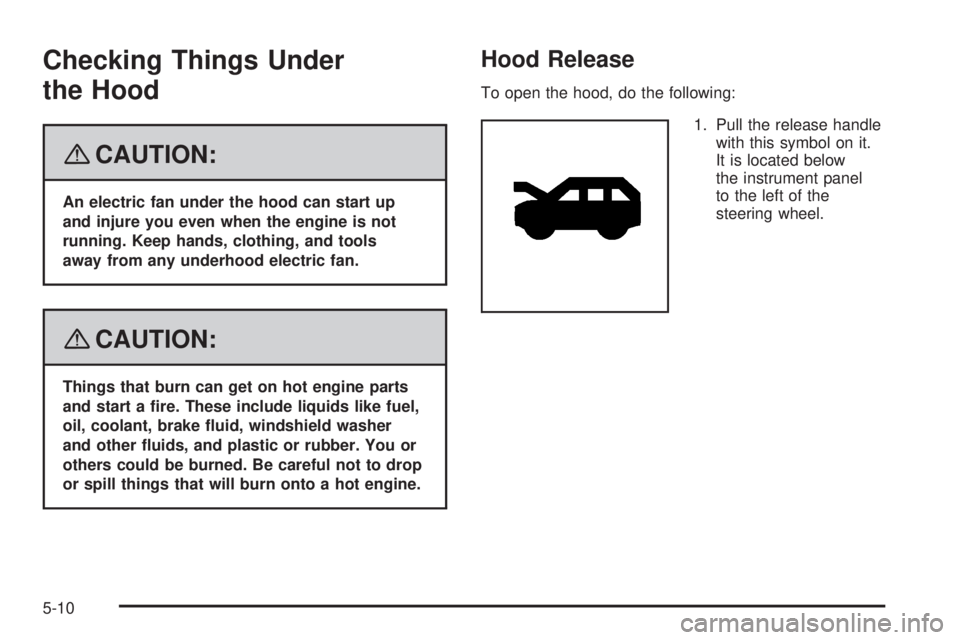
1. Pull the release handle
with this symbol on it.
It is located below
the instrument panel
to the left of the
steering wheel.
5-10
Page 240 of 368
Radiator Pressure Cap
Notice:If the pressure cap is not tightly installed,
coolant loss and possible engine damage may occur.
Be sure the cap is properly and tightly secured.
SeeEngine Compartment Overview on page 5-12for
more information on location.
Engine Overheating
You will nd a coolant temperature gage on your
vehicle’s instrument panel. SeeEngine Coolant
Temperature Gage on page 3-35.
If Steam Is Coming From Your Engine
{CAUTION:
Steam from an overheated engine can burn
you badly, even if you just open the hood.
Stay away from the engine if you see or hear
steam coming from it. Just turn it off and get
everyone away from the vehicle until it cools
down. Wait until there is no sign of steam or
coolant before you open the hood.
If you keep driving when your engine is
overheated, the liquids in it can catch re.
You or others could be badly burned. Stop
your engine if it overheats, and get out of
the vehicle until the engine is cool.
Notice:If your engine catches re because you
keep driving with no coolant, your vehicle can
be badly damaged. The costly repairs would not
be covered by your warranty.
5-26
Page 272 of 368
Federal Communications
Commission (FCC) and Industry
and Science Canada
The Tire Pressure Monitor System (TPMS) operates
on a radio frequency and complies with Part 15 of
the FCC Rules. Operation is subject to the following
two conditions:
1. This device may not cause harmful interference.
2. This device must accept any interference received,
including interference that may cause undesired
operation.
The Tire Pressure Monitor System (TPMS) operates
on a radio frequency and complies with RSS-210
of Industry and Science Canada. Operation is subject
to the following two conditions:
1. This device may not cause interference.
2. This device must accept any interference received,
including interference that may cause undesired
operation of the device.
Changes or modications to this system by other than
an authorized service facility could void authorization
to use this equipment.
Tire Pressure Monitor Operation
The Tire Pressure Monitor System (TPMS) is designed
to warn the driver when a low tire pressure condition
exists. TPMS sensors are mounted onto each tire
and wheel assembly, excluding the spare tire and wheel
assembly. The TPMS sensors monitor the air pressure
in the vehicle’s tires and transmits the tire pressure
readings to a receiver located in the vehicle.
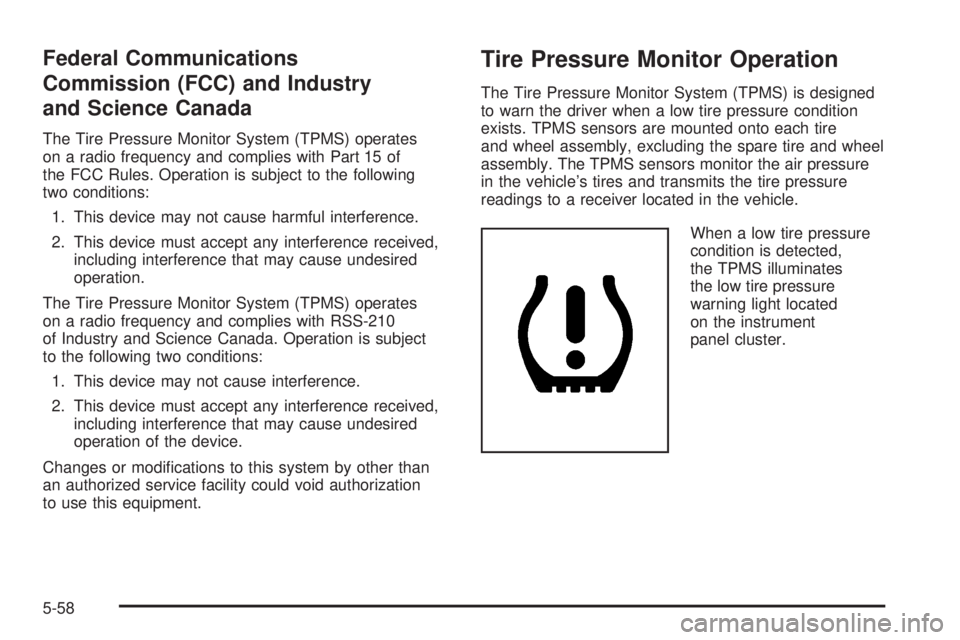
When a low tire pressure
condition is detected,
the TPMS illuminates
the low tire pressure
warning light located
on the instrument
panel cluster.
5-58
Page 298 of 368
Leather
A soft cloth dampened with water can be used to
remove dust. If a more thorough cleaning is necessary,
a soft cloth dampened with a mild soap solution can
be used. Allow the leather to dry naturally. Do not use
heat to dry. Never use steam to clean leather. Never
use spot lifters or spot removers on leather. Many
commercial leather cleaners and coatings that are
sold to preserve and protect leather may permanently
change the appearance and feel of your leather and are
not recommended. Do not use silicone or wax-based
products, or those containing organic solvents to
clean your vehicle’s interior because they can alter the
appearance by increasing the gloss in a non-uniform
manner. Never use shoe polish on leather.
Instrument Panel, Vinyl, and
Other Plastic Surfaces
A soft cloth dampened with water may be used to
remove dust. If a more thorough cleaning is necessary,
a clean soft cloth dampened with a mild soap solution
can be used to gently remove dust and dirt. Never
use spot lifters or removers on plastic surfaces.
Many commercial cleaners and coatings that are sold
to preserve and protect soft plastic surfaces may
permanently change the appearance and feel of your
interior and are not recommended. Do not use silicone
or wax-based products, or those containing organic
solvents to clean your vehicle’s interior because
they can alter the appearance by increasing the
gloss in a non-uniform manner.
Some commercial products may increase gloss on your
instrument panel. The increase in gloss may cause
annoying reections in the windshield and even make
it difficult to see through the windshield under certain
conditions.
5-84
Page 304 of 368
Vehicle Identication
Vehicle Identication Number (VIN)
This is the legal identier for your vehicle. It appears
on a plate in the front corner of the instrument panel,
on the driver side. You can see it if you look through
the windshield from outside your vehicle. The VIN
also appears on the Vehicle Certication and Service
Parts labels and the certicates of title and registration.
Engine Identication
The eighth character in the VIN is the engine code.
This code helps you identify your vehicle’s engine,
specications, and replacement parts. SeeCapacities
and Specifications on page 5-95for your vehicle’s
engine code.
Service Parts Identication Label
This label is on the inside of the glove box.
It is very helpful if you ever need to order parts.
The label has the following information:
Vehicle Identication Number (VIN)
Model designation
Paint information
Production options and special equipment
Do not remove this label from the vehicle.
Electrical System
Add-On Electrical Equipment
Notice:Do not add anything electrical to your
vehicle unless you check with your dealer/retailer
rst. Some electrical equipment can damage your
vehicle and the damage would not be covered by
your warranty. Some add-on electrical equipment can
keep other components from working as they should.
Add-on equipment can drain your vehicle’s battery,
even if your vehicle is not operating.
Your vehicle has an airbag system. Before attempting
to add anything electrical to your vehicle, seeServicing
Your Airbag-Equipped Vehicle on page 1-64.
5-90
Page 306 of 368
Instrument Panel Fuse Block
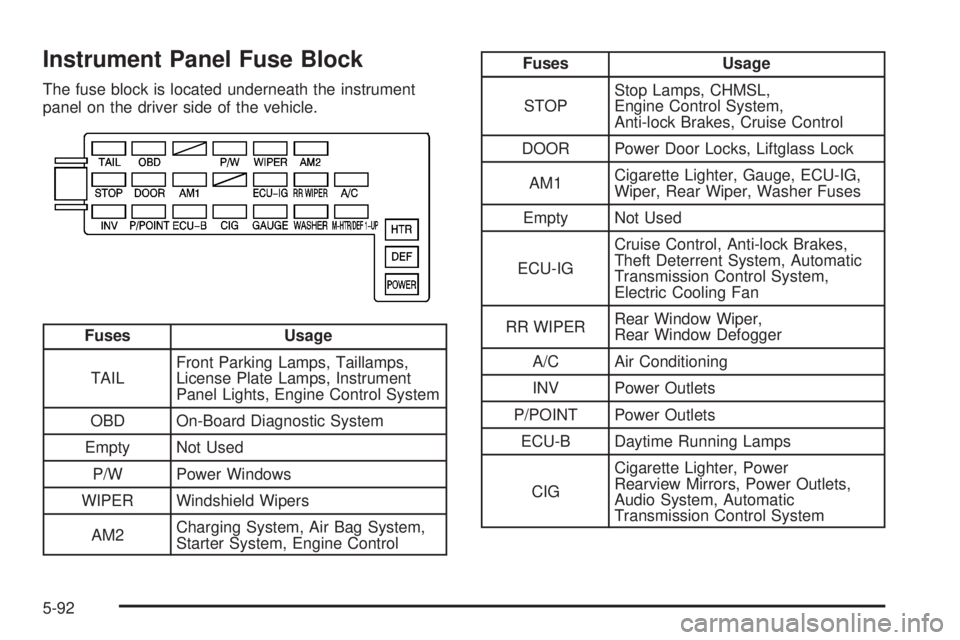
The fuse block is located underneath the instrument
panel on the driver side of the vehicle.
Fuses Usage
TAILFront Parking Lamps, Taillamps,
License Plate Lamps, Instrument
Panel Lights, Engine Control System
OBD On-Board Diagnostic System
Empty Not Used
P/W Power Windows
WIPER Windshield Wipers
AM2Charging System, Air Bag System,
Starter System, Engine Control
Fuses Usage
STOPStop Lamps, CHMSL,
Engine Control System,
Anti-lock Brakes, Cruise Control
DOOR Power Door Locks, Liftglass Lock
AM1Cigarette Lighter, Gauge, ECU-IG,
Wiper, Rear Wiper, Washer Fuses
Empty Not Used
ECU-IGCruise Control, Anti-lock Brakes,
Theft Deterrent System, Automatic
Transmission Control System,
Electric Cooling Fan
RR WIPERRear Window Wiper,
Rear Window Defogger
A/C Air Conditioning
INV Power Outlets
P/POINT Power Outlets
ECU-B Daytime Running Lamps
CIGCigarette Lighter, Power
Rearview Mirrors, Power Outlets,
Audio System, Automatic
Transmission Control System
5-92
Page 338 of 368
Customer Assistance and
Information
Customer Satisfaction Procedure
Your satisfaction and goodwill are important to
your dealer and to Pontiac. Normally, any concerns with
the sales transaction or the operation of your vehicle
will be resolved by your dealer’s sales or service
departments. Sometimes, however, despite the best
intentions of all concerned, misunderstandings can
occur. If your concern has not been resolved to your
satisfaction, the following steps should be taken:
STEP ONE:Discuss your concern with a member
of dealership management. Normally, concerns can
be quickly resolved at that level. If the matter has
already been reviewed with the sales, service, or parts
manager, contact the owner of the dealership or the
general manager.STEP TWO:If after contacting a member of dealership
management, it appears your concern cannot be
resolved by the dealership without further help, in
the U.S., contact the Pontiac Customer Assistance
Center by calling 1-800-762-2737. In Canada, contact
General Motors of Canada Customer Communication
Centre in Oshawa by calling 1-800-263-3777 (English)
or 1-800-263-7854 (French).
We encourage you to call the toll-free number in order
to give your inquiry prompt attention. Please have
the following information available to give the Customer
Assistance Representative:
Vehicle Identication Number (VIN). This is
available from the vehicle registration or title, or the
plate at the top left of the instrument panel and
visible through the windshield.
Dealership name and location.
Vehicle delivery date and present mileage.
When contacting Pontiac, please remember that your
concern will likely be resolved at a dealer’s facility.
That is why we suggest you follow Step One rst if you
have a concern.
7-2
Page 355 of 368
A
Accessories and Modications............................ 5-3
Adding Equipment to Your Airbag-Equipped
Vehicle.......................................................1-65
Additives, Fuel................................................. 5-6
Add-On Electrical Equipment............................5-90
Air Cleaner/Filter, Engine.................................5-17
Air Conditioning..............................................3-20
Airbag
Passenger Status Indicator...........................3-30
Readiness Light..........................................3-29
Airbag System................................................1-50
What Will You See After an Airbag Inates?....1-58
When Should an Airbag Inate?....................1-55
Where Are the Airbags?...............................1-52
Airbag Systems
Adding Equipment to Your Airbag-Equipped
Vehicle...................................................1-65
How Does an Airbag Restrain?......................1-57
Passenger Sensing System...........................1-59
Servicing Your Airbag-Equipped Vehicle..........1-64
What Makes an Airbag Inate?......................1-57
Antenna, Fixed Mast........................................3-64
Antenna, XM™ Satellite Radio Antenna System.....3-64
Antilock Brake System (ABS)............................. 4-4
Antilock Brake, System Warning Light................3-33Appearance Care
Aluminum Wheels........................................5-87
Care of Safety Belts....................................5-85
Chemical Paint Spotting...............................5-88
Cleaning Exterior Lamps/Lenses....................5-86
Fabric/Carpet..............................................5-83
Finish Care.................................................5-86
Finish Damage............................................5-88
Instrument Panel, Vinyl, and Other
Plastic Surfaces.......................................5-84
Interior Cleaning..........................................5-82
Leather......................................................5-84
Sheet Metal Damage...................................5-88
Tires..........................................................
5-88
Underbody Maintenance...............................5-88
Vehicle Care/Appearance Materials................5-89
Washing Your Vehicle...................................5-85
Weatherstrips..............................................5-85
Windshield, Backglass, and Wiper Blades.......5-87
Appointments, Scheduling Service....................... 7-9
Ashtray.........................................................3-19
Audio System.................................................3-42
Fixed Mast Antenna.....................................3-64
Radio Reception..........................................3-63
Setting the Time..........................................3-43
XM™ Satellite Radio Antenna System............3-64
Audio System(s).............................................3-44
1
Page 357 of 368
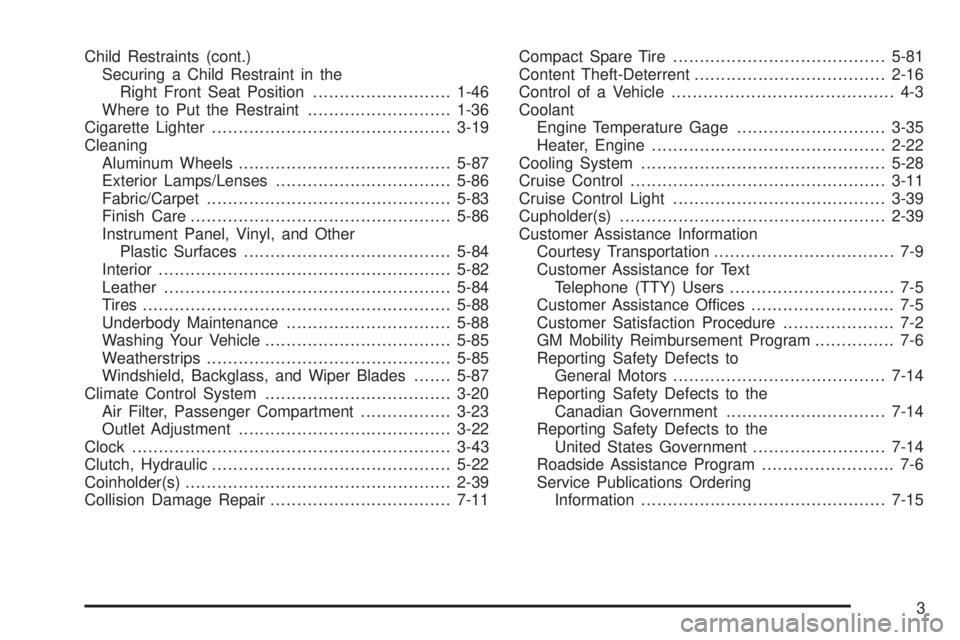
Child Restraints (cont.)
Securing a Child Restraint in the
Right Front Seat Position..........................1-46
Where to Put the Restraint...........................1-36
Cigarette Lighter.............................................3-19
Cleaning
Aluminum Wheels........................................5-87
Exterior Lamps/Lenses.................................5-86
Fabric/Carpet..............................................5-83
Finish Care.................................................5-86
Instrument Panel, Vinyl, and Other
Plastic Surfaces.......................................5-84
Interior.......................................................5-82
Leather......................................................5-84
Tires..........................................................5-88
Underbody Maintenance...............................5-88
Washing Your Vehicle...................................5-85
Weatherstrips..............................................5-85
Windshield, Backglass, and Wiper Blades.......5-87
Climate Control System...................................3-20
Air Filter, Passenger Compartment.................3-23
Outlet Adjustment........................................3-22
Clock............................................................3-43
Clutch, Hydraulic.............................................5-22
Coinholder(s)..................................................2-39
Collision Damage Repair..................................7-11Compact Spare Tire........................................5-81
Content Theft-Deterrent....................................2-16
Control of a Vehicle.......................................... 4-3
Coolant
Engine Temperature Gage............................3-35
Heater, Engine............................................2-22
Cooling System..............................................5-28
Cruise Control................................................3-11
Cruise Control Light........................................3-39
Cupholder(s)..................................................2-39
Customer Assistance Information
Courtesy Transportation.................................. 7-9
Customer Assistance for Text
Telephone (TTY) Users............................... 7-5
Customer Assistance Offices........................... 7-5
Customer Satisfaction Procedure..................... 7-2
GM Mobility Reimbursement Program............... 7-6
Reporting Safety Defects to
General Motors........................................7-14
Reporting Safety Defects to the
Canadian Government..............................7-14
Reporting Safety Defects to the
United States Government.........................7-14
Roadside Assistance Program......................... 7-6
Service Publications Ordering
Information..............................................7-15
3