fuse PONTIAC VIBE 2008 Owners Manual
[x] Cancel search | Manufacturer: PONTIAC, Model Year: 2008, Model line: VIBE, Model: PONTIAC VIBE 2008Pages: 368, PDF Size: 5.7 MB
Page 6 of 368
Front Seats
Manual Seats
{CAUTION:
You can lose control of the vehicle if you try to
adjust a manual driver’s seat while the vehicle
is moving. The sudden movement could startle
and confuse you, or make you push a pedal
when you do not want to. Adjust the driver’s
seat only when the vehicle is not moving.
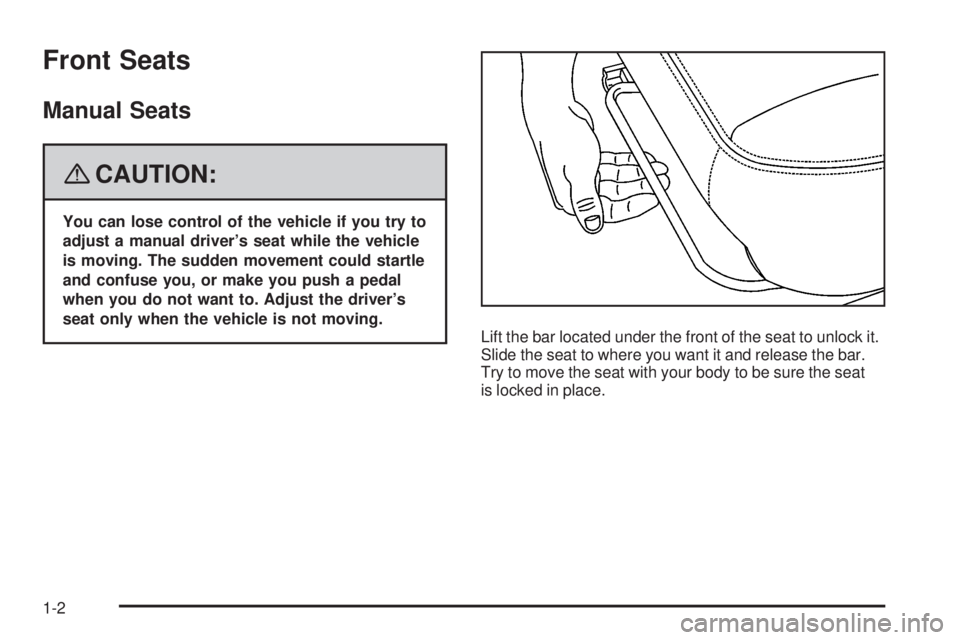
Lift the bar located under the front of the seat to unlock it.
Slide the seat to where you want it and release the bar.
Try to move the seat with your body to be sure the seat
is locked in place.
1-2
Page 7 of 368
Seat Height Adjuster
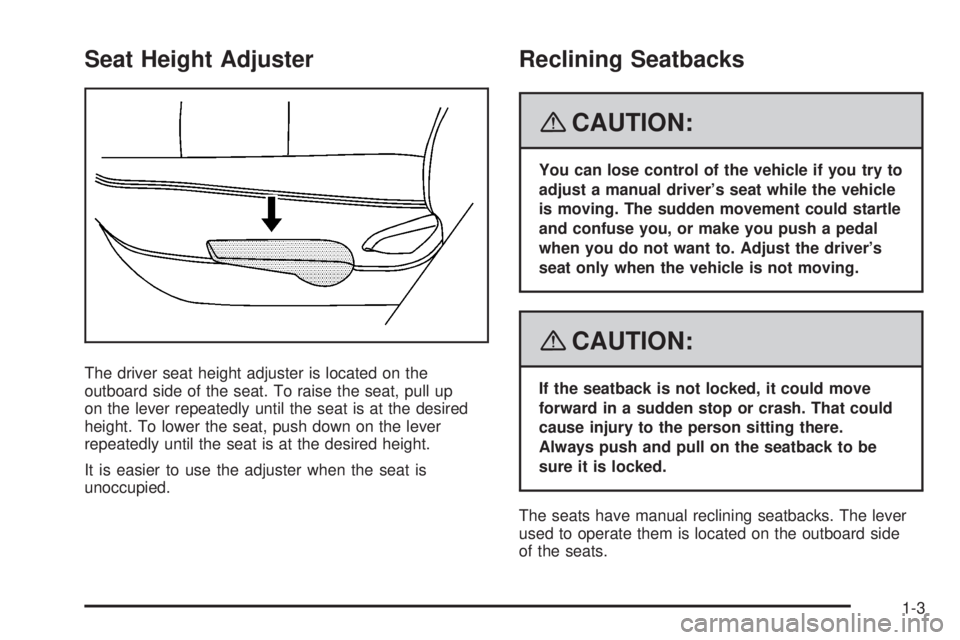
The driver seat height adjuster is located on the
outboard side of the seat. To raise the seat, pull up
on the lever repeatedly until the seat is at the desired
height. To lower the seat, push down on the lever
repeatedly until the seat is at the desired height.
It is easier to use the adjuster when the seat is
unoccupied.
Reclining Seatbacks
{CAUTION:
You can lose control of the vehicle if you try to
adjust a manual driver’s seat while the vehicle
is moving. The sudden movement could startle
and confuse you, or make you push a pedal
when you do not want to. Adjust the driver’s
seat only when the vehicle is not moving.
{CAUTION:
If the seatback is not locked, it could move
forward in a sudden stop or crash. That could
cause injury to the person sitting there.
Always push and pull on the seatback to be
sure it is locked.
The seats have manual reclining seatbacks. The lever
used to operate them is located on the outboard side
of the seats.
1-3
Page 87 of 368
Immobilizer Operation
(Canada Only)
Your vehicle has a passive theft-deterrent system.
The system is automatically armed when the key
is removed from the ignition.
You do not have to manually arm or disarm the system.
The security light will come on if there is a problem
with arming or disarming the theft-deterrent system.
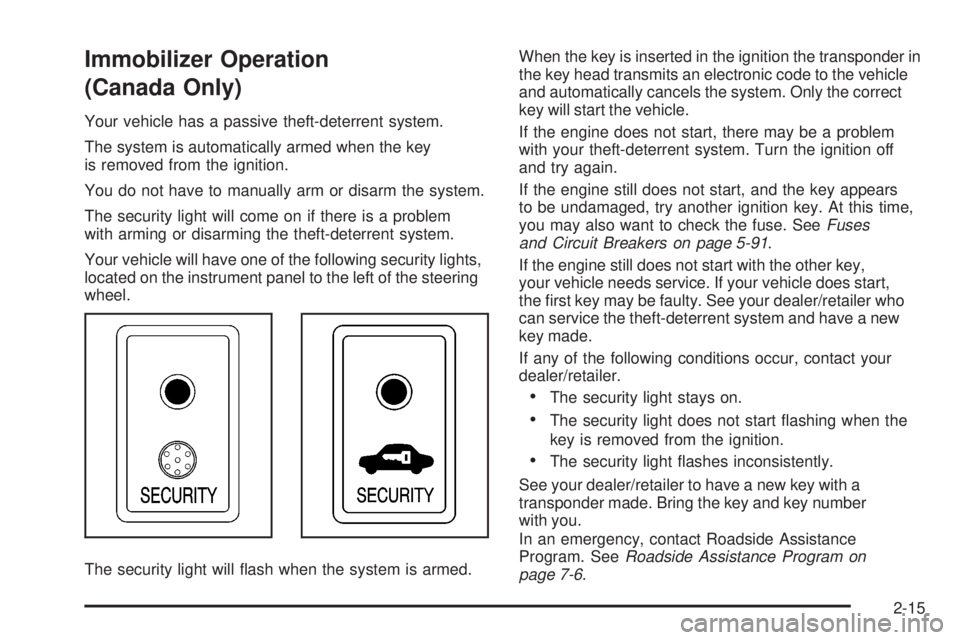
Your vehicle will have one of the following security lights,
located on the instrument panel to the left of the steering
wheel.
The security light will ash when the system is armed.When the key is inserted in the ignition the transponder in
the key head transmits an electronic code to the vehicle
and automatically cancels the system. Only the correct
key will start the vehicle.
If the engine does not start, there may be a problem
with your theft-deterrent system. Turn the ignition off
and try again.
If the engine still does not start, and the key appears
to be undamaged, try another ignition key. At this time,
you may also want to check the fuse. SeeFuses
and Circuit Breakers on page 5-91.
If the engine still does not start with the other key,
your vehicle needs service. If your vehicle does start,
the rst key may be faulty. See your dealer/retailer who
can service the theft-deterrent system and have a new
key made.
If any of the following conditions occur, contact your
dealer/retailer.
The security light stays on.
The security light does not start ashing when the
key is removed from the ignition.
The security light ashes inconsistently.
See your dealer/retailer to have a new key with a
transponder made. Bring the key and key number
with you.
In an emergency, contact Roadside Assistance
Program. SeeRoadside Assistance Program on
page 7-6.
2-15
Page 124 of 368

Turn and Lane-Change Signals
The turn signal has an upward (for right) and a
downward (for left) position. These positions allow
you to signal a turn or a lane change.
To signal a turn, move the lever all the way up or
down. When the turn is nished, the lever will return
automatically.
To signal a lane change, raise or lower the lever until
the arrow starts to ash. Hold it there until you complete
your lane change. The lever will return by itself when
you release it.
An arrow on the instrument
panel cluster will ash in
the direction of the turn or
lane change.
If you signal a turn or a lane change and notice the
arrow ashing rapidly, a signal bulb may be burned
out and other drivers will not see your turn signal.
If a bulb is burned out, have it replaced to help avoid an
accident. If the arrows do not go on at all when you signal
a turn, check for burned-out bulbs and then check the
fuse. SeeFuses and Circuit Breakers on page 5-91.
Headlamp High/Low-Beam Changer
The headlamps must be on for this feature to work.
For high beams, push the turn signal lever away
from you.
When the high beams
are on, this light on the
instrument panel cluster
also will be on.
It will go off when you switch to the low beams.
To switch back to low beams, pull the lever toward you.
Flash-to-Pass
With the lever in the low-beam position, pull the lever
toward you to momentarily switch to high beams
(to signal that you are going to pass). If you have the
headlamps on when you release the lever, they will
return to the low beams.
3-8
Page 134 of 368
Accessory Power Outlet(s)
With the accessory power outlet, you can plug in
auxiliary electrical equipment.
Your vehicle has an outlet under the climate controls.
To use the outlet, the ignition must be in ON or
ACC. Pull down the small cover to access the outlet.
Notice:Leaving electrical equipment on for
extended periods will drain the battery. Always
turn off electrical equipment when not in use and
do not plug in equipment that exceeds the maximum
amperage rating.
This circuit is protected by a fuse and has a maximum
current level. Do not use equipment exceeding the
maximum amperage rating.
Certain power accessory plugs may not be compatible
to the power accessory outlet and could result in blown
vehicle or adapter fuses. If you experience a problem
see your dealer for additional information on the power
accessory plugs.Notice:Adding any electrical equipment to your
vehicle may damage it or keep other components
from working as they should. The repairs would not
be covered by your warranty. Do not use equipment
exceeding maximum amperage rating of 20 amperes.
Check with your dealer/retailer before adding
electrical equipment.
When adding electrical equipment, be sure to follow
the proper installation instructions included with
the equipment.
Notice:Improper use of the power outlet can cause
damage not covered by your warranty. Do not hang
any type of accessory or accessory bracket from the
plug because the power outlets are designed for
accessory power plugs only.
Power Outlet 115 Volt Alternating
Current
With this power outlet, you can plug in auxiliary electrical
equipment with a maximum limit of 115 VAC. If you try
to use equipment that requires more than the limit, a
protection circuit will cut the power supply. The power
will automatically restart when equipment that operates
within the limit is plugged in.
3-18
Page 135 of 368
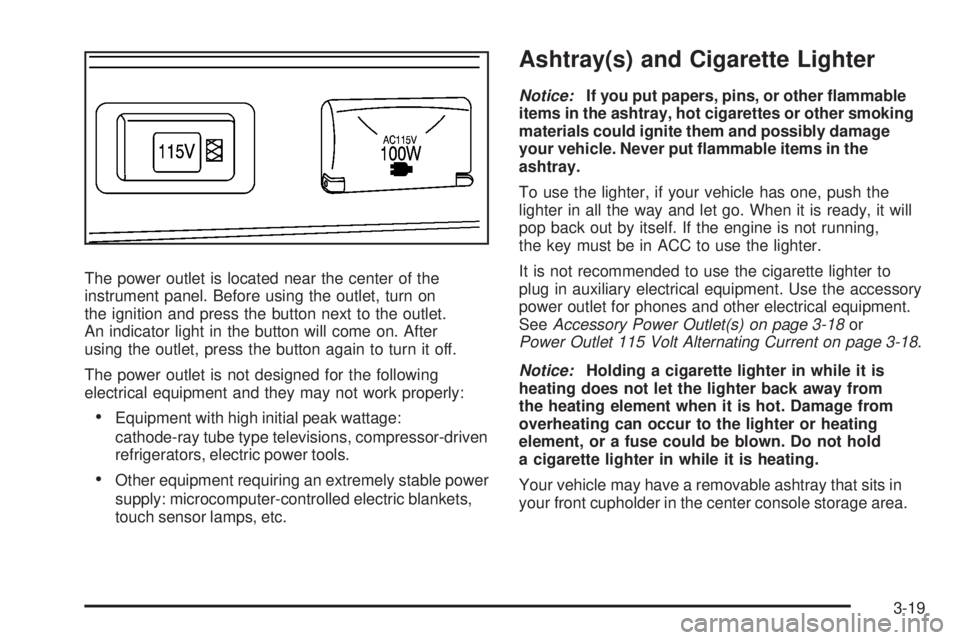
The power outlet is located near the center of the
instrument panel. Before using the outlet, turn on
the ignition and press the button next to the outlet.
An indicator light in the button will come on. After
using the outlet, press the button again to turn it off.
The power outlet is not designed for the following
electrical equipment and they may not work properly:
Equipment with high initial peak wattage:
cathode-ray tube type televisions, compressor-driven
refrigerators, electric power tools.
Other equipment requiring an extremely stable power
supply: microcomputer-controlled electric blankets,
touch sensor lamps, etc.
Ashtray(s) and Cigarette Lighter
Notice:If you put papers, pins, or other ammable
items in the ashtray, hot cigarettes or other smoking
materials could ignite them and possibly damage
your vehicle. Never put ammable items in the
ashtray.
To use the lighter, if your vehicle has one, push the
lighter in all the way and let go. When it is ready, it will
pop back out by itself. If the engine is not running,
the key must be in ACC to use the lighter.
It is not recommended to use the cigarette lighter to
plug in auxiliary electrical equipment. Use the accessory
power outlet for phones and other electrical equipment.
SeeAccessory Power Outlet(s) on page 3-18or
Power Outlet 115 Volt Alternating Current on page 3-18.
Notice:Holding a cigarette lighter in while it is
heating does not let the lighter back away from
the heating element when it is hot. Damage from
overheating can occur to the lighter or heating
element, or a fuse could be blown. Do not hold
a cigarette lighter in while it is heating.
Your vehicle may have a removable ashtray that sits in
your front cupholder in the center console storage area.
3-19
Page 216 of 368

Different Size Tires and Wheels......................5-65
Uniform Tire Quality Grading..........................5-65
Wheel Alignment and Tire Balance..................5-67
Wheel Replacement......................................5-67
Tire Chains..................................................5-68
If a Tire Goes Flat........................................5-69
Changing a Flat Tire.....................................5-70
Removing the Spare Tire and Tools................5-71
Removing the Flat Tire and Installing
the Spare Tire..........................................5-73
Storing a Flat or Spare Tire and Tools............5-79
Compact Spare Tire......................................5-81
Appearance Care............................................5-82
Interior Cleaning...........................................5-82
Fabric/Carpet...............................................5-83
Leather.......................................................5-84
Instrument Panel, Vinyl, and Other
Plastic Surfaces........................................5-84
Care of Safety Belts......................................5-85
Weatherstrips...............................................5-85
Washing Your Vehicle...................................5-85
Cleaning Exterior Lamps/Lenses.....................5-86
Finish Care..................................................5-86
Windshield, Backglass, and
Wiper Blades............................................5-87Aluminum Wheels.........................................5-87
Tires...........................................................5-88
Sheet Metal Damage.....................................5-88
Finish Damage.............................................5-88
Underbody Maintenance................................5-88
Chemical Paint Spotting.................................5-88
Vehicle Care/Appearance Materials..................5-89
Vehicle Identication......................................5-90
Vehicle Identication Number (VIN).................5-90
Service Parts Identication Label.....................5-90
Electrical System...........................................
.5-90
Add-On Electrical Equipment..........................5-90
Headlamp Wiring..........................................5-91
Windshield Wiper Fuses................................5-91
Power Windows and Other
Power Options..........................................5-91
Fuses and Circuit Breakers............................5-91
Instrument Panel Fuse Block..........................5-92
Engine Compartment Fuse Block....................5-93
Capacities and Specications..........................5-95
Maintenance Replacement Parts......................5-96
Engine Drive Belt Routing..............................5-97
Section 5 Service and Appearance Care
5-2
Page 218 of 368

California Perchlorate Materials
Requirements
Certain types of automotive applications, such as
airbag initiators, seat belt pretensioners, and lithium
batteries contained in remote keyless entry transmitters,
may contain perchlorate materials. Special handling
may be necessary. For additional information, see
www.dtsc.ca.gov/hazardouswaste/perchlorate.
Doing Your Own Service Work
{CAUTION:
You can be injured and your vehicle could be
damaged if you try to do service work on a
vehicle without knowing enough about it.
Be sure you have sufficient knowledge,
experience, the proper replacement parts,
and tools before you attempt any vehicle
maintenance task.
Be sure to use the proper nuts, bolts,
and other fasteners. English and metric
fasteners can be easily confused. If you
use the wrong fasteners, parts can later
break or fall off. You could be hurt.
If you want to do some of your own service work, you will
want to use the proper service manual. It tells you much
more about how to service your vehicle than this manual
can. To order the proper service manual, seeService
Publications Ordering Information on page 7-15.
Your vehicle has an airbag system. Before attempting
to do your own service work, seeServicing Your
Airbag-Equipped Vehicle on page 1-64.
5-4
Page 227 of 368
A. Windshield Washer Fluid Reservoir. See “Adding
Washer Fluid” underWindshield Washer Fluid
on page 5-34.
B. Power Steering Fluid Reservoir. SeePower Steering
Fluid on page 5-33.
C. Radiator Pressure Cap. SeeRadiator Pressure Cap
on page 5-26.
D. Engine Oil Dipstick. See “Checking Engine Oil”
underEngine Oil on page 5-13.
E. Coolant Recovery Tank. SeeCooling System on
page 5-28.
F. Engine Oil Fill Cap. See “When to Add Engine Oil”
underEngine Oil on page 5-13.
G. Automatic Transmission Fluid Dipstick (If Equipped).
See “Checking the Fluid Level” underAutomatic
Transmission Fluid on page 5-19.
H. Brake Master Cylinder Reservoir and Hydraulic
Clutch (If Equipped). See “Brake Fluid” underBrakes
on page 5-35andHydraulic Clutch on page 5-22.
I. Engine Air Cleaner/Filter. SeeEngine Air
Cleaner/Filter on page 5-17.
J. Battery. SeeBattery on page 5-38.
K. Engine Compartment Fuse Block. SeeEngine
Compartment Fuse Block on page 5-93.Engine Oil
If the engine oil pressure
light appears on the
instrument cluster,
check the engine oil
level right away.
For more information, seeOil Pressure Light on
page 3-38. You should check the engine oil level
regularly; this is an added reminder.
Checking Engine Oil
It is a good idea to check the engine oil every time you
get fuel. In order to get an accurate reading, the oil
must be warm and the vehicle must be on level ground.
The engine oil dipstick handle is a yellow loop. See
Engine Compartment Overview on page 5-12for
the location of the engine oil dipstick.
1. Turn off the engine and give the oil several minutes
to drain back into the oil pan. If you do not do this,
the oil dipstick might not show the actual level.
2. Pull out the dipstick and clean it with a paper towel
or cloth, then push it back in all the way. Remove it
again, keeping the tip down, and check the level.
5-13
Page 305 of 368
Headlamp Wiring
The headlamp wiring is protected by a circuit breaker.
An electrical overload will cause the lamps to go on
and off, or in some cases to remain off. If this happens,
have your headlamp wiring checked right away.
Windshield Wiper Fuses
The windshield wiper motor is protected by a circuit
breaker and a fuse. If the motor overheats due to heavy
snow or ice, the wiper will stop until the motor cools.
If the overload is caused by some electrical problem,
and not snow or ice, be sure to get it xed.
Power Windows and Other
Power Options
Circuit breakers in the fuse block protect the power
windows and other power accessories. When the
current load is too heavy, the circuit breaker opens
and closes, protecting the circuit until the problem is
xed or goes away.
Fuses and Circuit Breakers
The wiring circuits in your vehicle are protected from
short circuits by a combination of fuses, circuit breakers
and fusible thermal links. This greatly reduces the
chance of res caused by electrical problems.
Look at the silver-colored band inside the fuse. If the
band is broken or melted, replace the fuse. Be sure you
replace a bad fuse with a new one of the identical
size and rating.
If you ever have a problem on the road and don’t
have a spare fuse, you can borrow one that has the
same amperage. Just pick some feature of your
vehicle that you can get along without – like the radio
or cigarette lighter – and use its fuse, if it is the
correct amperage. Replace it as soon as you can.
5-91