transmission PONTIAC VIBE 2009 User Guide
[x] Cancel search | Manufacturer: PONTIAC, Model Year: 2009, Model line: VIBE, Model: PONTIAC VIBE 2009Pages: 318, PDF Size: 1.53 MB
Page 142 of 318
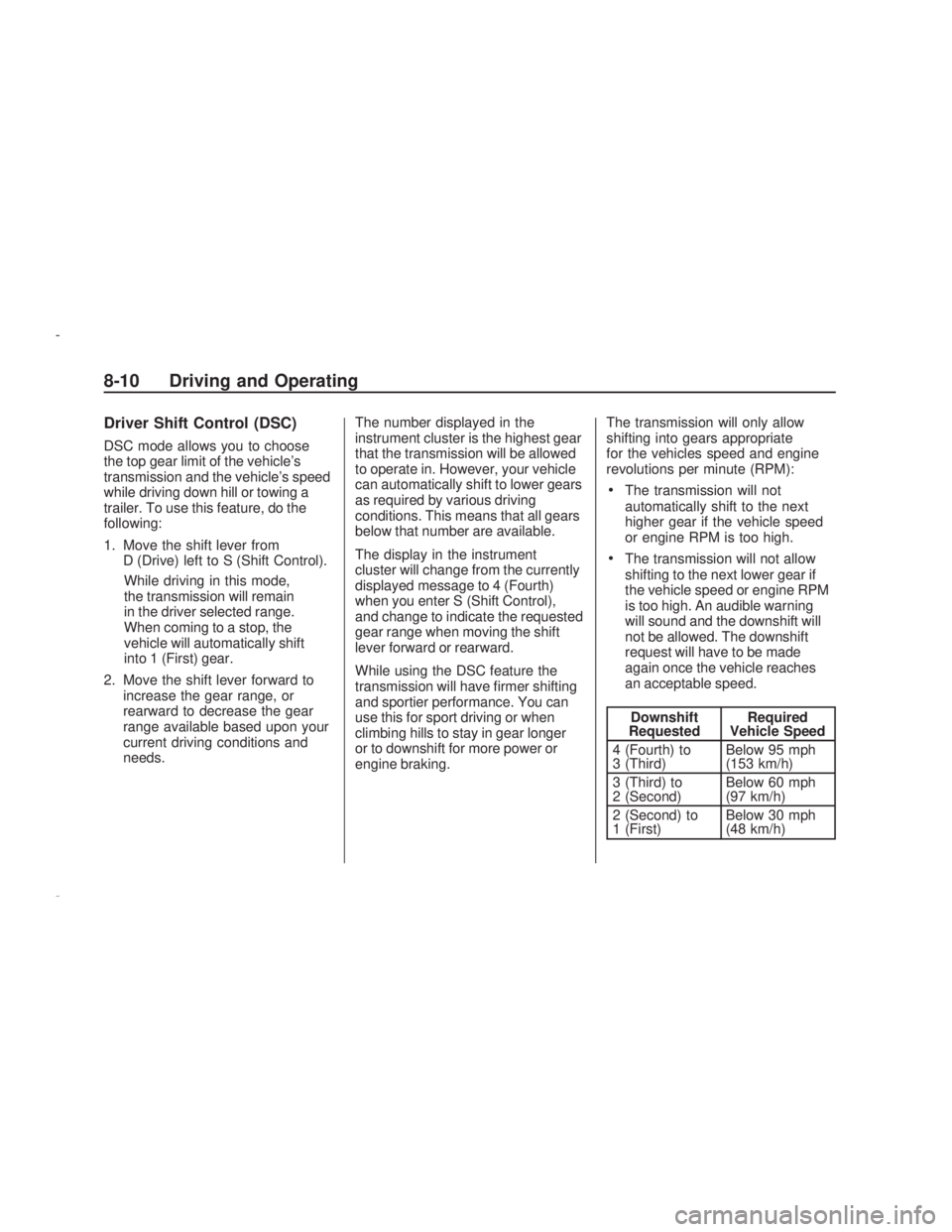
Driver Shift Control (DSC)
DSC mode allows you to choose
the top gear limit of the vehicle’s
transmission and the vehicle’s speed
while driving down hill or towing a
trailer. To use this feature, do the
following:
1. Move the shift lever from
D (Drive) left to S (Shift Control).
While driving in this mode,
the transmission will remain
in the driver selected range.
When coming to a stop, the
vehicle will automatically shift
into 1 (First) gear.
2. Move the shift lever forward to
increase the gear range, or
rearward to decrease the gear
range available based upon your
current driving conditions and
needs.The number displayed in the
instrument cluster is the highest gear
that the transmission will be allowed
to operate in. However, your vehicle
can automatically shift to lower gears
as required by various driving
conditions. This means that all gears
below that number are available.
The display in the instrument
cluster will change from the currently
displayed message to 4 (Fourth)
when you enter S (Shift Control),
and change to indicate the requested
gear range when moving the shift
lever forward or rearward.
While using the DSC feature the
transmission will have rmer shifting
and sportier performance. You can
use this for sport driving or when
climbing hills to stay in gear longer
or to downshift for more power or
engine braking.The transmission will only allow
shifting into gears appropriate
for the vehicles speed and engine
revolutions per minute (RPM):
The transmission will not
automatically shift to the next
higher gear if the vehicle speed
or engine RPM is too high.
The transmission will not allow
shifting to the next lower gear if
the vehicle speed or engine RPM
is too high. An audible warning
will sound and the downshift will
not be allowed. The downshift
request will have to be made
again once the vehicle reaches
an acceptable speed.
Downshift
RequestedRequired
Vehicle Speed
4 (Fourth) to
3 (Third)Below 95 mph
(153 km/h)
3 (Third) to
2 (Second)Below 60 mph
(97 km/h)
2 (Second) to
1 (First)Below 30 mph
(48 km/h)
8-10 Driving and Operating
2009 - Pontiac Vibe Owner Manual
Page 143 of 318

Manual Transmission
Operation
1 (First):Press the clutch pedal and
shift into 1 (First). Then, slowly let
up on the clutch pedal as you press
the accelerator pedal.You can shift into 1 (First) when
you are going less than 20 mph
(32 km/h). If you have come to a
complete stop and it is hard to shift
into 1 (First), put the shift lever in
NEUTRAL and let up on the clutch.
Press the clutch pedal back down.
Then shift into 1 (First).
2 (Second):Press the clutch pedal
as you let up on the accelerator
pedal and shift into 2 (Second).
Then, slowly let up on the clutch
pedal as you press the accelerator
pedal.
3 (Third), 4 (Fourth), 5 (Fifth):
Shift into 3 (Third), 4 (Fourth)
and 5 (Fifth) the same way you
do for 2 (Second). Slowly let up
on the clutch pedal as you press
the accelerator pedal.To stop, let up on the accelerator
pedal and press the brake pedal.
Just before the vehicle stops, press
the clutch pedal and the brake pedal,
and shift to NEUTRAL.
Neutral:Use this position when
you start or idle the engine.
R (Reverse):To back up, press
down on the clutch pedal and shift
into R (Reverse). Let up on the
clutch pedal slowly while pressing
the accelerator pedal.
Notice:Shifting to R (Reverse)
while the vehicle is moving
forward could damage the
transmission. The repairs would
not be covered by the vehicle
warranty. Shift to R (Reverse)
only after the vehicle is stopped.
Also, use R (Reverse) along with
the parking brake for parking
your vehicle.
Driving and Operating 8-11
2009 - Pontiac Vibe Owner Manual
Page 144 of 318
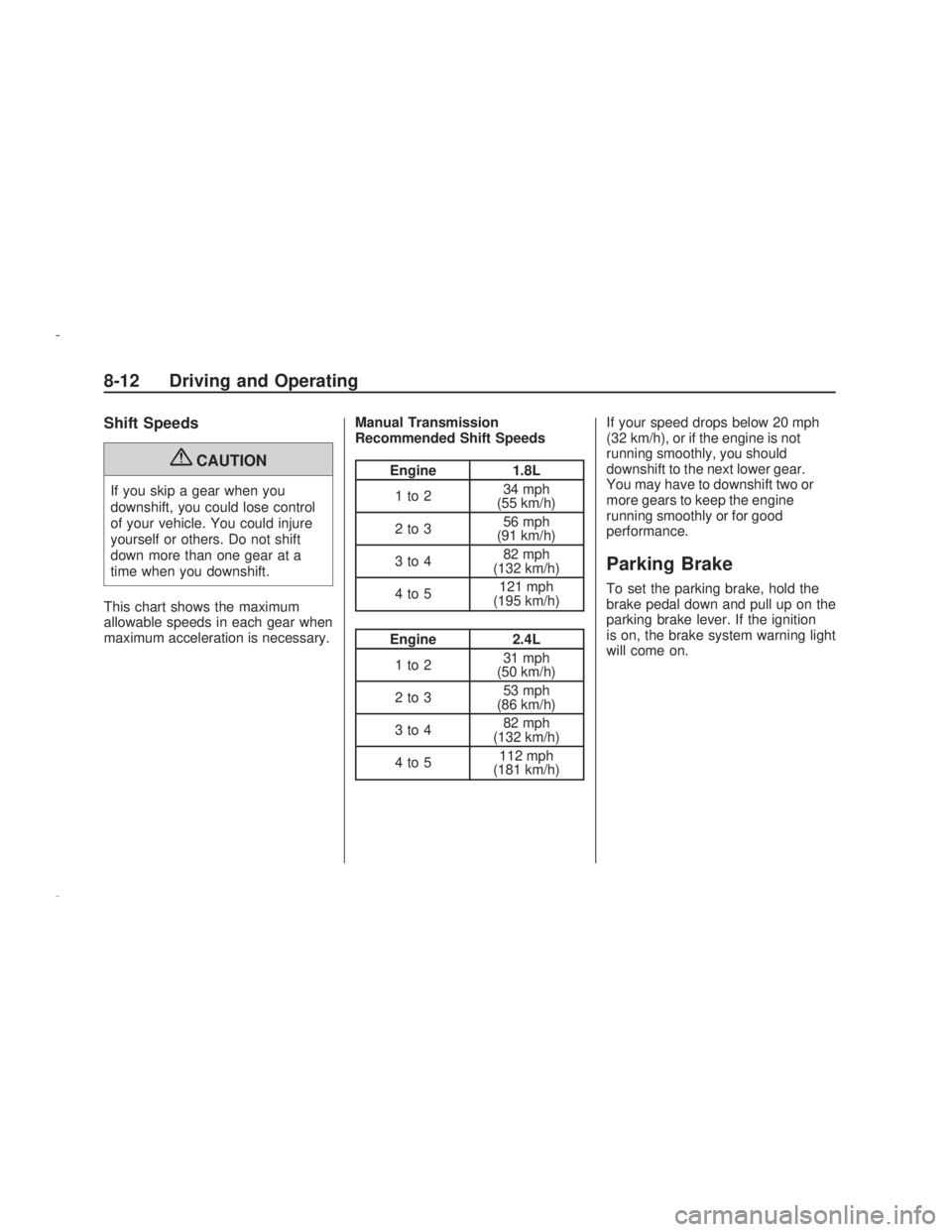
Shift Speeds
{CAUTION
If you skip a gear when you
downshift, you could lose control
of your vehicle. You could injure
yourself or others. Do not shift
down more than one gear at a
time when you downshift.
This chart shows the maximum
allowable speeds in each gear when
maximum acceleration is necessary.Manual Transmission
Recommended Shift Speeds
Engine 1.8L
1to234 mph
(55 km/h)
2to356 mph
(91 km/h)
3to482 mph
(132 km/h)
4to5121 mph
(195 km/h)
Engine 2.4L
1to231 mph
(50 km/h)
2to353 mph
(86 km/h)
3to482 mph
(132 km/h)
4to5112 mph
(181 km/h)If your speed drops below 20 mph
(32 km/h), or if the engine is not
running smoothly, you should
downshift to the next lower gear.
You may have to downshift two or
more gears to keep the engine
running smoothly or for good
performance.
Parking Brake
To set the parking brake, hold the
brake pedal down and pull up on the
parking brake lever. If the ignition
is on, the brake system warning light
will come on.
8-12 Driving and Operating
2009 - Pontiac Vibe Owner Manual
Page 146 of 318
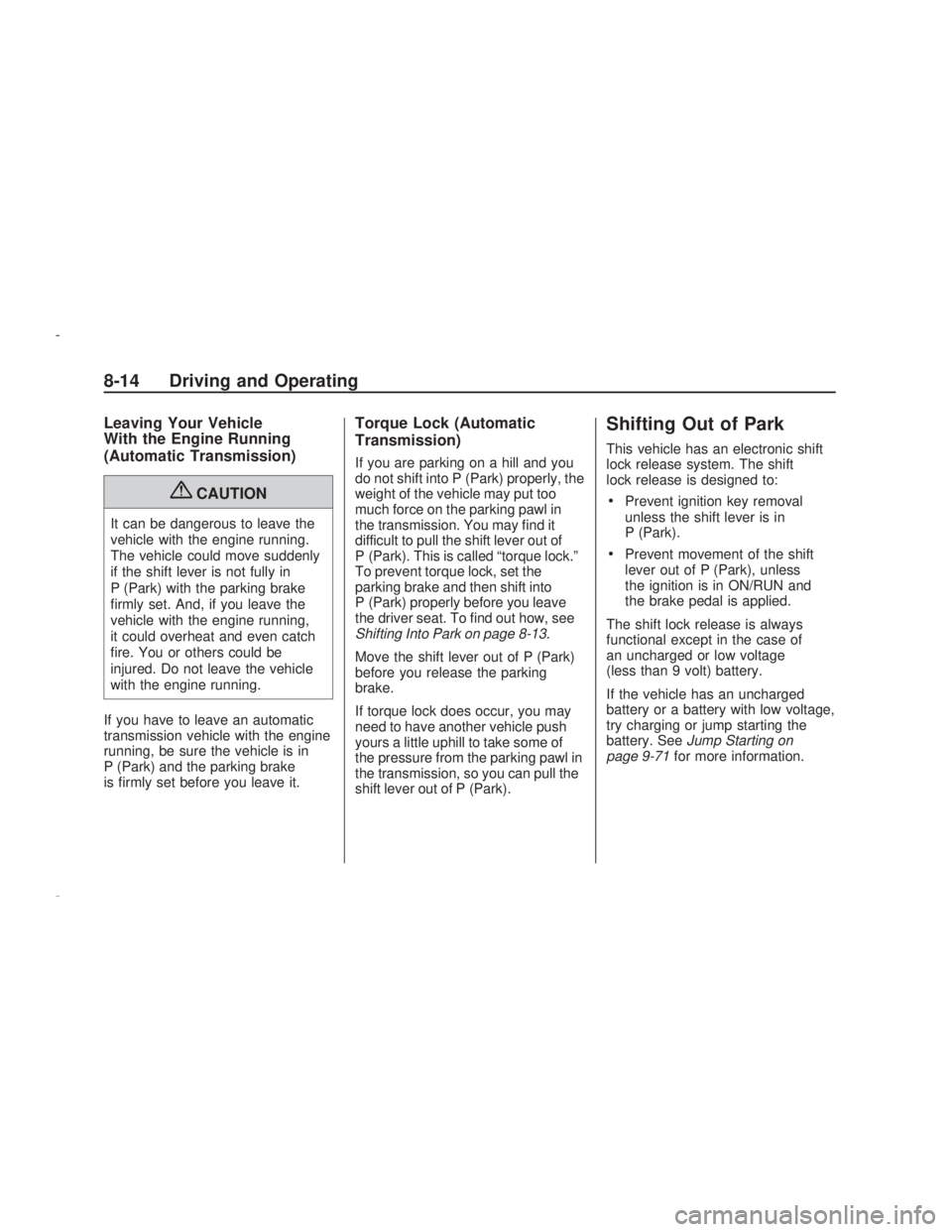
Leaving Your Vehicle
With the Engine Running
(Automatic Transmission)
{CAUTION
It can be dangerous to leave the
vehicle with the engine running.
The vehicle could move suddenly
if the shift lever is not fully in
P (Park) with the parking brake
rmly set. And, if you leave the
vehicle with the engine running,
it could overheat and even catch
re. You or others could be
injured. Do not leave the vehicle
with the engine running.
If you have to leave an automatic
transmission vehicle with the engine
running, be sure the vehicle is in
P (Park) and the parking brake
is rmly set before you leave it.
Torque Lock (Automatic
Transmission)
If you are parking on a hill and you
do not shift into P (Park) properly, the
weight of the vehicle may put too
much force on the parking pawl in
the transmission. You may nd it
difficult to pull the shift lever out of
P (Park). This is called “torque lock.”
To prevent torque lock, set the
parking brake and then shift into
P (Park) properly before you leave
the driver seat. To nd out how, see
Shifting Into Park on page 8-13.
Move the shift lever out of P (Park)
before you release the parking
brake.
If torque lock does occur, you may
need to have another vehicle push
yours a little uphill to take some of
the pressure from the parking pawl in
the transmission, so you can pull the
shift lever out of P (Park).
Shifting Out of Park
This vehicle has an electronic shift
lock release system. The shift
lock release is designed to:
Prevent ignition key removal
unless the shift lever is in
P (Park).
Prevent movement of the shift
lever out of P (Park), unless
the ignition is in ON/RUN and
the brake pedal is applied.
The shift lock release is always
functional except in the case of
an uncharged or low voltage
(less than 9 volt) battery.
If the vehicle has an uncharged
battery or a battery with low voltage,
try charging or jump starting the
battery. SeeJump Starting on
page 9-71for more information.
8-14 Driving and Operating
2009 - Pontiac Vibe Owner Manual
Page 147 of 318
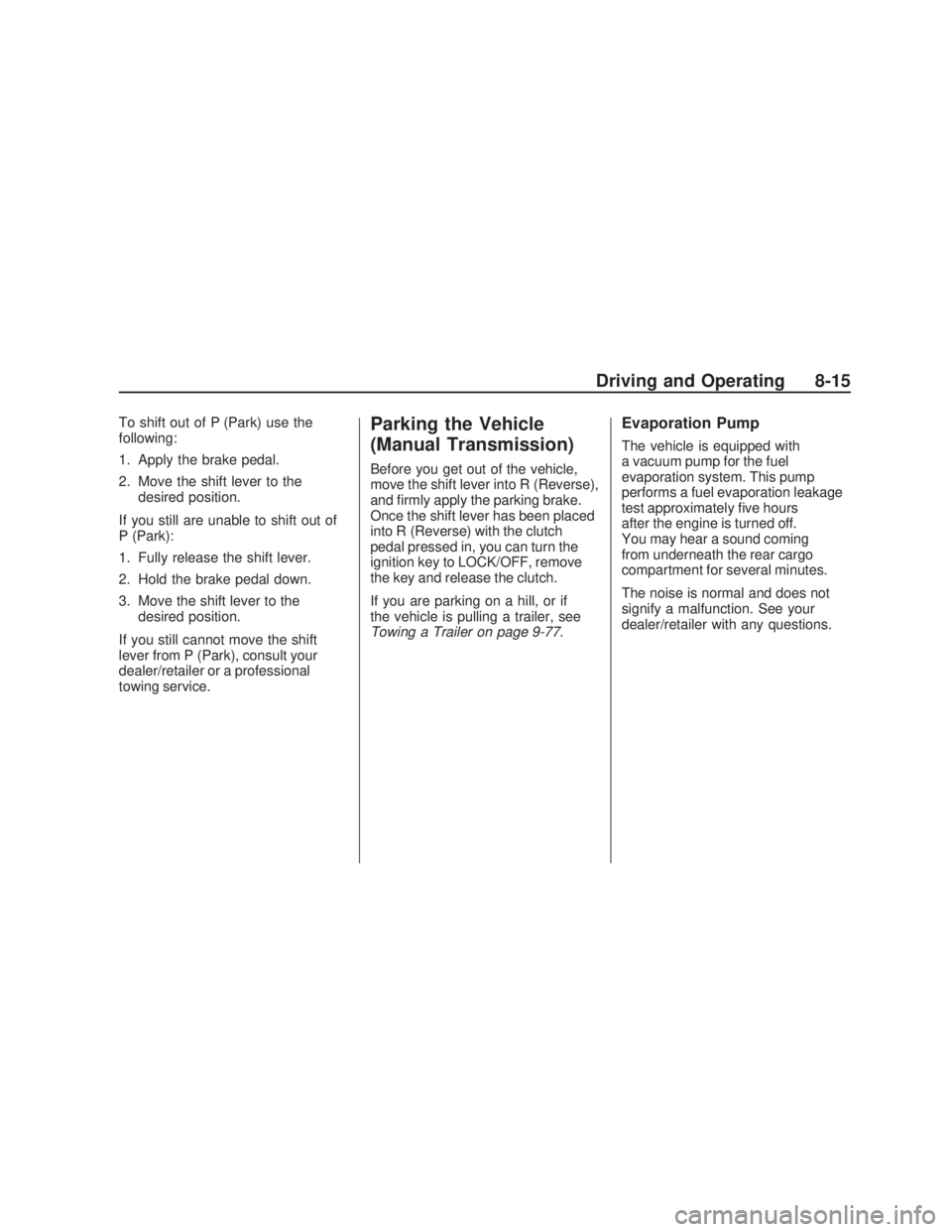
To shift out of P (Park) use the
following:
1. Apply the brake pedal.
2. Move the shift lever to the
desired position.
If you still are unable to shift out of
P (Park):
1. Fully release the shift lever.
2. Hold the brake pedal down.
3. Move the shift lever to the
desired position.
If you still cannot move the shift
lever from P (Park), consult your
dealer/retailer or a professional
towing service.Parking the Vehicle
(Manual Transmission)
Before you get out of the vehicle,
move the shift lever into R (Reverse),
and rmly apply the parking brake.
Once the shift lever has been placed
into R (Reverse) with the clutch
pedal pressed in, you can turn the
ignition key to LOCK/OFF, remove
the key and release the clutch.
If you are parking on a hill, or if
the vehicle is pulling a trailer, see
Towing a Trailer on page 9-77.
Evaporation Pump
The vehicle is equipped with
a vacuum pump for the fuel
evaporation system. This pump
performs a fuel evaporation leakage
test approximately ve hours
after the engine is turned off.
You may hear a sound coming
from underneath the rear cargo
compartment for several minutes.
The noise is normal and does not
signify a malfunction. See your
dealer/retailer with any questions.
Driving and Operating 8-15
2009 - Pontiac Vibe Owner Manual
Page 149 of 318
Running the Vehicle
While Parked
It is better not to park with the
engine running. But if you ever have
to, here are some things to know.
{CAUTION
Idling a vehicle in an enclosed
area with poor ventilation is
dangerous. Engine exhaust may
enter the vehicle. Engine exhaust
contains Carbon Monoxide (CO)
which cannot be seen or smelled.
It can cause unconsciousness
and even death. Never run the
engine in an enclosed area that
has no fresh air ventilation. For
more information, see Engine
ExhaustEngine Exhaust on
page 8-16.
{CAUTION
It can be dangerous to get out
of the vehicle if the automatic
transmission shift lever is not fully
in P (Park) with the parking brake
rmly set. The vehicle can roll.
Do not leave the vehicle when the
engine is running unless you have
to. If you have left the engine
running, the vehicle can move
suddenly. You or others could be
injured. To be sure the vehicle will
not move, even when you are on
fairly level ground, always set the
parking brake and move the shift
lever to P (Park).
Follow the proper steps to be
sure the vehicle will not move.
SeeShifting Into Park on page 8-13.
If parking on a hill and pulling a
trailer, seeTowing a Trailer
on page 9-77.
Driving Your Vehicle
Defensive Driving
Defensive driving means “always
expect the unexpected.” The rst
step in driving defensively is to wear
your safety belt, seeSafety Belts on
page 1-8.
{CAUTION
Assume that other road users
(pedestrians, bicyclists, and other
drivers) are going to be careless
and make mistakes. Anticipate
what they might do and be ready.
In addition:
Allow enough following
distance between you and
the driver in front of you.
Focus on the task of driving.
Driver distraction can cause
collisions resulting in injury or
possible death. These simple
defensive driving techniques
could save your life.
Driving and Operating 8-17
2009 - Pontiac Vibe Owner Manual
Page 160 of 318
Before Leaving on a
Long Trip
To prepare your vehicle for a long
trip, consider having it serviced
by your dealer/retailer before
departing.
Things to check on your own
include:
Windshield Washer Fluid:
Reservoir full? Windows
clean — inside and outside?
Wiper Blades:In good shape?
Fuel, Engine Oil, Other Fluids:All
levels checked?
Lamps:Do they all work and are
lenses clean?
Tires:Are treads good? Are
tires inated to recommended
pressure?
Weather and Maps:Safe to
travel? Have up-to-date maps?
Highway Hypnosis
Always be alert and pay attention
to your surroundings while driving.
If you become tired or sleepy, nd
a safe place to park your vehicle
and rest.
Other driving tips include:
Keep the vehicle well ventilated.
Keep interior temperature cool.
Keep your eyes moving — scan
the road ahead and to the sides.
Check the rearview mirror and
vehicle instruments often.
Hill and Mountain Roads
Driving on steep hills or through
mountains is different than driving
on at or rolling terrain. Tips for
driving in these conditions include:
Keep the vehicle serviced
and in good shape.
Check all uid levels and brakes,
tires, cooling system, and
transmission.
Going down steep or long hills,
shift to a lower gear.
{CAUTION
If you do not shift down, the
brakes could get so hot that they
would not work well. You would
then have poor braking or even
none going down a hill. You could
crash. Shift down to let the engine
assist the brakes on a steep
downhill slope.
8-28 Driving and Operating
2009 - Pontiac Vibe Owner Manual
Page 163 of 318

To save fuel, run the engine for only
short periods as needed to warm the
vehicle and then shut the engine off
and close the window most of the
way to save heat. Repeat this until
help arrives but only when you feel
really uncomfortable from the cold.
Moving about to keep warm also
helps.
If it takes some time for help to
arrive, now and then when you run
the engine, push the accelerator
pedal slightly so the engine runs
faster than the idle speed. This
keeps the battery charged to restart
the vehicle and to signal for help with
the headlamps. Do this as little as
possible to save fuel.If Your Vehicle is Stuck
in Sand, Mud, Ice,
or Snow
Slowly and cautiously spin the
wheels to free the vehicle when
stuck in sand, mud, ice, or snow.
SeeRocking Your Vehicle to Get It
Out on page 8-31.
{CAUTION
If you let your vehicle’s tires spin
at high speed, they can explode,
and you or others could be
injured. The vehicle can overheat,
causing an engine compartment
re or other damage. Spin the
wheels as little as possible and
avoid going above 35 mph
(55 km/h) as shown on the
speedometer.
For information about using tire
chains on the vehicle, seeTire
Chains on page 9-60.
Rocking Your Vehicle to
Get It Out
Turn the steering wheel left and right
to clear the area around the front
wheels. Turn off any traction or
stability system. Shift back and forth
between R (Reverse) and a forward
gear, or with a manual transmission,
between 1 (First) or 2 (Second) and
R (Reverse), spinning the wheels
as little as possible. To prevent
transmission wear, wait until the
wheels stop spinning before shifting
gears. Release the accelerator pedal
while shifting, and press lightly on
the accelerator pedal when the
transmission is in gear. Slowly
spinning the wheels in the forward
and reverse directions causes a
rocking motion that could free the
vehicle. If that does not get the
vehicle out after a few tries, it might
need to be towed out. If the vehicle
does need to be towed out, see
Towing Your Vehicle on page 9-75.
Driving and Operating 8-31
2009 - Pontiac Vibe Owner Manual
Page 173 of 318
Vehicle Service
and Care
Service
Service...............................9-2
Accessories and
Modications.....................9-3
California Proposition
65 Warning.......................9-3
California Perchlorate
Materials Requirements.....9-3
Doing Your Own
Service Work....................9-4
Adding Equipment to the
Outside of the Vehicle......9-4
Owner Checks
Owner Checks....................9-5
Hood Release.....................9-5
Engine Compartment
Overview...........................9-6
Engine Oil..........................9-9
Engine Air Cleaner/Filter. . . .9-12
Automatic Transmission
Fluid................................9-14
Manual Transmission
Fluid................................9-16
Hydraulic Clutch................9-17
Cooling System.................9-18
Engine Coolant.................9-18
Pressure Cap....................9-22
Engine Overheating...........9-22
Power Steering Fluid.........9-24
Windshield Washer Fluid. . .9-24
Windshield Wiper Blade
Replacement...................9-25
Brakes..............................9-27
Battery..............................9-30
Headlamp Aiming
Headlamp Aiming..............9-30
Bulb Replacement
Bulb Replacement.............9-31
Halogen Bulbs..................9-31
Headlamps and Parking
Lamps.............................9-31
Taillamps..........................9-33
License Plate Lamp..........9-34
Replacement Bulbs...........9-35
Electrical System
Add-On Electrical
Equipment.......................9-35
Headlamp Wiring..............9-35
Windshield Wiper Fuses. . . .9-36
Power Windows and
Other Power Options.......9-36
Fuses and Circuit
Breakers.........................9-36
Instrument Panel Fuse
Block...............................9-36
Engine Compartment
Fuse Block......................9-39
Tires
Tires.................................9-41
Tire Sidewall Labeling.......9-42
Tire Terminology and
Denitions.......................9-44
Ination - Tire Pressure. . . .9-47
Tire Pressure Monitor
System............................9-48
Tire Pressure Monitor
Operation........................9-50
Tire Inspection and
Rotation..........................9-53
When It Is Time for New
Tires...............................9-54
Vehicle Service and Care 9-1
2009 - Pontiac Vibe Owner Manual
Page 179 of 318
A. Engine Oil Dipstick. See
″Checking Engine Oil″under
Engine Oil on page 9-9.
B.Pressure Cap on page 9-22.
C.Windshield Washer Fluid
on page 9-24.
D. Coolant Recovery Tank.
SeeEngine Coolant on
page 9-18.
E. Engine Oil Fill Cap. See “When
to Add Engine Oil” underEngine
Oil on page 9-9.
F.Engine Air Cleaner/Filter on
page 9-12.G.Brakes on page 9-27and
Hydraulic Clutch on page 9-17
(If Equipped).
H.Engine Compartment Fuse Block
on page 9-39.
I.Battery on page 9-30.
J. Remote Positive (+) Terminal.
SeeJump Starting on page 9-71.
K. Automatic Transmission
Fluid Dipstick. See″Checking
the Fluid Level″underAutomatic
Transmission Fluid on page 9-14
(If Equipped) (Out of View).
Vehicle Service and Care 9-7
2009 - Pontiac Vibe Owner Manual