lock PONTIAC VIBE 2009 Repair Manual
[x] Cancel search | Manufacturer: PONTIAC, Model Year: 2009, Model line: VIBE, Model: PONTIAC VIBE 2009Pages: 318, PDF Size: 1.53 MB
Page 162 of 318
Blizzard Conditions
Being stuck in snow can be in
a serious situation. Stay with the
vehicle unless there is help nearby.
If possible, use theRoadside
Assistance Program on page 12-5.
To get help and keep everyone in
the vehicle safe:
Turn on theHazard Warning
Flashers on page 4-3.
Tie a red cloth to an outside
mirror.
{CAUTION
Snow can trap engine exhaust
under the vehicle. This may cause
exhaust gases to get inside.
Engine exhaust contains carbon
monoxide (CO) which cannot be
seen or smelled. It can cause
unconsciousness and even death.
(Continued)
CAUTION (Continued)
If the vehicle is stuck in the snow:
Clear away snow from
around the base of your
vehicle, especially any that
is blocking the exhaust pipe.
Check again from time to
time to be sure snow does
not collect there.
Open a window about
two inches on the side of
the vehicle that is away from
the wind to bring in fresh air.
Fully open the air outlets
on or under the instrument
panel.
Adjust the Climate Control
system to a setting that
circulates the air inside
the vehicle and set the fan
speed to the highest setting.
See Climate Control System
in the Index.
(Continued)
CAUTION (Continued)
For more information about
carbon monoxide, seeEngine
Exhaust on page 8-16.
Snow can trap exhaust gases
under your vehicle. This can
cause deadly CO (carbon
monoxide) gas to get inside. CO
could overcome you and kill you.
You cannot see it or smell it, so
you might not know it is in your
vehicle. Clear away snow from
around the base of your vehicle,
especially any that is blocking the
exhaust
Run the engine for short periods
only as needed to keep warm,
but be careful.
8-30 Driving and Operating
2009 - Pontiac Vibe Owner Manual
Page 164 of 318
Loading the Vehicle
It is very important to know how
much weight your vehicle can
carry. Two labels on the vehicle
show how much weight it may
properly carry, the Tire and
Loading Information label and
the Certication label.
{CAUTION
Do not load the vehicle any
heavier than the Gross Vehicle
Weight Rating (GVWR), or
either the maximum front or
rear Gross Axle Weight Rating
(GAWR). If you do, parts on
the vehicle can break, and it
can change the way your
vehicle handles. These could
cause you to lose control and
crash. Also, overloading can
shorten the life of the vehicle.Tire and Loading Information
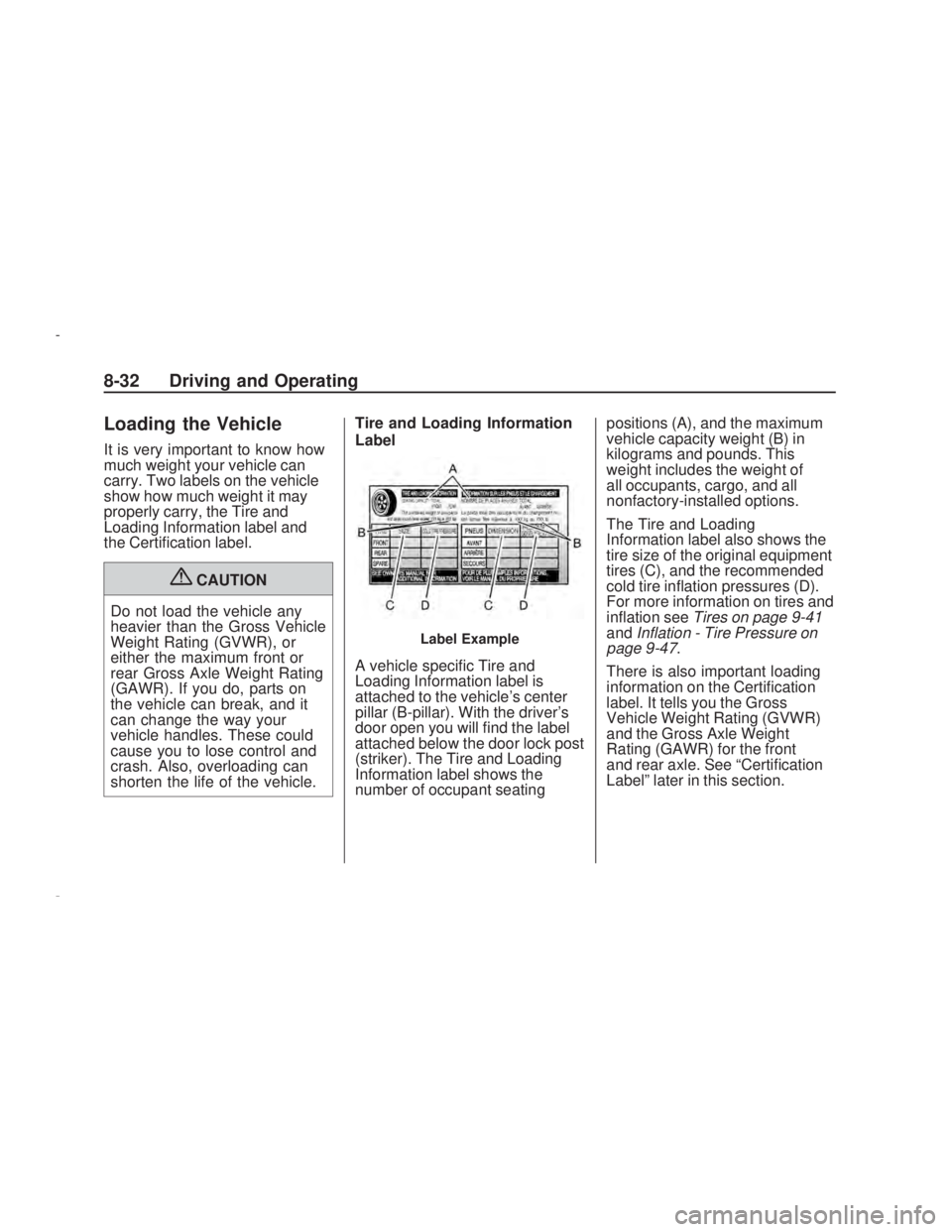
Label
A vehicle specic Tire and
Loading Information label is
attached to the vehicle’s center
pillar (B-pillar). With the driver’s
door open you will nd the label
attached below the door lock post
(striker). The Tire and Loading
Information label shows the
number of occupant seatingpositions (A), and the maximum
vehicle capacity weight (B) in
kilograms and pounds. This
weight includes the weight of
all occupants, cargo, and all
nonfactory-installed options.
The Tire and Loading
Information label also shows the
tire size of the original equipment
tires (C), and the recommended
cold tire ination pressures (D).
For more information on tires and
ination seeTires on page 9-41
andInflation - Tire Pressure on
page 9-47.
There is also important loading
information on the Certication
label. It tells you the Gross
Vehicle Weight Rating (GVWR)
and the Gross Axle Weight
Rating (GAWR) for the front
and rear axle. See “Certication
Label” later in this section.
Label Example
8-32 Driving and Operating
2009 - Pontiac Vibe Owner Manual
Page 170 of 318
Filling the Tank
{CAUTION
Fuel vapor burns violently and a
fuel re can cause bad injuries.
To help avoid injuries to you and
others, read and follow all the
instructions on the pump island.
Turn off the engine when you are
refueling. Do not smoke if you are
near fuel or refueling the vehicle.
Do not use cellular phones. Keep
sparks, ames, and smoking
materials away from fuel. Do not
leave the fuel pump unattended
when refueling the vehicle. This is
against the law in some places.
Do not re-enter the vehicle while
pumping fuel. Keep children away
from the fuel pump; never let
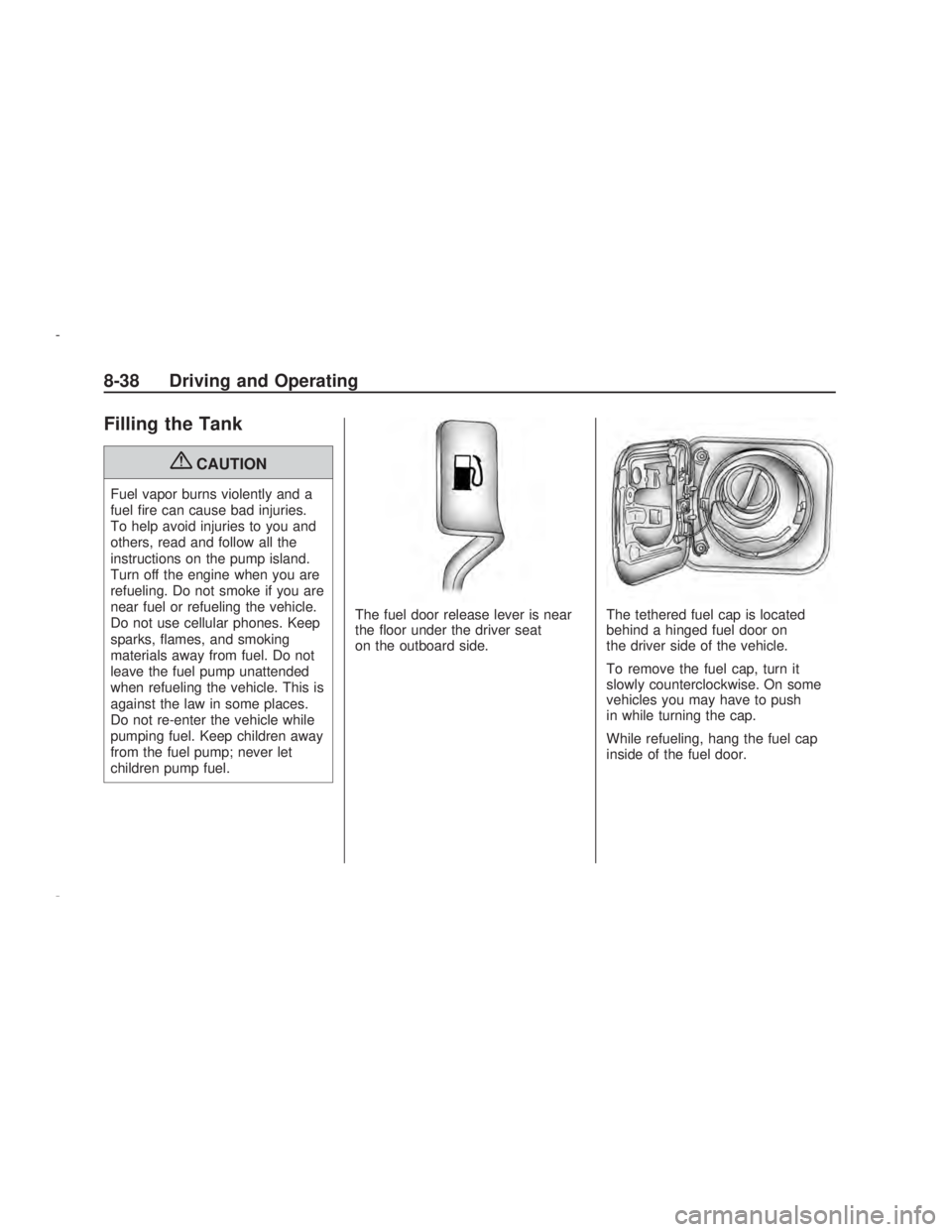
children pump fuel.The fuel door release lever is near
the oor under the driver seat
on the outboard side.The tethered fuel cap is located
behind a hinged fuel door on
the driver side of the vehicle.
To remove the fuel cap, turn it
slowly counterclockwise. On some
vehicles you may have to push
in while turning the cap.
While refueling, hang the fuel cap
inside of the fuel door.
8-38 Driving and Operating
2009 - Pontiac Vibe Owner Manual
Page 171 of 318

{CAUTION
Fuel can spray out on you if you
open the fuel cap too quickly.
If you spill fuel and then something
ignites it, you could be badly
burned. This spray can happen if
the tank is nearly full, and is more
likely in hot weather. Open the fuel
cap slowly and wait for any hiss
noise to stop. Then unscrew the
cap all the way.
Do not to spill fuel. Do not top off
or overll the tank and wait a few
seconds to remove the nozzle. Clean
fuel from painted surfaces as soon
as possible. SeeExterior Cleaning
on page 9-86.When replacing the fuel cap, turn
it clockwise until it clicks. Make
sure the cap is fully installed.
The diagnostic system can
determine if the fuel cap has been
left off or improperly installed.
This would allow fuel to evaporate
into the atmosphere. See
Malfunction Indicator Lamp
on page 4-20.
{CAUTION
If a re starts while you are
refueling, do not remove the
nozzle. Shut off the ow of fuel
by shutting off the pump or by
notifying the station attendant.
Leave the area immediately.Notice:If you need a new fuel
cap, be sure to get the right type.
Your dealer/retailer can get one for
you. If you get the wrong type, it
may not t properly. This may
cause the malfunction indicator
lamp to light and may damage the
fuel tank and emissions system.
SeeMalfunction Indicator Lamp
on page 4-20.
Driving and Operating 8-39
2009 - Pontiac Vibe Owner Manual
Page 173 of 318
Vehicle Service
and Care
Service
Service...............................9-2
Accessories and
Modications.....................9-3
California Proposition
65 Warning.......................9-3
California Perchlorate
Materials Requirements.....9-3
Doing Your Own
Service Work....................9-4
Adding Equipment to the
Outside of the Vehicle......9-4
Owner Checks
Owner Checks....................9-5
Hood Release.....................9-5
Engine Compartment
Overview...........................9-6
Engine Oil..........................9-9
Engine Air Cleaner/Filter. . . .9-12
Automatic Transmission
Fluid................................9-14
Manual Transmission
Fluid................................9-16
Hydraulic Clutch................9-17
Cooling System.................9-18
Engine Coolant.................9-18
Pressure Cap....................9-22
Engine Overheating...........9-22
Power Steering Fluid.........9-24
Windshield Washer Fluid. . .9-24
Windshield Wiper Blade
Replacement...................9-25
Brakes..............................9-27
Battery..............................9-30
Headlamp Aiming
Headlamp Aiming..............9-30
Bulb Replacement
Bulb Replacement.............9-31
Halogen Bulbs..................9-31
Headlamps and Parking
Lamps.............................9-31
Taillamps..........................9-33
License Plate Lamp..........9-34
Replacement Bulbs...........9-35
Electrical System
Add-On Electrical
Equipment.......................9-35
Headlamp Wiring..............9-35
Windshield Wiper Fuses. . . .9-36
Power Windows and
Other Power Options.......9-36
Fuses and Circuit
Breakers.........................9-36
Instrument Panel Fuse
Block...............................9-36
Engine Compartment
Fuse Block......................9-39
Tires
Tires.................................9-41
Tire Sidewall Labeling.......9-42
Tire Terminology and
Denitions.......................9-44
Ination - Tire Pressure. . . .9-47
Tire Pressure Monitor
System............................9-48
Tire Pressure Monitor
Operation........................9-50
Tire Inspection and
Rotation..........................9-53
When It Is Time for New
Tires...............................9-54
Vehicle Service and Care 9-1
2009 - Pontiac Vibe Owner Manual
Page 175 of 318
Accessories and
Modications
When non-dealer/non-retailer
accessories are added to the vehicle,
they can affect vehicle performance
and safety, including such things
as airbags, braking, stability, ride
and handling, emissions systems,
aerodynamics, durability, and
electronic systems like antilock
brakes, traction control, and stability
control. Some of these accessories
could even cause malfunction or
damage not covered by the vehicle
warranty.
GM Accessories are designed
to complement and function with
other systems on the vehicle.
Your GM dealer/retailer can
accessorize the vehicle using
genuine GM Accessories. Whenyou go to your GM dealer/retailer
and ask for GM Accessories, you will
know that GM-trained and supported
service technicians will perform the
work using genuine GM Accessories.
Also, seeAdding Equipment to
Your Airbag-Equipped Vehicle on
page 1-34.
California Proposition 65
Warning
Most motor vehicles, including this
one, contain and/or emit chemicals
known to the State of California to
cause cancer and birth defects or
other reproductive harm. Engine
exhaust, many parts and systems
(including some inside the vehicle),
many uids, and some component
wear by-products contain and/or
emit these chemicals.
California Perchlorate
Materials Requirements
Certain types of automotive
applications, such as airbag
initiators, seat belt pretensioners,
and lithium batteries contained in
remote keyless transmitters, may
contain perchlorate materials.
Special handling may be necessary.
For additional information, see
www.dtsc.ca.gov/hazardouswaste/
perchlorate.
Vehicle Service and Care 9-3
2009 - Pontiac Vibe Owner Manual
Page 179 of 318
A. Engine Oil Dipstick. See
″Checking Engine Oil″under
Engine Oil on page 9-9.
B.Pressure Cap on page 9-22.
C.Windshield Washer Fluid
on page 9-24.
D. Coolant Recovery Tank.
SeeEngine Coolant on
page 9-18.
E. Engine Oil Fill Cap. See “When
to Add Engine Oil” underEngine
Oil on page 9-9.
F.Engine Air Cleaner/Filter on
page 9-12.G.Brakes on page 9-27and
Hydraulic Clutch on page 9-17
(If Equipped).
H.Engine Compartment Fuse Block
on page 9-39.
I.Battery on page 9-30.
J. Remote Positive (+) Terminal.
SeeJump Starting on page 9-71.
K. Automatic Transmission
Fluid Dipstick. See″Checking
the Fluid Level″underAutomatic
Transmission Fluid on page 9-14
(If Equipped) (Out of View).
Vehicle Service and Care 9-7
2009 - Pontiac Vibe Owner Manual
Page 181 of 318
A. Engine Oil Dipstick. See
“Checking Engine Oil” under
Engine Oil on page 9-9.
B.Pressure Cap on page 9-22.
C.Windshield Washer Fluid
on page 9-24.
D. Coolant Recovery Tank. See
Engine Coolant on page 9-18.
E. Engine Oil Fill Cap. See “When
to Add Engine Oil” underEngine
Oil on page 9-9.
F.Brakes on page 9-27and
Hydraulic Clutch on page 9-17
(If Equipped).
G.Engine Air Cleaner/Filter on
page 9-12.
H.Engine Compartment Fuse Block
on page 9-39.I.Battery on page 9-30.
J. Remote Positive (+) Terminal.
SeeJump Starting on page 9-71.
K. Automatic Transmission
Fluid Dipstick. See″Checking
the Fluid Level″underAutomatic
Transmission Fluid on page 9-14
(If Equipped) (Out of View).
Engine Oil
Checking Engine Oil
It is a good idea to check the
engine oil every time you get fuel.
In order to get an accurate reading,
the oil must be warm and the
vehicle must be on level ground.The engine oil dipstick handle
is a yellow loop. SeeEngine
Compartment Overview on page 9-6
for the location of the engine oil
dipstick.
1. Turn off the engine and give the
oil several minutes to drain back
into the oil pan. If you do not
do this, the oil dipstick might
not show the actual level.
2. Pull out the dipstick and clean
it with a paper towel or cloth,
then push it back in all the way.
Remove it again, keeping the tip
down, and check the level.
Vehicle Service and Care 9-9
2009 - Pontiac Vibe Owner Manual
Page 187 of 318
Then, without shutting off the
engine, follow these steps:
The automatic transmission
dipstick has an orange handle
and is located near the front of the
engine compartment. SeeEngine
Compartment Overview on page 9-6
for more information on location.
1. Release the tab and pull out the
dipstick and wipe it with a clean
rag or paper towel.
2. Push it back in all the way, wait
three seconds and then pull it
back out again.
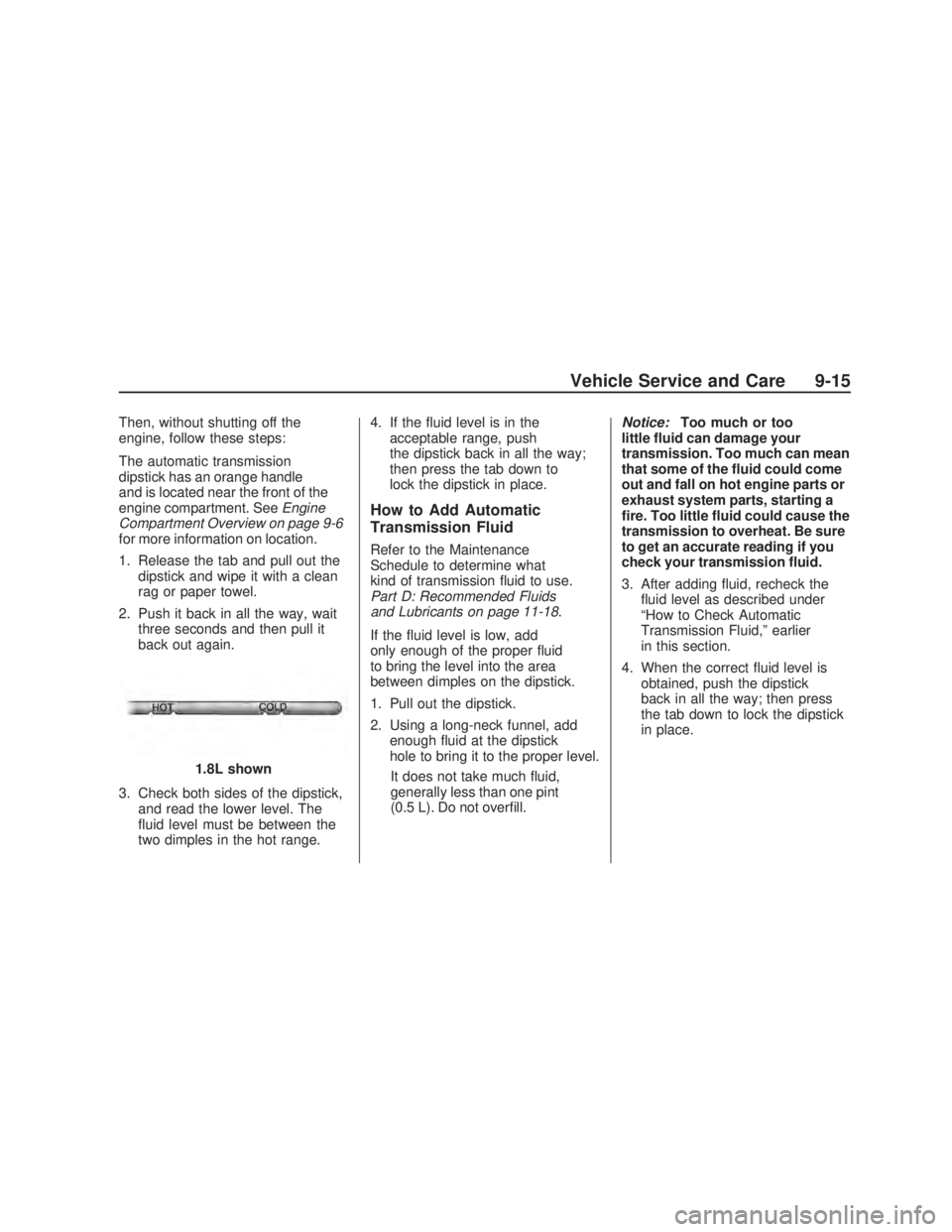
3. Check both sides of the dipstick,
and read the lower level. The
uid level must be between the
two dimples in the hot range.4. If the uid level is in the
acceptable range, push
the dipstick back in all the way;
then press the tab down to
lock the dipstick in place.
How to Add Automatic
Transmission Fluid
Refer to the Maintenance
Schedule to determine what
kind of transmission uid to use.
Part D: Recommended Fluids
and Lubricants on page 11-18.
If the uid level is low, add
only enough of the proper uid
to bring the level into the area
between dimples on the dipstick.
1. Pull out the dipstick.
2. Using a long-neck funnel, add
enough uid at the dipstick
hole to bring it to the proper level.
It does not take much uid,
generally less than one pint
(0.5 L). Do not overll.Notice:Too much or too
little uid can damage your
transmission. Too much can mean
that some of the uid could come
out and fall on hot engine parts or
exhaust system parts, starting a
re. Too little uid could cause the
transmission to overheat. Be sure
to get an accurate reading if you
check your transmission uid.
3. After adding uid, recheck the
uid level as described under
“How to Check Automatic
Transmission Fluid,” earlier
in this section.
4. When the correct uid level is
obtained, push the dipstick
back in all the way; then press
the tab down to lock the dipstick
in place.
1.8L shown
Vehicle Service and Care 9-15
2009 - Pontiac Vibe Owner Manual
Page 193 of 318
{CAUTION
Steam and scalding liquids from a
hot cooling system can blow out
and burn you badly. They are
under pressure, and if you turn the
radiator pressure cap — even a
little — they can come out at high
speed. Never turn the cap when
the cooling system, including the
radiator pressure cap, is hot. Wait
for the cooling system and radiator
pressure cap to cool if you ever
have to turn the pressure cap.
{CAUTION
Turning the radiator pressure cap
when the engine and radiator are
hot can allow steam and scalding
liquids to blow out and burn you
badly. With the coolant recovery
tank, you will almost never have
to add coolant at the radiator.
Never turn the radiator pressure
cap — even a little — when the
engine and radiator are hot.
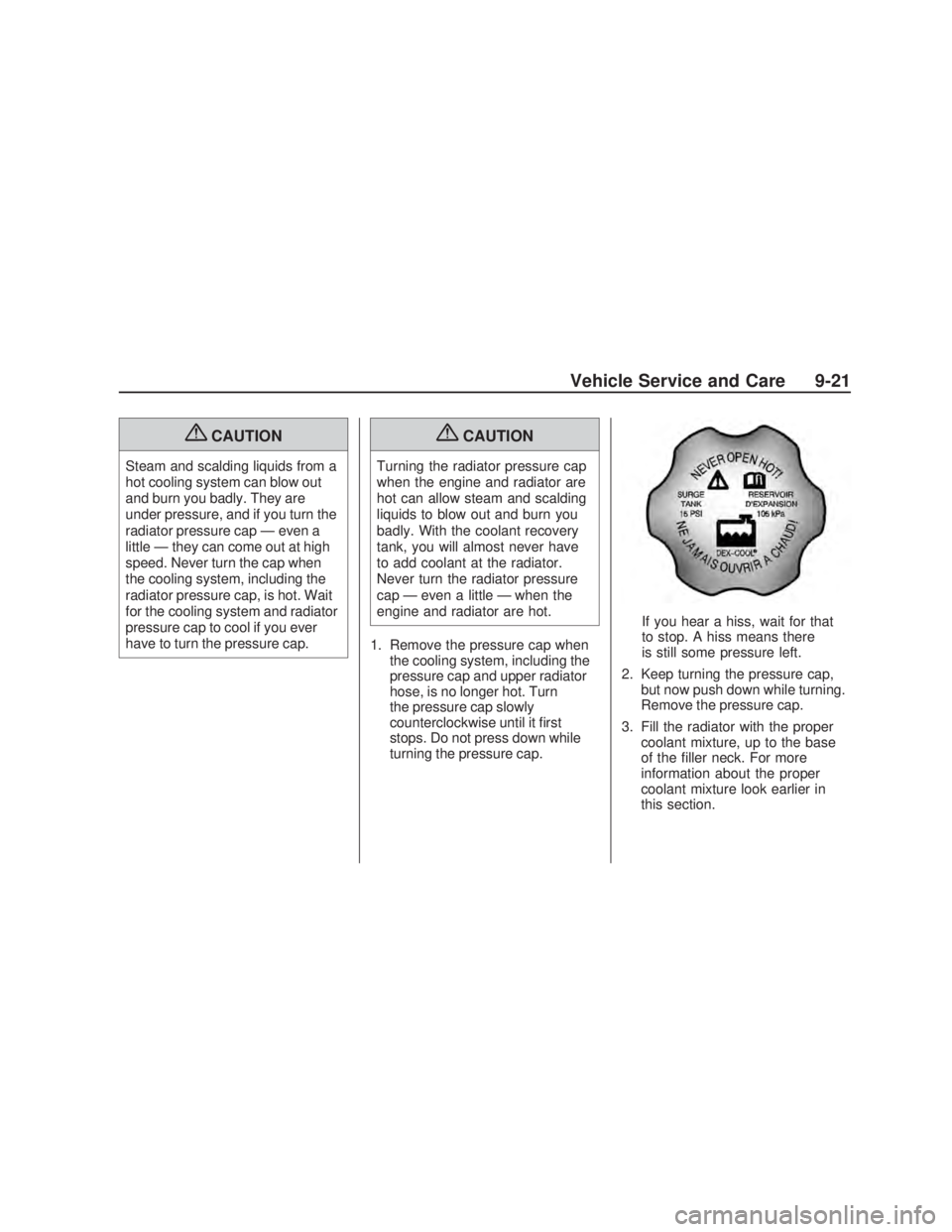
1. Remove the pressure cap when
the cooling system, including the
pressure cap and upper radiator
hose, is no longer hot. Turn
the pressure cap slowly
counterclockwise until it rst
stops. Do not press down while
turning the pressure cap.If you hear a hiss, wait for that
to stop. A hiss means there
is still some pressure left.
2. Keep turning the pressure cap,
but now push down while turning.
Remove the pressure cap.
3. Fill the radiator with the proper
coolant mixture, up to the base
of the ller neck. For more
information about the proper
coolant mixture look earlier in
this section.
Vehicle Service and Care 9-21
2009 - Pontiac Vibe Owner Manual