fuel PONTIAC VIBE 2010 User Guide
[x] Cancel search | Manufacturer: PONTIAC, Model Year: 2010, Model line: VIBE, Model: PONTIAC VIBE 2010Pages: 318, PDF Size: 1.7 MB
Page 135 of 318
Driving and
Operating
Driving InformationDriving for Better FuelEconomy ...........................
.8-2
Defensive Driving .................
.8-2
Drunk Driving ......................
.8-3
Control of a Vehicle ..............
.8-3
Braking ...............................
.8-4
Steering ..............................
.8-4
Off-Road Recovery ...............
.8-6
Loss of Control ....................
.8-6
Driving on Wet Roads ............8-7
Highway Hypnosis ................
.8-8
Hill and Mountain Roads ........8-8
Winter Driving ......................
.8-9
If the Vehicle is Stuck ..........8-11
Vehicle Load Limits .............
.8-12
Starting and OperatingNew Vehicle Break-In ...........8-16
Ignition Positions ................
.8-16
Retained Accessory Power (RAP) ....................
.8-18Starting the Engine
.............
.8-18
Engine Heater ....................
.8-19
Shifting Into Park ................
.8-20
Shifting Out of Park .............8-22
Parking .............................
.8-22
Parking Over Things That Burn ........................
.8-23
Engine ExhaustEngine Exhaust..................
.8-23
Running the Vehicle While Parked ............................
.8-24
Automatic TransmissionAutomatic Transmission
(Four Speed Automatic) ......8-24
Automatic Transmission (Five Speed Automatic) .......8-27
Manual Mode .....................
.8-28
Manual TransmissionManual Transmission ...........8-29
Drive SystemsAll-Wheel Drive..................
.8-31
BrakesAntilock Brake
System (ABS) ..................
.8-32
Parking Brake ....................
.8-33
Ride Control SystemsTraction Control
System (TCS) ..................
.8-33
StabiliTrak System ..............
.8-35
Cruise ControlCruise Control ....................
.8-36
FuelFuel..................................
.8-38
Recommended Fuel .............8-39
Gasoline Specifications .........8-39
California Fuel Requirements ...................
.8-39
Fuels in Foreign Countries . . . .8-40
Fuel Additives ....................
.8-40
Filling the Tank ..................
.8-41
Filling a Portable Fuel Container .........................
.8-43
TowingGeneral Towing Information . . .8-43
Driving Characteristics and Towing Tips .....................
.8-44
Trailer Towing ....................
.8-48
Towing Equipment ..............
.8-49
Conversions and Add-OnsAdd-On Electrical
Equipment .......................
.8-50
Driving and Operating 8-1
Page 136 of 318
Driving Information
Driving for Better
Fuel Economy
Driving habits can affect fuel
mileage. Here are some driving
tips to get the best fuel economy
possible.
•Avoid fast starts and accelerate
smoothly.
•Brake gradually and avoid abrupt
stops.
•Avoid idling the engine for long
periods of time.
•When road and weather
conditions are appropriate, use
cruise control, if equipped.
•Always follow posted speed limits
or drive more slowly when
conditions require.
•Keep vehicle tires properly
inflated.
•Combine several trips into a
single trip.
•Replace the vehicle’s tires with
the same TPC Spec number
molded into the tire’s sidewall
near the size.
•Follow recommended scheduled
maintenance.
Defensive Driving
Defensive driving means “always
expect the unexpected.” The first
step in driving defensively is to wear
your safety belt, seeSafety Belts on
page 2-8.
{CAUTION
Assume that other road users
(pedestrians, bicyclists, and other
drivers) are going to be careless
and make mistakes. Anticipate
what they might do and be ready.
In addition:
•Allow enough following
distance between you and
the driver in front of you.
•Focus on the task of driving.
Driver distraction can cause
collisions resulting in injury or
possible death. These simple
defensive driving techniques
could save your life.
8-2 Driving and Operating
Page 145 of 318
To save fuel, run the engine for only
short periods as needed to warm the
vehicle and then shut the engine off
and close the window most of the
way to save heat. Repeat this until
help arrives but only when you feel
really uncomfortable from the cold.
Moving about to keep warm also
helps.
If it takes some time for help to
arrive, now and then when you run
the engine, push the accelerator
pedal slightly so the engine runs
faster than the idle speed. This
keeps the battery charged to restart
the vehicle and to signal for help with
the headlamps. Do this as little as
possible to save fuel.If the Vehicle is Stuck
Slowly and cautiously spin the
wheels to free the vehicle when
stuck in sand, mud, ice, or snow.
{CAUTION
If you let your vehicle’s tires spin at
high speed, they can explode, and
you or others could be injured. The
vehicle can overheat, causing an
engine compartment fire or other
damage. Spin the wheels as little
as possible and avoid going above
55 km/h (35 mph) as shown on the
speedometer.
For information about using tire
chains on the vehicle, see Tire
Chains on page 9-61 .
Rocking the Vehicle to Get
it Out
Turn the steering wheel left and
right to clear the area around the
front wheels. Turn off any traction
system. Shift back and forth between
R (Reverse) and a forward gear,
or with a manual transmission,
between 1 (First) or 2 (Second) and
R (Reverse), spinning the wheels
as little as possible. To prevent
transmission wear, wait until the
wheels stop spinning before shifting
gears. Release the accelerator pedal
while shifting, and press lightly on
the accelerator pedal when the
transmission is in gear. Slowly
spinning the wheels in the forward
and reverse directions causes a
rocking motion that could free the
vehicle. If that does not get the
vehicle out after a few tries, it might
need to be towed out. If the vehicle
does need to be towed out, see
Towing the Vehicle on page 9-73 .
Driving and Operating 8-11
Page 148 of 318
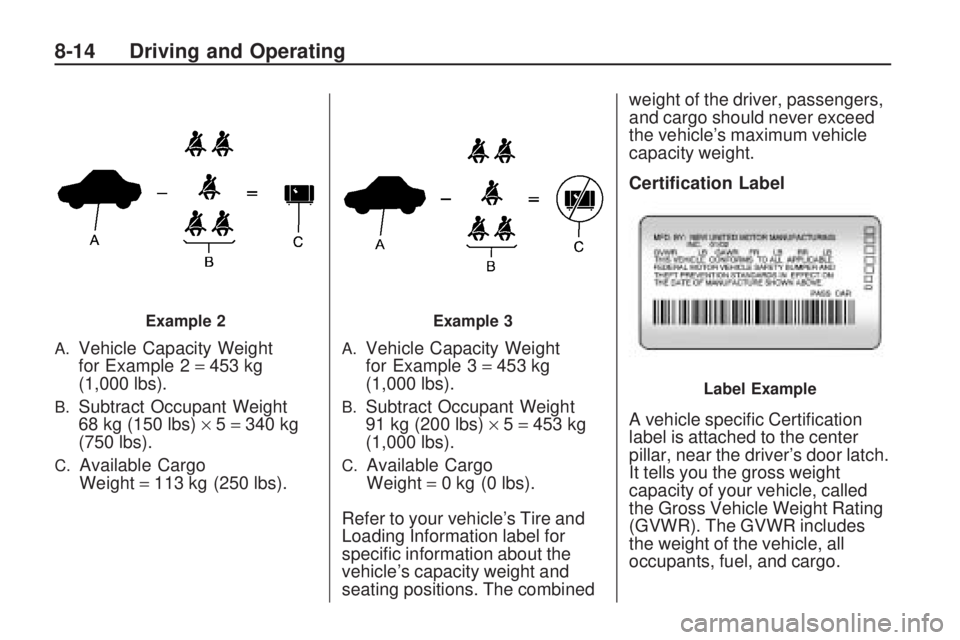
A.Vehicle Capacity Weight
for Example 2 =453 kg
(1,000 lbs).
B.Subtract Occupant Weight
68 kg (150 lbs) ×5 =340 kg
(750 lbs).
C.Available Cargo
Weight =113 kg (250 lbs).
A.Vehicle Capacity Weight
for Example 3 =453 kg
(1,000 lbs).
B.Subtract Occupant Weight
91 kg (200 lbs) ×5 =453 kg
(1,000 lbs).
C.Available Cargo
Weight =0 kg (0 lbs).
Refer to your vehicle’s Tire and
Loading Information label for
specific information about the
vehicle’s capacity weight and
seating positions. The combined weight of the driver, passengers,
and cargo should never exceed
the vehicle’s maximum vehicle
capacity weight.
Certication Label
A vehicle specific Certification
label is attached to the center
pillar, near the driver’s door latch.
It tells you the gross weight
capacity of your vehicle, called
the Gross Vehicle Weight Rating
(GVWR). The GVWR includes
the weight of the vehicle, all
occupants, fuel, and cargo.
Example 2Example 3
Label Example
8-14 Driving and Operating
Page 153 of 318
Notice:Holding the key in START
for longer than 15 seconds at a
time will cause the battery to be
drained much sooner. And the
excessive heat can damage the
starter motor. Wait about
15 seconds between each try to
help avoid draining the battery or
damaging the starter.
2. If the engine does not start, wait about 15 seconds and try again
to start the engine by turning
the ignition to START. Wait about
15 seconds between each try.
When the engine has run about
10 seconds to warm up, the
vehicle is ready to be driven.
Do not run the engine at high
speed when it is cold.
If the weather is below freezing
(32°F or 0°C), let the engine run
for a few minutes to warm up. 3. If the engine still will not start, or
starts but then stops, it could be
flooded with too much gasoline.
Try pushing the accelerator pedal
all the way to the floor and holding
it there as you hold the key in
START for about three seconds.
If the vehicle starts briefly but then
stops again, do the same thing,
but this time keep the pedal down
for five or six seconds. This clears
the extra gasoline from the
engine. Notice:
The engine is designed
to work with the electronics in
the vehicle. If electrical parts or
accessories are added, you
could change the way the engine
operates. Before adding electrical
equipment, check with your
dealer/retailer. If you do not,
the engine might not perform
properly. Any resulting damage
would not be covered by the
vehicle warranty.
Engine Heater
The engine coolant heater, if
available, can help in cold weather
conditions at or below 0°F ( −18°C)
for easier starting and better fuel
economy during engine warm-up.
Plug in the coolant heater at least
four hours before starting the vehicle.
Driving and Operating 8-19
Page 157 of 318
Evaporation Pump
The vehicle is equipped with
a vacuum pump for the fuel
evaporation system. This pump
performs a fuel evaporation leakage
test approximately five hours
after the engine is turned off.
You may hear a sound coming
from underneath the rear cargo
compartment for several minutes.
The noise is normal and does not
signify a malfunction. See your
dealer/retailer with any questions.
Parking Over Things
That Burn
{CAUTION
Things that can burn could touch
hot exhaust parts under the
vehicle and ignite. Do not park
over papers, leaves, dry grass,
or other things that can burn.
Engine Exhaust
{CAUTION
Engine exhaust contains Carbon
Monoxide (CO) which cannot be
seen or smelled. Exposure to CO
can cause unconsciousness and
even death.
Exhaust may enter the vehicle if:
•The vehicle idles in areas
with poor ventilation (parking
garages, tunnels, deep snow
that may block underbody
airflow or tail pipes).
•The exhaust smells or
sounds strange or different.
•The exhaust system leaks
due to corrosion or damage.(Continued)
CAUTION (Continued)
•The vehicle’s exhaust system
has been modified, damaged
or improperly repaired.
•There are holes or openings
in the vehicle body from
damage or after-market
modifications that are not
completely sealed.
If unusual fumes are detected or if
it is suspected that exhaust is
coming into the vehicle:
•Drive it only with the windows
completely down.
•Have the vehicle repaired
immediately.
Never park the vehicle with the
engine running in an enclosed
area such as a garage or a
building that has no fresh air
ventilation.
Driving and Operating 8-23
Page 160 of 318
N (Neutral):In this position, the
engine does not connect with the
wheels. To restart the vehicle when it
is already moving, use N (Neutral)
only. Also, use N (Neutral) when the
vehicle is being towed.
{CAUTION
Shifting into a drive gear while the
engine is running at high speed is
dangerous. Unless your foot is
firmly on the brake pedal, the
vehicle could move very rapidly.
You could lose control and hit
people or objects. Do not shift into
a drive gear while the engine is
running at high speed. Notice:
Shifting out of P (Park)
or N (Neutral) with the engine
running at high speed may
damage the transmission. The
repairs would not be covered by
the vehicle warranty. Be sure the
engine is not running at high
speed when shifting the vehicle.
D (Drive): This position is for
normal driving. It provides the best
fuel economy. If you need more
power for passing, and you are:
•Going less than 35 mph
(56 km/h), push the accelerator
pedal about halfway down.
•Going about 35 mph (56 km/h) or
more, push the accelerator all
the way down.
Notice: If the vehicle seems to
start up rather slowly or not shift
gears when you go faster, and
you continue to drive the vehicle that way, you could damage the
transmission. Have the vehicle
serviced right away. You can drive
in L2 (Low) when you are driving
less than 35 mph (56 km/h) and
D (Drive) for higher speeds
until then.
2 (Second):
This position reduces
vehicle speed more than D (Drive)
without using the brakes. You can
use 2 (Second) on hills. It can help
control vehicle speed as you go
down steep mountain roads, but then
you would also want to use the
brakes off and on.
L (Low): This position reduces
vehicle speed even more than
2 (Second) without using the brakes.
You can use it on very steep hills, or
in deep snow or mud. If the shift lever
is put in L (Low), the transmission will
not shift into low gear until the vehicle
is going slow enough.
8-26 Driving and Operating
Page 162 of 318
N (Neutral):In this position,
the engine does not connect with
the wheels. To restart the engine
when the vehicle is already moving,
use N (Neutral) only. Also, use
N (Neutral) when the vehicle is
being towed.
{CAUTION
Shifting into a drive gear while the
engine is running at high speed is
dangerous. Unless your foot is
firmly on the brake pedal, the
vehicle could move very rapidly.
You could lose control and hit
people or objects. Do not shift into
a drive gear while the engine is
running at high speed. Notice:
Shifting out of P (Park)
or N (Neutral) with the engine
running at high speed may
damage the transmission.
The repairs would not be covered
by the vehicle warranty. Be sure
the engine is not running at high
speed when shifting the vehicle.
D (Drive): This position is for normal
driving. It provides the best fuel
economy from the vehicle. If you
need more power for passing, and
you are:
•Going less than 35 mph
(55 km/h), push the accelerator
pedal about halfway down.
•Going about 35 mph (55 km/h) or
more, push the accelerator all the
way down.
Manual Mode
Driver Shift Control (DSC)
DSC mode allows you to choose
the top gear limit of the vehicle’s
transmission and the vehicle’s speed
while driving down hill or towing a
trailer. To use this feature, do the
following:
1. Move the shift lever from D (Drive) left to S (Shift Control).
While driving in this mode, the
transmission will remain in the
driver selected range. When
coming to a stop, the vehicle
will automatically shift into
1 (First) gear.
2. Move the shift lever forward to increase the gear range, or
rearward to decrease the gear
range available based upon your
current driving conditions and
needs.
8-28 Driving and Operating
Page 172 of 318
Using Cruise Control on Hills
The cruise control performance will
vary depending upon the vehicle
speed, load, and the steepness of
the hills.
When going up steep hills, you might
have to step on the accelerator pedal
to maintain the vehicle speed.
When going downhill, you might
have to brake or shift to a lower gear
to keep the vehicle speed down.
Applying the brake or downshifting
to 2 SECOND or L LOW turns
off the cruise control.Ending Cruise Control
There are several ways to turn off
the cruise control:
•Step on the brake pedal or push
the clutch pedal, if the vehicle
has a manual transmission.
•Press the ON-OFF button.
•Pull the cruise control lever
toward you.
Erasing Speed Memory
The cruise control set speed memory
is erased when the cruise control or
the ignition is turned off.
Fuel
Use of the recommended fuel
is an important part of the proper
maintenance of this vehicle. To help
keep the engine clean and maintain
optimum vehicle performance, we
recommend the use of gasoline
advertised as TOP TIER Detergent
Gasoline.
Look for the TOP TIER label on the
fuel pump to ensure gasoline meets
enhanced detergency standards
developed by auto companies. A list
of marketers providing TOP TIER
Detergent Gasoline can be found at
www.toptiergas.com.
8-38 Driving and Operating
Page 173 of 318
Recommended Fuel
Use regular unleaded gasoline with a
posted octane rating of 87 or higher.
If the octane rating is less than 87,
you might notice an audible knocking
noise when you drive, commonly
referred to as spark knock. If this
occurs, use a gasoline rated at
87 octane or higher as soon as
possible. If you are using gasoline
rated at 87 octane or higher and you
hear heavy knocking, the engine
needs service.
Gasoline Specications
At a minimum, gasoline should
meet ASTM specification D 4814
in the United States or CAN/
CGSB-3.5 or 3.511 in Canada.
Some gasolines contain an
octane-enhancing additive called
methylcyclopentadienyl manganese
tricarbonyl (MMT). We recommend
against the use of gasolines
containing MMT. SeeFuel Additives
on page 8-40 for additional
information.
California Fuel
Requirements
If the vehicle is certified to meet
California Emissions Standards, it is
designed to operate on fuels that
meet California specifications.
See the underhood emission control
label. If this fuel is not available in
states adopting California emissions
standards, the vehicle will operate
satisfactorily on fuels meeting federal
specifications, but emission control
system performance might be
affected. The malfunction indicator
lamp could turn on and the vehicle
might fail a smog-check test.
See Malfunction Indicator Lamp on
page 4-14. If this occurs, return to
your authorized dealer/retailer for
diagnosis. If it is determined that the
condition is caused by the type of
fuel used, repairs might not be
covered by the vehicle warranty.
Driving and Operating 8-39