maintenance PONTIAC VIBE 2010 User Guide
[x] Cancel search | Manufacturer: PONTIAC, Model Year: 2010, Model line: VIBE, Model: PONTIAC VIBE 2010Pages: 318, PDF Size: 1.7 MB
Page 139 of 318
If you turn the steering wheel in
either direction several times until it
stops, or hold the steering wheel in
the stopped position for an extended
amount of time, you may notice a
reduced amount of power steering
assist. The normal amount of power
steering assist should return shortly
after a few normal steering
movements.
The electric power steering
system does not require regular
maintenance. If you suspect
steering system problems, such as
abnormally high steering effort for a
prolonged period of time, contact
your dealer/retailer for service
repairs.Steering Tips
It is important to take curves at a
reasonable speed.
Traction in a curve depends on the
condition of the tires and the road
surface, the angle at which the curve
is banked, and vehicle speed. While
in a curve, speed is the one factor
that can be controlled.
If there is a need to reduce speed,
do it before entering the curve,
while the front wheels are straight.
Try to adjust the speed so you can
drive through the curve. Maintain a
reasonable, steady speed. Wait to
accelerate until out of the curve, and
then accelerate gently into the
straightaway.
Steering in Emergencies
There are times when steering
can be more effective than braking.
For example, you come over a hill
and find a truck stopped in your lane,
or a car suddenly pulls out from
nowhere, or a child darts out from
between parked cars and stops right
in front of you. These problems can
be avoided by braking — if you can
stop in time. But sometimes you
cannot stop in time because there
is no room. That is the time for
evasive action — steering around
the problem.
The vehicle can perform very well
in emergencies like these. First
apply the brakes. SeeBraking on
page 8-4. It is better to remove as
much speed as possible from a
collision. Then steer around the
problem, to the left or right
depending on the space available.
Driving and Operating 8-5
Page 172 of 318
Using Cruise Control on Hills
The cruise control performance will
vary depending upon the vehicle
speed, load, and the steepness of
the hills.
When going up steep hills, you might
have to step on the accelerator pedal
to maintain the vehicle speed.
When going downhill, you might
have to brake or shift to a lower gear
to keep the vehicle speed down.
Applying the brake or downshifting
to 2 SECOND or L LOW turns
off the cruise control.Ending Cruise Control
There are several ways to turn off
the cruise control:
•Step on the brake pedal or push
the clutch pedal, if the vehicle
has a manual transmission.
•Press the ON-OFF button.
•Pull the cruise control lever
toward you.
Erasing Speed Memory
The cruise control set speed memory
is erased when the cruise control or
the ignition is turned off.
Fuel
Use of the recommended fuel
is an important part of the proper
maintenance of this vehicle. To help
keep the engine clean and maintain
optimum vehicle performance, we
recommend the use of gasoline
advertised as TOP TIER Detergent
Gasoline.
Look for the TOP TIER label on the
fuel pump to ensure gasoline meets
enhanced detergency standards
developed by auto companies. A list
of marketers providing TOP TIER
Detergent Gasoline can be found at
www.toptiergas.com.
8-38 Driving and Operating
Page 181 of 318
Parking on Hills
{CAUTION
Parking the vehicle on a hill with
the trailer attached can be
dangerous. If something goes
wrong, the rig could start to move.
People can be injured, and both
the vehicle and the trailer can be
damaged. When possible, always
park the rig on a flat surface.
If parking the rig on a hill:
1. Press the brake pedal, but do not shift into P (Park) yet for vehicles
with an automatic transmission,
or into gear for vehicles with a
manual transmission. Turn the
wheels into the curb if facing
downhill or into traffic if facing
uphill.
2. Have someone place chocks under the trailer wheels. 3. When the wheel chocks are in
place, release the brake pedal
until the chocks absorb the load.
4. Reapply the brake pedal. Then apply the parking brake and
shift into P (Park) for vehicles
with an automatic transmission
or into gear for vehicles with
a manual transmission.
5. Release the brake pedal.
Leaving After Parking on
a Hill
1. Apply and hold the brake pedal while you:
•start the engine,
•shift into a gear, and
•release the parking brake.
2. Let up on the brake pedal.
3. Drive slowly until the trailer is clear of the chocks.
4. Stop and have someone pick up and store the chocks.
Maintenance When Trailer
Towing
The vehicle needs service more
often when pulling a trailer. See this
manual’s Maintenance Schedule or
Index for more information. Things
that are especially important in trailer
operation are automatic transmission
fluid, engine oil, axle lubricant, belts,
cooling system and brake system.
It is a good idea to inspect these
before and during the trip.
Check periodically to see that all
hitch nuts and bolts are tight.
Engine Cooling When Trailer
Towing
The cooling system may temporarily
overheat during severe operating
conditions. See Engine Overheating
on page 9-23.
Driving and Operating 8-47
Page 188 of 318
When you go to your GM dealer/
retailer and ask for GM Accessories,
you will know that GM-trained and
supported service technicians will
perform the work using genuine GM
Accessories.
Also, seeAdding Equipment to
the Airbag-Equipped Vehicle
on page 2-35.Vehicle Checks
Doing Your Own
Service Work
{CAUTION
You can be injured and the
vehicle could be damaged if you
try to do service work on a vehicle
without knowing enough about it.
•Be sure you have sufficient
knowledge, experience, the
proper replacement parts, and
tools before attempting any
vehicle maintenance task.
(Continued)
CAUTION (Continued)
•Be sure to use the proper
nuts, bolts, and other
fasteners. English and
metric fasteners can be
easily confused. If the wrong
fasteners are used, parts
can later break or fall off.
You could be hurt.
If doing some of your own service
work, use the proper service
manual. It tells you much more
about how to service the vehicle
than this manual can. To order
the proper service manual,
see Service Publications Ordering
Information on page 12-12 .
9-4 Vehicle Care
Page 189 of 318
This vehicle has an airbag system.
Before attempting to do your
own service work, seeAirbag
System Check on page 2-36 .
Keep a record with all parts receipts
and list the mileage and the date
of any service work performed.
See Maintenance Records on
page 10-18.Hood
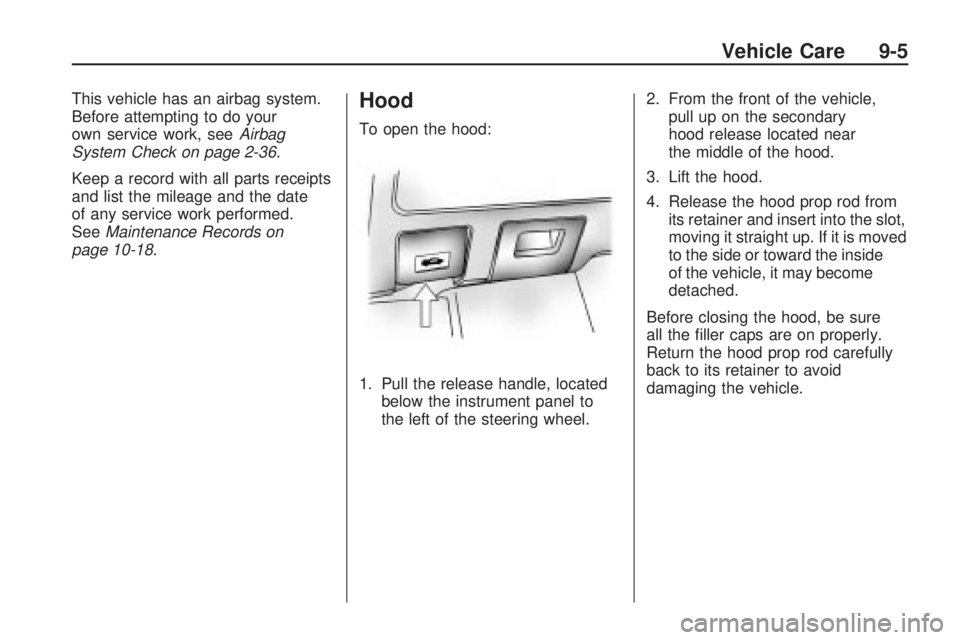
To open the hood:
1. Pull the release handle, located below the instrument panel to
the left of the steering wheel. 2. From the front of the vehicle,
pull up on the secondary
hood release located near
the middle of the hood.
3. Lift the hood.
4. Release the hood prop rod from its retainer and insert into the slot,
moving it straight up. If it is moved
to the side or toward the inside
of the vehicle, it may become
detached.
Before closing the hood, be sure
all the filler caps are on properly.
Return the hood prop rod carefully
back to its retainer to avoid
damaging the vehicle.
Vehicle Care 9-5
Page 195 of 318
•GM6094MUse only an oil that meets GM
Standard GM6094M.
•SAE 5W-30SAE 5W-30 is best for the
vehicle. These numbers on an
oil container show its viscosity,
or thickness. Do not use
other viscosity oils such
as SAE 20W-50.
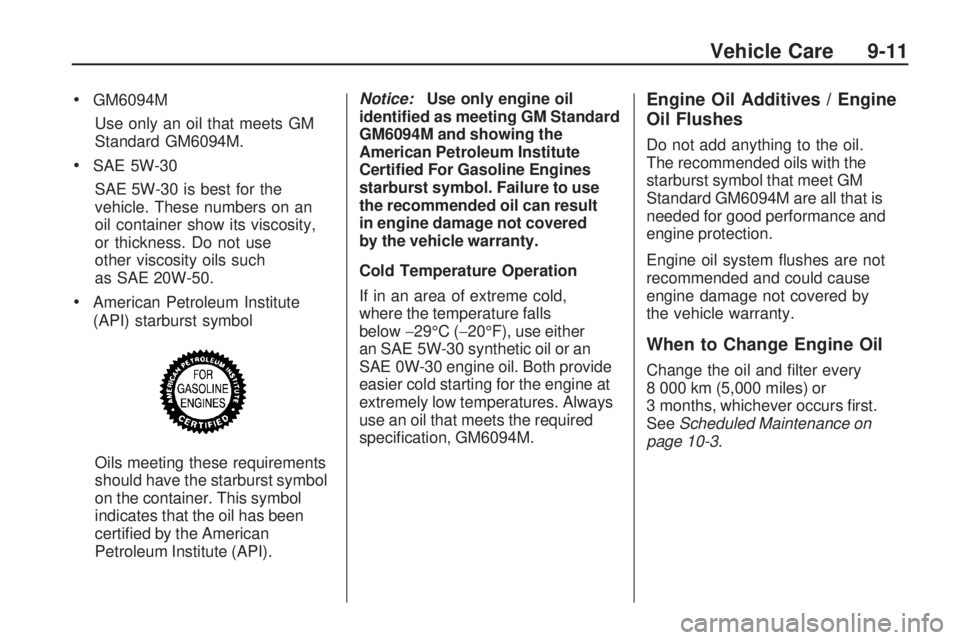
•American Petroleum Institute
(API) starburst symbol
Oils meeting these requirements
should have the starburst symbol
on the container. This symbol
indicates that the oil has been
certified by the American
Petroleum Institute (API). Notice:
Use only engine oil
identied as meeting GM Standard
GM6094M and showing the
American Petroleum Institute
Certied For Gasoline Engines
starburst symbol. Failure to use
the recommended oil can result
in engine damage not covered
by the vehicle warranty.
Cold Temperature Operation
If in an area of extreme cold,
where the temperature falls
below −29°C (−20°F), use either
an SAE 5W-30 synthetic oil or an
SAE 0W-30 engine oil. Both provide
easier cold starting for the engine at
extremely low temperatures. Always
use an oil that meets the required
specification, GM6094M.
Engine Oil Additives / Engine
Oil Flushes
Do not add anything to the oil.
The recommended oils with the
starburst symbol that meet GM
Standard GM6094M are all that is
needed for good performance and
engine protection.
Engine oil system flushes are not
recommended and could cause
engine damage not covered by
the vehicle warranty.
When to Change Engine Oil
Change the oil and filter every
8 000 km (5,000 miles) or
3 months, whichever occurs first.
See Scheduled Maintenance on
page 10-3.
Vehicle Care 9-11
Page 196 of 318
What to Do with Used Oil
Used engine oil contains certain
elements that can be unhealthy for
your skin and could even cause
cancer. Do not let used oil stay on
your skin for very long. Clean your
skin and nails with soap and water,
or a good hand cleaner. Wash or
properly dispose of clothing or rags
containing used engine oil. See the
manufacturer’s warnings about the
use and disposal of oil products.
Used oil can be a threat to the
environment. If you change your own
oil, be sure to drain all the oil from the
filter before disposal. Never dispose
of oil by putting it in the trash, pouring
it on the ground, into sewers, or into
streams or bodies of water. Recycle
it by taking it to a place that collects
used oil.
Automatic Transmission
Fluid
When to Check and Change
Automatic Transmission Fluid
Check the fluid in the transmission
and differential at the intervals listed
inScheduled Maintenance on
page 10-3, and be sure to use
the transmission fluid listed in
Recommended Fluids and
Lubricants on page 10-15 .
How to Check Automatic
Transmission Fluid
This operation can be difficult, you
may choose to have this done at the
dealer/retailer service department.
If you do it yourself, be sure to
follow all the instructions here,
or you could get a false reading
on the dipstick. Wait at least 30 minutes before
checking the transmission fluid level
if you have been driving:
•When outside temperatures are
above 90°F (32°C).
•At high speed for quite a while.
•In heavy traffic — especially
in hot weather.
•While pulling a trailer.
To get the right reading, the fluid
should be at normal operating
temperature, which is 158°F to
176°F (70°C to 80°C).
Get the vehicle warmed up by
driving about 15 miles (24 km)
when outside temperatures
are above 50°F (10°C). If it is
colder than 50°F (10°C), you
may have to drive longer.
9-12 Vehicle Care
Page 198 of 318
How to Add Automatic
Transmission Fluid
Refer to the Maintenance
Schedule to determine what
kind of transmission fluid to use.
Recommended Fluids and
Lubricants on page 10-15.
If the fluid level is low, add only
enough of the proper fluid to bring
the level into the area between
dimples on the dipstick.
1. Pull out the dipstick.
2. Using a long-neck funnel, add enough fluid at the dipstick
hole to bring it to the proper level.
It does not take much fluid,
generally less than one pint
(0.5 L). Do not overfill. Notice:
Too much or too
little uid can damage your
transmission. Too much can mean
that some of the uid could come
out and fall on hot engine parts or
exhaust system parts, starting a
re. Too little uid could cause the
transmission to overheat. Be sure
to get an accurate reading if you
check your transmission uid.
3. After adding fluid, recheck the fluid level as described under
“How to Check Automatic
Transmission Fluid,” earlier
in this section.
4. When the correct fluid level is obtained, push the dipstick
back in all the way; then press
the tab down to lock the dipstick
in place.
Manual Transmission
Fluid
When to Check
A good time to have your manual
transmission fluid level checked
is when the engine oil is changed.
However, the fluid in your manual
transmission does not require
changing.
How to Check
This operation can be difficult, you
may choose to have this done
at your dealer/retailer service
department.
If you do it yourself, be sure to
follow all the instructions here, or
you could get a false reading.
9-14 Vehicle Care
Page 199 of 318
Notice:Too much or too
little uid can damage your
transmission. Too much can mean
that some of the uid could come
out and fall on hot engine parts or
exhaust system parts, starting a
re. Too little uid could cause the
transmission to overheat. Be sure
to get an accurate reading if you
check your transmission uid.
Check the fluid level only when your
engine is off, the vehicle is parked on
a level place and the transmission
is cool enough for you to rest your
fingers on the transmission case.
Then, follow these steps:
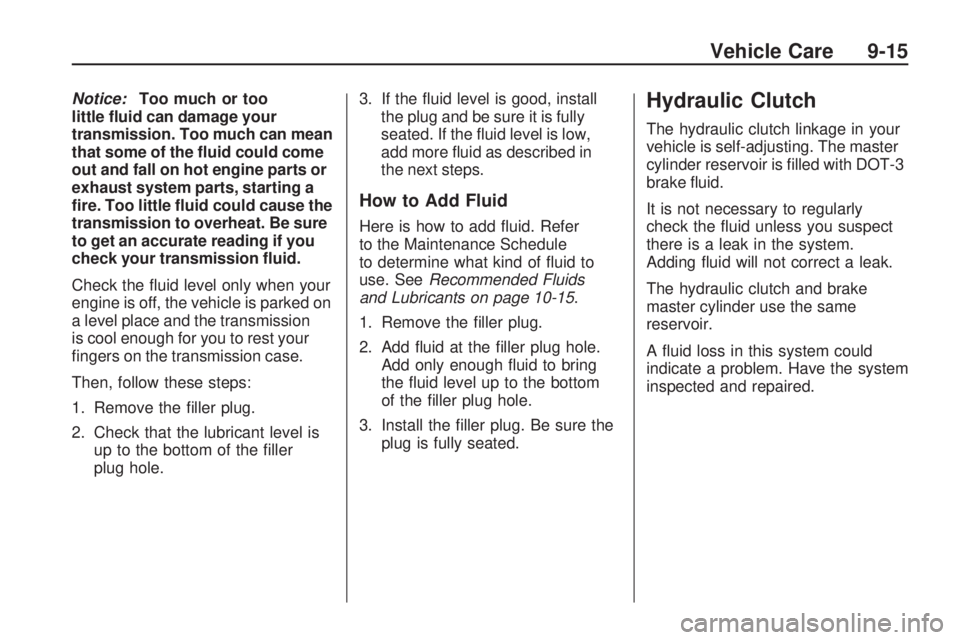
1. Remove the filler plug.
2. Check that the lubricant level is up to the bottom of the filler
plug hole. 3. If the fluid level is good, install
the plug and be sure it is fully
seated. If the fluid level is low,
add more fluid as described in
the next steps.
How to Add Fluid
Here is how to add fluid. Refer
to the Maintenance Schedule
to determine what kind of fluid to
use. See Recommended Fluids
and Lubricants on page 10-15 .
1. Remove the filler plug.
2. Add fluid at the filler plug hole. Add only enough fluid to bring
the fluid level up to the bottom
of the filler plug hole.
3. Install the filler plug. Be sure the plug is fully seated.
Hydraulic Clutch
The hydraulic clutch linkage in your
vehicle is self-adjusting. The master
cylinder reservoir is filled with DOT-3
brake fluid.
It is not necessary to regularly
check the fluid unless you suspect
there is a leak in the system.
Adding fluid will not correct a leak.
The hydraulic clutch and brake
master cylinder use the same
reservoir.
A fluid loss in this system could
indicate a problem. Have the system
inspected and repaired.
Vehicle Care 9-15
Page 200 of 318
When to Check and What
to Use
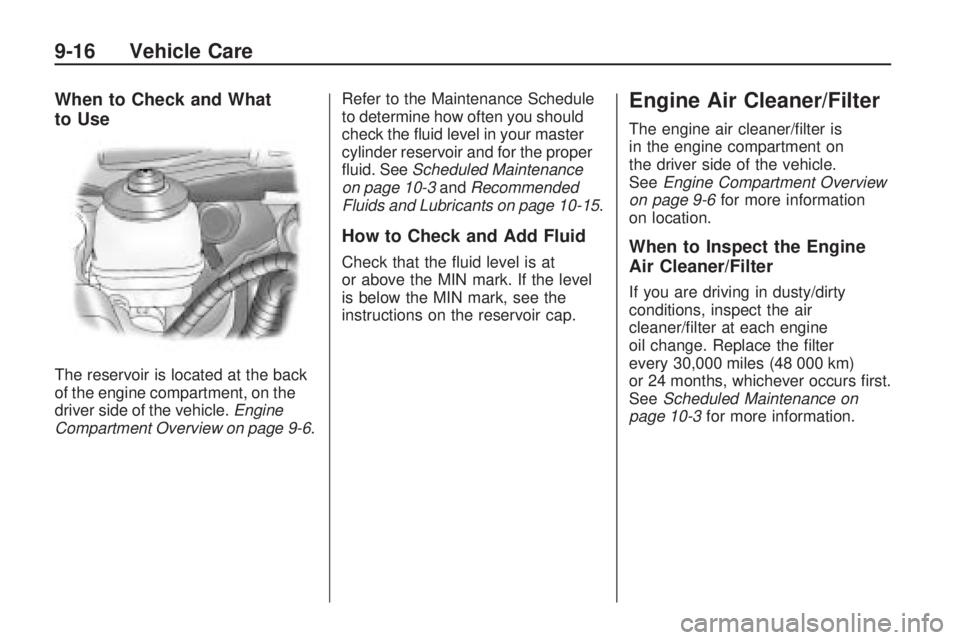
The reservoir is located at the back
of the engine compartment, on the
driver side of the vehicle.Engine
Compartment Overview on page 9-6 .Refer to the Maintenance Schedule
to determine how often you should
check the fluid level in your master
cylinder reservoir and for the proper
fluid. See
Scheduled Maintenance
on page 10-3 andRecommended
Fluids and Lubricants on page 10-15 .
How to Check and Add Fluid
Check that the fluid level is at
or above the MIN mark. If the level
is below the MIN mark, see the
instructions on the reservoir cap.
Engine Air Cleaner/Filter
The engine air cleaner/filter is
in the engine compartment on
the driver side of the vehicle.
SeeEngine Compartment Overview
on page 9-6 for more information
on location.
When to Inspect the Engine
Air Cleaner/Filter
If you are driving in dusty/dirty
conditions, inspect the air
cleaner/filter at each engine
oil change. Replace the filter
every 30,000 miles (48 000 km)
or 24 months, whichever occurs first.
See Scheduled Maintenance on
page 10-3 for more information.
9-16 Vehicle Care