maintenance PONTIAC VIBE 2010 Owner's Manual
[x] Cancel search | Manufacturer: PONTIAC, Model Year: 2010, Model line: VIBE, Model: PONTIAC VIBE 2010Pages: 318, PDF Size: 1.7 MB
Page 212 of 318
What to Add
Use only new DOT-3 brake
fluid from a sealed container.
SeeRecommended Fluids and
Lubricants on page 10-15 .
Always clean the brake fluid
reservoir cap and the area around
the cap before removing it. This
helps keep dirt from entering the
reservoir.
{CAUTION
With the wrong kind of fluid in the
brake or clutch hydraulic system,
the brakes or clutch might not
work well. This could cause a
crash. Always use the proper
brake fluid. Notice:
Using the wrong uid can
badly damage brake or clutch
hydraulic system parts.
For example, just a few drops
of mineral-based oil, such as
engine oil, in the brake or clutch
hydraulic system can damage
brake or clutch hydraulic
system parts so badly that they
will have to be replaced. Do not
let someone put in the wrong
kind of uid.
If brake uid is spilled on the
vehicle’s painted surfaces, the
paint nish can be damaged.
Be careful not to spill brake
uid on the vehicle. If you do,
wash it off immediately.
Battery
This vehicle has a maintenance
free battery. When it is time for a
new battery, see your dealer/retailer
for one that has the replacement
number shown on the original
battery’s label. See
Engine
Compartment Overview on
page 9-6 for battery location.
{WARNING
Battery posts, terminals, and
related accessories contain lead
and lead compounds, chemicals
known to the State of California
to cause cancer and reproductive
harm. Wash hands after handling.
9-28 Vehicle Care
Page 213 of 318
Vehicle Storage
{CAUTION
Batteries have acid that can burn
you and gas that can explode.
You can be badly hurt if you are
not careful. SeeJump Starting
on page 9-69 for tips on working
around a battery without
getting hurt.
Infrequent Usage: If the vehicle
is driven infrequently, remove the
black, negative (−) cable from the
battery. This helps keep the battery
from running down.
Extended Storage: For extended
storage of the vehicle, remove the
black, negative (−) cable from the
battery or use a battery trickle
charger. This helps maintain the
charge of the battery over an
extended period of time.
All-Wheel Drive
If you have an all-wheel-drive
vehicle, be sure to perform the
lubricant checks described in this
section.
Transfer Case
(Power Transfer Unit)
When to Check Lubricant
Refer to the Maintenance Schedule
to determine how often to check
the lubricant. See Scheduled
Maintenance on page 10-3 .
How to Check Lubricant
To get an accurate reading, the
vehicle should be on a level surface.
If the level is below the bottom of
the filler plug hole, you’ll need to add
some lubricant. Add enough lubricant
to raise the level to the bottom of the
filler plug hole.
What to Use
Refer to the Maintenance Schedule
to determine what kind of lubricant to
use. See Recommended Fluids and
Lubricants on page 10-15 .
Carrier Assembly-Differential
(Rear Drive Module)
When to Check and Change
Lubricant
Refer to the Maintenance Schedule
to determine how often to check the
lubricant and when to change it.
SeeScheduled Maintenance on
page 10-3.
How to Check Lubricant
To get an accurate reading, the
vehicle should be on a level surface.
If the level is below the bottom of
the filler plug hole, you’ll need to add
some lubricant. Add enough lubricant
to raise the level to the bottom of the
filler plug hole. A fluid loss could
indicate a problem; check and have
it repaired, if needed.
What to Use
Refer to the Maintenance Schedule
to determine what kind of lubricant to
use. See Recommended Fluids and
Lubricants on page 10-15 .
Vehicle Care 9-29
Page 235 of 318
As an added safety feature, your
vehicle has been equipped with
a tire pressure monitoring system
(TPMS) that illuminates a low
tire pressure telltale when one or
more of your tires is significantly
under-inflated.
Accordingly, when the low tire
pressure telltale illuminates, you
should stop and check your tires
as soon as possible, and inflate
them to the proper pressure. Driving
on a significantly under-inflated tire
causes the tire to overheat and can
lead to tire failure. Under-inflation
also reduces fuel efficiency and
tire tread life, and may affect the
vehicle’s handling and stopping
ability.
Please note that the TPMS is
not a substitute for proper tire
maintenance, and it is the driver’s
responsibility to maintain correcttire pressure, even if under-inflation
has not reached the level to trigger
illumination of the TPMS low tire
pressure telltale.
Your vehicle has also been
equipped with a TPMS malfunction
indicator to indicate when the system
is not operating properly. The TPMS
malfunction indicator is combined
with the low tire pressure telltale.
When the system detects a
malfunction, the telltale will flash
for approximately one minute and
then remain continuously illuminated.
This sequence will continue upon
subsequent vehicle start-ups as long
as the malfunction exists.
When the malfunction indicator
is illuminated, the system may not
be able to detect or signal low tire
pressure as intended. TPMS
malfunctions may occur for a variety
of reasons, including the installation
of replacement or alternate tires orwheels on the vehicle that prevent
the TPMS from functioning properly.
Always check the TPMS malfunction
telltale after replacing one or more
tires or wheels on your vehicle to
ensure that the replacement or
alternate tires and wheels allow
the TPMS to continue to function
properly.
See
Tire Pressure Monitor
Operation on page 9-52 for
additional information.
Federal Communications
Commission (FCC) and
Industry and Science Canada
See Radio Frequency Statement
(US, Can) on page 12-16 for
information regarding Part 15
of the Federal Communications
Commission (FCC) Rules and
RSS-210/211 of Industry and
Science Canada.
Vehicle Care 9-51
Page 236 of 318
Tire Pressure Monitor
Operation
This vehicle may have a Tire
Pressure Monitor System (TPMS).
The TPMS warns the driver when a
low tire pressure condition exists.
TPMS sensors are mounted onto
each tire and wheel assembly,
excluding the spare tire and
wheel assembly.
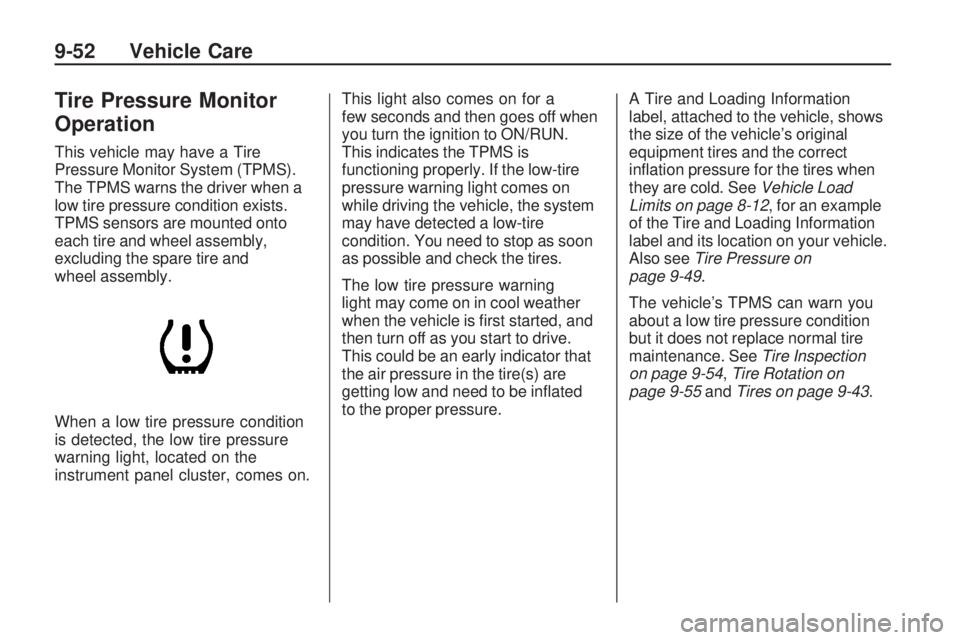
When a low tire pressure condition
is detected, the low tire pressure
warning light, located on the
instrument panel cluster, comes on.This light also comes on for a
few seconds and then goes off when
you turn the ignition to ON/RUN.
This indicates the TPMS is
functioning properly. If the low-tire
pressure warning light comes on
while driving the vehicle, the system
may have detected a low-tire
condition. You need to stop as soon
as possible and check the tires.
The low tire pressure warning
light may come on in cool weather
when the vehicle is first started, and
then turn off as you start to drive.
This could be an early indicator that
the air pressure in the tire(s) are
getting low and need to be inflated
to the proper pressure.
A Tire and Loading Information
label, attached to the vehicle, shows
the size of the vehicle’s original
equipment tires and the correct
inflation pressure for the tires when
they are cold. See
Vehicle Load
Limits on page 8-12, for an example
of the Tire and Loading Information
label and its location on your vehicle.
Also see Tire Pressure on
page 9-49.
The vehicle’s TPMS can warn you
about a low tire pressure condition
but it does not replace normal tire
maintenance. See Tire Inspection
on page 9-54, Tire Rotation on
page 9-55 andTires on page 9-43.
9-52 Vehicle Care
Page 239 of 318
Tire Rotation
Tires should be rotated every
5,000 to 8,000 miles (8 000 to
13 000 km). SeeScheduled
Maintenance on page 10-3.
The purpose of a regular tire
rotation is to achieve a uniform
wear for all tires on the vehicle.
This will ensure that the vehicle
continues to perform most like it
did when the tires were new.
Any time you notice unusual
wear, rotate the tires as soon
as possible and check wheel
alignment. Also check for
damaged tires or wheels.
See When It Is Time for New
Tires on page 9-56 andWheel
Replacement on page 9-60 for
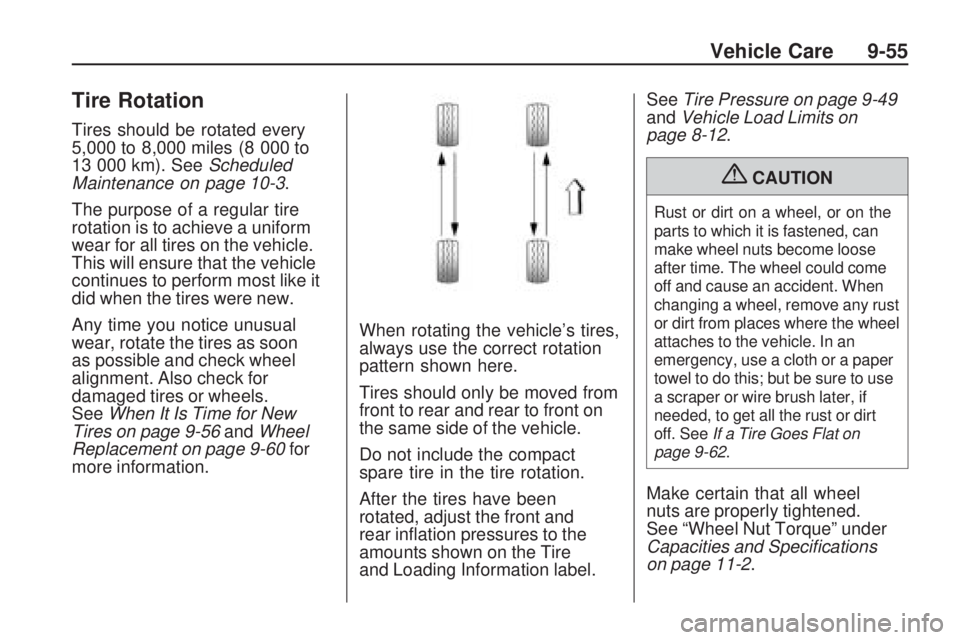
more information. When rotating the vehicle’s tires,
always use the correct rotation
pattern shown here.
Tires should only be moved from
front to rear and rear to front on
the same side of the vehicle.
Do not include the compact
spare tire in the tire rotation.
After the tires have been
rotated, adjust the front and
rear inflation pressures to the
amounts shown on the Tire
and Loading Information label.See
Tire Pressure on page 9-49
and Vehicle Load Limits on
page 8-12.
{CAUTION
Rust or dirt on a wheel, or on the
parts to which it is fastened, can
make wheel nuts become loose
after time. The wheel could come
off and cause an accident. When
changing a wheel, remove any rust
or dirt from places where the wheel
attaches to the vehicle. In an
emergency, use a cloth or a paper
towel to do this; but be sure to use
a scraper or wire brush later, if
needed, to get all the rust or dirt
off. See If a Tire Goes Flat on
page 9-62.
Make certain that all wheel
nuts are properly tightened.
See “Wheel Nut Torque” under
Capacities and Specications
on page 11-2.
Vehicle Care 9-55
Page 240 of 318
When It Is Time for New
Tires
Various factors, such as
maintenance, temperatures,
driving speeds, vehicle loading,
and road conditions influence
when you need new tires.
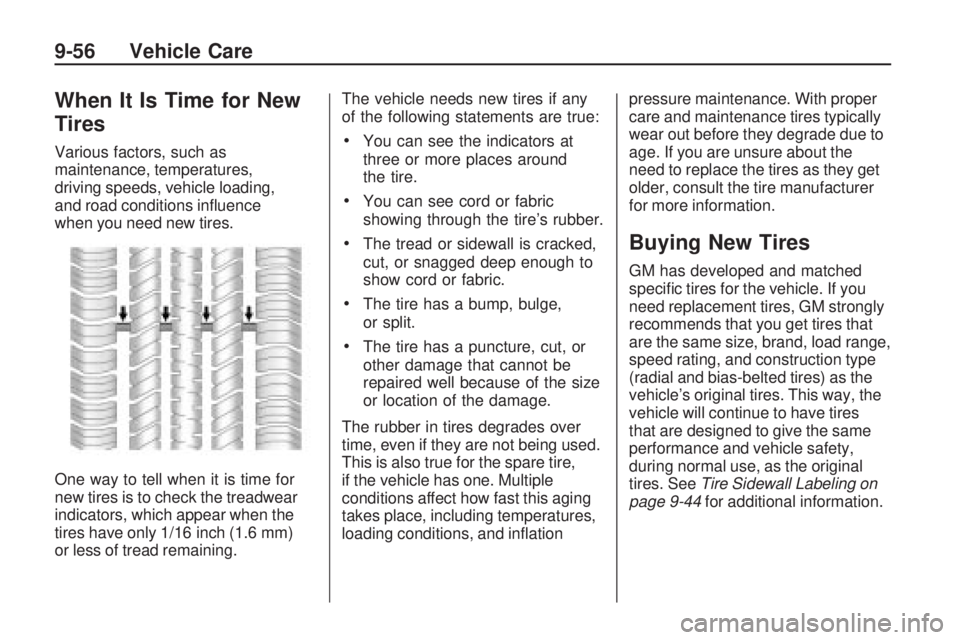
One way to tell when it is time for
new tires is to check the treadwear
indicators, which appear when the
tires have only 1/16 inch (1.6 mm)
or less of tread remaining.The vehicle needs new tires if any
of the following statements are true:•You can see the indicators at
three or more places around
the tire.
•You can see cord or fabric
showing through the tire’s rubber.
•The tread or sidewall is cracked,
cut, or snagged deep enough to
show cord or fabric.
•The tire has a bump, bulge,
or split.
•The tire has a puncture, cut, or
other damage that cannot be
repaired well because of the size
or location of the damage.
The rubber in tires degrades over
time, even if they are not being used.
This is also true for the spare tire,
if the vehicle has one. Multiple
conditions affect how fast this aging
takes place, including temperatures,
loading conditions, and inflation pressure maintenance. With proper
care and maintenance tires typically
wear out before they degrade due to
age. If you are unsure about the
need to replace the tires as they get
older, consult the tire manufacturer
for more information.
Buying New Tires
GM has developed and matched
specific tires for the vehicle. If you
need replacement tires, GM strongly
recommends that you get tires that
are the same size, brand, load range,
speed rating, and construction type
(radial and bias-belted tires) as the
vehicle’s original tires. This way, the
vehicle will continue to have tires
that are designed to give the same
performance and vehicle safety,
during normal use, as the original
tires. See
Tire Sidewall Labeling on
page 9-44 for additional information.
9-56 Vehicle Care
Page 246 of 318
If a Tire Goes Flat
It is unusual for a tire to blowout
while you are driving, especially if
you maintain your vehicle’s tires
properly. If air goes out of a tire,
it is much more likely to leak out
slowly. But if you should ever have
a blowout, here are a few tips about
what to expect and what to do:
If a front tire fails, the flat tire
creates a drag that pulls the vehicle
toward that side. Take your foot off
the accelerator pedal and grip the
steering wheel firmly. Steer to
maintain lane position, and then
gently brake to a stop well out of
the traffic lane.
A rear blowout, particularly on a
curve, acts much like a skid and
may require the same correction
you would use in a skid. In any rear
blowout remove your foot from the
accelerator pedal. Get the vehicle
under control by steering the way
you want the vehicle to go. It may bevery bumpy and noisy, but you can
still steer. Gently brake to a stop,
well off the road if possible.
{CAUTION
Lifting a vehicle and getting under
it to do maintenance or repairs is
dangerous without the appropriate
safety equipment and training. If a
jack is provided with the vehicle, it
is designed only for changing a
flat tire. If it is used for anything
else, you or others could be badly
injured or killed if the vehicle slips
off the jack. If a jack is provided
with the vehicle, only use it for
changing a flat tire.
If a tire goes flat, avoid further tire
and wheel damage by driving slowly
to a level place. Turn on the hazard
warning flashers. See Hazard
Warning Flashers on page 5-3 .
{CAUTION
Changing a tire can be dangerous.
The vehicle can slip off the jack
and roll over or fall on you or other
people. You and they could be
badly injured or even killed. Find
a level place to change your tire.
To help prevent the vehicle from
moving:
1. Set the parking brake firmly.
2. Put an automatic transmission shift lever in
P (Park), or shift a manual
transmission to 1 (First) or
R (Reverse).
3. Turn off the engine and do not restart while the vehicle
is raised.
4. Do not allow passengers to remain in the vehicle.
(Continued)
9-62 Vehicle Care
Page 261 of 318
Washing the Vehicle
To preserve the vehicle’s finish,
keep it clean by washing it often.
Do not wash the vehicle in
direct sunlight and use a car
washing soap.
Notice:Certain cleaners contain
chemicals that can damage the
emblems or nameplates on the
vehicle. Check the cleaning
product label. If it states that it
should not be used on plastic
parts, do not use it on the vehicle
or damage may occur and it would
not be covered by the warranty.
Do not use cleaning agents that are
petroleum based or that contain acid
or abrasives, as they can damage
the paint, metal or plastic on the
vehicle. Approved cleaning products
can be obtained from your dealer/
retailer. Follow all manufacturers’ directions regarding correct product
usage, necessary safety precautions
and appropriate disposal of any
vehicle care product.
Rinse the vehicle well, before
washing and after to remove all
cleaning agents completely. If they
are allowed to dry on the surface,
they could stain.
Dry the finish with a soft, clean
chamois or an all-cotton towel
to avoid surface scratches and
water spotting.
High pressure car washes may
cause water to enter the vehicle.
Avoid using high pressure washes
closer than 12 inches (30 cm) to the
surface of the vehicle. Use of power
washers exceeding 1,200 psi
(8 274 kPa) can result in damage
or removal of paint and decals.
Notice:
Conveyor systems on
some automatic car washes could
damage the vehicle. There may
not be enough clearance for
the undercarriage. Check with the
car wash manager before using
the automatic car wash.
Weatherstrips
Silicone grease on weatherstrips will
make them last longer, seal better,
and not stick or squeak. Apply
silicone grease with a clean cloth.
During very cold, damp weather
frequent application may be required.
See “Fluids and Lubricants” in the
Index of the “Maintenance and
Warranty and Owner assistance
Information” manual.
Vehicle Care 9-77
Page 263 of 318
Windshield and Wiper Blades
Clean the outside of the windshield
with glass cleaner.
Clean the rubber blades using a
lint free cloth or paper towel soaked
with windshield washer fluid or a mild
detergent. Wash the windshield
thoroughly when cleaning the blades.
Bugs, road grime, sap, and a buildup
of vehicle wash/wax treatments may
cause wiper streaking. Replace the
wiper blades if they are worn or
damaged.
Wipers can be damaged by:
•Extreme dusty conditions
•Sand and salt
•Heat and sun
•Snow and ice, without proper
removal
Tires
Use a stiff brush with tire cleaner to
clean the tires.
Notice:Using petroleum-based
tire dressing products on the
vehicle may damage the paint
nish and/or tires. When applying
a tire dressing, always wipe off
any overspray from all painted
surfaces on the vehicle.
Sheet Metal Damage
If the vehicle is damaged and
requires sheet metal repair or
replacement, make sure the body
repair shop applies anti-corrosion
material to parts repaired or
replaced to restore corrosion
protection.
Original manufacturer replacement
parts will provide the corrosion
protection while maintaining
the vehicle warranty.
Finish Damage
Any stone chips, fractures or deep
scratches in the finish should be
repaired right away. Bare metal will
corrode quickly and may develop into
major repair expense.
Minor chips and scratches can be
repaired with touch-up materials
available from your dealer/retailer.
Larger areas of finish damage can be
corrected in your dealer’s/retailer’s
body and paint shop.
Underbody Maintenance
Chemicals used for ice and snow
removal and dust control can collect
on the underbody. If these are not
removed, corrosion and rust can
develop on the underbody parts such
as fuel lines, frame, floor pan, and
exhaust system even though they
have corrosion protection.
Vehicle Care 9-79
Page 269 of 318
Service and
Maintenance
General InformationGeneral Information.............10-1
Scheduled MaintenanceScheduled Maintenance ........10-3
Recommended Fluids,
Lubricants, and Parts
Recommended Fluids and
Lubricants ......................
.10-15
Maintenance Replacement Parts .............................
.10-17
Maintenance RecordsMaintenance Records .........10-18
General Information
Important: Keep engine oil at the
proper level and change as
recommended.
Have you purchased the GM
Protection Plan? The Plan
supplements the vehicle warranties.
See the Warranty and Owner
Assistance booklet or your dealer/
retailer for details.
Notice:
Maintenance intervals,
checks, inspections, replacement
parts, and recommended uids
and lubricants as prescribed in
this manual are necessary to
keep this vehicle in good working
condition. Any damage caused
by failure to follow scheduled
maintenance might not be covered
by the vehicle warranty. Proper vehicle maintenance not only
helps to keep the vehicle in good
working condition, but also helps the
environment. All recommended
maintenance is important. Improper
vehicle maintenance can even affect
the quality of the air we breathe.
Improper fluid levels or the wrong tire
inflation can increase the level of
emissions from the vehicle. To help
protect the environment, and to keep
the vehicle in good condition, be sure
to maintain the vehicle properly.
Using the Maintenance
Schedule
We want to help keep this vehicle in
good working condition. But we do
not know exactly how you will drive it.
You might drive very short distances
only a few times a week. Or you
might drive long distances all the
time in very hot, dusty weather.
You might use the vehicle in making
deliveries. Or you might drive it to
work, to do errands, or in many
other ways.
Service and Maintenance 10-1