steering PONTIAC VIBE 2010 User Guide
[x] Cancel search | Manufacturer: PONTIAC, Model Year: 2010, Model line: VIBE, Model: PONTIAC VIBE 2010Pages: 318, PDF Size: 1.7 MB
Page 85 of 318
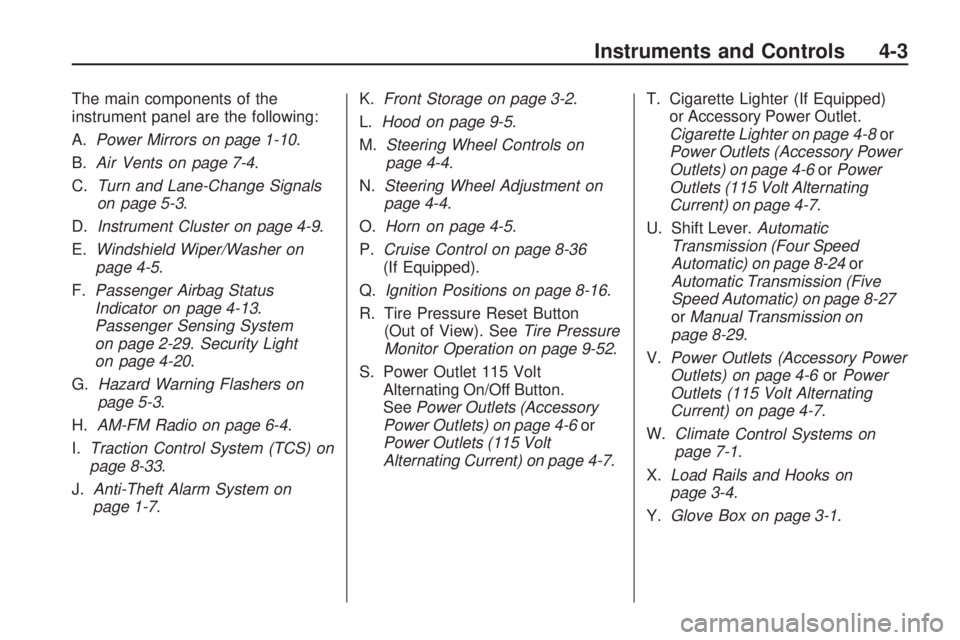
The main components of the
instrument panel are the following:
A.Power Mirrors on page 1-10 .
B. Air Vents on page 7-4.
C. Turn and Lane-Change Signals
on page 5-3.
D. Instrument Cluster on page 4-9 .
E. Windshield Wiper/Washer on
page 4-5.
F. Passenger Airbag Status
Indicator on page 4-13 .
Passenger Sensing System
on page 2-29. Security Light
on page 4-20.
G. Hazard Warning Flashers on
page 5-3.
H. AM-FM Radio on page 6-4 .
I. Traction Control System (TCS) on
page 8-33.
J. Anti-Theft Alarm System on
page 1-7. K.
Front Storage on page 3-2 .
L. Hood on page 9-5.
M. Steering Wheel Controls on
page 4-4.
N. Steering Wheel Adjustment on
page 4-4.
O. Horn on page 4-5.
P. Cruise Control on page 8-36
(If Equipped).
Q. Ignition Positions on page 8-16 .
R. Tire Pressure Reset Button (Out of View). See Tire Pressure
Monitor Operation on page 9-52 .
S. Power Outlet 115 Volt Alternating On/Off Button.
See Power Outlets (Accessory
Power Outlets) on page 4-6 or
Power Outlets (115 Volt
Alternating Current) on page 4-7 .T. Cigarette Lighter (If Equipped)
or Accessory Power Outlet.
Cigarette Lighter on page 4-8 or
Power Outlets (Accessory Power
Outlets) on page 4-6 orPower
Outlets (115 Volt Alternating
Current) on page 4-7.
U. Shift Lever. Automatic
Transmission (Four Speed
Automatic) on page 8-24 or
Automatic Transmission (Five
Speed Automatic) on page 8-27
or Manual Transmission on
page 8-29.
V. Power Outlets (Accessory Power
Outlets) on page 4-6 orPower
Outlets (115 Volt Alternating
Current) on page 4-7 .
W. Climate
Control Systems on
page 7-1.
X. Load Rails and Hooks on
page 3-4.
Y. Glove Box on page 3-1 .
Instruments and Controls 4-3
Page 86 of 318
Controls
Steering Wheel
Adjustment
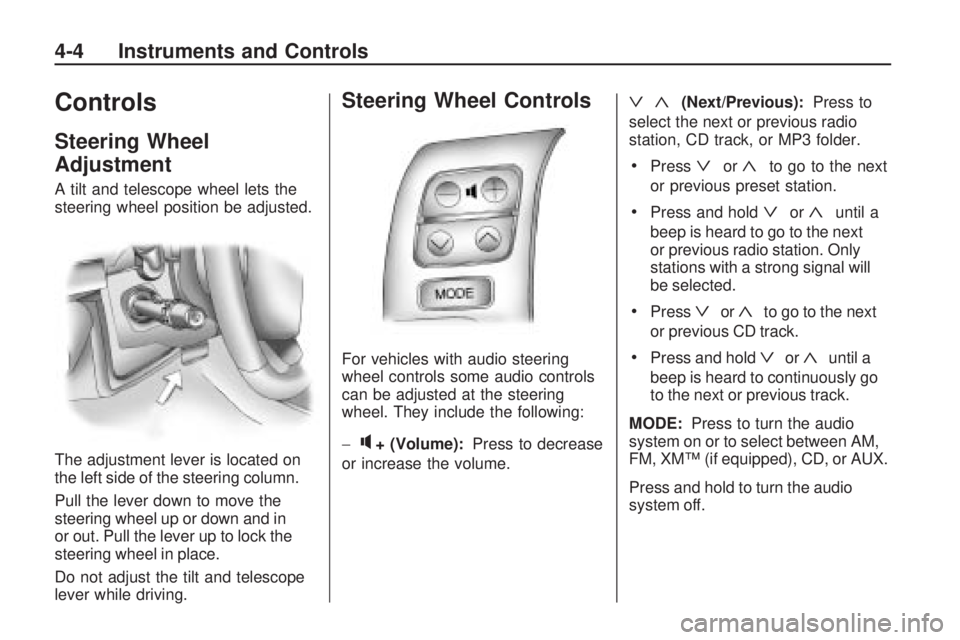
A tilt and telescope wheel lets the
steering wheel position be adjusted.
The adjustment lever is located on
the left side of the steering column.
Pull the lever down to move the
steering wheel up or down and in
or out. Pull the lever up to lock the
steering wheel in place.
Do not adjust the tilt and telescope
lever while driving.
Steering Wheel Controls
For vehicles with audio steering
wheel controls some audio controls
can be adjusted at the steering
wheel. They include the following:
−
q+ (Volume):Press to decrease
or increase the volume.
ª«(Next/Previous): Press to
select the next or previous radio
station, CD track, or MP3 folder.
•Pressªor«to go to the next
or previous preset station.
•Press and holdªor«until a
beep is heard to go to the next
or previous radio station. Only
stations with a strong signal will
be selected.
•Pressªor«to go to the next
or previous CD track.
•Press and holdªor«until a
beep is heard to continuously go
to the next or previous track.
MODE: Press to turn the audio
system on or to select between AM,
FM, XM™ (if equipped), CD, or AUX.
Press and hold to turn the audio
system off.
4-4 Instruments and Controls
Page 87 of 318
Horn
Press near or on the horn symbols
on the steering wheel pad to sound
the horn.
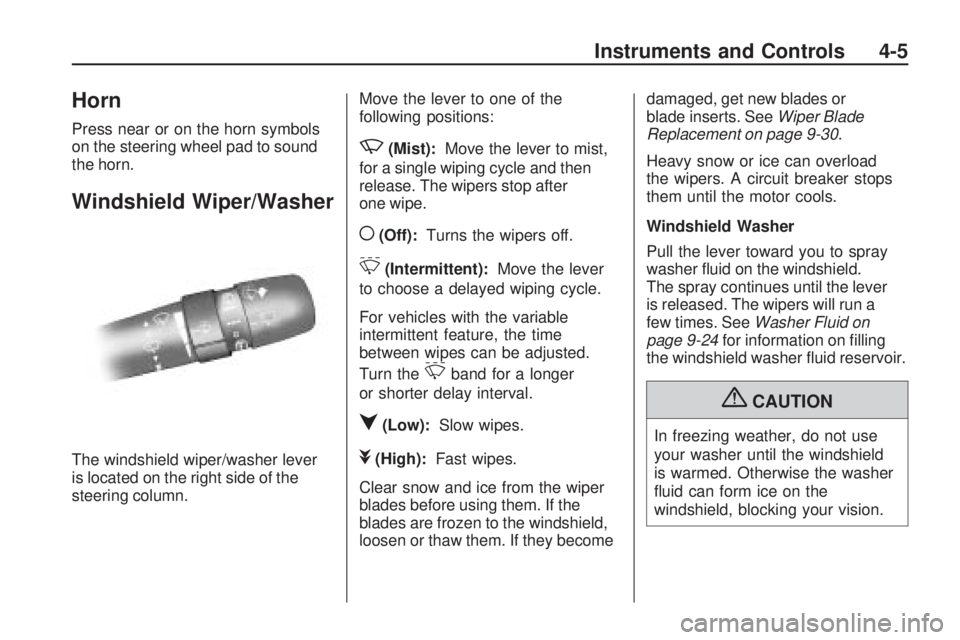
Windshield Wiper/Washer
The windshield wiper/washer lever
is located on the right side of the
steering column.Move the lever to one of the
following positions:
z(Mist):
Move the lever to mist,
for a single wiping cycle and then
release. The wipers stop after
one wipe.
((Off): Turns the wipers off.
&(Intermittent): Move the lever
to choose a delayed wiping cycle.
For vehicles with the variable
intermittent feature, the time
between wipes can be adjusted.
Turn the
&band for a longer
or shorter delay interval.
q(Low): Slow wipes.
l(High): Fast wipes.
Clear snow and ice from the wiper
blades before using them. If the
blades are frozen to the windshield,
loosen or thaw them. If they become damaged, get new blades or
blade inserts. See
Wiper Blade
Replacement on page 9-30 .
Heavy snow or ice can overload
the wipers. A circuit breaker stops
them until the motor cools.
Windshield Washer
Pull the lever toward you to spray
washer fluid on the windshield.
The spray continues until the lever
is released. The wipers will run a
few times. See Washer Fluid on
page 9-24 for information on filling
the windshield washer fluid reservoir.
{CAUTION
In freezing weather, do not use
your washer until the windshield
is warmed. Otherwise the washer
fluid can form ice on the
windshield, blocking your vision.
Instruments and Controls 4-5
Page 100 of 318

If the regular brake system warning
light is also on, there are no antilock
brakes and there is a problem with
the regular brakes. SeeBrake
System Warning Light on page 4-17 .
Service All-Wheel Drive
Light
This light will come on briefly when
the ignition is turned on, and the
engine is not running, as a check
to show you it is working.
It should go out when the engine is
started. It should go out when the
engine is started. If it stays on, or
comes on while you are driving, you
may have a problem with the system.
Have it checked by your dealer/
retailer.
The four-wheel-drive indicator will
light up when the All-Wheel drive is
active.
Speed Sensitive Power
Steering (SSPS) Warning
Light
Vehicles with this feature, have a
warning light that comes on briefly
when the ignition is turned to
ON/RUN as a check to show it
is working.
If the warning light does not come
on, have it fixed so it will be able to
warn if there is a problem.
If the warning light stays on, or
comes on while driving, the Speed
Sensitive Power Steering may not be
working. See your dealer/retailer for
service.
StabiliTrak®Indicator
Light
This light warns that there is a
problem with the Traction Control
System (TCS) or the Vehicle
Stability Control (VSC) system.
The light comes on when the ignition
is turned to ON/RUN.
If the light comes on while driving,
the system is not working.
The TCS light comes on when the
VSC system warning light comes on,
even if the TRAC OFF button is not
pressed.
See StabiliTrak System on
page 8-35 for more information on
Vehicle Stability Control System.
4-18 Instruments and Controls
Page 109 of 318
Lighting
Exterior LightingExterior Lamp Controls...........5-1
Headlamp High/Low-Beam Changer ............................
.5-2
Flash-to-Pass .......................
.5-2
Daytime Running Lamps (DRL) .....................
.5-2
Automatic Headlamp System .............................
.5-3
Hazard Warning Flashers .......5-3
Turn and Lane-Change Signals ..............................
.5-3
Fog Lamps ..........................
.5-4
Interior LightingInstrument Panel Illumination
Control ..............................
.5-4
Dome Lamps .......................
.5-4
Reading Lamps ....................
.5-5
Lighting FeaturesEntry Lighting ......................
.5-5
Battery Power Protection ........5-5
Exterior Lighting
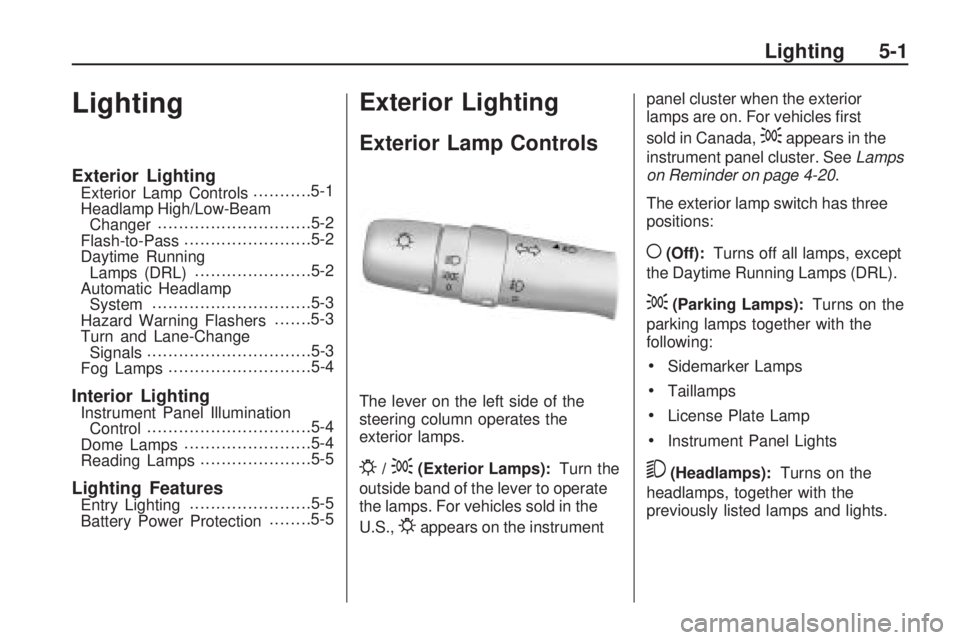
Exterior Lamp Controls
The lever on the left side of the
steering column operates the
exterior lamps.
P/;(Exterior Lamps):
Turn the
outside band of the lever to operate
the lamps. For vehicles sold in the
U.S.,
Pappears on the instrument panel cluster when the exterior
lamps are on. For vehicles first
sold in Canada,
;appears in the
instrument panel cluster. See Lamps
on Reminder on page 4-20 .
The exterior lamp switch has three
positions:
((Off): Turns off all lamps, except
the Daytime Running Lamps (DRL).
;(Parking Lamps): Turns on the
parking lamps together with the
following:
•Sidemarker Lamps
•Taillamps
•License Plate Lamp
•Instrument Panel Lights
5(Headlamps): Turns on the
headlamps, together with the
previously listed lamps and lights.
Lighting 5-1
Page 135 of 318
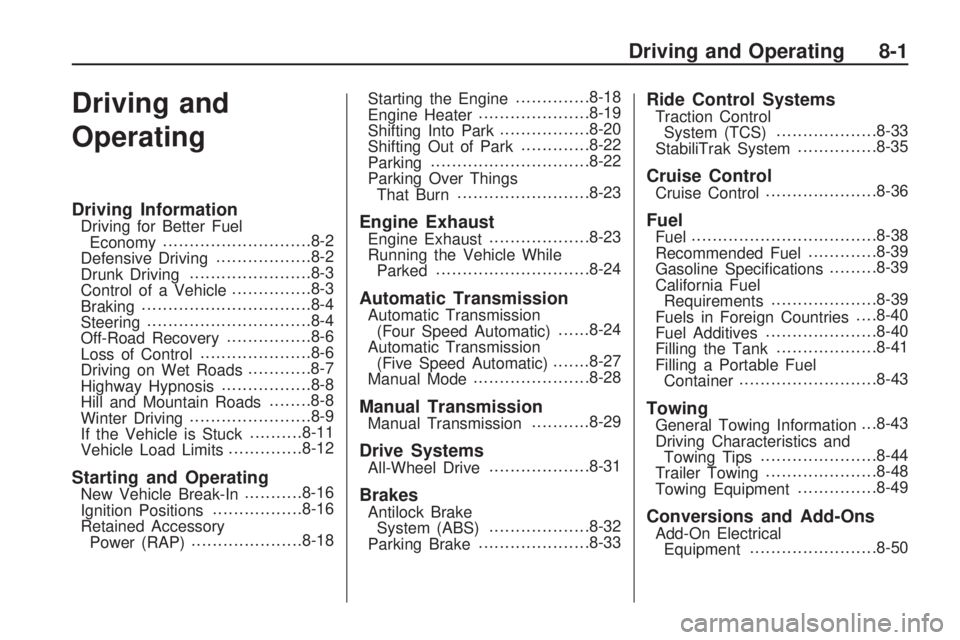
Driving and
Operating
Driving InformationDriving for Better FuelEconomy ...........................
.8-2
Defensive Driving .................
.8-2
Drunk Driving ......................
.8-3
Control of a Vehicle ..............
.8-3
Braking ...............................
.8-4
Steering ..............................
.8-4
Off-Road Recovery ...............
.8-6
Loss of Control ....................
.8-6
Driving on Wet Roads ............8-7
Highway Hypnosis ................
.8-8
Hill and Mountain Roads ........8-8
Winter Driving ......................
.8-9
If the Vehicle is Stuck ..........8-11
Vehicle Load Limits .............
.8-12
Starting and OperatingNew Vehicle Break-In ...........8-16
Ignition Positions ................
.8-16
Retained Accessory Power (RAP) ....................
.8-18Starting the Engine
.............
.8-18
Engine Heater ....................
.8-19
Shifting Into Park ................
.8-20
Shifting Out of Park .............8-22
Parking .............................
.8-22
Parking Over Things That Burn ........................
.8-23
Engine ExhaustEngine Exhaust..................
.8-23
Running the Vehicle While Parked ............................
.8-24
Automatic TransmissionAutomatic Transmission
(Four Speed Automatic) ......8-24
Automatic Transmission (Five Speed Automatic) .......8-27
Manual Mode .....................
.8-28
Manual TransmissionManual Transmission ...........8-29
Drive SystemsAll-Wheel Drive..................
.8-31
BrakesAntilock Brake
System (ABS) ..................
.8-32
Parking Brake ....................
.8-33
Ride Control SystemsTraction Control
System (TCS) ..................
.8-33
StabiliTrak System ..............
.8-35
Cruise ControlCruise Control ....................
.8-36
FuelFuel..................................
.8-38
Recommended Fuel .............8-39
Gasoline Specifications .........8-39
California Fuel Requirements ...................
.8-39
Fuels in Foreign Countries . . . .8-40
Fuel Additives ....................
.8-40
Filling the Tank ..................
.8-41
Filling a Portable Fuel Container .........................
.8-43
TowingGeneral Towing Information . . .8-43
Driving Characteristics and Towing Tips .....................
.8-44
Trailer Towing ....................
.8-48
Towing Equipment ..............
.8-49
Conversions and Add-OnsAdd-On Electrical
Equipment .......................
.8-50
Driving and Operating 8-1
Page 137 of 318
Drunk Driving
{CAUTION
Drinking and then driving is
very dangerous. Your reflexes,
perceptions, attentiveness, and
judgment can be affected by even
a small amount of alcohol. You
can have a serious — or even
fatal — collision if you drive after
drinking. Do not drink and drive or
ride with a driver who has been
drinking. Ride home in a cab; or if
you are with a group, designate a
driver who will not drink.
Death and injury associated with
drinking and driving is a global
tragedy.
Alcohol affects four things that
anyone needs to drive a vehicle:
judgment, muscular coordination,
vision, and attentiveness. Police records show that
almost 40 percent of all motor
vehicle-related deaths involve
alcohol. In most cases, these deaths
are the result of someone who was
drinking and driving. In recent years,
more than 17,000 annual motor
vehicle-related deaths have been
associated with the use of alcohol,
with about 250,000 people injured.
For persons under 21, it is against
the law in every U.S. state to drink
alcohol. There are good medical,
psychological, and developmental
reasons for these laws.
The obvious way to eliminate the
leading highway safety problem
is for people never to drink alcohol
and then drive.
Medical research shows that alcohol
in a person’s system can make crash
injuries worse, especially injuries
to the brain, spinal cord, or heart.
This means that when anyone who
has been drinking — driver or
passenger — is in a crash, that
person’s chance of being killed or
permanently disabled is higher than
if the person had not been drinking.
Control of a Vehicle
The following three systems
help to control the vehicle while
driving — brakes, steering, and
accelerator. At times, as when
driving on snow or ice, it is easy to
ask more of those control systems
than the tires and road can provide.
Meaning, you can lose control of the
vehicle.
Adding non-dealer/non-retailer
accessories can affect vehicle
performance. See
Accessories
and Modications on page 9-3 .
Driving and Operating 8-3
Page 138 of 318
Braking
SeeBrake System Warning Light on
page 4-17.
Braking action involves perception
time and reaction time. Deciding
to push the brake pedal is
perception time. Actually doing
it is reaction time.
Average reaction time is about
three-fourths of a second. But
that is only an average. It might be
less with one driver and as long as
two or three seconds or more with
another. Age, physical condition,
alertness, coordination, and eyesight
all play a part. So do alcohol,
drugs, and frustration. But even in
three-fourths of a second, a vehicle
moving at 100 km/h (60 mph) travels
20 m (66 ft). That could be a lot of
distance in an emergency, so
keeping enough space between the
vehicle and others is important. And, of course, actual stopping
distances vary greatly with the
surface of the road, whether it is
pavement or gravel; the condition of
the road, whether it is wet, dry, or icy;
tire tread; the condition of the brakes;
the weight of the vehicle; and the
amount of brake force applied.
Avoid needless heavy braking. Some
people drive in spurts — heavy
acceleration followed by heavy
braking — rather than keeping
pace with traffic. This is a mistake.
The brakes might not have time to
cool between hard stops. The brakes
will wear out much faster with a lot of
heavy braking. Keeping pace with
the traffic and allowing realistic
following distances eliminates a lot of
unnecessary braking. That means
better braking and longer brake life.
If the engine ever stops while the
vehicle is being driven, brake
normally but do not pump the brakes.
If the brakes are pumped, the pedal
could get harder to push down. If the
engine stops, there will still be some
power brake assist but it will be used
when the brake is applied. Once the
power assist is used up, it can take
longer to stop and the brake pedal
will be harder to push.
Adding non-dealer/non-retailer
accessories can affect vehicle
performance. See
Accessories and
Modications on page 9-3 .
Steering
If the engine stalls while driving, the
power steering assist system will
continue to operate until you are able
to stop the vehicle. If power steering
assist is lost because the electric
power steering system is not
functioning, the vehicle can be
steered but it will take more effort.
8-4 Driving and Operating
Page 139 of 318
If you turn the steering wheel in
either direction several times until it
stops, or hold the steering wheel in
the stopped position for an extended
amount of time, you may notice a
reduced amount of power steering
assist. The normal amount of power
steering assist should return shortly
after a few normal steering
movements.
The electric power steering
system does not require regular
maintenance. If you suspect
steering system problems, such as
abnormally high steering effort for a
prolonged period of time, contact
your dealer/retailer for service
repairs.Steering Tips
It is important to take curves at a
reasonable speed.
Traction in a curve depends on the
condition of the tires and the road
surface, the angle at which the curve
is banked, and vehicle speed. While
in a curve, speed is the one factor
that can be controlled.
If there is a need to reduce speed,
do it before entering the curve,
while the front wheels are straight.
Try to adjust the speed so you can
drive through the curve. Maintain a
reasonable, steady speed. Wait to
accelerate until out of the curve, and
then accelerate gently into the
straightaway.
Steering in Emergencies
There are times when steering
can be more effective than braking.
For example, you come over a hill
and find a truck stopped in your lane,
or a car suddenly pulls out from
nowhere, or a child darts out from
between parked cars and stops right
in front of you. These problems can
be avoided by braking — if you can
stop in time. But sometimes you
cannot stop in time because there
is no room. That is the time for
evasive action — steering around
the problem.
The vehicle can perform very well
in emergencies like these. First
apply the brakes. SeeBraking on
page 8-4. It is better to remove as
much speed as possible from a
collision. Then steer around the
problem, to the left or right
depending on the space available.
Driving and Operating 8-5
Page 140 of 318
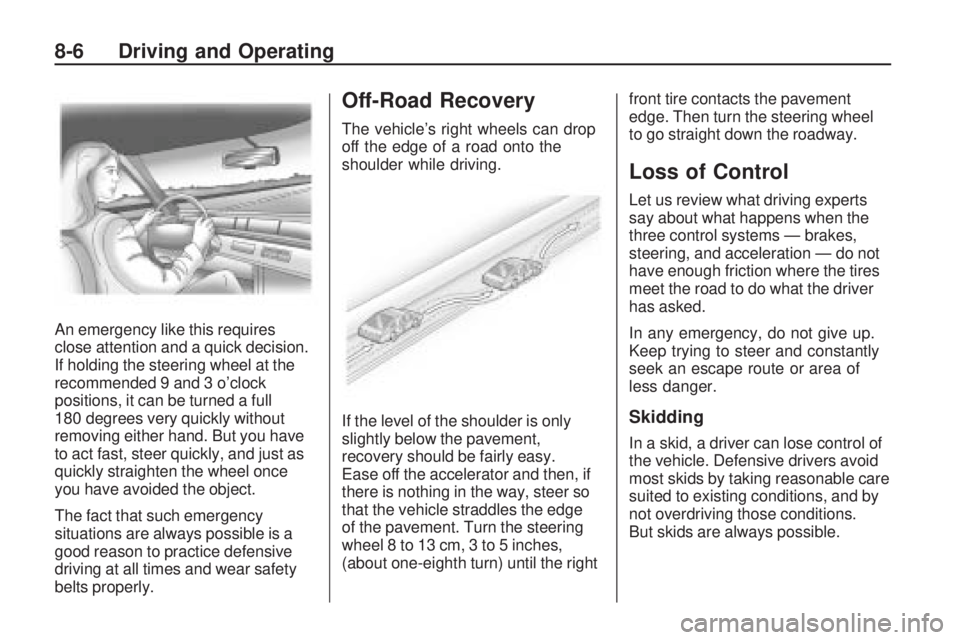
An emergency like this requires
close attention and a quick decision.
If holding the steering wheel at the
recommended 9 and 3 o’clock
positions, it can be turned a full
180 degrees very quickly without
removing either hand. But you have
to act fast, steer quickly, and just as
quickly straighten the wheel once
you have avoided the object.
The fact that such emergency
situations are always possible is a
good reason to practice defensive
driving at all times and wear safety
belts properly.
Off-Road Recovery
The vehicle’s right wheels can drop
off the edge of a road onto the
shoulder while driving.
If the level of the shoulder is only
slightly below the pavement,
recovery should be fairly easy.
Ease off the accelerator and then, if
there is nothing in the way, steer so
that the vehicle straddles the edge
of the pavement. Turn the steering
wheel 8 to 13 cm, 3 to 5 inches,
(about one-eighth turn) until the rightfront tire contacts the pavement
edge. Then turn the steering wheel
to go straight down the roadway.
Loss of Control
Let us review what driving experts
say about what happens when the
three control systems — brakes,
steering, and acceleration — do not
have enough friction where the tires
meet the road to do what the driver
has asked.
In any emergency, do not give up.
Keep trying to steer and constantly
seek an escape route or area of
less danger.
Skidding
In a skid, a driver can lose control of
the vehicle. Defensive drivers avoid
most skids by taking reasonable care
suited to existing conditions, and by
not overdriving those conditions.
But skids are always possible.
8-6 Driving and Operating