ECU PONTIAC VIBE 2010 Owner's Guide
[x] Cancel search | Manufacturer: PONTIAC, Model Year: 2010, Model line: VIBE, Model: PONTIAC VIBE 2010Pages: 318, PDF Size: 1.7 MB
Page 73 of 318
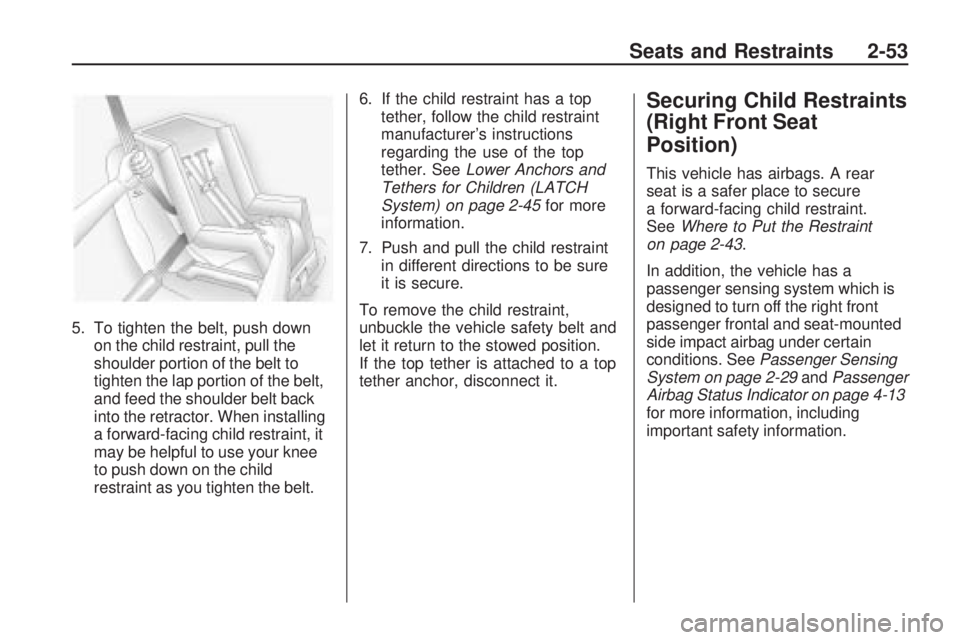
5. To tighten the belt, push downon the child restraint, pull the
shoulder portion of the belt to
tighten the lap portion of the belt,
and feed the shoulder belt back
into the retractor. When installing
a forward-facing child restraint, it
may be helpful to use your knee
to push down on the child
restraint as you tighten the belt. 6. If the child restraint has a top
tether, follow the child restraint
manufacturer’s instructions
regarding the use of the top
tether. See Lower Anchors and
Tethers for Children (LATCH
System) on page 2-45 for more
information.
7. Push and pull the child restraint in different directions to be sure
it is secure.
To remove the child restraint,
unbuckle the vehicle safety belt and
let it return to the stowed position.
If the top tether is attached to a top
tether anchor, disconnect it.
Securing Child Restraints
(Right Front Seat
Position)
This vehicle has airbags. A rear
seat is a safer place to secure
a forward-facing child restraint.
See Where to Put the Restraint
on page 2-43.
In addition, the vehicle has a
passenger sensing system which is
designed to turn off the right front
passenger frontal and seat-mounted
side impact airbag under certain
conditions. See Passenger Sensing
System on page 2-29 andPassenger
Airbag Status Indicator on page 4-13
for more information, including
important safety information.
Seats and Restraints 2-53
Page 74 of 318
A label on the sun visor says,
“Never put a rear-facing child seat
in the front.” This is because the risk
to the rear-facing child is so great,
if the airbag deploys.
{CAUTION
A child in a rear-facing child
restraint can be seriously injured or
killed if the right front passenger
airbag inflates. This is because
the back of the rear-facing child
restraint would be very close to
the inflating airbag. A child in a
forward-facing child restraint can
be seriously injured or killed if
the right front passenger airbag
inflates and the passenger seat
is in a forward position.(Continued)
CAUTION (Continued)
Even if the passenger sensing
system has turned off the right
front passenger frontal airbag, no
system is fail-safe. No one can
guarantee that an airbag will not
deploy under some unusual
circumstance, even though it
is turned off.
Secure rear-facing child restraints
in a rear seat, even if the airbag is
off. If you secure a forward-facing
child restraint in the right front seat,
always move the front passenger
seat as far back as it will go. It is
better to secure the child restraint
in a rear seat.
SeePassenger Sensing System
on page 2-29 for additional
information. If the child restraint has the LATCH
system, see
Lower Anchors and
Tethers for Children (LATCH
System) on page 2-45 for how and
where to install the child restraint
using LATCH. If a child restraint is
secured in the seating position using
a safety belt and it uses a top tether,
see Lower Anchors and Tethers
for Children (LATCH System) on
page 2-45 for top tether anchor
locations.
Do not secure a child seat in a
position without a top tether anchor
if a national or local law requires
that the top tether be anchored,
or if the instructions that come
with the child restraint say that
the top strap must be anchored.
In Canada, the law requires
that forward-facing child restraints
have a top tether, and that the tether
be attached.
2-54 Seats and Restraints
Page 75 of 318
You will be using the lap-shoulder
belt to secure the child restraint in
this position. Follow the instructions
that came with the child restraint.
1. Move the seat as far back asit will go before securing the
forward-facing child restraint.
When the passenger sensing
system has turned off the right
front passenger frontal and
seat-mounted side impact airbag,
the off indicator on the passenger
airbag status indicator should
light and stay lit when you start
the vehicle. See Passenger
Airbag Status Indicator on
page 4-13.
2. Put the child restraint on the seat.
3. Pick up the latch plate, and run the lap and shoulder portions of
the vehicle’s safety belt through
or around the restraint. The child
restraint instructions will show
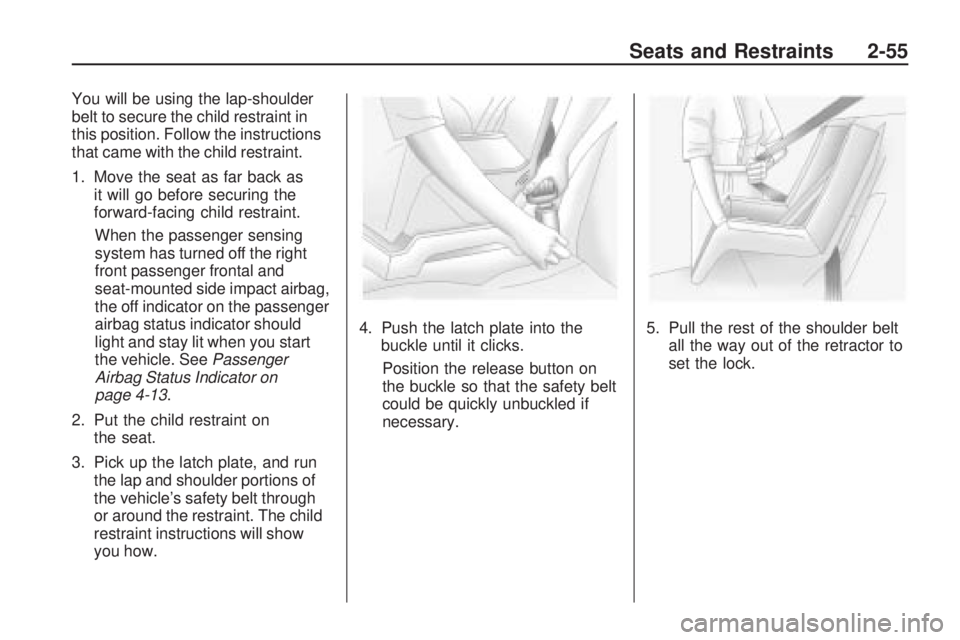
you how. 4. Push the latch plate into the
buckle until it clicks.
Position the release button on
the buckle so that the safety belt
could be quickly unbuckled if
necessary. 5. Pull the rest of the shoulder belt
all the way out of the retractor to
set the lock.
Seats and Restraints 2-55
Page 76 of 318
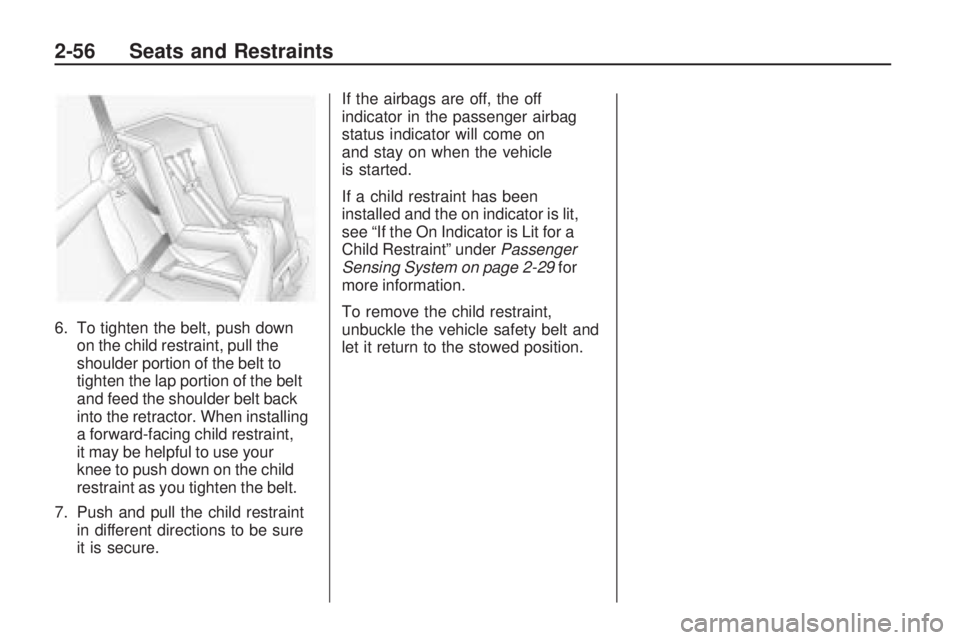
6. To tighten the belt, push downon the child restraint, pull the
shoulder portion of the belt to
tighten the lap portion of the belt
and feed the shoulder belt back
into the retractor. When installing
a forward-facing child restraint,
it may be helpful to use your
knee to push down on the child
restraint as you tighten the belt.
7. Push and pull the child restraint in different directions to be sure
it is secure. If the airbags are off, the off
indicator in the passenger airbag
status indicator will come on
and stay on when the vehicle
is started.
If a child restraint has been
installed and the on indicator is lit,
see “If the On Indicator is Lit for a
Child Restraint” under
Passenger
Sensing System on page 2-29 for
more information.
To remove the child restraint,
unbuckle the vehicle safety belt and
let it return to the stowed position.
2-56 Seats and Restraints
Page 78 of 318
Front Storage
The driver storage compartment
is located near the left side of the
steering column on the bottom of the
instrument panel. Pull up on the lever
to open the cover.
Overhead Console
If your vehicle has an overhead
console, push on the cover to open.
Center Console Storage
To access the center console
storage area, pull up on the lock
release lever to raise the upper cover
and access the tray storage. Pull up
on the lower release lever to raise
the tray and access more storage.
Additional Storage
Features
Cargo Cover
For vehicles equipped with a
cargo cover.
Using the cargo cover:
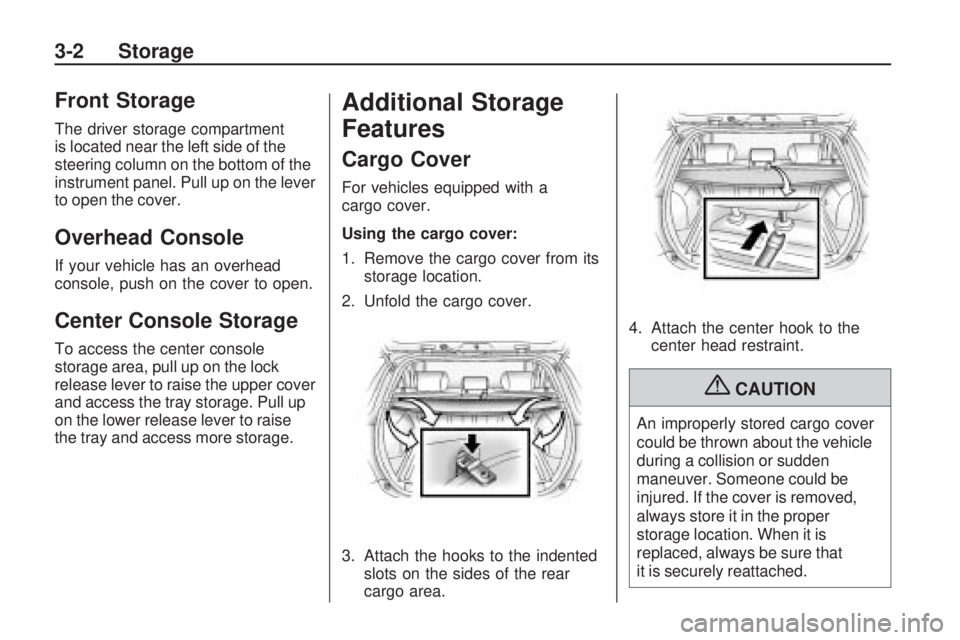
1. Remove the cargo cover from itsstorage location.
2. Unfold the cargo cover.
3. Attach the hooks to the indented slots on the sides of the rear
cargo area. 4. Attach the center hook to the
center head restraint.
{CAUTION
An improperly stored cargo cover
could be thrown about the vehicle
during a collision or sudden
maneuver. Someone could be
injured. If the cover is removed,
always store it in the proper
storage location. When it is
replaced, always be sure that
it is securely reattached.
3-2 Storage
Page 80 of 318
Load Rails and Hooks
There are hooks for hanging items
in the cabin, luggage compartment,
and in the cargo management
system, if the vehicle has one.
On the front passenger side, press
the hook to open and use it. There is
a weight limit of 44 lb (20 kg).
The luggage compartment hooks
should only be used to hang
items under 7 lb (3 kg).
For vehicles with a cargo
management system, open the deck
lid to hang items under 5 lb (2.3 kg).
Cargo Tie Downs
The cargo tie down straps and
hooks are intended to be used to
secure a flat tire or other items.
The tie down hooks are located in
the rear cargo area. The straps are
under the rear floor panel.
To use, hook the end of the straps
to the hooks in a criss-cross pattern.
Pull on the straps at the buckle to
tighten as needed.
Cargo Management
System
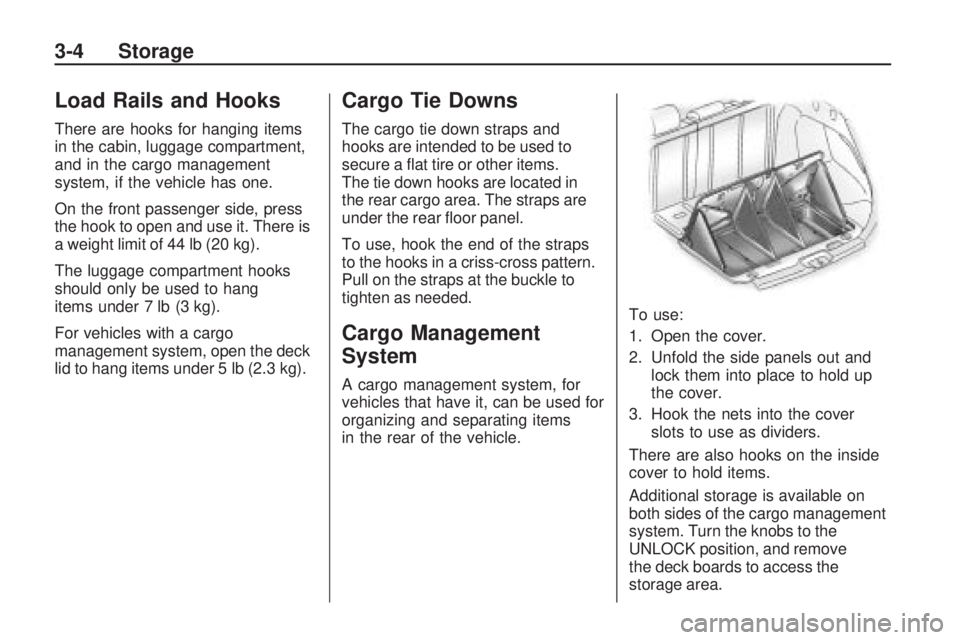
A cargo management system, for
vehicles that have it, can be used for
organizing and separating items
in the rear of the vehicle.To use:
1. Open the cover.
2. Unfold the side panels out and
lock them into place to hold up
the cover.
3. Hook the nets into the cover slots to use as dividers.
There are also hooks on the inside
cover to hold items.
Additional storage is available on
both sides of the cargo management
system. Turn the knobs to the
UNLOCK position, and remove
the deck boards to access the
storage area.
3-4 Storage
Page 81 of 318
Roof Rack System
Roof Rack
{CAUTION
If something is carried on top of
the vehicle that is longer or wider
than the roof rack — like paneling,
plywood, or a mattress — the wind
can catch it while the vehicle is
being driven. The item being
carried could be violently torn off,
and this could cause a collision,
and damage the vehicle. Never
carry something longer or wider
than the roof rack on top of the
vehicle unless using a GM
Certified accessory carrier.Notice:
Loading cargo on the
roof rack that weighs more than
75 kg (165 lbs) or hangs over
the rear or sides of the vehicle
may damage the vehicle.
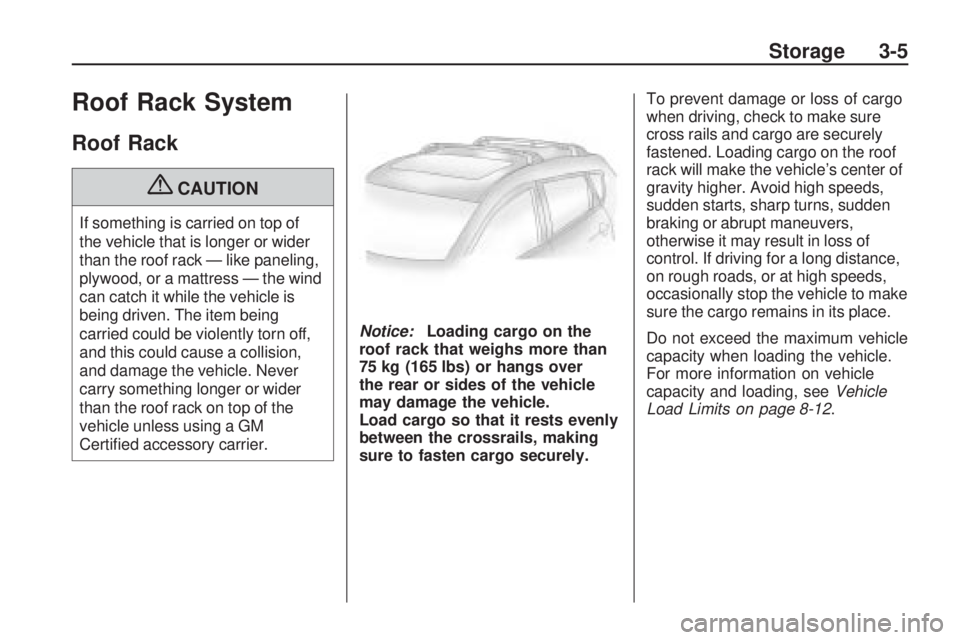
Load cargo so that it rests evenly
between the crossrails, making
sure to fasten cargo securely. To prevent damage or loss of cargo
when driving, check to make sure
cross rails and cargo are securely
fastened. Loading cargo on the roof
rack will make the vehicle’s center of
gravity higher. Avoid high speeds,
sudden starts, sharp turns, sudden
braking or abrupt maneuvers,
otherwise it may result in loss of
control. If driving for a long distance,
on rough roads, or at high speeds,
occasionally stop the vehicle to make
sure the cargo remains in its place.
Do not exceed the maximum vehicle
capacity when loading the vehicle.
For more information on vehicle
capacity and loading, see
Vehicle
Load Limits on page 8-12 .
Storage 3-5
Page 83 of 318

Instruments and
Controls
Instrument Panel OverviewInstrument Panel Overview.....4-2
ControlsSteering Wheel Adjustment.....4-4
Steering Wheel Controls .........4-4
Horn ...................................
.4-5
Windshield Wiper/Washer .......4-5
Rear Window Wiper/Washer . . . .4-6
Power Outlets (Accessory Power Outlets) ....................
.4-6
Power Outlets (115 Volt Alternating Current) .............
.4-7
Cigarette Lighter ..................
.4-8
Ashtrays .............................
.4-8
Warning Lights, Gages, and
Indicators
Warning Lights, Gages, and
Indicators ..........................
.4-8
Instrument Cluster ................
.4-9
Speedometer .....................
.4-10
Odometer ..........................
.4-10
Trip Odometer ....................
.4-10
Tachometer .......................
.4-10
Fuel Gage .........................
.4-10
Engine Coolant Temperature Gage .............4-11
Safety Belt Reminders ..........4-11
Airbag Readiness Light .........4-12
Passenger Airbag Status Indicator ..........................
.4-13
Charging System Light .........4-14
Malfunction Indicator Lamp .................
.4-14
Brake System Warning Light ...............................
.4-17
Antilock Brake System (ABS) Warning Light ...........4-17
Service All-Wheel Drive Light ...............................
.4-18Speed Sensitive Power
Steering (SSPS) Warning
Light ...............................
.4-18
StabiliTrak®Indicator Light . . . .4-18
Traction Control System (TCS) Warning Light ...........4-19
Tire Pressure Light .............
.4-19
Engine Oil Pressure Light .....4-19
Low Fuel Warning Light ........4-20
Security Light .....................
.4-20
High-Beam on Light .............4-20
Fog Lamp Light ..................
.4-20
Lamps on Reminder .............4-20
Taillamp Indicator Light .........4-21
Low Washer Fluid Warning Light ...............................
.4-21
Cruise Control Light .............4-21
Door Ajar Light ...................
.4-21
Vehicle PersonalizationVehicle Personalization .........4-21
OnStar SystemOnStar®System.................
.4-23
Instruments and Controls 4-1
Page 85 of 318
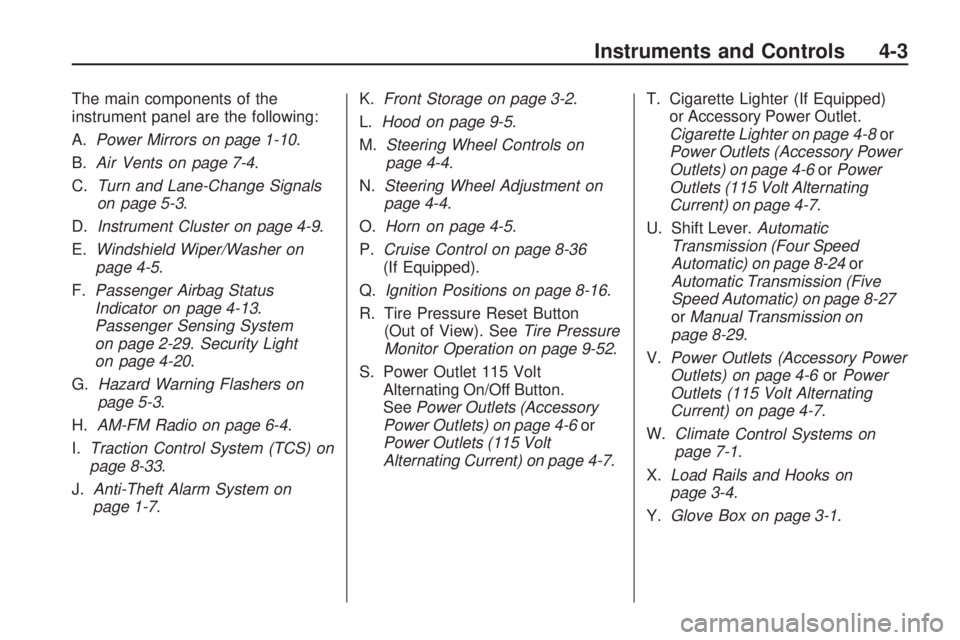
The main components of the
instrument panel are the following:
A.Power Mirrors on page 1-10 .
B. Air Vents on page 7-4.
C. Turn and Lane-Change Signals
on page 5-3.
D. Instrument Cluster on page 4-9 .
E. Windshield Wiper/Washer on
page 4-5.
F. Passenger Airbag Status
Indicator on page 4-13 .
Passenger Sensing System
on page 2-29. Security Light
on page 4-20.
G. Hazard Warning Flashers on
page 5-3.
H. AM-FM Radio on page 6-4 .
I. Traction Control System (TCS) on
page 8-33.
J. Anti-Theft Alarm System on
page 1-7. K.
Front Storage on page 3-2 .
L. Hood on page 9-5.
M. Steering Wheel Controls on
page 4-4.
N. Steering Wheel Adjustment on
page 4-4.
O. Horn on page 4-5.
P. Cruise Control on page 8-36
(If Equipped).
Q. Ignition Positions on page 8-16 .
R. Tire Pressure Reset Button (Out of View). See Tire Pressure
Monitor Operation on page 9-52 .
S. Power Outlet 115 Volt Alternating On/Off Button.
See Power Outlets (Accessory
Power Outlets) on page 4-6 or
Power Outlets (115 Volt
Alternating Current) on page 4-7 .T. Cigarette Lighter (If Equipped)
or Accessory Power Outlet.
Cigarette Lighter on page 4-8 or
Power Outlets (Accessory Power
Outlets) on page 4-6 orPower
Outlets (115 Volt Alternating
Current) on page 4-7.
U. Shift Lever. Automatic
Transmission (Four Speed
Automatic) on page 8-24 or
Automatic Transmission (Five
Speed Automatic) on page 8-27
or Manual Transmission on
page 8-29.
V. Power Outlets (Accessory Power
Outlets) on page 4-6 orPower
Outlets (115 Volt Alternating
Current) on page 4-7 .
W. Climate
Control Systems on
page 7-1.
X. Load Rails and Hooks on
page 3-4.
Y. Glove Box on page 3-1 .
Instruments and Controls 4-3
Page 102 of 318
If the light comes on and stays on, it
means that oil is not flowing through
the engine properly. The vehicle
could be low on oil and might have
some other system problem.
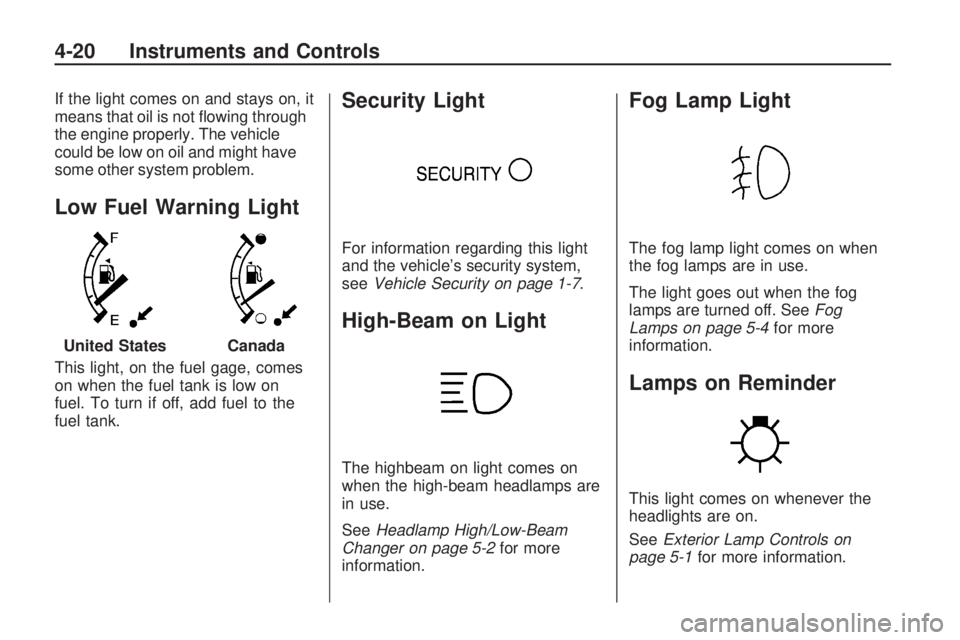
Low Fuel Warning Light
This light, on the fuel gage, comes
on when the fuel tank is low on
fuel. To turn if off, add fuel to the
fuel tank.
Security Light
For information regarding this light
and the vehicle’s security system,
seeVehicle Security on page 1-7 .
High-Beam on Light
The highbeam on light comes on
when the high-beam headlamps are
in use.
SeeHeadlamp High/Low-Beam
Changer on page 5-2 for more
information.
Fog Lamp Light
The fog lamp light comes on when
the fog lamps are in use.
The light goes out when the fog
lamps are turned off. See Fog
Lamps on page 5-4 for more
information.
Lamps on Reminder
This light comes on whenever the
headlights are on.
See Exterior Lamp Controls on
page 5-1 for more information.
United States
Canada
4-20 Instruments and Controls