ignition PONTIAC VIBE 2010 Owner's Guide
[x] Cancel search | Manufacturer: PONTIAC, Model Year: 2010, Model line: VIBE, Model: PONTIAC VIBE 2010Pages: 318, PDF Size: 1.7 MB
Page 152 of 318
Retained Accessory
Power (RAP)
These vehicle accessories may be
used for less than a minute after
the engine is turned off.
•Power Windows, if equipped
•Sunroof, if equipped
The power windows and sunroof will
continue to work for less than a
minute or until either front door is
opened. The radio will work when
the key is in ON/RUN or ACC/
ACCESSORY.
Starting the Engine
Automatic Transmission
Move the shift lever to P (Park) or
N (Neutral). The engine will not
start in any other position. To restart
when you are already moving, use
N (Neutral) only. Notice:
Shifting into P (Park)
with the vehicle moving could
damage the transmission. Shift
into P (Park) only when the vehicle
is stopped.
Manual Transmission
The shift lever should be in
NEUTRAL and the parking brake
engaged. Hold the clutch pedal
to the floor and start the engine.
The vehicle will not start if the clutch
pedal is not all the way down.
Starting Procedure
1. With your foot off the accelerator pedal, turn the ignition to START.
When the engine starts, let go of
the key. The idle speed will go
down as the engine gets warm.
Vehicles equipped with
the 1.8L engine have a
Computer-Controlled Cranking
System. This feature assists in
starting the engine and protects components. If the ignition key is
turned to the START position,
and then released when the
engine begins cranking, the
engine will continue cranking for
a about 30 seconds or until the
vehicle starts. If the engine does
not start and the key is held in
START for many seconds,
cranking will be stopped after
25 seconds to prevent cranking
motor damage. To prevent gear
damage, this system also
prevents cranking if the engine is
already running. Engine cranking
can be stopped by turning the
ignition switch to ACC/
ACCESSORY or LOCK/OFF.
Vehicles equipped with
the 2.4L engine should not
be cranked for more than
30 seconds at a time. This
may overheat the starter and
wiring systems.
8-18 Driving and Operating
Page 153 of 318
Notice:Holding the key in START
for longer than 15 seconds at a
time will cause the battery to be
drained much sooner. And the
excessive heat can damage the
starter motor. Wait about
15 seconds between each try to
help avoid draining the battery or
damaging the starter.
2. If the engine does not start, wait about 15 seconds and try again
to start the engine by turning
the ignition to START. Wait about
15 seconds between each try.
When the engine has run about
10 seconds to warm up, the
vehicle is ready to be driven.
Do not run the engine at high
speed when it is cold.
If the weather is below freezing
(32°F or 0°C), let the engine run
for a few minutes to warm up. 3. If the engine still will not start, or
starts but then stops, it could be
flooded with too much gasoline.
Try pushing the accelerator pedal
all the way to the floor and holding
it there as you hold the key in
START for about three seconds.
If the vehicle starts briefly but then
stops again, do the same thing,
but this time keep the pedal down
for five or six seconds. This clears
the extra gasoline from the
engine. Notice:
The engine is designed
to work with the electronics in
the vehicle. If electrical parts or
accessories are added, you
could change the way the engine
operates. Before adding electrical
equipment, check with your
dealer/retailer. If you do not,
the engine might not perform
properly. Any resulting damage
would not be covered by the
vehicle warranty.
Engine Heater
The engine coolant heater, if
available, can help in cold weather
conditions at or below 0°F ( −18°C)
for easier starting and better fuel
economy during engine warm-up.
Plug in the coolant heater at least
four hours before starting the vehicle.
Driving and Operating 8-19
Page 155 of 318
To shift into P (Park), do the
following:
1. Hold the brake pedal downand set the parking brake.
See Parking Brake on page 8-33
for more information.
2. Move the shift lever into P (Park) by pushing the lever all the way
toward the front of the vehicle
and to the left.
3. Turn the ignition key to LOCK/OFF.
4. Remove the key and take it with you. If you can leave the vehicle
with the key in your hand, the
vehicle is in P (Park).Leaving Your Vehicle With the
Engine Running (Automatic
Transmission)
{CAUTION
It can be dangerous to leave the
vehicle with the engine running.
The vehicle could move suddenly
if the shift lever is not fully in
P (Park) with the parking brake
firmly set. And, if you leave the
vehicle with the engine running, it
could overheat and even catch
fire. You or others could be
injured. Do not leave the vehicle
with the engine running.
If you have to leave an automatic
transmission vehicle with the engine
running, be sure the vehicle is in
P (Park) and the parking brake
is firmly set before you leave it.
Torque Lock (Automatic
Transmission)
If you are parking on a hill and you
do not shift into P (Park) properly, the
weight of the vehicle may put too
much force on the parking pawl in
the transmission. You may find it
difficult to pull the shift lever out of
P (Park). This is called “torque lock.”
To prevent torque lock, set the
parking brake and then shift into
P (Park) properly before you leave
the driver seat. To find out how, see
Shifting Into Park on page 8-20 .
Move the shift lever out of P (Park)
before you release the parking
brake.
If torque lock does occur, you may
need to have another vehicle push
yours a little uphill to take some of
the pressure from the parking pawl in
the transmission, so you can pull the
shift lever out of P (Park).
Driving and Operating 8-21
Page 156 of 318
Shifting Out of Park
This vehicle has an electronic shift
lock release system. The shift lock
release is designed to:
•Prevent ignition key removal
unless the shift lever is in
P (Park).
•Prevent movement of the shift
lever out of P (Park), unless the
ignition is in ON/RUN and the
brake pedal is applied.
The shift lock release is always
functional except in the case of an
uncharged or low voltage (less
than 9 volt) battery.
If the vehicle has an uncharged
battery or a battery with low voltage,
try charging or jump starting the
battery. See Shifting Out of Park on
page 8-22 for more information. To shift out of P (Park) use the
following:
1. Apply the brake pedal.
2. Move the shift lever to the
desired position.
If you still are unable to shift out of
P (Park):
1. Fully release the shift lever.
2. Hold the brake pedal down.
3. Move the shift lever to the desired position.
If you still cannot move the shift
lever from P (Park), consult
your dealer/retailer or a professional
towing service.
Parking
Before you get out of the vehicle,
move the shift lever into R (Reverse),
and firmly apply the parking brake.
Once the shift lever has been placed
into R (Reverse) with the clutch
pedal pressed in, you can turn the
ignition key to LOCK/OFF, remove
the key and release the clutch.
If you are parking on a hill, or if
the vehicle is pulling a trailer, see
Driving Characteristics and Towing
Tips on page 8-44.
8-22 Driving and Operating
Page 159 of 318
{CAUTION
It is dangerous to get out of the
vehicle if the shift lever is not fully
in P (Park) with the parking brake
firmly set. The vehicle can roll.
Do not leave the vehicle when the
engine is running unless you have
to. If you have left the engine
running, the vehicle can move
suddenly. You or others could be
injured. To be sure the vehicle will
not move, even when you are on
fairly level ground, always set the
parking brake and move the shift
lever to P (Park). SeeShifting Into
Park on page 8-20. If you are
pulling a trailer, see Driving
Characteristics and Towing Tips
on page 8-44. Make sure the shift lever is fully in
P (Park) before starting the engine.
The vehicle has an automatic
transmission shift lock control
system. You must fully apply the
regular brake first and move the shift
lever to the right before you can shift
from P (Park) when the ignition key is
in ON/RUN. If you cannot shift out of
P (Park), ease pressure on the shift
lever, then push the shift lever all the
way into P (Park) as you maintain
brake application. Then move the
shift lever to the right and move the
shift lever into another gear. See
Shifting Out of Park on page 8-22
.R (Reverse):
Use this gear to
back up.
Notice: Shifting to R (Reverse)
while the vehicle is moving
forward could damage the
transmission. The repairs would
not be covered by the vehicle
warranty. Shift to R (Reverse) only
after the vehicle is stopped.
To rock the vehicle back and forth to
get out of snow, ice or sand without
damaging the transmission, see If
the Vehicle is Stuck on page 8-11 .
Driving and Operating 8-25
Page 161 of 318
Automatic Transmission
(Five Speed Automatic)
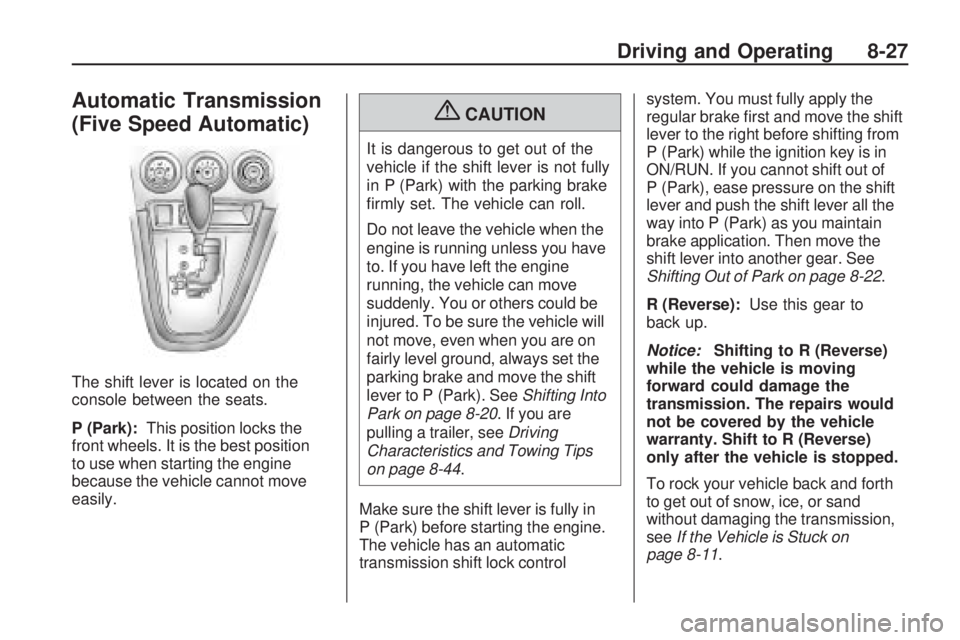
The shift lever is located on the
console between the seats.
P (Park):This position locks the
front wheels. It is the best position
to use when starting the engine
because the vehicle cannot move
easily.
{CAUTION
It is dangerous to get out of the
vehicle if the shift lever is not fully
in P (Park) with the parking brake
firmly set. The vehicle can roll.
Do not leave the vehicle when the
engine is running unless you have
to. If you have left the engine
running, the vehicle can move
suddenly. You or others could be
injured. To be sure the vehicle will
not move, even when you are on
fairly level ground, always set the
parking brake and move the shift
lever to P (Park). See Shifting Into
Park on page 8-20. If you are
pulling a trailer, see Driving
Characteristics and Towing Tips
on page 8-44.
Make sure the shift lever is fully in
P (Park) before starting the engine.
The vehicle has an automatic
transmission shift lock control system. You must fully apply the
regular brake first and move the shift
lever to the right before shifting from
P (Park) while the ignition key is in
ON/RUN. If you cannot shift out of
P (Park), ease pressure on the shift
lever and push the shift lever all the
way into P (Park) as you maintain
brake application. Then move the
shift lever into another gear. See
Shifting Out of Park on page 8-22
.
R (Reverse): Use this gear to
back up.
Notice: Shifting to R (Reverse)
while the vehicle is moving
forward could damage the
transmission. The repairs would
not be covered by the vehicle
warranty. Shift to R (Reverse)
only after the vehicle is stopped.
To rock your vehicle back and forth
to get out of snow, ice, or sand
without damaging the transmission,
see If the Vehicle is Stuck on
page 8-11.
Driving and Operating 8-27
Page 167 of 318
Parking Brake
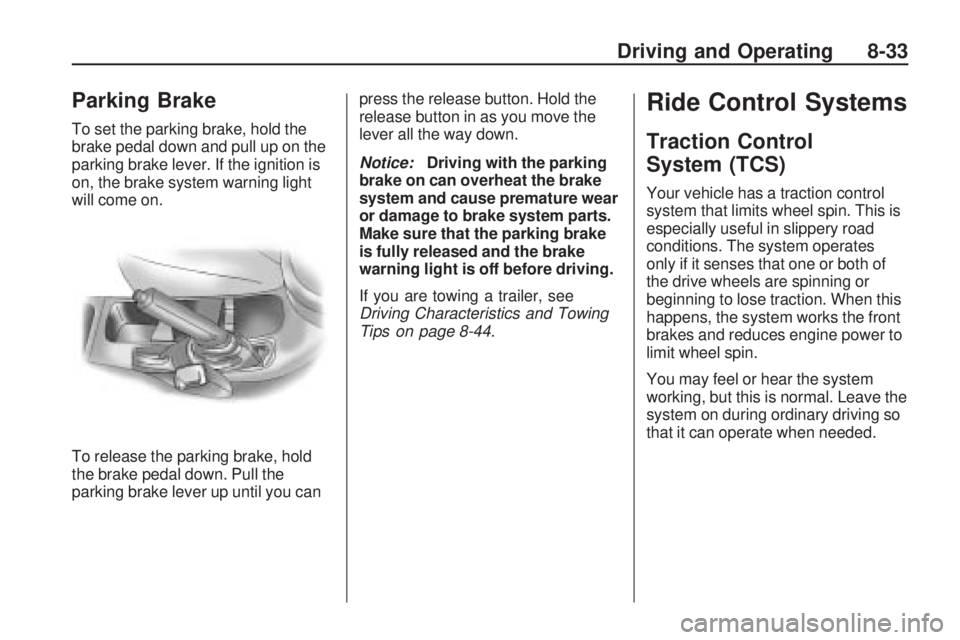
To set the parking brake, hold the
brake pedal down and pull up on the
parking brake lever. If the ignition is
on, the brake system warning light
will come on.
To release the parking brake, hold
the brake pedal down. Pull the
parking brake lever up until you canpress the release button. Hold the
release button in as you move the
lever all the way down.
Notice:
Driving with the parking
brake on can overheat the brake
system and cause premature wear
or damage to brake system parts.
Make sure that the parking brake
is fully released and the brake
warning light is off before driving.
If you are towing a trailer, see
Driving Characteristics and Towing
Tips on page 8-44.
Ride Control Systems
Traction Control
System (TCS)
Your vehicle has a traction control
system that limits wheel spin. This is
especially useful in slippery road
conditions. The system operates
only if it senses that one or both of
the drive wheels are spinning or
beginning to lose traction. When this
happens, the system works the front
brakes and reduces engine power to
limit wheel spin.
You may feel or hear the system
working, but this is normal. Leave the
system on during ordinary driving so
that it can operate when needed.
Driving and Operating 8-33
Page 168 of 318
When the ignition is turned to
ON/RUN, the system automatically
turns on. If the system has been
turned off, it will automatically turn on
at 55 km/h (35 mph). TCS cannot be
turned off above 55 km/h (35 mph).
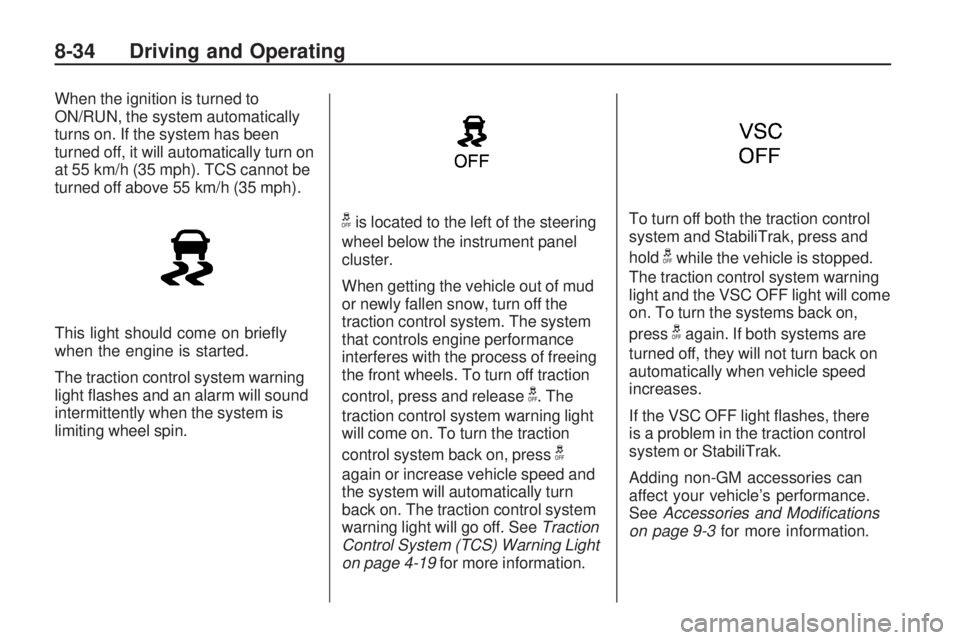
This light should come on briefly
when the engine is started.
The traction control system warning
light flashes and an alarm will sound
intermittently when the system is
limiting wheel spin.
gis located to the left of the steering
wheel below the instrument panel
cluster.
When getting the vehicle out of mud
or newly fallen snow, turn off the
traction control system. The system
that controls engine performance
interferes with the process of freeing
the front wheels. To turn off traction
control, press and release
g. The
traction control system warning light
will come on. To turn the traction
control system back on, press
g
again or increase vehicle speed and
the system will automatically turn
back on. The traction control system
warning light will go off. See Traction
Control System (TCS) Warning Light
on page 4-19 for more information. To turn off both the traction control
system and StabiliTrak, press and
hold
gwhile the vehicle is stopped.
The traction control system warning
light and the VSC OFF light will come
on. To turn the systems back on,
press
gagain. If both systems are
turned off, they will not turn back on
automatically when vehicle speed
increases.
If the VSC OFF light flashes, there
is a problem in the traction control
system or StabiliTrak.
Adding non-GM accessories can
affect your vehicle’s performance.
See Accessories and Modications
on page 9-3 for more information.
8-34 Driving and Operating
Page 172 of 318
Using Cruise Control on Hills
The cruise control performance will
vary depending upon the vehicle
speed, load, and the steepness of
the hills.
When going up steep hills, you might
have to step on the accelerator pedal
to maintain the vehicle speed.
When going downhill, you might
have to brake or shift to a lower gear
to keep the vehicle speed down.
Applying the brake or downshifting
to 2 SECOND or L LOW turns
off the cruise control.Ending Cruise Control
There are several ways to turn off
the cruise control:
•Step on the brake pedal or push
the clutch pedal, if the vehicle
has a manual transmission.
•Press the ON-OFF button.
•Pull the cruise control lever
toward you.
Erasing Speed Memory
The cruise control set speed memory
is erased when the cruise control or
the ignition is turned off.
Fuel
Use of the recommended fuel
is an important part of the proper
maintenance of this vehicle. To help
keep the engine clean and maintain
optimum vehicle performance, we
recommend the use of gasoline
advertised as TOP TIER Detergent
Gasoline.
Look for the TOP TIER label on the
fuel pump to ensure gasoline meets
enhanced detergency standards
developed by auto companies. A list
of marketers providing TOP TIER
Detergent Gasoline can be found at
www.toptiergas.com.
8-38 Driving and Operating
Page 223 of 318
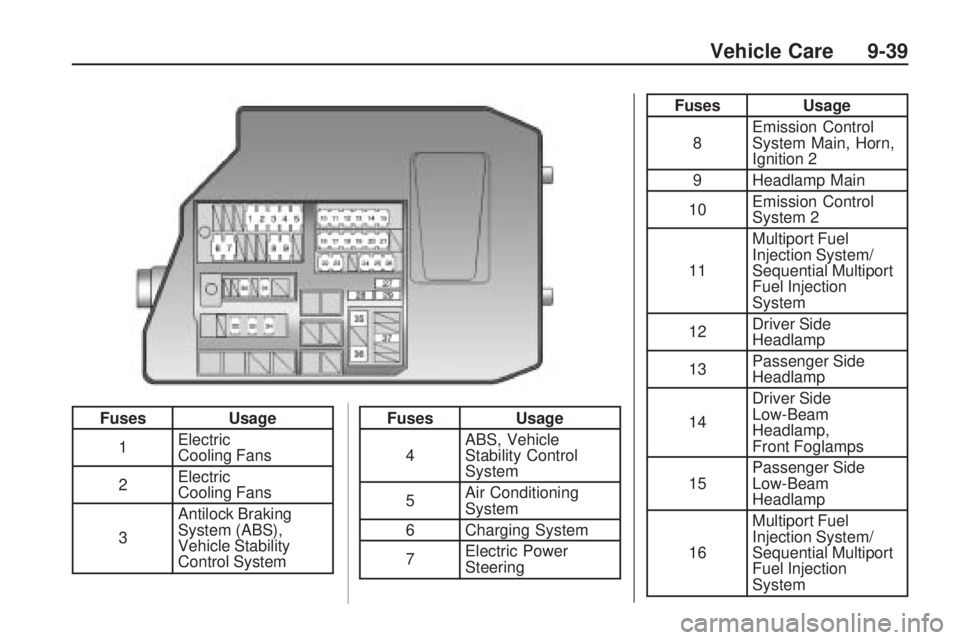
FusesUsage
1 Electric
Cooling Fans
2 Electric
Cooling Fans
3 Antilock Braking
System (ABS),
Vehicle Stability
Control SystemFuses
Usage
4 ABS, Vehicle
Stability Control
System
5 Air Conditioning
System
6 Charging System
7 Electric Power
Steering
Fuses
Usage
8 Emission Control
System Main, Horn,
Ignition 2
9 Headlamp Main
10 Emission Control
System 2
11 Multiport Fuel
Injection System/
Sequential Multiport
Fuel Injection
System
12 Driver Side
Headlamp
13 Passenger Side
Headlamp
14 Driver Side
Low-Beam
Headlamp,
Front Foglamps
15 Passenger Side
Low-Beam
Headlamp
16 Multiport Fuel
Injection System/
Sequential Multiport
Fuel Injection
System
Vehicle Care 9-39