ignition PONTIAC VIBE 2010 Service Manual
[x] Cancel search | Manufacturer: PONTIAC, Model Year: 2010, Model line: VIBE, Model: PONTIAC VIBE 2010Pages: 318, PDF Size: 1.7 MB
Page 224 of 318
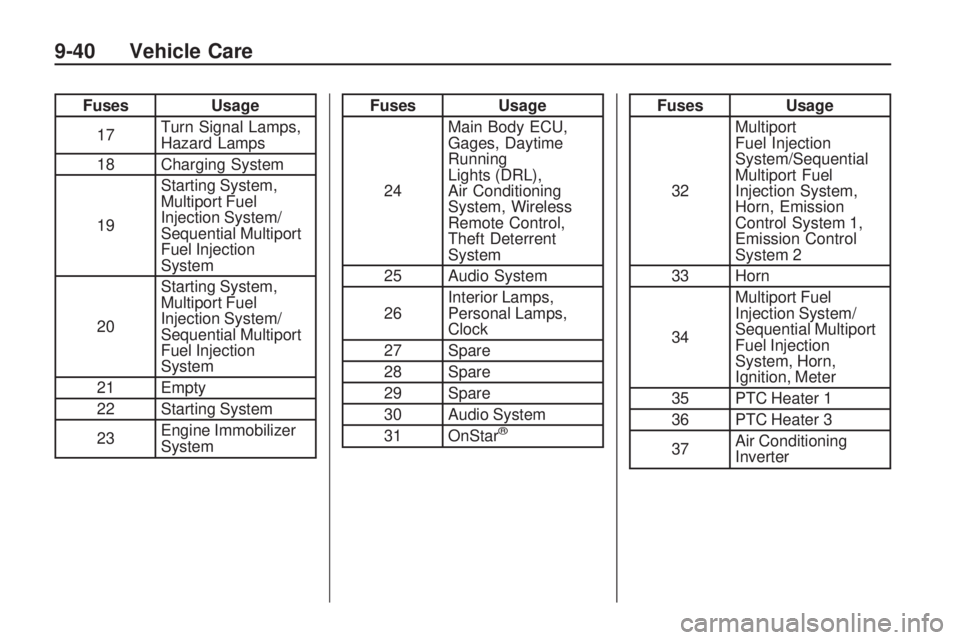
FusesUsage
17 Turn Signal Lamps,
Hazard Lamps
18 Charging System
19 Starting System,
Multiport Fuel
Injection System/
Sequential Multiport
Fuel Injection
System
20 Starting System,
Multiport Fuel
Injection System/
Sequential Multiport
Fuel Injection
System
21 Empty
22 Starting System
23 Engine Immobilizer
SystemFuses
Usage
24 Main Body ECU,
Gages, Daytime
Running
Lights (DRL),
Air Conditioning
System, Wireless
Remote Control,
Theft Deterrent
System
25 Audio System
26 Interior Lamps,
Personal Lamps,
Clock
27 Spare
28 Spare
29 Spare
30 Audio System
31 OnStar
®
Fuses Usage
32 Multiport
Fuel Injection
System/Sequential
Multiport Fuel
Injection System,
Horn, Emission
Control System 1,
Emission Control
System 2
33 Horn
34 Multiport Fuel
Injection System/
Sequential Multiport
Fuel Injection
System, Horn,
Ignition, Meter
35 PTC Heater 1
36 PTC Heater 3
37 Air Conditioning
Inverter
9-40 Vehicle Care
Page 227 of 318
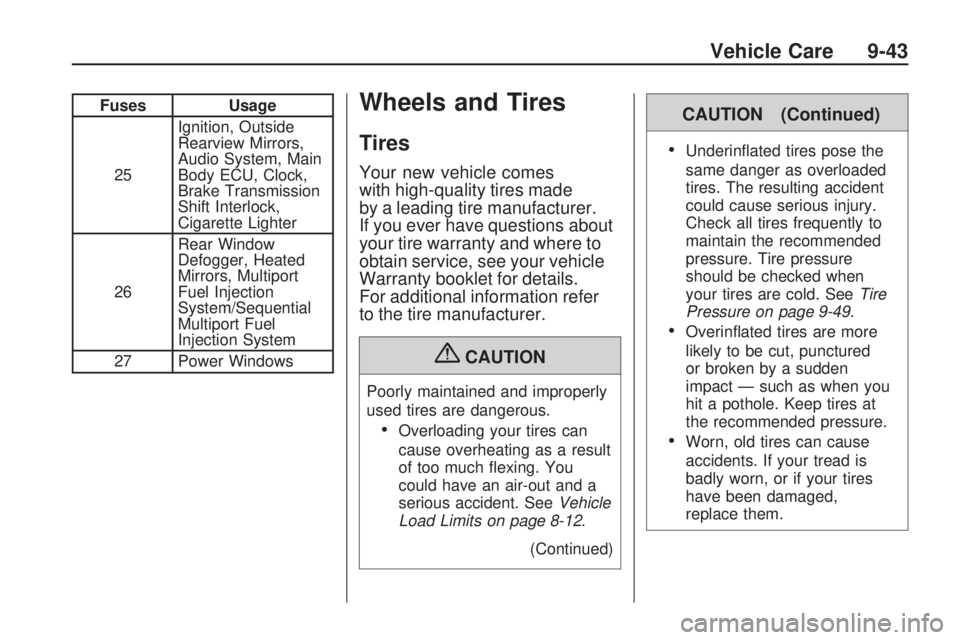
FusesUsage
25 Ignition, Outside
Rearview Mirrors,
Audio System, Main
Body ECU, Clock,
Brake Transmission
Shift Interlock,
Cigarette Lighter
26 Rear Window
Defogger, Heated
Mirrors, Multiport
Fuel Injection
System/Sequential
Multiport Fuel
Injection System
27 Power WindowsWheels and Tires
Tires
Your new vehicle comes
with high-quality tires made
by a leading tire manufacturer.
If you ever have questions about
your tire warranty and where to
obtain service, see your vehicle
Warranty booklet for details.
For additional information refer
to the tire manufacturer.
{CAUTION
Poorly maintained and improperly
used tires are dangerous.
•Overloading your tires can
cause overheating as a result
of too much flexing. You
could have an air-out and a
serious accident. See Vehicle
Load Limits on page 8-12 .
(Continued)
CAUTION (Continued)
•Underinflated tires pose the
same danger as overloaded
tires. The resulting accident
could cause serious injury.
Check all tires frequently to
maintain the recommended
pressure. Tire pressure
should be checked when
your tires are cold. See Tire
Pressure on page 9-49 .
•Overinflated tires are more
likely to be cut, punctured
or broken by a sudden
impact — such as when you
hit a pothole. Keep tires at
the recommended pressure.
•Worn, old tires can cause
accidents. If your tread is
badly worn, or if your tires
have been damaged,
replace them.
Vehicle Care 9-43
Page 236 of 318
Tire Pressure Monitor
Operation
This vehicle may have a Tire
Pressure Monitor System (TPMS).
The TPMS warns the driver when a
low tire pressure condition exists.
TPMS sensors are mounted onto
each tire and wheel assembly,
excluding the spare tire and
wheel assembly.
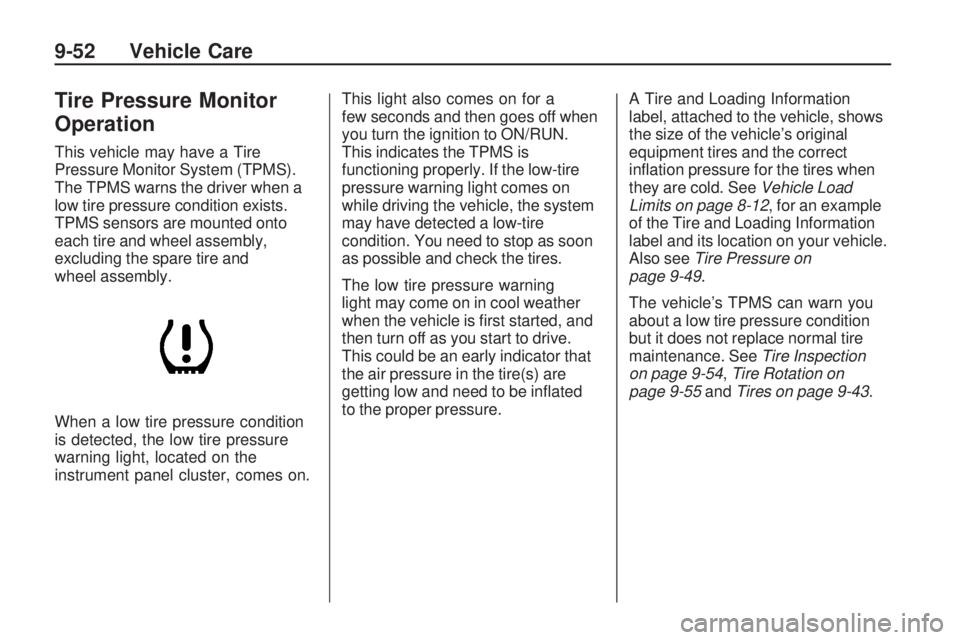
When a low tire pressure condition
is detected, the low tire pressure
warning light, located on the
instrument panel cluster, comes on.This light also comes on for a
few seconds and then goes off when
you turn the ignition to ON/RUN.
This indicates the TPMS is
functioning properly. If the low-tire
pressure warning light comes on
while driving the vehicle, the system
may have detected a low-tire
condition. You need to stop as soon
as possible and check the tires.
The low tire pressure warning
light may come on in cool weather
when the vehicle is first started, and
then turn off as you start to drive.
This could be an early indicator that
the air pressure in the tire(s) are
getting low and need to be inflated
to the proper pressure.
A Tire and Loading Information
label, attached to the vehicle, shows
the size of the vehicle’s original
equipment tires and the correct
inflation pressure for the tires when
they are cold. See
Vehicle Load
Limits on page 8-12, for an example
of the Tire and Loading Information
label and its location on your vehicle.
Also see Tire Pressure on
page 9-49.
The vehicle’s TPMS can warn you
about a low tire pressure condition
but it does not replace normal tire
maintenance. See Tire Inspection
on page 9-54, Tire Rotation on
page 9-55 andTires on page 9-43.
9-52 Vehicle Care
Page 237 of 318

TPMS Malfunction Light
The TPMS will not function properly
if one or more of the TPMS sensors
are missing or inoperable. When the
system detects a malfunction, the
low tire warning light flashes for
about one minute and then stays
on for the remainder of the ignition
cycle. The low tire warning light
comes on at each ignition cycle until
the problem is corrected. Some of
the conditions that can cause the
malfunction light to come on are:
•One of the road tires has been
replaced with the spare tire.
The spare tire does not have
a TPMS sensor. The TPMS
malfunction light and DIC
message should go off once
you re-install the road tire
containing the TPMS sensor.
•The initialization (reset) procedure
failed. See “TPMS Reset” later in
this section.
•One or more TPMS sensors
are missing or damaged.
The TPMS malfunction light
should go off when the TPMS
sensors are installed and the
sensor matching process is
performed successfully. See
your dealer/retailer for service.
•Replacement tires or wheels do
not match the vehicle’s original
equipment tires or wheels. Tires
and wheels other than those
recommended for your vehicle
could prevent the TPMS from
functioning properly. SeeBuying
New Tires on page 9-56.
•Operating electronic devices or
being near facilities using radio
wave frequencies similar to the
TPMS could cause the TPMS
sensors to malfunction.
•If tire chains are installed on the
vehicle.
•If there is a lot of snow or ice
around the wheels or wheel
housings.
•If a window tint that affects the
radio wave signals is installed.
If the TPMS is not functioning it
cannot detect or signal a low tire
condition. See your dealer/retailer for
service if the TPMS malfunction light
comes on and stays on.
Vehicle Care 9-53
Page 238 of 318

TPMS Reset
The TPMS sensors and transmitters
have unique identification codes.
Anytime you replace a TPMS sensor
or transmitter the identification codes
need to be registered and the TPMS
needs to be reset (initialized). When
the system is initialized, the current
air pressure in the tires is set as the
tire pressure benchmark. The tire
pressure warning system determines
decreased air pressure by comparing
tire pressure to the benchmark
pressure stored in the TPMS.
Do not reset the TPMS without first
correcting the cause of a low-tire
condition.
To reset the system:
1. Park the vehicle at a safe placeand apply the parking brake.
Turn the engine off.
2. Turn the ignition to ACC/ACCESSORY or
LOCK/OFF. 3. Adjust the tire pressure of all the
installed tires to the specified
cold tire inflation pressure level
indicated on the Tire and Loading
Information label attached to
the vehicle.
4. Turn the ignition to ON/RUN with the engine off.
5. Press and hold the tire pressure warning reset switch until the tire
pressure warning light flashes
slowly on/off three times.
Wait for a few minutes with the
ignition in ON/RUN, and then turn
the ignition to ACC/ACCESSORY
or LOCK/OFF. If the low-tire pressure warning
light does not flash three times
while you press and hold the
reset button, the reset has failed.
Repeat the reset process. If the
reset cannot be performed, see
your dealer/retailer for service.
If you press the tire pressure reset
switch while the vehicle is moving,
the reset is not performed. If you
press the tire pressure reset switch
accidentally and initialization is
performed, adjust the tire pressure to
the specified level and perform the
reset procedure again.
Tire Inspection
We recommend that you
regularly inspect your vehicle’s
tires, including the spare tire, if
the vehicle has one, for signs of
wear or damage. See When It Is
Time for New Tires on page 9-56
for more information.
9-54 Vehicle Care
Page 254 of 318
To avoid the possibility of the
vehicles rolling, set the parking
brake firmly on both vehicles
involved in the jump start
procedure. Put an automatic
transmission in P (Park) or
a manual transmission in
NEUTRAL before setting
the parking brake.
Notice: If you leave the radio or
other accessories on during the
jump starting procedure, they
could be damaged. The repairs
would not be covered by the
warranty. Always turn off the
radio and other accessories
when jump starting the vehicle.
3. Turn off the ignition on both vehicles. Unplug unnecessary
accessories plugged into the
cigarette lighter. Turn off the radio
and all lamps that are not needed.
This will avoid sparks and help
save both batteries. And it could
save the radio! 4. Open the hoods and locate the
batteries. Find the positive (+)
and negative (−) terminal
locations on each vehicle.
See Engine Compartment
Overview on page 9-6 for
more information on location.
{CAUTION
An electric fan can start up even
when the engine is not running
and can injure you. Keep hands,
clothing and tools away from any
underhood electric fan.
{CAUTION
Using a match near a battery
can cause battery gas to explode.
People have been hurt doing this,
and some have been blinded. Use
a flashlight if you need more light.
(Continued)
CAUTION (Continued)
Be sure the battery has enough
water. You do not need to add
water to the battery installed in
your new vehicle. But if a battery
has filler caps, be sure the right
amount of fluid is there. If it is
low, add water to take care of that
first. If you don’t, explosive gas
could be present.
Battery fluid contains acid that
can burn you. Do not get it on
you. If you accidentally get it in
your eyes or on your skin, flush
the place with water and get
medical help immediately.
{CAUTION
Fans or other moving engine
parts can injure you badly. Keep
your hands away from moving
parts once the engine is running.
9-70 Vehicle Care
Page 258 of 318
Here are some important things
to consider before recreational
vehicle towing:
•What is the towing capacity of the
towing vehicle? Be sure to read
the tow vehicle manufacturer’s
recommendations.
•What is the distance that will be
travelled? Some vehicles have
restrictions on how far and how
long they can tow.
•Is the proper equipment going to
be used? See your dealer/retailer
or trailering professional for
additional advice and equipment
recommendations.
•Is the vehicle ready to be towed?
Just as preparing the vehicle for a
long trip, make sure the vehicle is
prepared to be towed.
Dinghy Towing
If the vehicle has an automatic
transmission, it cannot be dinghy
towed. See “Dolly Towing” for more
information regarding towing the
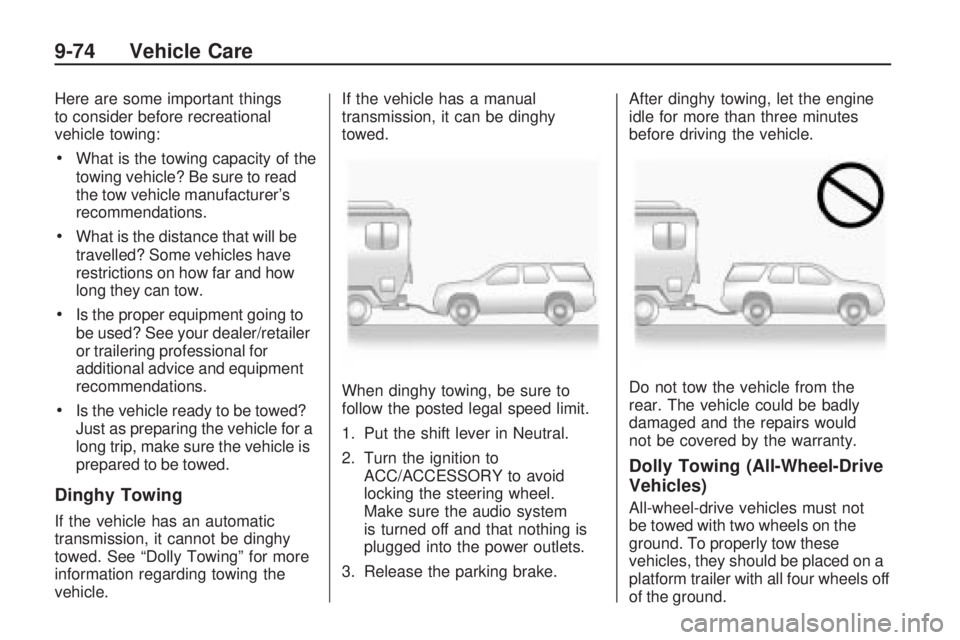
vehicle.If the vehicle has a manual
transmission, it can be dinghy
towed.
When dinghy towing, be sure to
follow the posted legal speed limit.
1. Put the shift lever in Neutral.
2. Turn the ignition to
ACC/ACCESSORY to avoid
locking the steering wheel.
Make sure the audio system
is turned off and that nothing is
plugged into the power outlets.
3. Release the parking brake. After dinghy towing, let the engine
idle for more than three minutes
before driving the vehicle.
Do not tow the vehicle from the
rear. The vehicle could be badly
damaged and the repairs would
not be covered by the warranty.
Dolly Towing (All-Wheel-Drive
Vehicles)
All-wheel-drive vehicles must not
be towed with two wheels on the
ground. To properly tow these
vehicles, they should be placed on a
platform trailer with all four wheels off
of the ground.
9-74 Vehicle Care
Page 259 of 318
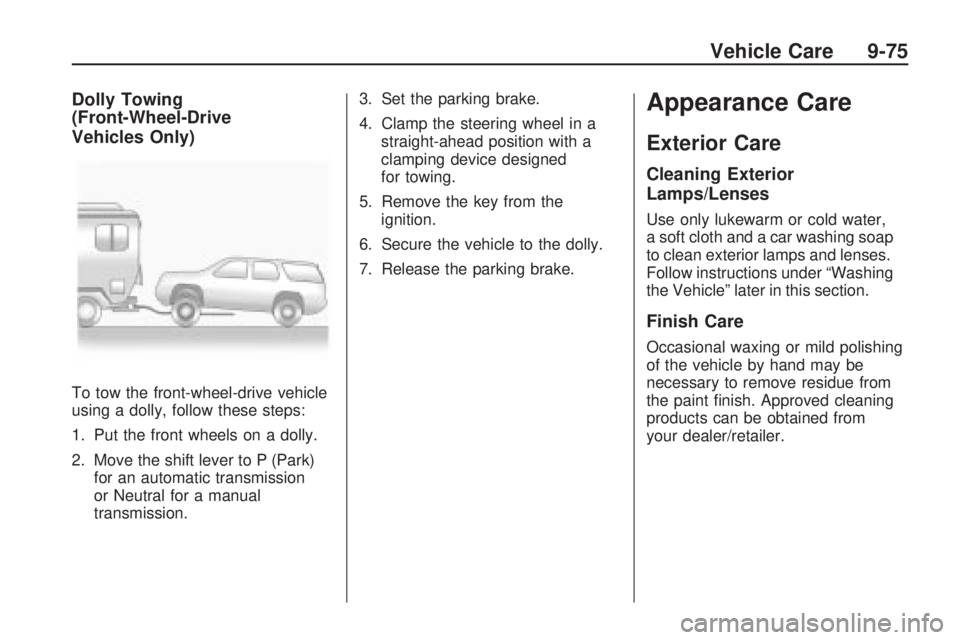
Dolly Towing
(Front-Wheel-Drive
Vehicles Only)
To tow the front-wheel-drive vehicle
using a dolly, follow these steps:
1. Put the front wheels on a dolly.
2. Move the shift lever to P (Park)for an automatic transmission
or Neutral for a manual
transmission. 3. Set the parking brake.
4. Clamp the steering wheel in a
straight-ahead position with a
clamping device designed
for towing.
5. Remove the key from the ignition.
6. Secure the vehicle to the dolly.
7. Release the parking brake.
Appearance Care
Exterior Care
Cleaning Exterior
Lamps/Lenses
Use only lukewarm or cold water,
a soft cloth and a car washing soap
to clean exterior lamps and lenses.
Follow instructions under “Washing
the Vehicle” later in this section.
Finish Care
Occasional waxing or mild polishing
of the vehicle by hand may be
necessary to remove residue from
the paint finish. Approved cleaning
products can be obtained from
your dealer/retailer.
Vehicle Care 9-75
Page 280 of 318
At Least Once a Year
Key Lock Cylinders Service
Lubricate the key lock cylinders
with the lubricant specified in
Recommended Fluids and
Lubricants on page 10-15.
Seat Operation Check
Make sure the head restraints stay
in position and all seat latches
lock. Check that the recliner holds
by pushing and pulling the seatback
while it is reclined.
Body Lubrication Service
Lubricate all hood latch assembly,
secondary latch, pivots, spring
anchor, release pawl, hood and
body door hinges, rear compartment,
and any folding seat hardware.
Recommended Fluids and
Lubricants on page 10-15 tells
you what to use. More frequent
lubrication might be required when
exposed to a corrosive environment.
Starter Switch Check
See Starter Switch Check on
page 9-30. Automatic Transmission Shift
Lock Control System Check
{CAUTION
When you are doing this
inspection, the vehicle could move
suddenly. If the vehicle moves,
you or others could be injured.
1. Before starting this check, be sure there is enough room around the
vehicle. It should be parked on a
level surface.
2. Firmly apply the parking brake. See Parking Brake on page 8-33 .
Be ready to apply the regular
brake immediately if the vehicle
begins to move.
3. With the engine off, turn the ignition to ON/RUN, but do not
start the engine. Without applying
the regular brake, try to move the
shift lever out of P (Park) with
normal effort. If the shift lever
moves out of P (Park), contact
your dealer/retailer for service. Ignition Transmission Lock
Check
While parked, and with the parking
brake set, try to turn the ignition
to LOCK/OFF in each shift
lever position.
•For automatic transmission
vehicles, the ignition should
turn to LOCK/OFF only when
the shift lever is in P (Park).
•For manual transmission
vehicles, the ignition should
turn to LOCK/OFF only if
you push the ignition key in
farther, while turning it toward
LOCK/OFF.
Contact your dealer/retailer if
service is required.
10-12 Service and Maintenance
Page 308 of 318
Radio Frequency
Identication (RFID)
RFID technology is used in some
vehicles for functions such as tire
pressure monitoring and ignition
system security, as well as in
connection with conveniences such
as key fobs for remote door locking/
unlocking and starting, and in-vehicle
transmitters for garage door openers.
RFID technology in GM vehicles
does not use or record personal
information or link with any other
GM system containing personal
information.
Radio Frequency
Statement (US, Can)
This vehicle has systems that
operate on a radio frequency that
comply with Part 15 of the Federal
Communications Commission (FCC)
Rules and with RSS-210/211 of
Industry and Science Canada.
Operation is subject to the following
two conditions:
1. The device may not causeinterference.
2. The device must accept any interference received, including
interference that may cause
undesired operation of the device.
Changes or modifications to any of
these systems by other than an
authorized service facility could void
authorization to use this equipment.
12-16 Customer Information