tow PONTIAC VIBE 2010 Workshop Manual
[x] Cancel search | Manufacturer: PONTIAC, Model Year: 2010, Model line: VIBE, Model: PONTIAC VIBE 2010Pages: 318, PDF Size: 1.7 MB
Page 251 of 318
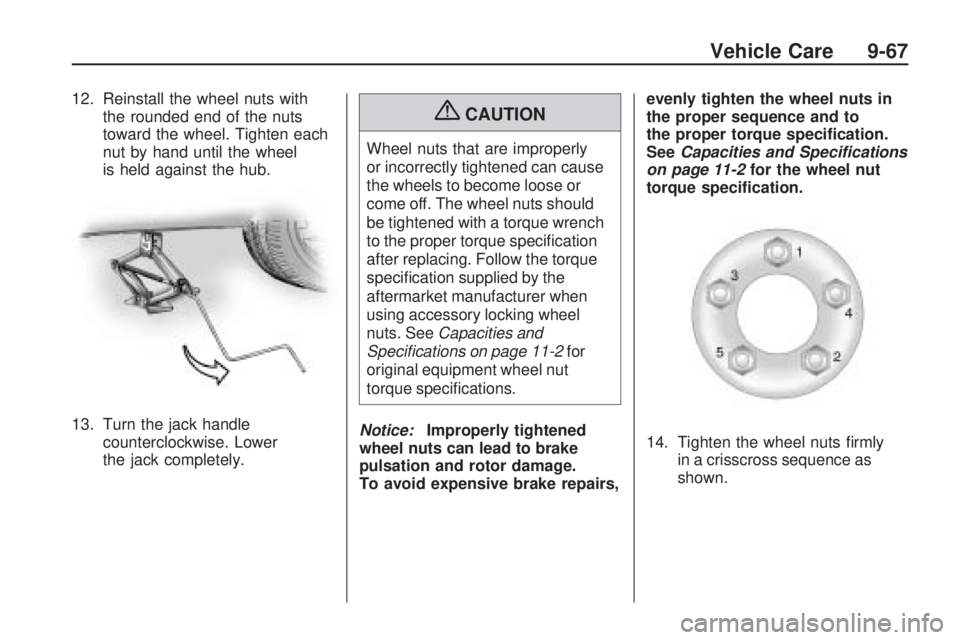
12. Reinstall the wheel nuts withthe rounded end of the nuts
toward the wheel. Tighten each
nut by hand until the wheel
is held against the hub.
13. Turn the jack handle counterclockwise. Lower
the jack completely.{CAUTION
Wheel nuts that are improperly
or incorrectly tightened can cause
the wheels to become loose or
come off. The wheel nuts should
be tightened with a torque wrench
to the proper torque specification
after replacing. Follow the torque
specification supplied by the
aftermarket manufacturer when
using accessory locking wheel
nuts. See Capacities and
Specications on page 11-2 for
original equipment wheel nut
torque specifications.
Notice: Improperly tightened
wheel nuts can lead to brake
pulsation and rotor damage.
To avoid expensive brake repairs, evenly tighten the wheel nuts in
the proper sequence and to
the proper torque specication.
See
Capacities and Specifications
on page 11-2 for the wheel nut
torque specication.
14. Tighten the wheel nuts firmly in a crisscross sequence as
shown.
Vehicle Care 9-67
Page 257 of 318
To disconnect the jumper cables
from both vehicles, do the following:
1. Disconnect the black negative (−)
cable from the vehicle that had
the dead battery.
2. Disconnect the black negative ( −)
cable from the vehicle with the
good battery.
3. Disconnect the red positive (+) cable from the vehicle with the
good battery.
4. Disconnect the red positive (+) cable from the other vehicle.Towing
Towing the Vehicle
To avoid damage, the disabled
vehicle should be towed with all
four wheels off the ground. Consult
your dealer/retailer or a professional
towing service if the disabled vehicle
must be towed. See Roadside
Assistance Program on page 12-6 .
To tow the vehicle behind
another vehicle for recreational
purposes — such as behind
a motorhome, see Recreational
Vehicle Towing following.
Recreational Vehicle
Towing
Recreational vehicle towing means
towing the vehicle behind another
vehicle – such as behind a
motorhome. The two most common
types of recreational vehicle towing
are known as dinghy towing and
dolly towing. Dinghy towing is towing
the vehicle with all four wheels on
the ground. Dolly towing is towing
the vehicle with two wheels on the
ground and two wheels up on a
device known as a dolly.
Vehicle Care 9-73
Page 258 of 318
Here are some important things
to consider before recreational
vehicle towing:
•What is the towing capacity of the
towing vehicle? Be sure to read
the tow vehicle manufacturer’s
recommendations.
•What is the distance that will be
travelled? Some vehicles have
restrictions on how far and how
long they can tow.
•Is the proper equipment going to
be used? See your dealer/retailer
or trailering professional for
additional advice and equipment
recommendations.
•Is the vehicle ready to be towed?
Just as preparing the vehicle for a
long trip, make sure the vehicle is
prepared to be towed.
Dinghy Towing
If the vehicle has an automatic
transmission, it cannot be dinghy
towed. See “Dolly Towing” for more
information regarding towing the
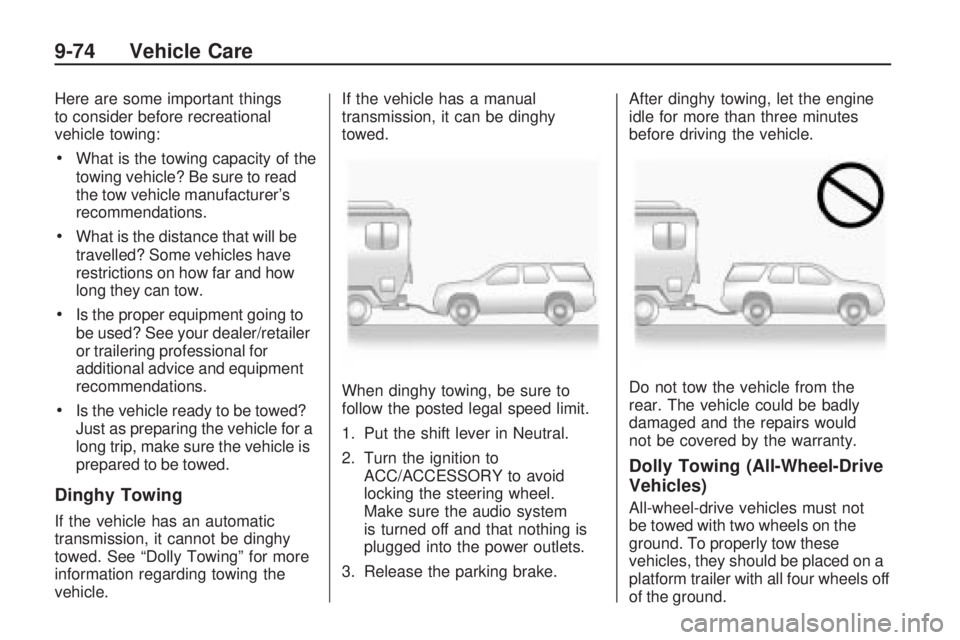
vehicle.If the vehicle has a manual
transmission, it can be dinghy
towed.
When dinghy towing, be sure to
follow the posted legal speed limit.
1. Put the shift lever in Neutral.
2. Turn the ignition to
ACC/ACCESSORY to avoid
locking the steering wheel.
Make sure the audio system
is turned off and that nothing is
plugged into the power outlets.
3. Release the parking brake. After dinghy towing, let the engine
idle for more than three minutes
before driving the vehicle.
Do not tow the vehicle from the
rear. The vehicle could be badly
damaged and the repairs would
not be covered by the warranty.
Dolly Towing (All-Wheel-Drive
Vehicles)
All-wheel-drive vehicles must not
be towed with two wheels on the
ground. To properly tow these
vehicles, they should be placed on a
platform trailer with all four wheels off
of the ground.
9-74 Vehicle Care
Page 259 of 318
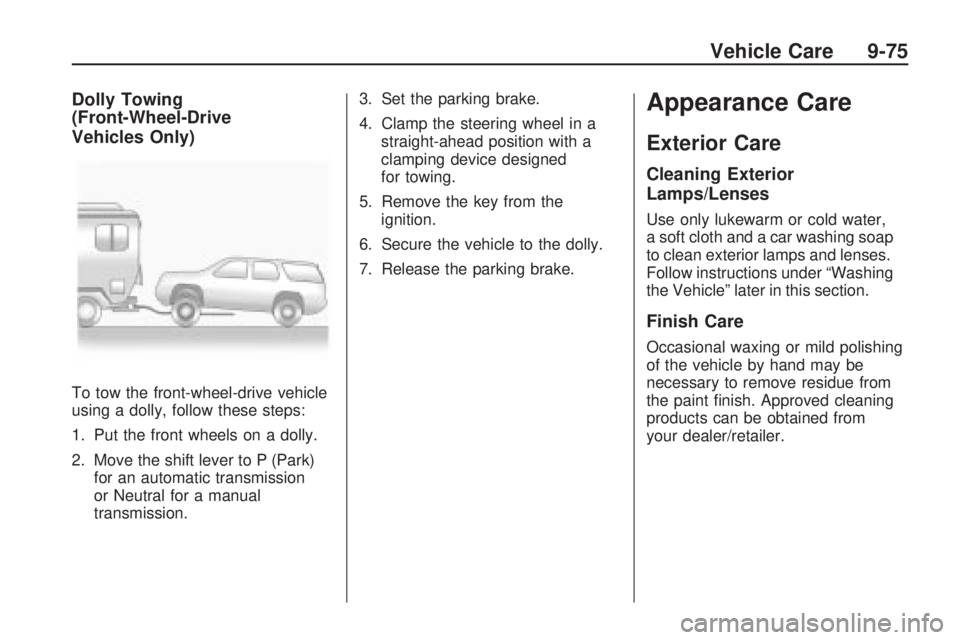
Dolly Towing
(Front-Wheel-Drive
Vehicles Only)
To tow the front-wheel-drive vehicle
using a dolly, follow these steps:
1. Put the front wheels on a dolly.
2. Move the shift lever to P (Park)for an automatic transmission
or Neutral for a manual
transmission. 3. Set the parking brake.
4. Clamp the steering wheel in a
straight-ahead position with a
clamping device designed
for towing.
5. Remove the key from the ignition.
6. Secure the vehicle to the dolly.
7. Release the parking brake.
Appearance Care
Exterior Care
Cleaning Exterior
Lamps/Lenses
Use only lukewarm or cold water,
a soft cloth and a car washing soap
to clean exterior lamps and lenses.
Follow instructions under “Washing
the Vehicle” later in this section.
Finish Care
Occasional waxing or mild polishing
of the vehicle by hand may be
necessary to remove residue from
the paint finish. Approved cleaning
products can be obtained from
your dealer/retailer.
Vehicle Care 9-75
Page 261 of 318
Washing the Vehicle
To preserve the vehicle’s finish,
keep it clean by washing it often.
Do not wash the vehicle in
direct sunlight and use a car
washing soap.
Notice:Certain cleaners contain
chemicals that can damage the
emblems or nameplates on the
vehicle. Check the cleaning
product label. If it states that it
should not be used on plastic
parts, do not use it on the vehicle
or damage may occur and it would
not be covered by the warranty.
Do not use cleaning agents that are
petroleum based or that contain acid
or abrasives, as they can damage
the paint, metal or plastic on the
vehicle. Approved cleaning products
can be obtained from your dealer/
retailer. Follow all manufacturers’ directions regarding correct product
usage, necessary safety precautions
and appropriate disposal of any
vehicle care product.
Rinse the vehicle well, before
washing and after to remove all
cleaning agents completely. If they
are allowed to dry on the surface,
they could stain.
Dry the finish with a soft, clean
chamois or an all-cotton towel
to avoid surface scratches and
water spotting.
High pressure car washes may
cause water to enter the vehicle.
Avoid using high pressure washes
closer than 12 inches (30 cm) to the
surface of the vehicle. Use of power
washers exceeding 1,200 psi
(8 274 kPa) can result in damage
or removal of paint and decals.
Notice:
Conveyor systems on
some automatic car washes could
damage the vehicle. There may
not be enough clearance for
the undercarriage. Check with the
car wash manager before using
the automatic car wash.
Weatherstrips
Silicone grease on weatherstrips will
make them last longer, seal better,
and not stick or squeak. Apply
silicone grease with a clean cloth.
During very cold, damp weather
frequent application may be required.
See “Fluids and Lubricants” in the
Index of the “Maintenance and
Warranty and Owner assistance
Information” manual.
Vehicle Care 9-77
Page 262 of 318
Wheels and Trim — Aluminum
or Chrome
The vehicle may have either
aluminum or chrome-plated wheels.
Keep the wheels clean using a
soft clean cloth with mild soap
and water. Rinse with clean water.
After rinsing thoroughly, dry with
a soft clean towel. A wax may
then be applied.
Notice:Chrome wheels and
other chrome trim may be
damaged if the vehicle is not
washed after driving on roads
that have been sprayed with
magnesium, calcium or sodium
chloride. These chlorides are
used on roads for conditions
such as ice and dust. Always
wash the vehicle’s chrome with
soap and water after exposure. Notice:
Using strong soaps,
chemicals, abrasive polishes,
cleaners, brushes, or cleaners
that contain acid on aluminum
or chrome-plated wheels,
could damage the surface of the
wheel(s). The repairs would
not be covered by the vehicle
warranty. Use only approved
cleaners on aluminum or
chrome-plated wheels.
The surface of these wheels is
similar to the painted surface of the
vehicle. Do not use strong soaps,
chemicals, abrasive polishes,
abrasive cleaners, cleaners with
acid, or abrasive cleaning brushes
on them because the surface could
be damaged. Do not use chrome
polish on aluminum wheels. Notice:
Using chrome polish on
aluminum wheels could damage
the wheels. The repairs would
not be covered by the vehicle
warranty. Use chrome polish
on chrome wheels only.
Use chrome polish only on
chrome-plated wheels, but avoid
any painted surface of the wheel,
and buff off immediately after
application.
Notice: Driving the vehicle
through an automatic car wash
that has silicone carbide tire
cleaning brushes, could damage
the aluminum or chrome-plated
wheels. The repairs would not be
covered by the vehicle warranty.
Never drive a vehicle that has
aluminum or chrome-plated
wheels through an automatic car
wash that uses silicone carbide
tire cleaning brushes.
9-78 Vehicle Care
Page 263 of 318
Windshield and Wiper Blades
Clean the outside of the windshield
with glass cleaner.
Clean the rubber blades using a
lint free cloth or paper towel soaked
with windshield washer fluid or a mild
detergent. Wash the windshield
thoroughly when cleaning the blades.
Bugs, road grime, sap, and a buildup
of vehicle wash/wax treatments may
cause wiper streaking. Replace the
wiper blades if they are worn or
damaged.
Wipers can be damaged by:
•Extreme dusty conditions
•Sand and salt
•Heat and sun
•Snow and ice, without proper
removal
Tires
Use a stiff brush with tire cleaner to
clean the tires.
Notice:Using petroleum-based
tire dressing products on the
vehicle may damage the paint
nish and/or tires. When applying
a tire dressing, always wipe off
any overspray from all painted
surfaces on the vehicle.
Sheet Metal Damage
If the vehicle is damaged and
requires sheet metal repair or
replacement, make sure the body
repair shop applies anti-corrosion
material to parts repaired or
replaced to restore corrosion
protection.
Original manufacturer replacement
parts will provide the corrosion
protection while maintaining
the vehicle warranty.
Finish Damage
Any stone chips, fractures or deep
scratches in the finish should be
repaired right away. Bare metal will
corrode quickly and may develop into
major repair expense.
Minor chips and scratches can be
repaired with touch-up materials
available from your dealer/retailer.
Larger areas of finish damage can be
corrected in your dealer’s/retailer’s
body and paint shop.
Underbody Maintenance
Chemicals used for ice and snow
removal and dust control can collect
on the underbody. If these are not
removed, corrosion and rust can
develop on the underbody parts such
as fuel lines, frame, floor pan, and
exhaust system even though they
have corrosion protection.
Vehicle Care 9-79
Page 265 of 318
Cleaners can contain solvents that
can become concentrated in the
vehicle’s interior. Before using
cleaners, read and adhere to all
safety instructions on the label.
While cleaning the vehicle’s interior,
maintain adequate ventilation by
opening the vehicle’s doors and
windows.
Do not clean the interior using the
following cleaners or techniques:
•Never use a knife or any
other sharp object to remove a
soil from any interior surface.
•Never use a stiff brush. It can
cause damage to the vehicle’s
interior surfaces.
•Never apply heavy pressure or
rub aggressively with a cleaning
cloth. Use of heavy pressure can
damage the interior and does not
improve the effectiveness of soil
removal.
•Use only mild, neutral-pH soaps.
Avoid laundry detergents
or dishwashing soaps with
degreasers. Using too much
soap will leave a residue that
leaves streaks and attracts dirt.
For liquid cleaners, about
20 drops per gallon (3.78 L)
of water is a good guide.
•Do not heavily saturate the
upholstery while cleaning.
•Damage to the vehicle’s interior
may result from the use of many
organic solvents such as naptha,
alcohol, etc.
Fabric/Carpet
Use a vacuum cleaner with a soft
brush attachment to remove dust
and loose dirt. A canister vacuum
with a beater bar in the nozzle may
only be used on floor carpet and
carpeted floor mats. For soils, always
try to remove them first with plain
water or club soda. Before cleaning,
gently remove as much of the soil as
possible using one of the following
techniques:
•For liquids: gently blot the
remaining soil with a paper towel.
Allow the soil to absorb into the
paper towel until no more can be
removed.
•For solid dry soils: remove as
much as possible and then
vacuum.
Vehicle Care 9-81
Page 266 of 318
To clean:
1. Saturate a lint-free, clean whitecloth with water or club soda.
2. Remove excess moisture.
3. Start on the outside edge of the soil and gently rub toward the
center. Continue cleaning, using
a clean area of the cloth each
time it becomes soiled.
4. Continue to gently rub the soiled area.
5. If the soil is not completely removed, use a mild soap
solution and repeat the cleaning
process with plain water.
If any of the soil remains, a
commercial fabric cleaner or spot
lifter may be necessary. Test a small
hidden area for colorfastness before
using a commercial upholstery
cleaner or spot lifter. If the locally
cleaned area gives any impression
that a ring formation may result,
clean the entire surface. A paper towel can be used to blot
excess moisture from the fabric
or carpet after the cleaning process.
Leather
To remove dust, a soft cloth
dampened with water can be used.
If a more thorough cleaning is
necessary, a soft cloth dampened
with a mild soap solution can be
used. Allow the leather to dry
naturally. Do not use heat, steam,
or spot lifters or spot removers,
or shoe polish on leather. Many
commercial leather cleaners and
coatings that are sold to preserve
and protect leather may permanently
change the appearance and
feel of the leather and are not
recommended. Do not use silicone
or wax-based products, or those
containing organic solvents to
clean the vehicle’s interior because
they can alter the appearance by
increasing the gloss in a non-uniform
manner.
Instrument Panel, Vinyl, and
Other Plastic Surfaces
To remove dust, a soft cloth
dampened with water can be used.
If a more thorough cleaning is
necessary, a clean soft cloth
dampened with a mild soap
solution can be used to gently
remove dust and dirt. Never use
spot lifters or removers on plastic
surfaces. Many commercial cleaners
and coatings that are sold to
preserve and protect soft plastic
surfaces may permanently change
the appearance and feel of the
interior and are not recommended.
Do not use silicone or wax-based
products, or those containing organic
solvents to clean the vehicle’s
interior because they can alter the
appearance by increasing the gloss
in a non-uniform manner.
9-82 Vehicle Care
Page 271 of 318
Scheduled
Maintenance
The services shown in this schedule
up to 192 000 km (120,000 miles)
should be repeated after 192 000 km
(120,000 miles) at the same intervals
for the life of this vehicle.
Footnotes
†The U.S. Environmental Protection
Agency or the California Air
Resources Board has determined
that the failure to perform this
maintenance item will not nullify the
emissions warranty or limit recall
liability prior to the completion of the
vehicle’s useful life. We, however,
urge that all recommended
maintenance services be performed
at the indicated intervals and the
maintenance be recorded.
+ A good time to check your brakes
is during tire rotation. See Tire
Rotation on page 9-55 .
8 000 km (5,000 Miles)
❑Change engine oil and filter
(or every 3 months, whichever
occurs first). An Emission Control
Service.
❑ Rotate tires. See Tire Rotation on
page 9-55 for proper rotation
pattern and additional information.
(See footnote +.)
❑ Inspect engine air cleaner filter
if vehicle is driven in dusty
conditions. Replace filter if
necessary.
16 000 km (10,000 Miles)
❑ Change engine oil and filter
(or every 3 months, whichever
occurs first). An Emission Control
Service.
❑ Rotate tires. See Tire Rotation
on page 9-55 for proper rotation
pattern and additional information.
(See footnote +.)
❑ Inspect engine air cleaner filter
if vehicle is driven in dusty
conditions. Replace filter if
necessary.
24 000 km (15,000 Miles)
❑ Change engine oil and filter
(or every 3 months, whichever
occurs first). An Emission Control
Service.
❑ Rotate tires. See Tire Rotation
on page 9-55 for proper rotation
pattern and additional information.
(See footnote +.)
❑ Inspect engine air cleaner filter
if vehicle is driven in dusty
conditions. Replace filter if
necessary.
❑ Inspect passenger compartment
air filter.
❑ Change transfer case fluid when
doing frequent trailer towing.
❑ Change rear differential fluid when
doing frequent trailer towing.
Service and Maintenance 10-3