light PORSCHE 911 2009 5.G Information Manual
[x] Cancel search | Manufacturer: PORSCHE, Model Year: 2009, Model line: 911, Model: PORSCHE 911 2009 5.GPages: 59, PDF Size: 5.74 MB
Page 7 of 59
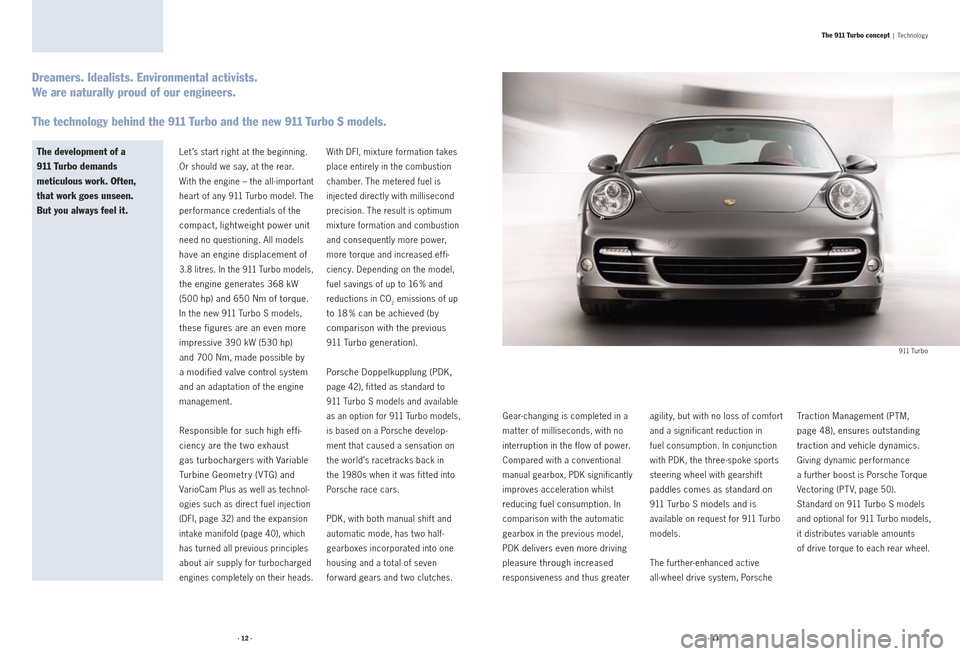
9 11 T u r b o
Let ’s start right at the beginning.
Or should we say, at the rear.
With the engine – the all-important
heart of any 911 Turbo model. The
performance credentials of the
compact, light weight power unit
need no questioning. All models
have an engine displacement of
3.8 litres. In the 911 Turbo models,
the engine generates 368 kW
(500 hp) and 650 Nm of torque.
In the new 911 Turbo S models,
these figures are an even more
impressive 390 kW (530 hp)
and 700 Nm, made possible by
a modified valve control system
and an adaptation of the engine
management.
Responsible for such high effi -
ciency are the t wo exhaust
gas turbochargers with Variable
Turbine Geometry (V TG) and
VarioCam Plus as well as technol -
ogies such as direct fuel injection
(DFI, page 32) and the expansion
intake manifold (page 40), which
has turned all previous principles
about air supply for turbocharged
engines completely on their heads. With DFI, mixture formation takes
place entirely in the combustion
chamber. The metered fuel is
injected directly with millisecond
precision. The result is optimum
mixture formation and combustion
and consequently more power,
more torque and increased effi -
ciency. Depending on the model,
fuel savings of up to 16 % and
reductions in CO
2 emissions of up
to 18 % can be achieved (by
comparison with the previous
911 Turbo generation).
Porsche Doppelkupplung (PDK,
page 42), fit ted as standard to
911 Turbo S models and available
as an option for 911 Turbo models,
is based on a Porsche develop -
ment that caused a sensation on
the world’s racetracks back in
the 1980s when it was fit ted into
Porsche race cars.
PDK, with both manual shif t and
automatic mode, has t wo half-
gearboxes incorporated into one
housing and a total of seven
forward gears and t wo clutches. Gear- changing is completed in a
mat ter of milliseconds, with no
i
nterruption in the flow of power.
Compared with a conventional
manual gearbox, PDK significantly
improves acceleration whilst
reducing fuel consumption. In
comparison with the automatic
gearbox in the previous model,
PDK delivers even more driving
pleasure through increased
responsiveness and thus greater agilit y, but with no loss of comfort
and a significant reduction in
fuel consumption. In conjunction
with PDK, the three-spoke sports
steering wheel with gearshift
paddles comes as standard on
911 Turbo S models and is
available on request for 911 Turbo
models.
The further- enhanced active
all-wheel drive system, Porsche
Traction Management (PTM,
page 48), ensures outstanding
traction and vehicle dynamics.
Giving dynamic performance
a further boost is Porsche Torque
Vectoring (PT V, page 50).
Standard on 911 Turbo S models
and optional for 911 Turbo models,
it distributes variable amounts
of drive torque to each rear wheel.
The development of a
911 Turbo demands
meticulous work. Often,
that work goes unseen.
But you always feel it.
Dreamers. Idealists. Environmental activists.
We are naturally proud of our engineers.
The technology behind the 911 Turbo and the new 911 Turbo S models.
The 911 Turbo concept | Technology
· 12 ·· 13 ·
Page 8 of 59
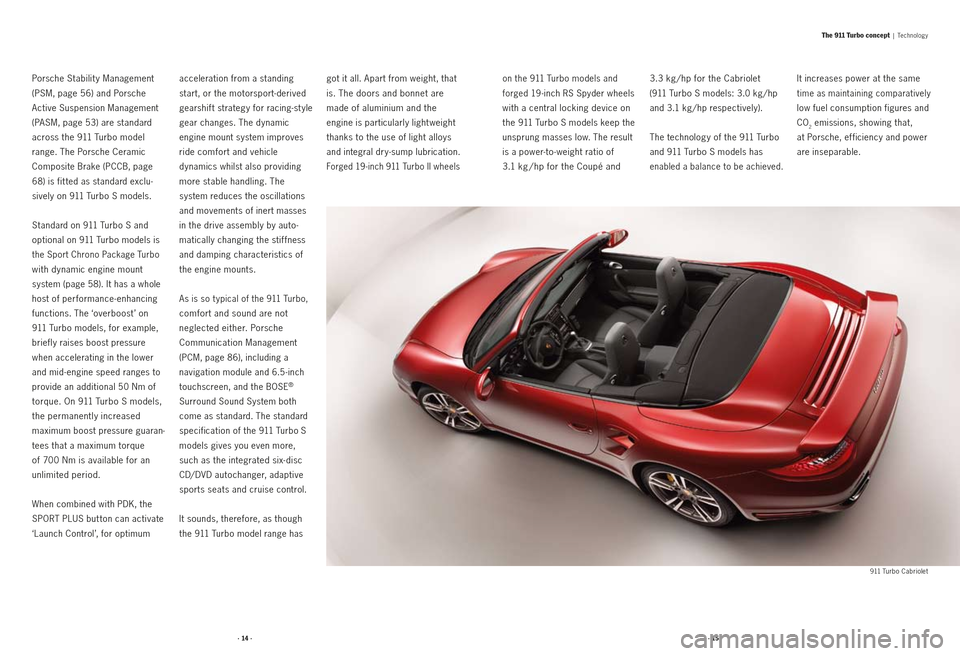
911 Turbo Cabriolet
Porsche Stabilit y Management
(PSM, page 56) and Porsche
Active Suspension Management
(PASM, page 53) are standard
across the 911 Turbo model
range. The Porsche Ceramic
Composite Brake (PCCB, page
68) is fit ted as standard exclu -
sively on 911 Turbo S models.
Standard on 911 Turbo S and
optional on 911 Turbo models is
the Sport Chrono Package Turbo
with dynamic engine mount
system (page 58). It has a whole
host of performance-enhancing
functions. The ‘overboost ’ on
911 Turbo models, for example,
briefly raises boost pressure
when accelerating in the lower
and mid-engine speed ranges to
provide an additional 50 Nm of
torque. On 911 Turbo S models,
the permanently increased
maximum boost pressure guaran-
tees that a maximum torque
of 700 Nm is available for an
unlimited period.
When combined with PDK, the
SPORT PLUS but ton can activate
‘Launch Control’, for optimum acceleration from a standing
start, or the motorsport- derived
gearshift strategy for racing-st yle
gear changes. The dynamic
engine mount system improves
ride comfort and vehicle
dynamics whilst also providing
more stable handling. The
system reduces the oscillations
and movements of inert masses
in the drive assembly by auto -
matically changing the stiffness
and damping characteristics of
the engine mounts.
As is so t ypical of the 911 Turbo,
comfort and sound are not
neglected either. Porsche
Communication Management
(PCM, page 86), including a
navigation module and 6.5-inch
touchscreen, and the BOSE
®
Surround Sound System both
come as standard. The standard
specification of the 911 Turbo S
models gives you even more,
such as the integrated six-disc
CD/ DVD autochanger, adaptive
sports seats and cruise control.
It sounds, therefore, as though
the 911 Turbo model range has got it all. Apart from weight, that
is. The doors and bonnet are
made of aluminium and the
engine is particularly light weight
thanks to the use of light alloys
and integral dry-sump lubrication.
Forged 19-inch 911 Turbo II wheels
on the 911 Turbo models and
forged
19-inch RS Spyder wheels
with
a central locking device on
the
911 Turbo S models keep the
unsprung masses low. The result
is a power-to -weight ratio of
3.1 kg / hp for the Coupé and
3.3 kg / hp for the Cabriolet
(911 Turbo S models: 3.0 kg / hp
and 3.1 kg / hp respectively).
The technology of the 911 Turbo
and 911 Turbo S models has
enabled a balance to be achieved. It increases power at the same
time as maintaining comparatively
low fuel consumption figures and
CO
2 emissions, showing that,
at Porsche, efficiency and power
are inseparable.
The 911 Turbo concept | Technology
· 14 ·· 15 ·
Page 9 of 59
Keeping the tried-and-tested
without ignoring innovation.
Another example of the
efficiency of the 911 Turbo.
It is precisely in turbulent times
when we need a place of calm.
Design.
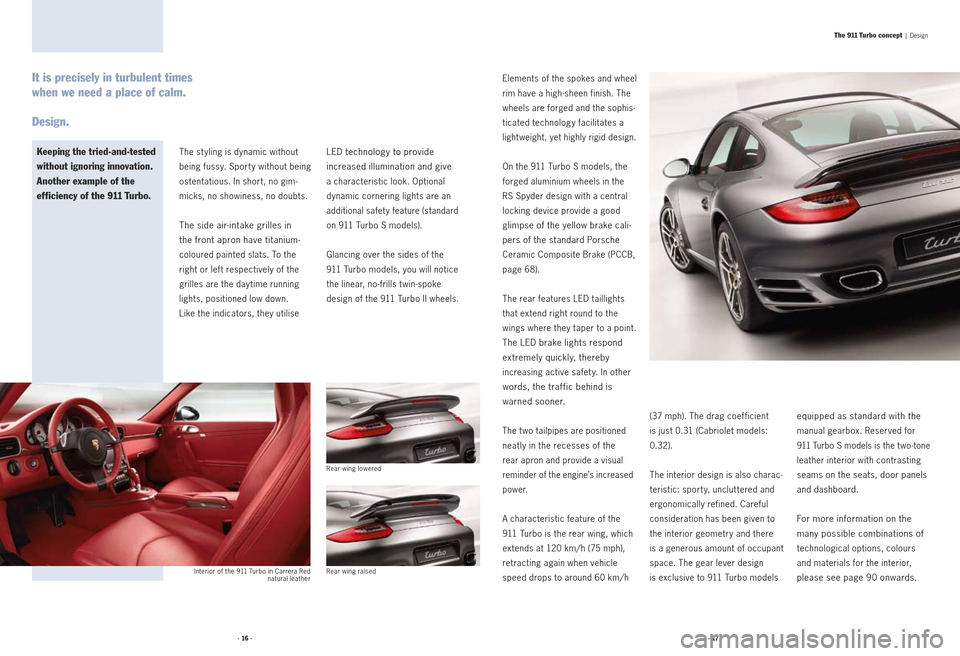
Rear wing raised
Interior of the 911 Turbo in Carrera Red
natural leatherRear wing lowered
The st yling is dynamic without
being fussy. Sport y without being
ostentatious. In short, no gim
-
micks, no showiness, no doubts.
The side air-intake grilles in
the front apron have titanium-
coloured painted slats. To the
right or lef t respectively of the
grilles are the day time running
lights, positioned low down.
Like the indicators, they utilise
LED technology to provide
increased illumination and give
a characteristic look. Optional
dynamic cornering lights are an
additional safet y feature (standard
on 911 Turbo S models).
Glancing over the sides of the
911 Turbo models, you will notice
the linear, no -frills t win -spoke
design of the 911 Turbo II wheels. Elements of the spokes and wheel
rim have a high -sheen finish. The
wheels are forged and the sophis
-
ticated technology facilitates a
light weight, yet highly rigid design.
On the 911 Turbo S models, the
forged aluminium wheels in the
RS Spyder design with a central
locking device provide a good
glimpse of the yellow brake cali -
pers of the standard Porsche
Ceramic Composite Brake (PCCB,
page 68).
The rear features LED taillights
that extend right round to the
wings where they taper to a point.
The LED brake lights respond
extremely quickly, thereby
increasing active safet y. In other
words, the traffic behind is
warned sooner.
The t wo tailpipes are positioned
neatly in the recesses of the
rear apron and provide a visual
reminder of the engine’s increased
power.
A characteristic feature of the
911 Turbo is the rear wing, which
extends at 120 km/ h (75 mph),
retracting again when vehicle
speed drops to around 60 km/ h (37 mph). The drag coefficient
is just 0.31 (Cabriolet models:
0.32).
The interior design is also charac -
teristic: sport y, unclut tered and
ergonomically refined. Careful
consideration has been given to
the interior geometry and there
is a generous amount of occupant
space. The gear lever design
is exclusive to 911 Turbo models
equipped as standard with the
manual gearbox. Reserved for
911 Turbo S models is the t wo -tone
leather interior with contrasting
seams on the seats, door panels
and dashboard.
For more information on the
many possible combinations of
technological options, colours
and materials for the interior,
please see page 90 onwards.
The 911 Turbo concept | Design
· 16 ·· 17 ·
Page 11 of 59
The new 911 Turbo S.
The new 911 Turbo S is perhaps
the embodiment of one of the
original Porsche principles: to
make do is not an option. To
stand still is inconceivable. We
move on, and more awaits around
the corner. Never anxious, always
cool and composed. Looking
forward at all times. This is why we
gave the 911 Turbo S even more. As a result of a modified valve
control system and an adaptation
of the engine management,
combined with an increase in
maximum boost pressure by
0.2 bar to 1.2 bar, the 3.8-litre
boxer engine develops 390 kW
(530 hp) bet ween 6,250 rpm and
6,750 rpm. The maximum torque
is an impressive 700 Nm bet ween
2,100 rpm and 4,250 rpm. This
means an extra 30 hp and 50 Nm
compared with the 911 Turbo. Yet, even though power output
has been increased, fuel consump
-
tion and CO2 emissions remain
at the same low level thanks to
the use of efficient technologies
such as DFI, Variable Turbine
Geometry (V TG), VarioCam Plus
and the expansion intake manifold.
Visually, the engine is distin -
guished by an air filter housing
with a carbon-weave finish and
the ‘turbo S’ logo.
The 911 Turbo S models represent
power in pure form, and they
have the performance figures
to prove it. With the standard
com bination of PDK and the Sport
Chrono Package Turbo with
dynamic engine mount system,
the 911 Turbo S storms through
the 100 km/ h (62 mph) mark from
a standing start in just 3.3 sec -
onds – the fastest ever achieved
by a Porsche production car.
0 to 200 km/ h (124 mph): 10.8
seconds. Top speed: 315 km/ h
(196 mph). It has even been pos -
sible to improve driving dynamics,
thanks not least to the standard-
fit ted Porsche Torque Vectoring
(PT V) including a mechanically
locking rear differential.
At Porsche, whenever we provide
more power as standard, we natu -
rally include extra safet y features
as standard, too. The track-proven
Porsche Ceramic Composite Brake
(PCCB) and the dynamic cornering
lights are t wo examples.
Also fit ted as standard are the
light weight, forged RS Spyder
wheels with a motorsport-derived
central locking device.
Inside, the three-spoke sports
steering wheel with gearshif t
paddles is pleasing to the eye,
and to the touch. The gearshif t
logic comes straight from the
racetrack: pull the right-hand
paddle to shift up, pull the left-
hand paddle to shift down.
Other standard features include
the adaptive sports seats, the
six- disc CD/ DVD autochanger
integrated into the PCM, cruise
control, the choice of t wo -tone
leather interior in Black and
Cream or Black and Titanium Blue
exclusive to the 911 Turbo S models,
and the windscreen
with a grey top-tint.
Visual cues that hint at the
enormous power within are the
‘ turbo S’ logos on the door sill
guards, rev counter, rear lid and
plaque on the upper section of
the air cleaner.
The new 911 Turbo S. The most
powerful interpretation of the
911 Turbo concept there has ever
been. Charged with a passion
to surpass past achievements.
Again and again.
The 911 Turbo concept | Model range
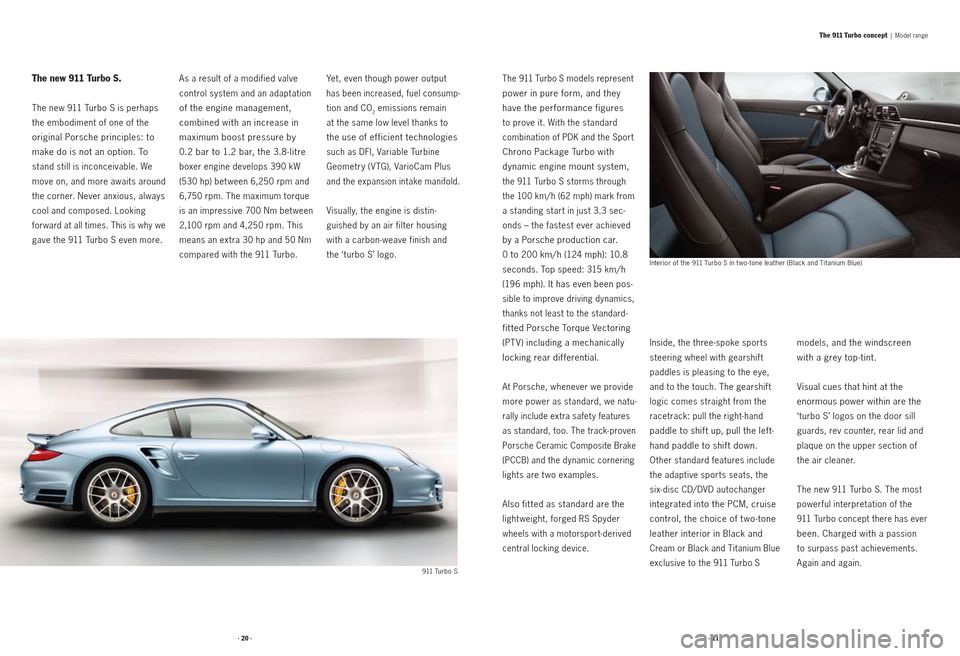
911 Turbo S Interior of the 911 Turbo S in t wo -tone leather (Black and Titanium Blue)
· 20 ·· 21 ·
Page 12 of 59
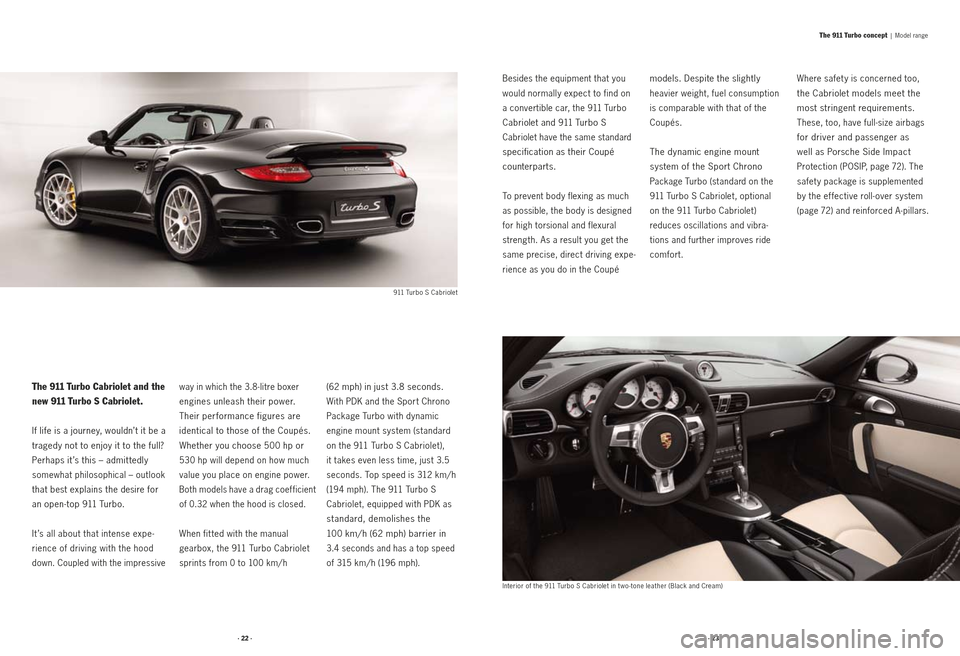
The 911 Turbo Cabriolet and the
new 911 Turbo S Cabriolet.
If life is a journey, wouldn’t it be a
tragedy not to enjoy it to the full?
Perhaps it ’s this – admit tedly
somewhat philosophical – outlook
that best explains the desire for
an open-top 911 Turbo.
It ’s all about that intense expe -
rience of driving with the hood
down. Coupled with the impressive
way in which the 3.8-litre boxer
engines unleash their power.
Their performance figures are
identical to those of the Coupés.
Whether you choose 500 hp or
530 hp will depend on how much
value you place on engine power.
Both models have a drag coefficient
of 0.32 when the hood is closed.
When fit ted with the manual
gearbox, the 911 Turbo Cabriolet
sprints from 0 to 100 km/ h
(62 mph) in just 3.8 seconds.
With PDK and the Sport Chrono
Package Turbo with dynamic
engine mount system (standard
on the 911 Turbo S Cabriolet),
it takes even less time, just 3.5
se conds. Top speed is 312 km/ h
(194 mph). The 911 Turbo S
Cabriolet, equipped with PDK as
standard, demolishes the
100 km/ h (62 mph) barrier in
3.4 seconds and has a top speed
of 315 km/ h (196 mph). Besides the equipment that you
would normally expect to find on
a convertible car, the 911 Turbo
Cabriolet and 911 Turbo S
Cabriolet have the same standard
specification as their Coupé
counterparts.
To prevent body flexing as much
as possible, the body is designed
for high torsional and flexural
strength. As a result you get the
same precise, direct driving expe -
rience as you do in the Coupé
The 911 Turbo concept | Model range
911 Turbo S Cabriolet
models. Despite the slightly
heavier weight, fuel consumption
is comparable with that of the
Coupés.
The dynamic engine mount
system of the Sport Chrono
Package Turbo (standard on the
911 Turbo S Cabriolet, optional
on the 911 Turbo Cabriolet)
reduces oscillations and vibra -
tions and further improves ride
comfort. Where safet y is concerned too,
the Cabriolet models meet the
most stringent requirements.
These, too, have full-size airbags
for driver and passenger as
well as Porsche Side Impact
Protection (POSIP, page 72). The
safet y package is supplemented
by the ef fective roll- over system
(page 72) and reinforced A-pillars.
Interior of the 911 Turbo S Cabriolet in t wo -tone leather (Black and Cream)
· 22 ·· 23 ·
Page 13 of 59
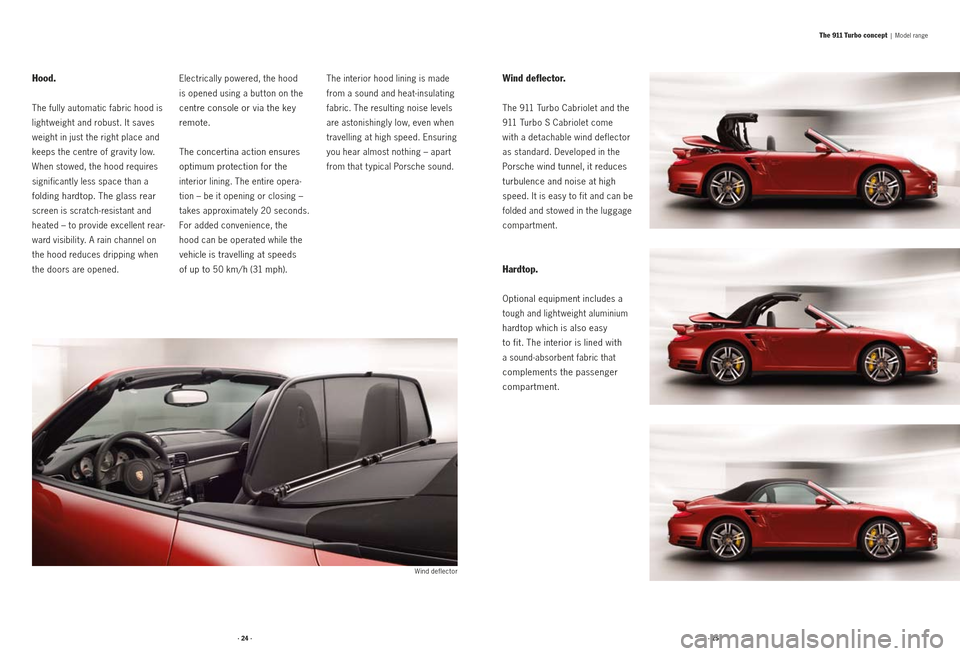
W ind deflector
Hood.
The fully automatic fabric hood is
light weight and robust. It saves
weight in just the right place and
keeps the centre of gravit y low.
When stowed, the hood requires
significantly less space than a
folding hardtop. The glass rear
screen is scratch-resistant and
heated – to provide excellent rear-
ward visibilit y. A rain channel on
the hood reduces dripping when
the doors are opened. Electrically powered, the hood
is opened using a but ton on the
centre console or via the key
remote.
The concertina action ensures
optimum protection for the
interior lining. The entire opera -
tion – be it opening or closing –
takes approximately 20 seconds.
For added convenience, the
hood can be operated while the
vehicle is travelling at speeds
of up to 50 km/ h (31 mph).
The interior hood lining is made
from a sound and heat-insulating
fabric. The resulting noise levels
are astonishingly low, even when
travelling at high speed. Ensuring
you hear almost nothing – apart
from that t ypical Porsche sound.
Wind deflector.
The 911 Turbo Cabriolet and the
911 Turbo S Cabriolet come
with a detachable wind deflector
as standard. Developed in the
Porsche wind tunnel, it reduces
turbulence and noise at high
speed. It is easy to fit and can be
folded and stowed in the luggage
compartment.
Hardtop.
Optional equipment includes a
tough and light weight aluminium
hardtop which is also easy
to fit. The interior is lined with
a sound-absorbent fabric that
complements the passenger
compartment.
The 911 Turbo concept | Model range
· 24 ·· 25 ·
Page 18 of 59
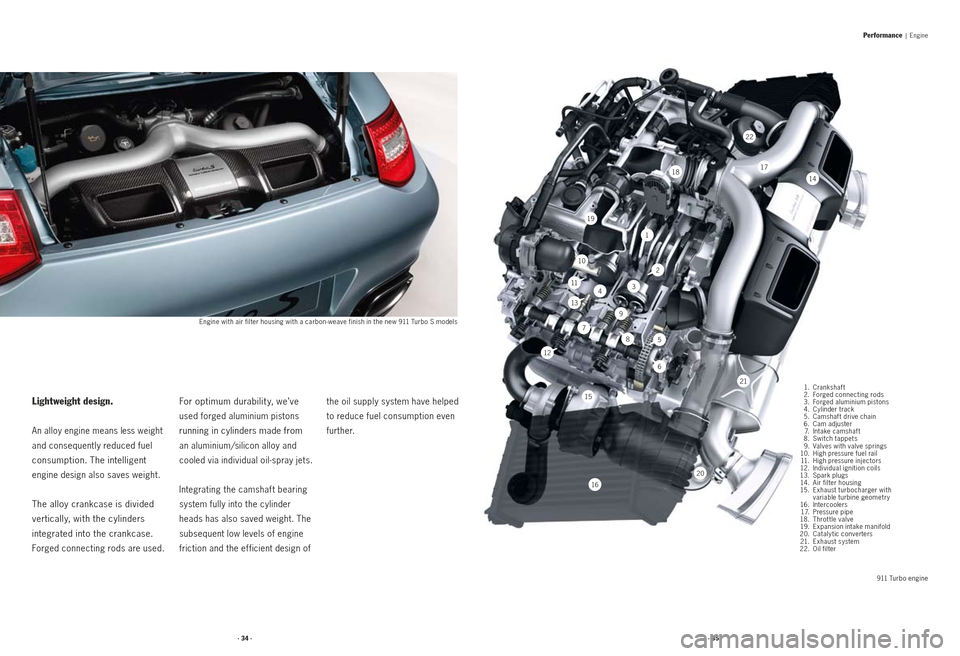
1
18
3
21
10
14
9
4
15
17
22
19
20
7
16
11
2
5
6
8
13
12 1. Crankshaft
2. Forged connecting rods
3. Forged aluminium pistons
4. Cylinder track
5. Camshaf t drive chain
6. Cam adjuster
7. Intake camshaf t
8. Switch tappets
9. Valves with valve springs
10. High pressure fuel rail
11. High pressure injectors
12. Individual ignition coils
13. Spark plugs
14. Air filter housing
15. Exhaust turbocharger with
variable turbine geometr y
16. Intercoolers
17. Pressure pipe
18. Throt tle valve
19. Expansion intake manifold
20. Cataly tic converters
21. Exhaust system
22. Oil filter
Lightweight design.
An alloy engine means less weight
and consequently reduced fuel
consumption. The intelligent
engine design also saves weight.
The alloy crankcase is divided
vertically, with the cylinders
integrated into the crankcase.
Forged connecting rods are used.
For optimum durabilit y, we’ve
used forged aluminium pistons
running in cylinders made from
an aluminium/silicon alloy and
cooled via individual oil-spray jets.
Integrating the camshaf t bearing
system fully into the cylinder
heads has also saved weight. The
subsequent low levels of engine
friction and the ef ficient design of the oil supply system have helped
to reduce fuel consumption even
further.
Performance
| Engine
Engine with air filter housing with a carbon -weave finish in the new 911 Turbo S models
911 Turbo engine
· 34 ·· 35 ·
Page 27 of 59
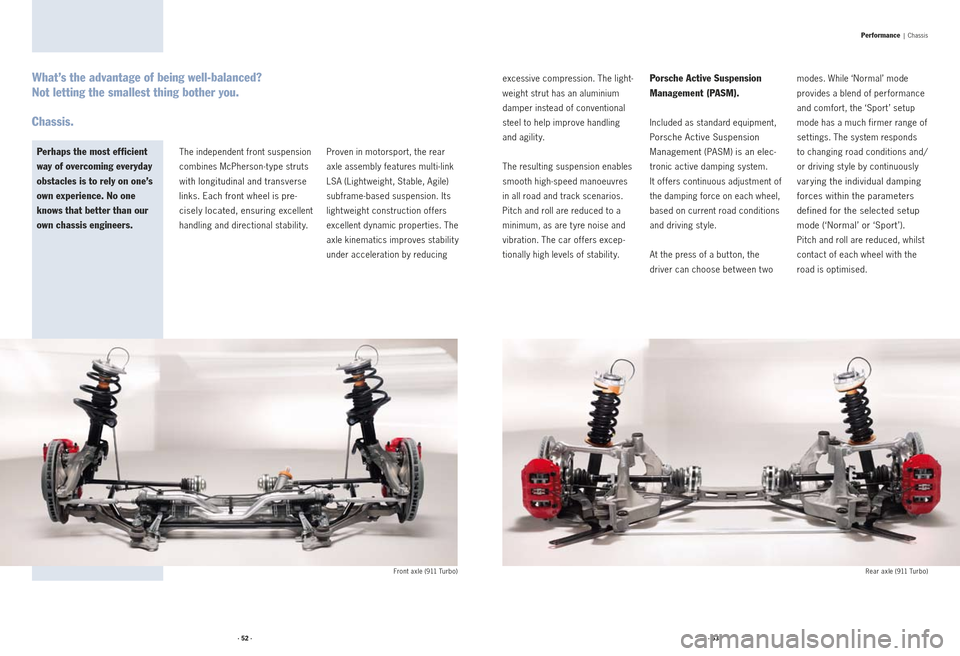
The independent front suspension
combines McPherson-type struts
with longitudinal and transverse
links. Each front wheel is pre-
cisely located, ensuring excellent
handling and directional stabilit y. Proven in motorsport, the rear
axle assembly features multi-link
LSA (Light weight, Stable, Agile)
subframe-based suspension. Its
light weight construction of fers
excellent dynamic properties. The
axle kinematics improves stabilit y
under acceleration by reducing excessive compression. The light
-
weight strut has an aluminium
damper instead of conventional
steel to help improve handling
and agility.
The resulting suspension enables
smooth high -speed manoeuvres
in all road and track scenarios.
Pitch and roll are reduced to a
minimum, as are t yre noise and
vibration. The car offers excep -
tionally high levels of stabilit y.
Porsche Active Suspension
Management (PASM).
Included as standard equipment,
Porsche Active Suspension
Management (PASM) is an elec -
tronic active damping system.
It of fers continuous adjustment of
the damping force on each wheel,
based on current road conditions
and driving st yle.
At the press of a but ton, the
driver can choose bet ween t wo modes. While ‘Normal’ mode
provides a blend of performance
and comfort, the ‘Sport ’ setup
mode has a much firmer range of
set tings. The system responds
to changing road conditions and/
or driving st yle by continuously
varying the individual damping
forces within the parameters
defined for the selected setup
mode (‘Normal’ or ‘Sport ’).
Pitch and roll are reduced, whilst
contact of each wheel with the
road is optimised.
What’s the advantage of being well-balanced?
Not letting the smallest thing bother you.
Chassis.
Perhaps the most efficient
way of overcoming everyday
obstacles is to rely on one’s
own experience. No one
knows that better than our
own chassis engineers.
Front axle (911 Turbo) Rear axle (911 Turbo)
Performance | Chassis
· 52 ·· 53 ·
Page 29 of 59
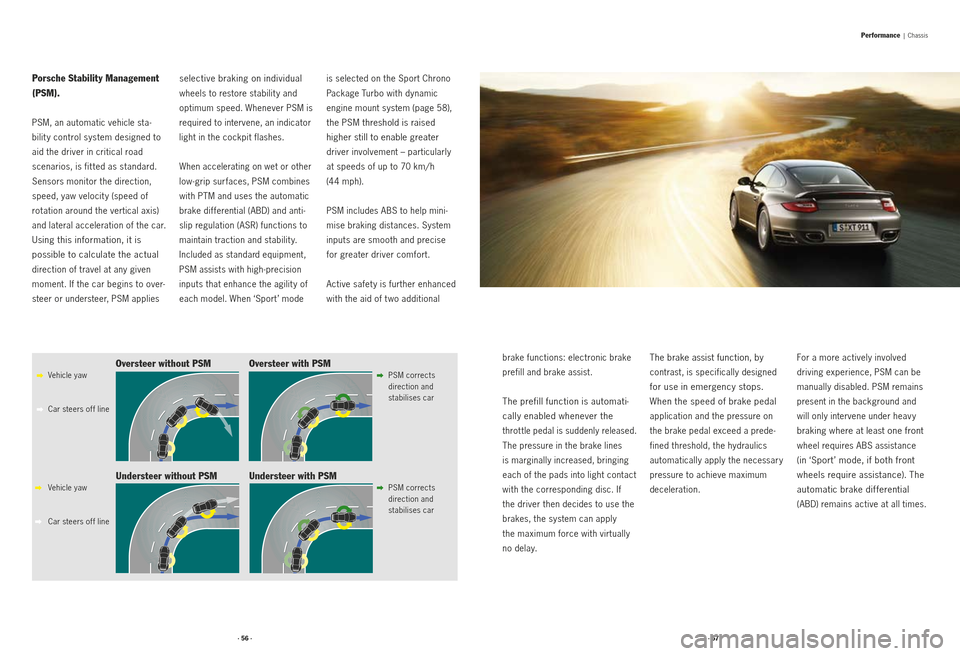
Porsche Stability Management
(PSM).
PSM, an automatic vehicle sta-
bilit y control system designed to
aid the driver in critical road
scenarios, is fit ted as standard.
Sensors monitor the direction,
speed, yaw velocit y (speed of
rotation around the vertical axis)
and lateral acceleration of the car.
Using this information, it is
possible to calculate the actual
direction of travel at any given
moment. If the car begins to over -
steer or understeer, PSM applies
selective braking on individual
wheels to restore stabilit y and
optimum speed. Whenever PSM is
required to intervene, an indicator
light in the cockpit flashes.
When accelerating on wet or other
low-grip surfaces, PSM combines
with PTM and uses the automatic
brake differential (ABD) and anti-
slip regulation (ASR) functions to
maintain traction and stabilit y.
Included as standard equipment,
PSM assists with high -precision
inputs that enhance the agilit y of
each model. When ‘Sport ’ mode is selected on the Sport Chrono
Package Turbo with dynamic
engine mount system (page 58),
the PSM threshold is raised
higher still to enable greater
driver involvement – particularly
at speeds of up to 70 km/ h
(44 mph).
PSM includes ABS to help mini -
mise braking distances. System
inputs are smooth and precise
for greater driver comfort.
Active safet y is further enhanced
with the aid of t wo additional
brake functions: electronic brake
prefill and brake assist.
The prefill function is automati-
cally enabled whenever the
throt tle pedal is suddenly released.
The pressure in the brake lines
is marginally increased, bringing
each of the pads into light contact
with the corresponding disc. If
the driver then decides to use the
brakes, the system can apply
the maximum force with virtually
no delay.
The brake assist function, by
contrast, is specifically designed
for use in emergency stops.
When the speed of brake pedal
application and the pressure on
the brake pedal exceed a prede -
fined threshold, the hydraulics
automatically apply the necessary
pressure to achieve maximum
deceleration. For a more actively involved
driving experience, PSM can be
manually disabled. PSM remains
present in the background and
will only intervene under heav y
braking where at least one front
wheel requires ABS assistance
(in ‘Sport ’ mode, if both front
wheels require assistance). The
automatic brake differential
(ABD) remains active at all times.
Vehicle yaw
Car steers of f line
Vehicle yaw
Car steers of f line PSM corrects
direction and
stabilises car
PSM corrects
direction and
stabilises carOversteer without PSM
Oversteer with PSM
Understeer with PSM
Understeer without PSM
Performance | Chassis
· 56 ·· 57 ·
Page 30 of 59
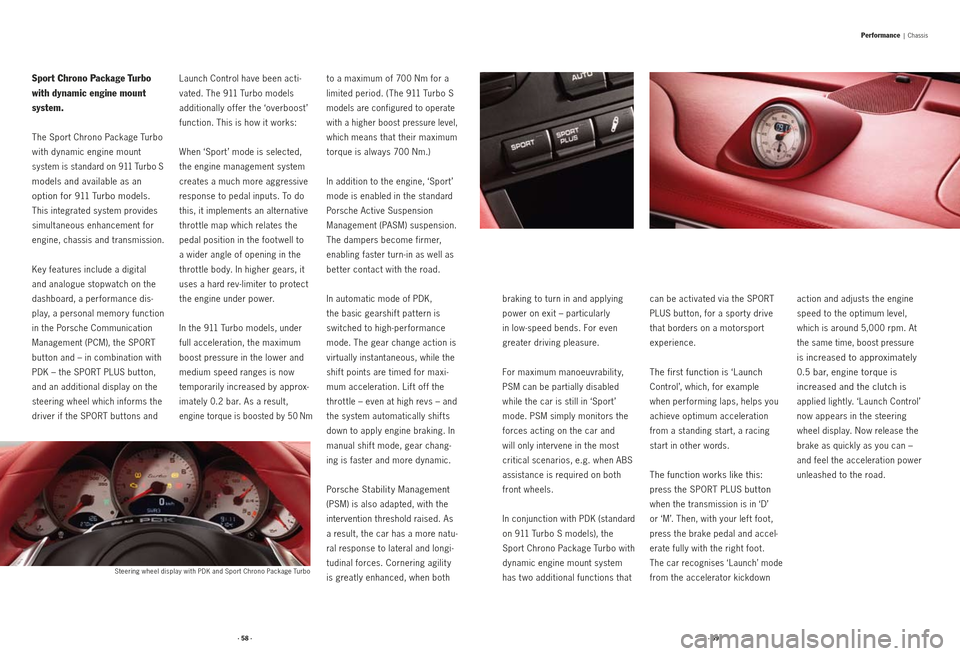
Sport Chrono Package Turbo
with dynamic engine mount
system.
The Sport Chrono Package Turbo
with dynamic engine mount
system is standard on 911 Turbo S
models and available as an
option for 911 Turbo models.
This integrated system provides
simultaneous enhancement for
engine, chassis and transmission.
Key features include a digital
and analogue stopwatch on the
dashboard, a performance dis -
play, a personal memor y function
in the Porsche Communication
Management (PCM), the SPORT
but ton and – in combination with
PDK – the SPORT PLUS but ton,
and an additional display on the
steering wheel which informs the
driver if the SPORT but tons and Launch Control have been acti
-
vated. The 911 Turbo models
additionally of fer the ‘overboost ’
function. This is how it works:
When ‘Sport ’ mode is selected,
the engine management system
creates a much more aggressive
response to pedal inputs. To do
this, it implements an alternative
throt tle map which relates the
pedal position in the foot well to
a wider angle of opening in the
throt tle body. In higher gears, it
uses a hard rev- limiter to protect
the engine under power.
In the 911 Turbo models, under
full acceleration, the maximum
boost pressure in the lower and
medium speed ranges is now
temporarily increased by approx -
imately 0.2 bar. As a result,
engine torque is boosted by 50 Nm to a maximum of 700 Nm for a
limited period. (The 911 Turbo S
models are configured to operate
with a higher boost pressure level,
which means that their maximum
torque is always 700 Nm.)
In addition to the engine, ‘Sport ’
mode is enabled in the standard
Porsche Active Suspension
Management (PASM) suspension.
The dampers become firmer,
enabling faster turn - in as well as
bet ter contact with the road.
In automatic mode of PDK,
the basic gearshif t pat tern is
switched to high-performance
mode. The gear change action is
virtually instantaneous, while the
shift points are timed for maxi -
mum acceleration. Lif t of f the
throt tle – even at high revs – and
the system automatically shif ts
down to apply engine braking. In
manual shif t mode, gear chang -
ing is faster and more dynamic.
Porsche Stabilit y Management
(PSM) is also adapted, with the
intervention threshold raised. As
a result, the car has a more natu -
ral response to lateral and longi -
tudinal forces. Cornering agilit y
is greatly enhanced, when both braking to turn in and applying
power on exit – particularly
in low-speed bends. For even
greater driving pleasure.
For maximum manoeuvrabilit y,
PSM can be partially disabled
while the car is still in ‘Sport ’
mode. PSM simply monitors the
forces acting on the car and
will only intervene in the most
critical scenarios, e.g. when ABS
assistance is required on both
front wheels.
In conjunction with PDK (standard
on 911 Turbo S models), the
Sport Chrono Package Turbo with
dynamic engine mount system
has t wo additional functions that can be activated via the SPORT
PLUS but ton, for a sport y drive
that borders on a motorsport
experience.
The first function is ‘Launch
Control’, which, for example
when per forming laps, helps you
achieve optimum acceleration
from a standing start, a racing
start in other words.
The function works like this:
press the SPORT PLUS but ton
when the transmission is in ‘D’
or ‘M’. Then, with your lef t foot,
press the brake pedal and accel -
erate fully with the right foot.
The car recognises ‘Launch’ mode
from the accelerator kickdown action and adjusts the engine
speed to the optimum level,
which is around 5,000 rpm. At
the same time, boost pressure
is increased to approximately
0.5 bar, engine torque is
increased and the clutch is
applied lightly. ‘Launch Control’
now appears in the steering
wheel display. Now release the
brake as quickly as you can –
and feel the acceleration power
unleashed to the road.
Steering wheel display with PDK and Sport Chrono Package Turbo
Performance | Chassis
· 58 ·· 59 ·