warning PORSCHE 911 2009 5.G Owners Manual
[x] Cancel search | Manufacturer: PORSCHE, Model Year: 2009, Model line: 911, Model: PORSCHE 911 2009 5.GPages: 310, PDF Size: 3.39 MB
Page 197 of 310
Mobile Roofs
195
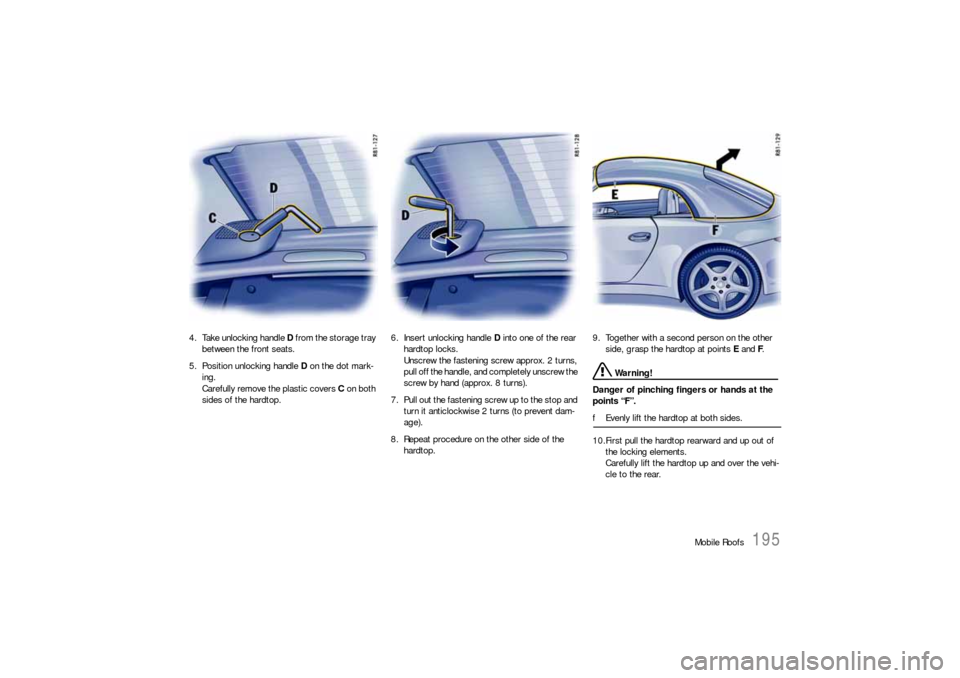
4. Take unlocking handle D from the storage tray
between the front seats.
5. Position unlocking handle D on the dot mark-
ing.
Carefully remove the plastic covers C on both
sides of the hardtop. 6. Insert unlocking handle D into one of the rear
hardtop locks.
Unscrew the fastening screw approx. 2 turns,
pull off the handle, and completely unscrew the
screw by hand (approx. 8 turns).
7. Pull out the fastening screw up to the stop and
turn it anticlockwise 2 turns (to prevent dam-
age).
8. Repeat procedure on the other side of the
hardtop. 9. Together with a second person on the other
side, grasp the hardtop at points E and F.
Warning!
Danger of pinching fingers or hands at the
points “F”.
fEvenly lift the hardtop at both sides.
10.First pull the hardtop rearward and up out of
the locking elements.
Carefully lift the hardtop up and over the vehi-
cle to the rear.
Page 200 of 310
198
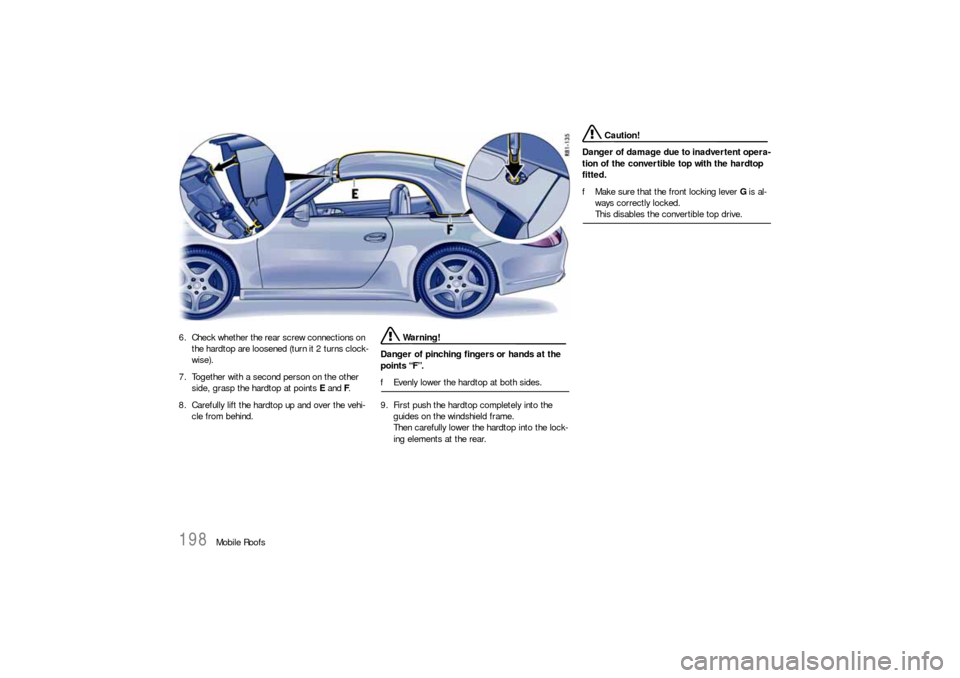
Mobile Roofs 6.Check whether the rear screw connections on
the hardtop are loosened (turn it 2 turns clock-
wise).
7. Together with a second person on the other
side, grasp the hardtop at points E and F.
8. Carefully lift the hardtop up and over the vehi-
cle from behind.
Warning!
Danger of pinching fingers or hands at the
points “F”.
fEvenly lower the hardtop at both sides.
9. First push the hardtop completely into the
guides on the windshield frame.
Then carefully lower the hardtop into the lock-
ing elements at the rear.
Caution!
Danger of damage due to inadvertent opera-
tion of the convertible top with the hardtop
fitted.
fMake sure that the front locking lever G is al-
ways correctly locked.This disables the convertible top drive.
Page 202 of 310
200
Mobile Roofs
TargaThis roof type is equipped with the following spe-
cial features:
– Roller blind
– Sliding glass roof
– Glass rear hatch
Warning!
Risk of injury when operating all components
of the Targa roof, especially when closing the
sliding glass roof.
fTake care to ensure that nobody can be injured
when the roof components are actuated.
fAlways withdraw the ignition key when leaving
the vehicle. Uninformed persons (e.g. children)
could injure themselves by operating the slid-
ing glass roof, the roller blind or the glass rear
hatch.
fIn case of danger, release the button immedi-
ately and operate the sliding glass roof or roll-er blind in the opposite direction.
Roller blindReadiness for operation
– With the ignition switched on (engine on or off)
or
– When door is closed and ignition key with-
drawn, but only until door is first opened.
The roller blind can be operated independently of
the sliding glass roof position.
Warning!
Risk of injury and damage.
fBefore operating the roller blind, ensure that
there are no persons or objects in the range of movement.
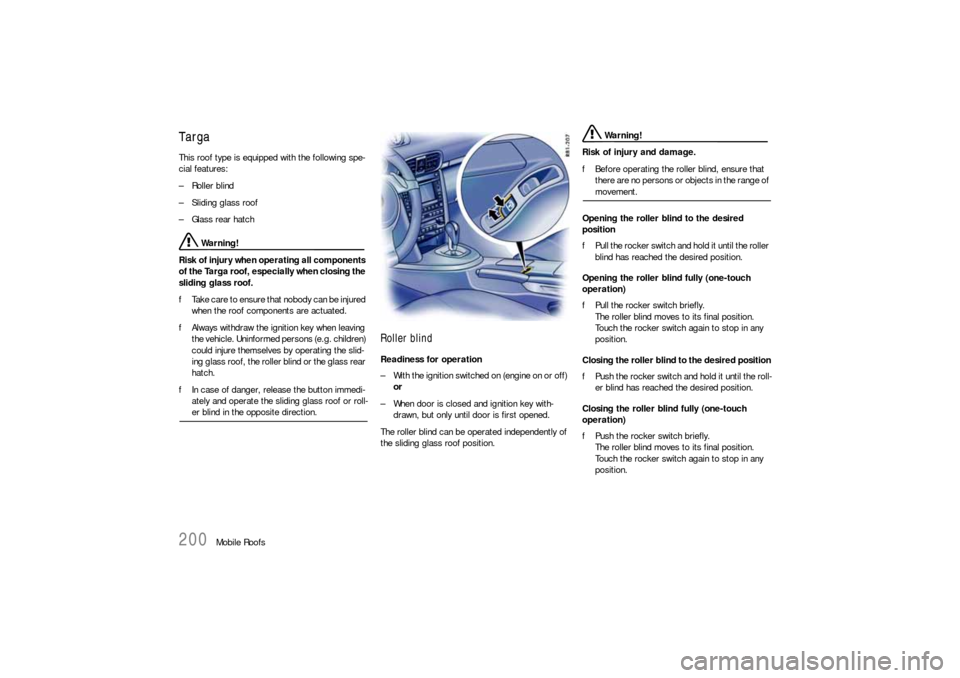
Opening the roller blind to the desired
position
fPull the rocker switch and hold it until the roller
blind has reached the desired position.
Opening the roller blind fully (one-touch
operation)
fPull the rocker switch briefly.
The roller blind moves to its final position.
Touch the rocker switch again to stop in any
position.
Closing the roller blind to the desired position
fPush the rocker switch and hold it until the roll-
er blind has reached the desired position.
Closing the roller blind fully (one-touch
operation)
fPush the rocker switch briefly.
The roller blind moves to its final position.
Touch the rocker switch again to stop in any
position.
Page 203 of 310
Mobile Roofs
201
Sliding glass roofReadiness for operation
– With ignition switched on (engine on or off) or
– When door is closed and ignition key with-
drawn, but only until door is first opened.
– The glass rear hatch must be closed.Opening sliding glass roof
Warning!
Risk of injury and damage.
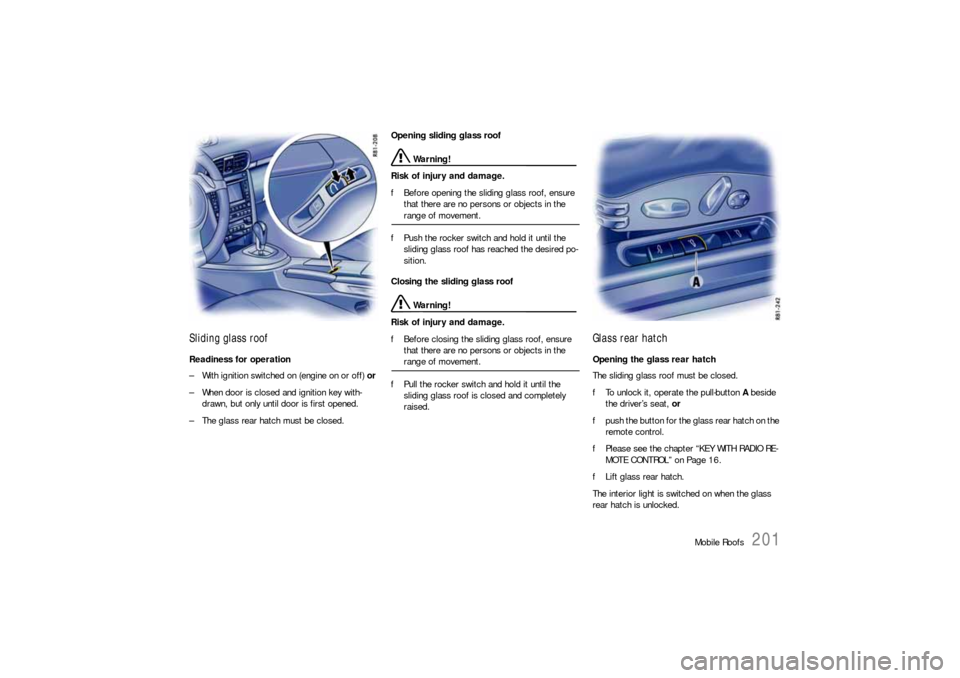
fBefore opening the sliding glass roof, ensure
that there are no persons or objects in the range of movement.
fPush the rocker switch and hold it until the
sliding glass roof has reached the desired po-
sition.
Closing the sliding glass roof Warning!
Risk of injury and damage.
fBefore closing the sliding glass roof, ensure
that there are no persons or objects in the range of movement.
fPull the rocker switch and hold it until the
sliding glass roof is closed and completely
raised.
Glass rear hatchOpening the glass rear hatch
The sliding glass roof must be closed.
fTo unlock it, operate the pull-button A beside
the driver’s seat, or
fpush the button for the glass rear hatch on the
remote control.
fPlease see the chapter “KEY WITH RADIO RE-
MOTE CONTROL” on Page 16.
fLift glass rear hatch.
The interior light is switched on when the glass
rear hatch is unlocked.
Page 204 of 310
202
Mobile Roofs Closing glass rear hatch
Warning!
Risk of pinching. The glass rear hatch is
automatically pulled into the lock and
locked.
fEnsure that your fingers are not caught under the glass rear hatch.
fPlace your hand on the glass rear hatch.
fLower the glass rear hatch until it is automati-
cally closed and locked.
Message in on-board computer Glass rear hatch
A message appears on the on-board computer if
the glass rear hatch is not completely closed.
fFully close the glass rear hatch.
Emergency operation of sliding glass roofClosing the sliding glass roof
fBefore using emergency operation, please
check whether the fuses may be defective.
fPlease see the chapter “ELECTRICAL SYS-
TEM” on Page 257.
Warning!
Risk of injury and damage.
fDo not operate the sliding glass roof with the
rocker switch during and after emergency op-eration.
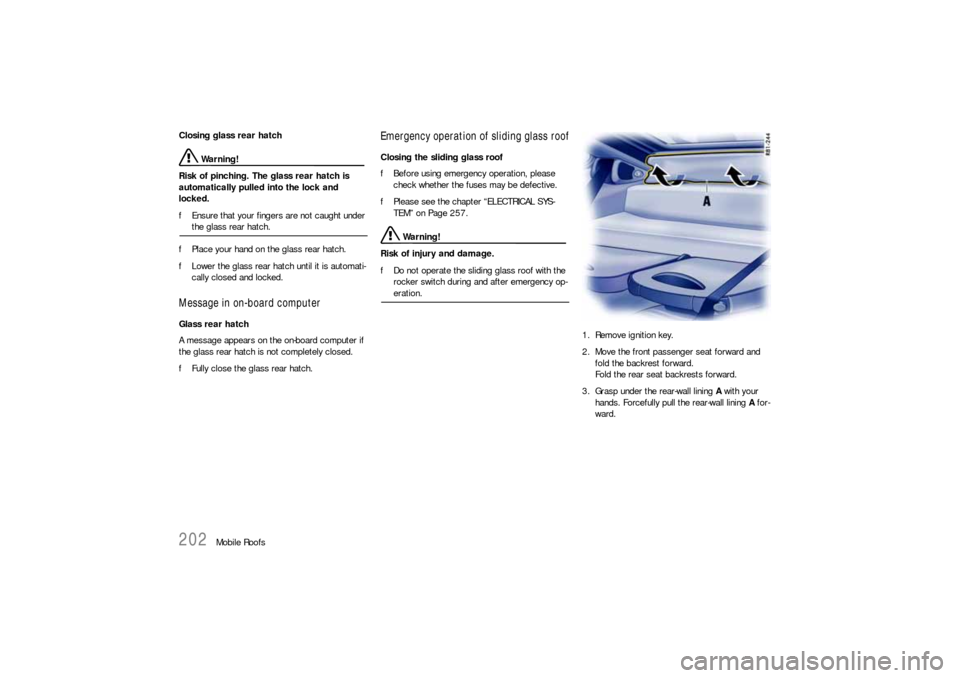
1. Remove ignition key.
2. Move the front passenger seat forward and
fold the backrest forward.
Fold the rear seat backrests forward.
3. Grasp under the rear-wall lining A with your
hands. Forcefully pull the rear-wall lining A for-
ward.
Page 209 of 310
Maintenance, Car Care
207
Coolant LevelfPlease see the chapter “EXERCISE EXTREME
CAUTION WHEN WORKING ON YOUR VEHICLE”
on Page 206.
The cooling system is filled at the factory with a
permanent coolant.
It provides year-round protection from corrosion
and freezing down to –31 °F/–35 °C
.
fOnly use antifreeze authorized by Porsche.
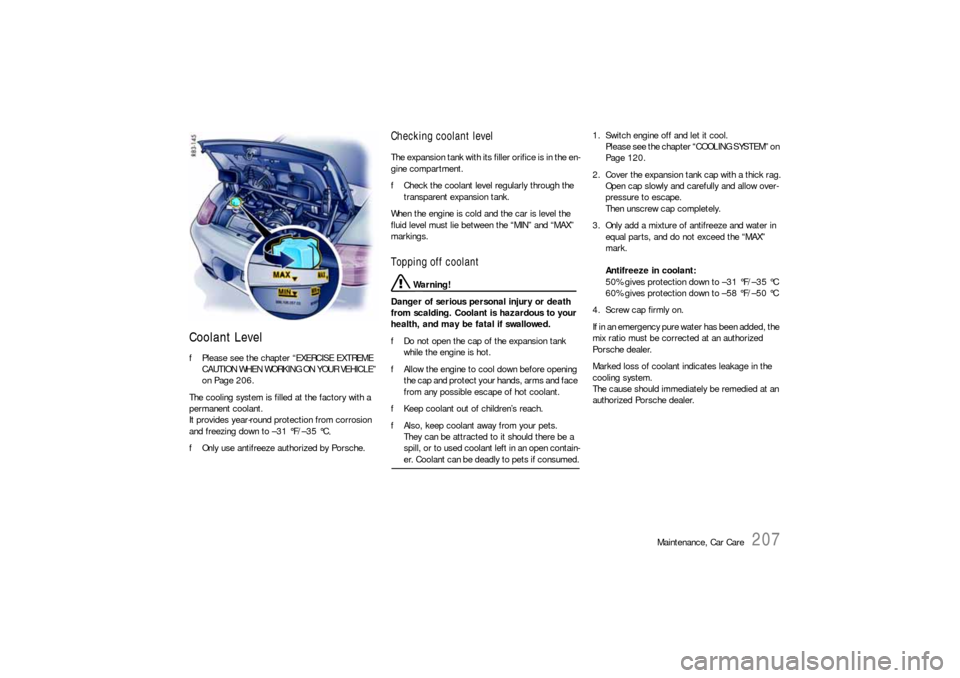
Checking coolant level The expansion tank with its filler orifice is in the en-
gine compartment.
fCheck the coolant level regularly through the
transparent expansion tank.
When the engine is cold and the car is level the
fluid level must lie between the “MIN” and “MAX”
markings. Topping off coolant
Warning!
Danger of serious personal injury or death
from scalding. Coolant is hazardous to your
health, and may be fatal if swallowed.
fDo not open the cap of the expansion tank
while the engine is hot.
fAllow the engine to cool down before opening
the cap and protect your hands, arms and face
from any possible escape of hot coolant.
fKeep coolant out of children’s reach.
fAlso, keep coolant away from your pets.
They can be attracted to it should there be a
spill, or to used coolant left in an open contain-er. Coolant can be deadly to pets if consumed.1. Switch engine off and let it cool.
Please see the chapter “COOLING SYSTEM” on
Page 120.
2. Cover the expansion tank cap with a thick rag.
Open cap slowly and carefully and allow over-
pressure to escape.
Then unscrew cap completely.
3. Only add a mixture of antifreeze and water in
equal parts, and do not exceed the “MAX”
mark.
Antifreeze in coolant:
50% gives protection down to –31 °F/–35 °C
60% gives protection down to –58 °F/–50 °C
4. Screw cap firmly on.
If in an emergency pure water has been added, the
mix ratio must be corrected at an authorized
Porsche dealer.
Marked loss of coolant indicates leakage in the
cooling system.
The cause should immediately be remedied at an
authorized Porsche dealer.
Page 210 of 310

208
Maintenance, Car Care
Engine-compartment blower,
radiator fan The radiator and radiator fans are in the front of
the car.
The engine-compartment blower is mounted on
the engine compartment lid.
Warning!
Risk of injury.
After the engine is switched off, the engine-
compartment temperature is monitored for
approx. 30 minutes.
During this period, and depending on tem-
perature, the engine-compartment blower
may continue to run or start to run.
fCarry out work in these areas only with the en-
gine off, the ignition off, and exercise extreme
caution.
Risk of injury. The radiator fans in the front
end of the car may be operating or
unexpectedly start operating when the
engine is switched on.
fCarry out work in these areas only with the en-gine switched off.
Engine Oil It is important to perform oil changes regularly in
accordance with the intervals specified in the
“Maintenance” booklet.
Engine oil consumption
It is normal for your engine to consume oil.
The rate of oil consumption depends on the quality
and viscosity of oil, the speed at which the engine
is operated, the climate, road conditions as well
as the amount of dilution and oxidation of the
lubricant.
If the vehicle is used for repeated short trips, and
consumes a normal amount of oil, the engine oil
measurement may not show any drop in the oil
level at all, even after 600 miles (1,000 km) or
more. This is because the oil is gradually becom-
ing diluted with fuel or moisture, making it appear
that the oil level has not changed.
The diluting ingredients evaporate out when the
vehicle is driven at high speeds, as on an express-
way, making it then appear that oil is excessively
consumed after driving at high speeds.
If the conditions you drive your vehicle in are
dusty, humid, or hot, the frequency of the oil
change intervals should be greater. If the vehicle is driven at a high rate of speed,
climatic conditions are warm, and the load is high,
the oil should be checked more frequently, as
driving conditions will determine the rate of oil
consumption.
– The engine in your vehicle depends on oil to
lubricate and cool all of its moving parts.
Therefore, the engine oil should be checked
regularly and kept at the required level.
– Make it a habit to have the engine oil level
checked at every fuel filling.
– The oil pressure warning light is not an oil level
indicator.
The oil pressure warning light indicates serious
engine damage may be occuring when lit, if en-
gine rpm is above idle speed.
Engine Oil Level fPlease see the chapter “EXERCISE EXTREME
CAUTION WHEN WORKING ON YOUR VEHICLE”
on Page 206.
fRegularly check the oil level using the on-board
computer after the vehicle is refuelled.
Please see the chapter “OIL DISPLAY AND
MEASUREMENT OF THE ENGINE OIL LEVEL”
on Page 153.
The difference between the minimum and maxi-
mum marks on the segment display is approx.
1.3 quarts (1.25 liters).
Each segment of the display corresponds to ap-
prox. 0.42 quart (0.4 liter).
Page 211 of 310
Maintenance, Car Care
209
Topping off engine oil
Warning!
Risk of burning from hot parts in engine com-
partment. Risk of injury by rotating parts.
The engine compartment blower on the en-
gine compartment lid can start up even with
engine off.
fExercise extrem caution when working in the
engine compartment.
fTop off engine oil only with the engine off.
Engine oil is hazardous to your health and
may be fatal if swallowed.
fKeep engine oil out of children’s reach.
Used engine oil contains chemicals that have
caused cancer in laboratory animals.
fAlways protect your skin by washing thorough-ly with soap and water.
Note
The Check Engine warning light may light up if the
cap of the oil filler opening is opened while the
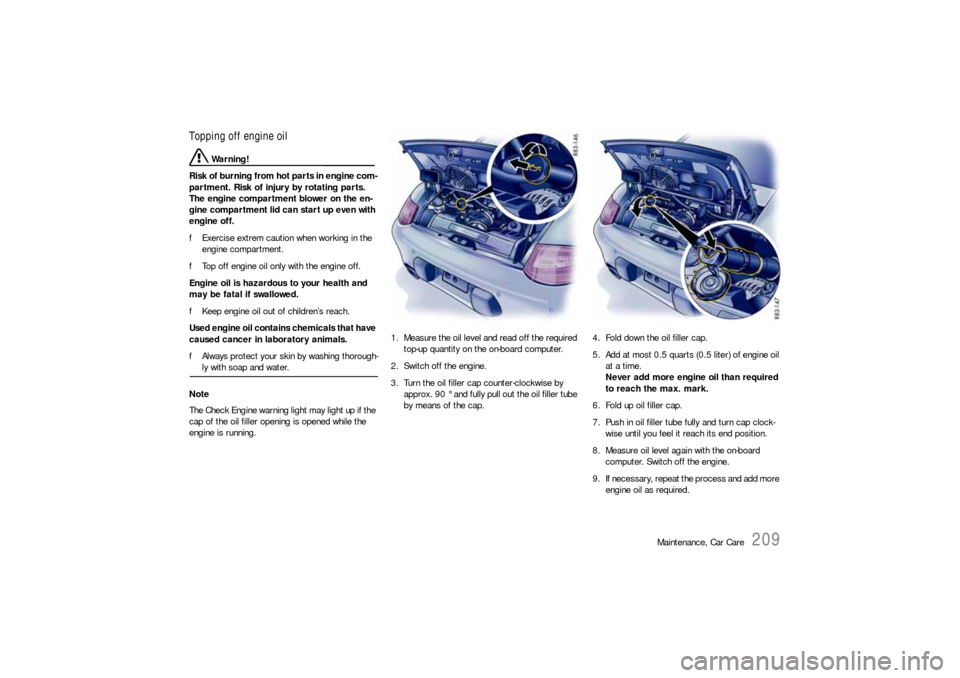
engine is running.1. Measure the oil level and read off the required
top-up quantity on the on-board computer.
2. Switch off the engine.
3. Turn the oil filler cap counter-clockwise by
approx. 90 ° and fully pull out the oil filler tube
by means of the cap.4. Fold down the oil filler cap.
5. Add at most 0.5 quarts (0.5 liter) of engine oil
at a time.
Never add more engine oil than required
to reach the max. mark.
6. Fold up oil filler cap.
7. Push in oil filler tube fully and turn cap clock-
wise until you feel it reach its end position.
8. Measure oil level again with the on-board
computer. Switch off the engine.
9. If necessary, repeat the process and add more
engine oil as required.
Page 214 of 310
212
Maintenance, Car Care
Brake Fluid LevelfPlease see the chapter “EXERCISE EXTREME
CAUTION WHEN WORKING ON YOUR VEHICLE”
on Page 206.
fUse only new (unused) Original Porsche
brake fluid.
Warning!
Brake fluid is hazardous to your health, and
may be fatal if swallowed.
Brake fluid also attacks paintwork.
fKeep brake fluid out of children’s reach.
fTake care while topping off brake fluid not to
soil the luggage compartment or items of lug-gage.
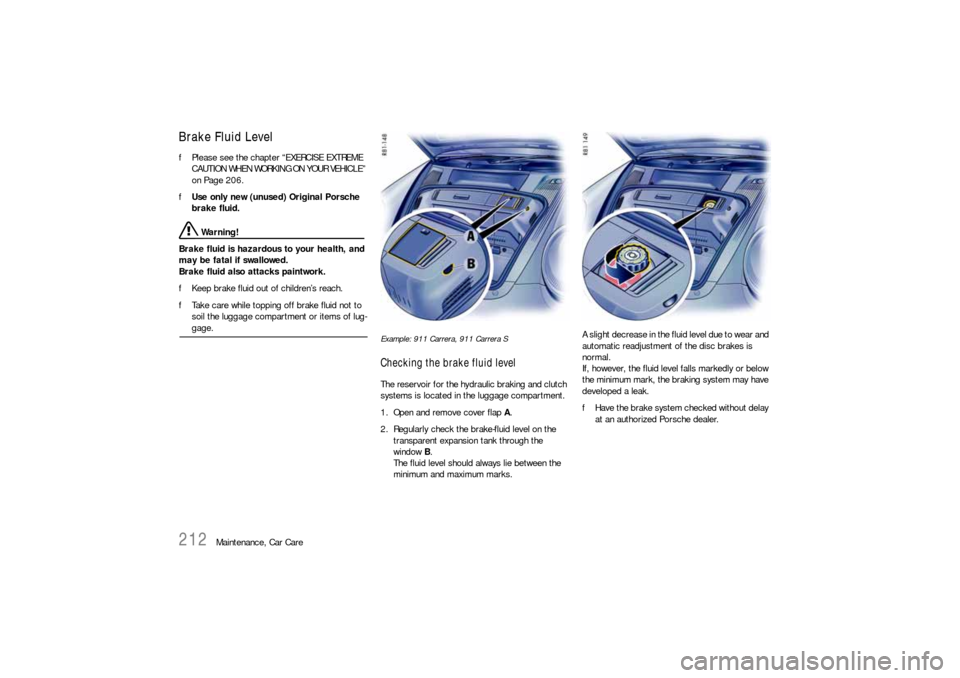
Example: 911 Carrera, 911 Carrera SChecking the brake fluid levelThe reservoir for the hydraulic braking and clutch
systems is located in the luggage compartment.
1. Open and remove cover flap A.
2. Regularly check the brake-fluid level on the
transparent expansion tank through the
window B.
The fluid level should always lie between the
minimum and maximum marks.A slight decrease in the fluid level due to wear and
automatic readjustment of the disc brakes is
normal.
If, however, the fluid level falls markedly or below
the minimum mark, the braking system may have
developed a leak.
fHave the brake system checked without delay
at an authorized Porsche dealer.
Page 215 of 310

Maintenance, Car Care
213
Changing the brake fluid Brake fluid absorbs moisture from the air over
time. This accumulation of water lowers the boil-
ing point and, under certain operating conditions,
can affect the braking performance.
Therefore have the brake fluid changed in accord-
ance with the change intervals stated in the
brochure “Maintenance”. – The warning lights on the instrument panel and
on the on-board computer indicate an insuffi-
cient brake fluid level.
– If the warning light lights up on the instrument
panel and the warning message appears on
the on-board computer in combination with a
larger pedal travel, a brake circuit may have
failed.
If the warning lights should light up when
driving:
fStop immediately in a suitable place.
fDo not continue driving.
Consult an authorized Porsche dealer.
Warning light USA
Warning light Canada