locking PORSCHE 911 2009 5.G User Guide
[x] Cancel search | Manufacturer: PORSCHE, Model Year: 2009, Model line: 911, Model: PORSCHE 911 2009 5.GPages: 310, PDF Size: 3.39 MB
Page 24 of 310

22
Operation, Safety
Automatic door locking Your authorized Porsche dealer can program di-
verse types of automatic door locking in the con-
trol unit of the central locking system:
Ty p e 1
Doors lock automatically when the ignition is
switched on.
Ty p e 2
Doors lock automatically when a speed of
3 - 6 mph (5 - 10 km/h) is exceeded. Ty p e 3
Doors lock automatically when the ignition is
switched on. If doors are opened with the engine
running, they lock again automatically when a
speed of 3 - 6 mph (5 - 10 km/h) is exceeded.
Ty p e 4
The doors do not lock automatically.
Note
Automatically locked doors can be unlocked with
the central locking button or opened by pulling on
the inside door handle twice.
fOn vehicles with the Sport Chrono Package
Plus, the PCM can be used to activate automat-
ic door locking.
Please observe the chapter “Individual Memo-
ry” in the separate PCM operating instructions.
Warning!
In an emergency situation where you need to
exit the car through an automatically locked
door, remember the following procedure to
open the door.
fUnlock the doors by pressing the central lock-
ing button or
fpull the inside door handle twice to open the door.
Page 25 of 310
Operation, Safety
23
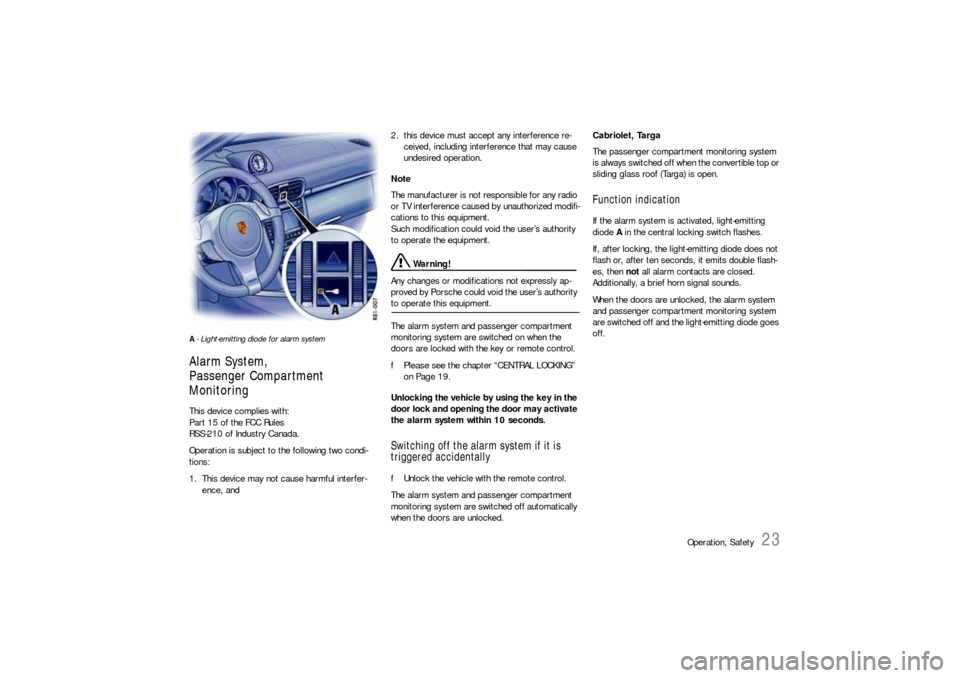
A- Light-emitting diode for alarm systemAlarm System,
Passenger Compartment
MonitoringThis device complies with:
Part 15 of the FCC Rules
RSS-210 of Industry Canada.
Operation is subject to the following two condi-
tions:
1. This device may not cause harmful interfer-
ence, and2. this device must accept any interference re-
ceived, including interference that may cause
undesired operation.
Note
The manufacturer is not responsible for any radio
or TV interference caused by unauthorized modifi-
cations to this equipment.
Such modification could void the user’s authority
to operate the equipment.
Warning!
Any changes or modifications not expressly ap-
proved by Porsche could void the user’s authority
to operate this equipment.
The alarm system and passenger compartment
monitoring system are switched on when the
doors are locked with the key or remote control.
fPlease see the chapter “CENTRAL LOCKING”
on Page 19.
Unlocking the vehicle by using the key in the
door lock and opening the door may activate
the alarm system within 10 seconds. Switching off the alarm system if it is
triggered accidentallyfUnlock the vehicle with the remote control.
The alarm system and passenger compartment
monitoring system are switched off automatically
when the doors are unlocked.Cabriolet, Targa
The passenger compartment monitoring system
is always switched off when the convertible top or
sliding glass roof (Targa) is open.
Function indication If the alarm system is activated, light-emitting
diode A in the central locking switch flashes.
If, after locking, the light-emitting diode does not
flash or, after ten seconds, it emits double flash-
es, then not all alarm contacts are closed.
Additionally, a brief horn signal sounds.
When the doors are unlocked, the alarm system
and passenger compartment monitoring system
are switched off and the light-emitting diode goes
off.
Page 26 of 310

24
Operation, Safety
When the alarm is armed, the following
areas are monitored – Doors
– Luggage compartment lid
– Engine compartment lid
– Convertible-top lock (Cabriolet)
– Glass rear hatch (Targa)
– Glove compartment
– Passenger compartment
If one of these alarm contacts is interrupted, the
alarm horn sounds for approximately 3 minutes.
Additionally, the emergency flasher flashes and
the passenger compartment light lightes for ap-
proximately five minutes.
When the alarm is triggered, the light-emitting
diode changes over to double flashes.
In order not to limit the action range of the passen-
ger compartment monitoring system:
fDo not fold the front seat backrests forward.
Deactivating the passenger compartment
monitoring system for one locking
processIf a person or animal remains in the car while it is
locked, the passenger compartment monitoring
system must be switched off.
fQuickly lock car twice.
The doors are locked but can be opened from
the inside:
1. Pull inner door handle once to unlock door
lock.
2. Pull inner door handle again to open door.
Note
fInform any person remaining in the car that the
alarm system will be triggered if the door is
opened.
Fault indication A double horn signal during locking indicates a
defect in the central locking or alarm system.
fHave the defect remedied at an authorized
Porsche dealer.
Page 28 of 310

26
Operation, Safety
Opening/closing windowsfFor the Cabriolet, select front or rear power
windows with rocker switch C.
The selection is displayed by the respective
light-emitting diode.
The two rocker switches A and B in the driver’s
door and the switch in the passenger’s door have
a two-stage function:
Opening
fPress the rocker switch down to the first stage
until the window has reached the desired
position.
Closing
fPress the rocker switch upwards to the first
stage until the window has reached the desired
position.
One-touch operation
fPress the rocker switch upwards or
downwards to the second stage.
Window moves to its final position.
Press again to stop the window in the desired
position.
Coupé, Targa
One-touch operation for closing the passenger’s
window is available once the window is approxi-
mately half-way closed.
Anti-crushing protectionIf a side window is blocked during closing, it will
stop and open again by about an inch.
Warning!
Risk of serious personal injuries.
If the rocker switch is pressed again within
10
seconds of the window being blocked, the
window will close with its full closing force.
Anti-crushing protection is disabled.
fOnce the anti-crushing protection acts to stop
the window and opens it slightly, do not press
the rocker switch again within 10 seconds
without checking to make sure that nothing is
blocking the path of the window.The window will close with full closing force.
One-touch operation is disabled for 10 seconds
after blockage of a side window.
Automatic window lowering fPlease see the chapter “DOORS” on Page 18.
fPlease see the chapter “CONVERTIBLE TOP”
on Page 181.Storing end position of the windowsIf the battery is disconnected and reconnected,
the windows will not be raised automatically when
the door is closed.
1. Close the windows with the rocker switch
once.
2. Press the rocker switch upwards again to store
the end position of the windows in the control
unit.
Page 30 of 310

28
Operation, Safety
Folding in door mirrors
Warning!
Danger of injury to fingers if the mirror
accidentally flips back when being folded in.
fExercise extreme caution when folding in mir-
ror by hand. Do not let go of the mirror before
the locking lever is locked or the mirror is fully unfolded.1. Push mirror towards the door window and
continue to hold it (high spring force).
2. Swivel the locking lever up to the stop and
slowly let go of the mirror.
Unfolding door mirrors1. Push mirror towards the door window and
continue to hold it (high spring force). The
locking lever disengages automatically.
2. Move mirror back to unfolded position by hand.
Do not let go of the mirror beforehand.
A-Sensor
B- Switch for automatic anti-glare operation
C- Light-emitting diode Automatic Anti-Glare Interior
Mirror and Door Mirror Sensors on the front and rear sides of the interior
mirror measure the incident light.
The mirrors automatically change to anti-glare po-
sition or revert to their normal state, depending on
the light intensity.
When reverse gear is selected, automatic anti-
glare operation is switched off.
Page 33 of 310
Operation, Safety
31
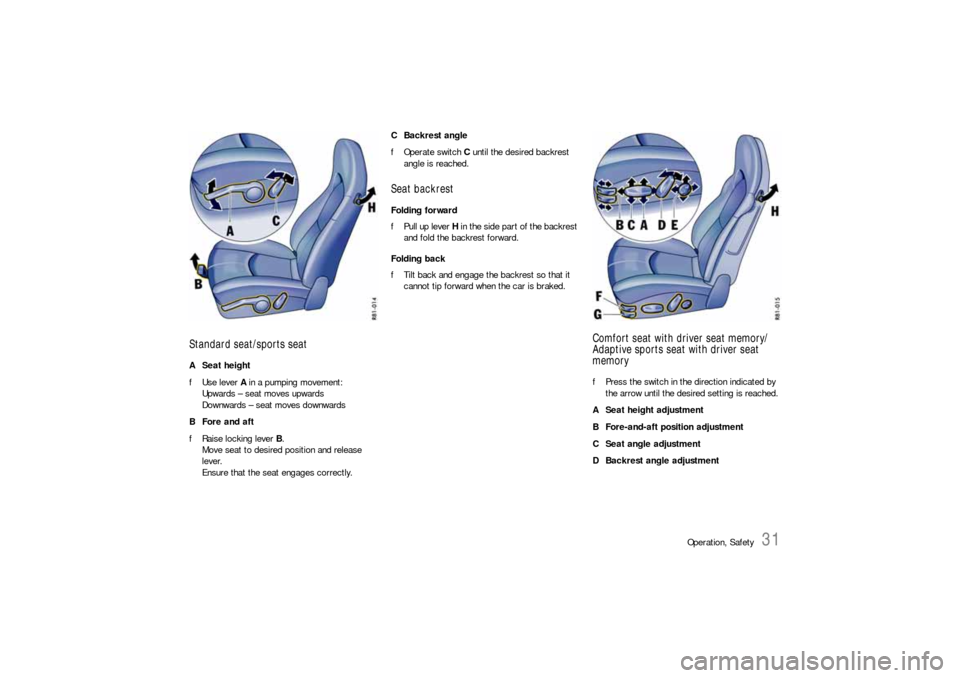
Standard seat/sports seatA Seat height
fUse lever A in a pumping movement:
Upwards – seat moves upwards
Downwards – seat moves downwards
B Fore and aft
fRaise locking lever B.
Move seat to desired position and release
lever.
Ensure that the seat engages correctly.C Backrest angle
fOperate switch C until the desired backrest
angle is reached.
Seat backrestFolding forward
fPull up lever H in the side part of the backrest
and fold the backrest forward.
Folding back
fTilt back and engage the backrest so that it
cannot tip forward when the car is braked.
Comfort seat with driver seat memory/
Adaptive sports seat with driver seat
memoryfPress the switch in the direction indicated by
the arrow until the desired setting is reached.
A Seat height adjustment
B Fore-and-aft position adjustment
C Seat angle adjustment
D Backrest angle adjustment
Page 34 of 310
32
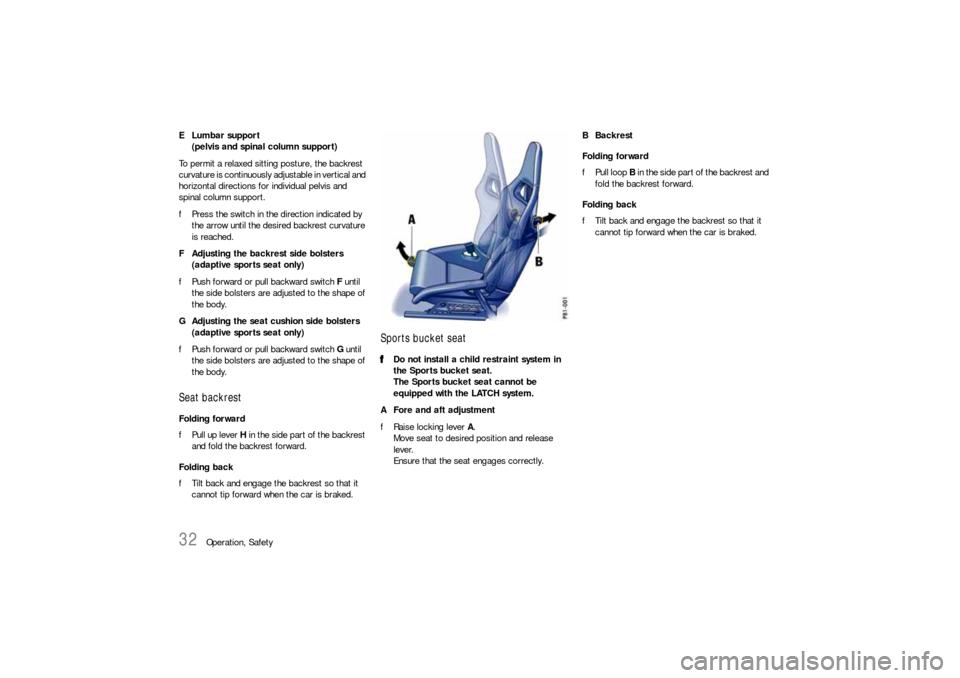
Operation, Safety E Lumbar support
(pelvis and spinal column support)
To permit a relaxed sitting posture, the backrest
curvature is continuously adjustable in vertical and
horizontal directions for individual pelvis and
spinal column support.
fPress the switch in the direction indicated by
the arrow until the desired backrest curvature
is reached.
F Adjusting the backrest side bolsters
(adaptive sports seat only)
fPush forward or pull backward switch F until
the side bolsters are adjusted to the shape of
the body.
G Adjusting the seat cushion side bolsters
(adaptive sports seat only)
fPush forward or pull backward switch G until
the side bolsters are adjusted to the shape of
the body.
Seat backrestFolding forward
fPull up lever H in the side part of the backrest
and fold the backrest forward.
Folding back
fTilt back and engage the backrest so that it
cannot tip forward when the car is braked.
Sports bucket seatfDo not install a child restraint system in
the Sports bucket seat.
The Sports bucket seat cannot be
equipped with the LATCH system.
A Fore and aft adjustment
fRaise locking lever A.
Move seat to desired position and release
lever.
Ensure that the seat engages correctly.BBackrest
Folding forward
fPull loop B in the side par t of the backrest and
fold the backrest forward.
Folding back
fTilt back and engage the backrest so that it
cannot tip forward when the car is braked.
Page 36 of 310

34
Operation, Safety
Operating with the remote control of the
vehicle keyEach remote control (up to six) can be assigned an
individual seat and door mirror position.
The stored seat and door mirror position is set au-
tomatically when the vehicle is unlocked using the
corresponding remote control.
Storing seat position
1. Switch the ignition on with the desired car key.
Reverse gear must not be engaged.
2. Set the desired seat and door-mirror positions.
3. Keep memory button M depressed and also
press key button 1 until an audible signal
confirms that the position has been stored.
The individual setting is now assigned to this
remote control and to the key button.
It is necessary to wait for at least 15 seconds
between locking and unlocking the door.Storing individual lowered position of the
passenger’s door mirror as a parking aid
Once the driver's seat setting has been stored, an
individual lowered position of the passenger's
door mirror may be stored for driving in reverse:
1. Apply the handbrake.
2. Switch the ignition on with the desired car key.
3. Engage reverse gear.
4. Select passenger side with mirror switch.
The passenger’s mirror swivels downwards.
5. Set passenger’s door mirror to desired final
position.
6. Keep memory button M depressed and also
press key button 1 until an audible signal
confirms that the position has been stored.
The individual setting is now assigned to this
remote control and to the key button.Recalling seat position
fUnlock the locked vehicle or the luggage
compartment with the remote control.
The stored seat position is automatically set.
The seat position assigned to a remote control
can also be recalled with the key button 1 if the
corresponding key was used to switch on the
ignition.
If no seat position has been assigned to a remote
control, the key button will not work.
Note on operation
Automatic seat adjustment can be interrupted
immediately:
fby switching on the ignition,
fby pressing the central locking button,
fby pressing any memory or seat adjustment
button.
Clearing the stored seat position
1. Switch the ignition on with the desired car key.
2. Press memory button twice and key button 1
once consecutively.
Page 39 of 310

Operation, Safety
37
Rear Seat BackrestsExtra storage space is gained by folding the rear
seat backrests forward.
Folding forward
fPull lever forward and fold the backrest
forward.
Folding back
fTilt the backrest back until you feel it click into
place. When doing so, make sure that the seat
belt is properly routed (see figure).Cabriolet
fDo not fold up the rear seat backrests with the
windstop installed.
Steering Wheel Adjustment
Warning!
Risk of accident.
The steering wheel may move further than
desired if you attempt to adjust it when
driving.
You can lose control of the vehicle, causing
serious personal injury or death.
fDo not adjust the steering wheel when driving.
Adjusting steering wheel height and
longitudinal direction1. Insert ignition key fully into ignition lock.
2. Push the locking lever downwards.
3. Adjust steering wheel to fit the chosen
backrest angle and your seat position by
moving the steering wheel up or down and
longitudinally.
4. Swivel locking lever back until you feel it en-
gage.
If necessary, move steering wheel slightly lon-
gitudinally.
Page 43 of 310

Operation, Safety
41
Safety Belts
Warning!
Always make sure your and your passengers’
safety belts are properly fastened while the
vehicle is in motion.
Failure to follow safety belt warnings may re-
sult in serious personal injury or death.
fFor your and your passengers’ protection, use
safety belts at all times while the vehicle is in
motion.
fUse appropriate child restraint systems for all
small children.
Proper wearing of safety belts
fSafety belts must be positioned on the body as
to restrain the upper body and lap from sliding
forward. Improperly positioned safety belts
can cause serious personal injury or death in
case of an accident.
fThe shoulder belt should always rest on your
upper body. The shoulder belt should never be
worn behind your back or under your arm.
fFor maximum effectiveness, the lap belt
should be worn low across the hips.
fPregnant women should position the belt as
low as possible across the pelvis. Make sure it
is not pressing against the abdomen. fBelts should not be worn twisted.
fDo not wear belts over rigid or breakable ob-
jects in or on your clothing, such as eye glass-
es, pens, keys, etc. as these may cause injury.
fSeveral layers of heavy clothing may interfere
with proper positioning of belts.
fBelts must not rub against sharp objects or
damage may occur to the belt.
fTwo occupants should never share the same
belt at the same time.
Care and maintenance
fKeep belt buckles free of any obstruction that
may prevent a secure locking.
fBelts that have been subjected to excessive
stretch forces in an accident must be inspect-
ed or replaced to ensure their continued effec-
tiveness in restraining you.
The same applies to belt tensioner systems
which have been triggered.
In addition, the anchor points of the belts
should be checked.
fIf safety belts do not work properly, see your
authorized Porsche dealer immediately.
fIf the belts show damage to webbing, bindings,
buckles or retractors, they should be replaced
to ensure safe operation.
fDo not modify or disassemble the safety belts
in your vehicle. fThe belts must be kept clean or the retractors
may not work properly.
Please see the chapter “CAR CARE INSTRUC-
TIONS” on Page 224.
fNever bleach or dye safety belts.
fDo not allow safety belts to retract until they
are completely dry after cleaning or this may
cause damage to the belt.
Belt tensioner Depending on the force of an impact, fastened
front seat safety belts are tightened in an acci-
dent.
The belt tensioners are triggered in:
– Front, side and rear impacts of sufficient
severity.
– For the Cabriolet, in cases of vehicle rollover.
Note
The belt-tensioner system can be triggered only
once; the system must be replaced afterward.
If there is a fault in the belt-tensioner system, the
airbag warning light lights up.
Work may be performed on the belt-tensioner sys-
tem only by an authorized Porsche dealer.
Smoke is released when the belt tensioners are
triggered. This does not indicate a fire in the
vehicle.