locking PORSCHE 911 2009 5.G Owner's Manual
[x] Cancel search | Manufacturer: PORSCHE, Model Year: 2009, Model line: 911, Model: PORSCHE 911 2009 5.GPages: 310, PDF Size: 3.39 MB
Page 44 of 310
42
Operation, Safety An audio-visual warning system is interconnect-
ed with the driver’s safety belt.
Every time the ignition is turned on, the gong will
sound for about 6 seconds to remind driver and
passenger to buckle up.
In addition, the gong will sound for approx. 90 sec-
onds if vehicle speed exceeds 15 mph/24 km/h.
The safety belt warning lights in the instrument
panel and on-board computer will go off as soon
as the driver has buckled up.
Inertia reel retractor The combination lap/shoulder belt with inertia reel
locking mechanism adjusts automatically to your
size and movements as long as the pull on the belt
is slow.
Rapid deceleration during hard braking or a colli-
sion locks the belt. The belt will also lock when you
drive up or down a steep hill or in a sharp curve,
otherwise, the shoulder belt will not inhibit your
upper body movement.
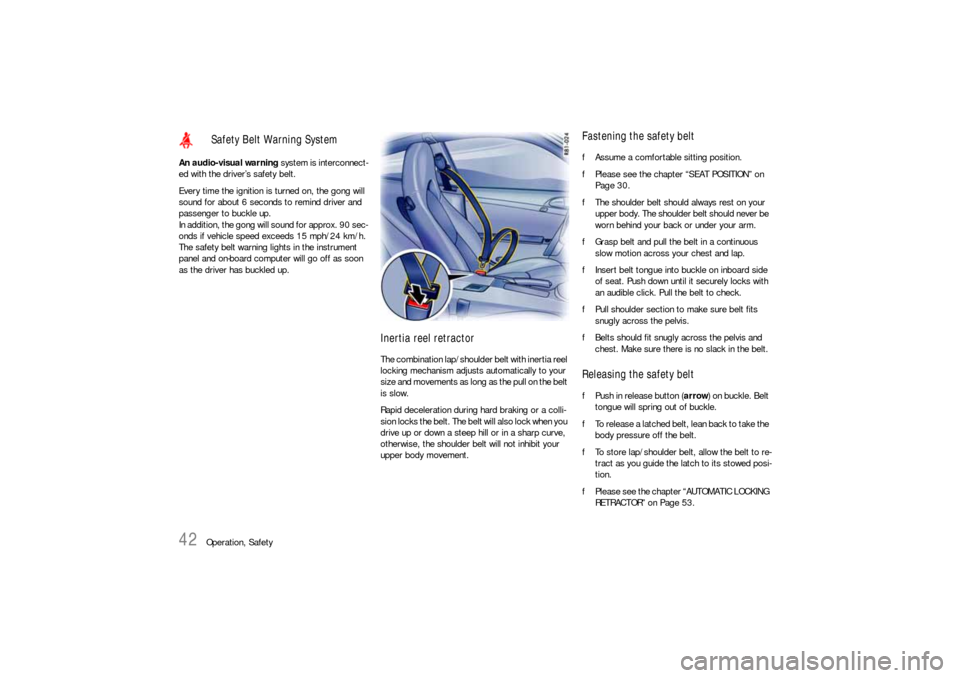
Fastening the safety beltfAssume a comfortable sitting position.
fPlease see the chapter “SEAT POSITION” on
Page 30.
fThe shoulder belt should always rest on your
upper body. The shoulder belt should never be
worn behind your back or under your arm.
fGrasp belt and pull the belt in a continuous
slow motion across your chest and lap.
fInsert belt tongue into buckle on inboard side
of seat. Push down until it securely locks with
an audible click. Pull the belt to check.
fPull shoulder section to make sure belt fits
snugly across the pelvis.
fBelts should fit snugly across the pelvis and
chest. Make sure there is no slack in the belt. Releasing the safety beltfPush in release button (arrow) on buckle. Belt
tongue will spring out of buckle.
fTo release a latched belt, lean back to take the
body pressure off the belt.
fTo store lap/shoulder belt, allow the belt to re-
tract as you guide the latch to its stowed posi-
tion.
fPlease see the chapter “AUTOMATIC LOCKING
RETRACTOR” on Page 53.
Safety Belt Warning System
Page 55 of 310

Operation, Safety
53
Automatic locking retractorfDo not install a child restraint system in
the Sports bucket seat.
The Sports bucket seat cannot be
equipped with the LATCH system.
The safety belts for the front passenger and rear
seats are equipped with an automatic locking re-
tractor for securing the child restraint system.
When activated, this retractor allows you to se-
curely fasten the child restraint system in place so
that inadvertent movements will not occur.
Danger!
The use of a child restraint system on the
front passenger seat can result in serious
personal injury or death to the child from an
airbag deployment.
To reduce risk of injury from an inflating air-
bag in an accident, Porsche strongly recom-
mends:
fUnder all normal circumstances, forward fa-cing child seats must be placed in the rear.
Before transporting a child on the passenger’s
seat:
fPlease see the chapter “CHILD RESTRAINT
SYSTEMS” on Page 50.
Danger!
Risk of serious personal injury or death to the
child, when excessive force is acting on the
passenger's seat due to the seat belt.
In such cases, the passenger's airbag can be
switched on unintentionally.
fAfter fastening the child restraint system, do
not adjust the seat.
fCheck the condition of the passenger’s airbag
shown by the indicator lamp in the central con-sole.Activating the automatic locking retractor
1. If a child restraint system must be fastened to
the passenger's seat, adjust the passenger's
seat as far away from the airbag as possible.
2. Fasten child seat.
3. Pull the safety belt retractor completely out. At
this point the locking mechanism is activated.
4. Insert the safety belt tongue into the buckle
and make certain that it is properly latched.
Make no more adjustments to the seat.
5. Allow the safety belt to retract until it is tight on
the child restraint system. You may further
tighten the belt by pulling on it to allow more of
it to retract.
Make sure that excessive seat belt forces do
not occur by moving the seat with the child
seat installed.
Releasing the safety belt
1. Unbuckle the safety belt latch.
2. Then make certain that the belt has fully
retracted. At this point the automatic locking
feature will be disengaged.
Seek appropriate advice from your authorized
Porsche dealer about the possible installation
of a Porsche child restraint system.
Page 57 of 310
Operation, Safety
55
Child Restraint Anchorages (Coupé and Targa)
fPlease see the chapter “AUTOMATIC LOCKING
RETRACTOR” on Page 53.
fDo not install a child restraint system in
the Sports bucket seat.
The Sports bucket seat cannot be
equipped with the LATCH system.
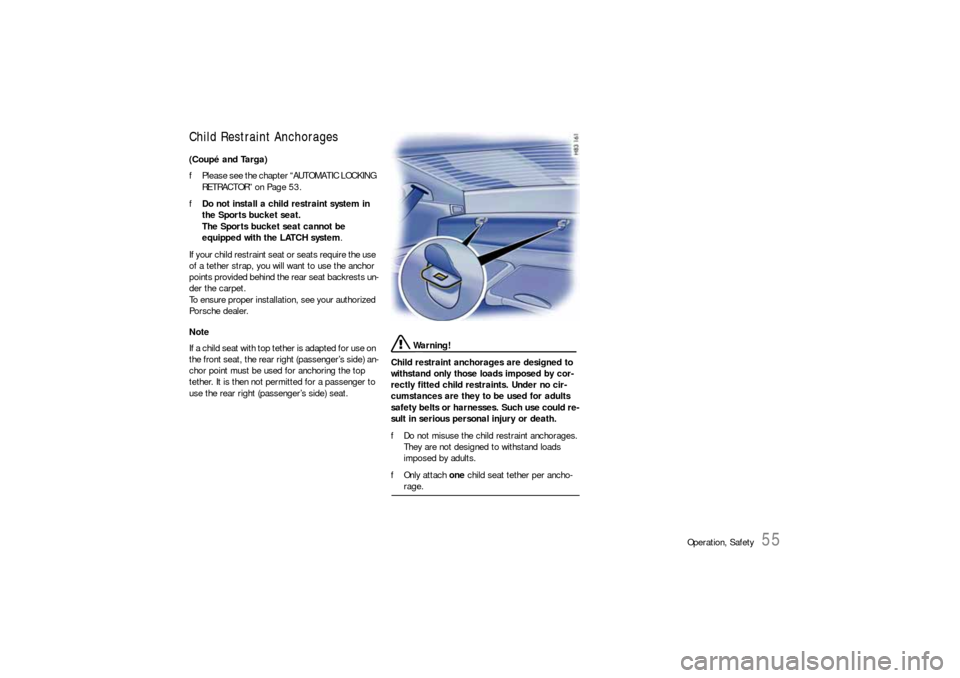
If your child restraint seat or seats require the use
of a tether strap, you will want to use the anchor
points provided behind the rear seat backrests un-
der the carpet.
To ensure proper installation, see your authorized
Porsche dealer.
Note
If a child seat with top tether is adapted for use on
the front seat, the rear right (passenger’s side) an-
chor point must be used for anchoring the top
tether. It is then not permitted for a passenger to
use the rear right (passenger’s side) seat.
Warning!
Child restraint anchorages are designed to
withstand only those loads imposed by cor-
rectly fitted child restraints. Under no cir-
cumstances are they to be used for adults
safety belts or harnesses. Such use could re-
sult in serious personal injury or death.
fDo not misuse the child restraint anchorages.
They are not designed to withstand loads
imposed by adults.
fOnly attach one child seat tether per ancho-rage.
Page 63 of 310

Operation, Safety
61
ABS Brake System
(Antilock Brake System)The ABS system represents a major contribution
to the enhancement of active safety in your vehi-
cle. This system prevents the wheels from locking
in a panic stop on almost all road surfaces.
With the ABS system in your vehicle, the
following areas are enhanced:
Steering, vehicle remains steerable under all
braking forces when ABS is engaged.
Good directional control, no swerving caused
by locking of wheels under braking conditions.
Shorter stopping distance, stopping distances
are usually reduced because controlled braking is
maximized.
Prevention of wheel lock up, no brake- induced
sliding and thus no localized tire wear from emer-
gency braking.
The crucial advantage of the ABS system over a
conventional brake system is in the area of main-
taining directional control and maneuverability of
the car in emergency situations.
Warning!
The increased control that is provided should
not induce you to take greater risks with your
safety. The limits dictated by the laws of
physics cannot be overcome, even with ABS.
The risk of accidents due to inappropriate
speed cannot be reduced, even by the ABS.
The driver bears the responsibility for all
driving maneuvers.
fAdapt your driving style to the prevailing road
and weather conditions.
fObey all traffic laws.
Other vehicles not equipped with the ABS
system may not be able to maintain control,
especially on wet or poor road surfaces and
thus may be more likely to impact you from
behind.
fTo minimize that risk, use your ABS system to
increase your ability to maneuver to avoid dan-
gerous situations and not merely to try to stop in the shortest distance possible.
Operation of the ABS systemA wheel speed sensor is mounted to each of the
four wheels. If wheel lock-up of either of the front
wheels or the rear wheels is sensed during brak-
ing, the brake pressure is adjusted automatically
until the wheel no longer slips.
If braking forces approach the wheel lock-up point
for all wheels (panic braking) the ABS system will
intervene to provide a rapid rythmic braking. The
proper operation of ABS is perceived by the driver
as a pulsating brake pedal in conjunction with au-
dible noise and perhaps some vibration.
fIf you experience these sensations while driv-
ing or a road surface with questionable trac-
tion, reduce vehicle speed appropriate for the
prevailing road conditions.
fIf full braking should be necessary, press the
brake pedal all the way down throughout the
entire braking procedure, regardless of the pul-
sating pedal. Do not ease up on pressure ap-
plied to the pedal.
The functional readiness of all the main electrical
components of the ABS is checked by an
electronic monitoring system both before and
while you drive.
Page 77 of 310

Operation, Safety
75
Switch position 2Start engine
fTurn ignition key to ignition lock position 2.
fPlease see the chapter “STARTING PROCEDU-
RES” on Page 77.Switch position 3Ignition off
fTurn ignition key to ignition lock position 3.
Note on operation
The vehicle battery discharges if the ignition key is
left inserted.
If the vehicle battery is dead, the key can only be
pulled out of the ignition lock if the emergency
operation is performed:
fPlease see the chapter “EMERGENCY OPERA-
TION – PULLING OUT THE IGNITION KEY” on
Page 76.
Locking the steering columnAutomatic locking
The steering column is automatically locked when
the ignition key is withdrawn from the ignition lock.
Warning!
Risk of an accident, resulting in serious per-
sonal injury or death.
The steering wheel will lock and will cause
loss of steering.
fNever remove key from the ignition lock or turn
the key off while the vehicle is moving.
fAlways withdraw the ignition key when leaving the vehicle.Automatic unlocking
The steering column is unlocked when the vehicle
is unlocked with the radio remote control.
Note
fTo avoid discharging the battery, always re-
move the ignition key from the ignition lock.
Please see the chapter “BATTERY” on
Page 261.
Gong If you leave the key in the ignition/steering lock, a
gong will sound when the driver’s door is opened.
This is a reminder to remove the key.
Page 78 of 310
76
Operation, Safety
Emergency operation – pulling out the
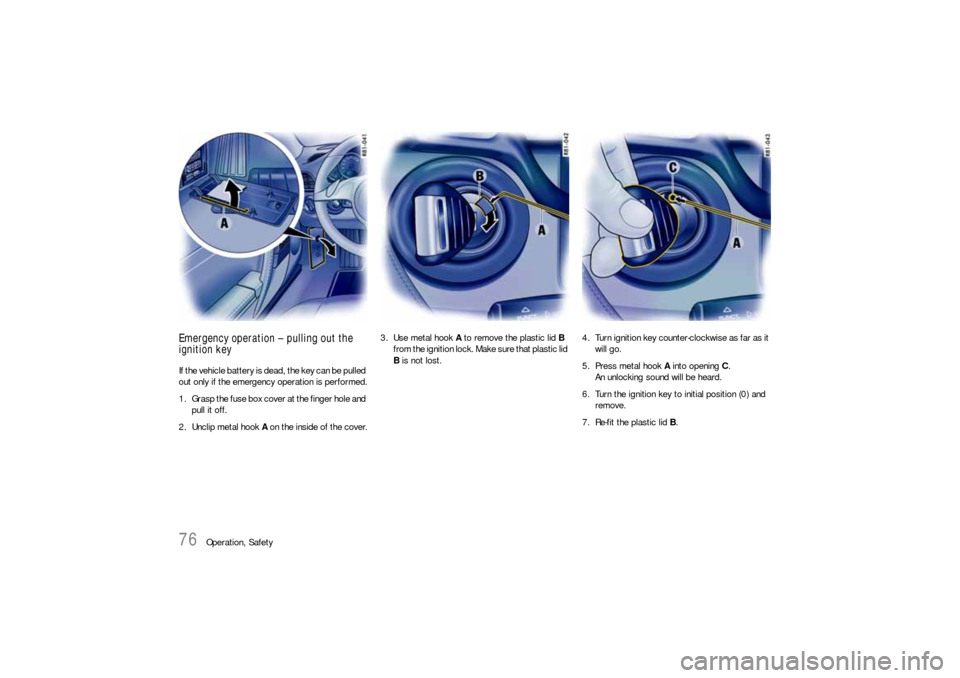
ignition keyIf the vehicle battery is dead, the key can be pulled
out only if the emergency operation is performed.
1. Grasp the fuse box cover at the finger hole and
pull it off.
2. Unclip metal hook A on the inside of the cover.3. Use metal hook A to remove the plastic lid B
from the ignition lock. Make sure that plastic lid
B is not lost.4. Turn ignition key counter-clockwise as far as it
will go.
5. Press metal hook A into opening C.
An unlocking sound will be heard.
6. Turn the ignition key to initial position (0) and
remove.
7. Re-fit the plastic lid B.
Page 80 of 310

78
Operation, Safety
Stopping Engine fTurn key back to position 3.
fDo not stop engine immediately after hard or
extended driving.
Keep engine running at increased idle for
about two minutes to prevent excessive heat
build-up before turning off engine.
fTo avoid discharging the battery, always re-
move the ignition key from the ignition lock.
fWhen leaving the car, always remove the igni-
tion key and apply the handbrake. Engage 1st
gear or reverse gear on vehicles with manual
transmission or move the selector lever to po-
sition P on vehicles with PDK transmission.
fEngage the steering lock by moving the steer-
ing wheel to the left or right.
Turn the steering wheel to the locking position
before you switch off the engine so that you
don’t have to exert yourself when locking or
unlocking the steering.
Warning!
Danger of injury. Hot engine compartment
components can burn skin on contact.
fBefore working on any part in the engine com-
partment, turn the engine off and let it cool down sufficiently.
Engine-compartment blower,
radiator fan The radiator and radiator fans are in the front of
the car.
The engine-compartment blower is mounted on
the engine compartment lid.
Warning!
Risk of injury.
After the engine is switched off, the engine-
compartment temperature is monitored for
approx. 30 minutes.
During this period, and depending on tem-
perature, the engine-compartment blower
may continue to run or start to run.
fCarry out work in these areas only with the en-
gine off, the ignition off, and exercise extreme
caution.
Risk of injury. The radiator fans in the front
end of the car may be operating or
unexpectedly start operating when the
engine is switched on.
fCarry out work in these areas only with the en-gine switched off.
Automatic garage door The ignition system in your Porsche may interfere
with your electronically operated garage door.
fTo check this, drive your Porsche close to the
garage door. Make sure not to interfere with
the operating range of the door.
fRun the engine at different speeds.
fIf the garage door opens or closes without you
operating the garage door unit in your car,
contact the dealer who installed the automatic
garage door to have the frequency and/or
coding of the garage door signal changed or
modified.
Page 83 of 310

Operation, Safety
81
Welcome Home LightingSwitching onfMove light switch to the HOME position.
For improved visibility and security when you get
in and out of the car, the daytime driving lights and
the tail lights remain on for a certain period of
time:
–When you get out of the car, the lights are
turned on for approx. 30 seconds after the
door is opened. The off-delay time resumes
when the vehicle is locked.
On vehicles with the Sport Chrono Package
Plus, the PCM can be used to set the off-delay
time. This setting also changes the lighting
period for unlocking the vehicle.
Please observe the chapter “Individual
Memory” in the separate PCM operating
instructions.
– The lights are turned on for approx.
30 seconds when the vehicle is unlocked.
The lights go out if the ignition is switched on
or when leaving the Welcome Home lighting.
Automatic Headlight Beam
Adjustment Vehicles with Bi-Xenon headlights feature
dynamic headlight beam adjustment.
When the ignition is switched on, the level of the
headlight beam automatically changes in accord-
ance with the vehicle load.
The level of the headlight beam is automatically
kept constant during acceleration and braking. Checking operation 1. Switch the low beam on.
2. Insert ignition key and switch ignition on.
The light beam first dips all the way down and
is then adapted to the vehicle load.
If this test item is not met, the headlight beam
adjustment system must be checked by an author-
ized Porsche dealer.
Page 94 of 310

92
Operation, Safety
Glove compartment
Warning!
Risk of injury by the glove compartment lid in
case of an accident.
fKeep the glove compartment closed while driving.
Opening
fPull the catch and open the lid.
Locking
fLock the catch to secure the contents against
unauthorized access.
CD holderOccupied drawers are indicated by a red window.
Opening drawers
fPush the button of the drawer you wish to
open.
Closing drawers
fFold up CD drawer and close until it engages.Pen holderA pen can be clipped in on the right side of the CD
holder.
Page 95 of 310
Operation, Safety
93
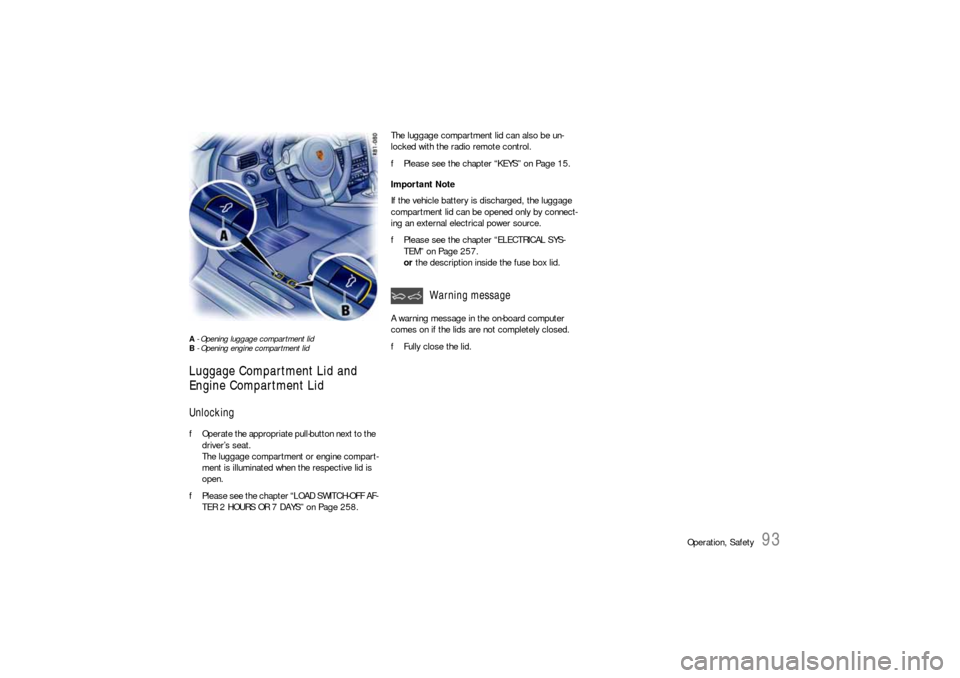
A - Opening luggage compartment lid
B - Opening engine compartment lid Luggage Compartment Lid and
Engine Compartment LidUnlocking fOperate the appropriate pull-button next to the
driver’s seat.
The luggage compartment or engine compart-
ment is illuminated when the respective lid is
open.
fPlease see the chapter “LOAD SWITCH-OFF AF-
TER 2 HOURS OR 7 DAYS” on Page 258.The luggage compartment lid can also be un-
locked with the radio remote control.
fPlease see the chapter “KEYS” on Page 15.
Important Note
If the vehicle battery is discharged, the luggage
compartment lid can be opened only by connect-
ing an external electrical power source.
fPlease see the chapter “ELECTRICAL SYS-
TEM” on Page 257.
or the description inside the fuse box lid.
A warning message in the on-board computer
comes on if the lids are not completely closed.
fFully close the lid.
Warning message