engine PORSCHE 911 CARRERA 2006 5.G User Guide
[x] Cancel search | Manufacturer: PORSCHE, Model Year: 2006, Model line: 911 CARRERA, Model: PORSCHE 911 CARRERA 2006 5.GPages: 308, PDF Size: 3.69 MB
Page 18 of 308

18
Controls, Instruments
Never invite car theft! An unlocked car with the key in the ignition lock
invites car theft.
A steering wheel lock and a gong alarm are
standard equipment in your Porsche.
The gong alarm will sound if you open the driver’s
door while the key is still in the ignition lock. It is
your reminder to pull the key out of the ignition
lock and to lock the doors.
Warning!
Any uncontrolled movement of the vehicle
may result in serious personal injury and
property damage.
Never leave your vehicle unattended with the
key in the ignition lock, especially if children
and/or pets are left unattended in the vehi-
cle. They can operate power windows and
other controls. If the engine is left running,
they may accidentally engage the shift lever.
fAlways remove the ignition key.
fAlways set the parking brake.
fLock the doors with the remote control.
Warning!
Risk of a serious accident.
The steering column will lock when you re-
move the key while you are driving or as the
car is rolling to a stop. You will not be able to
steer the car.
fNever remove the key from the steering lock while you are driving. To protect your vehicle and your possessions
from theft, you should always proceed as
follows when leaving your vehicle:
fClose windows.
fClose lifting/sliding roof
fClose convertible top (with the convertible top
open, the passenger compartment monitoring
system is always switched off)
fRemove ignition key.
fEngage steering lock.
fLock glove compartment.
fRemove valuables (e.g. car documents, tele-
phone, house keys) from the car.
fLock doors.
Page 19 of 308

Controls, Instruments
19
Keys fPlease observe the chapter “ALARM SYSTEM,
PASSENGER COMPARTMENT MONITORING”
on Page 26.
fPlease observe the chapter “CENTRAL LO-
CKING” on Page 22.
Two main keys and one spare key are supplied
with your Porsche.
These keys operate all the locks on your vehicle.
fBe careful with your car keys: do not part with
them except under exceptional circumstances.
fTo avoid battery run-down, always remove the
ignition key from the ignition lock.
Replacement keys Replacement car keys can be obtained only from
your authorized Porsche dealer, and this can
sometimes be very time-consuming.
You should therefore always keep the spare key on
your person.
Keep it in a safe place (e.g. wallet), but under no
circumstances in or on the vehicle.
The key codes of new keys have to be “reported”
to the car control unit by your authorized Porsche
dealer.
Disabling key codes
If a key is lost, the key codes can be disabled by
an authorized Porsche dealer.
All the remaining car keys are required for this pur-
pose.
Disabling the code ensures that the car can be
started only using authorized keys.
Note
fPlease note that the other locks can still be
opened with the disabled key.
Immobilizer There is a transponder (an electronic component)
in the key grip, containing a stored code.
When the ignition is switched on, the ignition lock
checks the code.
The immobilizer can be deactivated and the en-
gine started only using an authorized ignition key.
Switching off the immobilizer
fInsert the ignition key into the ignition lock.
If the ignition is left on for more than 2 minutes
without the engine being started, the immobilizer
is reactivated.
fIf this happens, turn the ignition key back to the
3 position before starting the engine.
Please observe the chapter “IGNITION/
STARTER SWITCH WITH ANTI-THEFT
STEERING LOCK” on Page 80.
Switching on the immobilizer
fRemove ignition key.Security Wheel Bolts fIf wheels have to be removed during a work-
shop visit, do not forget to hand over the sock-
et for the security wheel bolts along with the
car key.
Page 22 of 308

22
Controls, Instruments
Central Locking This device complies with:
Part 15 of the FCC Rules
RSS-210 of Industry Canada.
Operation is subject to the following two condi-
tions:
1. This device may not cause harmful interfer-
ence, and
2. this device must accept any interference re-
ceived, including interference that may cause
undesired operation.
Note
The manufacturer is not responsible for any radio
or TV interference caused by unauthorized modifi-
cations to this equipment.
Such modification could void the user’s authority
to operate the equipment.
Warning!
Any changes or modifications not expressly ap-
proved by Porsche could void the user’s authority
to operate this equipment.
fPlease observe the chapter “LOAD SWITCH-
OFF AFTER 2 HOURS OR 7 DAYS” on
Page 255.
fPlease observe the chapter “SEAT MEMORY”
on Page 36.Both car doors and the filler flap can be centrally
unlocked or locked with the remote control.
The vehicle cannot be locked if the driver’s door is
not completely closed.
A short signal from the alarm horn will draw
your attention to the fact that the following
components are not completely closed when you
try to lock the vehicle:
– Passenger’s door
– Luggage compartment lid
– Engine compartment lid
– Glove compartment
Unlocking the vehicle by using the key in the door
lock and opening the door may activate the alarm
system within 10 seconds.
Note
On vehicles with the Sport Chrono package, the
PCM can be used to activate automatic door
locking.
Please observe the chapter “Individual Memory” in
the separate PCM operating instructions.
Automatic relocking If the car is unlocked by remote control and none
of the car doors is opened within approx.
60 seconds, automatic relocking takes place.
This relocking time can be adapted to your individ-
ual requirements (10 - 100 seconds) by an author-
ized Porsche dealer.
Page 25 of 308

Controls, Instruments
25
Automatic door locking Your authorized Porsche dealer can program di-
verse types of automatic door locking in the con-
trol unit of the central locking system:
Ty p e 1
Doors lock automatically when the ignition is
switched on.
Ty p e 2
Doors lock automatically when a speed of
3 - 6 mph (5 - 10 km/h) is exceeded. Ty p e 3
Doors lock automatically when the ignition is
switched on. If doors are opened with the engine
running, they lock again automatically when a
speed of 3 - 6 mph (5 - 10 km/h) is exceeded.
Ty p e 4
The doors do not lock automatically.
Note
Automatically locked doors can be unlocked with
the central locking button or opened by pulling on
the inside door handle twice.
On vehicles with the Sport Chrono package, the
PCM can be used to activate automatic door lock-
ing.
Please observe the chapter “Individual Memory” in
the separate PCM operating instructions.
Warning!
In an emergency situation where you need to
exit the car through an automatically locked
door, remember the following procedure to
open the door.
fUnlock the doors by pressing the central lock-
ing button or
fpull the inside door handle twice to open the door.
Page 27 of 308

Controls, Instruments
27
When the alarm is armed, the following
areas are monitored –Doors
– Luggage compartment lid
– Engine compartment lid
– Convertible-top lock (Cabriolet)
– Glove compartment
– Passenger compartment
If one of these alarm contacts is interrupted, the
alarm horn sounds for approximately 3 minutes.
Additionally, the emergency flasher flashes and
the passenger compartment light lightes for ap-
proximately five minutes.
When the alarm is triggered, the light-emitting
diode changes over to double flashes.
In order not to limit the action range of the passen-
ger compartment monitoring system:
fDo not fold the front seat backrests forward.
Deactivating the passenger compartment
monitoring system for one locking
processIf a person or animal remains in the car while it is
locked, the passenger compartment monitoring
system must be switched off.
fQuickly lock car twice.
The doors are locked but can be opened from
the inside:
1. Pull inner door handle once to unlock door
lock.
2. Pull inner door handle again to open door.
Note
fInform any person remaining in the car that the
alarm system will be triggered if the door is
opened.
Fault indication A double horn signal during locking indicates a
defect in the central locking or alarm system.
fHave the defect remedied at an authorized
Porsche dealer.
Page 28 of 308
28
Controls, Instruments
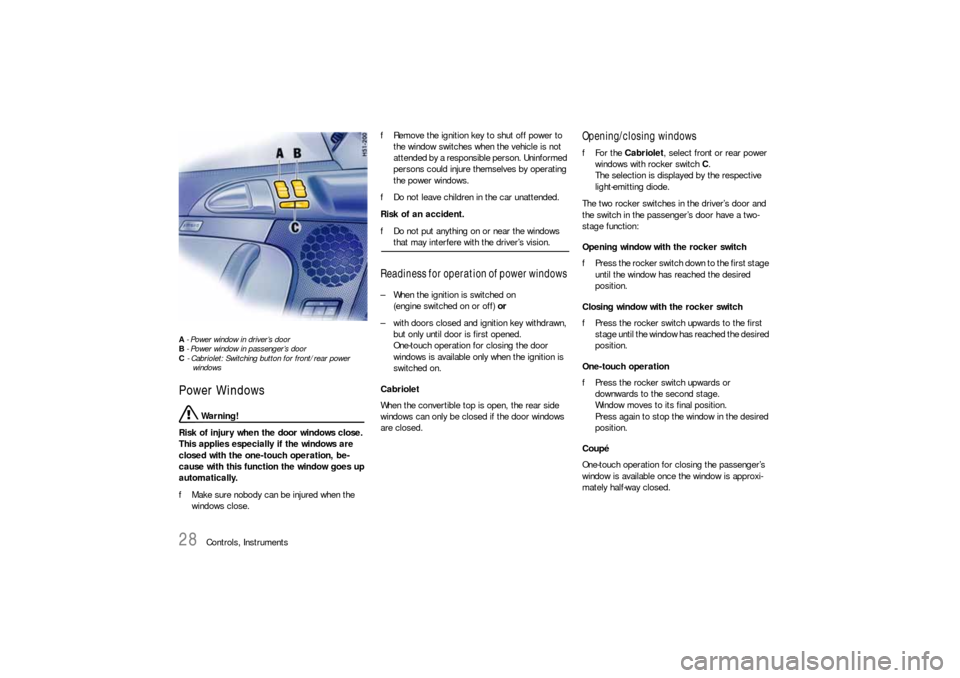
A - Power window in driver’s door
B - Power window in passenger’s door
C - Cabriolet: Switching button for front/rear power
windowsPower Windows
Warning!
Risk of injury when the door windows close.
This applies especially if the windows are
closed with the one-touch operation, be-
cause with this function the window goes up
automatically.
fMake sure nobody can be injured when the
windows close. fRemove the ignition key to shut off power to
the window switches when the vehicle is not
attended by a responsible person. Uninformed
persons could injure themselves by operating
the power windows.
fDo not leave children in the car unattended.
Risk of an accident.
fDo not put anything on or near the windows
that may interfere with the driver’s vision.
Readiness for operation of power windows – When the ignition is switched on
(engine switched on or off) or
– with doors closed and ignition key withdrawn,
but only until door is first opened.
One-touch operation for closing the door
windows is available only when the ignition is
switched on.
Cabriolet
When the convertible top is open, the rear side
windows can only be closed if the door windows
are closed.
Opening/closing windowsfFor the Cabriolet, select front or rear power
windows with rocker switch C.
The selection is displayed by the respective
light-emitting diode.
The two rocker switches in the driver’s door and
the switch in the passenger’s door have a two-
stage function:
Opening window with the rocker switch
fPress the rocker switch down to the first stage
until the window has reached the desired
position.
Closing window with the rocker switch
fPress the rocker switch upwards to the first
stage until the window has reached the desired
position.
One-touch operation
fPress the rocker switch upwards or
downwards to the second stage.
Window moves to its final position.
Press again to stop the window in the desired
position.
Coupé
One-touch operation for closing the passenger’s
window is available once the window is approxi-
mately half-way closed.
Page 49 of 308

Controls, Instruments
49
PASSENGER AIRBAG OFF indicator lamp
does not light up
– The passenger's airbag is active and ready for
operation.
– If the passenger's seat is not occupied, the
PASSENGER AIRBAG OFF indicator lamp will
also not light up, even though the passenger's
airbag is switched off.
Danger!
Risk of serious personal injury or death due
to the passenger airbag triggering uninten-
tionally.
When the ignition is on and the up to one-
year old child is seated in the child restraint
system on the passenger’s seat, the indicator
lamp “PASSENGER AIRBAG OFF” must be on.
If the “PASSENGER AIRBAG OFF” indicator
lamp does not light up, it could indicate a
fault in the system.
In this case:
fChild restraint systems facing forwards:
Install on the rear seats.
fChild restraint systems facing rearwards:
On vehicles with key-operated airbag deactiva-
tion device: Switch to position OFF.
fChild restraint systems facing rearwards:
On vehicles without key-operated airbag deac-
tivation device: Do not use a child restraint sys-
tem in the front passenger’s seat.fHave the fault remedied at your nearest author-
ized Porsche dealer.
Note
The key switch for switching off the passenger’s
airbag in combination with the LATCH attachment
bracket are not installed at the factory. They can
be retrofitted.
fPlease see your authorized Porsche dealer.
Faults are indicated by a warning light in the instru-
ment panel and a message on the on-board com-
puter.
fPlease observe the chapter “WARNINGS ON
THE INSTRUMENT PANEL AND THE ON-
BOARD COMPUTER” on Page 122.
fIn the following cases you should immedi-
ately consult an authorized Porsche
dealer in order to assure the airbag sys-
tem is functioning properly:
– If the warning light does not light up when the
ignition key is inserted or
– If the warning light does not go out once the
engine is running or
– If the warning light appears while driving.
Airbag maintenanceIn order to ensure long-term functioning, the air-
bag system must be inspected by an authorized
Porsche dealer at the intervals recommended in
your Maintenance Booklet.
Important information
If you sell your Porsche, notify the purchaser that
the vehicle is equipped with airbags, and refer
them to the chapter, “Airbag Systems“, in the
Owner's Manual (safety and disposal rules).
Further information on the airbag system can be
found on stickers attached to the sun visors.
For special recommendations on the use of child
restraints:
fPlease observe the chapter “CHILD RES-
TRAINT SYSTEMS” on Page 51.
Warning light and warning
message
Page 61 of 308

Controls, Instruments
61
Four-Wheel Drive With the four-wheel drive of the 911 Carrera 4 and
911 Carrera 4S, the engine power is variably dis-
tributed to the front and rear wheels.
Power distribution and wheel speed compensation
between the front and rear axles is realised with a
viscous multiple-disc clutch.
Distribution of the engine power is dependent
upon the wheel speed difference between the two
axles.
The viscous multiple-disc clutch always delivers
sufficient drive power to the front wheels (approx.
5% to 40%) to ensure optimum traction even on a
poor road surface.
In combination with the Porsche Stability Manage-
ment (PSM), four-wheel drive improves handling
and increases driving stability.
Warning!
The increased control that is provided should
not induce you to take greater risks with your
safety. The limits dictated by the laws of phy-
sics cannot be overcome, even with four-
wheel drive.
The risk of accidents due to inappropriate
speed cannot be reduced, even by four-
wheel drive.
The driver bears the responsibility for all dri-
ving maneuvers.
fAdapt your driving style to the prevailing road
and weather conditions.
fObey all traffic laws.
Dynamometer testing procedure Some U.S. states and Canadian provinces con-
duct emissions inspection/maintenance testing in-
volving the use of two-wheel dynamometer.
A two-wheeled dynamometer is a treadmill type
device upon which a single axle of the car, the dri-
ving axle of the vehicle, rotates to simulate vehicle
operation on the road while the vehicle remains
stationary.
Your 911 Carrera 4 or 911 Carrera 4S has a full-
time four-wheel drive system which cannot be
disabled. Severe damage to the powertrain can
result if tested on a two-wheel dynamometer.
Warning!
To avoid severe powertrain damage and a
possible unexpected movement of the vehic-
le.
fYour 911 Carrera 4 or 911 Carrera 4S vehicle
must never be tested on a two-wheel dynamo-
meter.
fAdvise the emission station of this warning be-fore testing the vehicle.
Power measurement
Power measurements on dynamometers are not
approved by Porsche.
Page 63 of 308

Controls, Instruments
63
Retractable Rear SpoilerThe rear spoiler improves driving stability,
especially at higher speeds.
Warning!
Risk of accident. If the rear spoiler cannot be
extended, driving stability will be adversely
affected by increased rear axle lift, which
could lead to loss of control.
fAdapt your driving style and speed to the
changed driving behaviour.
fHave the fault remedied at an authorized
Porsche dealer.
Risk of injury during manual retraction or
extension of the rear spoiler with the vehicle
stationary.
fMake sure that no persons or objects are
within the range of movement of the rear
spoiler.
Risk of damage from pushing the vehicle by
the spoiler.
fDo not push the vehicle at the spoiler.
Automatic modeThe limits for automatic extension and retraction
of the spoiler depend on various circumstances
(e.g. driving speed, engine compartment temper-
ature).
Engine compartment temperature
under 122°F/55°C
Spoiler extends at 75 mph/120 km/h and
retracts at 37 mph/60 km/h.
Engine compartment temperature
over 140°F/60°C
Spoiler extends at 50 mph/80 km/h and retracts
at 19 mph/30 km/h.
If automatic control fails, a warning message is
displayed by the on-board computer.
Page 68 of 308
68
Controls, Instruments
Brake booster The brake booster assists braking only when
the engine is running.
When the car is moving while the engine is not run-
ning, or if the brake booster is defective, more
pressure on the brake pedal is required to bring
the car to a stop.
If this happens, ABS and PSM will also not oper-
ate.
Moisture or road salt on brakes affects braking.
When the vehicle is driven on salted roads for ex-
tended periods, the brakes should be washed
down thoroughly about every 2 weeks. An auto-
matic carwash facility cannot do this job properly.
Brakes will dry after a few cautious brake applica-
tions.
Warning!
Driving through water may reduce the trac-
tion.
Moisture on brakes from road water, car
wash, or coating of road salt may affect
braking efficiency.
fCautiously apply brakes to test brakes after being exposed.
Brake wear Your car has excellent brakes, but they are still
subject to wear. The rate at which they wear de-
pends on how the brakes are used.
fHave the brake system inspected at the
intervals recommended in your Maintenance
Booklet.
If the warning lights in the instrument panel and on-
board computer stay on when the engine is run-
ning or come on while driving, the brake pads are
worn, excessively.
fDo not continue to operate the vehicle.
Have your authorized Porsche dealer inspect
or replace the brake pads.
Brake pads Wear on the brake pads and brake discs depends
to a great extent on the driving style and the con-
ditions of use and therefore cannot be expressed
in actual miles on the road.
The high-performance brake system is designed
for optimal braking effect at all speeds and tem-
peratures.
Certain speeds, braking forces and ambient
conditions (such as temperature and humidity)
therefore might cause “brake noises”.
New brake pads or linings
New brake pads and brake discs have to be “bro-
ken in”, and therefore only attain optimal friction
when the car has covered several hundred miles
or km.
The slightly reduced braking ability must be com-
pensated for by pressing the brake pedal harder.
This also applies whenever the brake pads and
brake discs are replaced.
Warning light USA
Warning light Canada