engine PORSCHE 911 CARRERA 2010 5.G Manual Online
[x] Cancel search | Manufacturer: PORSCHE, Model Year: 2010, Model line: 911 CARRERA, Model: PORSCHE 911 CARRERA 2010 5.GPages: 310, PDF Size: 3.39 MB
Page 219 of 310

Maintenance, Car Care
217
Unleaded fuels may not be available outside the
continental U.S. and Canada. Therefore, we rec-
ommend you do not take your car to areas or
countries where unleaded fuel may not be availa-
ble. Octane ratings Octane rating indicates a fuel’s ability to resist det-
onation. Therefore, buying the correct octane gas
is important to prevent engine “damage”.
The RON octane rating is based on the research
method. The CLC (U.S. Cost of Living Council oc-
tane rating) or AKI (antiknock index) octane rating
usually displayed on U.S. fuel pumps is calculated
as research octane number plus motor octane
number, divided by 2, that is written as:
The CLC or AKI octane rating is usually lower than
the RON rating:
For example: 95 RON equals 90 CLC or AKI
Fuels containing ethanolDo not use any fuels containing more than 10 per-
cent ethanol by volume.
We recommend, however, to change to a different
fuel or station if any of the following problems oc-
cur with your vehicle:
– Deterioration of driveability and performance.
– Substantially reduced fuel economy.
– Vapor lock and non-start problems, especially
at high altitude or at high temperature.
– Engine malfunction or stalling. Portable Fuel Containers
Danger!
Portable fuel containers, full or partially
empty, may leak causing an explosion, or re-
sult in fire in case of an accident.
fNever carry additional fuel in portable contain-ers in your vehicle.
Fuel Evaporation Control Fuel tank venting The evaporation chamber and the carbon canister
prevent fuel from escaping to the atmosphere at
extreme high outside temperatures, when driving
abruptly around curves and when the car is parked
at an incline or in any other nonlevel position. Vapor control system and storage When the fuel tank is filled, vapors are collected in
the evaporation chamber by a vent line leading the
vapors to the carbon canister where they are
stored as long as the engine does not run. Purge system When the engine is running, the fuel vapors from
the canister will be mixed with fresh air from the
ambient air of the canister. This mixture will be
directed to the intake air housing by the tank vent
line, mixed with the intake air and burned during
normal combustion. RON+MON
2R+M
2 or
Page 220 of 310

218
Maintenance, Car Care
Emission Control SystemIn the interest of clean air Pollution of our environment has become a prob-
lem that is of increasing concern to all of us. We
urge you to join us in our efforts for cleaner air in
controlling the pollutants emitted from the auto-
mobile.
Porsche has developed an emission control sys-
tem that controls or reduces those parts of the
emission that can be harmful to our environment.
Your Porsche is equipped with such a system.
Porsche warrants the Emission Control System in
your new car under the terms and conditions set
forth in the Warranty Booklet.
You, as the owner of the vehicle, have the
responsibility to provide regular maintenance serv-
ice for the vehicle and to keep a record of all main-
tenance work performed. To facilitate record
keeping, have the service performed by author-
ized Porsche dealers. They have Porsche trained
technicians and special tools to provide fast and
efficient service. To assure efficient operation of the Emission
Control System:
fHave your vehicle maintained properly and in
accordance with the recommendations de-
scribed in your Maintenance Booklet.
Lack of proper maintenance, as well as im-
proper use of the vehicle, will impair the func-
tion of the emission control system and could
lead to damage.
fDo not alter or remove any component of the
emission control system.
fDo not alter or remove any device, such as
heat shields, switches, ignition wires, valves,
etc., which are designed to protect your vehi-
cle’s emission control system.
In addition to serious engine damage, this can
result in a fire if excess raw fuel reaches the
exhaust system.
fDo not continue to operate your vehicle if you
detect engine misfire or other unusual operat-
ing conditions.
Parking
Warning!
Danger of fire resulting in serious personal
injury or death.
fDo not park or operate the vehicle in areas
where the hot exhaust system may come in
contact with dry grass, brush, fuel spill or oth-
er flammable material.
fIf your car catches on fire for any reason, call
the fire department.
Do not endanger your life by attempting to put out the fire.
Undercoating
Danger!
Danger of fire resulting in serious personal
injury or death.
fDo not apply additional undercoating or rust-
proofing on or near the exhaust manifold,
exhaust pipes, catalytic converters or heat
shields. During driving the substance used for undercoating could overheat and ignite.
Page 221 of 310

Maintenance, Car Care
219
How Emission Control Works When an automobile engine is running, it uses en-
ergy generated through the combustion of a mix-
ture of air and fuel. Depending on whether a car is
driven fast or slowly or whether the engine is cold
or hot, some of the fuel (hydrocarbons) may not
be burned completely, but may be discharged into
the engine crankcase or exhaust system. Additon-
al hydrocarbons may enter the atmosphere
through evaporation of fuel from the fuel tank.
These hydrocarbons (HC), when released into the
air, contribute to undesirable pollution.
In addition, carbon monoxide (CO) and oxides of
nitrogen (NOx) contribute to engine emissions.
They, too, are formed during the combustion proc-
ess and discharged into the exhaust system.
To reduce these pollutants, your Porsche is
equipped with a precisely calibrated fuel injection
system to assure a finely balanced air/fuel mixture
under all operating conditions.
Oxygen sensor The oxygen sensor, installed in the exhaust pipe
continuously senses the oxygen content of the
exhaust and signals the information to an electron-
ic control unit. The control unit corrects the air/
fuel ratio, so the engine always receives an accu-
rately metered air/fuel mixture. Crankcase ventilation Through crankcase ventilation, undesirable emis-
sions from the engine crankcase are not permit-
ted to reach the outside atmosphere. These emis-
sions are recirculated from the crankcase to the
air intake system. From here the emissions mix
with the intake air and are later burned in the en-
gine. Catalytic converters The catalytic converters are efficient “clean-up”
devices built into the exhaust system of the vehi-
cle. The catalytic converters burn the undesirable
pollutants in the exhaust gas before it is released
into the atmosphere.
The exclusive use of unleaded fuel is critical-
ly important for the life of the catalytic con-
verters. Therefore, only unleaded fuel must
be used.The catalytic converters will be damaged by:
– push or tow starting the vehicle
– misfiring of the engine
– turning off the ignition while the vehicle is mov-
ing or
– driving until the fuel tank is completely empty
– by other unusual operating conditions.
fDo not continue to operate your vehicle under
these conditions, since raw fuel might reach
the catalytic converters. This could result in
overheating of the converters. Federal law pro-
hibits use of leaded fuel in this car.
Page 222 of 310
220
Maintenance, Car Care
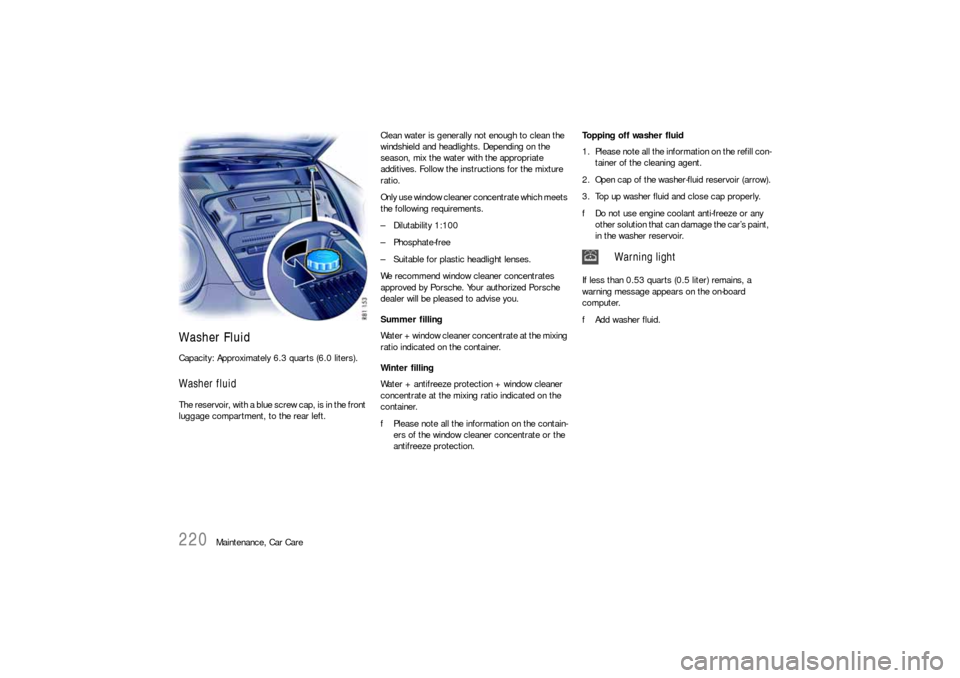
Washer FluidCapacity: Approximately 6.3 quarts (6.0 liters). Washer fluidThe reservoir, with a blue screw cap, is in the front
luggage compartment, to the rear left.Clean water is generally not enough to clean the
windshield and headlights. Depending on the
season, mix the water with the appropriate
additives. Follow the instructions for the mixture
ratio.
Only use window cleaner concentrate which meets
the following requirements.
– Dilutability 1:100
– Phosphate-free
– Suitable for plastic headlight lenses.
We recommend window cleaner concentrates
approved by Porsche. Your authorized Porsche
dealer will be pleased to advise you.
Summer filling
Water + window cleaner concentrate at the mixing
ratio indicated on the container.
Winter filling
Water + antifreeze protection + window cleaner
concentrate at the mixing ratio indicated on the
container.
fPlease note all the information on the contain-
ers of the window cleaner concentrate or the
antifreeze protection.Topping off washer fluid
1. Please note all the information on the refill con-
tainer of the cleaning agent.
2. Open cap of the washer-fluid reservoir (arrow).
3. Top up washer fluid and close cap properly.
fDo not use engine coolant anti-freeze or any
other solution that can damage the car’s paint,
in the washer reservoir.
If less than 0.53 quarts (0.5 liter) remains, a
warning message appears on the on-board
computer.
fAdd washer fluid.
Warning light
Page 223 of 310
Maintenance, Car Care
221
Power Steering Power steering is assisted by hydraulic auxiliary
forces.
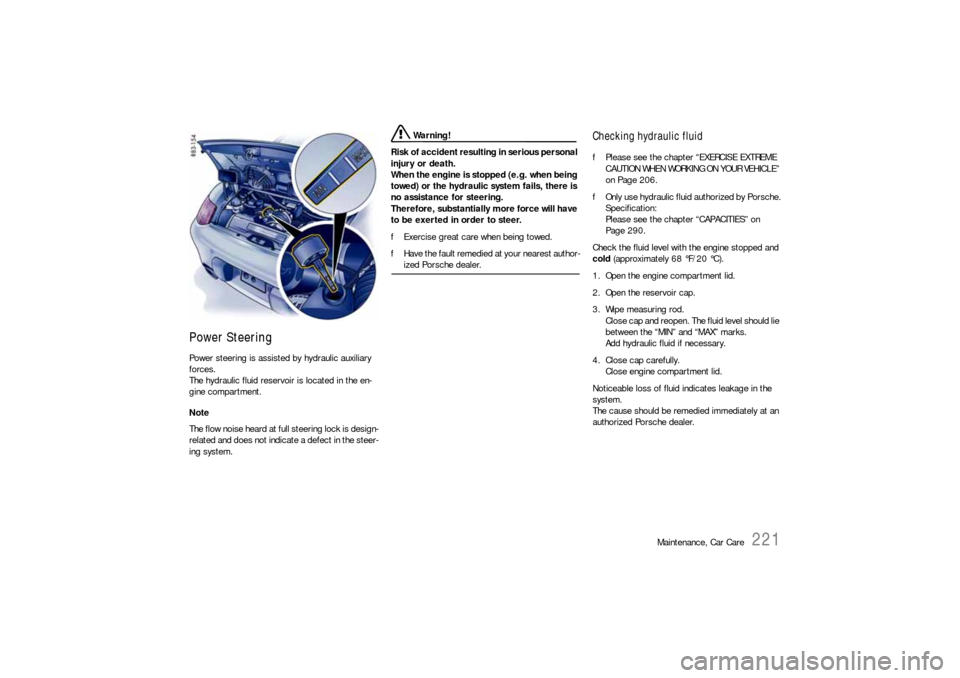
The hydraulic fluid reservoir is located in the en-
gine compartment.
Note
The flow noise heard at full steering lock is design-
related and does not indicate a defect in the steer-
ing system.
Warning!
Risk of accident resulting in serious personal
injury or death.
When the engine is stopped (e.g. when being
towed) or the hydraulic system fails, there is
no assistance for steering.
Therefore, substantially more force will have
to be exerted in order to steer.
fExercise great care when being towed.
fHave the fault remedied at your nearest author-ized Porsche dealer.
Checking hydraulic fluid fPlease see the chapter “EXERCISE EXTREME
CAUTION WHEN WORKING ON YOUR VEHICLE”
on Page 206.
fOnly use hydraulic fluid authorized by Porsche.
Specification:
Please see the chapter “CAPACITIES” on
Page 290.
Check the fluid level with the engine stopped and
cold (approximately 68 °F/20 °C).
1. Open the engine compartment lid.
2. Open the reservoir cap.
3. Wipe measuring rod.
Close cap and reopen. The fluid level should lie
between the “MIN” and “MAX” marks.
Add hydraulic fluid if necessary.
4. Close cap carefully.
Close engine compartment lid.
Noticeable loss of fluid indicates leakage in the
system.
The cause should be remedied immediately at an
authorized Porsche dealer.
Page 224 of 310

222
Maintenance, Car Care
Air Filter A dirty air filter not only reduces engine perform-
ance, but can lead to premature engine wear.
Regular filter replacement is part of the routine
maintenance service.
fIn dusty conditions, check the filter element
more frequently and replace if necessary.Combination Filter The fresh air passing through the combination fil-
ter into the passenger compartment is virtually
free of dust, pollen, and unpleasant odors.
fIf the outside air is polluted by exhaust fumes,
press the circulating-air button.
A dirty filter can be the cause of reduced air flow:
fHave filter replaced by your authorized
Porsche dealer.
Regular filter replacement is part of the routine
maintenance service.
Fluids/Oils for Manual
Transmission and Porsche
Doppelkupplung (PDK)The transmission fluids/oils have to be checked
and changed at the intervals listed in your Mainte-
nance Schedule.
fPlease see the chapter “CAPACITIES” on
Page 290.
Do not tow the car or run the engine without fluid/
oil in the transmission. The transmission may be
damaged by even a tiny speck of dirt, only a clean
funnel or spout must be used when adding fluid/
oil.
We recommend that you have the fluids/oils
changed at your Porsche dealer, who has the re-
quired lubricants and the necessary filling equip-
ment.
fIf you suspect an oil leak in the transmission,
have your authorized Porsche dealer check it
out immediately.
Page 229 of 310

Maintenance, Car Care
227
Paint To protect the paint on your vehicle in the best
possible way against mechanical and chemical
damage, you should
– preserve it regularly,
– polish it if necessary,
– remove spots and stains, and
– repair damaged paintwork.
fDo not apply care products containing silicone
to the convertible top and windows.
General information
fNever rub a dusty vehicle with a dry cloth,
because the grains of dirt will damage the
paintwork.
fDo not treat matt-painted components with
preservatives or polishes, otherwise the matt
effect will be lost.
Preservation
The paint surface becomes dull over time due to
weathering.
fPreserve paint regularly.
fApply paint preservative after washing the
vehicle and polish it smooth to preserve the
paintwork.This keeps the paint shiny and elastic. Dirt is
prevented from adhering to the paint surface and
industrial dust is prevented from penetrating the
paint.
Polishing
Do not resort to using Porsche polish until it be-
comes evident that the normal preservatives no
longer produce the desired finish.
Spots and stains
fRemove tar stains, grease, oil spots and dead
insects as soon as possible with Insect Remov-
er. They can cause discoloration if allowed to
remain on the paintwork.
fWash the affected area immediately after treat-
ing it.
Minor paint damage
fHave minor paint damage, such as scratches,
scores or chips caused by flying stones, re-
paired immediately by your authorized
Porsche dealer before corrosion sets in.
However, if there are already traces of corrosion,
they must first be removed carefully and thorough-
ly. Coat the area with a rust-proofing primer and
finish off with a top coat. The paint code and color
number are found on the data bank in the Mainte-
nance booklet.
fPlease see the chapter “VEHICLE DATA BANK”
on Page 284.
Engine compartment The engine compartment and the surface of the
engine are treated with a corrosion-inhibitor at the
factory.
If degreasing solvents are used to clean the en-
gine compartment or the engine is washed down,
the process almost invariably removes the corro-
sion-inhibiting coating. It is then absolutely neces-
sary to have a durable preservative applied to all
surfaces, body seams, joints and assemblies in
the engine compartment. This also applies when
corrosion-inhibitor parts are replaced.
Caution!
Risk of damage to the alternator.
fDo not point the cleaning jet directly at the al-ternator, or cover the alternator.
Effective rust-proofing is particularly important
during the cold weather season. If the vehicle is
driven frequently in areas where salt has been
spread on the roads, the engine compartment
should be cleaned thoroughly and subsequently
sealed after the cold weather season to prevent
salt from causing any lasting damage.
Page 231 of 310

Maintenance, Car Care
229
fAlways apply a fresh coating of suitable pre-
servative to unprotected areas after cleaning
the underside of the body, the transmission,
the engine or carrying out repairs to under-
body, engine or transmission components.
Effective rust-proofing is particularly important
during the cold weather season. If your car is driv-
en frequently in areas where salt has been spread
on the roads, the whole engine compartment
should be cleaned thoroughly after the winter to
prevent salt from causing any lasting damage. A
full under-body wash should also be performed at
the same time.Stainless steel exhaust tailpipesStainless steel exhaust tailpipes can discolor due
to soiling, strong heat, and combustion residues.
The original polish can be achieved again using
commercially available metal polishing paste or
metal polish.Light alloy wheels fPlease see the chapter “WASHING” on
Page 225.
Warning!
Danger of accident resulting in serious per-
sonal injury or death if cleaning agents (e.g.
wheel cleaning agents) come into contact
with the brake discs.The resulting film on the brake discs can im-
pair braking performance.
fMake sure that no cleaning agent comes into
contact with the brake discs.
fIf cleaning agent has come into contact with
the brake discs, thoroughly clean the brake
discs with a strong jet of water.
fPaying attention to any road users behind you,
dry the brake discs by applying the brakes at
short intervals.
Metal particles (such as brass or copper in brake
dust) must not remain too long on alloy wheels.
Contact corrosion can cause pitting.
Cleaners with an oxide-removing effect or the
wrong pH value, as are commonly used for other
metals, as well as mechanical tools and products,
will damage the oxide layer and are therefore
unsuitable.
fUse only cleaners for alloy wheels
(pH value 9.5). Products with the wrong
pH value can destroy the protective layer
on the wheels.
We recommend Porsche cleaner for alloy rims.
fIf possible, wash the wheels every two weeks
with a sponge or washing brush. If the wheels
are exposed to road salt, grit or industrial dust,
weekly cleaning is necessary.
Door, roof, lid and window seals
Caution!
The lubricant coating on the inner door
seals, convertible top and hardtop seals may
be damaged by unsuitable cleaning and care
agents.
fDo not use any chemical cleaning agents or
solvents.
fDo not use any preservative agents.
fWash dirt (e.g. abrasion, dust, road salt and
grit) from all seals regularly using warm soapy
water.
fIf there is a risk of frost, protect the outer door
seals and lid seals against freezing into place
with a suitable care product.Headlights, lights, interior and exterior
plastic parts, adhesive filmsUse only clean water and a little dishwashing
detergent to clean light lenses, plastic headlight
lenses, plastic parts and surfaces.
Do not clean when dry.
Use a soft sponge or a soft, lint-free cloth. Gently
wipe the surface without applying too much
pressure.
An interior window cleaner can also be used to
clean plastic surfaces (always read the cleaning
instructions on the container). We recommend
Porsche interior window cleaner.
Page 233 of 310

Maintenance, Car Care
231
Alcantara fDo not use a leather care product to clean
Alcantara.
For regular care it is sufficient to clean the cover
with a soft brush.
Heavy abrasion or rubbing when cleaning causes
a lasting change in the surface.
Cleaning when lightly soiled
fWet a soft cloth with water or a neutral soap
solution and wipe off the dirt.
Cleaning when heavily soiled
fWet a soft cloth with lukewarm water or
thinned white spirit and dab the dirt from the
outside in. Cleaning Safety belts fUse mild detergent to clean soiled belts.
fWhen drying, avoid direct sunlight.
fOnly use suitable cleaning agents.
fDo not tint or bleach the belts.
The belt fabric could be weakened, thus affec-
ting safety.
Storing your Porsche If you intend to store your Porsche for a prolonged
period, please consult your authorized Porsche
dealer. The staff will be glad to advise you on the
most suitable and necessary methods.
fClean your vehicle thoroughly inside and out-
side.
Clean the engine compartment.
The under carriage and chassis components
should be free of dirt and salt deposits.
fFill up the fuel tank.
fChange the oil and oil filter, and run the engine
for several minutes.
fIncrease the tire pressure to 50 psi (3.5 bar).
It is not recommended to lift the vehicle, due to
the possibility of corrosion on shock absorber
piston shafts.
The vehicle should be moved slightly, approxi-
mately every four weeks, to prevent flat spot
on the tires. Climate control
The air conditioning system should be in good
working condition and fully charged.
Windshield/Headlight washer
fCheck and correct antifreeze/cleaning solution
level as necessary.
Electrical system
fRemove the battery from the vehicle and store
it in a cool dry place, not on a cement floor.
When the battery is disconnected, the
alarm system is deactivated.
fRecharge the battery every 3 months. If the
battery remains in the vehicle with the cables
connected, it is necessary to check, remove
and recharge the battery every 2-3 weeks.
Do not fast charge the battery.
fPlease see the chapter “BATTERY” on
Page 261.
Vehicle interior
The interior must be dry, especially in the area of
the floor carpets. The use of drying agents (Silica-
Gel) is recommended in vehicles with leather inte-
rior and in areas with high humidity. The recom-
mended amount is 3 fabric bags of 1.1 lbs.
(500 grams) each placed on the floor carpets.
Windows, doors and lids must be closed. The air
vents should be opened.
Page 236 of 310

234
Practical Tips, Emergency Service
Exercise Extreme Caution when
Working on your Vehicle
Danger!
Ignoring the following instructions may
cause serious personal injury or death.
fThe engine compartment of any motor vehicle
is a potentially hazardous area. If you are not
fully familiar with proper repair procedures, do
not attempt the adjustments described on the
following pages.
This caution also applies to the entire vehicle.
fO n l y w o r k o n y o u r v e h i c l e o u t d o o r s o r i n a w e l l
ventilated area.
fEnsure that there are no open flames in the
area of your vehicle at any time when fuel
fumes might be present. Be especially cau-
tious of such devices such as hot water heat-
ers which ignite a flame intermittently.
fBefore working on any part in the engine com-
partment, turn the engine off and let it cool
down sufficiently. Hot engine compartment
components can burn skin on contact.
fBe alert and cautious around engine at all
times while the engine is running.
If work has to be performed with the engine
running, always set the parking brake, and
make sure the shift lever is in neutral position
or the PDK selector lever in position P or N.fIn particular, be very careful to ensure that
items of clothing (ties, shirt, sleeves etc.), jew-
elry, long hair, hand or fingers cannot get
caught in the engine-compartment blower, fan,
belts or other moving parts.
The radiator and radiator fans are in the front
of the car.
The engine-compartment blower is mounted
on the engine-compartment lid.
The engine-compartment blower can start or
continue running as a function of temperature,
even with the engine switched off.
Carry out work in these areas only with the en-
gine off, the ignition switched off, and exercise
extreme caution.
fYour Porsche is equipped with an electronic ig-
nition system. When the ignition is on, high volt-
age is present in all wires connected with the
ignition system; therefore, exercise extreme
caution when working on any part of the engine
while the ignition is on or the engine is running.
fAlways support your car with safety stands if it
is necessary to work under the car.
Jacks are not suitable for this kind of work.
fWhen working under the car without safety
stands but with the wheels on the ground,
make sure the car is on level ground, the
wheels are blocked, and that the engine
cannot be started.
Remove the ignition key.fDo not smoke or allow an open flame around
the battery or fuel.
Keep a fire extinguisher in close reach.
fIncomplete or improper servicing may cause
problems in the operation of the car. If in doubt
about any servicing, have it done by your au-
thorized Porsche dealer.
Improper maintenance during the warranty pe-
riod may affect your Porsche warranty cover-
age.
fSupplies of fluids, e.g. engine oil, brake fluid or
coolant, are hazardous to your health.
Keep these fluids out of children’s reach and
dispose of them in accordance with the appro-
priate regulations.
fSome countries require additional tools and
special spare parts to be carried.
Please make enquiries before driving abroad.