light PORSCHE 911 CARRERA 2011 5.G Information Manual
[x] Cancel search | Manufacturer: PORSCHE, Model Year: 2011, Model line: 911 CARRERA, Model: PORSCHE 911 CARRERA 2011 5.GPages: 67, PDF Size: 9.93 MB
Page 19 of 67
3839
Temperament
|
Engines
Integrated dry-sump lubrication.
Integrated dr y-sump lubrication ensures
a reliable supply of oil even when a
sport y driving st yle is adopted. It also
has additional cooling functions.
The oil tank is located in the engine,
thereby eliminating the need for an
external oil tank, which saves both space
and weight. To reduce power loss and
increase efficiency, an electronically con -
trolled oil pump supplies the lubricating
points inside the engine as and when
required. This results in optimum supply
of oil, low fuel consumption and, there -
fore, lower exhaust emissions.
Air intake system.
The resonance intake system increases
the intake volume by exploiting the fact
that air oscillates as it passes through
the intake manifold. The system can
adjust to engine speed. Benefits of this
include higher torque at low engine
speeds and a flat ter torque curve.
The
911 Carrera S models operate a t wo -
stage
system.
The entire intake system is made from
light weight plastic. In the new 911 Carrera
model range, the resonator volume of the
air filter housing varies with engine speed
to bring added character to the engine
sound, which becomes much more power -
ful at higher rpm.
Exhaust system.
The exhaust system of the new 911
models has been completely redesigned,
acoustics included.
The stainless-steel exhaust system com -
prises t wo distinctive and independent
exhaust tracts. The cataly tic converters
heat up rapidly for effective emissions
reduction.
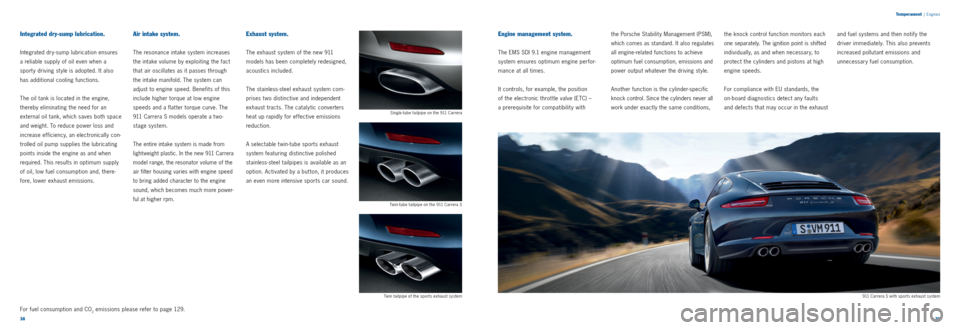
A selectable t win -tube sports exhaust
system featuring distinctive polished
stainless-steel tailpipes is available as an
option. Activated by a but ton, it produces
an even more intensive sports car sound.
911 Carrera S with sports exhaust system
Engine management system.
The EMS SDI 9.1 engine management
system ensures optimum engine perfor -
mance at all times.
It controls, for example, the position
of the electronic throt tle valve (ETC) –
a prerequisite for compatibility with the Porsche Stabilit y Management (PSM),
which comes as standard. It also regulates
all engine-related functions to achieve
optimum fuel consumption, emissions and
power output whatever the driving st yle.
Another function is the cylinder-specific
knock control. Since the cylinders never all
work under exactly the same conditions, the knock control function monitors each
one separately. The ignition point is shifted
individually, as and when necessary, to
protect the cylinders and pistons at high
engine speeds.
For compliance with EU standards, the
on - board diagnostics detect any faults
and defects that may occur in the exhaust and fuel systems and then notify the
driver immediately. This also prevents
increased pollutant emissions and
unnecessary fuel consumption.
Twin tailpipe of the sports exhaust system Single-tube tailpipe on the 911 Carrera
Twin-tube tailpipe on the 911 Carrera S
For fuel consumption and CO2 emissions please refer to page 129.
Page 23 of 67

4647
Temperament
| Chassis and body
Engineered design.
The new 911 fulfils two structural design
requirements thanks to its completely new
bodyshell: first, excellent driving dynamics
due to the body’s extremely high rigidit y;
second, a vehicle weight saving of up to
60 kg primarily as a result of the intelligent
lightweight construction.
To meet the second requirement,
we employed innovative and precise
techniques for combining various materials
in order to utilise specific material
properties exactly where they are needed.
For the bodyshell, therefore, we used
very thin, but nevertheless extremely
rigid, sheets of steel. Aluminium and magnesium were used extensively in
areas such as the roof, underbody, front
end, doors, rear wings and engine com
-
partment and luggage compartment lids.
Magnesium, which is a particularly light -
weight material, was also selected for
the cockpit and centre console support
beam and, in the Cabriolet models,
the hood shell elements. Such material efficiency is key to reducing the overall
weight and, as a result, fuel consumption
of the vehicle.
For the driver, this intelligent blend
of materials reduces the weight of the
vehicle and offers a high level of comfort
thanks to excellent vibration-damping
characteristics and particularly high com -
posite rigidit y, an increase in dynamic
torsional stiffness of up to 25 % compared
with that of the previous model, and
even
sportier handling despite a further
improvement in the weight to power ratio.
The 100 mm longer wheelbase improves
comfort as well as straight-line accuracy
and driving stabilit y at high speeds and in
fast corners.
Front and rear axles.
The redesigned independent suspension
at the front features a light weight spring-
strut axle with longitudinal and transverse
links and cross members that have been
refined for stiffness. Each front wheel
is precisely located, ensuring excellent directional stability, superior handling
and reduced pitching under braking, and
the wider track optimises turn-in.
The rear axle is equipped with a
motorsport-derived multi-link suspension
and chassis subframe. Refined axle kine -
matics for improved longitudinal damping
reduce acceleration squat and increase comfort. Light weight spring struts further
enhance agility.
The high proportion of aluminium used in
the construction of the axles reduces the
weight of the vehicle and of the unsprung
masses, helping to improve fuel economy,
comfort and agility.
Rear axle of the 911 Carrera S
Front axle of the 911 Carrera S
Aluminium
Deep-drawn steels
Multiphase steels
Super-high-strength micro-alloyed steels
Boron-alloyed steels
Page 24 of 67

4849
T
emperament
| Chassis and body
Hood.
Our engineers have completely redeveloped
the hood for the 911 Carrera Cabriolet
models. The result is a flexible roof
comprising of a glass rear screen and
three individual and integral hood ele -
ments, which are manufactured from
magnesium and covered in fabric. This
makes the hood highly robust and, yet,
particularly lightweight. Another benefit of the new design is
that the hood is smooth and firm. The
fabric remains taut keeping the familiar
911 lines elegant. A trivialit y? Only if
you choose to ignore the impressively
low drag coefficient of just 0.30 that
the new 911 Cabriolet models are able
to achieve. A further feat of Porsche
engineering.
The rear screen is made from glass and
is electrically heated and scratch-
resistant to provide excellent rearward visibilit y. A rain channel on the hood
carries away water to avoid dripping
when the doors are opened.
Electrically powered, the new hood is
operated using a but ton on the centre
console or via the key remote. It opens
or closes in approximately 13 seconds
and remains operable up to a speed
of 50 km/ h (31 mph). The concertina
action ensures optimum protection for
the interior lining. The interior hood lining is made from
a heat-insulating and sound-absorbing
material. Consistent interior temperatures
and an effective suppression of wind
noise are the perceptible results. Thank -
fully, however, even the hood’s sound -
proofing properties are no match for
the resonant Porsche sound.
Open, flexible, independent.
The optimum prerequisites for a long-term relationship.
Cabriolet technology.
Page 30 of 67

6061
Wheels.
On the new 911, the wheels have been
enlarged by one inch over the previous
model. Not only do the larger wheels
improve dynamic performance, they
also look more imposing.
The new 911 Carrera models are
equipped with 19-inch Carrera wheels as
standard. These are lightweight
alloys featuring a classic sport y design.
Tyre sizes are 235/40 ZR 19 and
285/35 ZR 19 at the front and rear
respectively.
The S models are equipped with light-
alloy 20 -inch Carrera S wheels as
standard. The visual effect is sport y and
dynamic. The t yres are slightly wider to cope with the increased power output
of these models: 245/35 ZR 20 at the
front, 295/30 ZR 20 at the rear.
The larger t yre size improves both ride
comfort and track performance. The
rolling resistance of the t yres
has been
reduced by up to 7 % to improve
fuel
economy, while t yre weight and dry brak -
ing distances have also been reduced. A selection of 20-inch wheels is available in
our range of options.
Tyre Pressure Monitoring (TPM).
Tyre Pressure Monitoring (TPM) is available
on request. This safet y system sends
warnings to the on-board computer’s
display screen in the event of low t yre
pressure or a gradual or sudden loss
of pressure. The individual pressures
in all four t yres can be displayed in the
instrument cluster.
Porsche Stability Management (PSM).
As standard, the new 911 models
are equipped with enhanced Porsche
Stabilit y Management (PSM), which
maintains stability even at the limits of
dynamic driving performance. Sensors
continuously monitor the direction,
speed, yaw velocity and lateral acceleration
of the car. Using this information, PSM is able to calculate the actual direction
of travel at any given moment. If the car
begins to oversteer or understeer, PSM
applies selective braking on individual
wheels to restore stabilit y.
Under acceleration on wet or low-grip
road surfaces, PSM improves traction
using the automatic brake differential
(ABD) and anti-slip regulation (ASR). When the SPORT PLUS mode of the
optional Sport Chrono Package is selected,
the PSM threshold is raised to allow a
sportier driving st yle.
For an even more dynamic experience,
you always have the option to deactivate
PSM. It is automatically reactivated,
for your safet y, only if you brake harder
and either of the front wheels (in SPORT
PLUS mode, both of the front wheels)
requires ABS assistance. ABS and ABD,
however, remain active at all times.
PSM therefore offers a high level of
driving stability and safety combined
with extraordinary agilit y. It ’s an
apparent contradiction in terms, but an
intrinsic part of the Porsche identit y.
19-inch Carrera wheel (standard on the 911 Carrera)
20-inch Carrera S wheel (standard on the 911 Carrera S)911 Carrera S with 20-inch Carrera Classic wheels
Temperament | Chassis and body
Page 33 of 67

6667
Composure
| Safet y
Control, discipline, precision.
At Porsche, we take driving pleasure very seriously.
S a f e t y.
Brakes.
Another crucial piece of the Porsche
identit y is the brakes. We value them as
highly as we do our engines and chassis.
They set standards for deceleration and
stabilit y, and give the driver the reassur -
ance needed to push the car to the limits
of its performance.
The 911 Carrera and 911 Carrera Cabriolet
are fit ted front and rear with anodised
black four-piston aluminium monobloc
fixed calipers. All brake discs have a
diameter of 330 mm. On the 911 Carrera S models, we have
fit ted larger brakes and more brake pistons
to cope with the increased engine power
of these models. The new generation of
brakes features red six-piston monobloc
aluminium fixed brake calipers at the
front and four-piston aluminium monobloc
fixed calipers at the rear. The brake
disc diameter is 340 mm at the front and
330 mm at the rear. The results are
enhanced braking performance and a
reduction in stopping distance compared
with that of the previous model.
On all models, the brake calipers have
an enclosed monobloc construction.
This makes them tougher but lighter and enables a more rapid response and
release of the brake even under extreme
loads. The pedal travel is short and
the biting point precise. The brake discs
are cross-drilled for better performance
in the wet.
Other benefits of the standard braking
system include the anti-lock braking
system (ABS), designed to keep decelera -
tion constant. Pedal effort is reduced and
braking response improved by a newly
developed 8-/9-inch tandem vacuum
brake booster. In the S models, brake disc
cooling is further enhanced by modified
air spoilers.
Standard brake system on the 911 Carrera
Standard brake system on the 911 Carrera S
Page 34 of 67
6869
From the start, Porsche has been
synonymous with motorsport. Ever since
1948, when we found our identit y on
the racetrack, we have taken the experi -
ence we have gained and applied it to
the road. The optional Porsche Ceramic
Composite Brake (PCCB) is a fine example.
This brake system has already had to
cope with the harshest requirements of
Composure | Safet y
motor racing and is fit ted in cars that
compete in demanding events such as
the Porsche Mobil 1 Supercup.
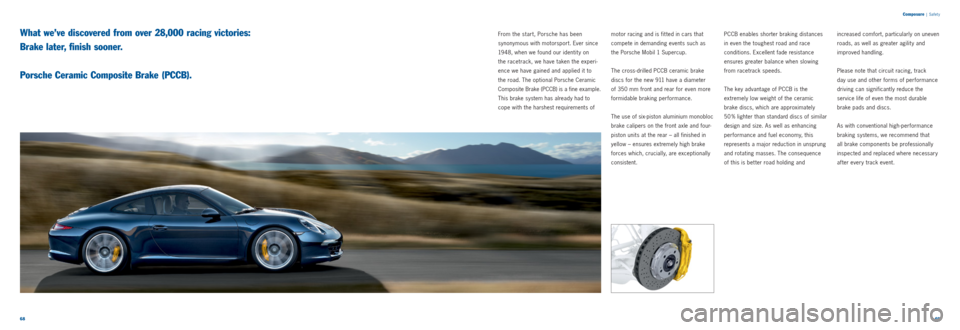
The cross-drilled PCCB ceramic brake
discs for the new 911 have a diameter
of 350 mm front and rear for even more
formidable braking performance.
The use of six-piston aluminium monobloc
brake calipers on the front axle and four-
piston units at the rear – all finished in
yellow – ensures extremely high brake
forces which, crucially, are exceptionally
consistent. What we’ve discovered from over 28,000 racing victories:
Brake later, finish sooner.
Porsche Ceramic Composite Brake (PCCB).PCCB enables shorter braking distances
in even the toughest road and race
conditions. Excellent fade resistance
ensures greater balance when slowing
from racetrack speeds.
The key advantage of PCCB is the
extremely low weight of the ceramic
brake discs, which are approximately
50 % lighter than standard discs of similar
design and size. As well as enhancing
performance and fuel economy, this
represents a major reduction in unsprung
and rotating masses. The consequence
of this is bet ter road holding and increased comfort, particularly on uneven
roads, as well as greater agilit y and
improved handling.
Please note that circuit racing, track
day use and other forms of performance
driving can significantly reduce the
service life of even the most durable
brake pads and discs.
As with conventional high-performance
braking systems, we recommend that
all brake components be professionally
inspected and replaced where necessary
after every track event.
Page 35 of 67
7071
Composure
| Safet y
Electric parking brake.
The new electric parking brake, which
you can activate and deactivate manually,
releases automatically as you pull away.
With the hill-hold function, you can
pull away without ever rolling back.
The system automatically detects when
the vehicle has come to a halt on an
uphill gradient requiring intervention.
PSM then maintains the brake pressure
at all four wheels to prevent the vehicle
from moving in the opposite direction.
Airbags.
The new 911 models offer advanced
airbag technology in the form of full-size
driver and front passenger airbags, which
are inflated in t wo stages depending
on the severit y and t ype of accident (e.g.
frontal or offset frontal). In less serious
accidents, the airbags are only partially
inflated, thereby minimising discomfort to
the occupants. In addition to the central airbag control
unit on the transmission tunnel, a pair
of impact sensors are located near the
headlights. This allows a crash to be
detected and evaluated far sooner and
with considerably greater accuracy.
Porsche Side Impact Protection
System (POSIP).
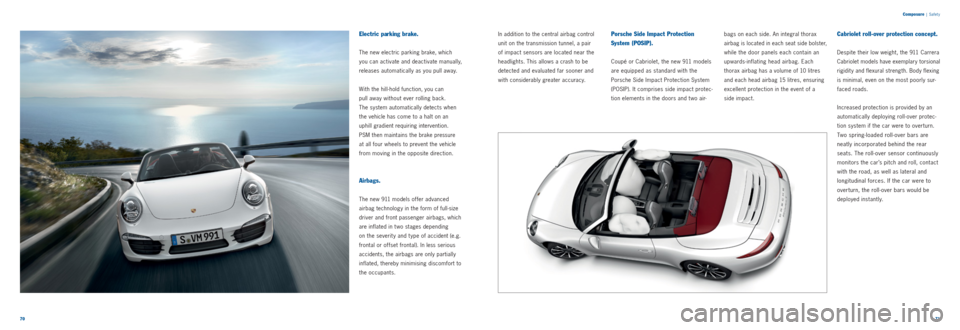
Coupé or Cabriolet, the new 911 models
are equipped as standard with the
Porsche Side Impact Protection System
(POSIP). It comprises side impact protec -
tion elements in the doors and t wo air -bags on each side. An integral thorax
airbag is located in each seat side bolster,
while the door panels each contain an
upwards-inflating head airbag. Each
thorax airbag has a volume of 10 litres
and each head airbag 15 litres, ensuring
excellent protection in the event of a
side impact.
Cabriolet roll-over protection concept.
Despite their low weight, the 911 Carrera
Cabriolet models have exemplary torsional
rigidit y and flexural strength. Body flexing
is minimal, even on the most poorly sur -
faced roads.
Increased protection is provided by an
automatically deploying roll-over protec -
tion system if the car were to overturn.
Two spring-loaded roll-over bars are
neatly incorporated behind the rear
seats. The roll-over sensor continuously
monitors the car’s pitch and roll, contact
with the road, as well as lateral and
longitudinal forces. If the car were to
overturn, the roll-over bars would be
deployed instantly.
Page 36 of 67
7273
Composure
| Safet y
The new 911 models are equipped as
standard with Bi-Xenon headlights
including a headlight cleaning system and
dynamic range control. With dipped or
main beam, the road ahead is illuminated
more uniformly.
The rest yled LED front light units
incorporate direction indicators, daytime -
running lights and position lights.
Automatic headlight activation is also
included as standard. The moment it gets
dark, the daytime running lights switch
off and the dipped beam headlights
switch on automatically. Cut ting edge LED technology is also used
for the taillights, the high-level third brake
light, the licence plate illumination, the
rear direction indicators and the rear fog
light. LEDs provide bet ter illumination and
respond more quickly to driver input.
In the event of sudden braking, the adaptive
LED brake lights begin to pulsate. If the
vehicle is braked to a halt, the hazard
warning lights will switch on automatically,
alerting following traf fic more quickly to
a critical situation.
The lighting system features an automatic
switch-off and the ‘Welcome Home’
function. It ’s good to know what ’s around
the next corner or on the way to your
front door.
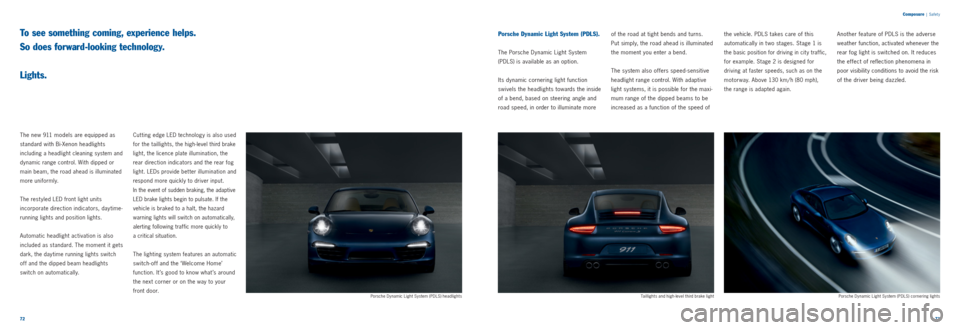
Porsche Dynamic Light System (PDLS).
The Porsche Dynamic Light System
(PDLS) is available as an option.
Its dynamic cornering light function
swivels the headlights towards the inside
of a bend, based on steering angle and
road speed, in order to illuminate more of the road at tight bends and turns.
Put simply, the road ahead is illuminated
the moment you enter a bend.
The system also of fers speed -sensitive
headlight range control. With adaptive
light systems, it is possible for the maxi -
mum range of the dipped beams to be
increased as a function of the speed of
Taillights and high-level third brake light Porsche Dynamic Light System (PDLS) cornering lights
Porsche Dynamic Light System (PDLS) headlights
To see something coming, experience helps.
So does forward-looking technology.
Lights.the vehicle. PDLS takes care of this
automatically in t wo stages. Stage 1 is
the basic position for driving in cit y traffic,
for example. Stage 2 is designed for
driving at faster speeds, such as on the
motorway. Above 130 km/ h (80 mph),
the range is adapted again.
Another feature of PDLS is the adverse
weather function, activated whenever the
rear fog light is switched on. It reduces
the effect of reflection phenomena in
poor visibilit y conditions to avoid the risk
of the driver being dazzled.
Page 40 of 67
8081
Composure
| Comfor t
Sports seats.
The Sports seats in full leather are
comfortable and provide support even
during performance driving. They are
equipped as standard with electric seat
height and backrest adjustment and
mechanical fore/aft adjustment.
Fully electric Sports seats.
If you don’t want to sacrifice sportiness
for comfort, the optional fully electric
Sports seats of fer fully electric adjustment
of seat height, backrest angle, squab angle,
sq ua b dept h, fore/a f t posi t io n, 4 - way
lumbar support and even the steering
column.
The integrated memor y package supports
the exterior mirrors and all seat positions
on the driver’s side as well as set tings
for the steering wheel, lights, wipers,
air conditioning, door locks, PCM, and
instrument cluster.
Sports seats Plus.
Available as an option are Sports seats
Plus in leather with electric seat height
and backrest adjustment as well as
mechanical fore/aft adjustment. The side
bolsters on the squab and backrest
have a firmer, sportier padding and offer
even bet ter lateral support. The backrest
shell is finished in Silver Grey.
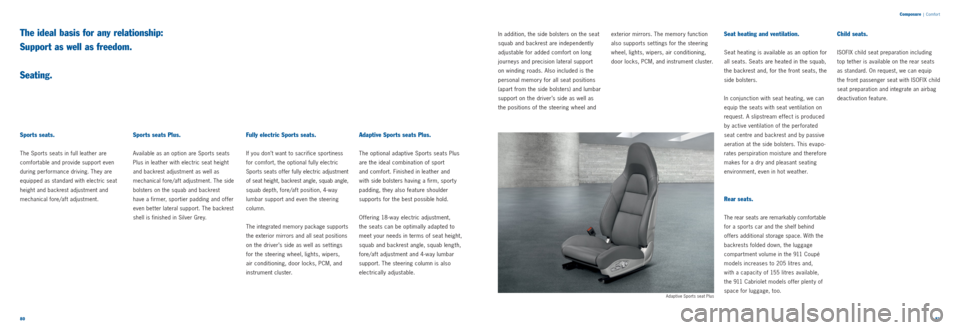
Adaptive Sports seats Plus.
The optional adaptive Sports seats Plus
are the ideal combination of sport
and comfort. Finished in leather and
with side bolsters having a firm, sport y
padding, they also feature shoulder
supports for the best possible hold.
Of fering 18 -way electric adjustment,
the seats can be optimally adapted to
meet your needs in terms of seat height,
squab and backrest angle, squab length,
fore/aft adjustment and 4-way lumbar
support. The steering column is also
electrically adjustable.
Adaptive Sports seat Plus
In addition, the side bolsters on the seat
squab and backrest are independently
adjustable for added comfort on long
journeys and precision lateral support
on winding roads. Also included is the
personal memory for all seat positions
(apart from the side bolsters) and lumbar
support on the driver’s side as well as
the positions of the steering wheel and exterior mirrors. The memory function
also supports set tings for the steering
wheel, lights, wipers, air conditioning,
door locks, PCM, and instrument cluster.
The ideal basis for any relationship:
Support as well as freedom.
Seating.Seat heating and ventilation.
Seat heating is available as an option for
all seats. Seats are heated in the squab,
the backrest and, for the front seats, the
side bolsters.
In conjunction with seat heating, we can
equip the seats with seat ventilation on
request. A slipstream effect is produced
by active ventilation of the perforated
seat centre and backrest and by passive
aeration at the side bolsters. This evapo -
rates perspiration moisture and therefore
makes for a dry and pleasant seating
environment, even in hot weather.
Rear seats.
The rear seats are remarkably comfortable
for a sports car and the shelf behind
offers additional storage space. With the
backrests folded down, the luggage
compartment volume in the 911 Coupé
models increases to 205 litres and,
with a capacit y of 155 litres available,
the 911 Cabriolet models offer plent y of
space for luggage, too.
Child seats.
ISOFIX child seat preparation including
top tether is available on the rear seats
as standard. On request, we can equip
the front passenger seat with ISOFIX child
seat preparation and integrate an airbag
deactivation feature.
Page 41 of 67
8283
Composure
| Comfor t
Climate control.
The new 911 models feature t wo -zone
automatic climate control as standard
with an enhanced ventilation effect and
separate temperature controls for the
driver and front passenger. The available
air conditioning modes are gentle,
normal and strong.
An active carbon filter traps particles,
pollen and odours and an automatic
air-recirculation function permanently
monitors air quality, reduces humidity
and switches from fresh to recirculated
air when required. A demister function keeps the windows
clear in cold weather. In warmer weather,
a solar sensor helps the climate control
to detect strong sunlight and automatically
compensate for the comfort of both the
driver and front passenger.
HomeLink®
(programmable garage door opener).
As an option, it is possible to have
a programmable garage door opener
integrated into the overhead console.
At the push of a but ton, it controls up
to three different garage doors, lighting
systems or alarm systems.
Many things have practical qualities.
Even more have a sporty function.
And some are just extremely convenient.
Additional comfort and convenience features.
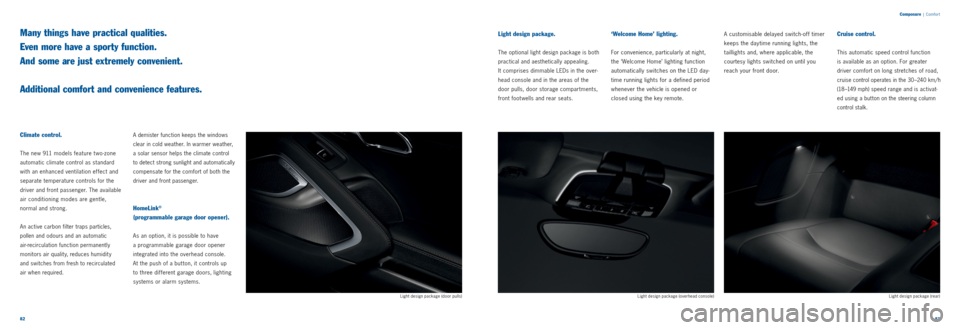
Light design package (overhead console)
Light design package (door pulls) Light design package (rear)
Light design package.
The optional light design package is both
practical and aesthetically appealing.
It comprises dimmable LEDs in the over -
head console and in the areas of the
door pulls, door storage compartments,
front foot wells and rear seats.
‘Welcome Home’ lighting.
For convenience, particularly at night,
the ‘Welcome Home’ lighting function
automatically switches on the LED day -
time running lights for a defined period
whenever the vehicle is opened or
closed using the key remote. A customisable delayed switch - of f timer
keeps the daytime running lights, the
taillights and, where applicable, the
courtesy lights switched on until you
reach your front door.
Cruise control.
This automatic speed control function
is available as an option. For greater
driver comfort on long stretches of road,
cruise control operates in the 30 –240 km/ h
(18 –149 m p h )
speed range and is activat -
ed using a
button on the steering column
control stalk.