brakes PORSCHE 911 CARRERA 2011 6.G Information Manual
[x] Cancel search | Manufacturer: PORSCHE, Model Year: 2011, Model line: 911 CARRERA, Model: PORSCHE 911 CARRERA 2011 6.GPages: 63, PDF Size: 9.45 MB
Page 11 of 63
2223
Strength
| The new 911 Carrera S
Its identity emerged on the racetrack.
Its home is on the road.
The new 911 Carrera S.
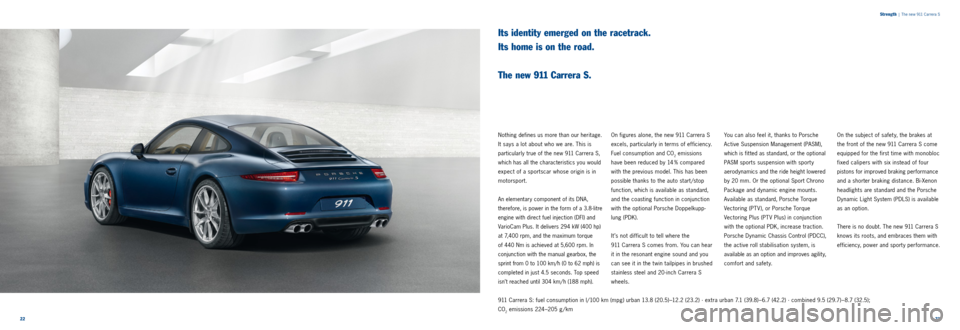
Nothing defines us more than our heritage.
It says a lot about who we are. This is
particularly true of the new 911 Carrera S,
which has all the characteristics you would
expect of a sportscar whose origin is in
motorsport.
An elementary component of its DNA,
therefore, is power in the form of a 3.8-litre
engine with direct fuel injection (DFI) and
VarioCam Plus. It delivers 294 kW (400 hp)
at 7,400 rpm, and the maximum torque
of 440 Nm is achieved at 5,600 rpm. In
conjunction with the manual gearbox, the
sprint from 0 to 100 km/h (0 to 62 mph) is
completed in just 4.5 seconds. Top speed
isn’t reached until 304 km/ h (188 mph).
On figures alone, the new 911 Carrera S
excels, particularly in terms of efficiency.
Fuel consumption and CO
2 em issio ns
have been reduced by 14 % compared
with the previous model. This has been
possible thanks to the auto start /stop
function, which is available as standard,
and the coasting function in conjunction
with the optional Porsche Doppelkupp -
lung (PDK).
It ’s not difficult to tell where the
911 Carrera S comes from. You can hear
it in the resonant engine sound and you
can see it in the t win tailpipes in brushed
stainless steel and 20 - inch Carrera S
wheels. You can also feel it, thanks to Porsche
Active Suspension Management (PASM),
which is fit ted as standard, or the optional
PASM sports suspension with sport y
aerodynamics and the ride height lowered
by 20 mm. Or the optional Sport Chrono
Package and dynamic engine mounts.
Available as standard, Porsche Torque
Vectoring (PTV), or Porsche Torque
Vectoring Plus (PTV Plus) in conjunction
with the optional PDK, increase traction.
Porsche Dynamic Chassis Control (PDCC),
the active roll stabilisation system, is
available as an option and improves agility,
comfort and safet y. On the subject of safet y, the brakes at
the front of the new 911 Carrera S come
equipped for the first time with monobloc
fixed calipers with six instead of four
pistons for improved braking performance
and a shorter braking distance. Bi-Xenon
headlights are standard and the Porsche
Dynamic Light System (PDLS) is available
as an option.
There is no doubt. The new 911 Carrera S
knows its roots, and embraces them with
efficiency, power and sporty performance.
911 Carrera S: fuel consumption in l/100 km (mpg) urban 13.8 (20.5) –12.2 (23.2) · extra urban 7.1 (39.8) – 6.7 (42.2) · combined 9.5 (29.7) –8.7 (32.5);
CO
2 emissions 224–205 g / km
Page 29 of 63
5859
Composure
| Safet y
Control, discipline, precision.
At Porsche, we take driving pleasure very seriously.
S a f e t y.
Brakes.
Another crucial piece of the Porsche
identit y is the brakes. We value them as
highly as we do our engines and chassis.
They set standards for deceleration and
stabilit y, and give the driver the reassur -
ance needed to push the car to the limits
of its performance.
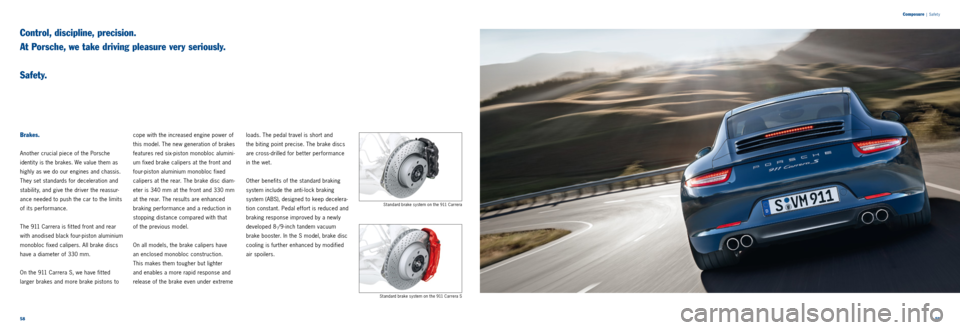
The 911 Carrera is fit ted front and rear
with anodised black four-piston aluminium
monobloc fixed calipers. All brake discs
have a diameter of 330 mm.
On the 911 Carrera S, we have fit ted
larger brakes and more brake pistons to cope with the increased engine power of
this model. The new generation of brakes
features red six-piston monobloc alumini
-
um fixed brake calipers at the front and
four-piston aluminium monobloc fixed
calipers at the rear. The brake disc diam -
eter is 340 mm at the front and 330 mm
at the rear. The results are enhanced
braking performance and a reduction in
stopping distance compared with that
of the previous model.
On all models, the brake calipers have
an enclosed monobloc construction.
This makes them tougher but lighter
and enables a more rapid response and
release of the brake even under extreme loads. The pedal travel is short and
the biting point precise. The brake discs
are cross-drilled for better performance
in the wet.
Other benefits of the standard braking
system include the anti-lock braking
system (ABS), designed to keep decelera -
tion constant. Pedal effort is reduced and
braking response improved by a newly
developed 8-/9-inch tandem vacuum
brake booster. In the S model, brake disc
cooling is further enhanced by modified
air spoilers.
Standard brake system on the 911 Carrera
Standard brake system on the 911 Carrera S
Page 45 of 63
9091
Responsibility
|
Motorsport
On the racetrack, we’re fiercely committed.
Not least to the future.
Motorsport.
How does one book one’s place in motor -
sport history? By finishing that crucial
one hundredth of a second faster than
the competition, or a whole lap ahead of
the rest of the field? Either way, victory is
sweet. At Porsche, however, one goal
mat ters above all: turning to the next
chapter and shaping the future of motor -
sport using intelligent technologies and
unconventional ideas with the incentive of
increased power output and enhanced
efficiency, as well as the abilit y to incor -
porate these innovations into cars engi -
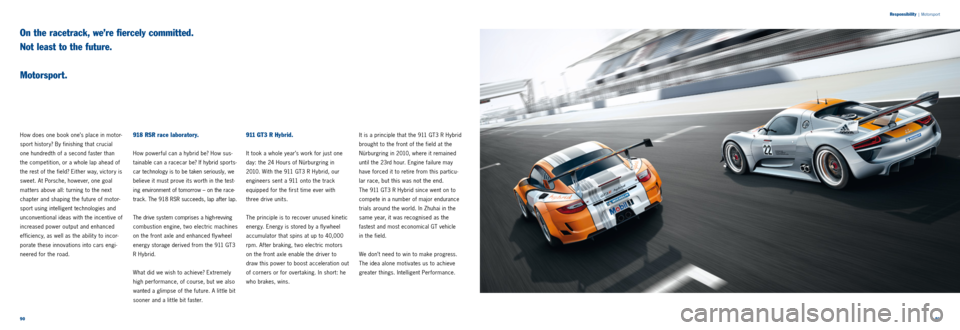
neered for the road.918 RSR race laboratory.
How powerful can a hybrid be? How sus-
tainable can a racecar be? If hybrid sports-
car
technology is to be taken seriously, we
believe it must prove its worth in the test -
ing environment of tomorrow – on the race-
track. The 918 RSR succeeds, lap after lap.
The drive system comprises a high-revving
combustion engine, two electric machines
on the front axle and enhanced fly wheel
energy storage derived from the 911 GT3
R Hybrid.
What did we wish to achieve? Extremely
high performance, of course, but we also
wanted a glimpse of the future. A lit tle bit
sooner and a lit tle bit faster.
911 GT3 R Hybrid.
It took a whole year’s work for just one
day: the 24 Hours of Nürburgring in
2010. With the 911 GT3 R Hybrid, our
engineers sent a 911 onto the track
equipped for the first time ever with
three drive units.
The principle is to recover unused kinetic
energy. Energy is stored by a fly wheel
accumulator that spins at up to 40,000
rpm. After braking, t wo electric motors
on the front axle enable the driver to
draw this power to boost acceleration out
of corners or for overtaking. In short: he
who brakes, wins. It is a principle that the 911 GT3 R Hybrid
brought to the front of the field at the
Nürburgring in 2010, where it remained
until the 23rd hour. Engine failure may
have forced it to retire from this particu
-
lar race, but this was not the end.
The 911 GT3 R Hybrid since went on to
compete in a number of major endurance
trials around the world. In Zhuhai in the
same year, it was recognised as the
fastest and most economical GT vehicle
in the field.
We don’t need to win to make progress.
The idea alone motivates us to achieve
greater things. Intelligent Per formance.
Page 60 of 63
120121
9 11 C a r r e r a9 11 C a r r e r a S
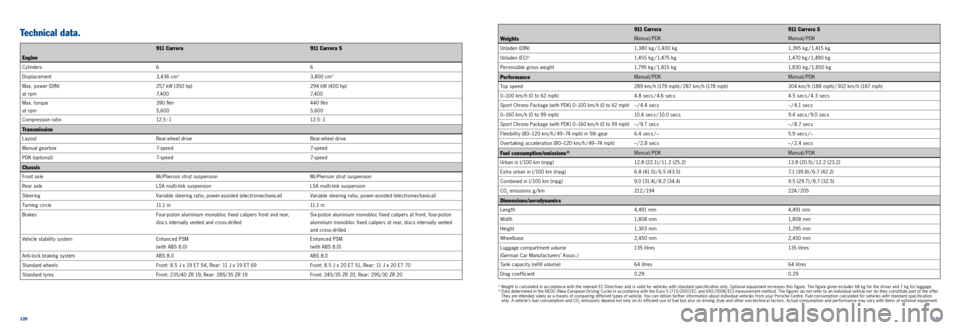
Engine
C y linders 6 6
Displacement 3,436 cm
33,800 cm3
Max. power (DIN)
at rpm 257 kW (350 hp)
7, 4 0 0 294 kW (400 hp)
7, 4 0 0
Max. torque
at rpm 390 Nm
5,600 440 Nm
5,600
Compression ratio 12.5 : 1 12.5 : 1
Transmission
LayoutRear-wheel drive Rear-wheel drive
Manual gearbox 7-speed 7-speed
PDK (optional) 7-speed 7-speed
Chassis
Front axleMcPherson strut suspension McPherson strut suspension
Rear axle LSA multi-link suspension LSA multi-link suspension
Steering Variable steering ratio, power-assisted (electromechanical) Variable steering ratio, power-assisted (electromechanical)
Turning circle 11. 1 m 11. 1 m
Brakes Four-piston aluminium monobloc fixed calipers front and rear,
discs internally vented and cross-drilled Six-piston aluminium monobloc fixed calipers at front, four-piston
aluminium monobloc fixed calipers at rear, discs internally vented
and cross-drilled
Vehicle stabilit y system Enhanced PSM
(with ABS 8.0) Enhanced PSM
(with ABS 8.0)
Anti - lock braking system ABS 8.0 ABS 8.0
Standard wheels Front: 8.5 J x 19 ET 54, Rear: 11 J x 19 ET 69 Front: 8.5 J x 20 ET 51, Rear: 11 J x 20 ET 70
Standard tyres Front: 235/40 ZR 19, Rear: 285/35 ZR 19 Front: 245/35 ZR 20, Rear: 295/30 ZR 20
9 11 C a r r e r a9 11 C a r r e r a S
Weights
Manual/PDK Manual/PDK
Unladen (DIN) 1,380 kg / 1,400 kg 1,395 kg / 1,415 kg
Unladen (EC)
1)1,455 kg / 1,475 kg 1,470 kg / 1,490 kg
Pe r m issi b le gross we igh t 1,795 kg / 1,815 kg 1,830 kg / 1,850 kg
PerformanceManual/PDKManual/PDK
Top speed 289 km/ h (179 mph) / 287 km/ h (178 mph) 304 km/ h (188 mph) / 302 km/ h (187 mph)
0 –100 km/ h (0 to 62 mph) 4.8 secs / 4.6 secs 4.5 secs / 4.3 secs
Sport Chrono Package (with PDK) 0 –100 km/ h (0 to 62 mph)– / 4.4 secs – / 4.1 secs
0 –160 km/ h (0 to 99 mph) 10.4 secs / 10.0 secs 9.4 secs / 9.0 secs
Sport Chrono Package (with PDK) 0 –160 km/ h (0 to 99 mph)– / 9.7 secs – / 8.7 secs
Flexibilit y (80 –120 km/ h / 49 –74 mph) in 5th gear 6.4 secs / – 5.9 secs / –
Overtaking acceleration (80 –120 km/ h / 49 –74 mph) – / 2.8 secs – / 2.4 secs
Fuel consumption/emissions 2)Manual/PDKManual/PDK
Urban in l/100 km (mpg) 12.8 (22.1) / 11.2 (25.2) 13.8 (20.5) / 12.2 (23.2)
Extra urban in l/100 km (mpg) 6.8 (41.5) / 6.5 (43.5) 7.1 (39.8) / 6.7 (42.2)
Combined in l/100 km (mpg) 9.0 (31.4) / 8.2 (34.4) 9.5 (29.7) / 8.7 (32.5)
CO
2 emissions g/km 212 / 194 224 / 205
Dimensions/aerodynamics
Length4,491 m m 4,491 m m
Width 1,808 mm 1,808 mm
Height 1,303 mm 1, 2 9 5 m m
Wheelbase 2,450 mm 2,450 mm
Luggage compartment volume
(German Car Manufacturers’ Assoc.) 135 l i t res
135 l i t res
Tank capacity (refill volume) 64 litres 64 litres
Drag coef ficient 0.29 0.29
1) Weight is calculated in accordance with the relevant EC Directives and is valid for vehicles with standard specification only. Optional equipment increases this figure. The figure given includes 68 kg for the driver and 7 kg for luggage.2) Data determined in the NEDC (New European Driving Cycle) in accordance with the Euro 5 (715/2007/ EC and 692/2008/ EC) measurement method. The figures do not refer to an individual vehicle nor do they constitute part of the of fer.
They are intended solely as a means of comparing dif ferent t ypes of vehicle. You can obtain further information about individual vehicles from your Porsche Centre. Fuel consumption calculated for vehicles with standard specification
only. A vehicle‘s fuel consumption and CO
2 emissions depend not only on its ef ficient use of fuel but also on driving st yle and other non -technical factors. Actual consumption and per formance may var y with items of optional equipment.
Technical data.
Page 61 of 63
122123
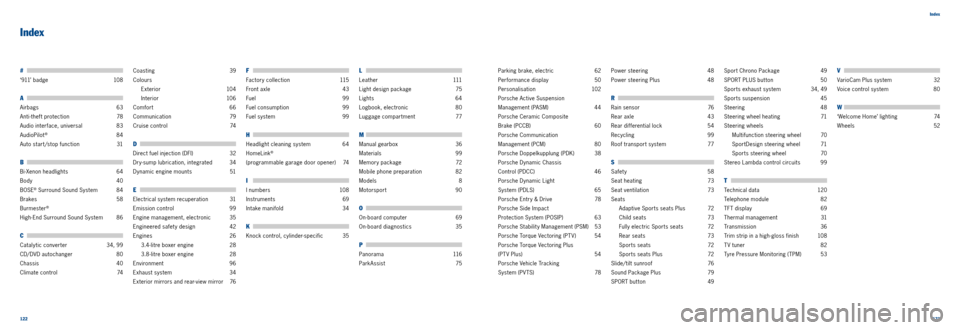
Index
#
‘911’ badge
108
A
Airbags 63
Anti-theft protection 78
Audio interface, universal 83
AudioPilot
® 84
Auto start/stop function 31
B
Bi-Xenon headlights 64
Body 40
BOSE
® Surround Sound System 84
Brakes 58
Burmester
®
High-End Surround Sound System 86
C
Cataly tic converter 34, 99
CD/ DVD autochanger 80
Chassis 40
Climate control 74Coasting
39
Colours Exterior 104
Interior 106
Comfort 66
Communication 79
Cruise control 74
D
Direct fuel injection (DFI) 32
Dry-sump lubrication, integrated 34
Dynamic engine mounts 51
E
Electrical system recuperation 31
Emission control 99
Engine management, electronic 35
Engineered safety design 42
Engines 26
3.4-litre boxer engine 28
3.8-litre boxer engine 28
Environment 96
Exhaust system 34
Exterior mirrors and rear-view mirror 76
F
Factory collection 115
Front axle 43
Fuel 99
Fuel consumption 99
Fuel system 99
H
Headlight cleaning system 64
HomeLink
®
(programmable garage door opener) 74
I
I numbers 108
Instruments 69
Intake manifold 34
K
Knock control, cylinder-specific 35
L
L e a t h e r 111
Light design package 75
Lights 64
Logbook, electronic 80
Luggage compartment 77
M
Manual gearbox 36
Materials 99
Memory package 72
Mobile phone preparation 82
Models 8
Motorsport 90
O
On-board computer 69
On-board diagnostics 35
P
Panorama 116
Park Assist 75 Parking brake, electric
62
Performance display 50
Personalisation 102
Porsche Active Suspension
Management (PASM) 44
Porsche Ceramic Composite
Brake (PCCB) 60
Porsche Communication
Management (PCM) 80
Porsche Doppelkupplung (PDK) 38
Porsche Dynamic Chassis
Control (PDCC) 46
Porsche Dynamic Light
System (PDLS) 65
Porsche Entry & Drive 78
Porsche Side Impact
Protection System (POSIP) 63
Porsche Stabilit y Management (PSM) 53
Porsche Torque Vectoring (PT V) 54
Porsche Torque Vectoring Plus
(PT V Plus) 54
Porsche Vehicle Tracking
System (PV TS) 78Power steering
48
Power steering Plus 48
R
Rain sensor 76
Rear axle 43
Rear differential lock 54
Recycling 99
Roof transport system 77
S
Safety 58
Seat heating 73
Seat ventilation 73
Seats Adaptive Sports seats Plus 72
Child seats 73
Fully electric Sports seats 72
Rear seats 73
Sports seats 72
Sports seats Plus 72
Slide/tilt sunroof 76
Sound Package Plus 79
SPORT but ton 49Sport Chrono Package
49
SPORT PLUS but ton 50
Sports exhaust system 34, 49
Sports suspension 45
Steering 48
Steering wheel heating 71
Steering wheels Multifunction steering wheel 70
SportDesign steering wheel 71
Sports steering wheel 70
Stereo Lambda control circuits 99
T
Technical data 120
Telephone module 82
TFT display 69
Thermal management 31
Transmission 36
Trim strip in a high-gloss finish 108
T V tuner 82
Tyre Pressure Monitoring (TPM) 53
Index
V
VarioCam Plus system 32
Voice control system 80
W
‘Welcome Home’ lighting 74
W heels 52