oil PORSCHE 911 CARRERA 2011 6.G Information Manual
[x] Cancel search | Manufacturer: PORSCHE, Model Year: 2011, Model line: 911 CARRERA, Model: PORSCHE 911 CARRERA 2011 6.GPages: 63, PDF Size: 9.45 MB
Page 7 of 63
1415
Strength
|
Exterior design
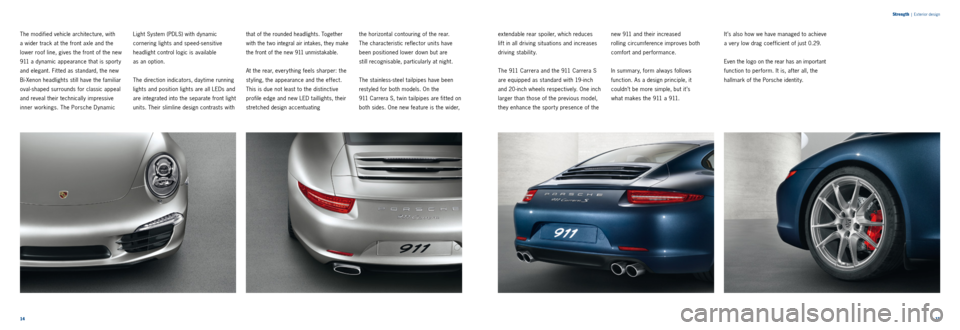
The modified vehicle architecture, with
a wider track at the front axle and the
lower roof line, gives the front of the new
911 a dynamic appearance that is sport y
and elegant. Fit ted as standard, the new
Bi-Xenon headlights still have the familiar
oval-shaped surrounds for classic appeal
and reveal their technically impressive
inner workings. The Porsche Dynamic Light System (PDLS) with dynamic
cornering lights and speed-sensitive
headlight control logic is available
as an option.
The direction indicators, daytime running
lights and position lights are all LEDs and
are integrated into the separate front light
units. Their slimline design contrasts with that of the rounded headlights. Together
with the two integral air intakes, they make
the front of the new 911 unmistakable.
At the rear, every thing feels sharper: the
styling, the appearance and the effect.
This is due not least to the distinctive
profile edge and new LED taillights, their
stretched design accentuating the horizontal contouring of the rear.
The characteristic reflector units have
been positioned lower down but are
still recognisable, particularly at night.
The stainless-steel tailpipes have been
rest yled for both models. On the
911 Carrera S, twin tailpipes are fitted on
both sides. One new feature is the wider, extendable rear spoiler, which reduces
lift in all driving situations and increases
driving stability.
The 911 Carrera and the 911 Carrera S
are equipped as standard with 19-inch
and 20-inch wheels respectively. One inch
larger than those of the previous model,
they enhance the sport y presence of the new 911 and their increased
rolling circumference improves both
comfort and performance.
In summary, form always follows
function. As a design principle, it
couldn’t be more simple, but it ’s
what makes the 911 a 911.
It ’s also how we have managed to achieve
a very low drag coefficient of just 0.29.
Even the logo on the rear has an important
function to perform. It is, after all, the
hallmark of the Porsche identity.
Page 14 of 63
1
2
3
4
5
6
7
89
10
11
12
13
14
15
16
17
18
19
20
21
22
23
2425
26
27
28
29
30
31
2829
Temperament
|
Engines
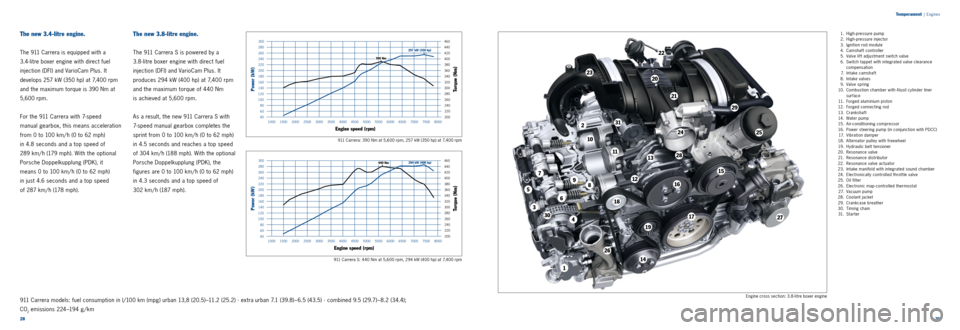
Engine cross section: 3.8-litre boxer engine
911 Carrera S: 440 Nm at 5,600 rpm, 294 kW (400 hp) at 7,400 rpm
1. High - pressure pump
2. High-pressure injector
3. Ignition rod module
4. Camshaft controller
5. Valve lif t adjustment switch valve
6. Switch tappet with integrated valve clearance
compensation
7. Intake camshaf t
8. Intake valves
9. Valve spring
10. Combustion chamber with Alusil cylinder liner
surface
11. Forged aluminium piston
12. Forged connecting rod
13. Crankshaft
14. Water pump
15. Air-conditioning compressor
16. Power steering pump (in conjunction with PDCC)
17. Vibration damper
18. Alternator pulley with freewheel
19. Hydraulic belt tensioner
20. Resonance valve
21. Resonance distributor
22. Resonance valve actuator
23. Intake manifold with integrated sound chamber
24. Electronically controlled throttle valve
25. Oil filter
26. Electronic map-controlled thermostat
27. Vacuum pump
28. Coolant jacket
29. Crankcase breather
30. Timing chain
31. S t a r t e r
911 Carrera: 390 Nm at 5,600 rpm, 257 kW (350 hp) at 7,400 rpm
The new 3.4-litre engine.
The 911 Carrera is equipped with a
3.4-litre boxer engine with direct fuel
injection (DFI) and VarioCam Plus. It
develops 257 kW (350 hp) at 7,400 rpm
and the maximum torque is 390 Nm at
5,600 rpm.
For the 911 Carrera with 7-speed
manual gearbox, this means acceleration
from 0 to 100 km/ h (0 to 62 mph)
in 4.8 seconds and a top speed of
289 km/ h (179 mph). With the optional
Porsche Doppelkupplung (PDK), it
means 0 to 100 km/ h (0 to 62 mph)
in just 4.6 seconds and a top speed
of 287 km/ h (178 mph).
The new 3.8-litre engine.
The 911 Carrera S is powered by a
3.8-litre boxer engine with direct fuel
injection (DFI) and VarioCam Plus. It
produces 294 kW (400 hp) at 7,400 rpm
and the maximum torque of 440 Nm
is achieved at 5,600 rpm.
As a result, the new 911 Carrera S with
7-speed manual gearbox completes the
sprint from 0 to 100 km/ h (0 to 62 mph)
in 4.5 seconds and reaches a top speed
of 304 km/ h (188 mph). With the optional
Porsche Doppelkupplung (PDK), the
figures are 0 to 100 km/ h (0 to 62 mph)
in 4.3 seconds and a top speed of
302 km/ h (187 mph).
911 Carrera models: fuel consumption in l/100 km (mpg) urban 13,8 (20.5) –11.2 (25.2) · extra urban 7.1 (39.8) – 6.5 (43.5) · combined 9.5 (29.7) –8.2 (34.4);
CO
2 emissions 224–194 g / km
40 60 80
100
120 140 160 180 200 220 240 260
1500 75008000
2000 2500300035004000450050005500600065007000
1000
294 kW (400 hp)440 Nm
300
280
Power (kW)
T orque (Nm)
Engine speed (rpm)
200
280 300 320 340 360 380 400 420
220 240 260
460
440
40
60 80
100 120 140 160 180 200 220 240 260
1500 75008000
2000 2500300035004000450050005500600065007000
1000
300
280
Power (kW)
T orque (Nm)
Engine speed (rpm)
200
280 300 320 340 360 380
400 420
220 240 260
460
440
257 kW (350 hp)
390 Nm
Page 17 of 63
3435
Temperament
|
Engines
Integrated dry-sump lubrication.
Integrated dr y-sump lubrication ensures
a reliable supply of oil even when a
sport y driving st yle is adopted. It also
has additional cooling functions.
The oil tank is located in the engine,
thereby eliminating the need for an
external oil tank, which saves both space
and weight. To reduce power loss and
increase efficiency, an electronically con -
trolled oil pump supplies the lubricating
points inside the engine as and when
required. This results in optimum supply
of oil, low fuel consumption and, there -
fore, lower exhaust emissions.
Air intake system.
The resonance intake system increases
the intake volume by exploiting the fact
that air oscillates as it passes through
the intake manifold. The system can
adjust to engine speed. Benefits of this
include higher torque at low engine
speeds and a flat ter torque curve.
The
911 Carrera S operates a t wo -stage
system.
The entire intake system is made from
light weight plastic. In the new 911 Carrera,
the resonator volume of the air filter
housing varies with engine speed to bring
added character to the engine sound,
which becomes much more powerful at
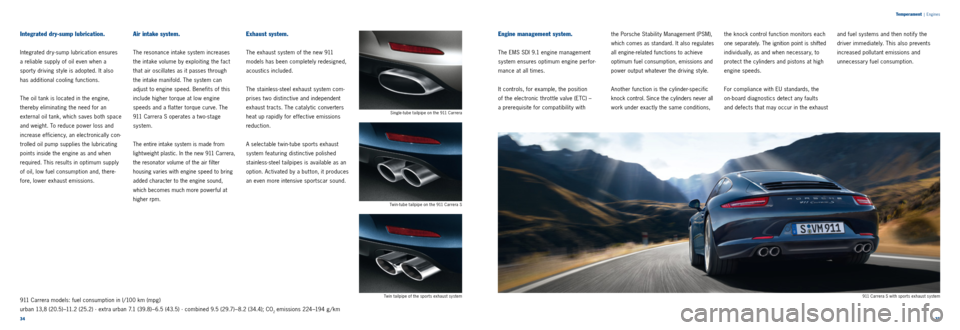
higher rpm.
Exhaust system.
The exhaust system of the new 911
models has been completely redesigned,
acoustics included.
The stainless-steel exhaust system com -
prises t wo distinctive and independent
exhaust tracts. The cataly tic converters
heat up rapidly for effective emissions
reduction.
A selectable t win -tube sports exhaust
system featuring distinctive polished
stainless-steel tailpipes is available as an
option. Activated by a but ton, it produces
an even more intensive sportscar sound.
911 Carrera S with sports exhaust system
Engine management system.
The EMS SDI 9.1 engine management
system ensures optimum engine perfor -
mance at all times.
It controls, for example, the position
of the electronic throt tle valve (ETC) –
a prerequisite for compatibility with the Porsche Stabilit y Management (PSM),
which comes as standard. It also regulates
all engine-related functions to achieve
optimum fuel consumption, emissions and
power output whatever the driving st yle.
Another function is the cylinder-specific
knock control. Since the cylinders never all
work under exactly the same conditions, the knock control function monitors each
one separately. The ignition point is shifted
individually, as and when necessary, to
protect the cylinders and pistons at high
engine speeds.
For compliance with EU standards, the
on - board diagnostics detect any faults
and defects that may occur in the exhaust and fuel systems and then notify the
driver immediately. This also prevents
increased pollutant emissions and
unnecessary fuel consumption.
Twin tailpipe of the sports exhaust system Single-tube tailpipe on the 911 Carrera
Twin-tube tailpipe on the 911 Carrera S911 Carrera models: fuel consumption in l/100 km (mpg)
urban 13,8 (20.5) –11.2 (25.2) · extra urban 7.1 (39.8) – 6.5 (43.5) · combined 9.5 (29.7) –8.2 (34.4); CO
2 emissions 224–194 g / km
Page 22 of 63

4445
Temperament
| Chassis and body
PASM, the electronic damping control
system, is standard in the 911 Carrera S
and available as an option for the
911 Carrera. It actively and continuously
regulates damping forces according
to driving st yle and road conditions.
In addition, the suspension is lowered
by 10 mm.
PASM has t wo modes, which can be
selected using a separate but ton on
the centre console: ‘Normal’, which is a
blend of performance and comfort, and
‘Sport ’ where the setup is much firmer. Sensors record the body movements
that accompany powerful acceleration,
braking or uneven road surfaces. In the
new 911, the number of sensors has
been increased for improved data acqui -
sition and even more ef ficient control
interventions. The PASM control unit eval -
uates the driving conditions and modifies
the damping force on each of the wheels
in accordance with the selected mode.
In ‘Sport ’ mode, the suspension is set to
a harder damper rating. On uneven roads,
PASM immediately switches to a softer rating, thereby improving contact
bet ween the wheels and the road.
When the road surface improves, PASM
automatically reverts to the original,
harder rating. If ‘Normal’ mode is selected
and the driver’s st yle becomes more
assertive, PASM automatically switches
to a harder rating. Damping firms up,
and driving stabilit y and road safet y are
increased.
The results are tangible: increased
driving stability, improved comfort and
enhanced performance.
No need to let the laws of physics
spoil your fun.
Porsche Active Suspension Management (PASM).PASM sports suspension.
The new PASM sports suspension is
available as an option for both models
in conjunction with 20-inch wheels and
Porsche Torque Vectoring (PTV) or
Porsche Torque Vectoring Plus (PTV Plus). The ride height is 20 mm lower than
with the standard suspension or 10 mm
compared with the PASM suspension.
The springs are harder and shorter, and
the anti-roll bars on the front and rear
axles are stiffer. The front spoiler lip has
a more sport y geometry, the rear spoiler extends even further. These not only
further reduce lift at the front axle, but
also provide downforce at the rear axle
for improved aerodynamics and even
better performance.
Page 29 of 63
5859
Composure
| Safet y
Control, discipline, precision.
At Porsche, we take driving pleasure very seriously.
S a f e t y.
Brakes.
Another crucial piece of the Porsche
identit y is the brakes. We value them as
highly as we do our engines and chassis.
They set standards for deceleration and
stabilit y, and give the driver the reassur -
ance needed to push the car to the limits
of its performance.
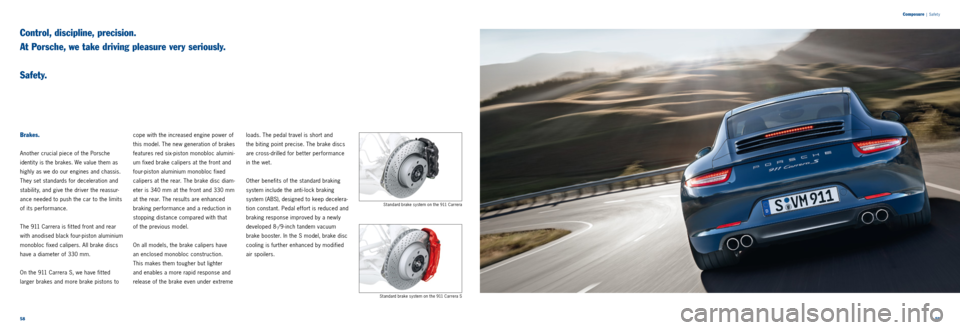
The 911 Carrera is fit ted front and rear
with anodised black four-piston aluminium
monobloc fixed calipers. All brake discs
have a diameter of 330 mm.
On the 911 Carrera S, we have fit ted
larger brakes and more brake pistons to cope with the increased engine power of
this model. The new generation of brakes
features red six-piston monobloc alumini
-
um fixed brake calipers at the front and
four-piston aluminium monobloc fixed
calipers at the rear. The brake disc diam -
eter is 340 mm at the front and 330 mm
at the rear. The results are enhanced
braking performance and a reduction in
stopping distance compared with that
of the previous model.
On all models, the brake calipers have
an enclosed monobloc construction.
This makes them tougher but lighter
and enables a more rapid response and
release of the brake even under extreme loads. The pedal travel is short and
the biting point precise. The brake discs
are cross-drilled for better performance
in the wet.
Other benefits of the standard braking
system include the anti-lock braking
system (ABS), designed to keep decelera -
tion constant. Pedal effort is reduced and
braking response improved by a newly
developed 8-/9-inch tandem vacuum
brake booster. In the S model, brake disc
cooling is further enhanced by modified
air spoilers.
Standard brake system on the 911 Carrera
Standard brake system on the 911 Carrera S