weight PORSCHE 911 CARRERA 2011 6.G Information Manual
[x] Cancel search | Manufacturer: PORSCHE, Model Year: 2011, Model line: 911 CARRERA, Model: PORSCHE 911 CARRERA 2011 6.GPages: 63, PDF Size: 9.45 MB
Page 4 of 63
9
8
Many legends look to the past.
This one looks to the future.
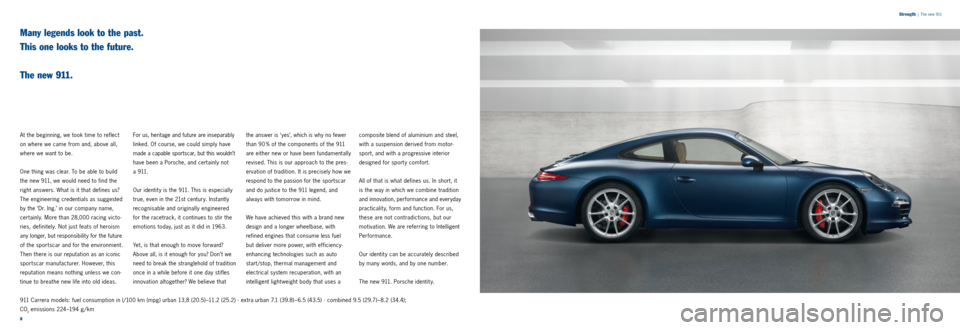
The new 911.
At the beginning, we took time to reflect
on where we came from and, above all,
where we want to be.
One thing was clear. To be able to build
the new 911, we would need to find the
right answers. What is it that defines us?
The engineering credentials as suggested
by the ‘Dr. Ing.’ in our company name,
certainly. More than 28,000 racing victo -
ries, definitely. Not just feats of heroism
any longer, but responsibilit y for the future
of the sportscar and for the environment.
Then there is our reputation as an iconic
sportscar manufacturer. However, this
reputation means nothing unless we con -
tinue to breathe new life into old ideas. For us, heritage and future are inseparably
linked. Of course, we could simply have
made a capable sportscar, but this wouldn’t
have been a Porsche, and certainly not
a 9 11 .
Our identit y is the 911. This is especially
true, even in the 21st century. Instantly
recognisable and originally engineered
for the racetrack, it continues to stir the
emotions today, just as it did in 1963.
Yet, is that enough to move forward?
Above all, is it enough for you? Don’t we
need to break the stranglehold of tradition
once in a while before it one day stifles
innovation altogether? We believe that
the answer is ‘yes’, which is why no fewer
than 90 % of the components of the 911
are either new or have been fundamentally
revised. This is our approach to the pres -
ervation of tradition. It is precisely how we
respond to the passion for the sportscar
and do justice to the 911 legend, and
always with tomorrow in mind.
We have achieved this with a brand new
design and a longer wheelbase, with
refined engines that consume less fuel
but deliver more power, with efficiency-
enhancing technologies such as auto
start /stop, thermal management and
electrical system recuperation, with an
intelligent light weight body that uses a composite blend of aluminium and steel,
with a suspension derived from motor
-
sport, and with a progressive interior
designed for sport y comfort.
All of that is what defines us. In short, it
is the way in which we combine tradition
and innovation, performance and everyday
practicality, form and function. For us,
these are not contradictions, but our
motivation. We are referring to Intelligent
Performance.
Our identit y can be accurately described
by many words, and by one number.
The new 911. Porsche identit y.
911 Carrera models: fuel consumption in l/100 km (mpg) urban 13,8 (20.5) –11.2 (25.2) · extra urban 7.1 (39.8) – 6.5 (43.5) · combined 9.5 (29.7) –8.2 (34.4);
CO
2 emissions 224–194 g / km
Strength | The new 911
Page 9 of 63
1819
Strength
|
Engineering
Let’s forget the future for a moment.
As we discover it in the present.
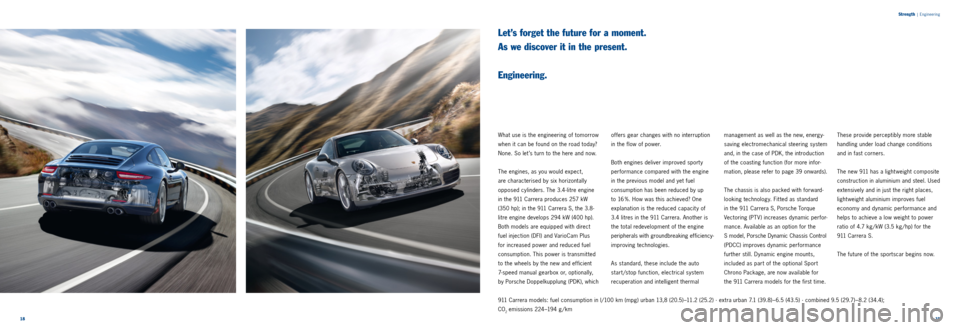
Engineering.
What use is the engineering of tomorrow
when it can be found on the road today?
None. So let ’s turn to the here and now.
The engines, as you would expect,
are characterised by six horizontally
opposed cylinders. The 3.4-litre engine
in the 911 Carrera produces 257 kW
(350 hp); in the 911 Carrera S, the 3.8-
litre engine develops 294 kW (400 hp).
Both models are equipped with direct
fuel injection (DFI) and VarioCam Plus
for increased power and reduced fuel
consumption. This power is transmit ted
to the wheels by the new and efficient
7-speed manual gearbox or, optionally,
by Porsche Doppelkupplung (PDK), which offers gear changes with no interruption
in the flow of power.
Both engines deliver improved sport y
performance compared with the engine
in the previous model and yet fuel
consumption has been reduced by up
to 16 %. How was this achieved? One
explanation is the reduced capacit y of
3.4 litres in the 911 Carrera. Another is
the total redevelopment of the engine
peripherals with groundbreaking efficiency-
improving technologies.
As standard, these include the auto
start/stop function, electrical system
recuperation and intelligent thermal management as well as the new, energy-
saving electromechanical steering system
and, in the case of PDK, the introduction
of the coasting function (for more infor
-
mation, please refer to page 39 onwards).
The chassis is also packed with forward-
looking technology. Fit ted as standard
in the 911 Carrera S, Porsche Torque
Vectoring (PT V) increases dynamic perfor -
mance. Available as an option for the
S model, Porsche Dynamic Chassis Control
(PDCC) improves dynamic performance
further still. Dynamic engine mounts,
included as part of the optional Sport
Chrono Package, are now available for
the 911 Carrera models for the first time. These provide perceptibly more stable
handling under load change conditions
and in fast corners.
The new 911 has a light weight composite
construction in aluminium and steel. Used
extensively and in just the right places,
lightweight aluminium improves fuel
economy and dynamic performance and
helps to achieve a low weight to power
ratio of 4.7 kg / kW (3.5 kg / hp) for the
9 11 C a r r e r a S .
The future of the sportscar begins now.
911 Carrera models: fuel consumption in l/100 km (mpg) urban 13,8 (20.5) –11.2 (25.2) · extra urban 7.1 (39.8) – 6.5 (43.5) · combined 9.5 (29.7) –8.2 (34.4);
CO
2 emissions 224–194 g / km
Page 13 of 63

2627
Temperament
|
Engines
To give more and take less.
That’s Porsche engineering.
Engines.
You could ask whether the sportscar is
still relevant. It would be a good question,
but you might as well ask the same of
dreams.
The answer to both questions lies in
the future or, to be more precise, in the
future of the sportscar. In the new 911,
the future has already begun. The highly
ef ficient, state - of-the -art engines make
a considerable contribution to reducing
fuel consumption, but their sound is still
unmistakably Porsche. The new 911 engines are also unmistaka
-
bly sport y thanks to the new SPORT
but ton fit ted as standard. At the push
of a button, the engine becomes tuned
for a sharper response and engine
dynamics that are even more direct.
The 3.4-litre engine of the new
911 Carrera demonstrates, therefore,
that performance and efficiency need
not be mutually exclusive. Rather, the
downsized engine capacity and increased
maximum torque are the intelligent basis
by which power output can be increased
in an environmentally acceptable and
sustainable way. Fuel consumption and CO2 emissions have been reduced
by up to 16 % compared with the previous
model.
In their search for improved efficiency,
our engineers analysed an extensive
series of engine components. Answers
were found, including rapid heating
of the engine and gearbox by the new
thermal management after an engine
start, optimised air induction and the
extremely effective direct fuel injection
(DFI).
The same principle applies to the 3.8-litre
engine in the 911 Carrera S. There has been no change in displacement since
the previous model, but power output has
been increased while fuel consumption
has been reduced by up to 14 %.
Weight is critical to efficiency. This is
why the engines have a light-alloy
construction, which makes them light -
weight and structurally rigid for improved
fuel economy and a long life.
The engine is the intelligent core of our
identit y. What else could the ‘Dr. Ing.’ in
our company name possibly stand for?
911 Carrera models: fuel consumption in l/100 km (mpg) urban 13,8 (20.5) –11.2 (25.2) · extra urban 7.1 (39.8) – 6.5 (43.5) · combined 9.5 (29.7) –8.2 (34.4);
CO
2 emissions 224–194 g / km
Page 17 of 63

3435
Temperament
|
Engines
Integrated dry-sump lubrication.
Integrated dr y-sump lubrication ensures
a reliable supply of oil even when a
sport y driving st yle is adopted. It also
has additional cooling functions.
The oil tank is located in the engine,
thereby eliminating the need for an
external oil tank, which saves both space
and weight. To reduce power loss and
increase efficiency, an electronically con -
trolled oil pump supplies the lubricating
points inside the engine as and when
required. This results in optimum supply
of oil, low fuel consumption and, there -
fore, lower exhaust emissions.
Air intake system.
The resonance intake system increases
the intake volume by exploiting the fact
that air oscillates as it passes through
the intake manifold. The system can
adjust to engine speed. Benefits of this
include higher torque at low engine
speeds and a flat ter torque curve.
The
911 Carrera S operates a t wo -stage
system.
The entire intake system is made from
light weight plastic. In the new 911 Carrera,
the resonator volume of the air filter
housing varies with engine speed to bring
added character to the engine sound,
which becomes much more powerful at
higher rpm.
Exhaust system.
The exhaust system of the new 911
models has been completely redesigned,
acoustics included.
The stainless-steel exhaust system com -
prises t wo distinctive and independent
exhaust tracts. The cataly tic converters
heat up rapidly for effective emissions
reduction.
A selectable t win -tube sports exhaust
system featuring distinctive polished
stainless-steel tailpipes is available as an
option. Activated by a but ton, it produces
an even more intensive sportscar sound.
911 Carrera S with sports exhaust system
Engine management system.
The EMS SDI 9.1 engine management
system ensures optimum engine perfor -
mance at all times.
It controls, for example, the position
of the electronic throt tle valve (ETC) –
a prerequisite for compatibility with the Porsche Stabilit y Management (PSM),
which comes as standard. It also regulates
all engine-related functions to achieve
optimum fuel consumption, emissions and
power output whatever the driving st yle.
Another function is the cylinder-specific
knock control. Since the cylinders never all
work under exactly the same conditions, the knock control function monitors each
one separately. The ignition point is shifted
individually, as and when necessary, to
protect the cylinders and pistons at high
engine speeds.
For compliance with EU standards, the
on - board diagnostics detect any faults
and defects that may occur in the exhaust and fuel systems and then notify the
driver immediately. This also prevents
increased pollutant emissions and
unnecessary fuel consumption.
Twin tailpipe of the sports exhaust system Single-tube tailpipe on the 911 Carrera
Twin-tube tailpipe on the 911 Carrera S911 Carrera models: fuel consumption in l/100 km (mpg)
urban 13,8 (20.5) –11.2 (25.2) · extra urban 7.1 (39.8) – 6.5 (43.5) · combined 9.5 (29.7) –8.2 (34.4); CO
2 emissions 224–194 g / km
Page 20 of 63
4041
Temperament
| Chassis and body
“That can’t be done.”
If ever a sentence gave motivation to sportscar designers, this is it.
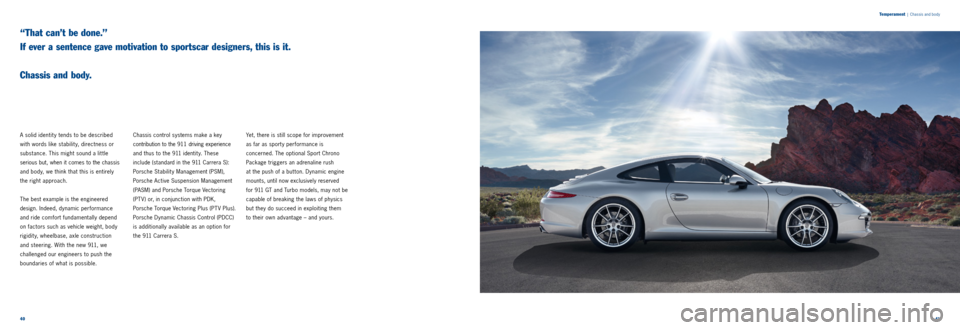
Chassis and body.
A solid identit y tends to be described
with words like stability, directness or
substance. This might sound a lit tle
serious but, when it comes to the chassis
and body, we think that this is entirely
the right approach.
The best example is the engineered
design. Indeed, dynamic per formance
and ride comfort fundamentally depend
on factors such as vehicle weight, body
rigidity, wheelbase, axle construction
and steering. With the new 911, we
challenged our engineers to push the
boundaries of what is possible. Chassis control systems make a key
contribution to the 911 driving experience
and thus to the 911 identit y. These
include (standard in the 911 Carrera S):
Porsche Stability Management (PSM),
Porsche Active Suspension Management
(PASM) and Porsche Torque Vectoring
(PTV) or, in conjunction with PDK,
Porsche Torque Vectoring Plus (PTV Plus).
Porsche Dynamic Chassis Control (PDCC)
is additionally available as an option for
the 911 Carrera S. Yet, there is still scope for improvement
as far as sport y performance is
concerned. The optional Sport Chrono
Package triggers an adrenaline rush
at the push of a but ton. Dynamic engine
mounts, until now exclusively reserved
for 911 GT and Turbo models, may not be
capable of breaking the laws of physics
but they do succeed in exploiting them
to their own advantage – and yours.
Page 21 of 63
4243
Temperament
| Chassis and body
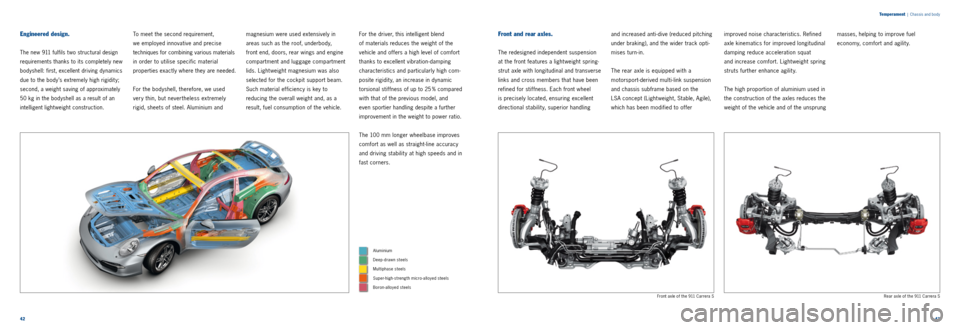
Engineered design.
The new 911 fulfils two structural design
requirements thanks to its completely new
bodyshell: first, excellent driving dynamics
due to the body’s extremely high rigidit y;
second, a weight saving of approximately
50 kg in the bodyshell as a result of an
intelligent lightweight construction.
To meet the second requirement,
we employed innovative and precise
techniques for combining various materials
in order to utilise specific material
properties exactly where they are needed.
For the bodyshell, therefore, we used
very thin, but nevertheless extremely
rigid, sheets of steel. Aluminium and magnesium were used extensively in
areas such as the roof, underbody,
front end, doors, rear wings and engine
compartment and luggage compartment
lids. Light weight magnesium was also
selected for the cockpit support beam.
Such material efficiency is key to
reducing the overall weight and, as a
result, fuel consumption of the vehicle. For the driver, this intelligent blend
of materials reduces the weight of the
vehicle and offers a high level of comfort
thanks to excellent vibration-damping
characteristics and particularly high com -
posite rigidit y, an increase in dynamic torsional stiffness of up to 25 % compared
with that of the previous model, and
even
sportier handling despite a further
improvement in the weight to power ratio.
The 100 mm longer wheelbase improves
comfort as well as straight-line accuracy
and driving stabilit y at high speeds and in
fast corners.
Front and rear axles.
The redesigned independent suspension
at the front features a light weight spring-
strut axle with longitudinal and transverse
links and cross members that have been
refined for stiffness. Each front wheel
is precisely located, ensuring excellent
directional stability, superior handling and increased anti-dive (reduced pitching
under braking), and the wider track opti
-
mises turn-in.
The rear axle is equipped with a
motorsport-derived multi-link suspension
and chassis subframe based on the
LSA concept (Lightweight, Stable, Agile),
which has been modified to offer improved noise characteristics. Refined
axle kinematics for improved longitudinal
damping reduce acceleration squat
and increase comfort. Light weight spring
struts further enhance agilit y.
The high proportion of aluminium used in
the construction of the axles reduces the
weight of the vehicle and of the unsprung masses, helping to improve fuel
economy, comfort and agility.
Rear axle of the 911 Carrera S
Front axle of the 911 Carrera S
Aluminium
Deep-drawn steels
Multiphase steels
Super-high-strength micro-alloyed steels
Boron-alloyed steels
Page 26 of 63

5253
Wheels.
On the new 911, the wheels have been
enlarged by one inch over the previous
model. Not only do the larger wheels
improve dynamic performance, they
also look more imposing.
The new 911 Carrera is equipped with
19-inch Carrera wheels as standard. These are light weight alloys featuring
a classic sport y design. Tyre sizes are
235/40 ZR 19 and 285/35 ZR 19 at
the front and rear respectively.
The S model is equipped with light-alloy
20 -inch Carrera S wheels as standard.
The visual effect is sport y and dynamic.
The t yres are slightly wider to cope
with the increased power output of this model: 245/35 ZR 20 at the front,
295/30 ZR 20 at the rear.
The larger t yre size improves both ride
comfort and track performance. The
rolling resistance of the summer t yres
has been reduced by up to 7 % to improve
fuel economy, while t yre weight and dry
braking distances have also been
reduced. A selection of 20-inch wheels is available in
our range of options.
Tyre Pressure Monitoring (TPM).
Tyre Pressure Monitoring (TPM) is available
on request. This safet y system sends
warnings to the on-board computer’s
display screen in the event of low t yre
pressure or a gradual or sudden loss
of pressure. The individual pressures
in all four t yres can be displayed in the
instrument cluster.
Porsche Stability Management (PSM).
As standard, the new 911 models
are equipped with enhanced Porsche
Stabilit y Management (PSM), which
maintains stability even at the limits of
dynamic driving performance. Sensors
continuously monitor the direction,
speed, yaw velocity and lateral acceleration
of the car. Using this information, PSM is able to calculate the actual direction
of travel at any given moment. If the car
begins to oversteer or understeer, PSM
applies selective braking on individual
wheels to restore stabilit y.
Under acceleration on wet or low-grip
road surfaces, PSM improves traction
using the automatic brake differential
(ABD), anti-slip regulation (ASR) and
engine drag torque control (EDC) function.
When the SPORT PLUS mode of the
optional Sport Chrono Package is selected,
the PSM threshold is raised to allow a
sportier driving st yle.
For an even more dynamic experience,
you always have the option to deactivate
PSM. It is automatically reactivated,
for your safet y, only if you brake harder
and either of the front wheels (in SPORT
PLUS mode, both of the front wheels)
requires ABS assistance. ABS and ABD,
however, remain active at all times.
PSM therefore offers a high level of
driving stability and safety combined
with extraordinary agilit y. It ’s an
apparent contradiction in terms, but an
intrinsic part of the Porsche identit y.
19-inch Carrera wheel (standard on the 911 Carrera)
20-inch Carrera S wheel (standard on the 911 Carrera S)911 Carrera S with 20-inch Carrera Classic wheels
Temperament | Chassis and body
Page 30 of 63
6061
From the start, Porsche has been
synonymous with motorsport. Ever since
1948, when we found our identit y on
the racetrack, we have taken the experi -
ence we have gained and applied it to
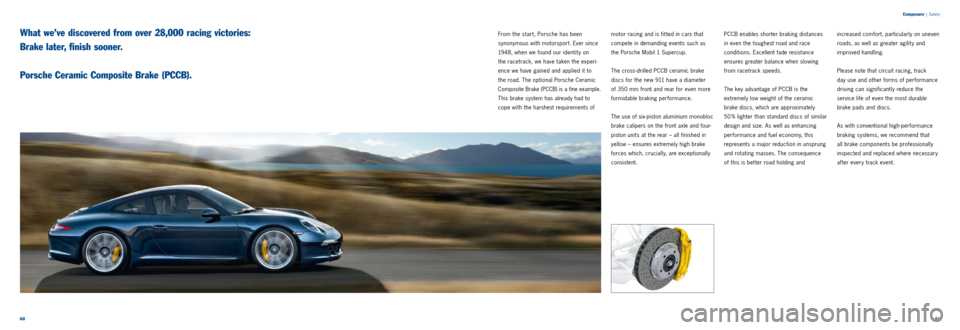
the road. The optional Porsche Ceramic
Composite Brake (PCCB) is a fine example.
This brake system has already had to
cope with the harshest requirements of
Composure | Safet y
motor racing and is fit ted in cars that
compete in demanding events such as
the Porsche Mobil 1 Supercup.
The cross-drilled PCCB ceramic brake
discs for the new 911 have a diameter
of 350 mm front and rear for even more
formidable braking performance.
The use of six-piston aluminium monobloc
brake calipers on the front axle and four-
piston units at the rear – all finished in
yellow – ensures extremely high brake
forces which, crucially, are exceptionally
consistent. What we’ve discovered from over 28,000 racing victories:
Brake later, finish sooner.
Porsche Ceramic Composite Brake (PCCB).PCCB enables shorter braking distances
in even the toughest road and race
conditions. Excellent fade resistance
ensures greater balance when slowing
from racetrack speeds.
The key advantage of PCCB is the
extremely low weight of the ceramic
brake discs, which are approximately
50 % lighter than standard discs of similar
design and size. As well as enhancing
performance and fuel economy, this
represents a major reduction in unsprung
and rotating masses. The consequence
of this is bet ter road holding and increased comfort, particularly on uneven
roads, as well as greater agilit y and
improved handling.
Please note that circuit racing, track
day use and other forms of performance
driving can significantly reduce the
service life of even the most durable
brake pads and discs.
As with conventional high-performance
braking systems, we recommend that
all brake components be professionally
inspected and replaced where necessary
after every track event.
Page 34 of 63
6869
Composure
| Comfor t
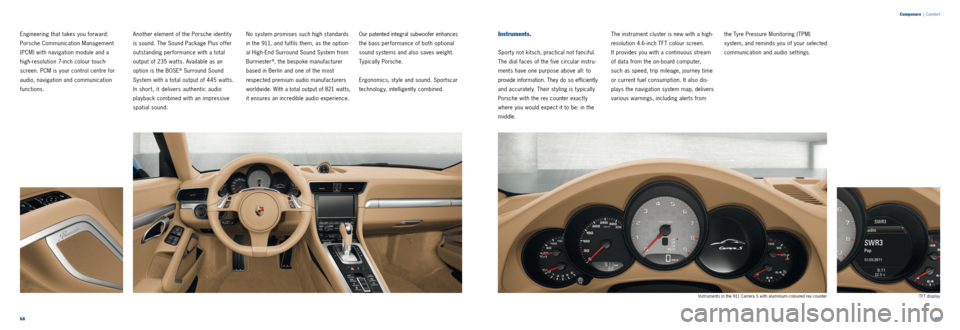
Engineering that takes you forward:
Porsche Communication Management
(PCM) with navigation module and a
high-resolution 7-inch colour touch -
screen. PCM is your control centre for
audio, navigation and communication
functions.Instruments.
Sporty not kitsch, practical not fanciful.
The dial faces of the five circular instru -
ments have one purpose above all: to
provide information. They do so efficiently
and accurately. Their st yling is t ypically
Porsche with the rev counter exactly
where you would expect it to be: in the
middle.
Another element of the Porsche identit y
is sound. The Sound Package Plus offer
outstanding performance with a total
output of 235 wat ts. Available as an
option is the BOSE
® Surround Sound
System with a total output of 445 wat ts.
In short, it delivers authentic audio
playback combined with an impressive
spatial sound. No system promises such high standards
in the 911, and fulfils them, as the option
-
al High-End Surround Sound System from
Burmester
®, the bespoke manufacturer
based in Berlin and one of the most
respected premium audio manufacturers
worldwide. With a total output of 821 wat ts,
it ensures an incredible audio experience. Our patented integral subwoofer enhances
the bass performance of both optional
sound systems and also saves weight.
Typically Porsche.
Ergonomics, st yle and sound. Sportscar
technology, intelligently combined.
The instrument cluster is new with a high-
resolution 4.6-inch TFT colour screen.
It provides you with a continuous stream
of data from the on-board computer,
such as speed, trip mileage, journey time
or current fuel consumption. It also dis -
plays the navigation system map, delivers
various warnings, including alerts from the Tyre Pressure Monitoring (TPM)
system, and reminds you of your selected
communication and audio settings.
TFT display
Instruments in the 911 Carrera S with aluminium - coloured rev counter
Page 38 of 63
7677
Composure
| Comfor t
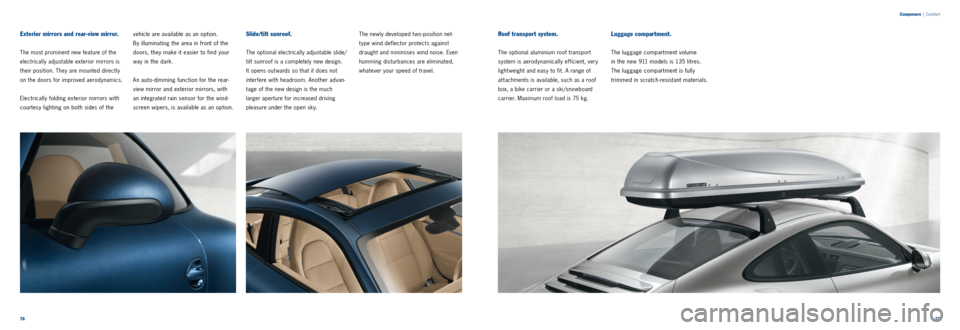
Exterior mirrors and rear-view mirror.
The most prominent new feature of the
electrically adjustable exterior mirrors is
their position. They are mounted directly
on the doors for improved aerodynamics.
Electrically folding exterior mirrors with
courtesy lighting on both sides of the
Roof transport system.
The optional aluminium roof transport
system is aerodynamically ef ficient, ver y
light weight and easy to fit. A range of
at tachments is available, such as a roof
box, a bike carrier or a ski/snowboard
carrier. Maximum roof load is 75 kg.
vehicle are available as an option.
By illuminating the area in front of the
doors, they make it easier to find your
way in the dark.
An auto-dimming function for the rear-
view mirror and exterior mirrors, with
an integrated rain sensor for the wind -
screen wipers, is available as an option.Slide/tilt sunroof.
The optional electrically adjustable slide/
tilt sunroof is a completely new design.
It opens out wards so that it does not
interfere with headroom. Another advan -
tage of the new design is the much
larger aperture for increased driving
pleasure under the open sky. The newly developed t wo -position net-
t ype wind deflector protects against
draught and minimises wind noise. Even
humming disturbances are eliminated,
whatever your speed of travel.
Luggage compartment.
The luggage compartment volume
in the new 911 models is 135 litres.
The luggage compartment is fully
trimmed in scratch - resistant materials.