fuel PORSCHE 911 CARRERA 2011 6.G Information Manual
[x] Cancel search | Manufacturer: PORSCHE, Model Year: 2011, Model line: 911 CARRERA, Model: PORSCHE 911 CARRERA 2011 6.GPages: 72, PDF Size: 13.67 MB
Page 18 of 72
3839
Temperament
|
Engines
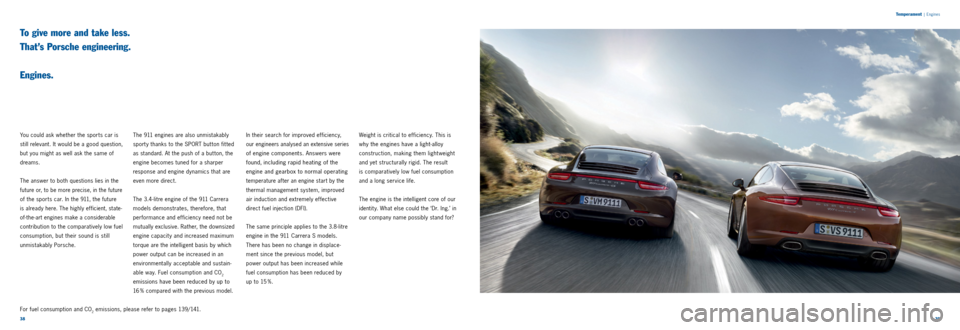
To give more and take less.
That’s Porsche engineering.
Engines.
You could ask whether the sports car is
still relevant. It would be a good question,
but you might as well ask the same of
dreams.
The answer to both questions lies in the
future or, to be more precise, in the future
of the sports car. In the 911, the future
is already here. The highly efficient, state
ofthe art engines make a considerable
contribution to the comparatively low fuel
consumption, but their sound is still
unmistakably Porsche. The 911 engines are also unmistakably
sport y thanks to the SPORT but ton fit ted
as standard. At the push of a but ton, the
engine becomes tuned for a sharper
response and engine dynamics that are
even more direct.
The 3.4
litre engine of the 911 Carrera
models demonstrates, therefore, that
performance and efficiency need not be
mutually exclusive. Rather, the downsized
engine capacity and increased maximum
torque are the intelli
gent basis by which
power output can be increased in an
environmentally acceptable and sustain
able way. Fuel consumption and CO
2
emissions have been reduced by up to
16 % compared with the previous model. In their search for improved efficiency,
our engineers analysed an extensive series
of engine components. Answers were
found, including rapid heating of the
engine and gearbox to normal operating
temperature after an engine start by the
thermal management system, improved
air induction and extremely effective
direct fuel injection (DFI).
The same principle applies to the 3.8 litre
engine in the 911 Carrera S models.
There has been no change in displace
ment since the previous model, but
power output has been increased while
fuel consumption has been reduced by
up to 15 %. Weight is critical to efficiency. This is
why the engines have a lightalloy
construction, making them lightweight
and yet structurally rigid. The result
is comparatively low fuel consumption
and a long service life.
The engine is the intelligent core of our
identit y. What else could the ‘Dr. Ing.’ in
our company name possibly stand for?
For fuel consumption and CO
2 emissions, please refer to pages 139/141.
Page 19 of 72
1
2
3
4
5
6
7
89
10
11
12
13
14
15
16
17
18
19
20
21
22
23
2425
26
27
28
29
30
31
4041
Temperament
|
Engines
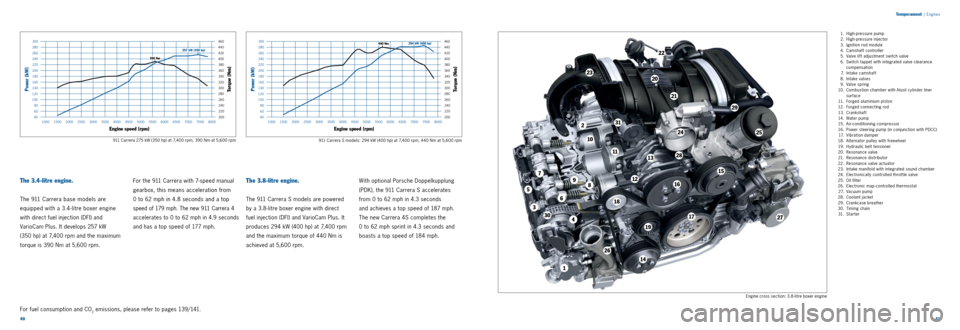
Engine cross section: 3.8 litre boxer engine
911 Carrera S models: 294 kW (400 hp) at 7,400 rpm, 440 Nm at 5,600 rpm
1. High pressure pump
2. High pressure injector
3. Ignition rod module
4. Camshaft controller
5. Valve lif t adjustment switch valve
6. Switch tappet with integrated valve clearance
compensation
7. Intake camshaf t
8. Intake valves
9. Valve spring
10. Combustion chamber with Alusil cylinder liner
surface
11. Forged aluminium piston
12. Forged connecting rod
13. Crankshaft
14. Water pump
15. Air conditioning compressor
16. Power steering pump (in conjunction with PDCC)
17. Vibration damper
18. Alternator pulley with freewheel
19. Hydraulic belt tensioner
20. Resonance valve
21. Resonance distributor
22. Resonance valve actuator
23. Intake manifold with integrated sound chamber
24. Electronically controlled throttle valve
25. Oil filter
26. Electronic map controlled thermostat
27. Vacuum pump
28. Coolant jacket
29. Crankcase breather
30. Timing chain
31. S t a r t e r
911 Carrera 275 kW (350 hp) at 7,400 rpm, 390 Nm at 5,600 rpm
The 3.4-litre engine.
The 911 Carrera base models are
equipped with a 3.4 litre boxer engine
with direct fuel injection (DFI) and
VarioCam Plus. It develops 257 kW
(350 hp) at 7,400 rpm and the maximum
torque is 390 Nm at 5,600 rpm. For the 911 Carrera with 7
speed manual
gearbox, this means acceleration from
0 to 62 mph in 4.8 seconds and a top
speed of 179 mph. The new 911 Carrera 4
accelerates to 0 to 62 mph in 4.9 seconds
and has a top speed of 177 mph.
For fuel consumption and CO
2 emissions, please refer to pages 139/141.
40 60 80
100 120 140 160 180 200 220 240 260
1500 75008000
2000 2500300035004000450050005500600065007000
1000
294 kW (400 hp)440 Nm
300
280
Power (kW)
T orque (Nm)
Engine speed (rpm)
200
280 300 320 340 360 380
400 420
220 240 260
460
44040
60 80
100 120 140 160 180 200 220 240 260
1500 75008000
2000 2500300035004000450050005500600065007000
1000
300
280
Power (kW)
T orque (Nm)
Engine speed (rpm)
200
280 300 320 340 360 380
400 420
220 240 260
460
440
257 kW (350 hp)
390 Nm
The 3.8-litre engine.
The 911 Carrera S models are powered
by a 3.8
litre boxer engine with direct
fuel injection (DFI) and VarioCam Plus. It
produces 294 kW (400 hp) at 7,400 rpm
and the maximum torque of 440 Nm is
achieved at 5,600 rpm. With optional Porsche Doppelkupplung
(PDK), the 911 Carrera S accelerates
from 0 to 62 mph in 4.3 seconds
and achieves a top speed of 187 mph.
The new Carrera 4S completes the
0 to 62 mph sprint in 4.3 seconds and
boasts a top speed of 184 mph.
Page 20 of 72
4243
A widely held belief about motorsport is
that power is the only thing that mat ters.
From experience, we know bet ter. Extra
horsepower alone has never been enough
to win a single race. Much more important
to us are ideas – ideas that inspire more
intelligent vehicle concepts and more
ef ficient drive systems. The same applies
on the road. It ’s about get ting the most
out of what you’ve got.
Auto start/stop function.
The auto start/stop function is standard
in the 911 Carrera models.
In cars with the manual gearbox, the
engine switches off automatically when,
for example, you stop at traffic lights,
select neutral and release the clutch
pedal. In cars with Porsche Doppelkupplung
(PDK), the engine switches off whenever
you stop and leave your foot on the
brake pedal.
All audio and communication systems
remain switched on and the climate con
trol continues to maintain your selected
temperature. The only differences you
will notice are the silence at the rear and
the fuel saving. As soon as you operate
the clutch or release the brake, the
engine will restart swiftly and smoothly. The auto start/stop function may remain
inactive under particular circumstances,
for example: extreme outside tempera
tures, when the SPORT but ton is selected
or if bat tery charge is low. It is also pos
sible to deactivate the function manually
using a separate but ton on the centre
console.
Thermal management.
The thermal management system
regulates the temperature in the engine
and gearbox through the intelligent
manipulation of heat flow.
In this way, the engine and gearbox reach
their optimum operating temperature
sooner. As a result, fuel consumption is
reduced through increased combustion
efficiency and lubrication performance.
Electrical system recuperation.
The 911 Carrera models are also equipped
as standard with fuel saving electrical
system recuperation technology. The
vehicle bat tery is recharged by the alter
nator, predominantly under braking.
Under acceleration, on the other hand,
the power draw of the alternator is limited
to increase the engine output available
for driving. The electrical systems are
supplied by the electrical energy stored
during the recharging process.
Temperament | Engines
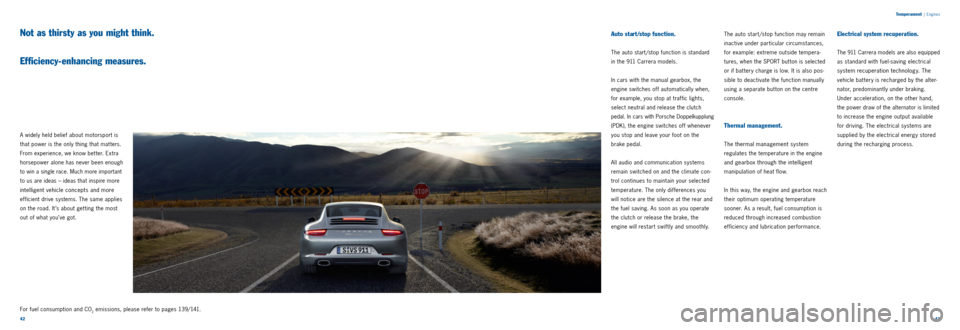
Not as thirsty as you might think.
Efficiency- enhancing measures.
For fuel consumption and CO2 emissions, please refer to pages 139/141.
Page 21 of 72
4445
DFI delivers fuel directly into the combustion
chamber with millisecond precision. The
spray and cone angles of the multihole
injectors have been optimised for torque,
power output, fuel consumption, emissions
and ef ficient combustion.
With direct injection, the engine manage
ment system regulates injection timing
individually for each cylinder as well as
the injection rate for each cylinder bank.
This improves the combustion process
and fuel economy. operation to the prevailing conditions.
This results in instant acceleration,
extremely smooth running and an
extraordinary level of tractive power,
but with a comparatively low level of
fuel consumption.
For faster heating of the catalytic converters
after a cold start and optimum torque in
the upper load range, up to three injection
pulses take place per combustion cycle.
DFI improves the internal cooling of
the combustion chamber by having the
mixture prepared directly in the cylinder.
This allows for a higher compression
ratio, which helps to deliver more output
at the same time as enhanced engine
efficiency. Injection is regulated by the
electronic engine management system
and emissions are monitored by the
Lambda sensors.
Temperament | Engines
VarioCam Plus System.
VarioCam Plus is a two in one engine
concept for adjusting the intake
camshafts and switching the lift of the
intake valves.
The system first dif ferentiates bet ween
driver inputs that typify normal,
everyday driving and those inputs
that demand maximum performance.
The electronic engine management
system then seamlessly adapts valve
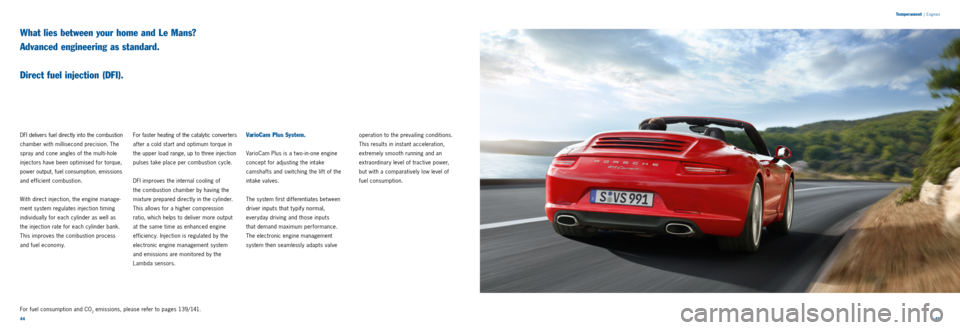
What lies between your home and Le Mans?
Advanced engineering as standard.
Direct fuel injection (DFI).
For fuel consumption and CO2 emissions, please refer to pages 139/141.
Page 22 of 72
4647
Temperament
|
Engines
Integrated dry-sump lubrication.
Integrated dr y sump lubrication ensures
a reliable supply of oil even when a
sport y driving st yle is adopted. It also
has additional cooling functions.
The oil tank is located in the engine,
thereby eliminating the need for an
external oil tank, which saves both space
and weight. To reduce power loss and
increase efficiency, an electronically
controlled oil pump supplies the lubricat
ing points inside the engine as and
when required. When demand is low, the
oil pump is operated at reduced power,
thereby saving fuel.
Air intake system.
The resonance intake system increases
the intake volume by exploiting the fact
that air oscillates as it passes through
the intake manifold. The system can
adjust to engine speed. Benefits of this
include higher torque at low engine
speeds and a flat ter torque curve.
The
9 11 Carrera S models operate a t wo
stage
system.
The entire intake system is made from
light weight plastic. In the 9 11 Carrera
model range, the resonator volume of
the air filter housing varies with engine
speed to bring added character to the
engine sound, which becomes much
more powerful at higher rpm.
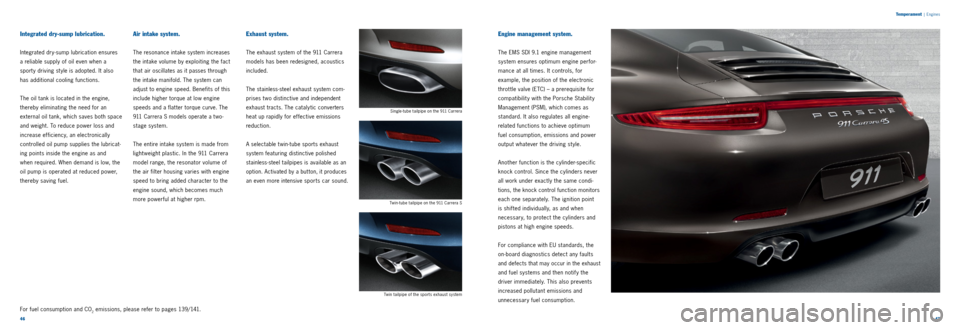
Exhaust system.
The exhaust system of the 911 Carrera
models has been redesigned, acoustics
included.
The stainless steel exhaust system com
prises t wo distinctive and independent
exhaust tracts. The cataly tic converters
heat up rapidly for effective emissions
reduction.
A selectable t win tube sports exhaust
system featuring distinctive polished
stainless steel tailpipes is available as an
option. Activated by a but ton, it produces
an even more intensive sports car sound.
Engine management system.
The EMS SDI 9.1 engine management
system ensures optimum engine perfor
mance at all times. It controls, for
example, the position of the electronic
throt tle valve (ETC) – a prerequisite for
compati bility with the Porsche Stability
Management (PSM), which comes as
standard. It also regulates all engine
related functions to achieve optimum
fuel consumption, emissions and power
output whatever the driving st yle.
Another function is the cylinder specific
knock control. Since the cylinders never
all work under exactly the same condi
tions, the knock control function monitors
each one separately. The ignition point
is shifted individually, as and when
necessary, to protect the cylinders and
pistons at high engine speeds.
For compliance with EU standards, the
on board diagnostics detect any faults
and defects that may occur in the exhaust
and fuel systems and then notify the
driver immediately. This also prevents
increased pollutant emissions and
unnecessary fuel consumption.
Twin tailpipe of the sports exhaust system Single
tube tailpipe on the 911 Carrera
Twin tube tailpipe on the 911 Carrera S
For fuel consumption and CO2 emissions, please refer to pages 139/141.
Page 23 of 72
4849
Temperament
|
Transmission
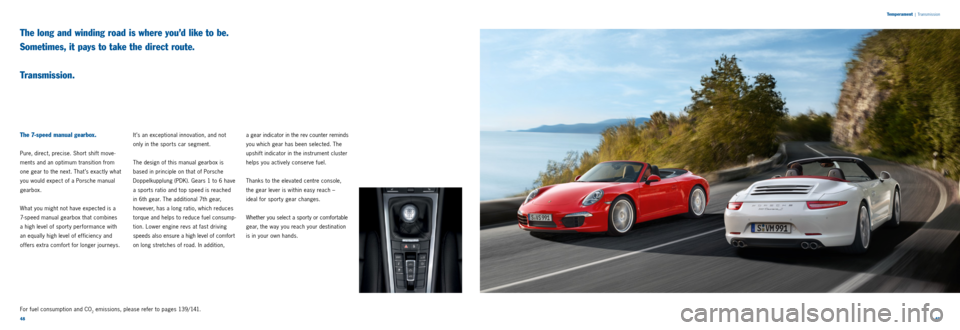
The long and winding road is where you’d like to be.
Sometimes, it pays to take the direct route.
Transmission.
The 7-speed manual gearbox.
Pure, direct, precise. Short shif t move
ments and an optimum transition from
one gear to the next. That ’s exactly what
you would expect of a Porsche manual
gearbox.
What you might not have expected is a
7 speed manual gearbox that combines
a high level of sport y performance with
an equally high level of efficiency and
offers extra comfort for longer journeys. It’s an exceptional innovation, and not
only in the sports car segment.
The design of this manual gearbox is
based in principle on that of Porsche
Doppelkupplung (PDK). Gears 1 to 6 have
a sports ratio and top speed is reached
in 6th gear. The additional 7th gear,
however, has a long ratio, which reduces
torque and helps to reduce fuel consump
tion. Lower engine revs at fast driving
speeds also ensure a high level of com
fort
on long stretches of road. In addition
, a gear indicator in the rev counter reminds
you which gear has been selected. The
upshift indicator in the instrument cluster
helps you actively conserve fuel.
Thanks to the elevated centre console,
the gear lever is within easy reach –
ideal for sport y gear changes.
Whether you select a sporty or comfortable
gear, the way you reach your destination
is in your own hands.
For fuel consumption and CO
2 emissions, please refer to pages 139/141.
Page 24 of 72
462135
7R
5051
Porsche Doppelkupplung (PDK).
Available as an option for all 911 Carrera
models is 7speed PDK, featuring
manual and automatic modes. It facili
tates extremely fast gear changes
with no interruption in the flow of power,
whilst at the same time improving
acceleration and fuel efficiency. In total, PDK has seven gears at its dis
posal. Gears 1 to 6 have a sports ratio
and top speed is reached in 6th gear.
7th gear has a long ratio and helps to
reduce fuel consumption by keeping
engine revs low.
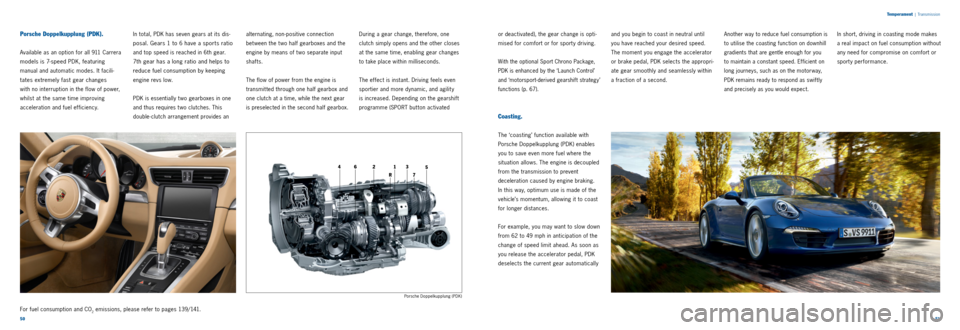
PDK is essentially t wo gearboxes in one
and thus requires t wo clutches. This
double clutch arrangement provides an
Porsche Doppelkupplung (PDK)
alternating, non positive connection
bet ween the t wo half gearboxes and the
engine by means of t wo separate input
shafts.
The flow of power from the engine is
transmit ted through one half gearbox and
one clutch at a time, while the next gear
is preselected in the second half gearbox. During a gear change, therefore, one
clutch simply opens and the other closes
at the same time, enabling gear changes
to take place within milliseconds.The effect is instant. Driving feels even
sportier and more dynamic, and agility
is increased. Depending on the gearshift
programme (SPORT button activated
Temperament | Transmission
or deactivated), the gear change is opti
mised for comfort or for sport y driving.
With the optional Sport Chrono Package,
PDK is enhanced by the ‘Launch Control’
and ‘motorsport derived gearshif t strategy’
functions (p. 67).
Coasting.
The ‘coasting’ function available with
Porsche Doppelkupplung (PDK) enables
you to save even more fuel where the
situation allows. The engine is decoupled
from the transmission to prevent
deceleration caused by engine braking.
In this way, optimum use is made of the
vehicle’s momentum, allowing it to coast
for longer distances.
For example, you may want to slow down
from 62 to 49 mph in anticipation of the
change of speed limit ahead. As soon as
you release the accelerator pedal, PDK
deselects the current gear auto matically and you begin to coast in neutral until
you have reached your desired speed.
The moment you engage the accelerator
or brake pedal, PDK selects the appropri
ate gear smoothly and seamlessly within
a fraction of a second. In short, driving in coasting mode makes
a real impact on fuel consumption without
any need for compromise on comfort or
sporty performance.
Another way to reduce fuel consumption is
to utilise the coasting function on downhill
gradients that are gentle enough for you
to maintain a constant speed. Efficient on
long journeys, such as on the motorway,
PDK remains ready to respond as swiftly
and precisely as you would expect.
For fuel consumption and CO2 emissions, please refer to pages 139/141.
Page 27 of 72

5657
Temperament
| Chassis and body
Engineered design.
The innovative bodyshell of the 911 fulfils
t wo structural design requirements: first,
excellent driving dynamics due to the
body’s extremely high rigidit y; second,
a vehicle weight saving of up to 65 kg
primarily as a result of the intelligent
lightweight construction. To meet the second requirement, we
employed state
of the art techniques for
combining various materials in order
to utilise specific material properties
exactly where they are needed.
For the bodyshell, therefore, we used
very thin, but nevertheless extremely
rigid, sheets of steel. Aluminium and magnesium were used extensively in
areas such as the roof, underbody, front
end, doors, rear wings and engine com
partment and luggage compartment lids.
Magnesium, which is a particularly light
weight material, was also selected for
the cockpit and centre console support
beam and, in the Cabriolet models,
the hood shell elements. Such material efficiency is key to reducing the overall
weight and, as a result, fuel consumption
of the vehicle.
For the driver, this intelligent blend
of materials reduces the weight of the
vehicle and offers a high level of comfort
thanks to excellent vibration damping
characteristics and particularly high com
posite rigidit y, an increase in dynamic
torsional stiffness of up to 25 % compared
with that of the previous model, and
even
sportier handling despite a further
improvement in the weight to power ratio.
The longer wheelbase improves comfort
as well as straight line accuracy and
driving stabilit y at high speeds and in
fast corners.
Front and rear axles.
The independent suspension at the front
features a light weight spring strut axle
with longitudinal and transverse links and
cross members that have been refined
for stiffness. Each front wheel is precisely
located, ensuring excellent directional stability, superior handling and reduced
pitching under braking, and the wide
track optimises turn
in.
The rear axle is equipped with a
motorsport derived multi link suspension
and chassis subframe. Refined axle
kinematics for improved longitudinal
damping reduce acceleration squat and increase comfort. Light weight spring
struts further enhance agilit y.
The high proportion of aluminium used in
the construction of the axles reduces the
weight of the vehicle and of the unsprung masses, helping to improve fuel economy,
comfort and agility.
Rear axle of the 911 Carrera S
Front axle of the 911 Carrera S
Aluminium
Deep
drawn steels
Multiphase steels
Super high strength micro alloyed steels
Boron alloyed steels
Page 34 of 72

7071
Wheels.
The 911 Carrera models are equipped
with 19inch Carrera wheels as standard.
These are light weight alloys featuring a
classic sport y design. Tyre sizes are
235/40 ZR 19 and 285/35 ZR 19 at the
front and rear, respectively. All wheel
drive models are fit ted with even wider
295/35 ZR 19 t yres at the rear. The S models are equipped with light
alloy 20inch Carrera S wheels as
standard. The visual effect is sport y and
dynamic. The t yres are slightly wider
to cope with the increased power output
of these models: 245/35 ZR 20 at the
front, 295/30 ZR 20 at the rear. All wheel
drive models have 305/30 ZR 20 t yres
at the rear.
The large t yre size improves both ride
comfort and track performance. Rolling
resistance, dry braking distances and t yre
weight are all comparatively low, thereby
helping to reduce fuel consumption.
A selection of 20 inch wheels is available
in our range of options.Tyre Pressure Monitoring (TPM).
Tyre Pressure Monitoring (TPM) is avail
able on request. This safet y system sends
warnings to the on board computer’s
display screen in the event of low t yre
pressure or a gradual or sudden loss
of pressure. The individual pressures
in all four t yres can be displayed in the
instrument cluster.
Porsche Stability Management (PSM).
As standard, the 911 Carrera models are
equipped with enhanced Porsche Stability
Management (PSM), which maintains sta
bilit y even at the limits of dynamic driving
performance. Sensors continuously moni
tor the direction, speed, yaw velocit y and
lateral acceleration of the car. Using this
information, PSM is able to calculate the actual direction of travel at any given
moment. If the car begins to oversteer or
understeer, PSM applies selective braking
on individual wheels to restore stabilit y.
Under acceleration on wet or low grip
road surfaces, PSM improves traction
using the automatic brake differential
(ABD) and anti slip regulation (ASR).
When the SPORT PLUS mode of the
optional Sport Chrono Package is selected,
the PSM threshold is raised to allow a
sportier driving st yle.
For an even more dynamic experience,
you always have the option to deactivate
PSM. It is automatically reactivated,
for your safet y, only if you brake harder
and either of the front wheels (in SPORT
PLUS mode, both of the front wheels) requires ABS assistance. ABS and ABD,
however, remain active at all times.
PSM therefore offers a high level of
driving stability and safety combined
with extraordinary agilit y. It ’s an
apparent contradiction in terms, but an
intrinsic part of the Porsche identit y.
19 inch Carrera wheel (standard on the 911 Carrera
models)
20inch Carrera S wheel (standard on the 911 S models)911 Carrera 4 Cabriolet with 20 inch Carrera Classic wheels
Temperament | Chassis and body
For fuel consumption and CO2 emissions, please refer to pages 139/141.
Page 38 of 72

7879
From the start, Porsche has been
synonymous with motorsport. Ever since
1948, when we found our identit y on
the racetrack, we have taken the experi
ence we have gained and applied it to
the road. The optional Porsche Ceramic
Composite Brake (PCCB) is a fine example.
This brake system has already had to
cope with the harshest requirements of
Composure | Safet y
motor racing and is fit ted in cars that
compete in demanding events such as
the Porsche Mobil 1 Supercup.
The cross drilled PCCB ceramic brake
discs for the 911 Carrera have a diame
ter of 350 mm front and rear for even
more formidable braking performance. What we’ve discovered from over 30,000 racing victories:
Brake later, finish sooner.
Porsche Ceramic Composite Brake (PCCB).The use of six piston aluminium monobloc
brake calipers on the front axle and four
piston units at the rear – all finished in
yellow – ensures extremely high brake
forces which, crucially, are exceptionally
consistent.
PCCB enables shorter braking distances
in even the toughest road and race
conditions. Excellent fade resistance
ensures greater balance when slowing
from racetrack speeds.
The key advantage of PCCB is the
extremely low weight of the ceramic
brake discs, which are approximately
50 % lighter than standard discs of similar
design and size. As well as enhancing performance and fuel economy, this
represents a major reduction in unsprung
and rotating masses. The consequence
of this is bet ter road holding and
increased comfort, particularly on uneven
roads, as well as greater agilit y and
improved handling.
Please note that circuit racing, track
day use and other forms of performance
driving can significantly reduce the
service life of even the most durable
brake pads and discs.
As with conventional high performance
braking systems, we recommend that
all brake components be professionally
inspected and replaced where necessary
after every track event.
For fuel consumption and CO
2 emissions, please refer to pages 139/141.