ESP PORSCHE 911 CARRERA 2011 6.G Information Manual
[x] Cancel search | Manufacturer: PORSCHE, Model Year: 2011, Model line: 911 CARRERA, Model: PORSCHE 911 CARRERA 2011 6.GPages: 72, PDF Size: 13.67 MB
Page 2 of 72
Strength 6
Exterior design 12
Interior design 16
Engineering 18
The 911 Carrera models 20
Temperament 36
Engines 38
Tra n s m i ssi o n 4 8
Chassis and body 54
Composure 74
Safet y 76
Comfort 84
Responsibility 106
Motorsport 108
Environment 114
Personality 118
Personalisation 120
Panorama 134
9 11 i d e n t i t y 1 3 6
Technical data 138
Index 142
Page 4 of 72

89 10
Many legends look to the past.
This one looks to the future.
T h e 9 11 .
It ’s time to look forward. Because,
traditionally, the 911 has always had
an eye to the future.
Our own engineering tradition is evident
from the ‘Dr. Ing.’ in our company name.
Also from our racing victories, now total
ling more than 30,000. Not just feats
of heroism any longer, but responsibilit y
for the future of the sports car and for
the environment. Then there is the 911’s
reputation as an iconic sports car. How
ever, this reputation means nothing
unless we continue to breathe new life
into old ideas.
For us, heritage and future are inseparably
linked. Of course, we could simply
have made a capable sports car, but this
wouldn’t have been a Porsche, and
certainly not a 911.
Our identit y is the 911. This is especially
true, even in the 21st century. Instantly
recognisable and originally engineered
for the racetrack, it continues to stir the
emotions today, just as it did in 1963.
Yet, is that enough to move forward?
Above all, is it enough for you? Don’t we
need to break the stranglehold of tradi
tion once in a while before it one day
stifles innovation altogether? We believe that the answer is ‘yes’, which is why
almost every component in the latest
generation 911 is new. This is our approach to the preservation of tradition.
It is precisely how we respond to the
passion for the sports car and do justice
to the 911 legend, and always with
tomorrow in mind.
We have achieved this with a future
oriented design and a longer wheelbase,
with refined engines that consume less
fuel but deliver more power, with efficiency
enhancing technologies such as auto
start/stop, thermal management and
electrical system recuperation, with an
intelligent light weight body and a new hood concept on the Cabriolet models,
with the further enhanced Porsche Traction
Management (PTM) active all wheel drive,
and an interior that combines sophisticated
ergonomics and
sporty comfort.
All of that is what defines us. In short, it
is the way in which we combine tradition
and innovation, performance and everyday
practicality, form and function. For us,
these are not contradictions, but our moti
vation. We are referring to Intelligent
Performance.
Our identit y can be accurately described
by many words, and by one number.
The 911. Porsche identit y. Identit y is a combination of disposition,
personalit y and heritage. In our at tempt to
understand it, we tend to compare
differences.
This is equally true in the case of the
911 Carrera models. With defining
at tributes such as performance, efficiency,
st yle and comfort, they reveal a character
of their own and fulfil your individual
expectations – not just of any sports car,
but of a 911.
For fuel consumption and CO
2 emissions, please refer to pages 139/141.
Strength | The 911
Page 6 of 72
Front C4 Heck C4
1415
S
treng th
| Exterior design
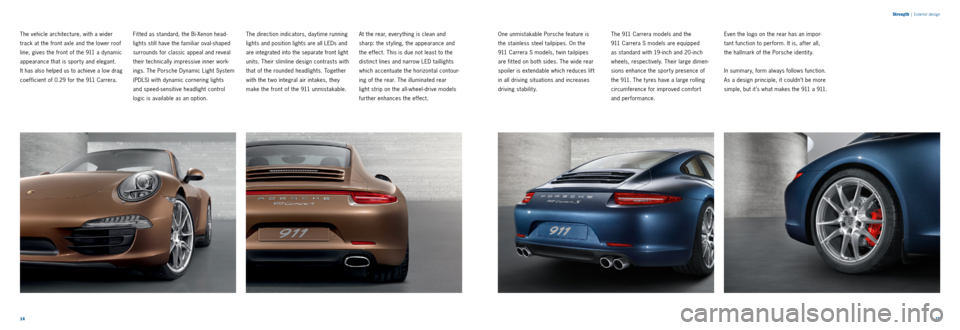
The vehicle architecture, with a wider
track at the front axle and the lower roof
line, gives the front of the 911 a dynamic
appearance that is sport y and elegant.
It has also helped us to achieve a low drag
coefficient of 0.29 for the 911 Carrera. Fit ted as standard, the Bi
Xenon head
lights still have the familiar oval shaped
surrounds for classic appeal and reveal
their technically impressive inner work
ings. The Porsche Dynamic Light System
(PDLS) with dynamic cornering lights
and speed sensitive headlight control
logic is available as an option. The direction indicators, daytime running
lights and position lights are all LEDs and
are integrated into the separate front light
units. Their slimline design contrasts with
that of the rounded headlights. Together
with the two integral air intakes, they
make the front of the 911 unmistakable. At the rear, every thing is clean and
sharp: the styling, the appearance and
the effect. This is due not least to the
distinct lines and narrow LED taillights
which accentuate the horizontal contour
ing of the rear. The illuminated rear
light strip on the all wheel drive models
further enhances the effect. One unmistakable Porsche feature is
the stainless steel tailpipes. On the
911 Carrera S models, t win tailpipes
are fit ted on both sides. The wide rear
spoiler is extendable which reduces lift
in all driving situations and increases
driving stability. The 911 Carrera models and the
911 Carrera S models are equipped
as standard with 19 inch and 20 inch
wheels, respectively. Their large dimen
sions enhance the sport y presence of
the 911. The t yres have a large rolling
circumference for improved comfort
and performance. Even the logo on the rear has an impor
tant function to perform. It is, after all,
the hallmark of the Porsche identity.
In summary, form always follows function.
As a design principle, it couldn’t be more
simple, but it ’s what makes the 9 11 a 9 11.
Page 7 of 72
1617
Strength
|
Interior design
Sporty ergonomics for ordinary driving.
Extraordinary comfort for sporty driving.
Interior design.
At Porsche, we don’t build everyday
sports cars, we build sports cars for
everyday use. How? By understanding
that great agilit y and maximum comfort
are not mutually exclusive but are, in
fact, aspects of a harmonious overall
concept.
This is especially true of the interior of
the 911. Sportiness, functionality and
high quality materials combine to form a
cohesive whole that is conducive to
dynamic driving, even during everyday
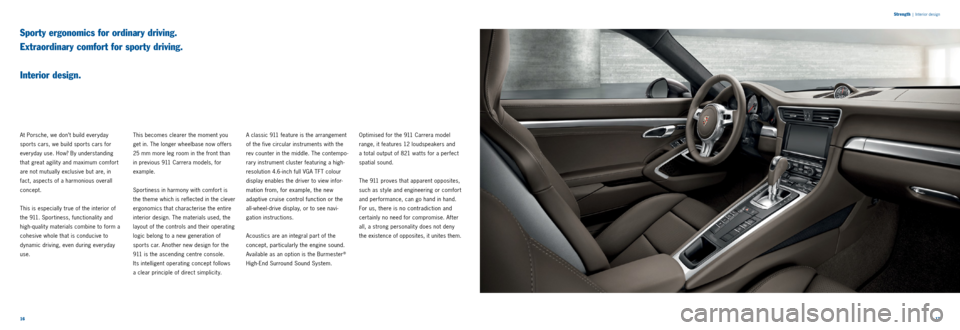
use. This becomes clearer the moment you
get in. The longer wheelbase
now of fers
25 mm more leg room in the front than
in previous 911 Carrera models, for
example.
Sportiness in harmony with comfort is
the theme which is reflected in the clever
ergonomics that characterise the entire
interior design. The materials used, the
layout of the controls and their operating
logic belong to a new generation of
sports car. Another new design for the
911 is the ascending centre console.
Its intelligent operating concept follows
a clear principle of direct simplicity. A classic 911 feature is the arrangement
of the five circular instruments with the
rev counter in the middle. The contempo
rary instrument cluster featuring a high
resolution 4.6 inch full VGA TFT colour
display enables the driver to view infor
mation from, for example, the new
adaptive cruise control function or the
all wheel drive display, or to see navi
gation instructions.
Acoustics are an integral part of the
concept, particularly the engine sound.
Available as an option is the Burmester
®
High End Surround Sound System. Optimised for the 911 Carrera model
range, it features 12 loudspeakers and
a total output of 821 wat ts for a perfect
spatial sound.
The 911 proves that apparent opposites,
such as st yle and engineering or comfort
and performance, can go hand in hand.
For us, there is no contradiction and
certainly no need for compromise. After
all, a strong personalit y does not deny
the existence of opposites, it unites them.
Page 9 of 72
2021
Strength
| The 911 Carrera
Meetings, conferences, business lunches.
How about some leisure in between?
The 911 Carrera.
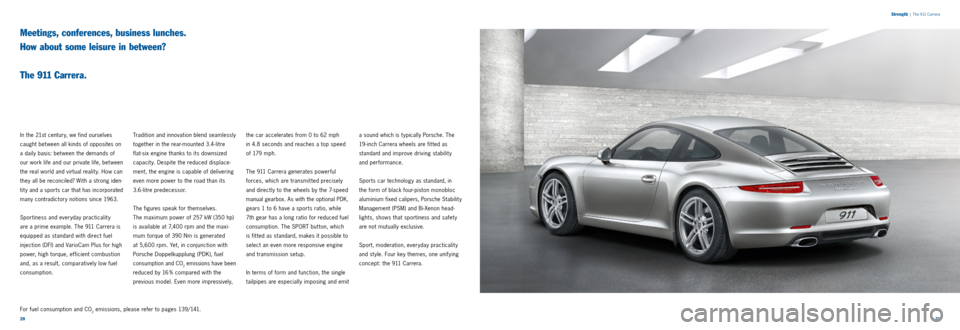
In the 21st century, we find ourselves
caught bet ween all kinds of opposites on
a daily basis: bet ween the demands of
our work life and our private life, between
the real world and virtual realit y. How can
they all be reconciled? With a strong iden
tit y and a sports car that has incorporated
many contradictory notions since 1963.
Sportiness and everyday practicality
are a prime example. The 911 Carrera is
equipped as standard with direct fuel
injection (DFI) and VarioCam Plus for high
power, high torque, efficient combustion
and, as a result, comparatively low fuel
consumption. Tradition and innovation blend seamlessly
together in the rear
mounted 3.4 litre
flat six engine thanks to its downsized
capacity. Despite the reduced displace
ment, the engine is capable of delivering
even more power to the road than its
3.6 litre predecessor.
The figures speak for themselves.
The maximum power of 257 kW (350 hp)
is available at 7,400 rpm and the maxi
mum torque of 390 Nm is generated
at 5,600 rpm. Yet, in conjunction with
Porsche Doppelkupplung (PDK), fuel
consumption and CO2 emissions have been
reduced by 16 % compared with the
previous model. Even more impres
sively,
the car accelerates from 0 to 62 mph
in 4.8 seconds and reaches a top speed
of 179 mph.
The 911 Carrera generates powerful
forces, which are transmit ted precisely
and directly to the wheels by the 7 speed
manual gearbox. As with the optional PDK,
gears 1 to 6 have a sports ratio, while
7th gear has a long ratio for reduced fuel
consumption. The SPORT but ton, which
is fit ted as standard, makes it possible to
select an even more responsive engine
and transmission setup.
In terms of form and function, the single
tailpipes are especially imposing and emit a sound which is t ypically Porsche. The
19
inch Carrera wheels are fit ted as
standard and improve driving stability
and performance.
Sports car technology as standard, in
the form of black four piston monobloc
aluminium fixed calipers, Porsche Stability
Management (PSM) and Bi Xenon head
lights, shows that sportiness and safety
are not mutually exclusive.
Sport, moderation, everyday practicality
and st yle. Four key themes, one unifying
concept: the 911 Carrera.
For fuel consumption and CO
2 emissions, please refer to pages 139/141.
Page 12 of 72
2627
Strength
| The 911 Carrera S Cabriolet
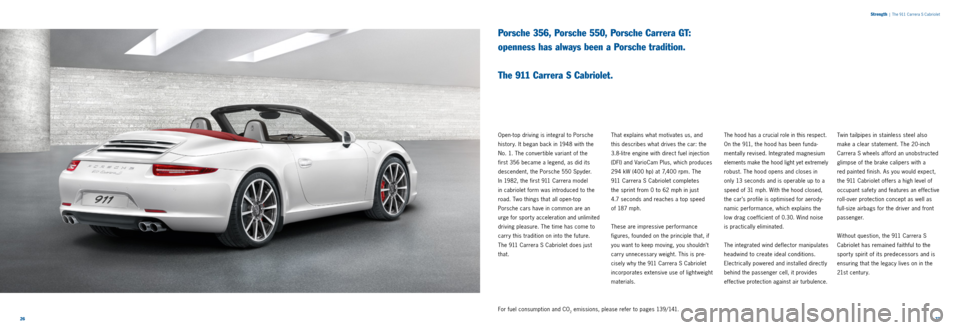
Porsche 356, Porsche 550, Porsche Carrera GT:
openness has always been a Porsche tradition.
The 911 Carrera S Cabriolet.
Open top driving is integral to Porsche
history. It began back in 1948 with the
No. 1. The convertible variant of the
first 356 became a legend, as did its
descendent, the Porsche 550 Spyder.
In 1982, the first 911 Carrera model
in cabriolet form was introduced to the
road. Two things that all open top
Porsche cars have in common are an
urge for sport y acceleration and unlimited
driving pleasure. The time has come to
carry this tradition on into the future.
The 911 Carrera S Cabriolet does just
that. That explains what motivates us, and
this describes what drives the car: the
3.8 litre engine with direct fuel injection
(DFI) and VarioCam Plus, which produces
294 kW (400 hp) at 7,400 rpm. The
911 Carrera S Cabriolet completes
the sprint from 0 to 62 mph in just
4.7 seconds and reaches a top speed
of 187 mph.
These are impressive performance
figures, founded on the principle that, if
you want to keep moving, you shouldn’t
carry unnecessary weight. This is pre
cisely why the 911 Carrera S Cabriolet
incorporates extensive use of lightweight
materials.
The hood has a crucial role in this respect.
On the 911, the hood has been funda
mentally revised. Integrated magnesium
elements make the hood light yet extremely
robust. The hood opens and closes in
only 13 seconds and is operable up to a
speed of 31 mph. With the hood closed,
the car’s profile is optimised for aerody
namic performance, which explains the
low drag coefficient of 0.30. Wind noise
is practically eliminated.
The integrated wind deflector manipulates
headwind to create ideal conditions.
Electrically powered and installed directly
behind the passenger cell, it provides
effective protection against air turbulence.
Twin tailpipes in stainless steel also
make a clear statement. The 20 inch
Carrera S wheels afford an unobstructed
glimpse of the brake calipers with a
red painted finish. As you would expect,
the 911 Cabriolet offers a high level of
occupant safet y and features an effective
roll over protection concept as well as
full size airbags for the driver and front
p a s s e n g e r.
Without question, the 911 Carrera S
Cabriolet has remained faithful to the
sporty spirit of its predecessors and is
ensuring that the legacy lives on in the
21s t ce n t u r y.
For fuel consumption and CO
2 emissions, please refer to pages 139/141.
Page 13 of 72
2829
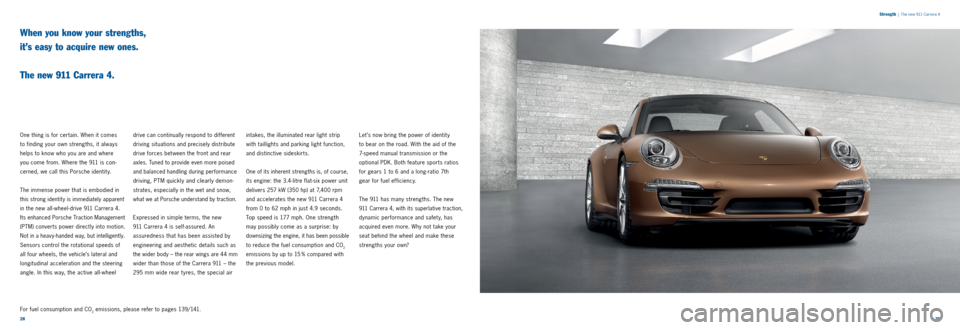
When you know your strengths,
it’s easy to acquire new ones.
The new 911 Carrera 4.
One thing is for certain. When it comes
to finding your own strengths, it always
helps to know who you are and where
you come from. Where the 911 is con
cerned, we call this Porsche identit y.
The immense power that is embodied in
this strong identit y is immediately apparent
in the new all wheel drive 911 Carrera 4.
Its enhanced Porsche Traction Management
(PTM) converts power directly into motion.
Not in a heav y handed way, but intelligently.
Sensors control the rotational speeds of
all four wheels, the vehicle’s lateral and
longitudinal acceleration and the steering
angle. In this way, the active all wheel drive can continually respond to different
driving situations and precisely distribute
drive forces bet ween the front and rear
axles. Tuned to provide even more poised
and balanced handling during performance
driving, PTM quickly and clearly
demon
strates, especially in the wet and snow,
what we at Porsche understand by traction.
Expressed in simple terms, the new
911 Carrera 4 is self assured. An
assuredness that has been assisted by
engineering and aesthetic details such as
the wider body – the rear wings are 44 mm
wider than those of the Carrera 911 – the
295 mm wide rear t yres, the special air intakes, the illuminated rear light strip
with taillights and parking light function,
and distinctive sideskirts.
One of its inherent strengths is, of course,
its engine: the 3.4 litre flat six power unit
delivers 257 kW (350 hp) at 7,400 rpm
and accelerates the new 911 Carrera 4
from 0 to 62 mph in just 4.9 seconds.
Top speed is 177 mph. One strength
may possibly come as a surprise: by
downsizing the engine, it has been possible
to reduce the fuel consumption and CO
2
emissions by up to 15 % compared with
the previous model.
For fuel consumption and CO
2 emissions, please refer to pages 139/141.
Strength | The new 911 Carrera 4
Let ’s now bring the power of identit y
to bear on the road. With the aid of the
7 speed manual transmission or the
optional PDK. Both feature sports ratios
for gears 1 to 6 and a long ratio 7th
gear for fuel efficiency.
The 911 has many strengths. The new
911 Carrera 4, with its superlative traction,
dynamic performance and safet y, has
acquired even more. Why not take your
seat behind the wheel and make these
strengths your own?
Page 14 of 72
3031
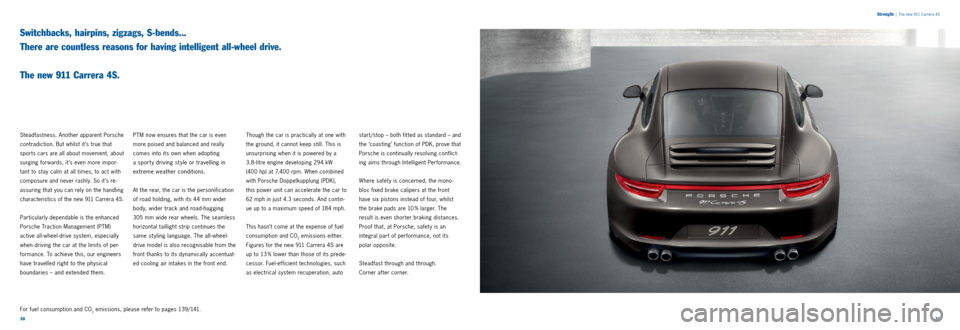
Switchbacks, hairpins, zigzags, S-bends...
There are countless reasons for having intelligent all-wheel drive.
The new 911 Carrera 4S.
Steadfastness. Another apparent Porsche
contradiction. But whilst it ’s true that
sports cars are all about movement, about
surging forwards, it ’s even more impor
tant to stay calm at all times, to act with
composure and never rashly. So it ’s re
assuring that you can rely on the handling
characteristics of the new 911 Carrera 4S.
Particularly dependable is the enhanced
Porsche Traction Management (PTM)
active allwheeldrive system, especially
when driving the car at the limits of per
formance. To achieve this, our engineers
have travelled right to the physical
boundaries – and extended them.
PTM now ensures that the car is even
more poised and balanced and really
comes into its own when adopting
a sport y driving st yle or travelling in
extreme weather conditions.
At the rear, the car is the personification
of road holding, with its 44 mm wider
body, wider track and roadhugging
305 mm wide rear wheels. The seamless
horizontal taillight strip continues the
same st yling language. The allwheel
drive model is also recognisable from the
front thanks to its dynamically accentuat
ed cooling air intakes in the front end. Though the car is practically at one with
the ground, it cannot keep still. This is
unsurprising when it is powered by a
3.8litre engine developing 294 kW
(400 hp) at 7,400 rpm. When combined
with Porsche Doppelkupplung (PDK),
this power unit can accelerate the car to
62 mph in just 4.3 seconds. And contin
ue up to a maximum speed of 184 mph.
This hasn’t come at the expense of fuel
consumption and CO
2 emissions either.
Figures for the new 911 Carrera 4S are
up to 13 % lower than those of its prede
cessor. Fuelefficient technologies, such
as electrical system recuperation, auto
start /stop – both fit ted as standard – and
the ‘coasting’ function of PDK, prove that
Porsche is continually resolving conflict
ing aims through Intelligent Performance.
Where safety is concerned, the mono
bloc fixed brake calipers at the front
have six pistons instead of four, whilst
the brake pads are 10 % larger. The
result is even shorter braking distances.
Proof that, at Porsche, safet y is an
integral part of performance, not its
polar opposite.
Steadfast through and through.
Corner after corner.
For fuel consumption and CO
2 emissions, please refer to pages 139/141.
Strength | The new 911 Carrera 4S
Page 18 of 72
3839
Temperament
|
Engines
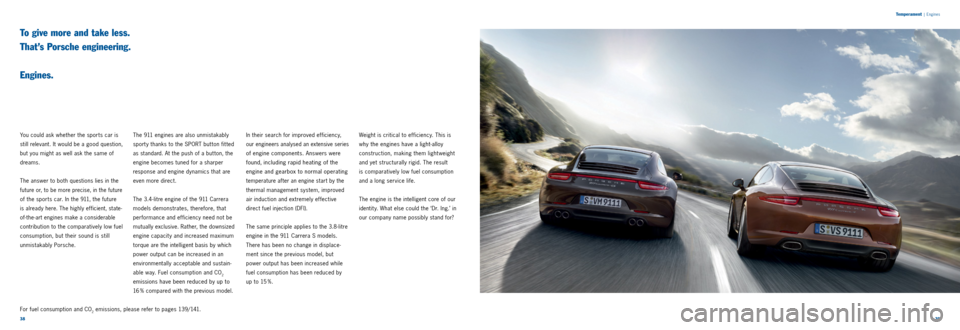
To give more and take less.
That’s Porsche engineering.
Engines.
You could ask whether the sports car is
still relevant. It would be a good question,
but you might as well ask the same of
dreams.
The answer to both questions lies in the
future or, to be more precise, in the future
of the sports car. In the 911, the future
is already here. The highly efficient, state
ofthe art engines make a considerable
contribution to the comparatively low fuel
consumption, but their sound is still
unmistakably Porsche. The 911 engines are also unmistakably
sport y thanks to the SPORT but ton fit ted
as standard. At the push of a but ton, the
engine becomes tuned for a sharper
response and engine dynamics that are
even more direct.
The 3.4
litre engine of the 911 Carrera
models demonstrates, therefore, that
performance and efficiency need not be
mutually exclusive. Rather, the downsized
engine capacity and increased maximum
torque are the intelli
gent basis by which
power output can be increased in an
environmentally acceptable and sustain
able way. Fuel consumption and CO
2
emissions have been reduced by up to
16 % compared with the previous model. In their search for improved efficiency,
our engineers analysed an extensive series
of engine components. Answers were
found, including rapid heating of the
engine and gearbox to normal operating
temperature after an engine start by the
thermal management system, improved
air induction and extremely effective
direct fuel injection (DFI).
The same principle applies to the 3.8 litre
engine in the 911 Carrera S models.
There has been no change in displace
ment since the previous model, but
power output has been increased while
fuel consumption has been reduced by
up to 15 %. Weight is critical to efficiency. This is
why the engines have a lightalloy
construction, making them lightweight
and yet structurally rigid. The result
is comparatively low fuel consumption
and a long service life.
The engine is the intelligent core of our
identit y. What else could the ‘Dr. Ing.’ in
our company name possibly stand for?
For fuel consumption and CO
2 emissions, please refer to pages 139/141.
Page 24 of 72
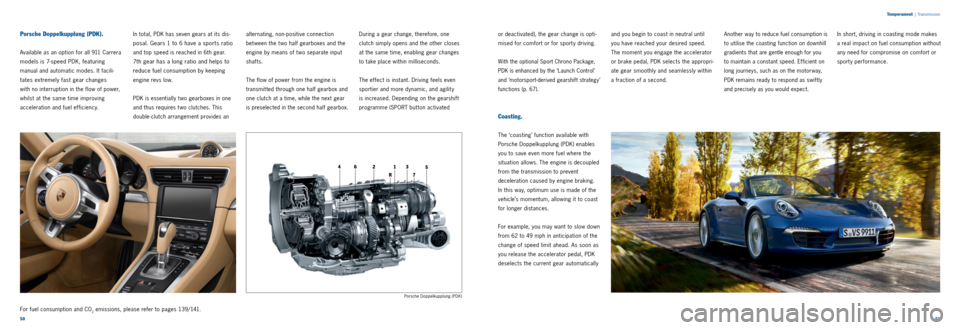
462135
7R
5051
Porsche Doppelkupplung (PDK).
Available as an option for all 911 Carrera
models is 7speed PDK, featuring
manual and automatic modes. It facili
tates extremely fast gear changes
with no interruption in the flow of power,
whilst at the same time improving
acceleration and fuel efficiency. In total, PDK has seven gears at its dis
posal. Gears 1 to 6 have a sports ratio
and top speed is reached in 6th gear.
7th gear has a long ratio and helps to
reduce fuel consumption by keeping
engine revs low.
PDK is essentially t wo gearboxes in one
and thus requires t wo clutches. This
double clutch arrangement provides an
Porsche Doppelkupplung (PDK)
alternating, non positive connection
bet ween the t wo half gearboxes and the
engine by means of t wo separate input
shafts.
The flow of power from the engine is
transmit ted through one half gearbox and
one clutch at a time, while the next gear
is preselected in the second half gearbox. During a gear change, therefore, one
clutch simply opens and the other closes
at the same time, enabling gear changes
to take place within milliseconds.The effect is instant. Driving feels even
sportier and more dynamic, and agility
is increased. Depending on the gearshift
programme (SPORT button activated
Temperament | Transmission
or deactivated), the gear change is opti
mised for comfort or for sport y driving.
With the optional Sport Chrono Package,
PDK is enhanced by the ‘Launch Control’
and ‘motorsport derived gearshif t strategy’
functions (p. 67).
Coasting.
The ‘coasting’ function available with
Porsche Doppelkupplung (PDK) enables
you to save even more fuel where the
situation allows. The engine is decoupled
from the transmission to prevent
deceleration caused by engine braking.
In this way, optimum use is made of the
vehicle’s momentum, allowing it to coast
for longer distances.
For example, you may want to slow down
from 62 to 49 mph in anticipation of the
change of speed limit ahead. As soon as
you release the accelerator pedal, PDK
deselects the current gear auto matically and you begin to coast in neutral until
you have reached your desired speed.
The moment you engage the accelerator
or brake pedal, PDK selects the appropri
ate gear smoothly and seamlessly within
a fraction of a second. In short, driving in coasting mode makes
a real impact on fuel consumption without
any need for compromise on comfort or
sporty performance.
Another way to reduce fuel consumption is
to utilise the coasting function on downhill
gradients that are gentle enough for you
to maintain a constant speed. Efficient on
long journeys, such as on the motorway,
PDK remains ready to respond as swiftly
and precisely as you would expect.
For fuel consumption and CO2 emissions, please refer to pages 139/141.