clutch PORSCHE 911 CARRERA 2011 6.G Information Manual
[x] Cancel search | Manufacturer: PORSCHE, Model Year: 2011, Model line: 911 CARRERA, Model: PORSCHE 911 CARRERA 2011 6.GPages: 72, PDF Size: 13.67 MB
Page 20 of 72
4243
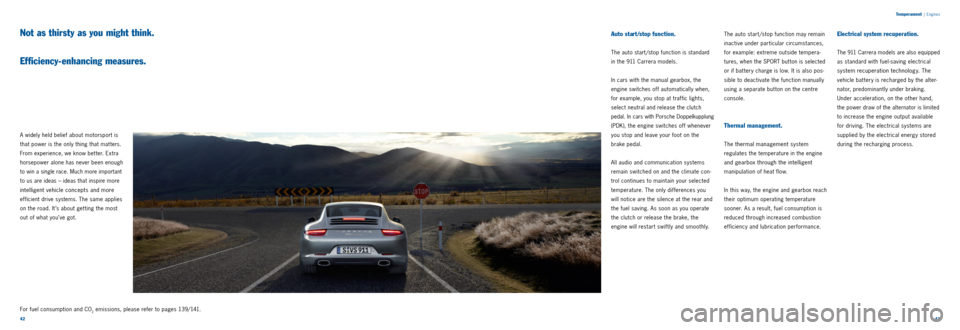
A widely held belief about motorsport is
that power is the only thing that mat ters.
From experience, we know bet ter. Extra
horsepower alone has never been enough
to win a single race. Much more important
to us are ideas – ideas that inspire more
intelligent vehicle concepts and more
ef ficient drive systems. The same applies
on the road. It ’s about get ting the most
out of what you’ve got.
Auto start/stop function.
The auto start/stop function is standard
in the 911 Carrera models.
In cars with the manual gearbox, the
engine switches off automatically when,
for example, you stop at traffic lights,
select neutral and release the clutch
pedal. In cars with Porsche Doppelkupplung
(PDK), the engine switches off whenever
you stop and leave your foot on the
brake pedal.
All audio and communication systems
remain switched on and the climate con
trol continues to maintain your selected
temperature. The only differences you
will notice are the silence at the rear and
the fuel saving. As soon as you operate
the clutch or release the brake, the
engine will restart swiftly and smoothly. The auto start/stop function may remain
inactive under particular circumstances,
for example: extreme outside tempera
tures, when the SPORT but ton is selected
or if bat tery charge is low. It is also pos
sible to deactivate the function manually
using a separate but ton on the centre
console.
Thermal management.
The thermal management system
regulates the temperature in the engine
and gearbox through the intelligent
manipulation of heat flow.
In this way, the engine and gearbox reach
their optimum operating temperature
sooner. As a result, fuel consumption is
reduced through increased combustion
efficiency and lubrication performance.
Electrical system recuperation.
The 911 Carrera models are also equipped
as standard with fuel saving electrical
system recuperation technology. The
vehicle bat tery is recharged by the alter
nator, predominantly under braking.
Under acceleration, on the other hand,
the power draw of the alternator is limited
to increase the engine output available
for driving. The electrical systems are
supplied by the electrical energy stored
during the recharging process.
Temperament | Engines
Not as thirsty as you might think.
Efficiency- enhancing measures.
For fuel consumption and CO2 emissions, please refer to pages 139/141.
Page 24 of 72
462135
7R
5051
Porsche Doppelkupplung (PDK).
Available as an option for all 911 Carrera
models is 7speed PDK, featuring
manual and automatic modes. It facili
tates extremely fast gear changes
with no interruption in the flow of power,
whilst at the same time improving
acceleration and fuel efficiency. In total, PDK has seven gears at its dis
posal. Gears 1 to 6 have a sports ratio
and top speed is reached in 6th gear.
7th gear has a long ratio and helps to
reduce fuel consumption by keeping
engine revs low.
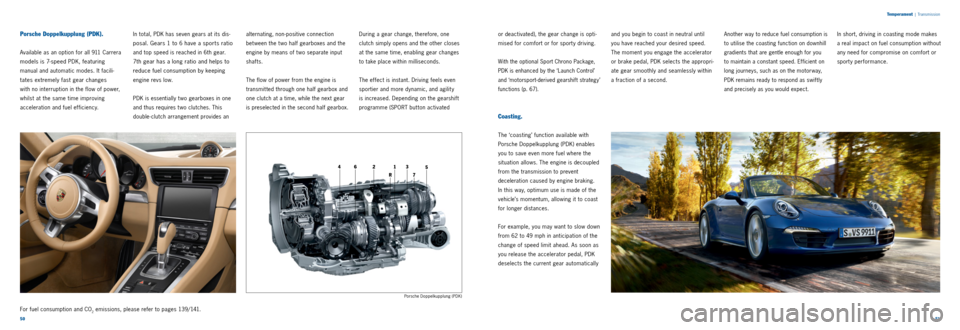
PDK is essentially t wo gearboxes in one
and thus requires t wo clutches. This
double clutch arrangement provides an
Porsche Doppelkupplung (PDK)
alternating, non positive connection
bet ween the t wo half gearboxes and the
engine by means of t wo separate input
shafts.
The flow of power from the engine is
transmit ted through one half gearbox and
one clutch at a time, while the next gear
is preselected in the second half gearbox. During a gear change, therefore, one
clutch simply opens and the other closes
at the same time, enabling gear changes
to take place within milliseconds.The effect is instant. Driving feels even
sportier and more dynamic, and agility
is increased. Depending on the gearshift
programme (SPORT button activated
Temperament | Transmission
or deactivated), the gear change is opti
mised for comfort or for sport y driving.
With the optional Sport Chrono Package,
PDK is enhanced by the ‘Launch Control’
and ‘motorsport derived gearshif t strategy’
functions (p. 67).
Coasting.
The ‘coasting’ function available with
Porsche Doppelkupplung (PDK) enables
you to save even more fuel where the
situation allows. The engine is decoupled
from the transmission to prevent
deceleration caused by engine braking.
In this way, optimum use is made of the
vehicle’s momentum, allowing it to coast
for longer distances.
For example, you may want to slow down
from 62 to 49 mph in anticipation of the
change of speed limit ahead. As soon as
you release the accelerator pedal, PDK
deselects the current gear auto matically and you begin to coast in neutral until
you have reached your desired speed.
The moment you engage the accelerator
or brake pedal, PDK selects the appropri
ate gear smoothly and seamlessly within
a fraction of a second. In short, driving in coasting mode makes
a real impact on fuel consumption without
any need for compromise on comfort or
sporty performance.
Another way to reduce fuel consumption is
to utilise the coasting function on downhill
gradients that are gentle enough for you
to maintain a constant speed. Efficient on
long journeys, such as on the motorway,
PDK remains ready to respond as swiftly
and precisely as you would expect.
For fuel consumption and CO2 emissions, please refer to pages 139/141.
Page 25 of 72

5253
T
emperament
| Transmission
It is possible to have a lot of power and
yet not be able to move any thing. Only
by using your power intelligently will you
truly progress – and with consummate
ease.
Enhanced Porsche Traction Management
(PTM) is standard on all 911 Carrera
all wheel drive models. It is an active all
wheel drive system with an electronically
variable map controlled multi plate clutch,
automatic brake differential (ABD) and
anti slip regulation (ASR). Drive power is distributed bet ween the
permanently driven rear axle and the
front axle by means of the electronically
variable multi
plate clutch.
The status of the vehicle is continuously
monitored so that it is possible to respond
to different driving situations. Sensors
are used to collect a range of data, includ
ing the rotational speed of all four wheels,
the lateral and longitudinal acceleration
of the car and the current steering angle. If, for example, the rear wheels begin
to lose traction under acceleration, a
greater proportion of the drive power
is automatically transmit ted to the front
axle by a more positive engagement of
the multi plate clutch. In addition, ASR
prevents wheel spin by adapting the
engine’s power output. During cornering,
the optimal level of drive power is dis
tributed to the front wheels to ensure
excellent lateral stability.
In conjunction with Porsche Stability
Management (PSM), PTM helps to ensure
the perfect distribution of drive power for
optimum traction in most road scenarios,
whether on long straights, through tight
corners, or on surfaces with different
friction coefficients.
Far better than a power struggle
is power interplay.
Porsche Traction Management (PTM).
Page 53 of 72

108109
Responsibility
|
Motorsport
It’s hard to say what’s been our most emotional moment on the racetrack.
We have more than 60 years’ worth of them.
Motorsport.
To be able to call upon more than 60 years
of experience as you bat tle for every
hundredth of a second out on the track –
that ’s what Porsche Motorsport is all
about. Our driving force is our teams –
all those people, from driver to engineer,
who work tirelessly on racetracks
throug
h
out the world to take us forward.
They have been realising and living one
shared dream for generations: Ferry
Porsche’s dream of a car that could be
both victorious on the track and practical
on the road. And from that dream,
more than 30,000 victories have ensued
to date. Victories achieved, for example, with
the Porsche 956 – one of the most suc
cessful race cars of all time. And with
those
that continue to show that same
potential,
such as the 911 GT3 RSR and
the 911 GT3 Cup.
Both are race cars that have been
successful in circuit races, endurance
races, hill climbs and even in rallies.
As successful, in fact, as the brand as
a whole. To date, Porsche Motorsport
has built more than 3,000 race cars,
over 1,000 of which are still in use today. They enter amateur and top
class racing
events, including the American Le Mans
Series and the one make championships,
of which there are more than 19, the
Porsche Carrera Cup and the Porsche
Mobil 1 Supercup being just t wo. What
ever the race, there are always new
goals in mind. Take, for instance, the
Le Mans 24 Hour race in 2014. That race
will see a prototype, designed complete
ly from scratch, line up at the start, aim
ing to continue the series of 16 overall
victories enjoyed so far at Sarthe. For Porsche, what ’s even more important
than a place on the podium is the experi
ence acquired from racing. And the ideas
and visions that come out of that experi
ence. All knowledge gained on the race
track will get transferred as either design
or test principles to our road cars. Just
like the exhaust gas turbocharger and
double clutch transmission technology
did, for instance. This close relationship
be t ween the racetrack and the road is
unique and allows every Porsche custom
er to participate – directly or indirectly –
in the racing experience. It lets them get
a feel for what drives us. Yesterday, today
and tomorrow: Spirit. Principles. Vision.