warning light PORSCHE 911 GT3 2004 5.G User Guide
[x] Cancel search | Manufacturer: PORSCHE, Model Year: 2004, Model line: 911 GT3, Model: PORSCHE 911 GT3 2004 5.GPages: 195, PDF Size: 16.94 MB
Page 41 of 195
ClutchPedal
The clutch pedalmustbedepressed fully
before thestarter willengage.
A
Warning!
Risk ofan accident.
\>
Always checkthemovement ofthe clutch ped-
al before driving andmake surethatitis not
obstructed byafloor matorany other object.
\>
Secure thefloor mattoprevent itfrom sliding
into positions thatcould interfere withthesafe
operation ofyour vehicle.
Your Porsche dealerwillbeglad tooffer you
floor mats ofthe correct sizeincluding asecur-
ing possibility.
To avoid damage tothe clutch andtransmis-
sion:
\>
Always depress theclutch pedalfullywhen
changing gears.
\>
Donot hold thecar onasteep grade withthe
clutch pedalpartially depressed.
Should thefree travel ofthe clutch pedalsuddenly
become bigger,itcould mean amalfunction ofthe
clutch.
\>
See your Porsche dealerforcorrection.
40
Controls, Instruments
Parking
Brake
Parking brakeforceismechanically transferredto
the rear wheels bymeans ofcables.
\>
Use theparking brakeonlyafter thevehicle
has come toafull stop.
Setting
theparking brake
\>
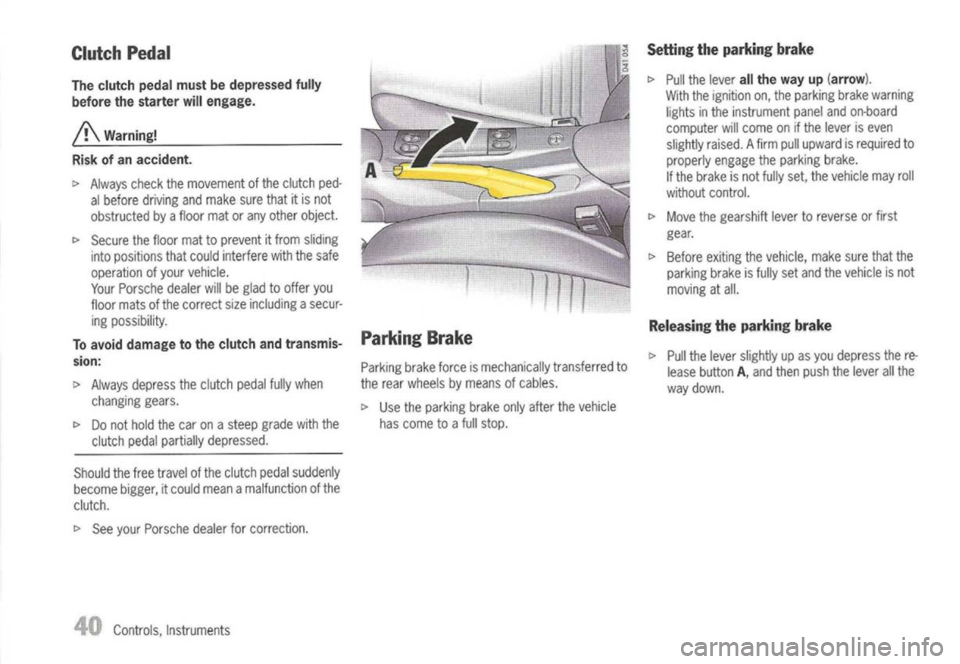
Pull thelever
allthe way up(arrow).
With theignition on,the parking brakewarning
lights inthe instrument panelandon-board
computer willcome onifthe lever iseven
slightly raised.Afirm pullupward isrequired to
properly engagetheparking brake.
If the brake isnot fully set,thevehicle mayroll
without control.
\>
Move thegearshift levertoreverse orfirst
gear.
\>
Before exitingthevehicle, makesurethatthe
parking brakeisfully setand thevehicle isnot
moving atall.
Releasing theparking brake
\>
Pull thelever slightly upasyou depress there-
lease button
A,
and then push thelever allthe
way down.
Page 42 of 195
Parkingbrakewarning lightUSA
Parking brakewarning light
Canada
The warning lightsinthe instrument panelandon-
board computer willgoout after theparking brake
is fully released.
The warning lightsarenotanindicator thatthe
parking brakeisfully set;itis only intended tobe
a warning torelease theparking brakebefore
driving thecar.
A
Caution!
A partially engaged brakewilloverheat the
rear brakes, reducetheireffectiveness and
cause excessive wear.
~ Release theparking brakefully.
t> When parking yourcar,always setthe parking
brake bypulling allthe way uponthe lever.
t>
Move thegearshift levertoreverse orfirst
gear.
t>
Onhills also turnthefront wheels towards the
curb.
Brakes
t>
Please observe thechapter "AERODYNAMIC
COMPONENTS" onPage 9.
t>
Make itahabit tocheck theoperation ofyour
brakes beforedriving.
Keep inmind thatthebraking distance increases
very rapidly asthe speed increases. At60 mph or
100 km/h, forexample, itis not twice butfour
times longer than30mph or50 km/h. Tiretrac-
tion isalso lesseffective whentheroads arewet
or slippery.
t>
Therefore, alwaysmaintain asafe distance
from thecarinfront ofyou.
Vehicles withoutPorsche Ceramic Compos-
ite Brake (PCCB)
Even though thebrake discsconsist ofalloyed
grey castiron,theywillunavoidably starttocor-
rode ifyour carisparked foranextended period.
The brakes willtend to"rub" asthe result.
The nature, extentandeffects ofcorrosion de-
pend onthe amount oftime thevehicle was
parked, whether granular orliquid roadsaltwas
spread andwhether grease.
If the braking comfort isnoticeably impaired,we
recommend havingthebrake system checked by
experts atan authorized Porschedealer.
Brake
system function
Your Porsche isequipped withapower assisted
hydraulic dualcircuit brakesystem withdisc
brakes atthe front andrear.
Both circuits function independently. Onebrake
circuit operates thefront andtheother operates
the rear.
If one brake circuit hasfailed, theother willstill op-
erate. However, youwillnotice anincreased pedal
travel whenyouapply thebrakes.
Failure ofone brake circuit willcause thestopping
distance toincrease.
A
Warning!
Risk ofan accident.
In the unlikely eventofhydraulic failureof
one brake circuit:
t> Push thebrake pedaldownfirmly andhold itin
that position.
A mechanical linkageactivates thesecond cir-
cuit, andyou willbeable tobring thevehicle to
a stop.
t> After bringing yourvehicle toacomplete stop,
avoid driving thevehicle andinstead haveit
towed tothe nearest authorized Porschedeal-
er for repair.
Controls,Instruments
Page 43 of 195
•Brakewarning lightUSA
~ Brakewarning lightCanada
If the warning lightsinthe instrument panelandon-
board computer goonwhile driving, thebrake flu-
id level maybetoo low, or(ifthe brake pedaltrav-
el has increased) oneofthe two brake circuits
may have failed.
A greater braking pressure willberequired, stop-
ping distances willbelonger andthebraking be-
havior willchange, particularly incurves.
With correctly adjustedbrakes,andacorrectly
working brakesystem, thepedal travel tothe
point ofbrake actuation shouldbe1-3/16 in.to
1-9/16 in.or30 to40 mm.
Whenever thebrake pedaltravel exceeds thisdis-
tance, havethebrake system checked.
42
Controls, Instruments
Brake
pedal
A
Warning!
Risk ofan accident.
Any obstruction ofthe brake pedalcould
increase thestopping distance.
~ Always checkthemovement ofthe brake ped-
al before driving andmake surethatitis not
obstructed byafloor matorany other object.
~ Secure thefloor mattoprevent itfrom sliding
into positions thatcould interfere withthesafe
operation ofyour vehicle.
Your Porsche dealerwillbeglad tooffer you
floor mats ofthe correct sizeincluding asecur-
ing possibility.
Note
In case oneofthe two brake circuits fails,in-
creased pedaltravel isrequired tobring your
vehicle toafull stop.
A
Warning!
To avoid overheating andpremature wearof
the brakes:
~ Before descending asteep grade, reduce
speed andshift thetransmission intoalower
gear ordriving position tocontrol speed.
~ Donot "ride thebrakes" byresting yourfooton
the pedal whennotintending toapply brake
pressure.
~ Donot hold thepedal downtoolong ortoo
often.
This could cause thebrakes toget hotand not
function properly.
Page 44 of 195
Brakebooster
The brake booster assistsbraking onlywhen
the engine isrunning.
When thecar ismoving whiletheengine isnot run-
ning, orifthe brake booster isdefective, more
pressure onthe brake pedalisrequired tobring
the car toastop.
Moisture orroad saltonbrakes affects braking.
When thevehicle isdriven onsalted roadsforex-
tended periods, thebrakes shouldbewashed
down thoroughly aboutevery2weeks. Anauto-
matic carwash facilitycannot dothis jobproperly.
Brakes willdry after afew cautious brakeapplica-
tions.
/!\.
Warning!
Driving through watermayreduce thetrac-
tion. Moisture onbrakes fromroadwater, car
wash, orcoating ofroad saltmay affect
braking efficiency.
c>
Cautiously applybrakes totest brakes after
being exposed.
Brake
wear
Your carhas excellent brakes,butthey arestill
subject towear. Therate atwhich theywear de-
pends onhow thebrakes areused.
c>
Have thebrake system inspected atthe
intervals recommended inyour Maintenance
Booklet.
•• Warning lightUSA
• Warning lightCanada
If the warning lightsinthe instrument panelandon-
board computer stayonwhen theengine isrun-
ning orcome onwhile driving, thebrake padsare
worn, excessively.
c>
Donot continue tooperate thevehicle.
Have yourauthorized Porschedealerinspect
or replace thebrake pads.
Brake
pads
Wear onthe brake padsandbrake discsdepends
to agreat extent onthe driving styleandthecon-
ditions ofuse and therefore cannotbeexpressed
in actual milesonthe road.
The high-performance brakesystem isdesigned
for optimal braking effectatall speeds andtem-
peratures.
Certain speeds, brakingforcesandambient
conditions (suchastemperature andhumidity)
therefore mightcause "brake noises".
New brake padsorlinings
New brake padsandbrake discshavetobe "bro-
ken i",and therefore onlyattain optimal friction
when thecar has covered severalhundred miles
or km.
The slightly reduced brakingabilitymustbecom-
pensated forbypressing thebrake pedalharder.
This alsoapplies whenever thebrake padsand
brake discsarereplaced.
Controls, Instruments
43
Page 46 of 195
Operation ofthe ABS system
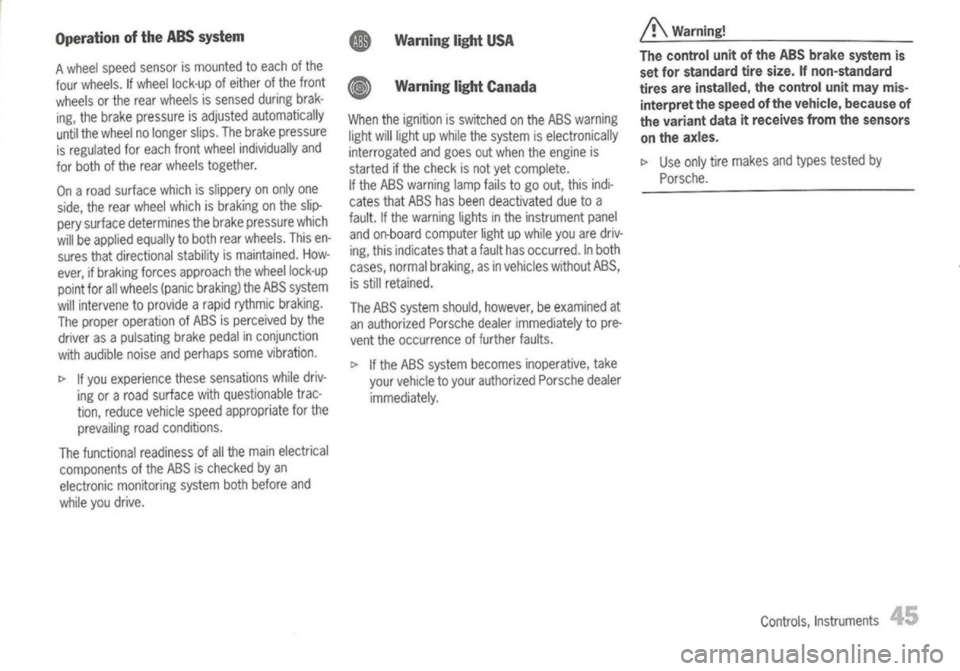
A wheel speed sensor ismounted toeach ofthe
four wheels. Ifwheel lock-up ofeither ofthe front
wheels orthe rear wheels issensed duringbrak-
ing, thebrake pressure isadjusted automatically
until thewheel nolonger slips.Thebrake pressure
is regulated foreach frontwheel individually and
for both ofthe rear wheels together.
On aroad surface whichisslippery ononly one
side, therear wheel whichisbraking onthe slip-
pery surface determines thebrake pressure which
will beapplied equallytoboth rearwheels. Thisen-
sures thatdirectional stabilityismaintained. How-
ever, ifbraking forcesapproach thewheel lock-up
point forallwheels (panicbraking) theABS system
will intervene toprovide arapid rythmic braking.
The proper operation ofABS isperceived bythe
driver asapulsating brakepedalinconjunction
with audible noiseandperhaps somevibration.
I>
Ifyou experience thesesensations whiledriv-
ing oraroad surface withquestionable trac-
tion, reduce vehicle speedappropriate forthe
prevailing roadconditions.
The functional readinessofall the main electrical
components ofthe ABS ischecked byan
electronic monitoring systembothbefore and
while youdrive. •
Warning lightUSA
• Warning lightCanada
When theignition isswitched onthe ABS warning
light willlight upwhile thesystem iselectronically
interrogated andgoes outwhen theengine is
started ifthe check isnot yetcomplete.
If the ABS warning lampfailstogo out, thisindi-
cates thatABS hasbeen deactivated duetoa
fault. Ifthe warning lightsinthe instrument panel
and on-board computer lightupwhile youaredriv-
ing, this indicates thatafault hasoccurred. Inboth
cases, normal braking, asinvehicles withoutABS,
is still retained.
The ABS system should,however, beexamined at
an authorized Porschedealerimmediately topre-
vent theoccurrence offurther faults.
I>
Ifthe ABS system becomes inoperative, take
your vehicle toyour authorized Porschedealer
immediately.
A
Warning!
The control unitofthe ABS brake system is
set forstandard tiresize. Ifnon-standard
tires areinstalled, thecontrol unitmay mis-
interpret thespeed ofthe vehicle, because of
the variant dataitreceives fromthesensors
on the axles.
I>
Use only tiremakes andtypes tested by
Porsche.
Controls,Instruments
Page 52 of 195
Switchposition 1
Ignition ison.
All electrical equipment canbeswitched on.
The warning lightslightupfor alamp check.
Please notethedescription ofthe individual warn-
ing lights.
I>
When turning thekey toposition 1,relieve the
steering lockwith aslight steering movement.
Note
To conserve batterypoweratlow rpm (traffic
jams, towndriving etc.),switch offallelectrical
consumers whicharenotneeded atthat moment.
Switch
position 2
Starting theengine
I>
Turn thekey from position 1to position 2.
The clutch pedalmustbedepressed fully
before thestarter willengage.
The first operation ofthe starter isended automat-
ically when theengine starts.
If the engine doesnotstart, subsequent starter
operations willnotbeended automatically.
If the engine doesnotstart atthe first time or
stalls atany time, thekey must bereturned to
position O.
When theengine isrunning, thewarning lights
should gooff. Ifa light does notgooff, take
appropriate actionasindicated inthis manual.
Switching
engineoff
I>
Turn theignition keyfrom position 1to
position O.
/!\
Warning!
Risk ofan accident.
The steering wheel
willlock
andwillcause
loss ofsteering.
I>
Never remove keyfrom theignition lockorturn
the key offwhile thevehicle ismoving.
I>
Toavoid battery run-down, alwaysremove the
ignition keyfrom theignition lock.
Please observe thechapter "SATTERY" on
Page 155.
I>
Turn thesteering wheeluntilthesteering lock
is engaged.
Gong
If you leave thekey inthe ignition/steering lock,a
gong willsound whenthedriver's doorisopened.
This isareminder toremove thekey.
Controls, Instruments
51
Page 53 of 195
StartingProcedures
c>
Please observe thechapter "IMMOBILIZER" on
Page 19.
A
Warning!
Serious injurymayresult ifyou areinvolved
in acollision withouthavingfastened the
safety belts.
c>
Fasten safetybeltsbefore driving away.
Before starting theengine
c>
Apply thehandbrake.
c>
Move thegearshift leverintoneutral.
The clutch pedalmustbedepressed fully
before thestarter willengage.
Temperature sensorsonthe engine automatically
provide thecorrect fuel/air mixture required for
starting.
Therefore, itis
not necessary todepress the
accelerator pedal
whilestarting acold ora
warm engine.
c>
Assoon asthe engine starts,release theigni-
tion key.
52
Controls, Instruments The
first operation ofthe starter isended automat-
ically when theengine starts.
If the engine doesnotstart, subsequent starter
operations willnotbeended automatically.
If the engine failstostart after 10or15 seconds
of cranking:
c>
Wait about 10seconds beforeengaging the
starter again.
c>
Donot letthe engine idletowarm up.
c>
When starting theengine, beready todrive
immediately.
Drive vehicle atmoderate speedsandavoid
engine speeds above4,200 rpmduring the
first 5minutes.
A
Danger!
Engine exhaust fumeshavemany compo-
nents which youcan smell. Theyalsocontain
carbon monoxide (CO),which isacolorless
and odorless gas.
Carbon monoxide cancause unconscious-
ness andeven death ifinhaled.
c>
Never startorlet the engine runinan en-
closed, unventilated area.
It is not recommended tosit inyour carforpro-
longed periods withtheengine onand thecar
not moving.
An unattended vehiclewitharunning engine
is potentially hazardous.
If warning lightsshould comeontoindicate
improper operation, theywould gounno-
ticed.
c>
Never leavetheengine idlingunattended.
Danger offire.
c>
Donot park oroperate thevehicle inareas
where thehotexhaust systemmaycome in
contact withdrygrass, brush,fuelspill oroth-
er flammable material.
c>
Ifyour carcatches onfire forany reason, call
the fire department.
Do not endanger yourlifebyattempting toput
out the fire.
Page 55 of 195
Instrument PanelUSAModels
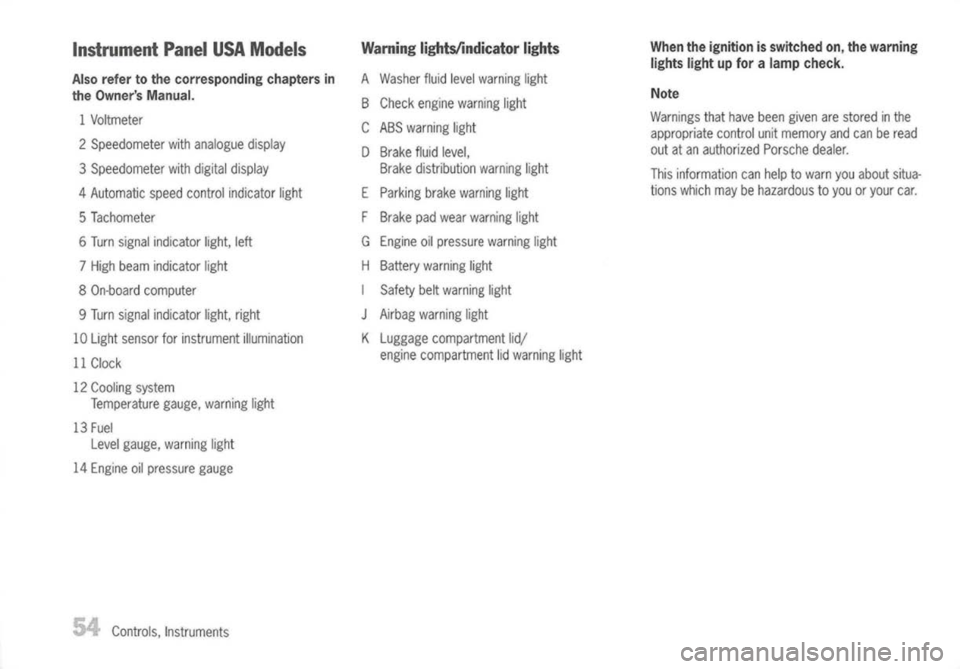
Also refer tothe corresponding chaptersin
the Owner's Manual.
1 Voltmeter
2 Speedometer withanalogue display
3 Speedometer withdigital display
4 Automatic speedcontrol indicator light
5 Tachometer
6 Turn signal indicator light,left
7 High beam indicator light
8 On-board computer
9 Turn signal indicator light,right
10 Light sensor forinstrument illumination
11 Clock
12 Cooling system
Temperature gauge,warning light
13 Fuel
Level gauge, warning light
14 Engine oilpressure gauge
Controls, Instruments
Warning
lightslindicator lights
A Washer fluidlevel warning light
B Check engine warning light
CABS warning light
D Brake fluidlevel,
Brake distribution warninglight
E Parking brakewarning light
F Brake padwear warning light
G Engine oilpressure warninglight
H Battery warning light
I Safety beltwarning light
J
Airbag warning light
K Luggage compartment lid/
engine compartment lidwarning light
When
theignition isswitched on,the warning
lights lightupfor alamp check.
Note
Warnings thathave been given arestored inthe
appropriate controlunitmemory andcanberead
out atan authorized Porschedealer.
This information canhelp towarn youabout situa-
tions which maybehazardous toyou oryour car.
Page 57 of 195
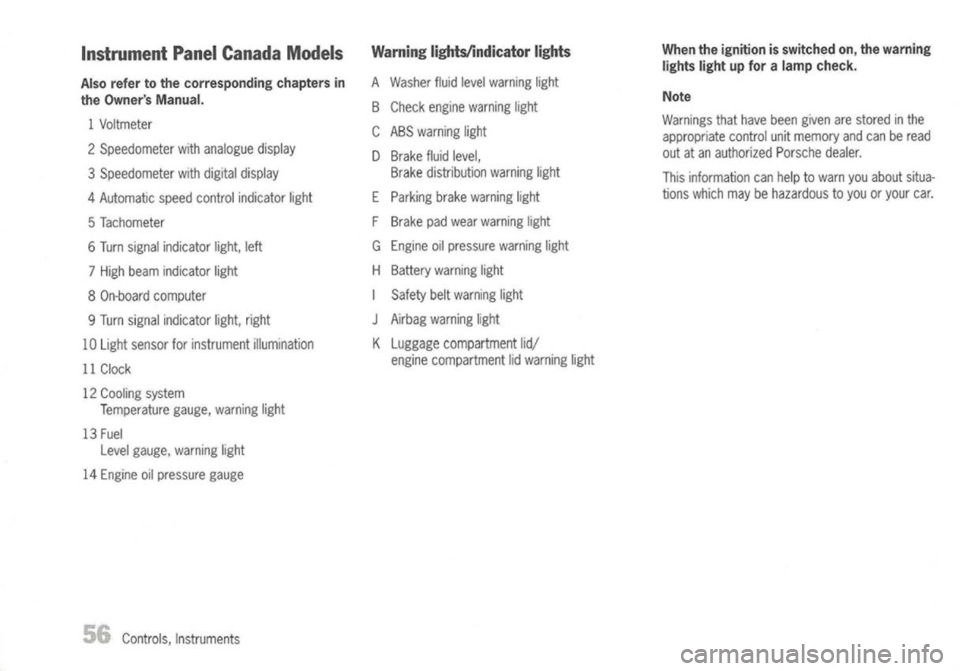
Instrument PanelCanada Models
Also refer tothe corresponding chaptersin
the Owner's Manual.
1 Voltmeter
2 Speedometer withanalogue display
3 Speedometer withdigital display
4 Automatic speedcontrol indicator light
5 Tachometer
6 Turn signal indicator light,left
7 High beam indicator light
8 On-board computer
9 Turn signal indicator light,right
10 Light sensor forinstrument illumination
11 Clock
12 Cooling system
Temperature gauge,warning light
13 Fuel
Level gauge, warning light
14 Engine oilpressure gauge
Controls, Instruments
Warning
Iights/indicator lights
A Washer fluidlevel warning light
B Check engine warning light
CABS warning light
o
Brake fluidlevel,
Brake distribution warninglight
E Parking brakewarning light
F Brake padwear warning light
G Engine oilpressure warninglight
H Battery warning light
I Safety beltwarning light
J
Airbag warning light
K Luggage compartment lid/
engine compartment lidwarning light
When
theignition isswitched on,the warning
lights lightupfor alamp check.
Note
Warnings thathave been given arestored inthe
appropriate controlunitmemory andcanberead
out atan authorized Porschedealer.
This information canhelp towarn youabout situa-
tions which maybehazardous toyou oryour car.
Page 59 of 195
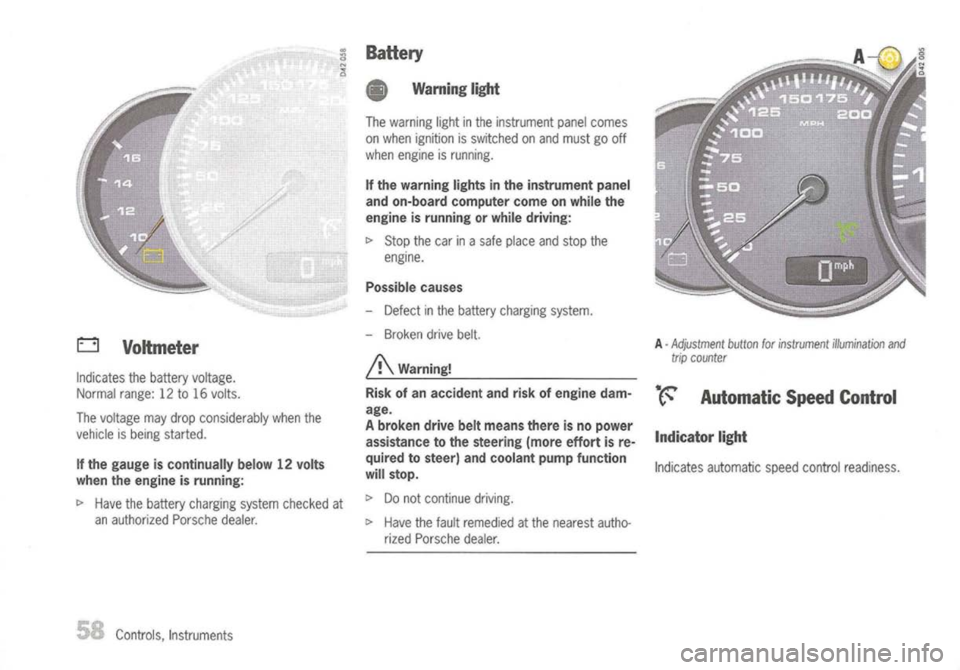
o
Voltmeter
Indicates thebattery voltage.
Normal range:12to16 volts.
The voltage maydrop considerably whenthe
vehicle isbeing started.
If the gauge iscontinually below12volts
when theengine isrunning:
t>
Have thebattery charging systemchecked at
an authorized Porschedealer.
Controls, Instruments
BaHery
• Warning light
The warning lightinthe instrument panelcomes
on when ignition isswitched onand must gooff
when engine isrunning.
If the warning lightsinthe instrument panel
and on-board computer comeonwhile the
engine isrunning orwhile driving:
t>
Stop thecarinasafe place andstop the
engine.
Possible causes
- Defect inthe battery charging system.
- Broken drivebelt.
A
Warning!
Risk ofan accident andriskofengine dam-
age.
A broken drivebeltmeans thereisno power
assistance tothe steering (moreeffortisre-
quired tosteer) andcoolant pumpfunction
will stop.
t>
Donot continue driving.
t>
Have thefault remedied atthe nearest autho-
rized Porsche dealer.
A
-
Adjustment buttonforinstrument illumination and
trip counter
•. ~ Automatic SpeedControl
Indicator light
Indicates automatic speedcontrol readiness.