warning light PORSCHE 911 GT3 2004 5.G Owners Manual
[x] Cancel search | Manufacturer: PORSCHE, Model Year: 2004, Model line: 911 GT3, Model: PORSCHE 911 GT3 2004 5.GPages: 195, PDF Size: 16.94 MB
Page 5 of 195
FuelQuality
Your engine isdesigned toprovide optimum performance andfueleconomy using
unleaded premiumfuelwith anoctane ratingof98 RON (93CLC orAKI).
Porsche therefore recommends theuse ofthese fuelsinyour vehicle.
Porsche alsorecognizes thatthese fuelsmaynotalways beavailable. Beassured thatyour vehicle willoperate
properly onunleaded premiumfuelswithoctane numbers ofatleast
95RON (90CLC orAKI).
since theengine's "Electronic Oktane™knockcontrol" willadapt theignition timing,ifnecessary.
Fuels containing alcoholandether
Some areasofthe U.S. require oxygenated fuelsduring certain portions ofthe year.
Oxygenated fuelsarefuels which contain alcohols (suchasmethanol orethanol) orether (such asMTBE).
Under normal conditions, theamount ofthese compounds inthe fuel willnot affect driveability.
You may useoxygenated fuelsinyour Porsche, providedtheoctane requirements foryour vehicle aremet.
We recommend, however,tochange toadifferent fuelorstation ifany ofthe following problems occurwithyour vehicle:
- Deterioration ofdriveability andperformance.
- Substantially reducedfueleconomy.
- Vapor lockandnon-start problems, especiallyathigh altitude orathigh temperature.
- Engine malfunction orstalling.
Fuels containing MMT
Some NorthAmerican fuelscontain anoctane enhancing additivecalledmethylcyclopentadienyl manganesetricarbonyl(MMT).
If such fuels areused, youremission controlsystem performance maybenegatively affected.
The check engine warning lightsonyour instrument panelmayturnon.
If this occurs, Porsche recommends youstop using fuelscontaining MMT.
4
Page 8 of 195
Environmentally friendlyvehicles
Modern environmental technologyensurescom-
pliance withallemission lawsapplicable world-
wide.
These havethefollowing advantages:
- Rapid operational readinessofthe catalytic
converters ensureslowemissions, evenin
short-trip operation.
- Reliable operation andgood emission control
over along useful life.
I>
Please refertothe chapter "FUELECONOMY"
on page 120.
Recycling
-for aPorsche, thisisvirtually
an academic question
More thantwo-thirds ofall Porsches everbuiltare
still running.
Just incase recycling isever necessary, we
take thefollowing precautionary measures:
- Identification ofall materials.
- Use ofrecyclable materials.
- Reusable components designedforsimple
removal.
- These reasons resultinafurther increase in
the recycling ratewhich iscurrently 80per
cent.
Emission
controlisbuilt in
Innovative enginetechnology combineshighen-
gine performance andenvironmental compati-
bility.
The engine diagnosis systemelectronically moni-
tors thecomponents andsystems thataffect ex-
haust gases.
This continuous monitoringandfault storage en-
ables swift, reliable diagnosis andfault detection.
Any fault messages areindicated tothe driver by
the "Check Engine" warning lightandtheon-board
computer.
I>
Please refertothe chapter "WARNINGS INTHE
INSTRUMENT PANELANDINTHE ON-BOARD
COMPUTER" onpage 75.
Page 14 of 195
Beforedrivingoff.. 14
Break inhints forthe first
1,000 miles/1,600 kilometers 16
Keys 19
Security WheelBolts 19
Doors 21
Central Locking 22
Alarm System, InfraredPassenger
Compartment Monitoring 24
Power Windows 26
Inside mirror 28
Rear View Mirrors 28
Rear Window Defogger,
Door Mirror Heating 29
Seat Adjustment 30
Steering WheelAdjustment.. 31
Safety Belts 32
Child Restraint Anchorages 35
Child Restraint Systems 36
Airbag Systems 38
Clutch Pedal 40
Parking Brake 40
Brakes 41
ABS Brake System
(Antilock BrakeSystem) 44
Interior lights 46
Footwell Lights 47
Operation, Instruments 48
Ignition/Starter Switchwith
anti-theft SteeringLock 50
Starting Procedures 52
Stopping Engine 53Instrument
PanelUSAModels 54
Instrument PanelCanada Models 56
Voltmeter 58
Automatic SpeedControl 58
Instrument Illumination 59
Trip Odometer 59
Speedometer 60
Changing overbetween
Miles /Kilometers 60
Tachometer 61
Turn Signal Indicator Light 61
High Beam 61
Cooling System 62
Fuel 63
C~k ~
Engine OilPressure 65
Check Engine
Warning Light 66
On-Board Computer (BC) 67
Warnings inthe Instrument Panelandinthe On-
Board Computer 75
Emergency FlasherSwitch 81
Light Switch 82
Automatic HeadlightBeamAdjustment 82
Turn Signal /
Headlight Dimmer/Flasher Lever 83
Windshield Wiper/Washer Lever 84
Automatic SpeedControl 86
Heating andVentilation 88
Automatic AirConditioning 90
Central andSide Vents 93
Fresh-air Intake 93Controls,
Instruments
Ashtray 94
Cigarette Lighter 94
Cupholder 95
Storage inthe Passenger Compartment 96
Luggage Compartment Lidand
Engine Compartment Lid 98
Luggage Compartment.. 100
Trunk Entrapment 101
Sun Visors 103
Spoiler, SideMember Panels 104
Car Audio Operation/Tips 105
Car Telephone and
Aftermarket Alarms 107
Roof Transport System 108
Gearshifting 109
Controls, Instruments
Page 16 of 195
Inthe driver's seat...
c>
Check operation ofthe horn.
c>
Position seatforeasy reach offoot pedals and
controls.
To reduce thepossibility ofinjury fromthe
airbag deployment, youshould always sitback
as far from thesteering wheelasispractical,
while stillmaintaining fullvehicle control.
c>
Adjustthe insideandoutside rearview mirrors.
c>
Buckle yoursafety belts.
C>
Check operation ofthe foot andparking brake.
C>
Check allwarning andindicator lightswith
ignition onand engine notrunning.
C>
Start engine andcheck allwarning displays for
warning symbols.
C>
Never leaveanidling carunattended.
C>
Lock doors frominside, especially withchil-
dren inthe cartoprevent inadvertent opening
of doors frominside oroutside.
Drive withdoors locked.
On
the road ...
C>
Never driveafteryouhave consumed alcohol
or drugs.
C>
Always haveyoursafety beltfastened.
C>
Always drivedefensively.
Expect theunexpected.
C>
Use signals toindicate turnsandlane changes.
C>
Turn onheadlights atdusk orwhen thedriving
conditions warrantit.
C>
Always keepasafe distance fromthevehicle
in front ofyou, depending ontraffic, roadand
weather conditions.
C>
Reduce speedatnight andduring inclement
weather. Driving inwet weather requirescautionandre-
duced speeds, particularly onroads with
standing water,asthe handling characteristics
of the vehicle maybeimpaired duetohydro-
planing ofthe tires.
C>
Always observe speedlimitsandobey road
signs andtraffic laws.
C>
When tired,getwell offthe road, stopandtake
a rest. Turntheengine off.Donot sitinthe ve-
hicle withengine idling.
Please observe thechapter "ENGINE EX-
HAUST" onPage 10.
C>
When parked, alwayssetthe parking brake.
Move thegearshift levertoreverse orfirst
gear.
On hills also turnthefront wheels towardthe
curb.
C>
When emergency repairsbecome necessary,
move thevehicle welloffthe road. Turnonthe
emergency flasheranduseother warning de-
vices toalert other motorists. Donot park or
operate thevehicle inareas where thehotex-
haust system maycome incontact withdry
grass, brush,fuelspill orother flammable ma-
terial.
C>
Make itahabit tohave theengine oilchecked
with every fuelfilling.
Controls, Instruments
Page 25 of 195
Automaticdoorlocking
Your authorized Porschedealercanprogram di-
verse typesofautomatic doorlocking inthe con-
trol unit ofthe central locking system:
Type 1
Doors lockautomatically whentheignition is
switched on.
Type
2
Doors lockautomatically whenaspeed of
3 -6 mph (5-10 km/h) isexceeded.
Type
3
Doors lockautomatically whentheignition is
switched on.Ifdoors areopened withtheengine
running, theylockagain automatically whena
speed of3-6 mph (5-10 km/h) isexceeded.
Type 4
The doors donot lock automatically.
Note
Automatically lockeddoorscanbeunlocked with
the central locking buttonoropened bypulling on
the inside doorhandle twice.
Controls, Instruments
j!\warning!
In an emergency situationwhereyouneed to
exit thecarthrough anautomatically locked
door, remember thefollowing procedure to
open thedoor.
I>
Unlock thedoors bypressing thecentral lock-
ing button
or
I>
pull theinside doorhandle
twice
toopen the
door.
Fault indication
A double
hornsignal
duringlocking indicates a
defect inthe central locking oralarm system.
Have thedefect remedied atan authorized
Porsche dealer.
Overload protection
If the central locking system isoperated more
than tentimes within aminute, furtheroperation is
blocked for30seconds.
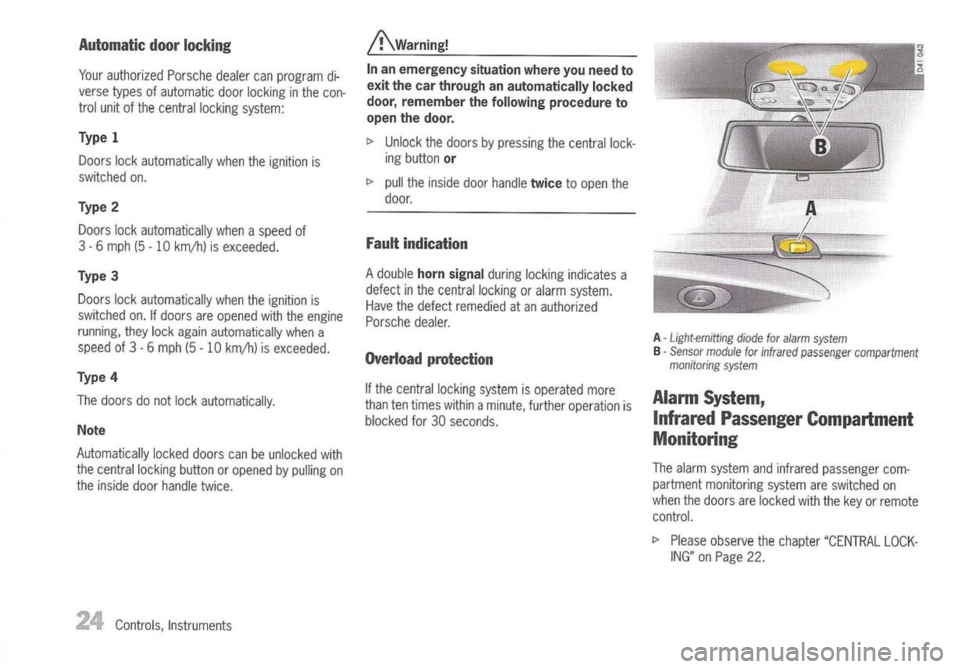
A
-
Light-emitting diodeforalarm system
B -
Sensor module forinfrared passenger compartment
monitoring system
Alarm System,
Infrared Passenger Compartment
Monitoring
The alarm system andinfrared passenger com-
partment monitoring systemareswitched on
when thedoors arelocked withthekey orremote
control.
I>
Please observe thechapter "CENTRAL LOCK-
ING" onPage 22.
Page 28 of 195
e
Closing windows
I>
Press rocker switchAuntil thewindow has
reached thedesired position.
One-touch operation
I>
Press rocker switchAbriefly.
Window movestoits final position.
Press againtostop thewindow inthe desired
position.
Comfort function whenlocking thevehicle at
the door lock
I>
Hold carkey indoor lockinthe locking direc-
tion until thewindows havereached thede-
sired position.
Anti-crushing
protection
If aside window isblocked duringclosing, itwill
stop andopen again byabout aninch.
A
Warning!
Risk ofsevere personal injuries.
If the rocker switchispressed againwithin
10 seconds ofthe window beingblocked, the
window willclose withitsfull closing force.
Anti-crushing protectionisdisabled.
I>
Once theanti-crushing protectionactstostop
the window andopens itslightly, donot press
the rocker switchagainwithin 10seconds
without checking tomake surethatnothing is
blocking thepath ofthe window.
The window willclose withfullclosing force.
One-touch operationisdisabled for10seconds
after blockage ofaside window.
Automatic
windowlowering
I>
Please observe thechapter "DOORS" onPage
21.
The standby function ofthe power
windows switches offafter twohours
When thecar isunlocked, thepower windows can
no longer beoperated aftertwohours (tosave the
car battery).
I>
Switch onthe ignition orstart theengine to
reactivate thepower windows.
Storing endposition ofthe windows
If the battery isdisconnected andreconnected,
the windows willnot beraised automatically when
the door isclosed.
1. Close thewindows withtherocker switch
once.
2. Press fronthalfofrocker switchagaintostore
the end position ofthe windows inthe control
unit.
Controls,Instruments
,27
Page 32 of 195
B-Fore andaft
I>
Raise locking lever.
Move seattodesired position andrelease
lever. Ensure thattheseat engages correctly.
C -
Backrest angle
I>
Operate switchuntilthedesired backrest
angle isreached.
Seat backrest
Folding forward
I>
Pull uplever Dinthe side partofthe backrest
and fold thebackrest forward.
Folding back
I>
Tilt back andengage thebackrest sothat it
cannot tipforward whenthecar isbraked.
Steering
WheelAdjustment
A
Warning!
Risk ofaccident.
The steering wheelmaymove further than
desired ifyou attempt toadjust itwhile driv-
ing.
You may losecontrol ofthe vehicle.
I>
Donot adjust thesteering wheelwhiledriving.
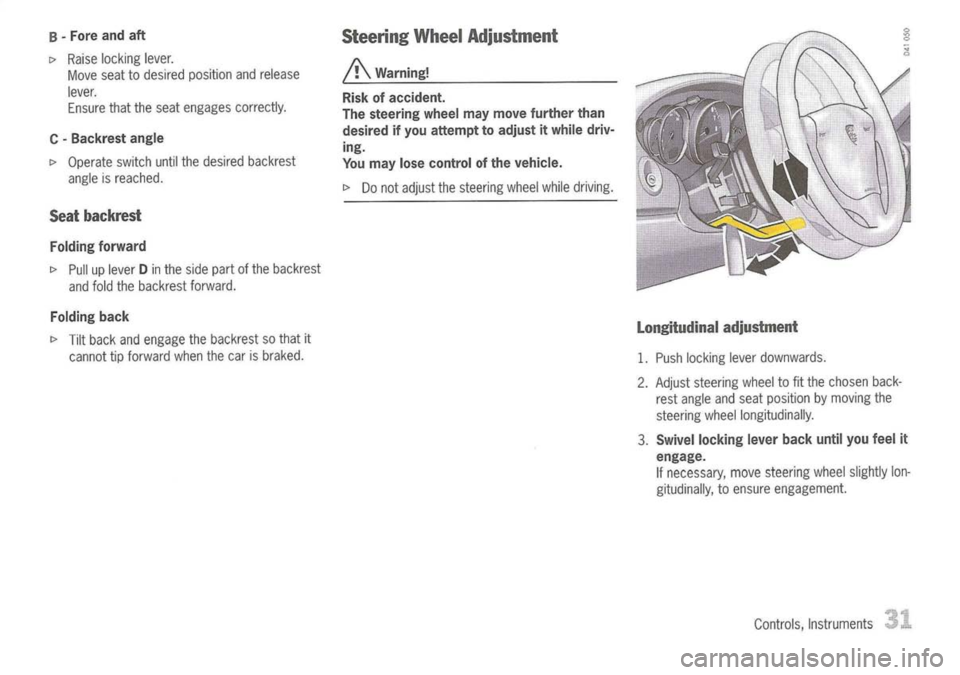
Longitudinal adjustment
1. Push locking leverdownwards.
2. Adjust steering wheelto
fit
the chosen back-
rest angle andseat position bymoving the
steering wheellongitudinally.
3. Swivel locking leverbackuntilyoufeel it
engage.
If
necessary, movesteering wheelslightly lon-
gitudinally, toensure engagement.
Controls, Instruments
Page 34 of 195
o
SafetyBeltWarning System
An audio-visual warning
systemisinterconnect-
ed with thedriver's safetybelt.
Every timetheignition isturned on,the gong will
sound forabout 6seconds toremind driverand
passenger tobuckle up.
The safety beltwarning lightsinthe instrument
panel andon-board computer willgooffassoon
as the driver hasbuckled up.
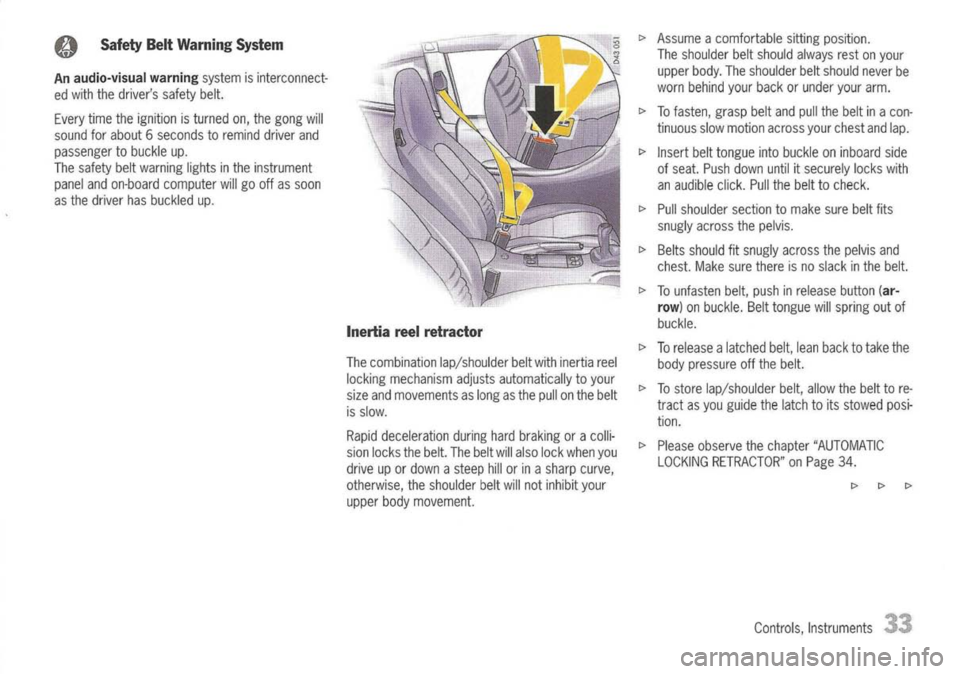
Inertiareelretractor
The combination lap/shoulder beltwith inertia reel
locking mechanism adjustsautomatically toyour
size andmovements aslong asthe pull onthe belt
is slow.
Rapid deceleration duringhardbraking oracolli-
sion locks thebelt. Thebeltwillalso lockwhen you
drive upordown asteep hillorinasharp curve,
otherwise, theshoulder beltwillnotinhibit your
upper bodymovement. ~
Assume acomfortable sittingposition.
The shoulder beltshould always restonyour
upper body.Theshoulder beltshould neverbe
worn behind yourback orunder yourarm.
~ Tofasten, graspbeltandpullthebelt inacon-
tinuous slowmotion acrossyourchest andlap.
~ Insert belttongue intobuckle oninboard side
of seat. Pushdown until
it
securely lockswith
an audible click.Pullthebelt tocheck.
~ Pull shoulder sectiontomake surebeltfits
snugly across thepelvis.
~ Belts should fitsnugly across thepelvis and
chest. Makesurethere isno slack inthe belt.
~ Tounfasten belt,push inrelease button
(ar-
row)
onbuckle. Belttongue willspring outof
buckle.
~ Torelease alatched belt,leanback totake the
body pressure offthe belt.
~ Tostore lap/shoulder belt,allow thebelt tore-
tract asyou guide thelatch toits stowed posi-
tion.
~ Please observe thechapter "AUTOMATIC
LOCKING RETRACTOR" onPage 34.
~ ~~
Controls, Instruments
Page 38 of 195
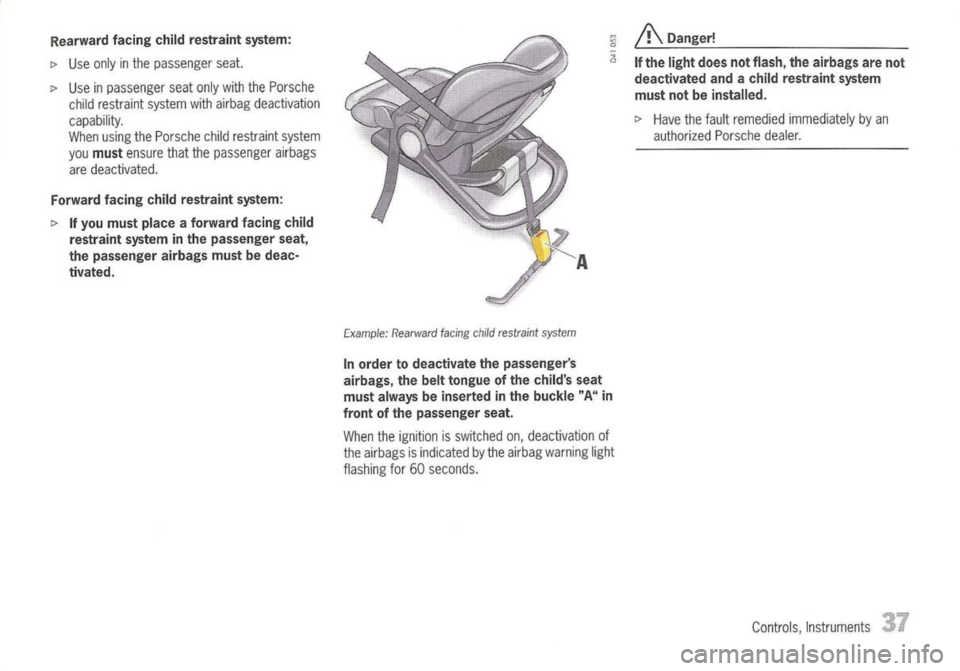
Rearward facingchildrestraint system:
I>
Use only inthe passenger seat.
I>
Use inpassenger seatonlywiththePorsche
child restraint systemwithairbag deactivation
capability.
When usingthePorsche childrestraint system
you
must
ensure thatthepassenger airbags
are deactivated.
Forward facingchildrestraint system:
I>
Ifyou must place aforward facingchild
restraint systeminthe passenger seat,
the passenger airbagsmustbedeac-
tivated.
Example:Rearward facingchildrestraint system
In order todeactivate thepassenger's
airbags, thebelt tongue ofthe child's seat
must always beinserted inthe buckle
"AU
in
front ofthe passenger seat.
When theignition isswitched on,deactivation of
the airbags isindicated bythe airbag warning light
flashing for60seconds.
/!\
Danger!
If the light does notflash, theairbags arenot
deactivated andachild restraint system
must notbeinstalled.
I>
Have thefault remedied immediately byan
authorized Porschedealer.
Controls, Instruments
Page 40 of 195
~Donot add anyadditional coverings orstickers
to the steering wheelorinthe area ofthe pas-
senger airbagandside airbags. Doingsomay
adversely affectthefunctioning ofthe airbag
system orcause harmtothe occupants ifthe
airbag system shoulddeploy.
~ Donot undertake anywiring forelectrical ac-
cessory equipment inthe vicinity ofthe airbag
wiring harnesses. Doingsomay disable the
airbag system orcause inflation.
~ Ifthe warning lightcomes on,the airbag sys-
tem should berepaired immediately byyour
authorized Porschedealer.
Note
Airbag components (e.g.steering wheel,door
trim) maybedisassembled onlybyanauthorized
Porsche dealer.
When disposing ofaused airbag unit,oursafety
instructions mustbefollowed. Theseinstructions
can beobtained atany authorized Porschedealer.
Q)
Warning light
The central triggering unitmonitors theoperation-
al readiness ofthe airbag system andthewarning
light.
Any malfunctions thatmay occur willbeindicated
by the warning lightsinthe instrument paneland
on-board computer.
~ Inthe following casesyoushould immedi-
ately consult anauthorized Porschedeal-
er inorder toassure theairbag system is
functioning properly:
- Illumination ofthe airbag warning lightduring
travel orrepeated illumination longerthan5
seconds aftertheignition circuitisturned on.
- Illumination failstolight upduring ignition
circuit activation.
If the airbags onthe passenger's sideare
switched offbythe
child restraint system,
orif
an installed childrestraint systemisdetected
when theignition isswitched on,the warning light
flashes
for60seconds whentheignition ison.
A
Danger!
If the light does notflash, theairbags arenot
deactivated andachild restraint system
must notbeinstalled.
~ Have thefault remedied immediately byan
authorized Porschedealer.
Airbag
maintenance
In order toensure long-term functioning, theair-
bag system mustbeinspected byan authorized
Porsche dealerafter4,8and 10years fromthe
date ofmanufacture shownonthe safety compli-
ance sticker, andevery 2years thereafter.
Important information
If you sellyour Porsche, notifythepurchaser that
the vehicle isequipped withairbags, andrefer
them tothe chapter, "AirbagSystems", inthe own-
er's manual (safetyanddisposal rules).
Further information onthe airbag system canbe
found onstickers atthe sun visors, aswell ason
all airbag components.
~ For special recommendations onthe use of
child restraints:
Please observe thechapter "CHILDRE-
STRAINT SYSTEMS" onPage 36.
Controls, Instruments