light PORSCHE 911 GT3 2004 5.G Manual PDF
[x] Cancel search | Manufacturer: PORSCHE, Model Year: 2004, Model line: 911 GT3, Model: PORSCHE 911 GT3 2004 5.GPages: 195, PDF Size: 16.94 MB
Page 144 of 195
Temperature A,8,C
The temperature gradesareA(the highest), Band
C, representing thetire's resistance tothe gener-
ation ofheat anditsability todissipate heatwhen
tested undercontrolled conditions onaspecified
indoor laboratory testwheel.
Sustained hightemperatures cancause themate-
rial ofthe tire todegenerate andreduce tirelife,
and excessive temperature canlead tosudden
tire failure.
The grade Ccorresponds toalevel ofperfor-
mance whichallpassenger cartires must meet
under theFederal MotorVehicle SafetyStandard
No. 109.
Grades Band Arepresent higherlevelsofperfor-
mance onthe laboratory testwheel thanthemini-
mum required bylaw.
A
Warning!
The temperature gradeforthis tireisestablished
for atire that isproperly inflatedandnotoverload-
ed.
Excessive speed,underinflation, orexcessive
loading, eitherseparately orincombination, can
cause heatbuildup andpossible tirefailure.
Tire
pressures
A
Warning!
Incorrect tirepressure causesincreased tire
wear andadversely affectsroadhandling.
I>
Always useanaccurate tirepressure gauge
when checking inflationpressures.
I>
Donot exceed themaximum tirepressure list-
ed onthe tire sidewall.
Please observe thechapter "VEHICLE IDENTI-
FICATION, TECHNICAL DATA"onPage 179.
I>
Cold tireinflation pressure means:alltires
must becold, ambient temperature maximum
68°F (20°C), whenadjusting theinflation pres-
sure.
Avoid sunlight strikingthetires before measur-
ing cold pressures, sincethepressures would
rise from temperature influence.
I>
Valve capsprotect thevalve fromdustand
dirt, andthus from leakage.
Always screwcapstightly down.
Replace missingcapsimmediately.
I>
Donot use commercially availablesealantor
tire inflating bottles.
Tire
traction
A
Warning!
When driving onwet orslushy roads,a
wedge ofwater maybuild upbetween the
tires andtheroad. Thisphenomenon is
known as"hydroplane" andmay cause par-
tial orcomplete lossoftraction, vehicle
control orstopping ability.
I>
Reduce speedonwet surface toprevent this.
Tire life
Tire lifedepends onvarious factors, i.e., road
surfaces, trafficandweather conditions, driving
habits, typeoftires andtirecare.
I>
Inspect yourtires forwear anddamage before
driving off.Ifyou notice uneven orsubstantial
wear, wheels mightneedalignment ortires
should bebalanced orreplaced.
Practical Tips,Emergency Service
Page 152 of 195
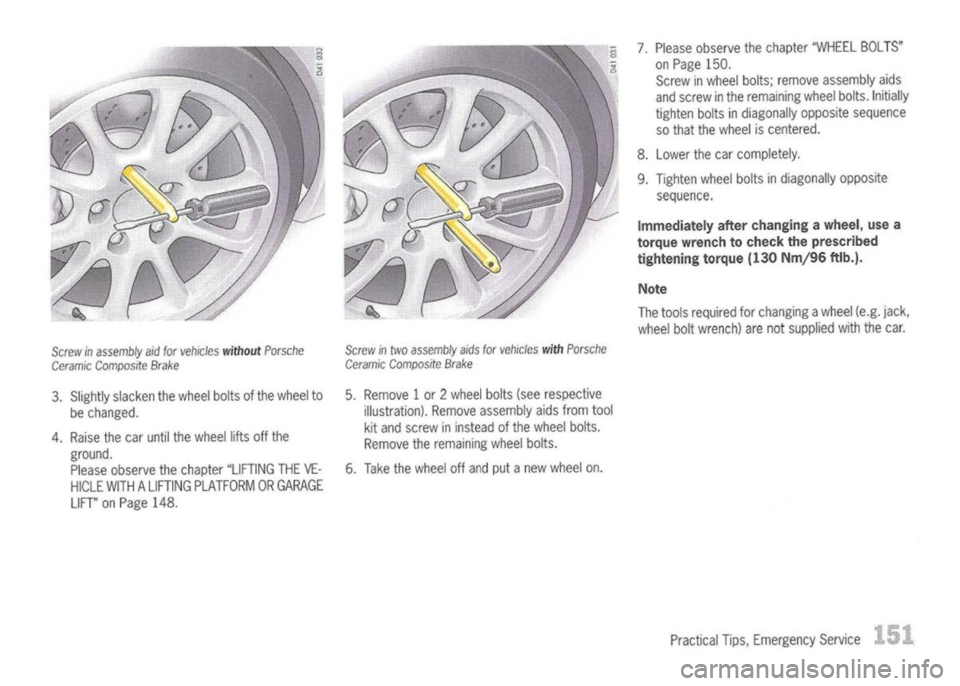
Screwinassembly aid
for
vehicles
without
Porsche
Ceramic
Composite Brake
3. Slightly slacken thewheel boltsofthe wheel to
be changed.
4. Raise thecar until thewheel liftsoffthe
ground. Please observe thechapter "LIFTING THEVE-
HICLE WITHALIFTING PLATFORM ORGARAGE
LIFT" onPage 148.
Screw
in
two
assembly aids
for
vehicles
with
Porsche
Ceramic Composite Brake
5. Remove 1or 2wheel bolts(seerespective
illustration). Removeassembly aidsfrom tool
kit and screw ininstead ofthe wheel bolts.
Remove theremaining wheelbolts.
6. Take thewheel offand putanew wheelan. 7.
Please observe thechapter "WHEEL BOLTS"
on Page 150.
Screw inwheel bolts;remove assembly aids
and screw inthe remaining wheelbolts.Initially
tighten boltsindiagonally oppositesequence
so that thewheel iscentered.
8. Lower thecar completely.
9. Tighten wheelboltsindiagonally opposite
sequence.
Immediately afterchanging awheel, usea
torque wrench tocheck theprescribed
tightening torque(130Nm/96 ftlb.).
Note
The tools required forchanging awheel (e.g.jack,
wheel boltwrench) arenotsupplied withthecar.
Practical Tips,Emergency Service
1
Page 153 of 195
Electrical System
In order toavoid damage andfaults inelectrical or
electronic systems,electrical accessories should
be installed atyour authorized Porschedealer.
~ Only useaccessories authorizedbyPorsche.
A
Warning!
Risk ofshort circuit andfire.
Replacing fusesorrelays withtheengine
running orthe ignition oncould cause elec-
trical shock.
~ Disconnected thebattery duringallwork on
the electrical system.
Please observe thechapter "BATTERY" on
Page 155.
Relays
Defective
relays
shouldbechanged onlybyan
authorized workshop.
Practical Tips,Emergency Service
Alann
system,
centrallocking
The status ofthe central locking andalarm system
is not changed bydisconnecting thebattery.
When thebattery isdisconnected, thealarm sys-
tem ceases tofunction.
Overload protection
If the central locking systemisoperated more
than tentimes within aminute, furtheroperation is
blocked for30seconds.
load
switch-off aftertwohours
or five days
If the ignition keyisremoved, loadswhich are
switched onorinstandby (e.g.power windows,
luggage compartment lighting,interiorlight,radio)
are automatically switchedoffafter approximately
2 hours.
If the vehicle isnot started orunlocked withthere-
mote control within
fivedays,
theremote control
standby function isswitched off(toprevent dis-
charging ofthe vehicle battery).
1. Inthis case, unlock thedriver's doorwiththe
key atthe door lock.
Leave thedoor closed inorder toprevent the
alarm system frombeing triggered.
2. Press button 1on the remote control.
The remote controlisnow activated again.
Page 158 of 195

j!\
Warning!
Hydrogen gasgenerated bythe battery
could cause anexplosion, resultinginsevere
personal injuries.
c> Charge battery inawell ventilated area.
c> Never charge afrozen battery. Itmay explode
because ofgas trapped inthe ice. Allow afro-
zen battery tothaw outfirst.
c> Ifyou getelectrolyte, whichisan acid, inyour
eyes oron your skin, immediately rinsewith
cold water forseveral minutes andcalladoc-
tor.
Slow
battery charging
1. Pay attention toallwarnings andfollow instruc-
tions thatcome withyour battery charger.
2. When charging, ensureadequate ventilation.
3. Remove battery.
Please observe thechapter "REMOVING THE
BATTERY" onPage 158.
4. Allvent caps should beopen.
The fluid level should meettheindicator mark
in each cell.
5. Ensure thatcharger isswitched off-danger of
short circuit!
6. Connect chargercables.
Charger cablesmustbeconnected
POSITIVE
(+1
toPOSITIVE
(+)
and
NEGATIVE (-)toNEGATIVE
(-I.
7. Switch oncharger.
Normally, abattery shouldbecharged atno
more than10percent ofits rated capacity.
Rated capacity ofthe battery inyour vehicle is
listed onthe battery housing.
8. After charging, turnoffcharger anddiscon-
nect charger cables.
9. Tighten thevent caps andreinstall battery
Please observe thechapter "INSTALLING THE
BATTERY" onPage 158. Winter
operation
During thewinter months, batterycapacity tends
to decrease astemperatures drop.
Additionally, morepower isconsumed whilestart-
ing, andtheheadlights, heater,rearwindow de-
fogger, etc.,areused more frequently.
c> let your Porsche dealertestthebattery's
capacity beforewintersetsin.
Replacing battery
The service lifeofthe battery issubject tonormal
wear; itdepends graetlyoncare, climatic condi-
tions, anddriving conditions (distances, loads).
c> Only useanoriginal Porsche battery,withthe
correct partnumber, asareplacement.
c> Please observe thedisposal instructions for
batteries.
c>c>c>
Practical Tips,Emergency Service
Page 160 of 195
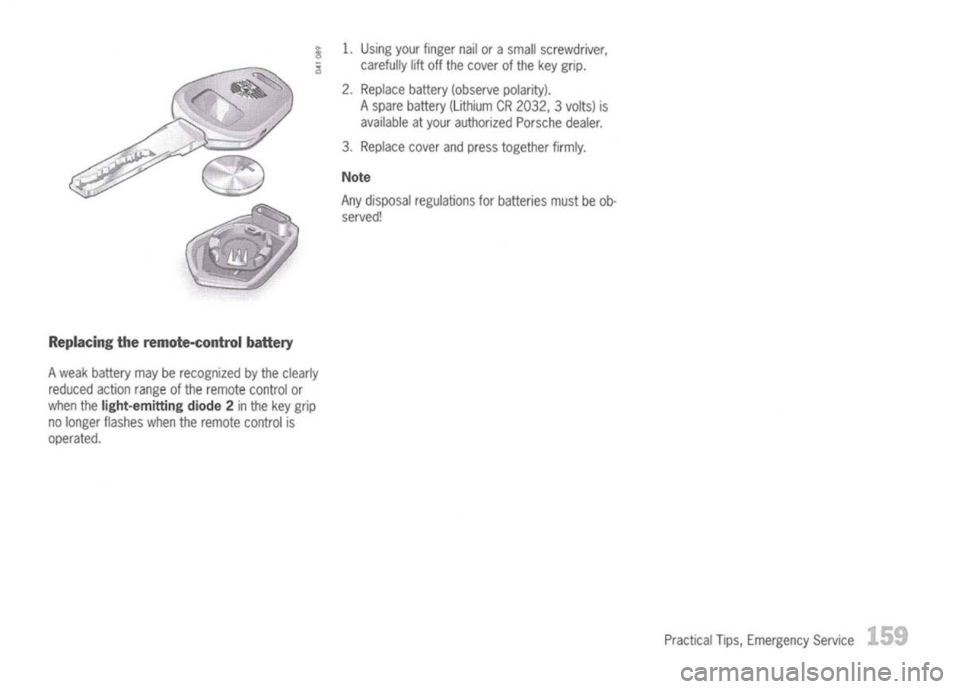
Replacing theremote-control battery
A weak battery mayberecognized bythe clearly
reduced actionrangeofthe remote controlor
when the
light-emitting diode2
inthe key grip
no longer flashes whentheremote controlis
operated. 1.
Using yourfinger nailorasmall screwdriver,
carefully liftoff the cover ofthe key grip.
2. Replace battery(observe polarity).
A spare battery (Lithium CR2032, 3volts) is
available atyour authorized Porschedealer.
3. Replace coverandpress together firmly.
Note
Any disposal regulations forbatteries mustbeob-
served'
PracticalTips,Emergency Service
159
Page 163 of 195
Lights, Replacing Bulbs
A
Warning!
Risk ofshort circuit.
c>
Always switchoffthe relevant consumer when
changing bulbs.
Risk ofinjury. Theheadlights areunder high
voltage wheninstalled.
c>
Becareful duringallwork inthe area ofthe
headlights.
Risk ofdamage. Bulbsofahigher wattage
can damage thelamp housing.
c>
Only thebulbs shown inthe chart maybeused.
c>
New bulbs mustbeclean andfree from
grease.
Therefore, nevertouch bulbswith
your barehands.
Use acloth orsoft paper whilereplacing bulbs.
c>
For reasons oftraffic safety, werecommend
that youalways carryspare bulbssothat you
can have acorrectly illuminated caratall
times. In certain countries, thecarrying ofspare
bulbs ismandatory.
Practical Tips,Emergency Service
A
Caution!
Risk ofdamage toheadlights duetoexces-
sive temperatures andabrasion.
c>
Attach nocoverings (e.g.films, "stone
guards") inthe area ofthe headlights.
c>
Use soapy wateronlytoclean lightlenses and
plastic headlight lenses.
In no case maychemical cleanersorother vol-
atile cleaning fluidsbeused.
c>
Toprevent scratches, donot rubwith adry or
merely moistcloth,tissue orinsect sponges.
Page 164 of 195
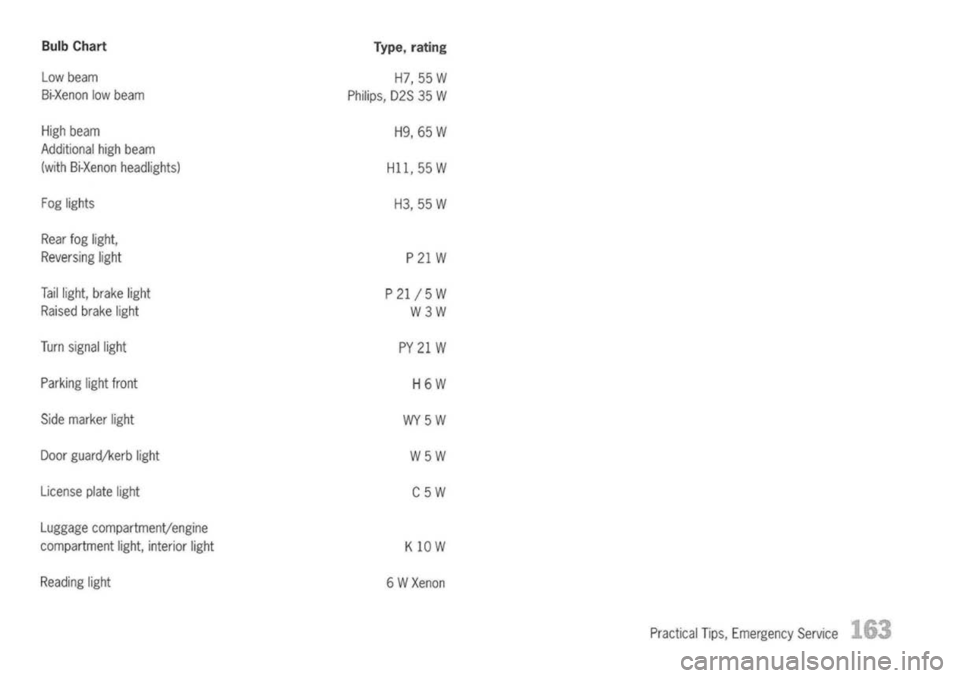
BulbChart
Type.
rating
Low beam
H7,55W
Bi-Xenon lowbeam
Philips,D2S35W
High beam
H9,65W
Additional highbeam
(with Bi-Xenon headlights)
Hll,55W
Fog lights
H3,55W
Rear foglight,
Reversing light
P21 W
Taillight, brakelight
P21 /5 W
Raised brakelight
W3W
Turn signal light
PY21W
Parking lightfront
H6W
Side marker light
WY5W
Door guardjkerb light
W5W
License platelight
C5W
Luggage compartmenVengine
compartment light,interior light
K10 W
Reading light
6W Xenon
PracticalTips,Emergency Service
Page 165 of 195
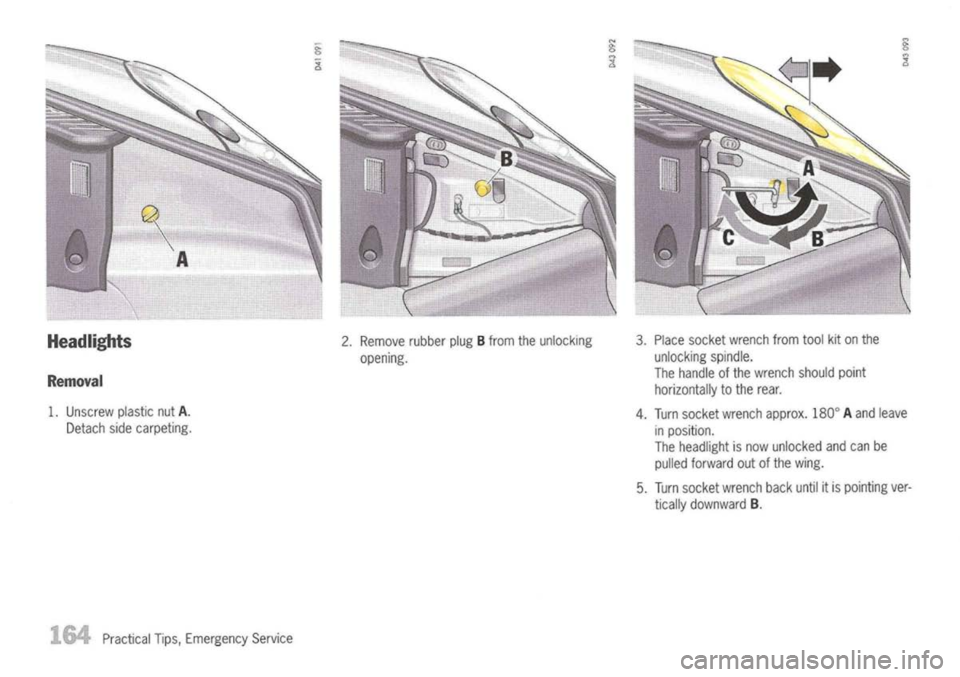
Headlights
Removal
1. Unscrew plasticnut
A.
Detach sidecarpeting.
Practical Tips,Emergency Service 2.
Remove rubberplugBfrom theunlocking
opening. 3.
Place socket wrench fromtoolkitonthe
unlocking spindle.
The handle ofthe wrench shouldpoint
horizontally tothe rear.
4. Turn socket wrench approx. 180
0
Aand leave
in position.
The headlight isnow unlocked andcanbe
pulled forward outofthe wing.
5. Turn socket wrench backuntilitis pointing ver-
tically downward
B.
Page 166 of 195
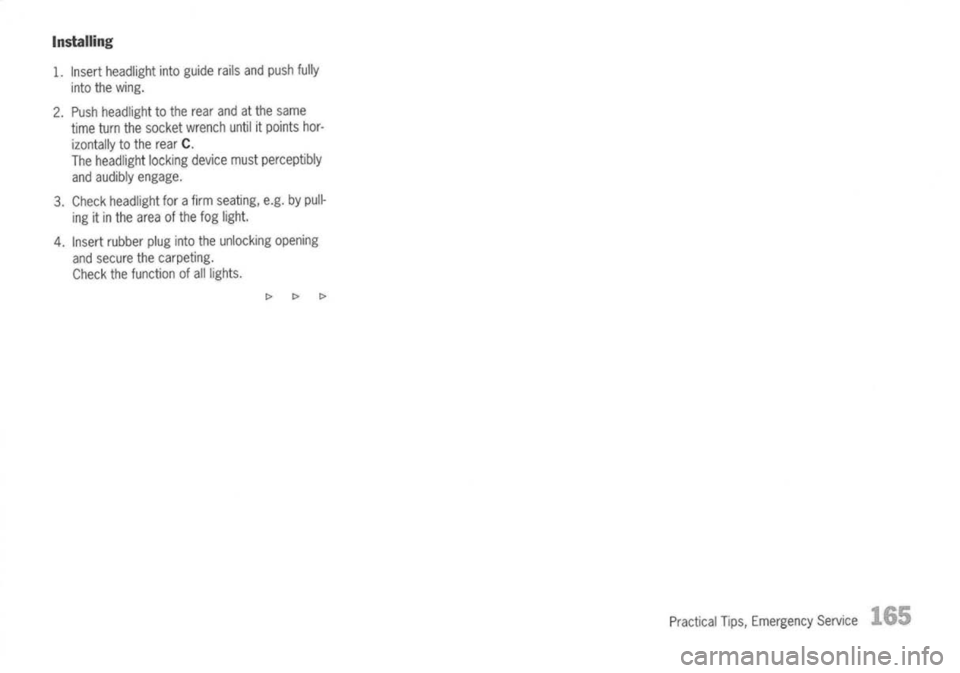
Installing
1. Insert headlight intoguide railsandpush fully
into thewing.
2. Push headlight tothe rear andatthe same
time turnthesocket wrench untilitpoints hor-
izontally tothe rear
C.
The headlight lockingdevicemustperceptibly
and audibly engage.
3. Check headlight forafirm seating, e.g.bypull-
ing itin the area ofthe fog light.
4. Insert rubber plugintotheunlocking opening
and secure thecarpeting.
Check thefunction ofall lights.
I>I>I>
PracticalTips,Emergency Service
Page 167 of 195
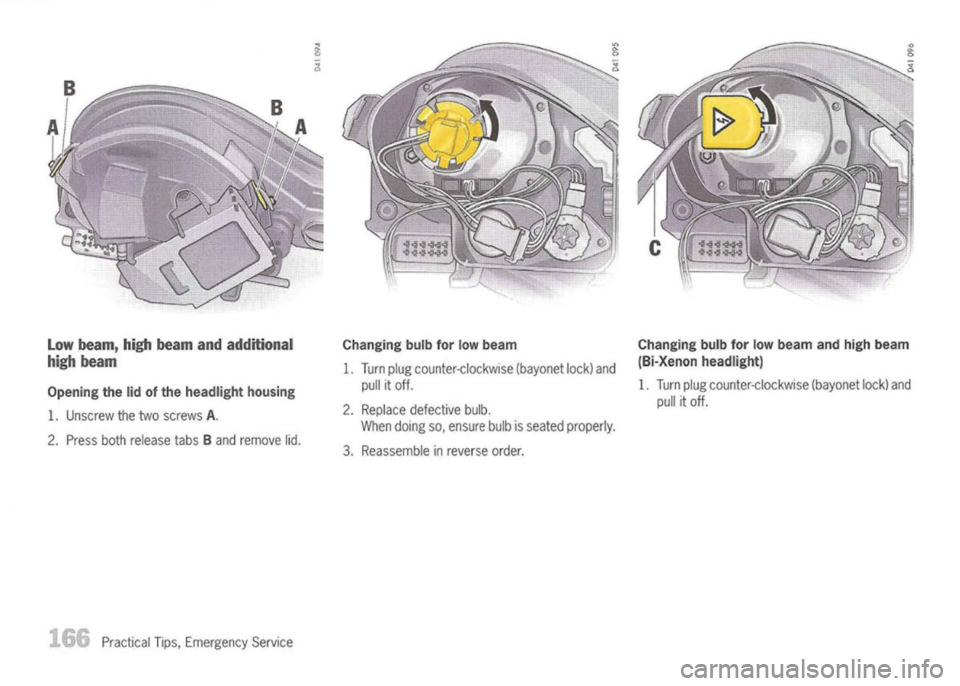
Lowbeam, highbeam andadditional
high beam
Opening thelidofthe headlight housing
1. Unscrew thetwo screws
A.
2. Press bothrelease tabsBand remove lid.
Practical Tips,Emergency Service
Changing
bulbforlow beam
1. Turn plugcounter-clockwise (bayonetlock)and
pull itoff.
2. Replace defective bulb.
When doing so,ensure bulbisseated properly.
3. Reassemble inreverse order.
Changing
bulbforlow beam andhigh beam
(Bi-Xenon headlight)
1. Turn plugcounter-clockwise (bayonetlock)and
pull itoff.