ESP PORSCHE 911 GT3 2010 5.G Owner's Manual
[x] Cancel search | Manufacturer: PORSCHE, Model Year: 2010, Model line: 911 GT3, Model: PORSCHE 911 GT3 2010 5.GPages: 251, PDF Size: 14.33 MB
Page 107 of 251

106
Instruments, On-Board Computer
Instrument Panel Canada Models Also refer to the corresponding chapters in
the Owner’s Manual.
1.Engine oil temperature gauge
2.Speedometer with analogue display
3.Tire pressure warning light
4.Turn signal indicator light, left
5.Tachometer
6.High beam indicator light
7.Turn signal indicator light, right
8.Upshift indicator
9.Cooling system
Temperature gauge, warning light
10.Fuel
Level gauge, warning light
11.Engine oil pressure gauge
12.Adjustment button for instrument illumination
and trip counter
13.Odometer and daily trip mileage display
14.Automatic speed control indicator light15.Light sensor for instrument illumination
16.Airbag warning light
17.Check Engine warning light
(Emission control warning light)
18.Central warning light
19.On-board computer display
20.Porsche Stability Management
PSM Multifunctional light
21.Brake warning light
22.Safety belt warning light
23.ABS warning light
24.Clock and outside temperature display
25.Adjustment button for clockWhen the ignition is switched on, the warning
lights light up for a lamp check.
Note
Warnings that have been given are stored in the
appropriate control unit memory and can be read
out at an authorized Porsche dealer.
This information can help to warn you about situa-
tions which may be hazardous to you or your car. 10_GT3_21.book Seite 106 Donnerstag, 4. Juni 2009 12:48 12
Page 135 of 251
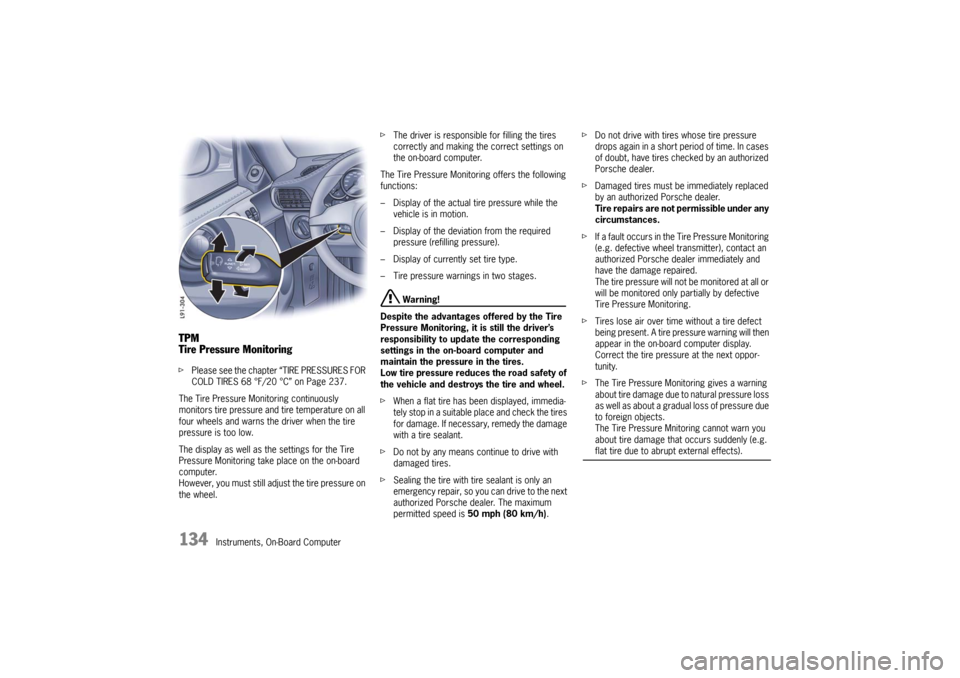
134
Instruments, On-Board Computer
TPM
Tire Pressure MonitoringfPlease see the chapter “TIRE PRESSURES FOR
COLD TIRES 68 °F/20 °C” on Page 237.
The Tire Pressure Monitoring continuously
monitors tire pressure and tire temperature on all
four wheels and warns the driver when the tire
pressure is too low.
The display as well as the settings for the Tire
Pressure Monitoring take place on the on-board
computer.
However, you must still adjust the tire pressure on
the wheel.fThe driver is responsible for filling the tires
correctly and making the correct settings on
the on-board computer.
The Tire Pressure Monitoring offers the following
functions:
– Display of the actual tire pressure while the
vehicle is in motion.
– Display of the deviation from the required
pressure (refilling pressure).
– Display of currently set tire type.
– Tire pressure warnings in two stages.
Warning!
Despite the advantages offered by the Tire
Pressure Monitoring, it is still the driver’s
responsibility to update the corresponding
settings in the on-board computer and
maintain the pressure in the tires.
Low tire pressure reduces the road safety of
the vehicle and destroys the tire and wheel.
fWhen a flat tire has been displayed, immedia-
tely stop in a suitable place and check the tires
for damage. If necessary, remedy the damage
with a tire sealant.
fDo not by any means continue to drive with
damaged tires.
fSealing the tire with tire sealant is only an
emergency repair, so you can drive to the next
authorized Porsche dealer. The maximum
permitted speed is 50 mph (80 km/h).fDo not drive with tires whose tire pressure
drops again in a short period of time. In cases
of doubt, have tires checked by an authorized
Porsche dealer.
fDamaged tires must be immediately replaced
by an authorized Porsche dealer.
Tire repairs are not permissible under any
circumstances.
fIf a fault occurs in the Tire Pressure Monitoring
(e.g. defective wheel transmitter), contact an
authorized Porsche dealer immediately and
have the damage repaired.
The tire pressure will not be monitored at all or
will be monitored only partially by defective
Tire Pressure Monitoring.
fTires lose air over time without a tire defect
being present. A tire pressure warning will then
appear in the on-board computer display.
Correct the tire pressure at the next oppor-
tunity.
fThe Tire Pressure Monitoring gives a warning
about tire damage due to natural pressure loss
as well as about a gradual loss of pressure due
to foreign objects.
The Tire Pressure Mnitoring cannot warn you
about tire damage that occurs suddenly (e.g.
flat tire due to abrupt external effects).
10_GT3_21.book Seite 134 Donnerstag, 4. Juni 2009 12:48 12
Page 139 of 251
138
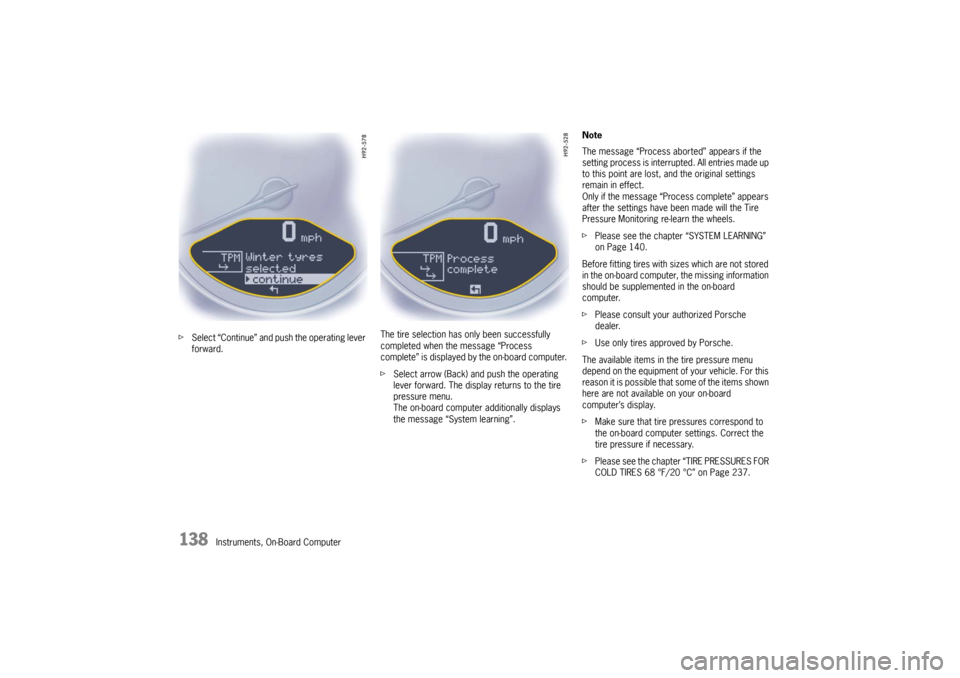
Instruments, On-Board Computer fSelect “Continue” and push the operating lever
forward.The tire selection has only been successfully
completed when the message “Process
complete” is displayed by the on-board computer.
fSelect arrow (Back) and push the operating
lever forward. The display returns to the tire
pressure menu.
The on-board computer additionally displays
the message “System learning”.Note
The message “Process aborted” appears if the
setting process is interrupted. All entries made up
to this point are lost, and the original settings
remain in effect.
Only if the message “Process complete” appears
after the settings have been made will the Tire
Pressure Monitoring re-learn the wheels.
fPlease see the chapter “SYSTEM LEARNING”
on Page 140.
Before fitting tires with sizes which are not stored
in the on-board computer, the missing information
should be supplemented in the on-board
computer.
fPlease consult your authorized Porsche
dealer.
fUse only tires approved by Porsche.
The available items in the tire pressure menu
depend on the equipment of your vehicle. For this
reason it is possible that some of the items shown
here are not available on your on-board
computer’s display.
fMake sure that tire pressures correspond to
the on-board computer settings. Correct the
tire pressure if necessary.
fPlease see the chapter “TIRE PRESSURES FOR
COLD TIRES 68 °F/20 °C” on Page 237.
10_GT3_21.book Seite 138 Donnerstag, 4. Juni 2009 12:48 12
Page 140 of 251
Instruments, On-Board Computer
139
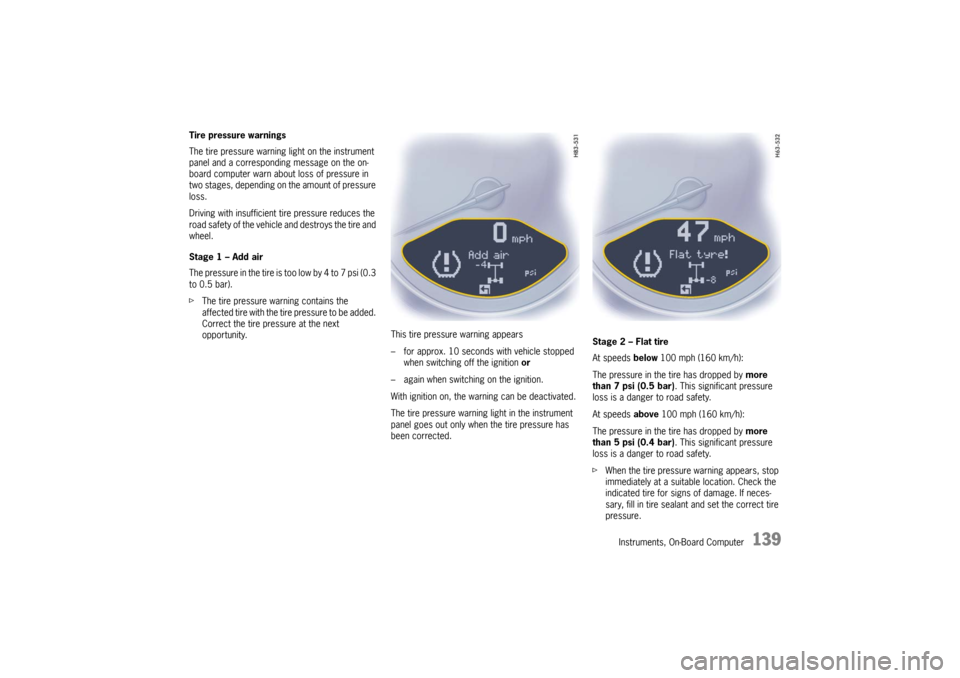
Tire pressure warnings
The tire pressure warning light on the instrument
panel and a corresponding message on the on-
board computer warn about loss of pressure in
two stages, depending on the amount of pressure
loss.
Driving with insufficient tire pressure reduces the
road safety of the vehicle and destroys the tire and
wheel.
Stage 1 – Add air
The pressure in the tire is too low by 4 to 7 psi (0.3
to 0.5 bar).
fThe tire pressure warning contains the
affected tire with the tire pressure to be added.
Correct the tire pressure at the next
opportunity. This tire pressure warning appears
– for approx. 10 seconds with vehicle stopped
when switching off the ignition or
– again when switching on the ignition.
With ignition on, the warning can be deactivated.
The tire pressure warning light in the instrument
panel goes out only when the tire pressure has
been corrected.Stage 2 – Flat tire
At speeds below 100 mph (160 km/h):
The pressure in the tire has dropped by more
than 7 psi (0.5 bar). This significant pressure
loss is a danger to road safety.
At speeds above 100 mph (160 km/h):
The pressure in the tire has dropped by more
than 5 psi (0.4 bar). This significant pressure
loss is a danger to road safety.
fWhen the tire pressure warning appears, stop
immediately at a suitable location. Check the
indicated tire for signs of damage. If neces-
sary, fill in tire sealant and set the correct tire
pressure.
10_GT3_21.book Seite 139 Donnerstag, 4. Juni 2009 12:48 12
Page 142 of 251

Instruments, On-Board Computer
141
Warning!
Your vehicle has also been equipped with a Tire
Pressure Monitoring (TPM) malfunction indicator
when the system is not operating properly.
The TPM malfunction indicator is combined with a
low tire pressure telltale.
When the system detects a malfunction, the
telltale will flash for approx. one minute and then
remain continuously illuminated. This sequence
will continue upon subsequent vehicle start-ups as
long as the malfunction exists.
When the malfunction indicator is illuminated, the
system may not be able to detect or signal low tire
pressure as intended.
TPM malfuntions may occur for a variety of
reasons, including the installation of replacement
or alternate tires or wheels on the vehicle that
prevent the TPM from functioning properly.
Always check the TPM malfunction telltale after
replacing one or more tires or wheels on your
vehicle to ensure that the replacement or alter-
nate tires and wheels allow the TPM to continue to
function properly.The warning light in the speedometer lights up:
– When a loss in pressure has been detected.
– When learning newly mounted wheels/wheel
sensors, as long as the vehicle’s own wheels
have not yet been recognized.
In the event of a defect in Tire Pressure Monitoring
or a temporary fault, the warning light in the
speedometer flashes for approx. one minute and
then remains continuously illuminated.
The tire pressure warning light in the instrument
panel goes out only when the cause of the fault
has been rectified.
Partial monitoringMonitoring of the other wheels is continued if there
is a fault in one or two wheel transmitters.
– The tire pressure warning light lights up.
– The message “TPM partial monitoring” is
displayed on the on-board computer.
– No tire pressures are displayed on the on-
board computer for wheels with faulty wheel
transmitters.
No monitoringIn the event of faults the Tire Pressure Monitoring
cannot monitor the tire pressure.
The warning light on the instrument panel flashes
for approx. one minute and then remains conti-
nuously illuminated and a corresponding message
appears on the on-board computer.
Monitoring is not active when:
– the Tire Pressure Monitoring is faulty,
– wheel transmitters for the Tire Pressure
Monitoring are missing,
– during the learning phase after the tire settings
have been updated,
– after a wheel change without updating the tire
settings,
– more than four wheel transmitters are
detected,
– there is external interference by other radio
sources, e.g. wireless headphones,
– tire temperatures are too high.
fPlease see the chapter “WARNINGS ON THE
INSTRUMENT PANEL AND THE ON-BOARD
COMPUTER” on Page 148.
Warning light
10_GT3_21.book Seite 141 Donnerstag, 4. Juni 2009 12:48 12
Page 143 of 251
142
Instruments, On-Board Computer
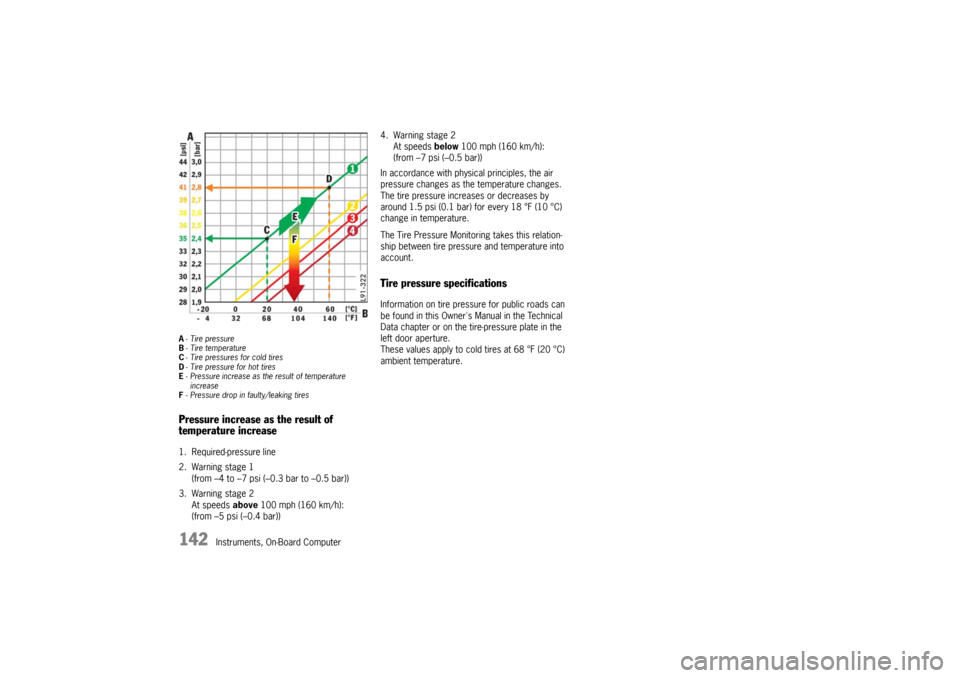
A-Tire pressure
B-Tire temperature
C-Tire pressures for cold tires
D-Tire pressure for hot tires
E-Pressure increase as the result of temperature
increase
F-Pressure drop in faulty/leaking tiresPressure increase as the result of
temperature increase1. Required-pressure line
2. Warning stage 1
(from –4 to –7 psi (–0.3 bar to –0.5 bar))
3. Warning stage 2
At speeds above 100 mph (160 km/h):
(from –5 psi (–0.4 bar))4. Warning stage 2
At speeds below 100 mph (160 km/h):
(from –7 psi (–0.5 bar))
In accordance with physical principles, the air
pressure changes as the temperature changes.
The tire pressure increases or decreases by
around 1.5 psi (0.1 bar) for every 18 °F (10 °C)
change in temperature.
The Tire Pressure Monitoring takes this relation-
ship between tire pressure and temperature into
account.
Tire pressure specificationsInformation on tire pressure for public roads can
be found in this Owner's Manual in the Technical
Data chapter or on the tire-pressure plate in the
left door aperture.
These values apply to cold tires at 68 °F (20 °C)
ambient temperature.
10_GT3_21.book Seite 142 Donnerstag, 4. Juni 2009 12:48 12
Page 145 of 251
144
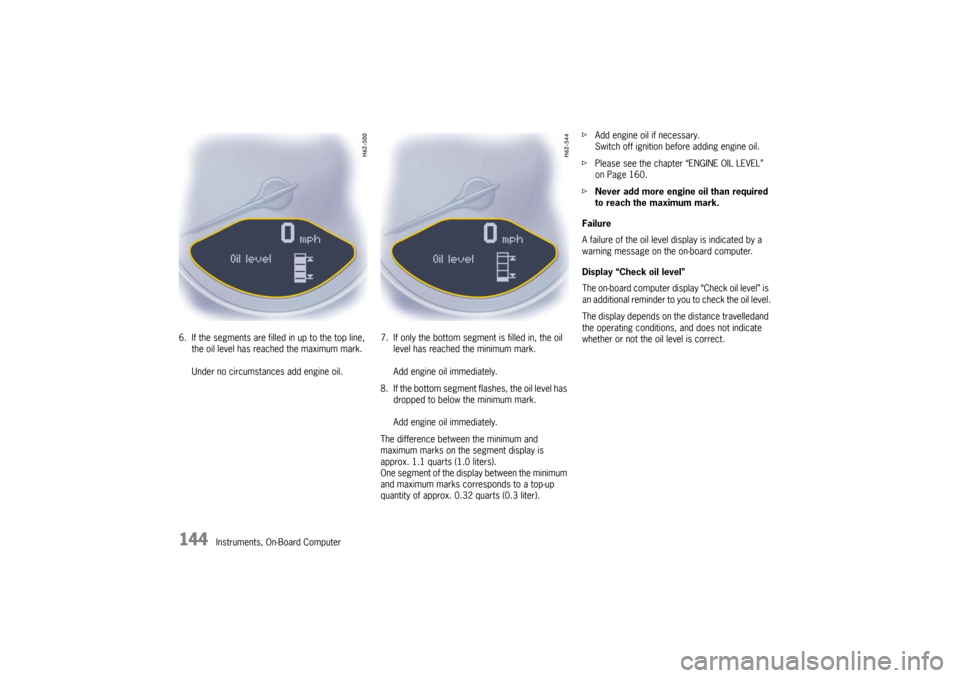
Instruments, On-Board Computer 6. If the segments are filled in up to the top line,
the oil level has reached the maximum mark.
Under no circumstances add engine oil.7. If only the bottom segment is filled in, the oil
level has reached the minimum mark.
Add engine oil immediately.
8. If the bottom segment flashes, the oil level has
dropped to below the minimum mark.
Add engine oil immediately.
The difference between the minimum and
maximum marks on the segment display is
approx. 1.1 quarts (1.0 liters).
One segment of the display between the minimum
and maximum marks corresponds to a top-up
quantity of approx. 0.32 quarts (0.3 liter).fAdd engine oil if necessary.
Switch off ignition before adding engine oil.
fPlease see the chapter “ENGINE OIL LEVEL”
on Page 160.
fNever add more engine oil than required
to reach the maximum mark.
Failure
A failure of the oil level display is indicated by a
warning message on the on-board computer.
Display “Check oil level”
The on-board computer display “Check oil level” is
an additional reminder to you to check the oil level.
The display depends on the distance travelledand
the operating conditions, and does not indicate
whether or not the oil level is correct.
10_GT3_21.book Seite 144 Donnerstag, 4. Juni 2009 12:48 12
Page 149 of 251

148
Warnings
Warnings on the instrument panel and the on-board computerIf a warning message appears, always refer to the corresponding chapters in the Owner’s Manual.
Warning messages are issued only if all measurement preconditions are met. Therefore, check all fluid levels regularly –
in particular, always check the engine oil level before refuelling.Acknowledging warning messagesWarning messages can be deleted from the on-board computer display.
fPush the on-board computer operating lever forward.
You can recall erased warning messages in the “INFO” menu.
Instrument
panelOn-board
computerText display on on-board
computerMeaning/measure
Seat belt Driver and passenger must fasten their seat belts.
Handbrake Handbrake is still on.
Ignition key
not removed
Replace battery
in ignition keyReplace the remote-control battery.
Ignition lock faulty,
visit workshopHave the fault remedied at an authorized Porsche dealer.
Ignition lock faulty,
visit workshop nowHave the fault remedied at an authorized Porsche dealer.
Relieve steering Relieve the steering lock by moving the steering wheel to the left or right.
Steering locked The steering wheel lock remains engaged.
Have the fault remedied at an authorized Porsche dealer.
10_GT3_21.book Seite 148 Donnerstag, 4. Juni 2009 12:48 12
Page 158 of 251

Maintenance, Car Care
157
Exercise Extreme Caution when
Working on your Vehicle
Danger!
Ignoring the following instructions may
cause serious personal injury or death.
fThe engine compartment of any motor vehicle
is a potentially hazardous area. If you are not
fully familiar with proper repair procedures, do
not attempt the adjustments described on the
following pages.
This caution also applies to the entire vehicle.
fO n l y w o r k o n y o u r v e h i c l e o u t d o o r s o r i n a w e l l
ventilated area.
fEnsure that there are no open flames in the
area of your vehicle at any time when fuel
fumes might be present. Be especially
cautious of such devices such as hot water
heaters which ignite a flame intermittently.
fBefore working on any part in the engine
compartment, turn the engine off and let it cool
down sufficiently. Hot engine compartment
components can burn skin on contact.
fBe alert and cautious around engine at all
times while the engine is running.
If work has to be performed with the engine
running, always set the parking brake, and
make sure the shift lever is in neutral position.fIn particular, be very careful to ensure that
items of clothing (ties, shirt, sleeves etc.),
jewelry, long hair, hand or fingers cannot get
caught in the engine-compartment blower, fan,
belts or other moving parts.
The radiator and radiator fans are in the front
of the car.
The engine-compartment blower is mounted
on the engine-compartment lid.
The engine-compartment blower can start or
continue running as a function of temperature,
even with the engine switched off.
Carry out work in these areas only with the
engine off, the ignition switched off, and
exercise extreme caution.
fYour Porsche is equipped with an electronic
ignition system. When the ignition is on, high
voltage is present in all wires connected with
the ignition system; therefore, exercise
extreme caution when working on any part of
the engine while the ignition is on or the engine
is running.
fAlways support your car with safety stands if it
is necessary to work under the car.
fWhen working under the car without safety
stands but with the wheels on the ground,
make sure the car is on level ground, the
wheels are blocked, and that the engine
cannot be started.
Remove the ignition key. fDo not smoke or allow an open flame around
the battery or fuel.
Keep a fire extinguisher close at hand.
fIncomplete or improper servicing may cause
problems in the operation o f t h e c a r. I f i n d o u b t
about any servicing, have it done by your
authorized Porsche dealer.
Improper maintenance during the warranty
period may affect your Porsche warranty
coverage.
fSupplies of fluids, e.g. engine oil, brake fluid or
coolant, are hazardous to your health.
Keep these fluids out of children’s reach and
dispose of them in accordance with the appro-
priate regulations.
fSome countries require additional tools and
special spare parts to be carried in your
vehicle.
Please make enquiries before driving abroad.
Power measurementsPower measurements on dynamometers are not
approved by Porsche.
10_GT3_21.book Seite 157 Donnerstag, 4. Juni 2009 12:48 12
Page 161 of 251

160
Maintenance, Car Care
Engine Oil Level fPlease see the chapter “EXERCISE EXTREME
CAUTION WHEN WORKING ON YOUR VEHICLE”
on Page 157.
fRegularly check the oil level using the on-board
computer after the vehicle is refueled.
Please see the chapter “OIL DISPLAY AND
MEASUREMENT OF THE ENGINE OIL LEVEL”
on Page 143.
The difference between the minimum and
maximum marks on the segment display is
approx. 1.1 quarts (1.0 liters).
Each segment of the display corresponds to
approx. 0.32 quart (0.3 liter).
Topping off engine oilPorsche recommends .1) Generally, you can find details on the
manufacturer approvals on the oil containers or as
a notice displayed by the retailer.
The current approval status is also available from
your authorized Porsche dealer.2) SAE viscosity class – Example: SAE 0W - 40
Specification 0W = Viscosity specification for low
temperatures (winter).
Specification 40 = Viscosity specification for high
temperatures.3) For all temperature ranges.4) For the temperature range above –25 °C.Always observe the following points:
– Use engine oils approved by Porsche only.
This is a precondition for optimum and
problem-free operation of your vehicle.
– Regular oil changes are part of servicing.
It is important that the service intervals,
particularly the oil change intervals, are
observed in accordance with the specifications
in the “Maintenance” booklet.
– Oils approved by Porsche can be mixed with
each other.
– Porsche engines are designed so that no oil
additives may be used.
– A label is located in the engine compartment,
which provides you with information on suitable
oil for your engine.
Your authorized Porsche dealer will be pleased to
advise you. The right oil for your vehicle
Vehicle Complies
with
approval
1)
Viscosity
class
2)
911 GT3: Porsche A40 SAE 0W - 40
3)
SAE 5W - 40
4)
SAE 5W - 50
4)
10_GT3_21.book Seite 160 Donnerstag, 4. Juni 2009 12:48 12