ESP PORSCHE 911 GT3 2010 5.G Owner's Guide
[x] Cancel search | Manufacturer: PORSCHE, Model Year: 2010, Model line: 911 GT3, Model: PORSCHE 911 GT3 2010 5.GPages: 251, PDF Size: 14.33 MB
Page 165 of 251

164
Maintenance, Car Care
Fuel Economy Fuel economy will vary depending on where,
when and how you drive, optional equipment
installed, and the general condition of your
car.
A car tuned to specifications and correctly
maintained, will help you to achieve optimal
fuel economy.
fHave your vehicle tuned to specifications.
Air cleaner should be dirt free to allow proper
engine “breathing”.
Battery should be fully charged.
Wheels should be properly aligned.
Tires should be inflated at correct pressure.
fAlways monitor your fuel consumption.
fDrive smoothly, avoid abrupt changes in speed
as much as possible.
fAvoid jack rabbit starts and sudden stops.
fDo not drive longer than necessary in the lower
gears. Shifting into a higher gear early without
lugging the engine will help save fuel.
fProlonged “warm up” idling wastes gas. Start
the vehicle just before you are ready to drive.
Accelerate slowly and smoothly.
fSwitch off the engine if stationary for longer
periods. fAny additional weight carried in the vehicle
reduces fuel economy. Always keep cargo to a
minimum and remove all unnecessary items.
fOrganize your trips to take in several errands
in one trip.
fAll electrical accessories contribute to incre-
ased fuel consumption.
fOnly switch on the air conditioning when neces-
sary.
The EPA estimated miles per gallon (mpg) is
to be used for comparison purposes, actual
mileage may be different from the estimated
mpg, depending on your driving speed,
weather conditions and trip length. Your
actual highway mileage will probably be less
than the estimated mpg.
fPlease observe all local and national speed
limits.
Operating your Porsche in other
Countries Government regulations in the United States and
Canada require that automobiles meet specific
emission regulations and safety standards. There-
fore, cars built for the U.S. and Canada differ from
vehicles sold in other countries.
If you plan to take your Porsche outside the conti-
nental limits of the United States or Canada, there
is the possibility that
– unleaded fuel may not be available;
– unleaded fuel may have a considerably lower
octane rating. Excessive engine knock and
serious damage to both engine and catalytic
converters could result;
– service may be inadequate due to lack of
proper service facilities, tools or diagnostic
equipment;
– replacement parts may not be available or very
difficult to get.
Porsche cannot be responsible for the
mechanical damage that could result
because of inadequate fuel, service or parts
availability.
If you purchased your Porsche abroad and want to
bring it back home, be sure to find out about
shipping and forwarding requirements, as well as
current import and customs regulations.
10_GT3_21.book Seite 164 Donnerstag, 4. Juni 2009 12:48 12
Page 168 of 251

Maintenance, Car Care
167
Unleaded fuels may not be available outside the
continental U.S. and Canada. Therefore, we
recommend you do not take your car to areas or
countries where unleaded fuel may not be
available. Octane ratings Octane rating indicates a fuel’s ability to resist
detonation. Therefore, buying the correct octane
gas is important to prevent engine “damage”.
The RON octane rating is based on the research
method. The CLC (U.S. Cost of Living Council
octane rating) or AKI (antiknock index) octane
rating usually displayed on U.S. fuel pumps is
calculated as research octane number plus motor
octane number, divided by 2, that is written as:
The CLC or AKI octane rating is usually lower than
the RON rating:
For example: 95 RON equals 90 CLC or AKI
Fuels containing ethanolDo not use any fuels containing more than 10
percent ethanol by volume.
We recommend, however, to change to a different
fuel or station if any of the following problems
occur with your vehicle:
– Deterioration of driveability and performance.
– Substantially reduced fuel economy.
– Vapor lock and non-start problems, especially
at high altitude or at high temperature.
– Engine malfunction or stalling. Portable Fuel Containers
Danger!
Portable fuel containers, full or partially
empty, may leak causing an explosion, or
result in fire in case of an accident.
fNever carry additional fuel in portable contai-ners in your vehicle.
Fuel Evaporation Control Fuel tank venting The evaporation chamber and the carbon canister
prevent fuel from escaping to the atmosphere at
extreme high outside temperatures, when driving
abruptly around curves and when the car is parked
at an incline or in any other nonlevel position. Vapor control system and storage When the fuel tank is filled, vapors are collected in
the evaporation chamber by a vent line leading the
vapors to the carbon canister where they are
stored as long as the engine does not run. Purge system When the engine is running, the fuel vapors from
the canister will be mixed with fresh air from the
ambient air of the canister. This mixture will be
directed to the intake air housing by the tank vent
line, mixed with the intake air and burned during
normal combustion. RON+MON
2R+M
2 or
10_GT3_21.book Seite 167 Donnerstag, 4. Juni 2009 12:48 12
Page 169 of 251

168
Maintenance, Car Care
Emission Control SystemIn the interest of clean air Pollution of our environment has become a
problem that is of increasing concern to all of us.
We urge you to join us in our efforts for cleaner air
in controlling the pollutants emitted from the
automobile.
Porsche has developed an emission control
system that controls or reduces those parts of the
emission that can be harmful to our environment.
Your Porsche is equipped with such a system.
Porsche warrants the Emission Control System in
your new car under the terms and conditions set
forth in the Warranty Booklet.
You, as the owner of the vehicle, have the
responsibility to provide regular maintenance
service for the vehicle and to keep a record of all
maintenance work performed. To facilitate record
keeping, have the service performed by autho-
rized Porsche dealers. They have Porsche trained
technicians and special tools to provide fast and
efficient service. To assure efficient operation of the Emission
Control System:
fHave your vehicle maintained properly and in
accordance with the recommendations
described in your Maintenance Booklet.
Lack of proper maintenance, as well as
improper use of the vehicle, will impair the
function of the emission control system and
could lead to damage.
fDo not alter or remove any component of the
emission control system.
fDo not alter or remove any device, such as
heat shields, switches, ignition wires, valves,
etc., which are designed to protect your
vehicle’s emission control system.
In addition to serious engine damage, this can
result in a fire if excess raw fuel reaches the
exhaust system.
fDo not continue to operate your vehicle if you
detect engine misfire or other unusual opera-
ting conditions.
Parking
Warning!
Danger of fire resulting in serious personal
injury or death.
fDo not park or operate the vehicle in areas
where the hot exhaust system may come in
contact with dry grass, brush, fuel spill or
other flammable material.
fIf your car catches on fire for any reason, call
the fire department.
Do not endanger your life by attempting to put out the fire.
Undercoating
Danger!
Danger of fire resulting in serious personal
injury or death.
fDo not apply additional undercoating or rust-
proofing on or near the exhaust manifold,
exhaust pipes, catalytic converters or heat
shields. During driving the substance used for undercoating could overheat and ignite.
10_GT3_21.book Seite 168 Donnerstag, 4. Juni 2009 12:48 12
Page 174 of 251

Maintenance, Car Care
173
Wiper Blades Wiper blades that are in perfect condition are vital
for a clear view.
fReplace the wiper blades twice per year
(before and after the cold season) or whenever
wiper performance deteriorates.
Caution!
Risk of damage if the wiper arm accidentally
falls back on to the window.
fAlways hold the wiper arm securely when repla-
cing the wiper blade.
Risk of damage if wiper blades that are
frozen in place are loosened improperly.
fThaw the wiper blades before loosening them.
Maintenance note
fPeriodically clean the wiper blades with
window cleaner, especially after the vehicle
has been washed in a car wash.
We recommend the Porsche window cleaner. If
they are very dirty (e.g. with insect remains),
the windows can be cleaned with a sponge or
cloth.If the wiper blades rub or squeak, this can be as a
result of the following:
– If the vehicle is washed in an automatic car
wash, wax residues may adhere to the winds-
hield. These wax residues can be removed
only by using window cleaner concentrate.
– The wiper blades may be damaged or worn.
fReplace damaged or worn wiper blades as
soon as possible.
fPlease see the chapter “WASHER FLUID” on
Page 170.
fPlease contact your authorized Porsche dealer
for further information.
Changing windshield wiper bladesfPlease follow the separate instructions for
fitting wiper blades as supplied by the
manufacturer.
fWe recommend that you get your authorized
Porsche dealer to replace the wiper blades.
Caution!
Risk of damage.
If a wiper blade is not changed properly, it
can come loose when the car is moving.
fCheck whether the wiper blade is seated
securely.
The wiper blade must engage the wiper arm properly.
10_GT3_21.book Seite 173 Donnerstag, 4. Juni 2009 12:48 12
Page 178 of 251

Maintenance, Car Care
177
Engine compartment The engine compartment and the surface of the
engine are treated with a corrosion-inhibitor at the
factory.
If degreasing solvents are used to clean the
engine compartment or the engine is washed
down, the process almost invariably removes the
corrosion-inhibiting coating. It is then absolutely
necessary to have a durable preservative applied
to all surfaces, body seams, joints and assemblies
in the engine compartment. This also applies
when corrosion-inhibitor parts are replaced.
Caution!
Risk of damage to the alternator.
fDo not point the cleaning jet directly at the alternator, or cover the alternator.
Effective corrosion-proofing is particularly impor-
tant during the cold weather season. If your car is
driven frequently in areas where salt has been
spread on the roads, the whole engine compart-
ment should be cleaned thoroughly after the
winter to prevent salt from causing any lasting
damage. A full under-body wash should also be
performed at the same time.
Windows The road dust which settles on the windshield and
windows contains particles of tire rubber and oil
residue. The interior trim and upholstery release
particles, particularly in strong sunlight, which
collect on the insides of the windows. These
deposits are augmented by impurities in the air
which enters the car through the fresh air vents.
fClean all windows regularly, inside and outside,
with Porsche window cleaner.
fIf you use a chamois leather for the windows,
do not use it for paintwork as it will otherwise
pick up a certain amount of preservative or
polish and could smear the windows and thus
impair vision.
fRemove dead insects with Porsche insect
remover.
Note
Door windows feature a water-repellent (hydro-
phobic) coating which prevents soiling of the
windows.
This coating is subject to natural wear and can be
renewed.
fConsult an authorized Porsche dealer.
Wiper blades Wiper blades that are in perfect condition are vital
for a clear view.
fReplace the wiper blades twice per year
(before and after the cold season) or whenever
wiper performance deteriorates.
fPeriodically clean the wiper blades with
Porsche window cleaner, especially after the
vehicle has been washed in a car wash.
If they are very dirty (e.g. with insect remains),
they can be cleaned with a sponge or cloth.
If the wiper blades rub or squeak, this can be as a
result of the following:
– If the vehicle is washed in an automatic car
wash, residues may adhere to the windshield.
These wax residues can be removed only by
using window cleaner concentrate.
– The wiper blades may be damaged or worn.
fReplace damaged wiper blades as soon as
possible.
Please see the chapter “WIPER BLADES” on
Page 173.
fPlease see the chapter “WASHER FLUID” on
Page 170.
fPlease contact your authorized Porsche dealer
for further information.
10_GT3_21.book Seite 177 Donnerstag, 4. Juni 2009 12:48 12
Page 182 of 251

Maintenance, Car Care
181
Storing your Porsche If you intend to store your Porsche for a prolonged
period, please consult your authorized Porsche
dealer. The staff will be glad to advise you on the
most suitable and necessary methods.
fClean your vehicle thoroughly inside and
outside.
Clean the engine compartment.
The under carriage and chassis components
should be free of dirt and salt deposits.
fFill up the fuel tank.
fChange the oil and oil filter, and run the engine
for several minutes.
fIncrease the tire pressure to 58 psi (4 bar).
It is not recommended to lift the vehicle, due to
the possibility of corrosion on shock absorber
piston shafts.
The vehicle should be moved slightly, approxi-
mately every four weeks, to prevent flat spot
on the tires. Climate control
The air conditioning system should be in good
working condition and fully charged.
Windshield/Headlight washer
fCheck and correct antifreeze/cleaning solution
level as necessary.
Electrical system
fRemove the battery from the vehicle and store
it in a cool dry place, not on a cement floor.
When the battery is disconnected, the
alarm system is deactivated.
fRecharge the battery every 3 months. If the
battery remains in the vehicle with the cables
connected, it is necessary to check, remove
and recharge the battery every 2-3 weeks.
Do not fast charge the battery.
fPlease see the chapter “BATTERY” on
Page 211.Vehicle interior
The interior must be dry, especially in the area of
the floor carpets. The use of drying agents (Silica-
Gel) is recommended in vehicles with leather
interior and in areas with high humidity. The
recommended amount is 3 fabric bags of 1.1 lbs.
(500 grams) each placed on the floor carpets.
Windows, doors and lids must be closed. The air
vents should be opened.
10_GT3_21.book Seite 181 Donnerstag, 4. Juni 2009 12:48 12
Page 184 of 251

Practical Tips, Emergency Service
183
Exercise Extreme Caution when
Working on your Vehicle
Danger!
Ignoring the following instructions may
cause serious personal injury or death.
fThe engine compartment of any motor vehicle
is a potentially hazardous area. If you are not
fully familiar with proper repair procedures, do
not attempt the adjustments described on the
following pages.
This caution also applies to the entire vehicle.
fO n l y w o r k o n y o u r v e h i c l e o u t d o o r s o r i n a w e l l
ventilated area.
fEnsure that there are no open flames in the
area of your vehicle at any time when fuel
fumes might be present. Be especially
cautious of such devices such as hot water
heaters which ignite a flame intermittently.
fBefore working on any part in the engine
compartment, turn the engine off and let it cool
down sufficiently. Hot engine compartment
components can burn skin on contact.
fBe alert and cautious around engine at all
times while the engine is running.
If work has to be performed with the engine
running, always set the parking brake, and
make sure the shift lever is in neutral position.fIn particular, be very careful to ensure that
items of clothing (ties, shirt, sleeves etc.),
jewelry, long hair, hand or fingers cannot get
caught in the engine-compartment blower, fan,
belts or other moving parts.
The radiator and radiator fan are in the front of
the car.
The engine-compartment blower is mounted
on the engine-compartment lid.
The engine-compartment blower can start or
continue running as a function of temperature,
even with the engine switched off.
Carry out work in these areas only with the
engine off, the ignition switched off, and
exercise extreme caution.
fYour Porsche is equipped with an electronic
ignition system. When the ignition is on, high
voltage is present in all wires connected with
the ignition system; therefore, exercise
extreme caution when working on any part of
the engine while the ignition is on or the engine
is running.
fAlways support your car with safety stands if it
is necessary to work under the car.
Jacks are not suitable for this kind of work.
fWhen working under the car without safety
stands but with the wheels on the ground,
make sure the car is on level ground, the
wheels are blocked, and that the engine
cannot be started.
Remove the ignition key.fDo not smoke or allow an open flame around
the battery or fuel.
Keep a fire extinguisher in close reach.
fIncomplete or improper servicing may cause
problems in the operation o f t h e c a r. I f i n d o u b t
about any servicing, have it done by your
authorized Porsche dealer.
Improper maintenance during the warranty
period may affect your Porsche warranty
coverage.
fSupplies of fluids, e.g. engine oil, brake fluid or
coolant, are hazardous to your health.
Keep these fluids out of children’s reach and
dispose of them in accordance with the appro-
priate regulations.
fSome countries require additional tools and
special spare parts to be carried.
Please make enquiries before driving abroad.
10_GT3_21.book Seite 183 Donnerstag, 4. Juni 2009 12:48 12
Page 186 of 251

Practical Tips, Emergency Service
185
Treadwear
The treadwear grade is a comparative rating
based on the wear rate of the tire when tested
under controlled conditions on a specific govern-
ment test course.
For example, a tire graded 150 would wear one
and a half (1-1/2) times as well on the government
course as a tire graded 100.
The relative performance of tires depends upon
the actual conditions of their use, however, and
may depart significantly from the norm due to var-
iations in driving habits, service practices and dif-
ferences in road characteristics and climate.
Traction AA, A, B, C
The traction grades, from highest to lowest, are
AA, A, B, and C and they represent the tire’s ability
to stop on wet pavement as measured under
controlled conditions on specified government
test surfaces of asphalt and concrete.
A tire marked C may have poor traction perfor-
mance.
Warning!
The traction grade assigned to this is based on
braking (straight-ahead) traction tests and does
not include cornering (turned) traction, accelera-
tion, hydroplaning or peak traction characteris-
tics. Temperature A, B, C
The temperature grades are A (the highest), B and
C, representing the tire’s resistance to the genera-
tion of heat and its ability to dissipate heat when
tested under controlled conditions on a specified
indoor laboratory test wheel.
Sustained high temperatures can cause the
material of the tire to degenerate and reduce tire
life, and excessive temperature can lead to
sudden tire failure.
The grade C corresponds to a level of perfor-
mance which all passenger car tires must meet
under the Federal Motor Vehicle Safety Standard
No. 109.
Grades B and A represent higher levels of perfor-
mance on the laboratory test wheel than the
minimum required by law.
Warning!
The temperature grade for this tire is established
for a tire that is properly inflated and not
overloaded.
Excessive speed, underinflation, or excessive
loading, either separately or in combination, can
cause heat buildup and possible tire failure, resul-
ting in serious personal injury or death.
Tire pressures
Warning!
Incorrect tire pressure causes increased tire
wear and adversely affects road handling.
This could lead to tire failure, resulting in loss
of control, leading to serious personal injury
or death.
fAlways use an accurate tire pressure gauge
when checking inflation pressures.
fDo not exceed the maximum tire pressure
listed on the tire sidewall.
Please see the chapter “TIRE PRESSURE
PLATE” on Page 235.
fCold tire inflation pressure means: all tires
must be cold, ambient temperature maximum
(68 °F/20 °C)
, when adjusting the inflation
pressure.
Avoid sunlight striking the tires before measu-
ring cold pressures, since the pressures would
rise from temperature influence.
fValve caps protect the valve from dust and dirt,
and thus from leakage.
Always screw caps tightly down.
Replace missing caps immediately.
fUse only plastic valve caps.
fDo not use commercially available sealant or
tire inflating bottles. Only use Porsche approved tire sealant.
10_GT3_21.book Seite 185 Donnerstag, 4. Juni 2009 12:48 12
Page 187 of 251
186
Practical Tips, Emergency Service fPlease see the chapter “TIRE PRESSURES FOR
COLD TIRES 68 °F/20 °C” on Page 237.
Each tire, should be checked every 2 weeks when
cold (68 °F/20 °C) and inflated to the inflation
pressure recommended in this Owner's Manual or
on the tire-pressure plate.
If your vehicle has tires of a different size than the
size indicated in this Owner's Manual or on the tire-
pressure plate, you should determine the proper
tire inflation pressure for those tires.
As an added safety feature, your vehicle has been
equipped with a tire pressure monitoring (TPM)
that illuminates a low tire pressure message when
one or more of your tires is significantly under-
inflated. Accordingly, when the low tire pressure
message illuminates, you should stop and check
your tires as soon as possible, and inflate them to
the proper pressure. Driving on a significantly
under-inflated tire causes the tire to overheat and
can lead to tire failure. Under-inflation also
reduces fuel efficiency and tire tread life, and may
affect the vehicle’s handling and stopping ability.
Please note that the TPM is not a substitute for
proper tire maintenance, and it is the driver’s
responsibility to maintain correct tire pressure,
even if under-inflation has not reached the level to
trigger illumination of the TPM low tire pressure
message.
fPlease see the chapter “TPM TIRE PRESSURE
MONITORING” on Page 134.
When tires are warm, the tire pressure is
increased.fNever let air out of hot tires.
This could cause the tire pressure to fall below
the prescribed value.
Insufficient tire filling pressure can cause tires to
overheat and thus be damaged – even invisibly.
Hidden tire damage is not eliminated by subse-
quently correcting the tire pressure.
Overloading
Danger!
Risk of damage to vehicle parts, loss of
control and serious personal injury or death.
fDo not overload your vehicle.
fIf loading the vehicle also correct the tire
pressure. Tire pressure for loaded vehicle can
be found on the tire pressure plate and in the
chapter technical data.
fNever exceed the specified axle load.
Overloading can shorten the service life of the
tires and car, as well as lead to dangerous
vehicle reactions and long braking distances.
Damage due to overloading is not covered by the vehicle warranty.
fPlease see the chapter “LOADING INFORMA-
TION” on Page 195.
fPlease see the chapter “TIRE PRESSURES FOR
COLD TIRES 68 °F/20 °C” on Page 237.
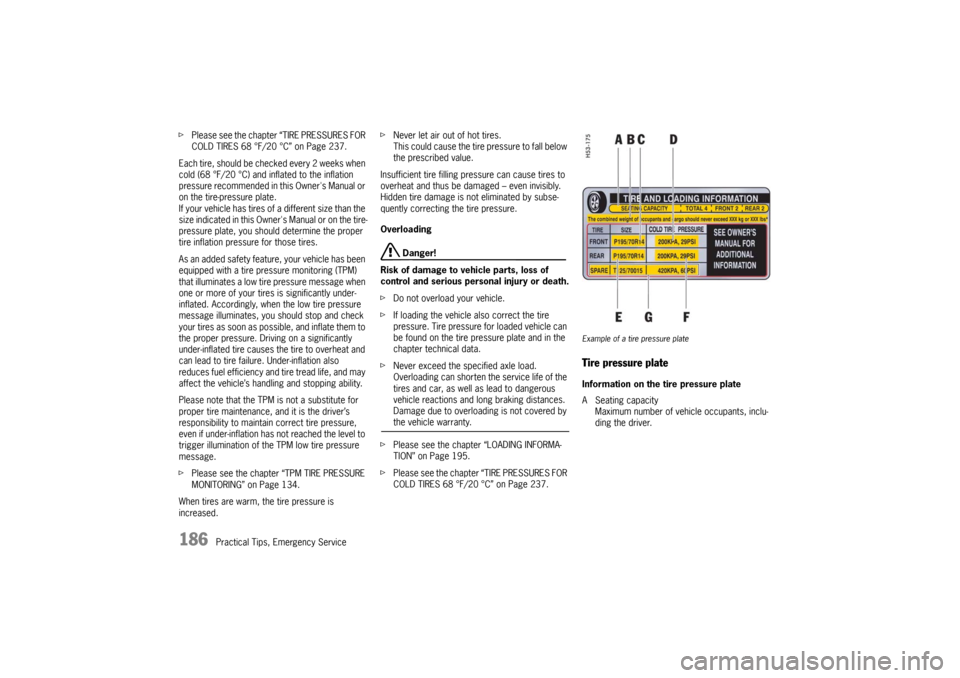
Example of a tire pressure plateTire pressure plateInformation on the tire pressure plate
A Seating capacity
Maximum number of vehicle occupants, inclu-
ding the driver.
10_GT3_21.book Seite 186 Donnerstag, 4. Juni 2009 12:48 12
Page 190 of 251

Practical Tips, Emergency Service
189
Danger!
Risk of serious personal injury or death.
Driving the vehicle with low tire pressure
increases risk of a tire failure and resulting
loss of control. Furthermore, low tire
pressure increases rate of wear of the
affected tires.
fCheck tires – including sidewalls – regularly for
foreign bodies, nicks, cuts, cracks and bulges.
fAfter driving off road, examine tires for signs
of damage such as cuts, tears, bulges or
foreign objects stuck in the tread. Replace a
damaged tire if necessary.
fCross curb edges slowly and at right angles if
possible.
Avoid driving over steep or sharp curbs.
fIn cases of doubt, have the wheel (particularly
the inner side) checked by an authorized Porsche dealer.
Tire replacements If in doubt, contact your authorized Porsche
dealer.
Use only tire makes and types approved by
Porsche.
If you do not use a Porsche recommended
replacement tire, make sure that you
purchase your new tires from a reputable tire
dealer and that the dealer complies with all
manufacturers warnings for those tires.
Only tires with the same make and with the
same specification code (e.g. “N0”, “N1”...)
can be mounted.
Before mounting new tires, check with your
Porsche dealer about the current release
status.
Use tires with “ZR” quality standards. There
are currently no standards concerning tire
strength at speeds above 150 mph (240 km/h).
Tires should be replaced no less than on one axle
at the time.
Only tires of the same make and type must be
used. Mixed tires are not permissible.
Initially, new tires do not have their full traction.
You should therefore drive at moderate speeds
during the first 60 - 120 miles (100 - 200 km). If new tires are installed only on one axle, a notice-
able change in handling occurs due to the different
tread depth of the other tires.
This happens especially if only rear tires are
replaced. However, this condition disappears as
the new tires are broken in.
fPlease adjust your driving style accordingly.
Installation of new tires should only be done by a
qualified tire technician.
Valves
Please observe the installation and replacement
instructions for valves.
fUse only genuine Porsche metal valves.
fProtect the valve inserts against soiling with
valve caps.
Soiled valve inserts can cause a gradual loss
of air.
fUse only plastic valve caps.
10_GT3_21.book Seite 189 Donnerstag, 4. Juni 2009 12:48 12