warning light PORSCHE 911 GT3 2010 5.G Owner's Manual
[x] Cancel search | Manufacturer: PORSCHE, Model Year: 2010, Model line: 911 GT3, Model: PORSCHE 911 GT3 2010 5.GPages: 251, PDF Size: 14.33 MB
Page 56 of 251

Operation, Safety
55
Brake system warning light
You can check the functionality of the brake
system warning light by switching the ignition to
the “On” position and verifying that the warning
light illuminates.
If the warning lights in the instrument panel and on-
board computer go on while driving, the brake
fluid level may be too low, or (if the brake pedal
travel has increased) one of the two brake circuits
may have failed.
A greater braking pressure will be required,
stopping distances will be longer and the braking
behavior will change, particularly in curves.
With correctly adjusted brakes, and a correctly
working brake system, the pedal travel to the
point of brake actuation should be 1-3/16 in. to
1-9/16 in. or 30 to 40 mm.
Whenever the brake pedal travel exceeds this
distance, have the brake system checked.
Brake pedal
Warning!
Risk of an accident, resulting in serious
personal injury or death.
Any obstruction of the brake pedal could
increase the stopping distance.
fAlways check the movement of the brake pedal
before driving and make sure that it is not
obstructed by a floor mat or any other object.
fSecure the floor mat to prevent it from sliding
into positions that could interfere with the safe
operation of your vehicle.
Your Porsche dealer will be glad to offer you nonskid floor mats of the correct size.
Note
In case one of the two brake circuits fails, incre-
ased pedal travel is required to bring your vehicle
to a full stop.
Warning!
To avoid overheating and premature wear of
the brakes:
fBefore descending a steep grade, reduce
speed and shift the transmission into a lower
gear to control speed.
fDo not “ride the brakes” by resting your foot on
the pedal when not intending to apply brake
pressure.
fDo not hold the pedal down too long or too
often.
This could cause the brakes to get hot and not function properly.
Brake warning light USA
Brake warning light Canada
10_GT3_21.book Seite 55 Donnerstag, 4. Juni 2009 12:48 12
Page 57 of 251

56
Operation, Safety
Brake booster The brake booster assists braking only when
the engine is running.
When the car is moving while the engine is not
running, or if the brake booster is defective, more
pressure on the brake pedal is required to bring
the car to a stop.
If this happens, ABS and PSM will also not
operate.
Moisture or road salt on brakes affects braking.
Brakes will dry after a few cautious brake applica-
tions.
Warning!
Risk of an accident, resulting in serious
personal injury or death.
Driving through water may reduce the
traction.
Moisture on brakes from road water, car
wash, or coating of road salt may affect
braking efficiency.
fCautiously apply brakes to test brakes after exposure to road water, etc.
Brake wear Your car has excellent brakes, but they are still
subject to wear. The rate at which they wear
depends on how the brakes are used.
fHave the brake system inspected at the
intervals recommended in your Maintenance
Booklet.
Brake system warning light
You can check the functionality of the brake
system warning light by switching the ignition to
the “On” position and verifying that the warning
light illuminates.
If the warning lights in the instrument panel and on-
board computer stay on when the engine is
running or come on while driving, the brake pads
are worn excessively.
fDo not continue to operate the vehicle.
Have your authorized Porsche dealer inspect
or replace the brake pads.
Brake pads Wear on the brake pads and brake discs depends
to a great extent on the driving style and the condi-
tions of use and therefore cannot be expressed in
actual miles on the road.
The high-performance brake system is designed
for optimal braking effect at all speeds and tempe-
ratures.
Certain speeds, braking forces and ambient
conditions (such as temperature and humidity)
therefore might cause “brake noises”. This also
applies after completion of the breaking-in period
required for the new brake components.
New brake pads or linings
New brake pads and brake discs have to be
“broken in”, and therefore only attain optimal
friction when the car has covered several hundred
miles or km.
The slightly reduced braking ability must be
compensated for by pressing the brake pedal
harder. This also applies whenever the brake pads
and brake discs are replaced.
Warning light USA
Warning light Canada
10_GT3_21.book Seite 56 Donnerstag, 4. Juni 2009 12:48 12
Page 59 of 251

58
Operation, Safety When the ignition is switched on the ABS warning
light will light up while the system is electronically
interrogated and goes out when the engine is
started if the check is not yet complete.
If the ABS warning lamp fails to go out, this
indicates that ABS has been deactivated due to a
fault. If the warning lights in the instrument panel
and on-board computer light up while you are
driving, this indicates that a fault has occurred. In
both cases, normal braking, as in vehicles without
ABS, is still retained.
The ABS system should, however, be examined at
an authorized Porsche dealer immediately to
prevent the occurrence of further faults.
fIf the ABS system becomes inoperative, take
your vehicle to your authorized Porsche dealer
immediately.
Warning!
Risk of an accident, resulting in serious
personal injury or death.
The control unit of the ABS brake system is
set for standard tire size. If non-standard
tires are installed, the control unit may misin-
terpret the speed of the vehicle, because of
the variant data it receives from the sensors
on the axles.
fUse only tire makes and types tested by Porsche.
Warning light USA
Warning light Canada
10_GT3_21.book Seite 58 Donnerstag, 4. Juni 2009 12:48 12
Page 60 of 251

Operation, Safety
59
Porsche Stability Management
(PSM)PSM is an active control system for stabilization of
the vehicle during extreme driving maneuvers.
Warning!
Risk of an accident, resulting in serious
personal injury or death.
The increased control that is provided should
not induce you to take greater risks with your
safety. The limits dictated by the laws of
physics cannot be overcome, even with PSM.
The risk of accidents due to inappropriate
speed cannot be reduced, even by PSM.
The driver bears the responsibility for all
driving maneuvers.
fAdapt your driving style to the prevailing road
and weather conditions.
fObey all traffic laws.
Sensors at the wheels, brakes, steering system
and engine continuously measure:
–Speed
– Direction of travel (steering angle)
– Lateral acceleration
– Rate of turn about the vertical axis
– Longitudinal accelerationPSM uses these values to determine the direction
of travel indicated by the driver.
PSM intervenes and helps to correct the course if
the actual direction of motion deviates from the
chosen course (steering-wheel position):
It brakes individual wheels as needed. In addition,
the engine power may be manipulated in order to
stabilize the vehicle.
The events below inform the driver of PSM control
operations and warn him/her to adapt his/her
driving style to the road conditions:
– The multifunctional information light on the
instrument panel flashes.
– Hydraulic noises can be heard.
– The vehicle decelerates and steering-wheel
forces are altered as PSM controls the brakes.
– Reduced engine power.
– The brake pedal pulsates and its position is
changed during braking.
In order to achieve full vehicle deceleration,
foot pressure must be increased after the
brake pedal has begun vibrating.
Advantages of PSM– Improved traction and lane-holding ability in all
driving situations – even on road surfaces with
varying friction.
– The system compensates for undesired lateral
vehicle reactions when the driver releases the
accelerator pedal or brakes when cornering.
This compensation functions up to the
maximum lateral acceleration.
– PSM actively helps stabilize the vehicle as
required during dynamic driving maneuvers
(e.g. rapid steering movements, during lane
changes or on alternating bends).
– Improved braking stability in curves and on
different or varying road surfaces.
10_GT3_21.book Seite 59 Donnerstag, 4. Juni 2009 12:48 12
Page 64 of 251
Operation, Safety
63
The previously selected PASM mode is always
activated after the engine is started.
There is no automatic return to Normal mode after
the ignition is switched off.
PASM makes two running-gear setups available to
the driver: “Normal” and “Sport”.
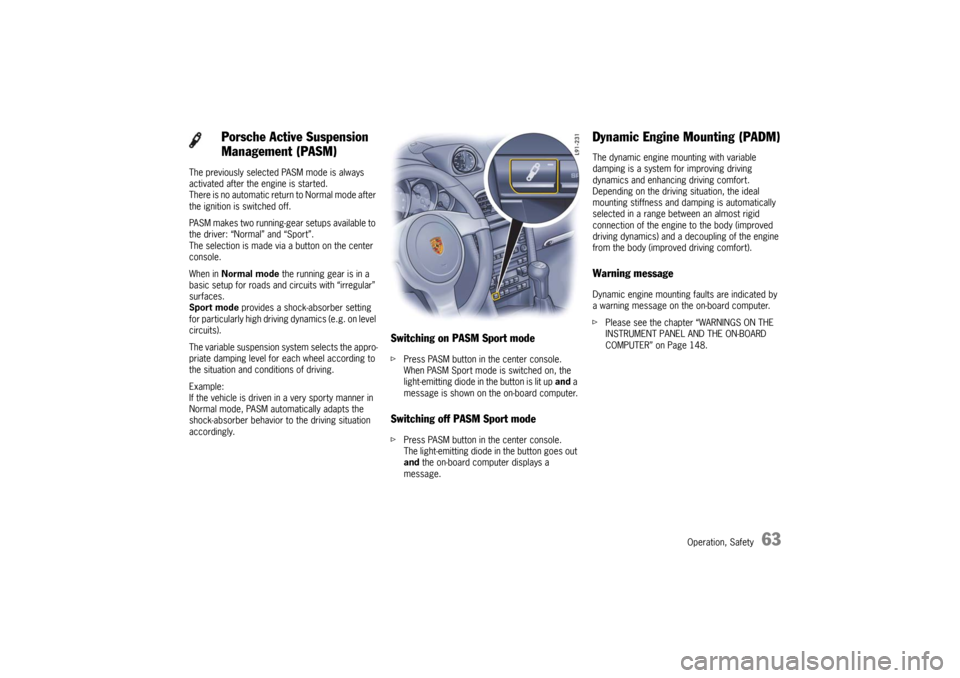
The selection is made via a button on the center
console.
When in Normal mode the running gear is in a
basic setup for roads and circuits with “irregular”
surfaces.
Sport mode provides a shock-absorber setting
for particularly high driving dynamics (e.g. on level
circuits).
The variable suspension system selects the appro-
priate damping level for each wheel according to
the situation and conditions of driving.
Example:
If the vehicle is driven in a very sporty manner in
Normal mode, PASM automatically adapts the
shock-absorber behavior to the driving situation
accordingly.
Switching on PASM Sport modefPress PASM button in the center console.
When PASM Sport mode is switched on, the
light-emitting diode in the button is lit up and a
message is shown on the on-board computer.Switching off PASM Sport modefPress PASM button in the center console.
The light-emitting diode in the button goes out
and the on-board computer displays a
message.
Dynamic Engine Mounting (PADM)The dynamic engine mounting with variable
damping is a system for improving driving
dynamics and enhancing driving comfort.
Depending on the driving situation, the ideal
mounting stiffness and damping is automatically
selected in a range between an almost rigid
connection of the engine to the body (improved
driving dynamics) and a decoupling of the engine
from the body (improved driving comfort).Warning messageDynamic engine mounting faults are indicated by
a warning message on the on-board computer.
fPlease see the chapter “WARNINGS ON THE
INSTRUMENT PANEL AND THE ON-BOARD
COMPUTER” on Page 148.
Porsche Active Suspension
Management (PASM)
10_GT3_21.book Seite 63 Donnerstag, 4. Juni 2009 12:48 12
Page 66 of 251

Operation, Safety
65
Lowering front axle fPress button in the center console.
The vehicle is lowered to the basic level.
The light-emitting diode in the button and in the
tachometer goes out.
Caution!
Risk of damage through bottoming out the
vehicle.
fDo not lower the vehicle when it is positioned above an obstacle.
Notes on operation
Warning messageFront axle lift system faults are indicated by
a warning message on the on-board computer.
fPlease see the chapter “WARNINGS ON THE
INSTRUMENT PANEL AND THE ON-BOARD
COMPUTER” on Page 148.
– When raised, the damping properties of the
front axle change and noise may be heard in
the area of the front axle coil springs during
steering movements.
– The doors must be closed when lowering the
front axle.
–The blowing-off procedure may result in
system-related hissing noise. This does not
represent a malfunction in the lift system.– During extended vehicle immobilization, the
pressure accumulator may be completely
emptied. In this case, the first time the axle is
raised, a period of up to 2 minutes may elapse
before the vehicle height is reached and “LIFT”
is displayed.
– A flashing LED in the button indicates that the
system is currently not available. Possible
causes may be:
> Automatic overload protection is active.
The system will be available again
following a brief cooling-down phase.
The cooling-down phase may be
extended when outside temperatures
are very high.
> The speed threshold of 30 mph
(50 km/h) has been exceeded. The
system will be available again once the
speed falls below the threshold.
> If automatic lowering is actuated by
exceeding a speed of approx. 30 mph
(50 km/h) in combination with hard
acceleration, the required lowering
duration may mean that “LIFT not
lowered” is displayed. The display goes
out again as soon as the front axle has
been completely lowered.
10_GT3_21.book Seite 65 Donnerstag, 4. Juni 2009 12:48 12
Page 71 of 251

70
Operation, Safety
Starting Procedures fPlease see the chapter “IMMOBILIZER” on
Page 18.
fPlease see the chapter “EMISSION CONTROL
SYSTEM” on Page 168.
Warning!
Serious injury or death may result if you are
involved in a collision without having
fastened the safety belts.
fFasten safety belts before driving away. Before starting the engine fApply the footbrake.
fMove the gearshift lever into neutral.
The clutch pedal must be depressed fully
before the starter will engage.
Temperature sensors on the engine automatically
provide the correct fuel/air mixture required for
starting.
Therefore, it is not necessary to depress the
accelerator pedal while starting a cold or a
warm engine.
Starting the enginefTurn ignition key to ignition lock position 2.
fAs soon as the engine starts, release the
ignition key.
The first operation of the starter is ended
automatically when the engine starts.
If the engine does not start, subsequent starter
operations will not be ended automatically.
If the engine fails to start after 10 or 15 seconds
of cranking:
fWait about 10 seconds before engaging the
starter again.
fWhen starting the engine, be ready to drive
immediately.
Drive vehicle at moderate speeds and avoid
engine speeds above 4,200 rpm during the
first 5 minutes.
fDo not let the engine idle to warm up.
Danger!
Engine exhaust fumes have many compon-
ents which you can smell. They also contain
carbon monoxide (CO), which is a colorless
and odorless gas.
Carbon monoxide can cause unconscious-
ness and even death if inhaled.
fNever start or let the engine run in an
enclosed, unventilated area.
It is not recommended to sit in your car for
prolonged periods with the engine on and the
car not moving.
An unattended vehicle with a running engine
is potentially hazardous.
If warning lights should come on to indicate
improper operation, they would go
unnoticed.
fNever leave the engine idling unattended.
Risk of fire due to hot exhaust system.
fDo not park or operate the vehicle in areas
where the hot exhaust system may come in
contact with dry grass, brush, fuel spill or
other flammable material.
fIf your car catches on fire for any reason, call
the fire department.
Do not endanger your life by attempting to put out the fire.
10_GT3_21.book Seite 70 Donnerstag, 4. Juni 2009 12:48 12
Page 73 of 251
72
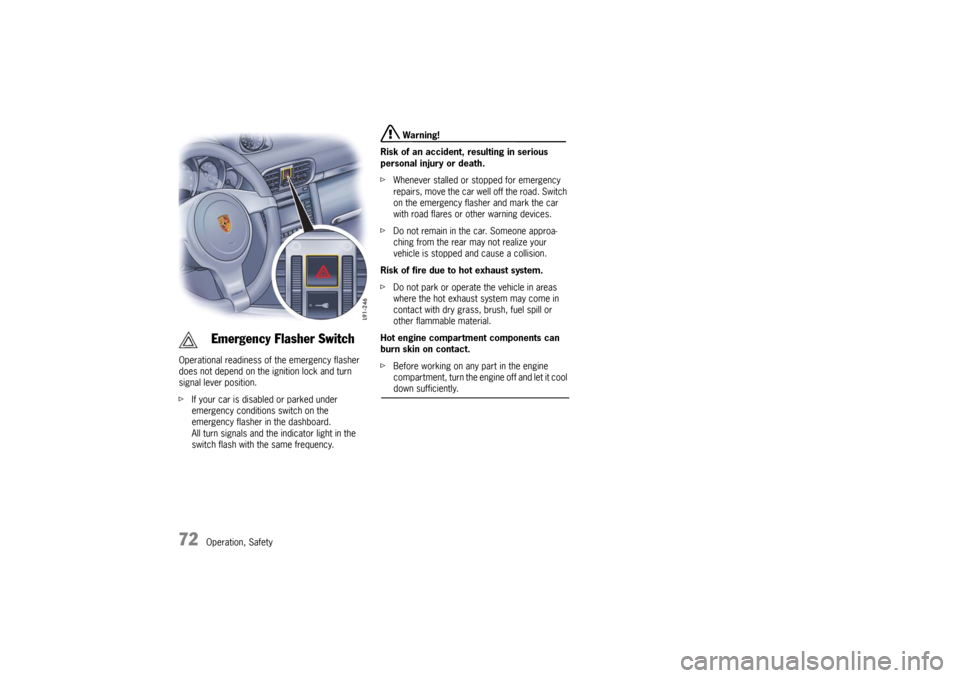
Operation, Safety Operational readiness of the emergency flasher
does not depend on the ignition lock and turn
signal lever position.
fIf your car is disabled or parked under
emergency conditions switch on the
emergency flasher in the dashboard.
All turn signals and the indicator light in the
switch flash with the same frequency.
Warning!
Risk of an accident, resulting in serious
personal injury or death.
fWhenever stalled or stopped for emergency
repairs, move the car well off the road. Switch
on the emergency flasher and mark the car
with road flares or other warning devices.
fDo not remain in the car. Someone approa-
ching from the rear may not realize your
vehicle is stopped and cause a collision.
Risk of fire due to hot exhaust system.
fDo not park or operate the vehicle in areas
where the hot exhaust system may come in
contact with dry grass, brush, fuel spill or
other flammable material.
Hot engine compartment components can
burn skin on contact.
fBefore working on any part in the engine
compartment, turn the engine off and let it cool down sufficiently.
Emergency Flasher Switch
10_GT3_21.book Seite 72 Donnerstag, 4. Juni 2009 12:48 12
Page 74 of 251
Operation, Safety
73
Warning chime
If the ignition key is withdrawn and the door is
opened while the lights (not the parking light or
Welcome Home lighting) are on, a chime warns of
possible battery discharge.
In some countries, differences are possible
due to provisions of law.
Daytime running lightsThe daytime running lights are integrated in the
front auxiliary headlights. These lights are
switched on only when the engine is running and
with the light switch in the positions OFF or HOME.
Operation of the daytime running lights may vary
depending on country-specific regulations.
Canada only:
In addition to the auxiliary headlights the parking
lights are switched on.
USA only:
The daytime running lights can be deactivated in
the on-board computer.
fPlease see the chapter “LIGHT” on Page 146.
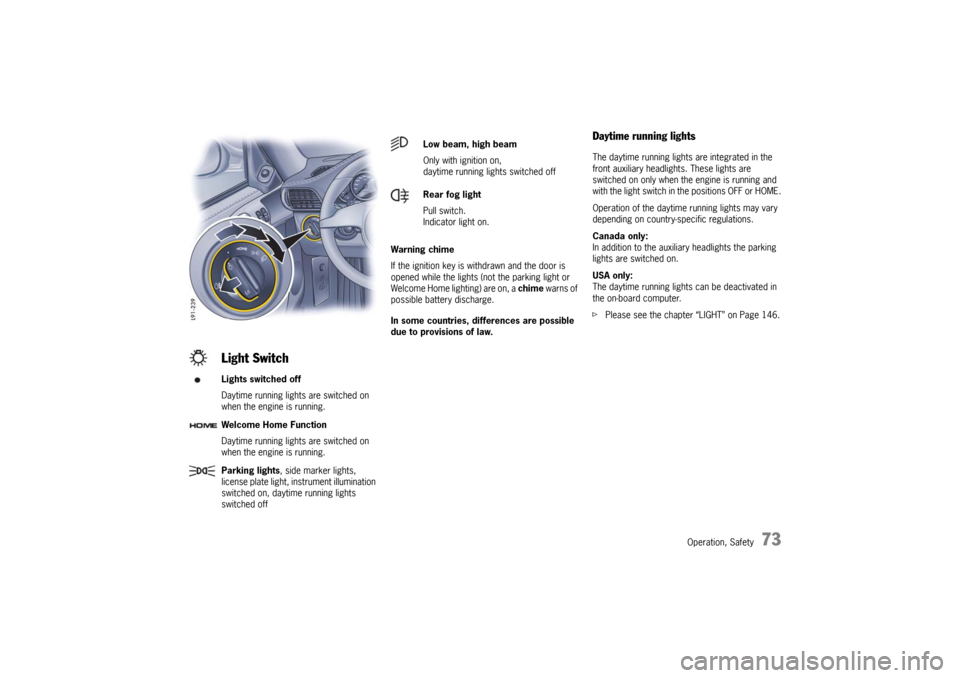
Light SwitchLights switched off
Daytime running lights are switched on
when the engine is running.
Welcome Home Function
Daytime running lights are switched on
when the engine is running.
Parking lights, side marker lights,
license plate light, instrument illumination
switched on, daytime running lights
switched off
Low beam, high beam
Only with ignition on,
daytime running lights switched off
Rear fog light
Pull switch.
Indicator light on.
10_GT3_21.book Seite 73 Donnerstag, 4. Juni 2009 12:48 12
Page 77 of 251
76
Operation, Safety
Windshield Wiper / Washer Lever
Warning!
Danger of injury when the windshield wipers
operate unintentionally, e.g. in rain sensor
operation.
Risk of damage to the windshield and wiper
system.
fAvoid running the wiper blades over a dry
windshield to prevent scratching the glass.
Spray washer fluid on the windshield first.
A scratched windshield will reduce visibility.
fAlways loosen wiper blades from frozen glass
before operating wipers to prevent damage to
the wiper motor or blades. fAlways switch off windshield wipers in car
wash to prevent them wiping unintentionally
(sensor operation).
fAlways switch off windshield wipers before
cleaning the windshield to avoid unintentional
operation (sensor operation).
fDo not operate the headlight washer in car
washes.
fDo not operate headlight washer when it is
frozen.
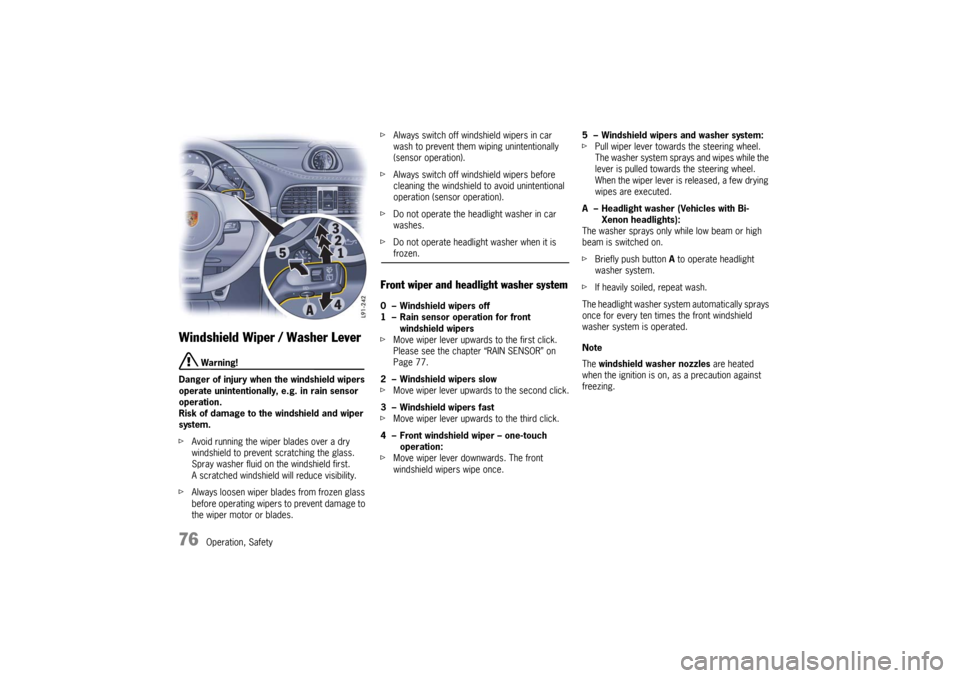
Front wiper and headlight washer system0 – Windshield wipers off
1 – Rain sensor operation for front
windshield wipers
fMove wiper lever upwards to the first click.
Please see the chapter “RAIN SENSOR” on
Page 77.
2 – Windshield wipers slow
fMove wiper lever upwards to the second click.
3 – Windshield wipers fast
fMove wiper lever upwards to the third click.
4 – Front windshield wiper – one-touch
operation:
fMove wiper lever downwards. The front
windshield wipers wipe once.5 – Windshield wipers and washer system:
fPull wiper lever towards the steering wheel.
The washer system sprays and wipes while the
lever is pulled towards the steering wheel.
When the wiper lever is released, a few drying
wipes are executed.
A – Headlight washer (Vehicles with Bi-
Xenon headlights):
The washer sprays only while low beam or high
beam is switched on.
fBriefly push button A to operate headlight
washer system.
fIf heavily soiled, repeat wash.
The headlight washer system automatically sprays
once for every ten times the front windshield
washer system is operated.
Note
The windshield washer nozzles are heated
when the ignition is on, as a precaution against
freezing.
10_GT3_21.book Seite 76 Donnerstag, 4. Juni 2009 12:48 12