light PORSCHE 911 TURBO 2013 6.G Information Manual
[x] Cancel search | Manufacturer: PORSCHE, Model Year: 2013, Model line: 911 TURBO, Model: PORSCHE 911 TURBO 2013 6.GPages: 59, PDF Size: 5.96 MB
Page 30 of 59
5758
1
2
1
2
Chassis | Lighting
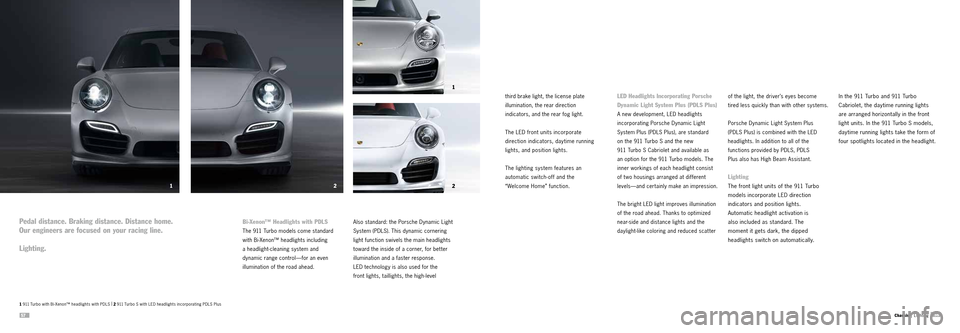
1 911 Turbo with Bi -Xenon™ headlights with PDLS |
2 911 Turbo S w ith LED headlights incorporating PDLS Plus
Bi-Xenon™ Headlights with PDLS
The 911 Turbo models come standard
with Bi-Xenon™ headlights including
a headlight-cleaning system and
dynamic range control—for an even
illumination of the road ahead. Also standard: the Porsche Dynamic Light
System (PDLS). This dynamic cornering
light function swivels the main headlights
toward the inside of a corner, for bet ter
illumination and a faster response.
LED technology is also used for the
front lights, taillights, the high-level
Pedal distance. Braking distance. Distance home.
Our engineers are focused on your racing line.
Lighting.
third brake light, the license plate
illumination, the rear direction
indicators, and the rear fog light.
The LED front units incorporate
direction indicators, daytime running
lights, and position lights.
The lighting system features an
automatic switch-off and the
“Welcome Home” function.of the light, the driver’s eyes become
tired less quickly than with other systems.
Porsche Dynamic Light System Plus
(PDLS Plus) is combined with the LED
headlights. In addition to all of the
functions provided by PDLS, PDLS
Plus also has High Beam Assistant.
Lighting
The front light units of the 911 Turbo
models incorporate LED direction
indicators and position lights.
Automatic headlight activation is
also included as standard. The
moment it gets dark, the dipped
headlights switch on automatically.
LED Headlights Incorporating Porsche
Dynamic Light System Plus (PDLS Plus)
A new development, LED headlights
incorporating Porsche Dynamic Light
System Plus (PDLS Plus), are standard
on the 911 Turbo S and the new
911 Turbo S Cabriolet and available as
an option for the 911 Turbo models. The
inner workings of each headlight consist
of t wo housings arranged at different
levels—and certainly make an impression.
The bright LED light improves illumination
of the road ahead. Thanks to optimized
near-side and distance lights and the
daylight-like coloring and reduced scatter
In the 911 Turbo and 911 Turbo
Cabriolet, the daytime running lights
are arranged horizontally in the front
light units. In the 911 Turbo S models,
day time running lights take the form of
four spotlights located in the headlight.
Page 32 of 59
6162
1
Responsibility | Brakes
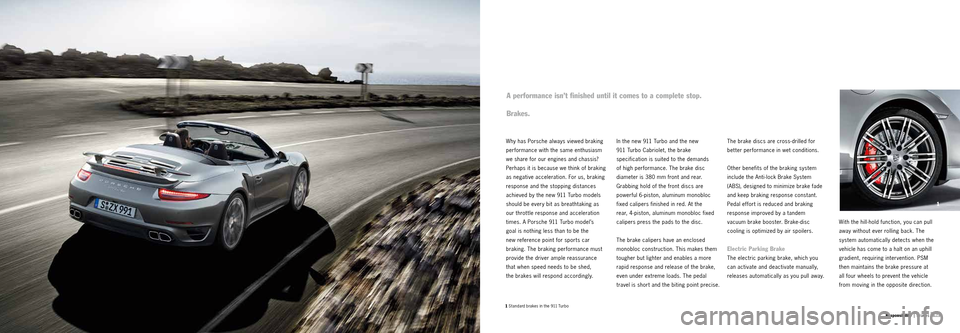
1 Standard brakes in the 911 Turbo
Why has Porsche always viewed braking
performance with the same enthusiasm
we share for our engines and chassis?
Perhaps it is because we think of braking
as negative acceleration. For us, braking
response and the stopping distances
achieved by the new 911 Turbo models
should be every bit as breathtaking as
our throt tle response and acceleration
times. A Porsche 911 Turbo model’s
goal is nothing less than to be the
new reference point for sports car
braking. The braking performance must
provide the driver ample reassurance
that when speed needs to be shed,
the brakes will respond accordingly. In the new 911 Turbo and the new
911 Turbo Cabriolet, the brake
specification is suited to the demands
of high performance. The brake disc
diameter is 380 mm front and rear.
Grabbing hold of the front discs are
powerful 6-piston, aluminum monobloc
fixed calipers finished in red. At the
rear, 4-piston, aluminum monobloc fixed
calipers press the pads to the disc.
The brake calipers have an enclosed
monobloc construction. This makes them
tougher but lighter and enables a more
rapid response and release of the brake,
even under extreme loads. The pedal
travel is short and the biting point precise. The brake discs are cross-drilled for
better performance in wet conditions.
Other benefits of the braking system
include the Anti-lock Brake System
(ABS), designed to minimize brake fade
and keep braking response constant.
Pedal effort is reduced and braking
response improved by a tandem
vacuum brake booster. Brake-disc
cooling is optimized by air spoilers.
Electric Parking Brake
The electric parking brake, which you
can activate and deactivate manually,
releases automatically as you pull away.
A performance isn’t finished until it comes to a complete stop.
Brakes.
With the hill-hold function, you can pull
away without ever rolling back. The
system automatically detects when the
vehicle has come to a halt on an uphill
gradient, requiring intervention. PSM
then maintains the brake pressure at
all four wheels to prevent the vehicle
from moving in the opposite direction.
Page 33 of 59

6364
1
Responsibility | Brakes
1 Porsche Ceramic Composite Brake (PCCB)
Porsche Ceramic Composite Brakes
(PCCB)
How exactly does Porsche take its
motorsport experience and transfer
it from the racetrack to the road? The
Porsche Ceramic Composite Brakes
(PCCB) are a clear example. Standard
equipment in the 911 Turbo S models
and available as an option for the
911 Turbo models, PCCB has already
had to cope with the harsh requirements
of motor racing and is fit ted in race
cars that compete in demanding events
such as the Porsche Mobil 1 Supercup.
The cross-drilled PCCB ceramic brake
discs have a diameter of 410 mm at the front and 390 mm at the back—for even
more formidable braking performance.
The use of 6-piston, aluminum monobloc
fixed calipers on the front axle and
4-piston, aluminum monobloc units
at the rear—all finished in yellow—
ensures extremely high brake forces
that remain exceptionally consistent.
PCCB enables shorter braking distances
in even the toughest road and track
conditions. Excellent fade resistance
guarantees greater balance when
slowing from highway speeds.
The key advantage of PCCB is the
extremely low weight of the ceramic
brake discs. Approximately 50 percent lighter than standard discs of similar
design and size, they enhance
performance and fuel economy.
Because this represents a major
reduction in unsprung and rotating
masses, it yields many results: bet ter
roadholding and increased comfort,
particularly on uneven roads, as well as
greater agility and improved handling.
Page 34 of 59

6566 Responsibility | Brakes
Sheet steel
Tailored blanks
Super high-strength steel
Ultra high -strength steel
Aluminum
Body
The innovative bodyshell of the new
911 Turbo models fulfills t wo structural
design requirements: first, excellent
driving dynamics due to the body’s
extremely high rigidit y. Second, a
savings in vehicle weight, primarily due
to its intelligent lightweight construction.
To meet the second requirement, we
employed state-of-the-art techniques
for combining various materials in order
to utilize specific material properties
exactly where they are needed.
Take the bodyshell, for example. It uses
very thin—but extremely rigid—sheets
of steel. Aluminum and magnesium
were utilized extensively in areas
including the roof, underbody, doors,
engine compartment, and luggage compartment lids. Magnesium, which
is a particularly lightweight material,
was also selected for the cockpit
and center console support beam.
Reducing the overall weight—i.e.,
improving the power-to-weight ratio—
translates directly into the aim of
increasing performance, whether
that ’s measured by the acceleration,
steering, or braking. And it ’s measurable
another way, too: at the fuel pump.
Reduced fuel consumption.
For the driver, reducing the weight
of the 911 Turbo results in a high
level of comfort as well. Vibration-
damping characteristics are
excellent and, compared to the
previous model, torsional stiffness
has increased up to 25 percent to
create even sportier handling.
Airbags and the Po
rsche Side Impact
Protection (POSIP) System
The airbag technology in the new 911 Turbo
models provides full-size driver and front-
passenger airbags, which are inflated in t wo
stages depending on the severit y and t ype
of accident. In less serious accidents, the
airbags are only partially inflated to help
minimize discomfort to the occupants.
Another standard feature is the Porsche
Side Impact Protection (POSIP) system.
This system comprises side impact
protection elements in the doors and t wo
airbags on each side, an integral thorax
airbag located in each seat side bolster,
and a head airbag contained in each of
the door panels. Knee airbags are also
standard on all 911 Turbo models.
Rollover Protection in the
Cabriolet Models
Despite their light weight, the 911 Turbo
Cabriolet models have exemplary
torsional rigidit y and flexural strength.
Body flexing is minimal, especially when
compared with driving most other open-
top sports cars on uneven road surfaces.
In the event of a 911 Turbo Cabriolet
model rolling over, additional protection
is provided by a supplemental safet y
roll bar protection system that deploys
automatically. The two spring-loaded
rollover bars are located behind
the back seats. The rollover sensor
continuously monitors the car’s pitch
and roll, lateral and longitudinal
acceleration, and contact with the road.
In an emergency, it deploys the rollover
bars within a fraction of a second.
Page 35 of 59

6768 Responsibility | Environment
Porsche has increased efficiency in all
of its current series while at the same
time increasing performance. This is
achieved by an efficient drive, thanks
to Direct Fuel Injection (DFI), Porsche
Doppelkupplung (PDK), Variable Turbine
Geometry (V TG) and VarioCam Plus,
intelligent lightweight construction, active
aerodynamics, and low rolling resistance. A high level of environmental
responsibilit y is ensured not least
by Porsche’s own environmental
management teams in Weissach. They
ensure that all developments take
account of environmental compatibility.
The objective is to achieve pure
performance, but not at the expense
of the environment. This also applies
to the new 911 Turbo models.
All automotive manufacturers look
to the future. After all, the life-span
of an automobile from inception to
the end of its functional life can span
decades or even longer. So what
the world needs in 15 to 20 years,
Porsche engineers must address now.
Our focus is always on this: ultimate
performance with ultimate efficiency.
What we find when we go our own way:
solutions.
Environment.
Exhaust Emissions Control
At Porsche, our cars have long
demonstrated that even high-performance
sports cars can achieve moderate fuel
consumption and exhaust emissions
values in their respective category. The new 911 Turbo is no exception. It
uses technologies such as Auto Start
Stop, thermal management, electrical
system recuperation, Direct Fuel Injection
(DFI), VarioCam Plus, and coasting
to help optimize fuel efficiency.And the cataly tic converters provide
efficient emissions control.
The stereo lambda sensor controls
and monitors each cylinder bank
separately. For each exhaust tract, oxygen sensors regulate the composition
of the exhaust gas, while another
lambda sensor on each cylinder bank
monitors pollutant conversion in the
respective catalytic converter.
Page 36 of 59
6970 Responsibility | Environment
Recycling
For both technical and ecological
reasons, intelligent lightweight
construction has been fundamental to
Porsche since our first car in 1948.
This forms the basis for achieving low
fuel consumption values in conjunction
with outstanding performance.
On the technical side, we use a high
proportion of aluminum, magnesium,
plastics, and super high-strength sheet
steel. The materials used have been
selected for their ability to withstand
load, yet they are considerably
lighter than conventional steel.On the ecological side, all materials used
are meticulously selected. All synthetic
components are easily recyclable. And
each material is labeled to facilitate its
separation for recycling. The reduction
in the number of plastic variants helps to
ensure more efficient recycling. Recycled
plastics are used where they meet our
exacting technical requirements.
In short, the new 911 Turbo models are
approximately 95 percent recyclable.
In addition, Porsche uses a high
proportion of environmentally
friendly water-based paints. For us,
environmental protection does not begin
at the end of a vehicle’s life. It starts at
the planning and development stage. having the same fuel economy of 17 mpg
in the cit y and 24 mpg on the highway.
Noise
The 911 Turbo models and the new
911 Turbo S comply with all current
noise regulations—without resorting
to engine encapsulation. To achieve
this, we’ve eliminated noise at the
source: Engine components are
more rigid, moving parts lighter,
and tolerances reduced to a
minimum. High-efficiency silencers
and resonators in the intake system
help to reduce noise even further.
Fuel
All Porsche models are designed to
operate on fuels with an ethanol content
of up to 10 percent. Ethanol has a positive
impact on the CO
2 balance since the plants
grown for the production of this biofuel
also absorb CO
2 from the atmosphere.
The release of hydrocarbons from the fuel
system has been minimized, thanks in no
small part to the active carbon filter and the
multilayered material from which the fuel
tank is made. All fuel lines are made from
multilayered plastic, steel, or aluminum.
The new 911 Turbo models have
maximized the fuel-saving technologies,
which results in all the 911 Turbo models
Page 40 of 59

77
1
2
1 911 Turbo rear in Yachting Blue |
2 Adaptive Sport Seat Plus
shell is finished in Silver Grey (911 Turbo
models) or Leather (911 Turbo S models).
Rear Seats
The rear seats are remarkably
comfortable for a sports car. And the
shelf behind offers additional storage
space. With the backrests folded down,
the luggage compartment volume in
the 911 Turbo Coupe increases to
9.2 cubic feet, providing plent y of space
for luggage. You have 5.5 cubic feet in
the new 911 Turbo Cabriolet models.
Power Sport Seats
When it comes to seating, the goals of
high performance are t ypically at odds
with the desire for comfort. But the seats
in the new 911 Turbo manage to serve
both goals equally well. The Sport seats
that are standard in the new 911 Turbo
and the new 911 Turbo Cabriolet offer
full power adjustment of seat height,
backrest angle, seat cushion angle, and
seat cushion depth, as well as fore/aft
position, and four-way lumbar support.
The integrated memory package
supports the exterior mirrors and all
seat positions on the driver’s side as
well as set tings for the steering wheel,
lights, wipers, air conditioning, door
locks, PCM, and instrument cluster.
lateral support on winding roads.
Also included is the personal memory
for all seat positions (apart from the
side bolsters) and lumbar support
on the driver’s side as well as the
positions of the steering wheel and
exterior mirrors. The memory function
also supports set tings for the lights,
wipers, air conditioning, door locks,
PCM, and instrument cluster.
Sport Seats Plus
Available as an option, at no extra
cost, are Sport Seats Plus in Leather
with power seat height and backrest
adjustment as well as mechanical fore/
aft adjustment. The side bolsters on
the seat cushion and backrest have
a firmer, sportier padding and offer
excellent lateral support. The backrest
Adaptive Sport Seats Plus
For maximum sports performance,
Adaptive Sport Seats Plus are standard
in the new 911 Turbo S and the new
911 Turbo S Cabriolet. The firm, sport y
padding of the side bolsters and
additional shoulder supports provides
the best possible hold. And with 18-way
electric adjustment, the seats can be
optimally adapted to meet your needs
in terms of seat height, seat cushion
and backrest angle, seat cushion
length, fore/aft adjustment, and four-
way lumbar support. The steering
column is also electrically adjustable.
In addition, the side bolsters on the
seat cushion and backrest can be
adjusted independently for added
comfort on long journeys and precision
Child Seats
LATCH child seat preparation
including top tether is available
for the rear seats as standard.
Seat Heating and Seat Ventilation
Seat heating is available for all seats
as an option at no extra charge. Seats
are heated in the seat cushion, the
backrest, and, for the front seats,
the side bolsters. In conjunction with
seat heating, we can equip the seats
with seat ventilation on request. A slipstream effect is produced by active
ventilation of the perforated seat center
and backrest and by passive aeration
at the side bolsters. This evaporates
perspiration moisture and therefore
makes for a dry and pleasant seating
environment, even in hot weather.
Page 41 of 59
7980
1
2
3Personality | Comfor t
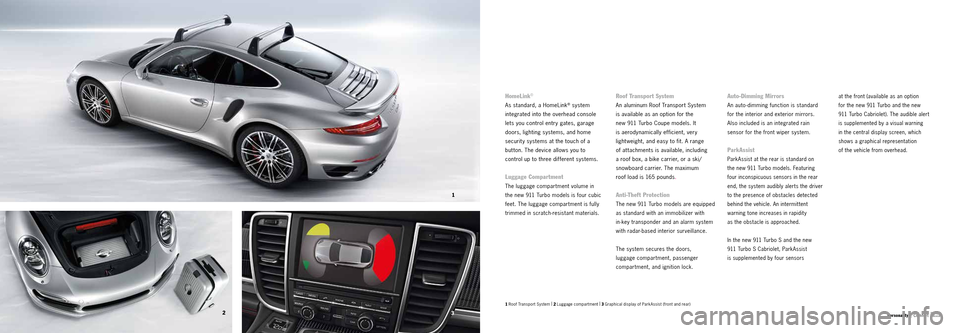
1 Roof Transport System |
2 Luggage compartment |
3 Graphical display of ParkAssist (front and rear)
HomeLink®
As standard, a HomeLink® system
integrated into the overhead console
lets you control entry gates, garage
doors, lighting systems, and home
securit y systems at the touch of a
but ton. The device allows you to
control up to three different systems.
Luggage Compartment
The luggage compartment volume in
the new 911 Turbo models is four cubic
feet. The luggage compartment is fully
trimmed in scratch-resistant materials.
Roof Transport System
An aluminum Roof Transport System
is available as an option for the
new 911 Turbo Coupe models. It
is aerodynamically efficient, very
light weight, and easy to fit. A range
of attachments is available, including
a roof box, a bike carrier, or a ski/
snowboard carrier. The maximum
roof load is 165 pounds .
Anti-Theft Protection
The new 911 Turbo models are equipped
as standard with an immobilizer with
in-key transponder and an alarm system
with radar-based interior surveillance.
The system secures the doors,
luggage compartment, passenger
compartment, and ignition lock.
Auto-Dimming Mirrors
An auto-dimming function is standard
for the interior and exterior mirrors.
Also included is an integrated rain
sensor for the front wiper system.
ParkAssist
Park Assist at the rear is standard on
the new 911 Turbo models. Featuring
four inconspicuous sensors in the rear
end, the system audibly alerts the driver
to the presence of obstacles detected
behind the vehicle. An intermit tent
warning tone increases in rapidity
as the obstacle is approached.
In the new 911 Turbo S and the new
911 Turbo S Cabriolet, Park Assist
is supplemented by four sensors at the front (available as an option
for the new 911 Turbo and the new
911 Turbo Cabriolet). The audible alert
is supplemented by a visual warning
in the central display screen, which
shows a graphical representation
of the vehicle from overhead.
Page 42 of 59
8182
12
Personality | Comfor t
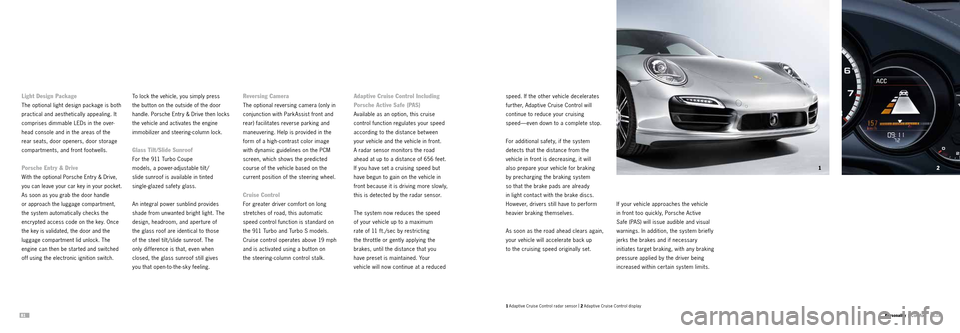
1 Adaptive Cruise Control radar sensor |
2 Adaptive Cruise Control display
Light Design Package
The optional light design package is both
practical and aesthetically appealing. It
comprises dimmable LEDs in the over-
head console and in the areas of the
rear seats, door openers, door storage
compartments, and front foot wells.
Porsche Entry & Drive
With the optional Porsche Entry & Drive,
you can leave your car key in your pocket.
As soon as you grab the door handle
or approach the luggage compartment,
the system automatically checks the
encrypted access code on the key. Once
the key is validated, the door and the
luggage compartment lid unlock. The
engine can then be started and switched
off using the electronic ignition switch. To lock the vehicle, you simply press
the but ton on the outside of the door
handle. Porsche Entry & Drive then locks
the vehicle and activates the engine
immobilizer and steering-column lock.
Glass Tilt/Slide Sunroof
For the 911 Turbo Coupe
models, a power-adjustable tilt /
slide sunroof is available in tinted
single-glazed safety glass.
An integral power sunblind provides
shade from unwanted bright light. The
design, headroom, and aperture of
the glass roof are identical to those
of the steel tilt /slide sunroof. The
only difference is that, even when
closed, the glass sunroof still gives
you that open-to-the-sky feeling.
Reversing Camera
The optional reversing camera (only in
conjunction with ParkAssist front and
rear) facilitates reverse parking and
maneuvering. Help is provided in the
form of a high-contrast color image
with dynamic guidelines on the PCM
screen, which shows the predicted
course of the vehicle based on the
current position of the steering wheel.
Cruise Control
For greater driver comfort on long
stretches of road, this automatic
speed control function is standard on
the 911 Turbo and Turbo S models.
Cruise control operates above 19 m p h
and is activated using a but ton on
the steering-column control stalk.
Adaptive Cruise Control Including
Po
rsche Active Safe (PAS)
Available as an option, this cruise
control function regulates your speed
according to the distance bet ween
your vehicle and the vehicle in front.
A radar sensor monitors the road
ahead at up to a distance of 656 feet.
If you have set a cruising speed but
have begun to gain on the vehicle in
front because it is driving more slowly,
this is detected by the radar sensor.
The system now reduces the speed
of your vehicle up to a maximum
rate of 11 f t . /s e c by restricting
the throt tle or gently applying the
brakes, until the distance that you
have preset is maintained. Your
vehicle will now continue at a reduced speed. If the other vehicle decelerates
further, Adaptive Cruise Control will
continue to reduce your cruising
speed— even down to a complete stop.
For additional safet y, if the system
detects that the distance from the
vehicle in front is decreasing, it will
also prepare your vehicle for braking
by precharging the braking system
so that the brake pads are already
in light contact with the brake discs.
However, drivers still have to perform
heavier braking themselves.
As soon as the road ahead clears again,
your vehicle will accelerate back up
to the cruising speed originally set.
If your vehicle approaches the vehicle
in front too quickly, Porsche Active
Safe (PAS) will issue audible and visual
warnings. In addition, the system briefly
jerks the brakes and if necessary
initiates target braking, with any braking
pressure applied by the driver being
increased within certain system limits.
Page 50 of 59
9798
1Available from 11/2013 at the earliest.2Available from 03/2014 at the earliest.Sport tailpipes
20-inch 911 Tu rbo wheel
20-inch 911 Tu
rbo S wheel
Rear wiper
Electric tilt/slide sunroof
Personality | Personalization
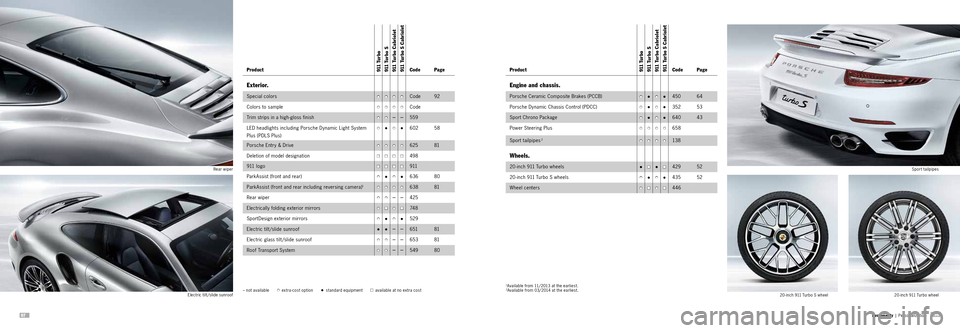
Product9 11
T
u r b o
9 11
T
u r b o
S
9
11 Turbo Cabriolet
911 Turbo S CabrioletCode Page
Exterior.
Special colors••••Code 92
Colors to sample
••••Code
Trim strips in a high -gloss finish
•• – –559
LED headlights including
Po
rsche Dynamic Light System
Plus (PDLS Plus)
• •••602 58
P
orsche Entry & Drive
••••625 81
Deletion of model designation
■■■■498
911 logo
■■■■9 11
Park Assist (front and rear)
• •••636 80
ParkAssist (front and rear including reversing camera)
1••••638 81
Rear wiper
•• – –425
Electrically folding exterior mirrors
•■•■74 8
SportDesign exterior mirrors
• •••529
Electric tilt/slide sunroof
• • – –651
81
Electric glass tilt/slide sunroof
•• – –653
81
Roof Transport System
•• – –549
80
Product9 11
T
u r b o
9 11
T
u r b o
S
9
11 Turbo Cabriolet
911 Turbo S CabrioletCode Page
Engine and chassis.
Porsche Ceramic Composite Brakes (PCCB)••••450 64
Po
rsche Dynamic Chassis Control (PDCC)
• •••352 53
Sport Chrono Package
• •••640 43
Power Steering Plus
••••658
Sport tailpipes
2••••13 8
Wheels.
20-inch 911 Tu rbo wheels•■•■42952
20 -inch 911
Tu
rbo
S w
heels
• •••435 52
Wheel centers
•■•■446
– not available• extra-cost option• standard equipment■ available at no extra cost