fuse PORSCHE 911 TURBO 2014 6.G Owner's Manual
[x] Cancel search | Manufacturer: PORSCHE, Model Year: 2014, Model line: 911 TURBO, Model: PORSCHE 911 TURBO 2014 6.GPages: 300, PDF Size: 10.61 MB
Page 248 of 300
246 Minor Repairs
The temperature grade for this tire is established for a tire that is properly inflated and not overloaded. Excessive speed, underinflation, or excessive loading, either separately or in combination, can cause heat buildup and possible tire failure.fDo not exceed the permitted maximum speed for the tires fitted to the vehicle.fEnsure that the tires are set to the correct inflation pressure.fObserve the maximum load for the vehicle.
Tire pressures
Driving the vehicle with low tire pressure increases risk of a tire failure and resulting loss of control. Furthermore, low tire pressure increases rate of wear of the affected tires and causes damage. fAlways use an accurate tire pressure gauge when checking inflation pressures.fDo not exceed the maximum tire pressure listed on the tire sidewall. (Also refer to “Technical data”).fPlease see the chapter “TIRE PRESSURE PLATE” on page 247.fCold tire inflation pressure means: all tires must be cold, ambient temperature maximum 68 °F (20 °C), when adjusting the inflation pressure. Avoid sunlight striking the tires before measuring cold pressures, since the pressures would rise from temperature influence.fValve caps protect the valve from dust and dirt, and thus from leakage. Always screw caps tightly down. Replace missing caps immediately.
fUse only plastic valve caps.fFor safety reasons, don't use tire inflating bottles.
fPlease see the chapter “TIRE PRESSURE FOR COLD TIRES (68 °F/ 20 °C)” on page 287.
Each tire, including the spare (if provided), should be checked monthly when cold and inflated to the
inflation pressure recommended by the vehicle manufacturer on the vehicle placard or tire inflation pressure label. (If your vehicle has tires of
a different size than the size indicated on the vehicle placard or tire inflation pressure label, you
should determine the proper tire inflation pressure
for those tires.)
As an added safety feature, your vehicle has been equipped with a Tire Pressure Monitoring System (TPMS) that illuminates a low tire pressure telltale when one or more of your tires is significantly under-inflated. Accordingly, when the low tire pressure telltale illuminates, you should stop and check your tires as soon as possible, and inflate them to the proper pressure. Driving on a significantly under-inflated tire causes the tire to overheat and can lead to tire failure. Under-inflation also reduces fuel efficiency and tire tread life, and may affect the vehicle’s handling and stopping ability.
Please note that the TPMS is not a substitute for proper tire maintenance, and it is the driver’s responsibility to maintain correct tire pressure, even if under-inflation has not reached the level to trigger illumination of the TPMS low tire pressure tell-tale.
For further information on the tire pressure monitoring:fPlease see the chapter “TIRE PRESSURE MENU (TIRE PRESSURE MONITORING SYSTEM, TPMS)” on page 105.
When tires are warm, the tire pressure is increased.fNever let air out of hot tires. This could cause the tire pressure to fall below the prescribed value.
Insufficient tire pressure can cause tires to over- heat and thus be damaged – even invisibly. Hidden tire damage is not eliminated by subsequently correcting the tire pressure.
Overloading
Overloading can lead to dangerous vehicle reactions and long braking distances.fDo not overload your vehicle. Be careful about the roof load. fIf you plan to load the vehicle, first correct the tire pressure. Tire pressure for loaded vehicle can be found on the tire pressure plate and in the chapter technical data.fNever exceed the specified axle load.
Tire Abuse
Low Tire Pressure
WARNINGh
DANGERhOverloading TiresDANGERh
14_991_Turbo_21.book Seite 246 Mittwoch, 9. April 2014 2:19 14
Page 251 of 300
Minor Repairs 249
Tire replacements
fUse only tire makes and types tested by Porsche.
If you do not use a Porsche recommended replacement tire, make sure that you purchase your new tires from a reputable tire dealer and that the dealer complies with all manufacturers warnings for those tires.
Only tires with the same manufacturer and with the same specification code (e.g. “N0”, “N1”…) should be mounted on the vehicle.
Before mounting new tires, check with your Porsche dealer about the current release status.
Use tires with “ZR” quality standards. There are currently no standards concerning tire strength at speeds above 150 mph (240 km/h).
Tires should be replaced no less than on one axle at the time. Only tires of the same make and type must be used. Mixed tires are not permissible and will affect vehicle performance, safety, and can affect vehicle warranty.
Porsche dealers can recommend the most current replacement tire options for your vehicle.
Initially, new tires do not have their full traction. You should therefore drive at moderate speeds during the first 60 - 120 miles (100 - 200 km).
Tires must always remain on the same side of the vehicle.When wheels are removed, the direction of rotation and position of each wheel should be marked.
If new tires are installed only on one axle, a noticeable change in handling occurs due to the different tread depth of the other tires. This happens especially if only rear tires are replaced. However, this condition disappears as the new tires are broken in.fPlease adjust your driving style accordingly.
Installation of new tires should only be done by a qualified tire technician.
Valves
fUse only plastic valve caps.fPlease read the fitting and replacement instructions regarding metal valves.fUse original Porsche metal valves only.fValve inserts with valve caps protect against soiling.Soiled valve inserts can cause a gradual loss of air.
Parking at the curb
Hard impacts against curbs (or traffic islands) are dangerous and may cause hidden tire damage which is not noticeable until later. Such damage can result in accidents at high speeds. Depending on the force of impact, the edge of the rim can also be damaged.fAfter such an impact, have the wheel checked by an expert.fIf you must drive over a curb or other obstacle, drive slowly and at an obtuse angle. Exercise care when parking along curbs.
Information
Tire repairs are not permissible under any circumstances.
Curb Impact / Tire Damage
DANGERh
14_991_Turbo_21.book Seite 249 Mittwoch, 9. April 2014 2:19 14
Page 253 of 300
Minor Repairs 251
The standard tires profile and rubber mixture are optimized for wet and dry driving conditions, and may not prove favorable for snow conditions.fInstall snow tires before driving in such conditions.
Risk of insufficient road grip leading to loss of control and damage to the vehicle.
The standard tires profile and rubber mixture are optimized for wet and dry driving conditions, and may not prove favorable for snow conditions.fInstall snow tires before driving in such conditions.
Before mounting snow tires, consult with your Porsche dealer. They have the technical information necessary to advise you on wheel and tire compatibility.fSnow tires should have the same load capacity as original equipment tires and should be mounted on all four wheels.
Driving the vehicle with low tire pressure increases risk of a tire failure and resulting loss of control. Furthermore, low tire pressure increases the rate of wear of the affected tires and causes damage.
Tires with badly worn treads are very dangerous and could cause accidents.fMake sure they are replaced immediately.fDo not exceed the snow tire speed rating.
Snow tires do not have the same degree of traction on dry, wet or snowfree roads as normal tires. Furthermore, snow tires wear rapidly under these conditions.
Information
We recommend that you fit snow tires on the vehicle at temperatures below 45 °F (7 °C) since the driving performance of summer tires is reduced at low temperatures and a lower level of comfort can also be expected. For example, juddering noises caused by the tires can occur while maneuvering the vehicle or accelerating out of bends on both dry and wet road surfaces.Extremely low temperatures of below 5 °F (-15 °C) can cause permanent damage to summer tires.
Snow tires lose their suitability when their tread depth falls below 5/32 in. (4 mm).
Comply with all state and local laws governing snow tire and tread depth requirements.
Exceeding the maximum permitted speed for the tires fitted could cause tire failure.fAlways check the maximum speed rating on the tire sidewall on any tire on the vehicle.fNever exceed the maximum speed rating of the tires.
Wheel change
fWhen wheels are removed, mark the direction of rotation and position of each wheel.Example: FR (front right), FL, RR and RL.fAlways fit the wheels in accordance with the markings.
Snow chains
Risk of damage to body, axle or brake components.fFit snow chains only to the rear wheels, and only with the tire/rim combination listed in the Technical Data.fUse only the fine-link snow chains recommended and authorized by Porsche so that sufficient clearance between the wheel well and the chain is assured.fPlease see the chapter “WHEELS, TIRES” on page 286.fFollow instructions issued by the supplier of the chains.
Snow Tire Use
Tire Hazards
WARNINGh
NOTICE
DANGERh
Excessive Speed for Tires
DANGERh
NOTICE
14_991_Turbo_21.book Seite 251 Mittwoch, 9. April 2014 2:19 14
Page 256 of 300
254 Minor Repairs
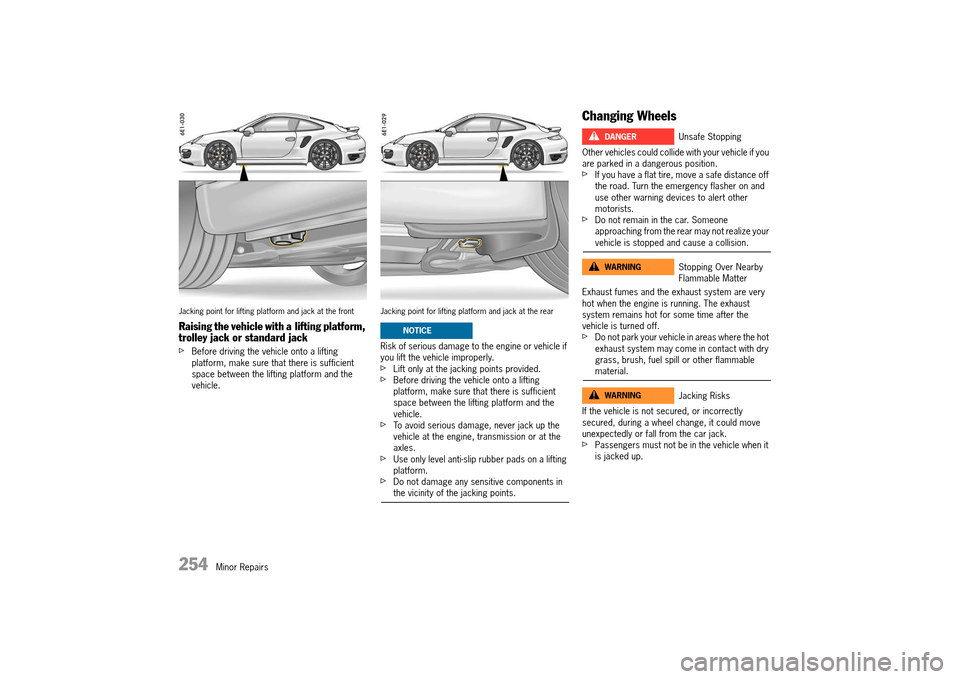
Jacking point for lifting platform and jack at the front
Raising the vehicle with a lifting platform, trolley jack or standard jack
fBefore driving the vehicle onto a lifting platform, make sure that there is sufficient space between the lifting platform and the vehicle.
Jacking point for lifting platform and jack at the rear
Risk of serious damage to the engine or vehicle if you lift the vehicle improperly.fLift only at the jacking points provided.fBefore driving the vehicle onto a lifting platform, make sure that there is sufficient space between the lifting platform and the vehicle.fTo avoid serious damage, never jack up the vehicle at the engine, transmission or at the axles.fUse only level anti-slip rubber pads on a lifting platform.fDo not damage any sensitive components in the vicinity of the jacking points.
Changing Wheels
Other vehicles could collide with your vehicle if you are parked in a dangerous position.fIf you have a flat tire, move a safe distance off the road. Turn the emergency flasher on and use other warning devices to alert other motorists.fDo not remain in the car. Someone approaching from the rear may not realize your vehicle is stopped and cause a collision.
Exhaust fumes and the exhaust system are very hot when the engine is running. The exhaust system remains hot for some time after the vehicle is turned off.fDo not park your vehicle in areas where the hot exhaust system may come in contact with dry grass, brush, fuel spill or other flammable material.
If the vehicle is not secured, or incorrectly secured, during a wheel change, it could move unexpectedly or fall from the car jack.fPassengers must not be in the vehicle when it is jacked up.
NOTICE
Unsafe Stopping
Stopping Over Nearby Flammable Matter
Jacking Risks
DANGERh
WARNINGh
WARNINGh
14_991_Turbo_21.book Seite 254 Mittwoch, 9. April 2014 2:19 14
Page 267 of 300
Minor Repairs 265
Flat Tire
1.Stop the vehicle as far away from the driving lane as possible.The vehicle must be parked on a firm and flat surface offering adequate grip.2. Switch emergency flasher on. 3. Apply the parking brake. 4. Move the PDK selector lever to position P. 5. Straighten the front wheels. 6. Remove the ignition key, or the control unit on vehicles with Porsche Entry & Drive, in order to lock the steering and prevent the engine from being started.7. Get all passengers to leave the vehicle. 8. Set up the warning triangle at a suitable distance.
Filling in tire sealant
The tire sealant can be found in the right-hand box in the luggage compartment. The compressor is located under the cover in the luggage compartment.
The tire sealant can be used to seal small cuts, especially in the tire tread.
Sealing the tire with the tire sealant is only an emergency solution so you can drive to the nearest workshop. Even if the tire is air-tight, it may only be used for short journeys in an emergency.
The tire sealant set comprises: – a filler bottle– a filler hose– a valve turner– a spare valve insert– a sticker with the maximum permitted speed– a compressor– operating instructions
Always observe the following points:fUse the tire sealant only in the case of cuts or punctures no larger than 0.15 in. (4 mm).fNever use the tire sealant if the rim is damaged.
The sealant is highly flammable and harmful to health.fFire, naked flame and smoking are prohibited when handling tire sealant.fAvoid contact with skin, eyes or clothing due to caustic chemical properties of the tire sealant.fKeep tire sealant away from children.fDo not inhale vapors, due to the consequent harm to personal health resulting in serious personal injury or death.
In the event of contact with sealant:
fIf sealant gets on your skin or into your eyes, thoroughly rinse the affected part of your body immediately with plenty of water.fChange soiled clothing immediately.fSee a doctor immediately in the event of an allergic reaction.fIf sealant is swallowed, thoroughly rinse out the mouth without delay and drink plenty of water. Do not induce vomiting.See a doctor immediately.
Limits on Tire Sealant Use
Tire Sealant Flammability
WARNINGh
WARNINGh
14_991_Turbo_21.book Seite 265 Mittwoch, 9. April 2014 2:19 14
Page 269 of 300
Minor Repairs 267
Electrical System
In order to avoid damage and faults in electrical or electronic systems, electrical accessories should be installed at an authorized Porsche dealerfUse only accessories approved by Porsche.
Replacing fuses or relays with the engine running or the ignition on could cause electrical shock.fDisconnect the negative terminal on the battery during all work on the electrical system.fPlease see the chapter “BATTERY (12 VOLT)” on page 271.
Relays
Relays should be checked or changed only at an authorized workshop.
Changing fuses
In order to prevent damage to the electrical system due to short circuits and overloads, the individual circuits are protected by fuses.
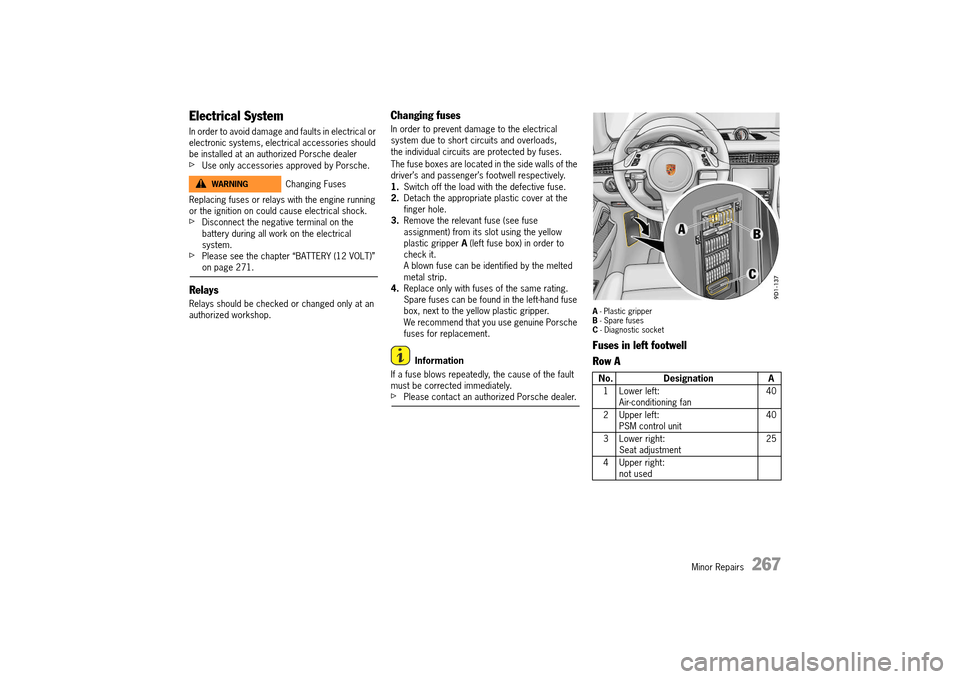
The fuse boxes are located in the side walls of the driver’s and passenger’s footwell respectively. 1. Switch off the load with the defective fuse. 2. Detach the appropriate plastic cover at the finger hole.3. Remove the relevant fuse (see fuse assignment) from its slot using the yellow plastic gripper A (left fuse box) in order to check it.A blown fuse can be identified by the melted metal strip.4. Replace only with fuses of the same rating. Spare fuses can be found in the left-hand fuse box, next to the yellow plastic gripper.We recommend that you use genuine Porsche fuses for replacement.
Information
If a fuse blows repeatedly, the cause of the fault must be corrected immediately.fPlease contact an authorized Porsche dealer.
A - Plastic gripper B - Spare fuses C - Diagnostic socket
Fuses in left footwell
Row A
Changing FusesWARNINGh
No. Designation A
1 Lower left: Air-conditioning fan 40
2 Upper left: PSM control unit 40
3 Lower right: Seat adjustment 25
4 Upper right: not used
14_991_Turbo_21.book Seite 267 Mittwoch, 9. April 2014 2:19 14
Page 271 of 300
Minor Repairs 269
Row D
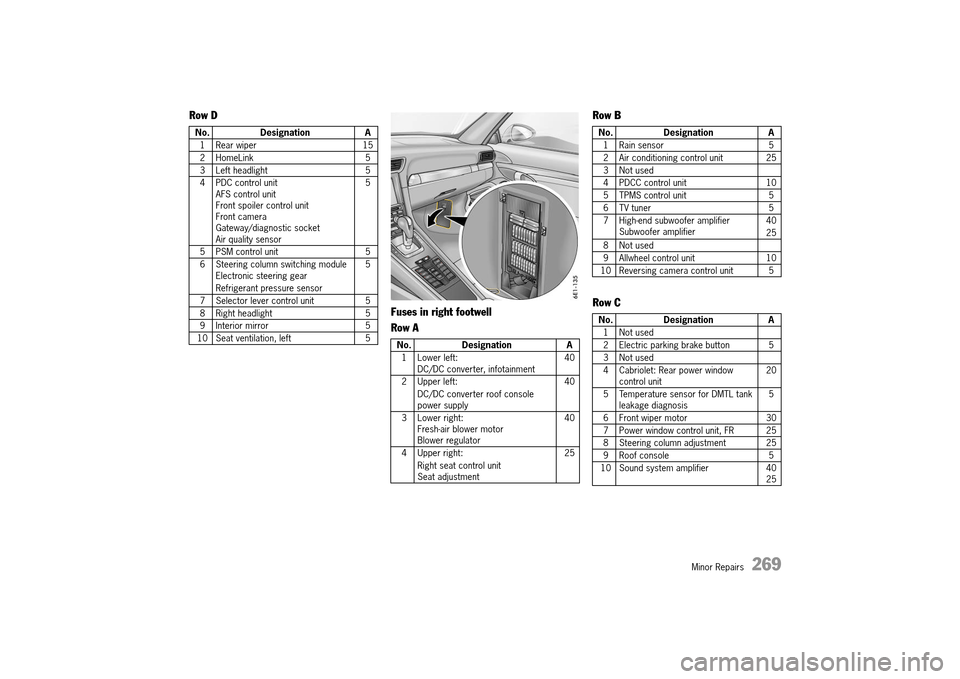
Fuses in right footwell
Row A
Row B
Row C
No. Designation A
1 Rear wiper 15
2 HomeLink 5
3 Left headlight 5
4 PDC control unit AFS control unitFront spoiler control unitFront cameraGateway/diagnostic socketAir quality sensor
5
5 PSM control unit 5
6 Steering column switching module Electronic steering gear
Refrigerant pressure sensor
5
7 Selector lever control unit 5
8 Right headlight 5
9 Interior mirror 5
10 Seat ventilation, left 5No. Designation A
1 Lower left: DC/DC converter, infotainment 40
2 Upper left:
DC/DC converter roof console power supply
40
3 Lower right: Fresh-air blower motorBlower regulator
40
4 Upper right:
Right seat control unit Seat adjustment
25
No. Designation A
1 Rain sensor 5
2 Air conditioning control unit 25
3 Not used
4 PDCC control unit 10
5 TPMS control unit 5
6 TV tuner 5
7 High-end subwoofer amplifier Subwoofer amplifier 40
25
8 Not used
9 Allwheel control unit 10
10 Reversing camera control unit 5
No. Designation A
1 Not used
2 Electric parking brake button 5
3 Not used
4 Cabriolet: Rear power window control unit 20
5 Temperature sensor for DMTL tank leakage diagnosis 5
6 Front wiper motor 30
7 Power window control unit, FR 25
8 Steering column adjustment 25
9 Roof console 5
10 Sound system amplifier 40 25
14_991_Turbo_21.book Seite 269 Mittwoch, 9. April 2014 2:19 14
Page 272 of 300
270 Minor Repairs
Row D Emergency unlocking of luggage compartment lid
If the battery is discharged, the luggage compartment lid can be opened only with the aid of a donor battery.
Information
The engine cannot be started with this method.fPlease see the chapter “EXTERNAL POWER SUPPLY, EMERGENCY STARTING WITH JUMPER CABLES” on page 273.
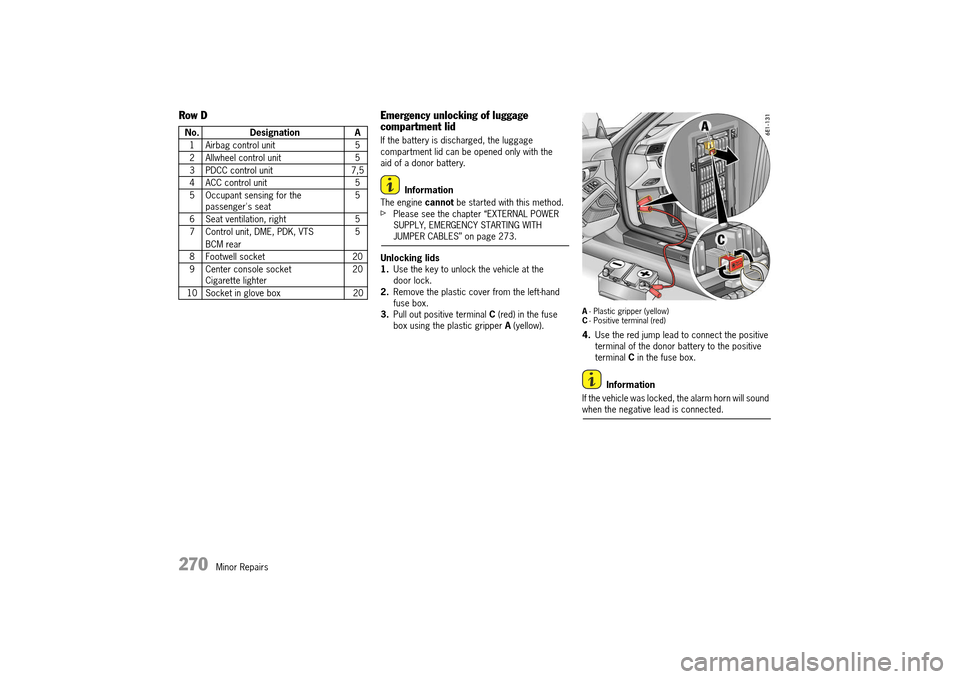
Unlocking lids 1. Use the key to unlock the vehicle at the door lock.2. Remove the plastic cover from the left-hand fuse box.3. Pull out positive terminal C (red) in the fuse box using the plastic gripper A (yellow).
A- Plastic gripper (yellow) C - Positive terminal (red)
4.Use the red jump lead to connect the positive terminal of the donor battery to the positive terminal C in the fuse box.
Information
If the vehicle was locked, the alarm horn will sound when the negative lead is connected.
No. Designation A
1 Airbag control unit 5
2 Allwheel control unit 5
3 PDCC control unit 7,5
4 ACC control unit 5
5 Occupant sensing for the passenger's seat 5
6 Seat ventilation, right 5
7 Control unit, DME, PDK, VTS
BCM rear
5
8 Footwell socket 20
9 Center console socket Cigarette lighter 20
10 Socket in glove box 20
14_991_Turbo_21.book Seite 270 Mittwoch, 9. April 2014 2:19 14
Page 273 of 300
Minor Repairs 271
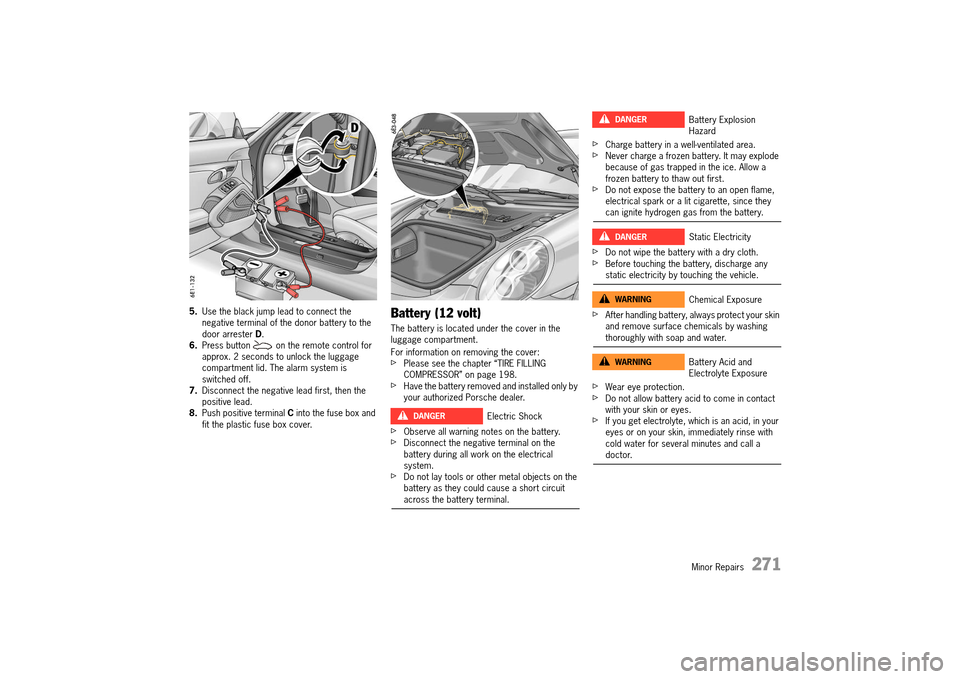
5.Use the black jump lead to connect the negative terminal of the donor battery to the door arrester D. 6. Press button on the remote control for approx. 2 seconds to unlock the luggage compartment lid. The alarm system is switched off.7. Disconnect the negative lead first, then the positive lead.8. Push positive terminal C into the fuse box and fit the plastic fuse box cover.
Battery (12 volt)
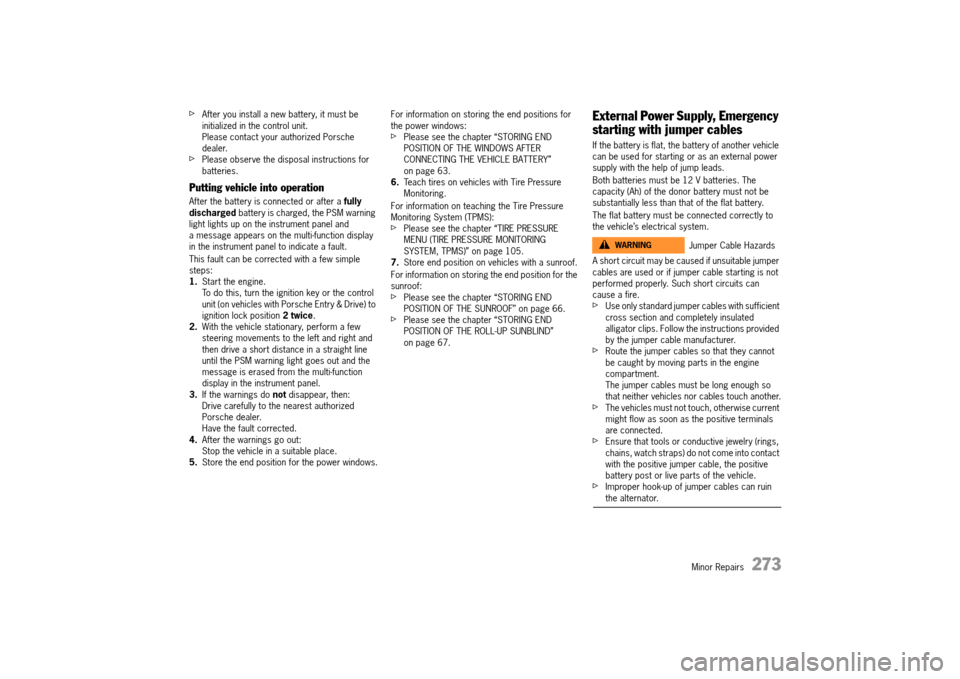
The battery is located under the cover in the luggage compartment.
For information on removing the cover:fPlease see the chapter “TIRE FILLING COMPRESSOR” on page 198.fHave the battery removed and installed only by your authorized Porsche dealer.
fObserve all warning notes on the battery.fDisconnect the negative terminal on the battery during all work on the electrical system.fDo not lay tools or other metal objects on the battery as they could cause a short circuit across the battery terminal.
fCharge battery in a well-ventilated area.fNever charge a frozen battery. It may explode because of gas trapped in the ice. Allow a frozen battery to thaw out first.fDo not expose the battery to an open flame, electrical spark or a lit cigarette, since they can ignite hydrogen gas from the battery.
fDo not wipe the battery with a dry cloth.fBefore touching the battery, discharge any static electricity by touching the vehicle.
fAfter handling battery, always protect your skin and remove surface chemicals by washing thoroughly with soap and water.
fWear eye protection.fDo not allow battery acid to come in contact with your skin or eyes.fIf you get electrolyte, which is an acid, in your eyes or on your skin, immediately rinse with cold water for several minutes and call a doctor.
Electric ShockDANGERh
Battery Explosion Hazard
Static Electricity
Chemical Exposure
Battery Acid and Electrolyte Exposure
DANGERh
DANGERh
WARNINGh
WARNINGh
14_991_Turbo_21.book Seite 271 Mittwoch, 9. April 2014 2:19 14
Page 275 of 300
Minor Repairs 273
fAfter you install a new battery, it must be initialized in the control unit.Please contact your authorized Porsche dealer.fPlease observe the disposal instructions for batteries.
Putting vehicle into operation
After the battery is connected or after a fully discharged battery is charged, the PSM warning light lights up on the instrument panel and a message appears on the multi-function display in the instrument panel to indicate a fault.
This fault can be corrected with a few simple steps: 1. Start the engine. To do this, turn the ignition key or the control unit (on vehicles with Porsche Entry & Drive) to ignition lock position 2 twice. 2. With the vehicle stationary, perform a few steering movements to the left and right and then drive a short distance in a straight line until the PSM warning light goes out and the message is erased from the multi-function display in the instrument panel.3. If the warnings do not disappear, then: Drive carefully to the nearest authorized Porsche dealer.Have the fault corrected.4. After the warnings go out: Stop the vehicle in a suitable place.5. Store the end position for the power windows.
For information on storing the end positions for the power windows: fPlease see the chapter “STORING END POSITION OF THE WINDOWS AFTER CONNECTING THE VEHICLE BATTERY” on page 63.6. Teach tires on vehicles with Tire Pressure Monitoring.
For information on teaching the Tire Pressure Monitoring System (TPMS): fPlease see the chapter “TIRE PRESSURE MENU (TIRE PRESSURE MONITORING SYSTEM, TPMS)” on page 105.7. Store end position on vehicles with a sunroof.
For information on storing the end position for the sunroof: fPlease see the chapter “STORING END POSITION OF THE SUNROOF” on page 66.fPlease see the chapter “STORING END POSITION OF THE ROLL-UP SUNBLIND” on page 67.
External Power Supply, Emergency
starting with jumper cables
If the battery is flat, the battery of another vehicle can be used for starting or as an external power supply with the help of jump leads.
Both batteries must be 12 V batteries. The capacity (Ah) of the donor battery must not be substantially less than that of the flat battery.
The flat battery must be connected correctly to the vehicle’s electrical system.
A short circuit may be caused if unsuitable jumper cables are used or if jumper cable starting is not performed properly. Such short circuits can cause a fire.fUse only standard jumper cables with sufficient cross section and completely insulated alligator clips. Follow the instructions provided by the jumper cable manufacturer.fRoute the jumper cables so that they cannot be caught by moving parts in the engine compartment.The jumper cables must be long enough so that neither vehicles nor cables touch another.fThe vehicles must not touch, otherwise current might flow as soon as the positive terminals are connected.fEnsure that tools or conductive jewelry (rings, chains, watch straps) do not come into contact with the positive jumper cable, the positive battery post or live parts of the vehicle.fImproper hook-up of jumper cables can ruin the alternator.
Jumper Cable HazardsWARNINGh
14_991_Turbo_21.book Seite 273 Mittwoch, 9. April 2014 2:19 14