fuse PORSCHE 911 TURBO 2014 6.G User Guide
[x] Cancel search | Manufacturer: PORSCHE, Model Year: 2014, Model line: 911 TURBO, Model: PORSCHE 911 TURBO 2014 6.GPages: 300, PDF Size: 10.61 MB
Page 110 of 300
108 Instrument Panel and Multi-Function Display
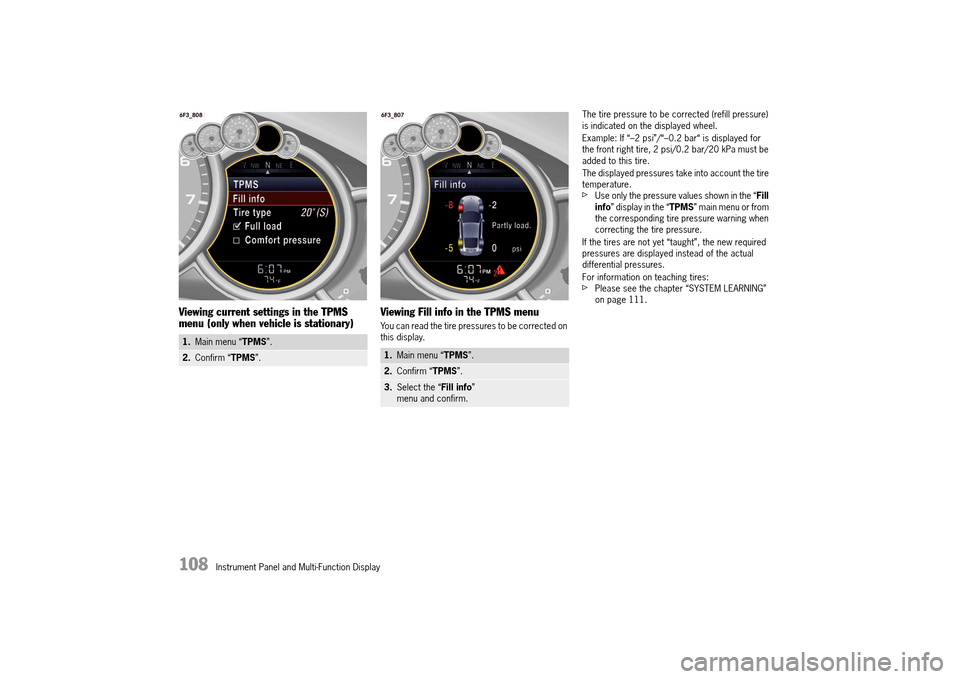
Viewing current settings in the TPMS menu (only when vehicle is stationary) Viewing Fill info in the TPMS menu
You can read the tire pressures to be corrected on this display.
The tire pressure to be corrected (refill pressure) is indicated on the displayed wheel.
Example: If “–2 psi”/“–0.2 bar“ is displayed for the front right tire, 2 psi/0.2 bar/20 kPa must be added to this tire.
The displayed pressures take into account the tire temperature.fUse only the pressure values shown in the “ Fill info ” display in the “TPMS” main menu or from the corresponding tire pressure warning when correcting the tire pressure.
If the tires are not yet “taught”, the new required pressures are displayed instead of the actual differential pressures.
For information on teaching tires:fPlease see the chapter “SYSTEM LEARNING” on page 111.
1. Main menu “TPMS”.
2.Confirm “TPMS”.1.Main menu “TPMS”.
2.Confirm “TPMS”.
3.Select the “Fill info” menu and confirm.
14_991_Turbo_21.book Seite 108 Mittwoch, 9. April 2014 2:19 14
Page 111 of 300
Instrument Panel and Multi-Function Display 109
Selecting tire type in the TPMS menu (type and size of fitted tire)
Exceeding the maximum tire speed could result in a tire burst, causing loss of control of the vehicle.fAlways observe the permissible maximum speed of the respective tire.fPorsche recommends obeying all traffic laws at all times to maintain the safety of yourself and all vehicle occupants.
Incomplete entries or selection of the wrong tires on the multi-function display affect correct indication of warnings and messages.fThe settings must be updated in the “ Tire pressure ” menu after changing a wheel, filling with tire sealant or adding air (after previous warning “ Check tires”). Please see the chapter “RED WARNING – “CHECK TIRES”” on page 112.
The new tire type and tire size must be selected even if the settings for the new set of wheels are the same as for the old wheels.
Option is selected.
Option is not selected.
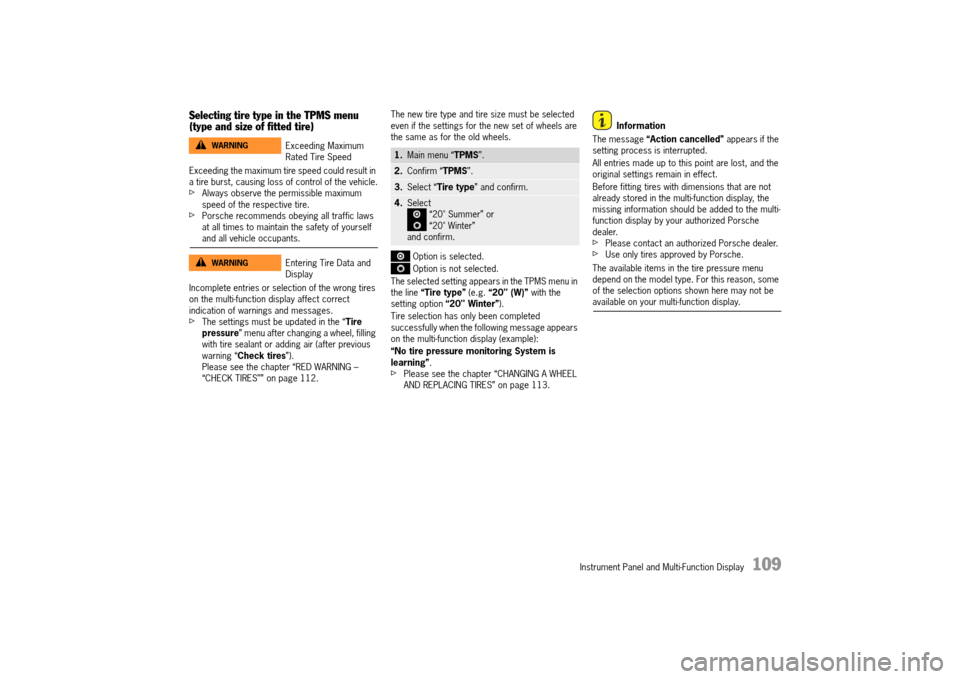
The selected setting appears in the TPMS menu in the line “Tire type” (e.g. “20" (W)” with the setting option “20" Winter”).
Tire selection has only been completed successfully when the following message appears on the multi-function display (example):
“No tire pressure monitoring System is learning” .fPlease see the chapter “CHANGING A WHEEL AND REPLACING TIRES” on page 113.
Information
The message “Action cancelled” appears if the setting process is interrupted.
All entries made up to this point are lost, and the original settings remain in effect.
Before fitting tires with dimensions that are not already stored in the multi-function display, the missing information should be added to the multi-function display by your authorized Porsche dealer.fPlease contact an authorized Porsche dealer.fUse only tires approved by Porsche.
The available items in the tire pressure menu depend on the model type. For this reason, some of the selection options shown here may not be available on your multi-function display.
Exceeding Maximum Rated Tire Speed
Entering Tire Data and Display
WARNINGh
WARNINGh
1. Main menu “TPMS”.
2.Confirm “TPMS”.
3.Select “Tire type” and confirm.
4.Select “20" Summer” or “20" Winter” and confirm.
14_991_Turbo_21.book Seite 109 Mittwoch, 9. April 2014 2:19 14
Page 171 of 300
Driving and Driving Safety 169
Static and fluttering
When the line-of-sight link between a transmitter and vehicle is blocked by large buildings or mountains, the radio sound may be accompanied with static or fluttering because of the characteristic of FM.
In a similar effect, a fluttering noise is sometimes heard when driving along a tree-lined road.
This static and fluttering can be reduced by adjusting the tone control for greater bass response until the disturbance has passed.
Multipath
Because of the reflecting characteristics of FM, direct and reflected signals may reach the antenna at the same time (multipath) and cancel each other out. As a vehicle moves through these electronic dead spots, the listener may hear a momentary flutter or loss of reception.
Station swapping
When two FM stations are close to each other, and an electronic dead spot, such as static or multipath area, interrupts the original signal, sometimes the stronger second signal will be selected automatically until the original one returns. This swapping can also occur as you drive away from the selected station and approach another station of a stronger signal.
Compact disk player
To avoid damage to compact disk player and disks.fUse only compact disks labeled as shown, having no dirt, damage or warpage.
fNever attempt to disassemble or oil any part of the player unit. Do not insert any object other than a disk into the slot. Remember there are no user-serviceable parts inside the compact disk player.fDo not allow the disk to sustain any fingerprints, scrapes or stickers on the surfaces. This may cause poor sound quality.Hold the disk only on the edge or center hole.fWhen not in use, take the disk out of the player, put the disk back into its case and store it away from dust, heat, damp and direct sunlight.Leaving the disk on the dashboard in the sun can damage the disk.fIf the disk gets dirty, clean the disk by wiping the surfaces from the center to the outside in a radial direction with a soft cloth. Do not use a conventional record cleaner or anti-static record preservative. Disk cleaners are available in audio stores.
Car Telephone and Aftermarket Alarms
Important legal and safety information regarding the use of cellular telephones
Some jurisdictions may prohibit the use of cellular telephones while driving a vehicle. Check the laws and regulations on the use of cellular telephones in the areas where you drive.
Looking away from the road or turning your attention away from your driving to operate a cell phone will sooner or later cause an accident. fDo not attempt to operate a hand-held cell phone while you are driving. Safety is more important than a phone call.
fLearn to operate the hands-free phone, if it is available, before you start driving. Then make use of the hands-free phone at all times.
It is essential to observe the telephone manufacturer’s instructions before operating the telephone.
Any portable telephone or radio transmitter which is used in a Porsche must be properly installed in accordance with the technical requirements of Porsche.
The transmission power must not exceed 10 W.
The devices must possess a type approval for your vehicle and have an “e” symbol.
If you should require equipment with transmission power values greater than 10 W, please consult your authorized Porsche dealer for this purpose. They are familiar with the technical requirements for installing devices of this kind.
The antennas for all radios and telephones with a transmitting antenna must be externally mounted.
The improper installation of radios or telephones or use of a radio or telephone with a transmitting antenna inside the car may cause the warning lights to come on.
Improper installation of such equipment can create a discharged battery or excessive current draw from added equipment.
NOTICE
Cell Phone UseDANGERh
14_991_Turbo_21.book Seite 169 Mittwoch, 9. April 2014 2:19 14
Page 177 of 300
Driving and Driving Safety 175
is suppressed because here, the vehicle does not slow down, despite the engine overrun torque and no fuel is consumed in this driving situation due to utilization of the overrun shut-off.
Ending coasting mode/utilizing engine braking effect
fPress the accelerator or brake pedalor Operate a shift paddle or a shift button or Shift gear using the selector lever.
Initiating coasting mode manually
– Driving in selector lever position D or driving in selector lever position M
When coasting mode is suppressed, e.g. in the case of sporty driving, sudden release of the accelerator pedal or excessively low engine temperature, coasting mode can be initiated manually.fTake your foot off the accelerator pedal and shift past the highest possible gear with the shift paddle, one of the shift buttons, or with the selector lever.
Switching coasting mode on and off using the Auto Start Stop button
Switching off
fPress button . The indicator light on the button lights up.Coasting mode is switched off and automatic stopping of the engine is suppressed.
Switching on
fPress button . The indicator light on the button goes out.Coasting mode is switched on and the engine is automatically stopped when the vehicle stops.
“Sport” mode activated
The PDK transmission switches to a sporty gear- changing map and shortens the shifting times.A sporty driving style is recognized more quickly and the gear-changing speeds are adapted to driving performance.
Braking downshifts are initiated earlier. Downshifts occur for small decelerations, even at higher revs.
“Sport Plus” mode activated
In “Sport Plus” mode, the PDK transmission changes to a shift program designed for driving on race circuits. 7th gear is not selected.The gear-changing performance is enhanced significantly again compared with “Sport” mode.fPlease see the chapter ““SPORT” AND “SPORT PLUS” MODE” on page 188.
Driving off with Launch Control
Launch Control allows you to achieve maximum acceleration from standstill.
Launch Control is designed to be used in a controlled environment on closed circuit driving courses where no vehicle cross traffic or pedestrian traffic is present.fUse Launch Control only if conditions permit it to be applied in a safe manner.fDo not use Launch Control if there is a possibility it could endanger other persons.Such a possibility exists if you cannot see that you have a clear road with no possibility of cross traffic in your intended direction of driving.
Information
Stress on components increases dramatically when starting with maximum acceleration in comparison with normal driving off.
Preconditions: – Launch Control should only be used when the engine has reached operating temperature.–“ Sport Plus” mode must be switched on (indicator light on the button comes on and SPORT PLUS appears on the digital speedometer or on the steering wheel).1. Press the brake with your left foot. 2. Quickly press the accelerator down fully (kickdown activated) and hold it.The engine speed will level off at around 5,500 rpm.“ Launch Control activated” is displayed on the multi-function display.Depending on equipment, the “LAUNCH CONTROL” logo appears on the steering wheel.3. Release the brake within a few seconds.
Remaining stationary for a long time with LAUNCH CONTROL can lead to overloading of the transmission.To protect the transmission, the engine power is then reduced and the LAUNCH CONTROL process is cancelled.
In order to drive off, the accelerator must first be fully released.
Endangering Other Road Users
WARNINGh
14_991_Turbo_21.book Seite 175 Mittwoch, 9. April 2014 2:19 14
Page 232 of 300
230 Maintenance and Car Care
Fuel Recommendations
Your Porsche is equipped with catalytic converters and must use UNLEADED FUEL WITHOUT METALLIC ADDITIVES ONLY .
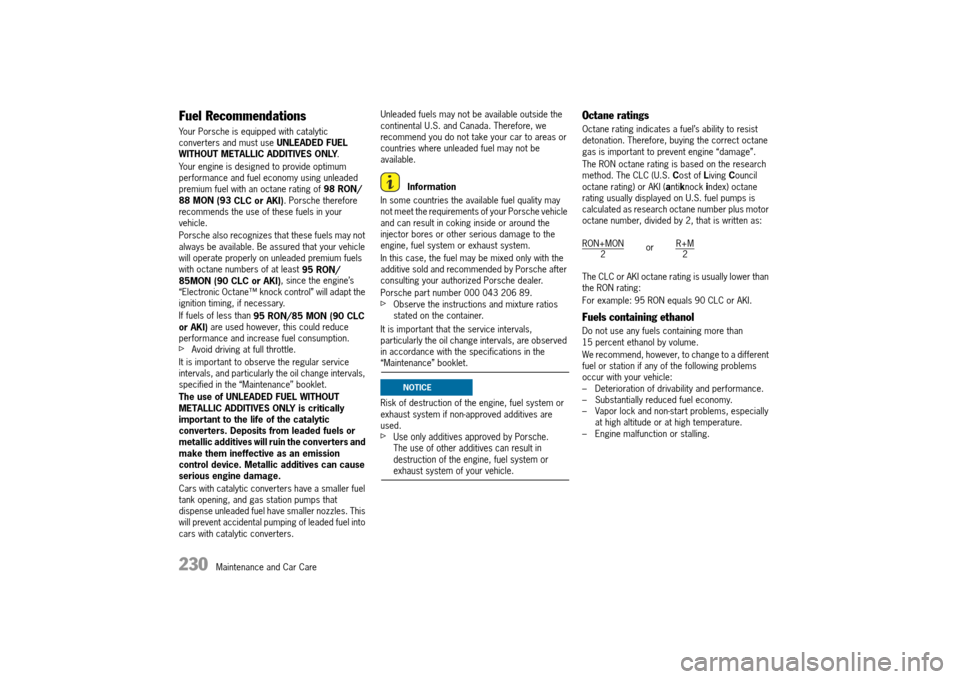
Your engine is designed to provide optimum performance and fuel economy using unleaded premium fuel with an octane rating of 98 RON/ 88 MON (93 CLC or AKI) . Porsche therefore recommends the use of these fuels in your vehicle.
Porsche also recognizes that these fuels may not always be available. Be assured that your vehicle will operate properly on unleaded premium fuels with octane numbers of at least 95 RON/ 85MON (90 CLC or AKI) , since the engine’s “Electronic Octane™ knock control” will adapt the ignition timing, if necessary.
If fuels of less than 95 RON/85 MON (90 CLC or AKI) are used however, this could reduce performance and increase fuel consumption.fAvoid driving at full throttle.
It is important to observe the regular service intervals, and particularly the oil change intervals, specified in the “Maintenance” booklet.
The use of UNLEADED FUEL WITHOUT METALLIC ADDITIVES ONLY is critically important to the life of the catalytic converters. Deposits from leaded fuels or metallic additives will ruin the converters and make them ineffective as an emission control device. Metallic additives can cause serious engine damage.
Cars with catalytic converters have a smaller fuel tank opening, and gas station pumps that dispense unleaded fuel have smaller nozzles. This will prevent accidental pumping of leaded fuel into cars with catalytic converters.
Unleaded fuels may not be available outside the continental U.S. and Canada. Therefore, we recommend you do not take your car to areas or countries where unleaded fuel may not be available.
Information
In some countries the available fuel quality may not meet the requirements of your Porsche vehicle and can result in coking inside or around the injector bores or other serious damage to the engine, fuel system or exhaust system.
In this case, the fuel may be mixed only with the additive sold and recommended by Porsche after consulting your authorized Porsche dealer.
Porsche part number 000 043 206 89.fObserve the instructions and mixture ratios stated on the container.
It is important that the service intervals, particularly the oil change intervals, are observed in accordance with the specifications in the “Maintenance” booklet.
Risk of destruction of the engine, fuel system or exhaust system if non-approved additives are used.fUse only additives approved by Porsche. The use of other additives can result in destruction of the engine, fuel system or exhaust system of your vehicle.
Octane ratings
Octane rating indicates a fuel’s ability to resist detonation. Therefore, buying the correct octane gas is important to prevent engine “damage”.
The RON octane rating is based on the research method. The CLC (U.S. Cost of Living Council octane rating) or AKI ( antiknock index) octane rating usually displayed on U.S. fuel pumps is calculated as research octane number plus motor octane number, divided by 2, that is written as:
The CLC or AKI octane rating is usually lower than the RON rating:
For example: 95 RON equals 90 CLC or AKI.
Fuels containing ethanol
Do not use any fuels containing more than 15 percent ethanol by volume.
We recommend, however, to change to a different fuel or station if any of the following problems occur with your vehicle: – Deterioration of drivability and performance. – Substantially reduced fuel economy. – Vapor lock and non-start problems, especially at high altitude or at high temperature. – Engine malfunction or stalling.
NOTICE
RON+MON2 R+M2 or
14_991_Turbo_21.book Seite 230 Mittwoch, 9. April 2014 2:19 14
Page 237 of 300
Maintenance and Car Care 235
Repairing the underbody protection
The underside of your car is durably protected against chemical and mechanical influences.
As it is not possible to exclude the risk of damage to this protective coating in day to day driving, it is advisable to have the underside of the car inspected at certain intervals - preferably before the start of winter and again in spring - and the undercoating restored as necessary.
Your authorized Porsche dealer is familiar with the bodyseal treatment procedures and has the necessary equipment for applying factory approved materials. We recommend that you entrust them with such work and inspections.
Unlike conventional spray oils, undercoating and rust-proofing compounds based on bitumen or wax do not attack the sound-proofing materials applied at the factory.
The exhaust system becomes very hot when the engine is running. Flammable material close to the exhaust system could ignite. Additional undercoating or rust protection agents on or near the exhaust system can become too hot when driving and ignite.fDo not apply additional undercoating or rust-proofing on or near the exhaust manifold, exhaust pipes, catalytic converters or heat shields. During driving the substance used for undercoating could overheat and ignite.
fBefore applying fresh underseal, carefully remove deposits or dirt and grease. Once it has dried, the new undercoating compound forms a tough protective coating which provides efficient rust-proofing of the floor panels and components.
fAlways apply a fresh coating of suitable preservative to unprotect areas after cleaning the underside of the body, the transmission, the engine or carrying out repairs to under-body, engine or transmission components.
Effective rust-proofing is particularly important during the cold weather season. If your car is driven frequently in areas where salt has been spread on the roads, the whole engine compartment should be cleaned thoroughly after the winter to prevent salt from causing any lasting damage. A full under-body wash should also be performed at the same time.
Cleaning headlights, lights, interior and exterior plastic components, adhesive foils, reversing camera and radar sensor for adaptive cruise control
Observe the following points: fUse only clean water and a little dishwashing liquid or interior window cleaner to clean headlights, lights, plastic components and surfaces.Use a soft sponge or a soft, lint-free cloth.fDo not spray water or interior window cleaner directly onto the plastic components in the passenger compartment, but first onto a sponge or cloth. Cleaning agents may, for example, enter controls or switches and cause damage.
Information
An interior window cleaner can also be used to clean plastic surfaces (always read the cleaning instructions on the container).We recommend Porsche interior window cleaner.fGently wipe the surface without applying too much pressure.fDo not clean when dry.
fNever use other chemical cleaners or solvents.fRinse cleaned surfaces with clear water.
Alloy wheels
Metal particles (e.g. brass or copper in brake dust) must not remain too long on alloy wheels.Contact corrosion can cause pitting.
Information
Cleaners with an oxide-removing effect or wrong pH value, as are commonly used for other metals, as well as mechanical tools and products, will damage the oxide layer and are therefore unsuitable.fUse only cleaners for alloy wheels (pH value 9.5). Products with the wrong pH value can destroy the protective layer on the wheels . We recommend Porsche cleaner for alloy rims.fIf possible, wash the wheels every two weeks with a sponge or washing brush. If the wheels are exposed to road salt, grit or industrial dust, weekly cleaning is necessary.fEvery three months, after cleaning, grease the wheels with car wax or an acid-free grease (e.g. Vaseline).Rub the grease in well with a soft cloth.fPlease see the chapter “CLEANING IN CAR WASHES” on page 233.
Exhaust System Fire Risk
WARNINGh
14_991_Turbo_21.book Seite 235 Mittwoch, 9. April 2014 2:19 14
Page 238 of 300
236 Maintenance and Car Care
If cleaning agents (e.g. wheel cleaning agents) come into contact with the brake disks, the resulting film on the brake disks can impair braking performance.fMake sure that no cleaning agent comes into contact with the brake disks.fIf cleaning agent has come into contact with the brake disks, clean the brake disks thoroughly with a strong jet of water.fPaying attention to any road users behind you, dry the brake disks by applying the brakes.
Stainless steel tailpipes
Stainless steel tailpipes can discolor due to soiling, strong heat and combustion residues.
The original shine can be achieved again using commercially available metal luster paste or metal polish.
Cleaning door, roof, lid and window seals
The lubricant coating on the inner door seals may be damaged by unsuitable cleaning and care agents.fDo not use any chemical cleaning agents or solvents.fDo not use any preservative agents.
fWash dirt (e.g. abrasion, dust, road salts) from all seals regularly using warm soapy water.fIf there is a risk of frost, protect the outer door seals and the lid and flap seals against freezing into place with a suitable care product.
Leather care
The natural surface markings of leather, e.g. creases, healed scars, insect sting marks, structural differences and slight variations in shade and grain add to the attractiveness of the high-quality natural leather product.
Observe the following care instructions:
The leather will be damaged by the use of unsuitable cleaning and care agents and by inappropriate treatment.fDo not use caustic cleaners or hard cleaning objects!fMake sure that perforated leather does not get wet on its reverse side.fRemove water drops from the leather without delay.
fClean all types of leather regularly to remove fine dust using a soft, damp, white woolen cloth or a commercially available microfiber cloth.fRemove heavy contamination (not water or moisture stains) with a leather cleaner.Always read the instructions for use given on the containers.We recommend Porsche leather care liquid.fTreat cleaned leather only with a leather care product.We recommend Porsche leather care liquid.
Seats with seat ventilation
Care instructions for water or moisture stains.
Rain water or moisture can stain the perforated leather.
Removing water and moisture stains
Preconditions: – Seat heating and seat ventilation must be switched off.– No direct sunlight.– Do not use leather cleaners or care products to remove water and moisture stains.fBlot the entire seat or backrest surface using a clean, absorbent sponge and distilled water.Make sure that the perforated leather does not get wet on its reverse side.fAllow the seat covering to dry completely at room temperature out of direct sunlight.Do not dry the seat covering by switching on the seat heating and seat ventilation.fOnce dry, wipe the seat covering with a dry, lint-free cloth.
Cleaning carpet, floor mats
fUse a vacuum cleaner or a brush (not too soft) for cleaning.fHeavy dirt and stains can be removed with a stain remover.We recommend Porsche stain remover.
To protect carpets, the Porsche range of accessories includes mats of the correct size and with the appropriate fastening.
Cleaning Agents on Brake Disks
WARNINGh
NOTICE
NOTICE
14_991_Turbo_21.book Seite 236 Mittwoch, 9. April 2014 2:19 14
Page 239 of 300
Maintenance and Car Care 237
Improperly secured floor mats can obstruct pedal travel.fAlways check the movement of the pedals before driving and make sure that they are not obstructed by a floor mat or any other object.fSecure the floor mat to prevent it from sliding into positions that could interfere with the safe operation of your vehicle – do not lay them loosely in the vehicle.Your authorized Porsche dealer will be glad to offer you floor mats of correct size including a securing possibility.
Cleaning airbag covers
Incorrect modifications may damage the airbag system. The airbag may not deploy properly in the event of an accident.fDo not make any modifications whatsoever to individual components, such as the padded covers on the steering wheel, the instrument panel, the underside of the instrument panel, front seats and door panels.fHave your authorized Porsche dealer to clean these components.
Cleaning fabric linings
fFabric linings on pillars, roofliner and sun blinds, etc. must be cleaned only using suitable cleaning agents or a suitable dry foam and a soft brush.
Alcantara® care
Do not use leather care products to clean Alcantara®. Alcantara® is a manufactured product. It is not genuine leather or suede.
For regular care, it is sufficient to clean the cover with a soft brush.
Strong abrasion or rubbing when cleaning will produce a lasting change to the surface.
Cleaning when lightly soiled
fWet a soft cloth with water or a neutral soap solution and wipe off the dirt.
Cleaning when heavily soiled
fWet a soft cloth with lukewarm water or thinned white spirit and dab the dirt from the outside in.
Cleaning the safety belts
fUse mild detergent to clean soiled belts.fWhen drying, avoid direct sunlight.fOnly use suitable cleaning agents.fDo not tint or bleach the belts.The belt fabric could be weakened, thus affecting safety.
Storing your Porsche
If you intend to store your Porsche for a prolonged period, please consult your authorized Porsche dealer. The staff will be glad to advise you on the most suitable and necessary methods. fClean your vehicle thoroughly inside and outside. The under carriage and chassis components should be free of dirt and salt deposits. fFill up the fuel tank. fChange the oil and oil filter, and run the engine for several minutes. fIncrease the tire pressure to 50 psi/3.5 bar/350 kPa.It is not recommended to lift the vehicle, due to the possibility of corrosion on shock absorber piston shafts.The vehicle should be moved slightly, approximately every four weeks, to prevent flat spot on the tires.
Climate control
The air conditioning system should be in good working condition and fully charged.
Windshield/Headlight washer
fCheck and correct antifreeze/cleaning solution level as necessary.
Obstructed Pedals
Vehicle Interior Modifications
WARNINGh
DANGERh
14_991_Turbo_21.book Seite 237 Mittwoch, 9. April 2014 2:19 14
Page 244 of 300
242 Minor Repairs
Checking the Coolant Level and
Adding Coolant
The coolant provides year-round protection from corrosion and freezing down to –31 °F (–35 °C)(–40 °F (–40 °C) in Nordic countries). Regular checking of the coolant level is part of servicing. The coolant level only needs to be checked when a warning message appears on the multi-function display in the instrument panel.fPlease see the chapter “OVERVIEW OF WARNING AND INFORMATION MESSAGES” on page 129.fUse only antifreeze authorized by Porsche.
Coolant is hazardous to health. Coolant can be deadly to children or pets if consumed.fKeep coolant out of children's reach.fAlso, keep coolant away from your pets. They can be attracted to it should there be a spill, or to used coolant left in an open container.
The coolant becomes very hot when the engine is running and can burn you.
The coolant reservoir is pressurized. Careless opening of the coolant reservoir can lead to hot coolant suddenly spraying out.fDo not open the cap on the reservoir when the engine is hot.fAllow the engine to cool down before opening the cap and protect your hands, arms and face from any possible escape of hot coolant.
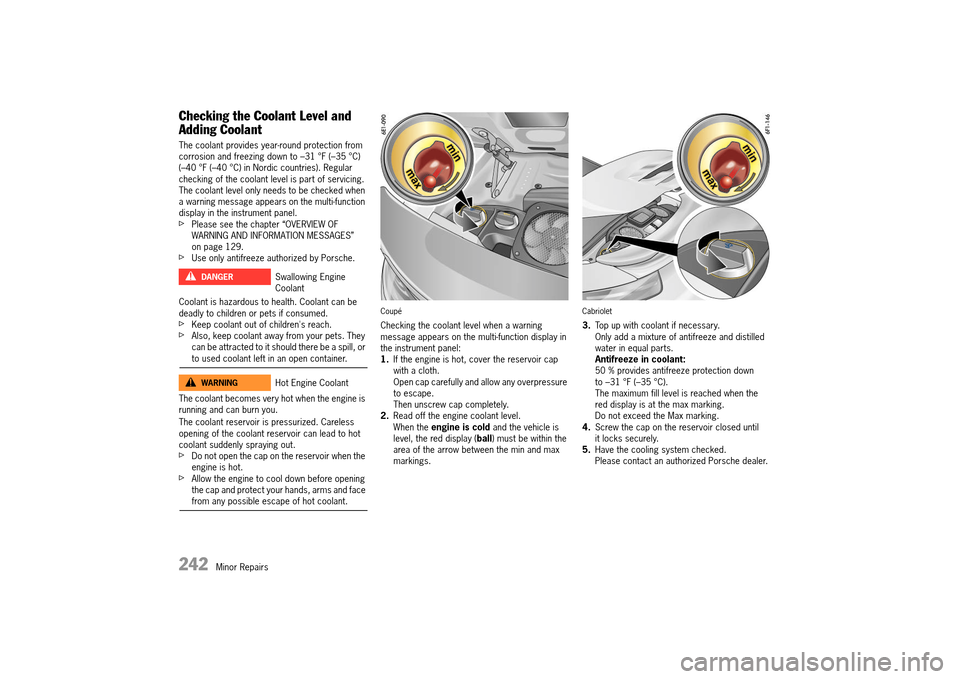
Coupé
Checking the coolant level when a warning message appears on the multi-function display in the instrument panel:1. If the engine is hot, cover the reservoir cap with a cloth.Open cap carefully and allow any overpressure to escape.Then unscrew cap completely.2. Read off the engine coolant level. When the engine is cold and the vehicle is level, the red display ( ball) must be within the area of the arrow between the min and max markings.
Cabriolet
3. Top up with coolant if necessary. Only add a mixture of antifreeze and distilled water in equal parts.Antifreeze in coolant:50 % provides antifreeze protection down to –31 °F (–35 °C).The maximum fill level is reached when the red display is at the max marking.Do not exceed the Max marking.4. Screw the cap on the reservoir closed until it locks securely.5. Have the cooling system checked. Please contact an authorized Porsche dealer.
Swallowing Engine Coolant
Hot Engine Coolant
DANGERh
WARNINGh
14_991_Turbo_21.book Seite 242 Mittwoch, 9. April 2014 2:19 14
Page 245 of 300
Minor Repairs 243
Information
If pure water is added in an emergency, the mixing ratio will have to be corrected.A significant loss of coolant indicates a leak in the cooling system.fThe cause must be eliminated without delay. Please contact an authorized Porsche dealer.
Hands, fingers, items of clothing (ties, sleeves, etc.), necklaces or long hair can be drawn in by moving parts, e.g. the engine-compartment blowers, drive belt, etc., when working in the engine compartment.
The engine-compartment blowers are mounted under the engine compartment lid.After the engine is switched off, the engine compartment temperature is monitored for approx. 30 minutes.During this period, and depending on temperature, the engine-compartment blowers may continue to run or start to run.fCarry out work in this area only with the engine off and exercise extreme caution.
The engine and adjacent components become very hot when the engine is running.fExercise extreme caution when working in the engine compartment.
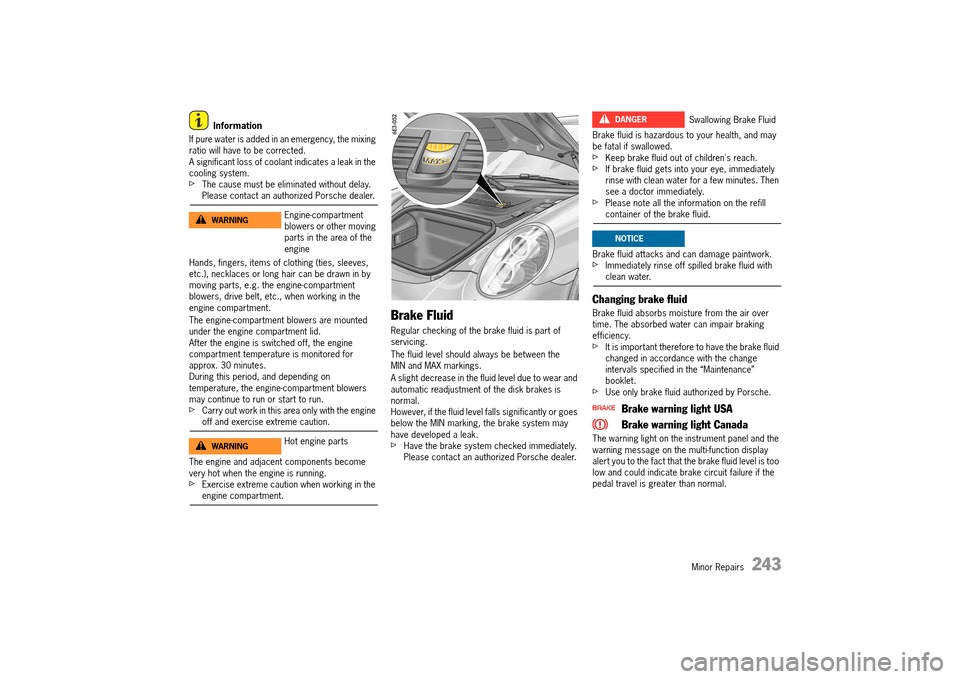
Brake Fluid
Regular checking of the brake fluid is part of servicing.
The fluid level should always be between the MIN and MAX markings.
A slight decrease in the fluid level due to wear and automatic readjustment of the disk brakes is normal.However, if the fluid level falls significantly or goes below the MIN marking, the brake system may have developed a leak.fHave the brake system checked immediately. Please contact an authorized Porsche dealer.
Brake fluid is hazardous to your health, and may be fatal if swallowed.fKeep brake fluid out of children's reach.fIf brake fluid gets into your eye, immediately rinse with clean water for a few minutes. Then see a doctor immediately.fPlease note all the information on the refill container of the brake fluid.
Brake fluid attacks and can damage paintwork.fImmediately rinse off spilled brake fluid with clean water.
Changing brake fluid
Brake fluid absorbs moisture from the air over time. The absorbed water can impair braking efficiency.fIt is important therefore to have the brake fluid changed in accordance with the change intervals specified in the “Maintenance” booklet.fUse only brake fluid authorized by Porsche.
Brake warning light USA
Brake warning light Canada
The warning light on the instrument panel and the warning message on the multi-function display alert you to the fact that the brake fluid level is too low and could indicate brake circuit failure if the pedal travel is greater than normal.
Engine-compartment blowers or other moving parts in the area of the engine
Hot engine parts
WARNINGh
WARNINGh
Swallowing Brake FluidDANGERh
NOTICE
14_991_Turbo_21.book Seite 243 Mittwoch, 9. April 2014 2:19 14