warning lights PORSCHE 911 TURBO 2014 6.G Owner's Guide
[x] Cancel search | Manufacturer: PORSCHE, Model Year: 2014, Model line: 911 TURBO, Model: PORSCHE 911 TURBO 2014 6.GPages: 300, PDF Size: 10.61 MB
Page 171 of 300
Driving and Driving Safety 169
Static and fluttering
When the line-of-sight link between a transmitter and vehicle is blocked by large buildings or mountains, the radio sound may be accompanied with static or fluttering because of the characteristic of FM.
In a similar effect, a fluttering noise is sometimes heard when driving along a tree-lined road.
This static and fluttering can be reduced by adjusting the tone control for greater bass response until the disturbance has passed.
Multipath
Because of the reflecting characteristics of FM, direct and reflected signals may reach the antenna at the same time (multipath) and cancel each other out. As a vehicle moves through these electronic dead spots, the listener may hear a momentary flutter or loss of reception.
Station swapping
When two FM stations are close to each other, and an electronic dead spot, such as static or multipath area, interrupts the original signal, sometimes the stronger second signal will be selected automatically until the original one returns. This swapping can also occur as you drive away from the selected station and approach another station of a stronger signal.
Compact disk player
To avoid damage to compact disk player and disks.fUse only compact disks labeled as shown, having no dirt, damage or warpage.
fNever attempt to disassemble or oil any part of the player unit. Do not insert any object other than a disk into the slot. Remember there are no user-serviceable parts inside the compact disk player.fDo not allow the disk to sustain any fingerprints, scrapes or stickers on the surfaces. This may cause poor sound quality.Hold the disk only on the edge or center hole.fWhen not in use, take the disk out of the player, put the disk back into its case and store it away from dust, heat, damp and direct sunlight.Leaving the disk on the dashboard in the sun can damage the disk.fIf the disk gets dirty, clean the disk by wiping the surfaces from the center to the outside in a radial direction with a soft cloth. Do not use a conventional record cleaner or anti-static record preservative. Disk cleaners are available in audio stores.
Car Telephone and Aftermarket Alarms
Important legal and safety information regarding the use of cellular telephones
Some jurisdictions may prohibit the use of cellular telephones while driving a vehicle. Check the laws and regulations on the use of cellular telephones in the areas where you drive.
Looking away from the road or turning your attention away from your driving to operate a cell phone will sooner or later cause an accident. fDo not attempt to operate a hand-held cell phone while you are driving. Safety is more important than a phone call.
fLearn to operate the hands-free phone, if it is available, before you start driving. Then make use of the hands-free phone at all times.
It is essential to observe the telephone manufacturer’s instructions before operating the telephone.
Any portable telephone or radio transmitter which is used in a Porsche must be properly installed in accordance with the technical requirements of Porsche.
The transmission power must not exceed 10 W.
The devices must possess a type approval for your vehicle and have an “e” symbol.
If you should require equipment with transmission power values greater than 10 W, please consult your authorized Porsche dealer for this purpose. They are familiar with the technical requirements for installing devices of this kind.
The antennas for all radios and telephones with a transmitting antenna must be externally mounted.
The improper installation of radios or telephones or use of a radio or telephone with a transmitting antenna inside the car may cause the warning lights to come on.
Improper installation of such equipment can create a discharged battery or excessive current draw from added equipment.
NOTICE
Cell Phone UseDANGERh
14_991_Turbo_21.book Seite 169 Mittwoch, 9. April 2014 2:19 14
Page 177 of 300
Driving and Driving Safety 175
is suppressed because here, the vehicle does not slow down, despite the engine overrun torque and no fuel is consumed in this driving situation due to utilization of the overrun shut-off.
Ending coasting mode/utilizing engine braking effect
fPress the accelerator or brake pedalor Operate a shift paddle or a shift button or Shift gear using the selector lever.
Initiating coasting mode manually
– Driving in selector lever position D or driving in selector lever position M
When coasting mode is suppressed, e.g. in the case of sporty driving, sudden release of the accelerator pedal or excessively low engine temperature, coasting mode can be initiated manually.fTake your foot off the accelerator pedal and shift past the highest possible gear with the shift paddle, one of the shift buttons, or with the selector lever.
Switching coasting mode on and off using the Auto Start Stop button
Switching off
fPress button . The indicator light on the button lights up.Coasting mode is switched off and automatic stopping of the engine is suppressed.
Switching on
fPress button . The indicator light on the button goes out.Coasting mode is switched on and the engine is automatically stopped when the vehicle stops.
“Sport” mode activated
The PDK transmission switches to a sporty gear- changing map and shortens the shifting times.A sporty driving style is recognized more quickly and the gear-changing speeds are adapted to driving performance.
Braking downshifts are initiated earlier. Downshifts occur for small decelerations, even at higher revs.
“Sport Plus” mode activated
In “Sport Plus” mode, the PDK transmission changes to a shift program designed for driving on race circuits. 7th gear is not selected.The gear-changing performance is enhanced significantly again compared with “Sport” mode.fPlease see the chapter ““SPORT” AND “SPORT PLUS” MODE” on page 188.
Driving off with Launch Control
Launch Control allows you to achieve maximum acceleration from standstill.
Launch Control is designed to be used in a controlled environment on closed circuit driving courses where no vehicle cross traffic or pedestrian traffic is present.fUse Launch Control only if conditions permit it to be applied in a safe manner.fDo not use Launch Control if there is a possibility it could endanger other persons.Such a possibility exists if you cannot see that you have a clear road with no possibility of cross traffic in your intended direction of driving.
Information
Stress on components increases dramatically when starting with maximum acceleration in comparison with normal driving off.
Preconditions: – Launch Control should only be used when the engine has reached operating temperature.–“ Sport Plus” mode must be switched on (indicator light on the button comes on and SPORT PLUS appears on the digital speedometer or on the steering wheel).1. Press the brake with your left foot. 2. Quickly press the accelerator down fully (kickdown activated) and hold it.The engine speed will level off at around 5,500 rpm.“ Launch Control activated” is displayed on the multi-function display.Depending on equipment, the “LAUNCH CONTROL” logo appears on the steering wheel.3. Release the brake within a few seconds.
Remaining stationary for a long time with LAUNCH CONTROL can lead to overloading of the transmission.To protect the transmission, the engine power is then reduced and the LAUNCH CONTROL process is cancelled.
In order to drive off, the accelerator must first be fully released.
Endangering Other Road Users
WARNINGh
14_991_Turbo_21.book Seite 175 Mittwoch, 9. April 2014 2:19 14
Page 185 of 300
Driving and Driving Safety 183
When PSM is switched off, PSM support is no longer provided in critical driving situations outside the ABS control range. fPSM should always be switched on during “normal” driving.
However, it may be a good idea to switch off PSM temporarily in exceptional situations:– On a loose surface and in deep snow.– When “rocking the vehicle free”.
Information
The vehicle retains its enhanced braking readiness through prefilling of the brake system even when PSM is switched off.
When PSM is switched off, wheel-specific brake interventions and the anti-slip control system (ASR) are also switched off.The automatic brake differential (ABD) remains on.
Switching PSM back on
fPress button . PSM is active immediately.The indicator light on the button and the PSM OFF warning light on the instrument panel go out.The message “ PSM on” appears on the multi-function display in the instrument panel.
“Sport Plus” mode
A sportier setup is obtained when “ Sport Plus” mode is switched on.PSM interventions occur later than in Normal mode. The vehicle can be maneuvered with greater agility at its performance limits, without having to dispense with the assistance of PSM in emergency situations. This helps to achieve optimal lap times, particularly on race circuits and on a dry road surface.
PSM warning light
– The PSM warning light on the instrument panel lights up for a lamp check when the ignition is switched on.– The light indicates a control operation, even when PSM is switched off, e.g. brake control in the event of one-sided wheel spin.– The light – in conjunction with the multi-function display – indicates a fault.The warning message “ PSM failure Consult a workshop Adapted driving permitted ” appears on the multi-function display in the instrument panel.
For information on warning messages on the multi-function display:fPlease see the chapter “OVERVIEW OF WARNING AND INFORMATION MESSAGES” on page 129.fAdapt your driving style according to the changed conditions.fContact an authorized Porsche dealer.
Towing
For information on towing:fPlease see the chapter “TOWING” on page 278.
No PSM assistanceWARNINGh
14_991_Turbo_21.book Seite 183 Mittwoch, 9. April 2014 2:19 14
Page 187 of 300

Driving and Driving Safety 185
Function
The decisive advantage of ABS lies in the driving stability and maneuverability of the vehicle in hazardous situations.
ABS prevents locking of the wheels during full braking, on almost all road surfaces, until just before the vehicle stops.
ABS begins to control the braking process as soon as a wheel shows a tendency to lock.This controlled braking process is comparable with extremely rapid cadence braking.The pulsating brake pedal and a “juddering noise” warn the driver to adapt his driving speed to the road conditions.fIf full braking is necessary, press the brake pedal fully during the whole braking operation, even though the pedal is pulsating. Do not reduce brake pressure.
Warning light USA
Warning light Canada
If the ABS warning light lights up on the instrument panel while the engine is running, the ABS has switched off because of a fault.The warning message “ ABS/PSM failure Adapted driving permitted ” appears on the multi-function display in the instrument panel.
For information on warning messages on the multi- function display: fPlease see the chapter “OVERVIEW OF WARNING AND INFORMATION MESSAGES” on page 129.
In this case, the braking system will operate without lock prevention , as in vehicles without ABS.fAdapt your driving style to the changed braking behavior.The ABS must be checked by your authorized Porsche dealer in order to prevent the occurrence of further faults with unpredictable consequences.Please contact an authorized Porsche dealer.
The ABS control unit is adjusted for the approved tire dimensions.The use of tires with non-approved dimensions can lead to different wheel speeds, causing ABS to switch off.
Porsche Active Suspension
Management (PASM)
The PASM system actively adjusts the shock absorbers. The adjustable damper system selects the appropriate damping level for each wheel according to the driving situation and driving conditions. Driving safety, agility and comfort are optimized.
Two different chassis setups can be selected at the push of a button:–“ Chassis Normal” –“ Chassis Sport”
In Normal mode the vehicle is in a sporty and comfortable setup.Sport mode offers very sporty shock absorber tuning (e.g. for driving on the race circuit).
In addition to manual mode selection, PASM also adjusts shock absorber tuning for either sporty or comfort driving, depending on the driving situation.
14_991_Turbo_21.book Seite 185 Mittwoch, 9. April 2014 2:19 14
Page 209 of 300
Parking 207
ParkAssist
When the driver is parking and maneuvering the vehicle, ParkAssist indicates the distance between the vehicle and a large obstacle by means of signal tones.fOn vehicles with front and rear sensors:For information on the ParkAssist visual display, please refer also to the section “PARKASSIST” in the operating instructions for the Porsche Communication Systems PCM/CDR.
ParkAssist is activated automatically when reverse gear is selected and the ignition is on.
If the vehicle has front ParkAssist, this also issues an automatic warning when the distance between the vehicle and an obstacle in front is less – than approx. 40 in./100 cm (acoustically) and approx. 32 in./80 cm (visually).
A warning signal sounds when – the distance between the vehicle and an obstacle at the rear is less than approx. 71 in./180 cm.The ParkAssist visual display appears on the central screen of the Porsche communication system.
Front and rear ParkAssist is not activated: – At a speed of more than approx. 9 mph (15 km/h).– When the electric parking brake is activated.– When the ParkAssist has been switched off with button A in the overhead console with the ignition switched on. The indicator light in button A lights up.
Responsibility for parking and for assessing the risk to persons, children, pets, and small objects around the vehicle lies completely with the driver. fMake sure that no persons (especially small children), animals or obstacles are within the maneuvering area. fIf the continuous tone sounds, stop and do not move your vehicle further in that direction.
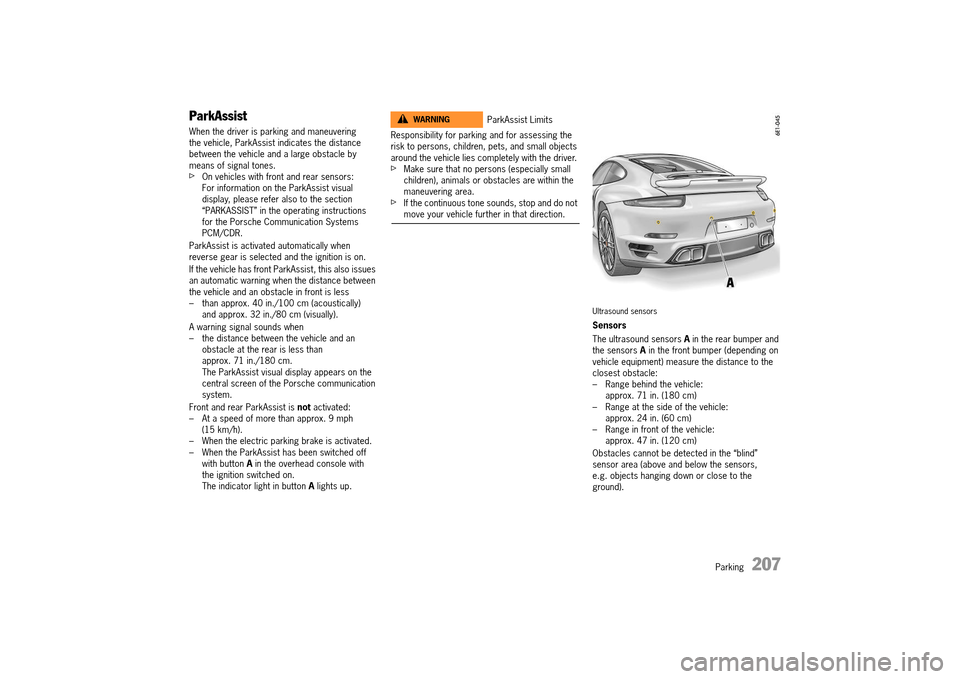
Ultrasound sensors
Sensors
The ultrasound sensors A in the rear bumper and the sensors A in the front bumper (depending on vehicle equipment) measure the distance to the closest obstacle:– Range behind the vehicle: approx. 71 in. (180 cm)– Range at the side of the vehicle: approx. 24 in. (60 cm)– Range in front of the vehicle: approx. 47 in. (120 cm)
Obstacles cannot be detected in the “blind” sensor area (above and below the sensors, e.g. objects hanging down or close to the ground).
ParkAssist LimitsWARNINGh
14_991_Turbo_21.book Seite 207 Mittwoch, 9. April 2014 2:19 14
Page 211 of 300
Parking 209
Deactivating ParkAssist
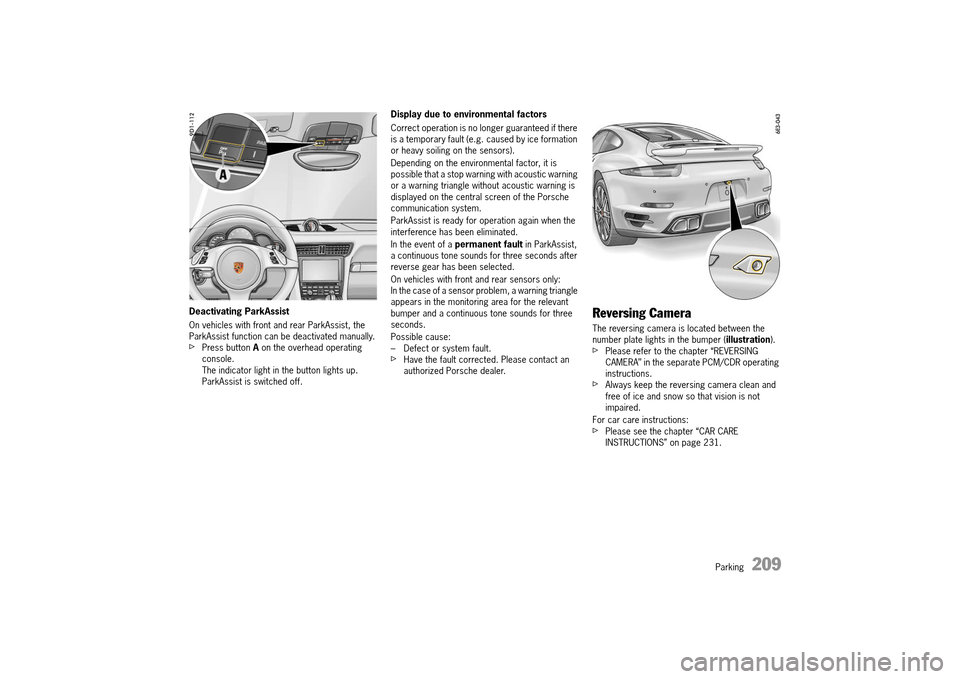
On vehicles with front and rear ParkAssist, the ParkAssist function can be deactivated manually.fPress button A on the overhead operating console.The indicator light in the button lights up.ParkAssist is switched off.
Display due to environmental factors
Correct operation is no longer guaranteed if there is a temporary fault (e.g. caused by ice formation or heavy soiling on the sensors).
Depending on the environmental factor, it is possible that a stop warning with acoustic warning or a warning triangle without acoustic warning is displayed on the central screen of the Porsche communication system.
ParkAssist is ready for operation again when the interference has been eliminated.
In the event of a permanent fault in ParkAssist, a continuous tone sounds for three seconds after reverse gear has been selected.
On vehicles with front and rear sensors only: In the case of a sensor problem, a warning triangle appears in the monitoring area for the relevant bumper and a continuous tone sounds for three seconds.
Possible cause: – Defect or system fault.fHave the fault corrected. Please contact an authorized Porsche dealer.
Reversing Camera
The reversing camera is located between the number plate lights in the bumper ( illustration).fPlease refer to the chapter “REVERSING CAMERA” in the separate PCM/CDR operating instructions.fAlways keep the reversing camera clean and free of ice and snow so that vision is not impaired.
For car care instructions:fPlease see the chapter “CAR CARE INSTRUCTIONS” on page 231.
14_991_Turbo_21.book Seite 209 Mittwoch, 9. April 2014 2:19 14
Page 213 of 300
Parking 211
Garage Door Opener HomeLink®
(Universal Remote Control)
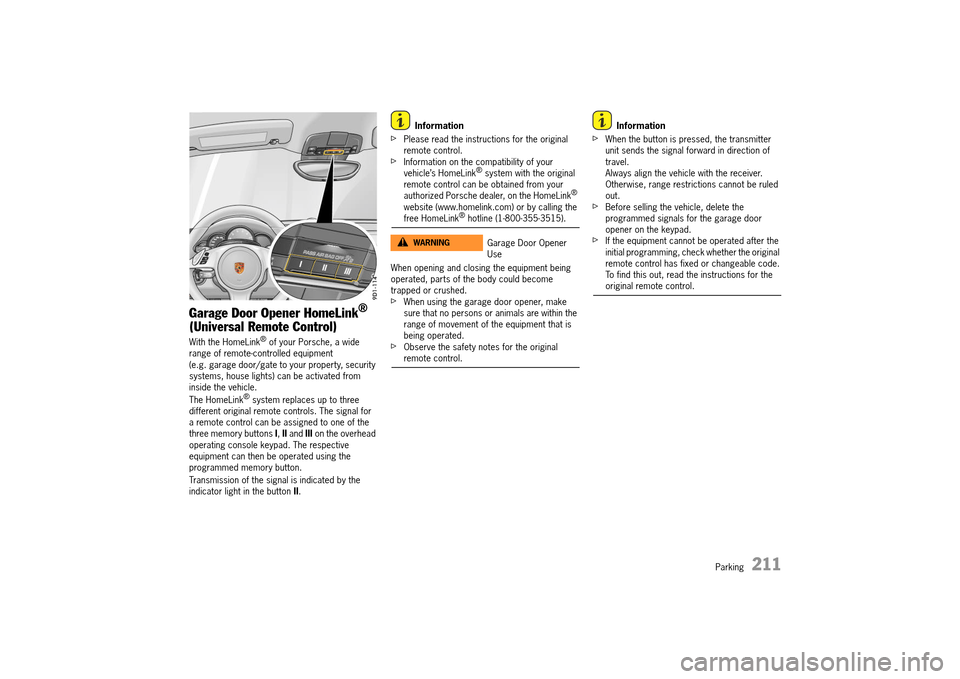
With the HomeLink® of your Porsche, a wide range of remote-controlled equipment (e.g. garage door/gate to your property, security systems, house lights) can be activated from inside the vehicle.
The HomeLink® system replaces up to three different original remote controls. The signal for a remote control can be assigned to one of the three memory buttons I, II and III on the overhead operating console keypad. The respective equipment can then be operated using the programmed memory button.
Transmission of the signal is indicated by the indicator light in the button II.
Information
fPlease read the instructions for the original remote control.fInformation on the compatibility of your vehicle’s HomeLink® system with the original remote control can be obtained from your authorized Porsche dealer, on the HomeLink® website (www.homelink.com) or by calling the free HomeLink® hotline (1-800-355-3515).
When opening and closing the equipment being operated, parts of the body could become trapped or crushed.fWhen using the garage door opener, make sure that no persons or animals are within the range of movement of the equipment that is being operated.fObserve the safety notes for the original remote control.
Information
fWhen the button is pressed, the transmitter unit sends the signal forward in direction of travel.Always align the vehicle with the receiver.Otherwise, range restrictions cannot be ruled out.fBefore selling the vehicle, delete the programmed signals for the garage door opener on the keypad. fIf the equipment cannot be operated after the initial programming, check whether the original remote control has fixed or changeable code.To find this out, read the instructions for the original remote control.
Garage Door Opener Use
WARNINGh
14_991_Turbo_21.book Seite 211 Mittwoch, 9. April 2014 2:19 14
Page 226 of 300
224 Maintenance and Car Care
Washer Fluid windshield
Observe the following points:fDepending on the season, mix the water with the appropriate additives (window cleaner concentrate, antifreeze) in the correct mixture ratio.
Summer filling with water + window cleaner concentrate in the mixture ratio specified on the container.
Winter filling with water + antifreeze + window cleaner concentrate in the mixture ratio specified on the container.
Always follow all the instructions on the containers of the additives used.
fOnly use window cleaner concentrate that meets the following requirements:– Dilutability 1:100,– Phosphate-free,– Suitable for plastic headlight lenses.
We recommend window cleaner concentrates approved by Porsche. Your authorized Porsche dealer will be pleased to advise you.
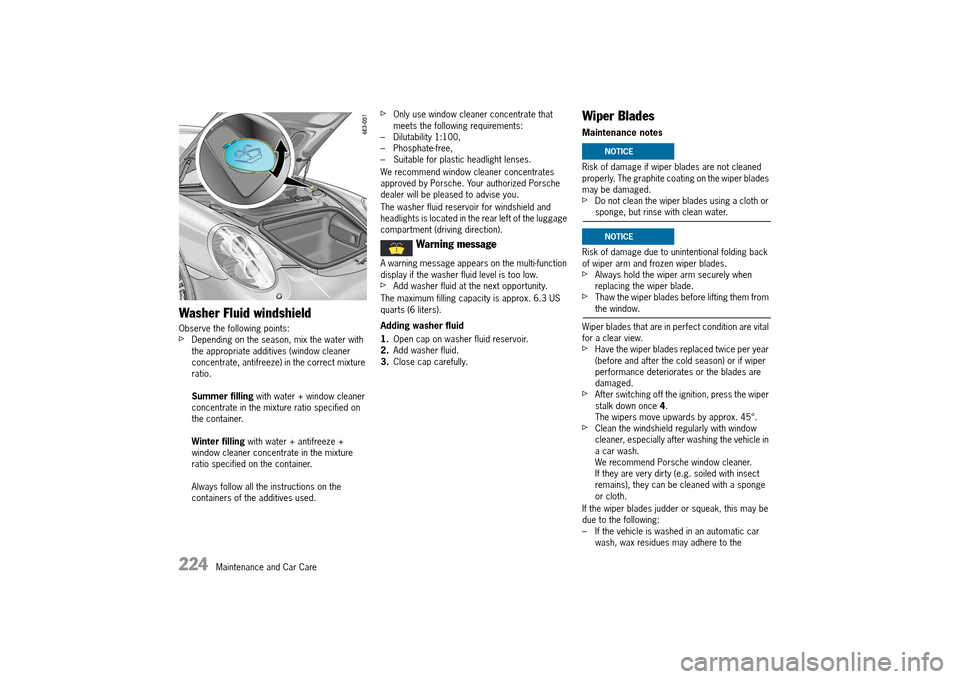
The washer fluid reservoir for windshield and headlights is located in the rear left of the luggage compartment (driving direction).
A warning message appears on the multi-function display if the washer fluid level is too low.fAdd washer fluid at the next opportunity.
The maximum filling capacity is approx. 6.3 US quarts (6 liters).
Adding washer fluid
1. Open cap on washer fluid reservoir. 2. Add washer fluid. 3. Close cap carefully.
Wiper Blades
Maintenance notes
Risk of damage if wiper blades are not cleaned properly. The graphite coating on the wiper blades may be damaged.fDo not clean the wiper blades using a cloth or sponge, but rinse with clean water.
Risk of damage due to unintentional folding back of wiper arm and frozen wiper blades.fAlways hold the wiper arm securely when replacing the wiper blade.fThaw the wiper blades before lifting them from the window.
Wiper blades that are in perfect condition are vital for a clear view.fHave the wiper blades replaced twice per year (before and after the cold season) or if wiper performance deteriorates or the blades are damaged.fAfter switching off the ignition, press the wiper stalk down once 4. The wipers move upwards by approx. 45°.fClean the windshield regularly with window cleaner, especially after washing the vehicle in a car wash.We recommend Porsche window cleaner. If they are very dirty (e.g. soiled with insect remains), they can be cleaned with a sponge or cloth.
If the wiper blades judder or squeak, this may be due to the following:– If the vehicle is washed in an automatic car wash, wax residues may adhere to the
Warning message
NOTICE
NOTICE
14_991_Turbo_21.book Seite 224 Mittwoch, 9. April 2014 2:19 14
Page 229 of 300
Maintenance and Car Care 227
fAlways monitor your fuel consumption.fDrive smoothly, avoid abrupt changes in speed as much as possible.fAvoid jack rabbit starts and sudden stops.fDo not drive longer than necessary in the lower gears. Shifting into a higher gear early without lugging the engine will help save fuel.fProlonged “warm up” idling wastes gas. Start the vehicle just before you are ready to drive. Accelerate slowly and smoothly.fSwitch off the engine if stationary for longer periods.fAny additional weight carried in the vehicle reduces fuel economy. Always keep cargo to a minimum and remove all unnecessary items.fOrganize your trips to take in several errands in one trip.fAll electrical accessories contribute to increased fuel consumption.fOnly switch on the air conditioning when necessary.fDo not drive with the Roof Transport System mounted unless you need it.
The EPA estimated miles per gallon (mpg) is to be used for comparison purposes, actual mileage may be different from the estimated mpg, depending on your driving speed, weather conditions and trip length. Your actual highway mileage may be less than the estimated mpg.fPlease observe all local and national speed limits.
Operating Your Porsche in other
Countries
Government regulations in the United States and Canada require that automobiles meet specific emission regulations and safety standards. Therefore, cars built for the U.S. and Canada differ from vehicles sold in other countries.
If you plan to take your Porsche outside the continental limits of the United States or Canada, there is the possibility that:– Unleaded fuel may not be available,– Unleaded fuel may have a considerably lower octane rating. Excessive engine knock and serious damage to both engine and catalytic converters could result,– Service may be inadequate due to lack of proper service facilities, tools or diagnostic equipment,– Replacement parts may not be available or very difficult to get.
Porsche cannot be responsible for the mechanical damage that could result because of inadequate fuel, service or parts availability.
If you purchased your Porsche abroad and want to bring it back home, be sure to find out about shipping and forwarding requirements, as well as current import and customs regulations.
Fuel
When the ignition is on, the fuel level is displayed on the instrument panel.fPlease see the chapter “FUEL GAUGE” on page 90.
fFire, open flame and smoking are prohibited when handling fuel.
Fuel and fuel vapors are hazardous to health.fAvoid contact with skin or clothing, since injury to your skin may occur.fDo not inhale fuel vapors, since they may make you ill and possibly cause death if inhalation is prolonged and occurs in a closed space.
To prevent damage to the emission control system and engine:fNever drive the tank dry.fAvoid high cornering speeds after the warning lights have come on.
fPlease see the chapter “FUEL ECONOMY” on page 226.
Check engine warning light
If the warning lights in the instrument panel come on and remain on while driving, it suggests: – a potential engine control problem and the need for system service or – an improperly fastened tank cap or
refueling with engine running.
Refueling Fire Risk
Fuel Vapors and Skin Contact
DANGERh
WARNINGh
NOTICE
14_991_Turbo_21.book Seite 227 Mittwoch, 9. April 2014 2:19 14
Page 237 of 300
Maintenance and Car Care 235
Repairing the underbody protection
The underside of your car is durably protected against chemical and mechanical influences.
As it is not possible to exclude the risk of damage to this protective coating in day to day driving, it is advisable to have the underside of the car inspected at certain intervals - preferably before the start of winter and again in spring - and the undercoating restored as necessary.
Your authorized Porsche dealer is familiar with the bodyseal treatment procedures and has the necessary equipment for applying factory approved materials. We recommend that you entrust them with such work and inspections.
Unlike conventional spray oils, undercoating and rust-proofing compounds based on bitumen or wax do not attack the sound-proofing materials applied at the factory.
The exhaust system becomes very hot when the engine is running. Flammable material close to the exhaust system could ignite. Additional undercoating or rust protection agents on or near the exhaust system can become too hot when driving and ignite.fDo not apply additional undercoating or rust-proofing on or near the exhaust manifold, exhaust pipes, catalytic converters or heat shields. During driving the substance used for undercoating could overheat and ignite.
fBefore applying fresh underseal, carefully remove deposits or dirt and grease. Once it has dried, the new undercoating compound forms a tough protective coating which provides efficient rust-proofing of the floor panels and components.
fAlways apply a fresh coating of suitable preservative to unprotect areas after cleaning the underside of the body, the transmission, the engine or carrying out repairs to under-body, engine or transmission components.
Effective rust-proofing is particularly important during the cold weather season. If your car is driven frequently in areas where salt has been spread on the roads, the whole engine compartment should be cleaned thoroughly after the winter to prevent salt from causing any lasting damage. A full under-body wash should also be performed at the same time.
Cleaning headlights, lights, interior and exterior plastic components, adhesive foils, reversing camera and radar sensor for adaptive cruise control
Observe the following points: fUse only clean water and a little dishwashing liquid or interior window cleaner to clean headlights, lights, plastic components and surfaces.Use a soft sponge or a soft, lint-free cloth.fDo not spray water or interior window cleaner directly onto the plastic components in the passenger compartment, but first onto a sponge or cloth. Cleaning agents may, for example, enter controls or switches and cause damage.
Information
An interior window cleaner can also be used to clean plastic surfaces (always read the cleaning instructions on the container).We recommend Porsche interior window cleaner.fGently wipe the surface without applying too much pressure.fDo not clean when dry.
fNever use other chemical cleaners or solvents.fRinse cleaned surfaces with clear water.
Alloy wheels
Metal particles (e.g. brass or copper in brake dust) must not remain too long on alloy wheels.Contact corrosion can cause pitting.
Information
Cleaners with an oxide-removing effect or wrong pH value, as are commonly used for other metals, as well as mechanical tools and products, will damage the oxide layer and are therefore unsuitable.fUse only cleaners for alloy wheels (pH value 9.5). Products with the wrong pH value can destroy the protective layer on the wheels . We recommend Porsche cleaner for alloy rims.fIf possible, wash the wheels every two weeks with a sponge or washing brush. If the wheels are exposed to road salt, grit or industrial dust, weekly cleaning is necessary.fEvery three months, after cleaning, grease the wheels with car wax or an acid-free grease (e.g. Vaseline).Rub the grease in well with a soft cloth.fPlease see the chapter “CLEANING IN CAR WASHES” on page 233.
Exhaust System Fire Risk
WARNINGh
14_991_Turbo_21.book Seite 235 Mittwoch, 9. April 2014 2:19 14