ESP PORSCHE 911 TURBO 2014 6.G Repair Manual
[x] Cancel search | Manufacturer: PORSCHE, Model Year: 2014, Model line: 911 TURBO, Model: PORSCHE 911 TURBO 2014 6.GPages: 300, PDF Size: 10.61 MB
Page 251 of 300
Minor Repairs 249
Tire replacements
fUse only tire makes and types tested by Porsche.
If you do not use a Porsche recommended replacement tire, make sure that you purchase your new tires from a reputable tire dealer and that the dealer complies with all manufacturers warnings for those tires.
Only tires with the same manufacturer and with the same specification code (e.g. “N0”, “N1”…) should be mounted on the vehicle.
Before mounting new tires, check with your Porsche dealer about the current release status.
Use tires with “ZR” quality standards. There are currently no standards concerning tire strength at speeds above 150 mph (240 km/h).
Tires should be replaced no less than on one axle at the time. Only tires of the same make and type must be used. Mixed tires are not permissible and will affect vehicle performance, safety, and can affect vehicle warranty.
Porsche dealers can recommend the most current replacement tire options for your vehicle.
Initially, new tires do not have their full traction. You should therefore drive at moderate speeds during the first 60 - 120 miles (100 - 200 km).
Tires must always remain on the same side of the vehicle.When wheels are removed, the direction of rotation and position of each wheel should be marked.
If new tires are installed only on one axle, a noticeable change in handling occurs due to the different tread depth of the other tires. This happens especially if only rear tires are replaced. However, this condition disappears as the new tires are broken in.fPlease adjust your driving style accordingly.
Installation of new tires should only be done by a qualified tire technician.
Valves
fUse only plastic valve caps.fPlease read the fitting and replacement instructions regarding metal valves.fUse original Porsche metal valves only.fValve inserts with valve caps protect against soiling.Soiled valve inserts can cause a gradual loss of air.
Parking at the curb
Hard impacts against curbs (or traffic islands) are dangerous and may cause hidden tire damage which is not noticeable until later. Such damage can result in accidents at high speeds. Depending on the force of impact, the edge of the rim can also be damaged.fAfter such an impact, have the wheel checked by an expert.fIf you must drive over a curb or other obstacle, drive slowly and at an obtuse angle. Exercise care when parking along curbs.
Information
Tire repairs are not permissible under any circumstances.
Curb Impact / Tire Damage
DANGERh
14_991_Turbo_21.book Seite 249 Mittwoch, 9. April 2014 2:19 14
Page 257 of 300
Minor Repairs 255
fBefore you change a wheel, be sure the ground is level and firm. If necessary, use a board under the jack to ensure that the jack does not sink into the ground.fSet the electric parking brake and block the wheels opposite the flat tire on the other side of the vehicle.fThe jack is only to be used for changing a wheel. Do not use it as a support to work under the car.fThe car must be jacked up only at the illustrated jacking points. Lifting at any other place may result in personal injury.
Risk of damage to the engine or vehicle if you lift the vehicle improperly.fThe car must be jacked up only at the illustrated jacking points. Lifting at any other place may result in damage to the vehicle.fNever jack up the car by the body, bumpers, engine, transmission or at the axles.fDo not damage any sensitive components in the vicinity of the jacking points.fFor safety reasons do not use tire inflating bot-tles. Do not use commercially available sealant bottles. Use only the tire inflating bottle located in the luggage compartment.
Information
The tools required for changing a wheel (e.g. jack, wheel bolt wrench, assembly aids) are not supplied as standard with the vehicle. Your authorized Porsche dealer will be pleased to advise you.
Information
The tire and wheel sizes on both axles are different.fDo not fit the wrong wheels on the wrong axle.fOnly use wheels/tires with approved dimensions for the relevant axle.
Sequence of operation
The jack must be used only to raise the car for wheel changing. The jack must never be used as a support to work underneath the vehicle. If the jack is accidentally dislodged, you or bystanders could suffer severe personal injury.fNever jack up other vehicles or other loads with the jack.fAlways place the car on stable supports if you have to work under it. When working under the vehicle, always use safety stands specifically designed for this purpose.
fPlease use a suitable knee rest to protect your clothing against soiling.1. Activate the electric parking brake and move the PDK selector lever to position P. Remove the ignition key or control unit on vehicles with Porsche Entry & Drive.2. Switch on the emergency flasher if necessary.
3. Secure the vehicle to prevent it from rolling away, e.g. by means of wedges under the wheels on the opposite side.This is particularly important on slopes.4. Slightly loosen the wheel bolts on the wheel to be changed.5. Lift the vehicle only at the specified jacking points.6. Raise the vehicle until the wheel lifts off the ground. fPlease see the chapter “RAISING THE VEHICLE WITH A LIFTING PLATFORM, TROLLEY JACK OR STANDARD JACK” on page 254.7. Remove 1 or 2 wheel bolts (see corresponding figure).NOTICE
Working Under VehicleWARNINGh
14_991_Turbo_21.book Seite 255 Mittwoch, 9. April 2014 2:19 14
Page 259 of 300
Minor Repairs 257
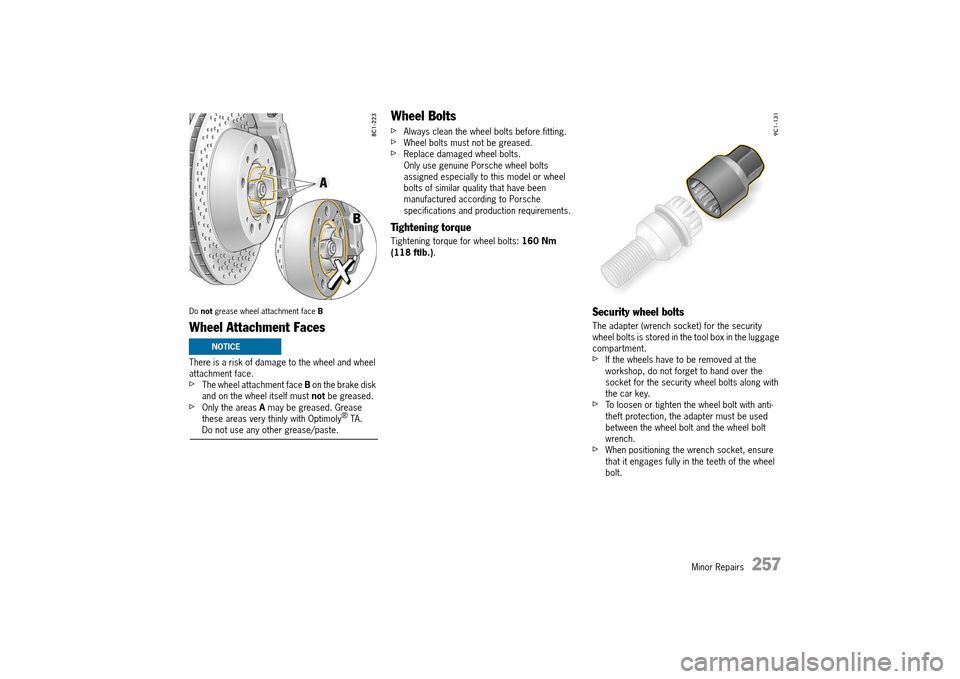
Do not grease wheel attachment face B
Wheel Attachment Faces
There is a risk of damage to the wheel and wheel attachment face.fThe wheel attachment face B on the brake disk and on the wheel itself must not be greased.fOnly the areas A may be greased. Grease these areas very thinly with Optimoly® TA. Do not use any other grease/paste.
Wheel Bolts
fAlways clean the wheel bolts before fitting.fWheel bolts must not be greased.fReplace damaged wheel bolts.Only use genuine Porsche wheel bolts assigned especially to this model or wheel bolts of similar quality that have been manufactured according to Porsche specifications and production requirements.
Tightening torque
Tightening torque for wheel bolts: 160 Nm (118 ftlb.) .
Security wheel bolts
The adapter (wrench socket) for the security wheel bolts is stored in the tool box in the luggage compartment.fIf the wheels have to be removed at the workshop, do not forget to hand over the socket for the security wheel bolts along with the car key.fTo loosen or tighten the wheel bolt with anti-theft protection, the adapter must be used between the wheel bolt and the wheel bolt wrench.fWhen positioning the wrench socket, ensure that it engages fully in the teeth of the wheel bolt.
NOTICE
14_991_Turbo_21.book Seite 257 Mittwoch, 9. April 2014 2:19 14
Page 261 of 300
Minor Repairs 259
If a wheel needs to be changed, the procedure described below must be adhered to exactly, as otherwise the wheel may loosen, resulting in damage. Porsche cannot be held liable if this happens.To achieve the high tightening torque required for the central bolt, a suitable, commercially available 443 ftlb. (600 Nm) torque wrench must be used. Alternatively, a corresponding tool with torque multiplier (part no. 997.450.323.90) is available from Porsche Motorsport. When a torque multiplier is used, the torque must be reduced in accordance with the tool’s operating instructions.
When loosening and fastening the wheel, a second person is needed to prevent the wheel from turning by firmly braking it.
The high mounting forces involved can cause the vehicle to roll away and slip off the jack.fAlways use a lifting platform if there is one available.
Risk of damage due to vehicle tipping over or falling off lifting equipment or using the wrong tool.
The high mounting forces involved can cause the vehicle to roll away and slip off the jack. An impact wrench can damage the central lock.fAlways use a lifting platform if there is one available.fDo not use an impact wrench .
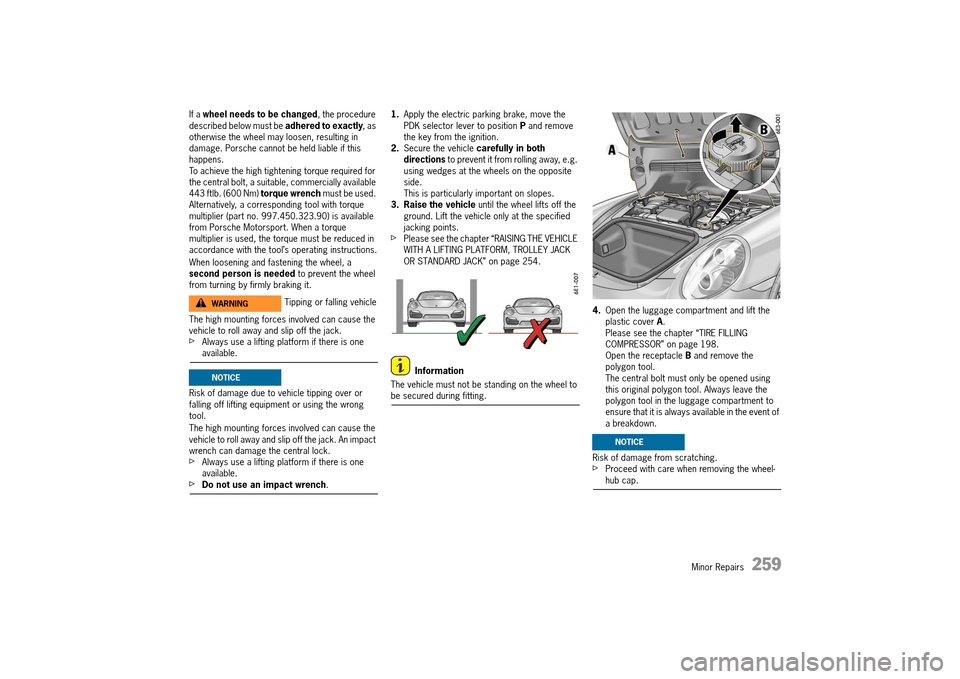
1. Apply the electric parking brake, move the PDK selector lever to position P and remove the key from the ignition.2. Secure the vehicle carefully in both directions to prevent it from rolling away, e.g. using wedges at the wheels on the opposite side.This is particularly important on slopes.3. Raise the vehicle until the wheel lifts off the ground. Lift the vehicle only at the specified jacking points.fPlease see the chapter “RAISING THE VEHICLE WITH A LIFTING PLATFORM, TROLLEY JACK OR STANDARD JACK” on page 254.
Information
The vehicle must not be standing on the wheel to be secured during fitting.
4. Open the luggage compartment and lift the plastic cover A. Please see the chapter “TIRE FILLING COMPRESSOR” on page 198.Open the receptacle B and remove the polygon tool.The central bolt must only be opened using this original polygon tool. Always leave the polygon tool in the luggage compartment to ensure that it is always available in the event of a breakdown.
Risk of damage from scratching.fProceed with care when removing the wheel-hub cap.
Tipping or falling vehicleWARNINGh
NOTICE
NOTICE
14_991_Turbo_21.book Seite 259 Mittwoch, 9. April 2014 2:19 14
Page 262 of 300
260 Minor Repairs
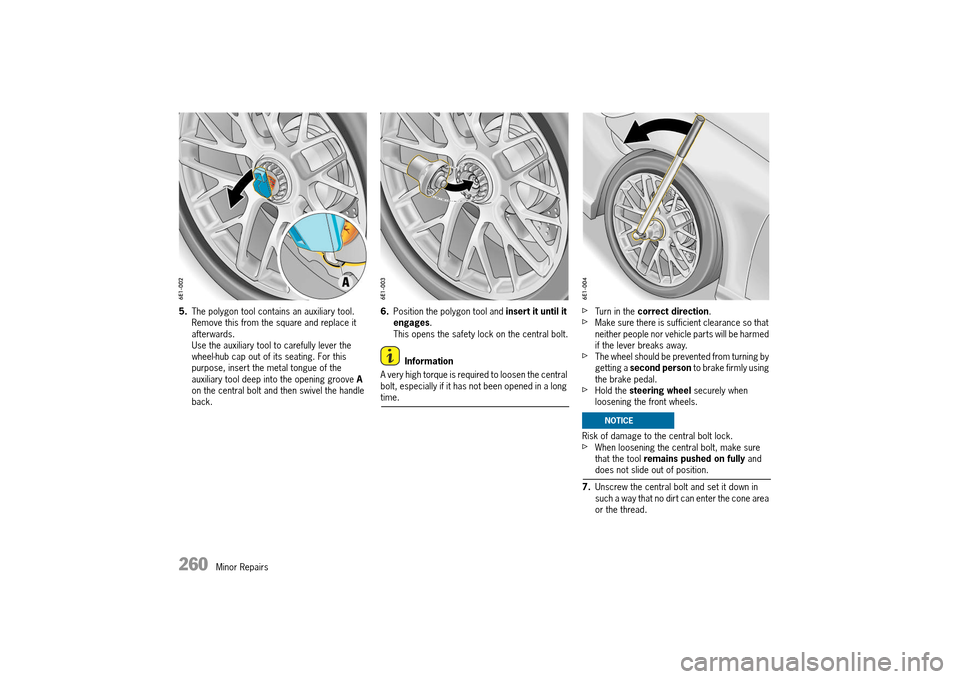
5.The polygon tool contains an auxiliary tool. Remove this from the square and replace it afterwards.Use the auxiliary tool to carefully lever the wheel-hub cap out of its seating. For this purpose, insert the metal tongue of the auxiliary tool deep into the opening groove A on the central bolt and then swivel the handle back.
6. Position the polygon tool and insert it until it engages . This opens the safety lock on the central bolt.
Information
A very high torque is required to loosen the central bolt, especially if it has not been opened in a long time.
fTurn in the correct direction.fMake sure there is sufficient clearance so that neither people nor vehicle parts will be harmed if the lever breaks away.fThe wheel should be prevented from turning by getting a second person to brake firmly using the brake pedal.fHold the steering wheel securely when loosening the front wheels.
Risk of damage to the central bolt lock.fWhen loosening the central bolt, make sure that the tool remains pushed on fully and does not slide out of position.
7. Unscrew the central bolt and set it down in such a way that no dirt can enter the cone area or the thread.
NOTICE
14_991_Turbo_21.book Seite 260 Mittwoch, 9. April 2014 2:19 14
Page 267 of 300
Minor Repairs 265
Flat Tire
1.Stop the vehicle as far away from the driving lane as possible.The vehicle must be parked on a firm and flat surface offering adequate grip.2. Switch emergency flasher on. 3. Apply the parking brake. 4. Move the PDK selector lever to position P. 5. Straighten the front wheels. 6. Remove the ignition key, or the control unit on vehicles with Porsche Entry & Drive, in order to lock the steering and prevent the engine from being started.7. Get all passengers to leave the vehicle. 8. Set up the warning triangle at a suitable distance.
Filling in tire sealant
The tire sealant can be found in the right-hand box in the luggage compartment. The compressor is located under the cover in the luggage compartment.
The tire sealant can be used to seal small cuts, especially in the tire tread.
Sealing the tire with the tire sealant is only an emergency solution so you can drive to the nearest workshop. Even if the tire is air-tight, it may only be used for short journeys in an emergency.
The tire sealant set comprises: – a filler bottle– a filler hose– a valve turner– a spare valve insert– a sticker with the maximum permitted speed– a compressor– operating instructions
Always observe the following points:fUse the tire sealant only in the case of cuts or punctures no larger than 0.15 in. (4 mm).fNever use the tire sealant if the rim is damaged.
The sealant is highly flammable and harmful to health.fFire, naked flame and smoking are prohibited when handling tire sealant.fAvoid contact with skin, eyes or clothing due to caustic chemical properties of the tire sealant.fKeep tire sealant away from children.fDo not inhale vapors, due to the consequent harm to personal health resulting in serious personal injury or death.
In the event of contact with sealant:
fIf sealant gets on your skin or into your eyes, thoroughly rinse the affected part of your body immediately with plenty of water.fChange soiled clothing immediately.fSee a doctor immediately in the event of an allergic reaction.fIf sealant is swallowed, thoroughly rinse out the mouth without delay and drink plenty of water. Do not induce vomiting.See a doctor immediately.
Limits on Tire Sealant Use
Tire Sealant Flammability
WARNINGh
WARNINGh
14_991_Turbo_21.book Seite 265 Mittwoch, 9. April 2014 2:19 14
Page 269 of 300
Minor Repairs 267
Electrical System
In order to avoid damage and faults in electrical or electronic systems, electrical accessories should be installed at an authorized Porsche dealerfUse only accessories approved by Porsche.
Replacing fuses or relays with the engine running or the ignition on could cause electrical shock.fDisconnect the negative terminal on the battery during all work on the electrical system.fPlease see the chapter “BATTERY (12 VOLT)” on page 271.
Relays
Relays should be checked or changed only at an authorized workshop.
Changing fuses
In order to prevent damage to the electrical system due to short circuits and overloads, the individual circuits are protected by fuses.
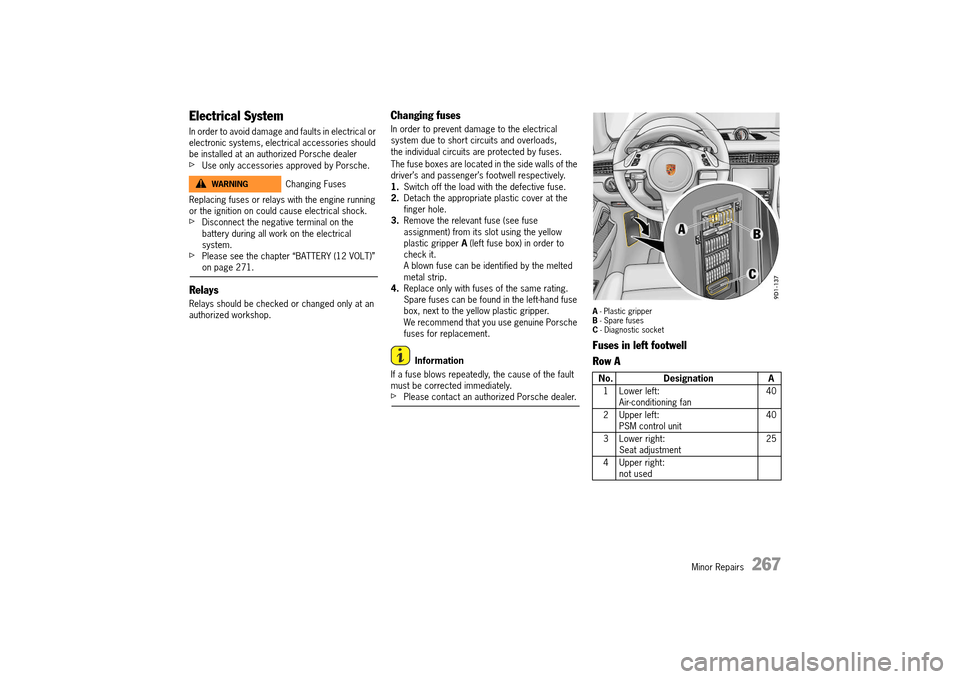
The fuse boxes are located in the side walls of the driver’s and passenger’s footwell respectively. 1. Switch off the load with the defective fuse. 2. Detach the appropriate plastic cover at the finger hole.3. Remove the relevant fuse (see fuse assignment) from its slot using the yellow plastic gripper A (left fuse box) in order to check it.A blown fuse can be identified by the melted metal strip.4. Replace only with fuses of the same rating. Spare fuses can be found in the left-hand fuse box, next to the yellow plastic gripper.We recommend that you use genuine Porsche fuses for replacement.
Information
If a fuse blows repeatedly, the cause of the fault must be corrected immediately.fPlease contact an authorized Porsche dealer.
A - Plastic gripper B - Spare fuses C - Diagnostic socket
Fuses in left footwell
Row A
Changing FusesWARNINGh
No. Designation A
1 Lower left: Air-conditioning fan 40
2 Upper left: PSM control unit 40
3 Lower right: Seat adjustment 25
4 Upper right: not used
14_991_Turbo_21.book Seite 267 Mittwoch, 9. April 2014 2:19 14
Page 280 of 300
278 Minor Repairs
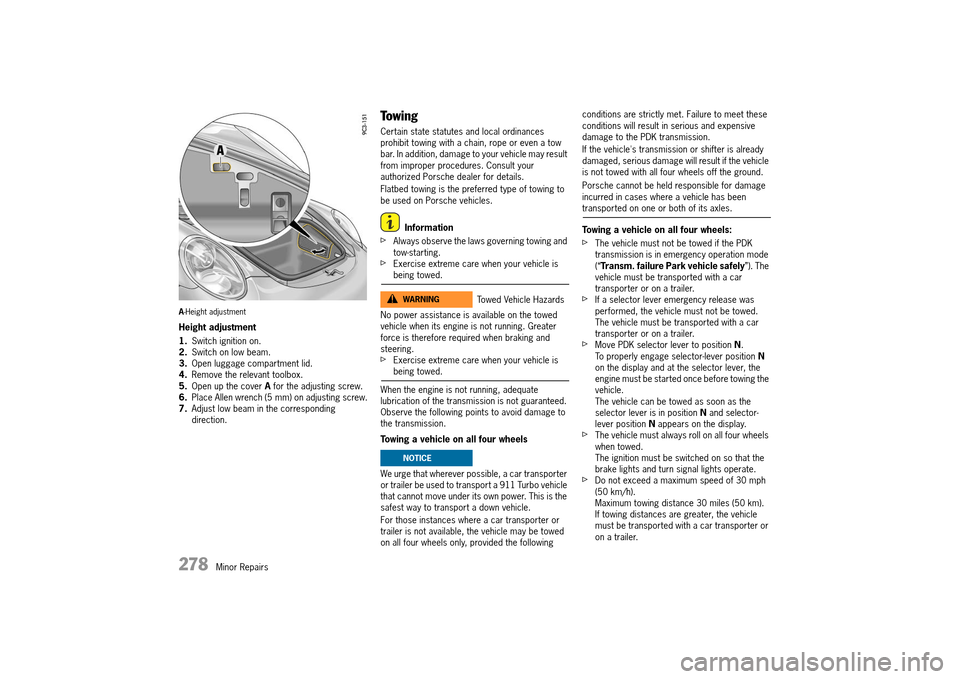
A-Height adjustment
Height adjustment
1. Switch ignition on. 2. Switch on low beam. 3. Open luggage compartment lid. 4. Remove the relevant toolbox. 5. Open up the cover A for the adjusting screw. 6. Place Allen wrench (5 mm) on adjusting screw. 7. Adjust low beam in the corresponding direction.
Towing
Certain state statutes and local ordinances prohibit towing with a chain, rope or even a tow bar. In addition, damage to your vehicle may result from improper procedures. Consult your authorized Porsche dealer for details.
Flatbed towing is the preferred type of towing to be used on Porsche vehicles.
Information
fAlways observe the laws governing towing and tow-starting.fExercise extreme care when your vehicle is being towed.
No power assistance is available on the towed vehicle when its engine is not running. Greater force is therefore required when braking and steering.fExercise extreme care when your vehicle is being towed.
When the engine is not running, adequate lubrication of the transmission is not guaranteed. Observe the following points to avoid damage to the transmission.
Towing a vehicle on all four wheels
We urge that wherever possible, a car transporter or trailer be used to transport a 911 Turbo vehicle that cannot move under its own power. This is the safest way to transport a down vehicle.
For those instances where a car transporter or trailer is not available, the vehicle may be towed on all four wheels only, provided the following
conditions are strictly met. Failure to meet these conditions will result in serious and expensive damage to the PDK transmission.
If the vehicle's transmission or shifter is already damaged, serious damage will result if the vehicle is not towed with all four wheels off the ground.
Porsche cannot be held responsible for damage incurred in cases where a vehicle has been transported on one or both of its axles.
Towing a vehicle on all four wheels:
fThe vehicle must not be towed if the PDK transmission is in emergency operation mode (“ Transm. failure Park vehicle safely”). The vehicle must be transported with a car transporter or on a trailer.fIf a selector lever emergency release was performed, the vehicle must not be towed. The vehicle must be transported with a car transporter or on a trailer.fMove PDK selector lever to position N. To properly engage selector-lever position N on the display and at the selector lever, the engine must be started once before towing the vehicle. The vehicle can be towed as soon as the selector lever is in position N and selector- lever position N appears on the display.fThe vehicle must always roll on all four wheels when towed.The ignition must be switched on so that the brake lights and turn signal lights operate.fDo not exceed a maximum speed of 30 mph (50 km/h).Maximum towing distance 30 miles (50 km).If towing distances are greater, the vehicle must be transported with a car transporter or on a trailer.
Towed Vehicle HazardsWARNINGh
NOTICE
14_991_Turbo_21.book Seite 278 Mittwoch, 9. April 2014 2:19 14
Page 281 of 300
Minor Repairs 279
Towing a vehicle on one axle:
Raising an axle, irrespective of whether at the front or rear, is only permissible if the drive shaft (cardan shaft) has been removed beforehand. The ignition must be switched off.fThe vehicle must not be towed if the PDK transmission is in emergency operation mode (yellow or red “ Transm. failure Park vehicle safely ” warning message). The vehicle must be transported with a car transporter or on a trailer.fIf a selector lever emergency release was performed, the vehicle must not be towed. The vehicle must be transported with a car transporter or on a trailer.fMove PDK selector lever to position N. To properly engage selector-lever position N on the display and at the selector lever, the engine must be started once before towing the vehicle. The vehicle can be towed as soon as the selector lever is in position N and selector- lever position N appears on the display.fSwitch ignition off. The ignition key must remain in the ignition lock so that the steering lock does not engage.The control unit must be removed from the ignition lock and the key inserted in vehicles with Porsche Entry & Drive. fPlease see the chapter “EMERGENCY OPERATION – UNLOCKING THE IGNITION KEY/CONTROL UNIT” on page 28.fMake sure that the vehicle is adequately illuminated.
fDo not exceed a maximum speed of 30 mph (50 km/h).Maximum towing distance 30 miles (50 km).If towing distances are greater, the vehicle must be transported with a car transporter or on a trailer.
Pulling out a vehicle stuck in snow, sand, etc.
fAlways pull out the stuck vehicle with the greatest care.fDo not pull out the vehicle abruptly or at an angle. fIf possible, pull the vehicle out backwards in its own tracks.
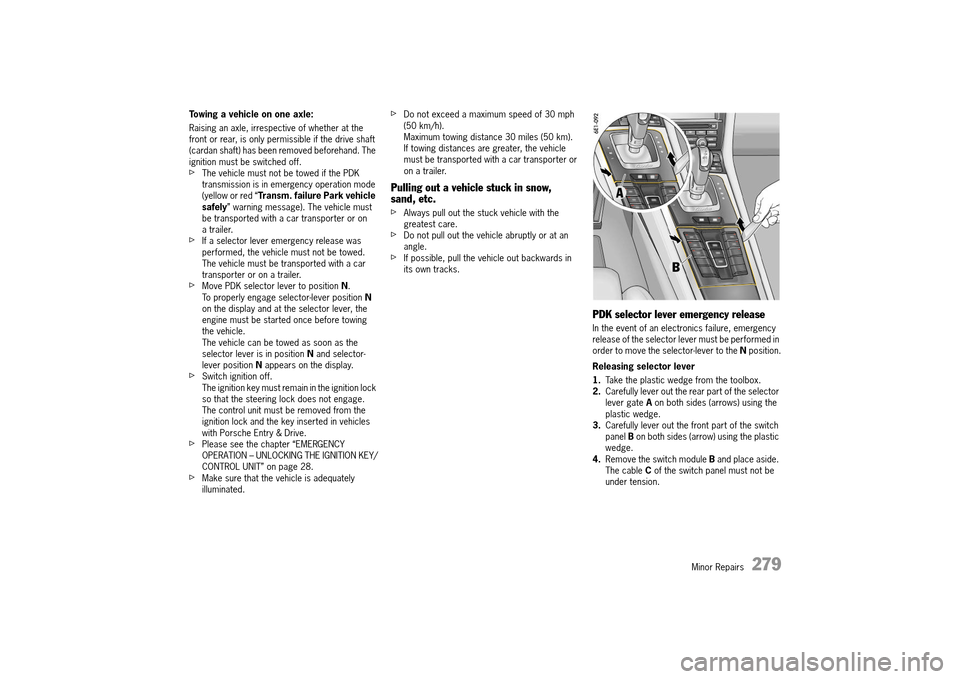
PDK selector lever emergency release
In the event of an electronics failure, emergency release of the selector lever must be performed in order to move the selector-lever to the N position.
Releasing selector lever
1. Take the plastic wedge from the toolbox. 2. Carefully lever out the rear part of the selector lever gate A on both sides (arrows) using the plastic wedge.3. Carefully lever out the front part of the switch panel B on both sides (arrow) using the plastic wedge.4. Remove the switch module B and place aside. The cable C of the switch panel must not be under tension.
14_991_Turbo_21.book Seite 279 Mittwoch, 9. April 2014 2:19 14
Page 290 of 300
288 Tire Pressure and Technical Data
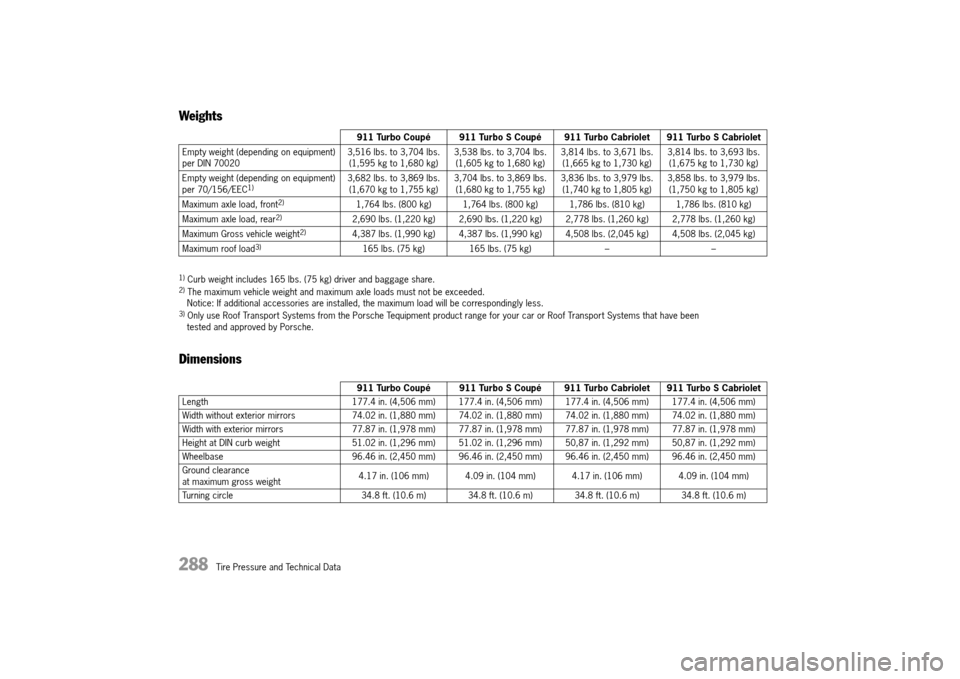
Weights
1) Curb weight includes 165 lbs. (75 kg) driver and baggage share.2) The maximum vehicle weight and maximum axle loads must not be exceeded.Notice: If additional accessories are installed, the maximum load will be correspondingly less.3) Only use Roof Transport Systems from the Porsche Tequipment product range for your car or Roof Transport Systems that have been tested and approved by Porsche.
Dimensions
911 Turbo Coupé 911 Turbo S Coupé 911 Turbo Cabriolet 911 Turbo S Cabriolet
Empty weight (depending on equipment) per DIN 700203,516 lbs. to 3,704 lbs.(1,595 kg to 1,680 kg)3,538 lbs. to 3,704 lbs.(1,605 kg to 1,680 kg)3,814 lbs. to 3,671 lbs.(1,665 kg to 1,730 kg)3,814 lbs. to 3,693 lbs.(1,675 kg to 1,730 kg)
Empty weight (depending on equipment)per 70/156/EEC1)3,682 lbs. to 3,869 lbs.(1,670 kg to 1,755 kg)3,704 lbs. to 3,869 lbs.(1,680 kg to 1,755 kg)3,836 lbs. to 3,979 lbs.(1,740 kg to 1,805 kg)3,858 lbs. to 3,979 lbs.(1,750 kg to 1,805 kg)
Maximum axle load, front2)1,764 lbs. (800 kg) 1,764 lbs. (800 kg) 1,786 lbs. (810 kg) 1,786 lbs. (810 kg)
Maximum axle load, rear2)2,690 lbs. (1,220 kg) 2,690 lbs. (1,220 kg) 2,778 lbs. (1,260 kg) 2,778 lbs. (1,260 kg)
Maximum Gross vehicle weight2)4,387 lbs. (1,990 kg) 4,387 lbs. (1,990 kg) 4,508 lbs. (2,045 kg) 4,508 lbs. (2,045 kg)
Maximum roof load3)165 lbs. (75 kg) 165 lbs. (75 kg)––
911 Turbo Coupé 911 Turbo S Coupé 911 Turbo Cabriolet 911 Turbo S Cabriolet
Length 177.4 in. (4,506 mm) 177.4 in. (4,506 mm) 177.4 in. (4,506 mm) 177.4 in. (4,506 mm)
Width without exterior mirrors 74.02 in. (1,880 mm) 74.02 in. (1,880 mm) 74.02 in. (1,880 mm) 74.02 in. (1,880 mm)
Width with exterior mirrors 77.87 in. (1,978 mm) 77.87 in. (1,978 mm) 77.87 in. (1,978 mm) 77.87 in. (1,978 mm)
Height at DIN curb weight 51.02 in. (1,296 mm) 51.02 in. (1,296 mm) 50,87 in. (1,292 mm) 50,87 in. (1,292 mm)
Wheelbase 96.46 in. (2,450 mm) 96.46 in. (2,450 mm) 96.46 in. (2,450 mm) 96.46 in. (2,450 mm)
Ground clearance at maximum gross weight4.17 in. (106 mm) 4.09 in. (104 mm) 4.17 in. (106 mm) 4.09 in. (104 mm)
Turning circle 34.8 ft. (10.6 m) 34.8 ft. (10.6 m) 34.8 ft. (10.6 m) 34.8 ft. (10.6 m)
Reifendruck_TechnischeDaten.fm Seite 288 Mittwoch, 9. April 2014 3:12 15