check engine PORSCHE 944 1987 1.G Owner's Manual
[x] Cancel search | Manufacturer: PORSCHE, Model Year: 1987, Model line: 944, Model: PORSCHE 944 1987 1.GPages: 66, PDF Size: 3.3 MB
Page 47 of 66
must be charged at least every 6 weeks. A
discharged battery allows rapid formation of
sulfates, leading to premature deterioration of
the plates.
WARNING
Charge battery in a well ventilated area.
Keep away from open flame or electrical
spark. Do not smoke. Hydrogen gas
generated by the battery is explosive.
Electrolyte fluid that may spill during charging should be washed off with a solution of warm water and baking soda to neutralize the acid. If you get electrolyte in your eyes or on your
skin, immediately rinse with cold water for
several minutes and call a doctor.
Never charge a frozen battery. It may
explode because of gas trapped in the ice.
Allow a frozen battery to thaw out first. Never use a fast charger as a booster to start the engine. This may seriously damage the
vehicle's electrical system and the charger.
Fast charging a battery is dangerous and
should only be attempted by a competent
mechanic with the proper equipment.
Slow battery charging
WARNING
Heed all warnings and follow instructions
that come with your battery charger.
Disconnect battery cables and remove the
battery.
All vent caps should be open. If fluid level is low, it should be topped up to the full mark in
each cell.
Connect charger cables.
Charger cables must be connected
POSITIVE (+) to POSITIVE (+) and
NEGATIVE (-) to NEGATIVE (-).
Do not connect or disconnect charger cables while charger is operating. Switch on charger. Normally, a battery should be charged at no
more than 10 percent of its rated capacity.
Rated capacity of the battery in your vehicle
is listed on the battery housing.
After charging, turn off charger and disconnect charger cables. Tighten the vent caps and reinstall battery.
91
Emergency Starting with Jumper Cables
WARNING
Improper use of booster battery to start a
vehicle may cause an explosion.
Lead-acid batteries generate explosive
gases. Keep sparks, flame and lighted
cigarettes away from batteries.
Do not charge a frozen battery, thaw it out
first. Gas trapped in the ice may cause an
explosion.
No attempt should be made to jump start any vehicle with a low electrolyte level in the
battery.
Check electrolyte level of each cell. If
necessary, fill with distilled water to just
above plates.
Make sure the voltage of both batteries is the same. The capacity (Ah) of the booster battery
should not be lower than that of the
discharged battery.
Vehicle with discharged battery: turn off
lights and accessories, remove key, move
lever to N or P and set parking brake.
Vehicle with booster battery should not be
running. Disconnect ground cable.
Remove vent caps from booster battery and
discharged battery. Preferably lay a cloth
over open vents to reduce explosion hazard.
How to use jumper cables WARNING
To avoid serious personal injury and damage to the vehicle, heed all warnings
and instructions of the jumper cable
manufacturer. The jumper cables must be long enough so that neither vehicles nor cables touch
another.
Improper hook-up of jumper cables can
ruin the alternator.
Always connect POSITIVE (+) to POSITIVE
(+), and NEGATIVE (-) to ground on engine
block.
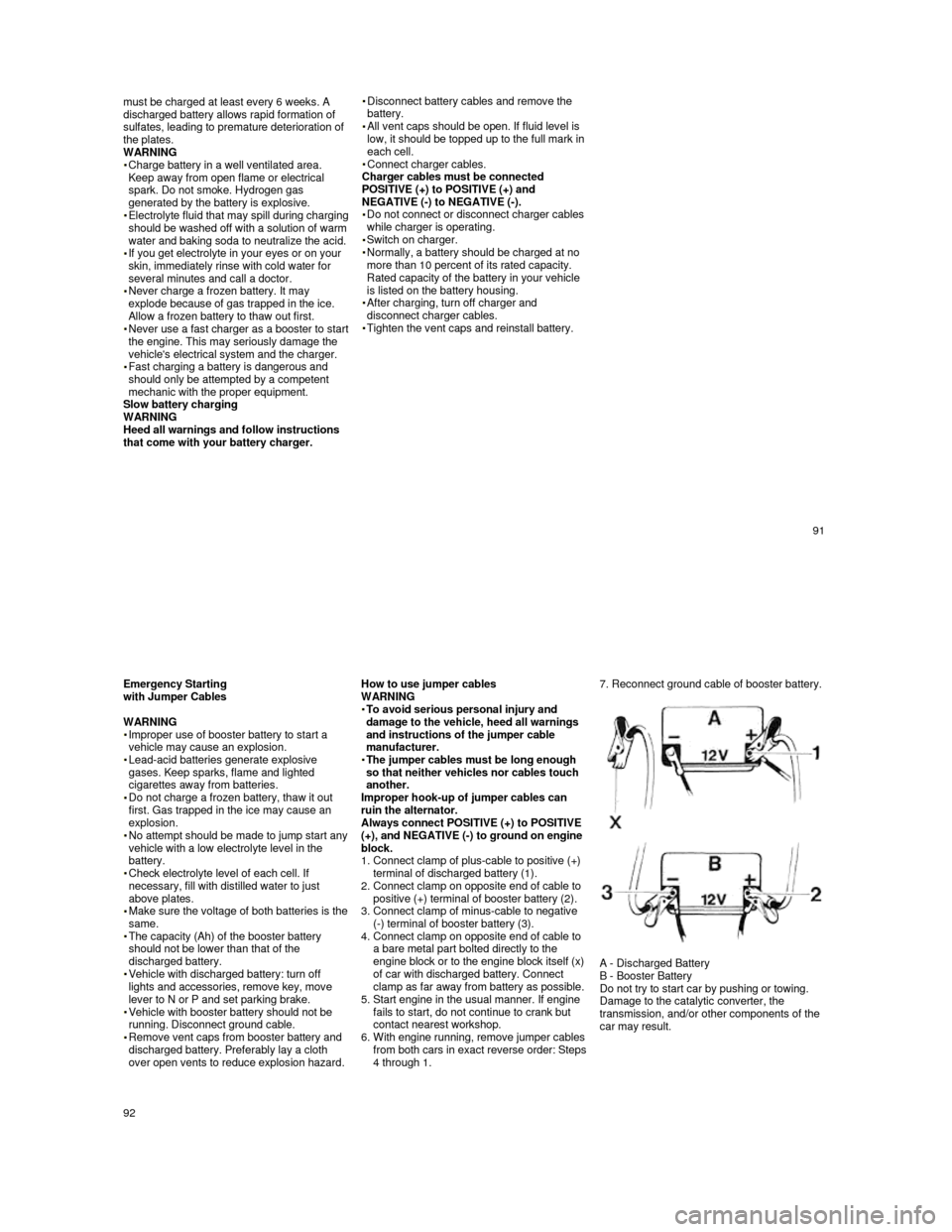
1. Connect clamp of plus-cable to positive (+) terminal of discharged battery (1).
2.
Connect clamp on opposite end of cable to
positive (+) terminal of booster battery (2).
3.
Connect clamp of minus-cable to negative
(-) terminal of booster battery (3).
4.
Connect clamp on opposite end of cable to
a bare metal part bolted directly to the
engine block or to the engine block itself (x)
of car with discharged battery. Connect
clamp as far away from battery as possible.
5. Start engine in the usual manner. If engine
fails to start, do not continue to crank but
contact nearest workshop.
6.
With engine running, remove jumper cables from both cars in exact reverse order: Steps 4 through 1.
7. Reconnect ground cable of booster battery.
A - Discharged Battery
B - Booster Battery
Do not try to start car by pushing or towing.
Damage to the catalytic converter, the
transmission, and/or other components of the
car may result.
92
Page 51 of 66
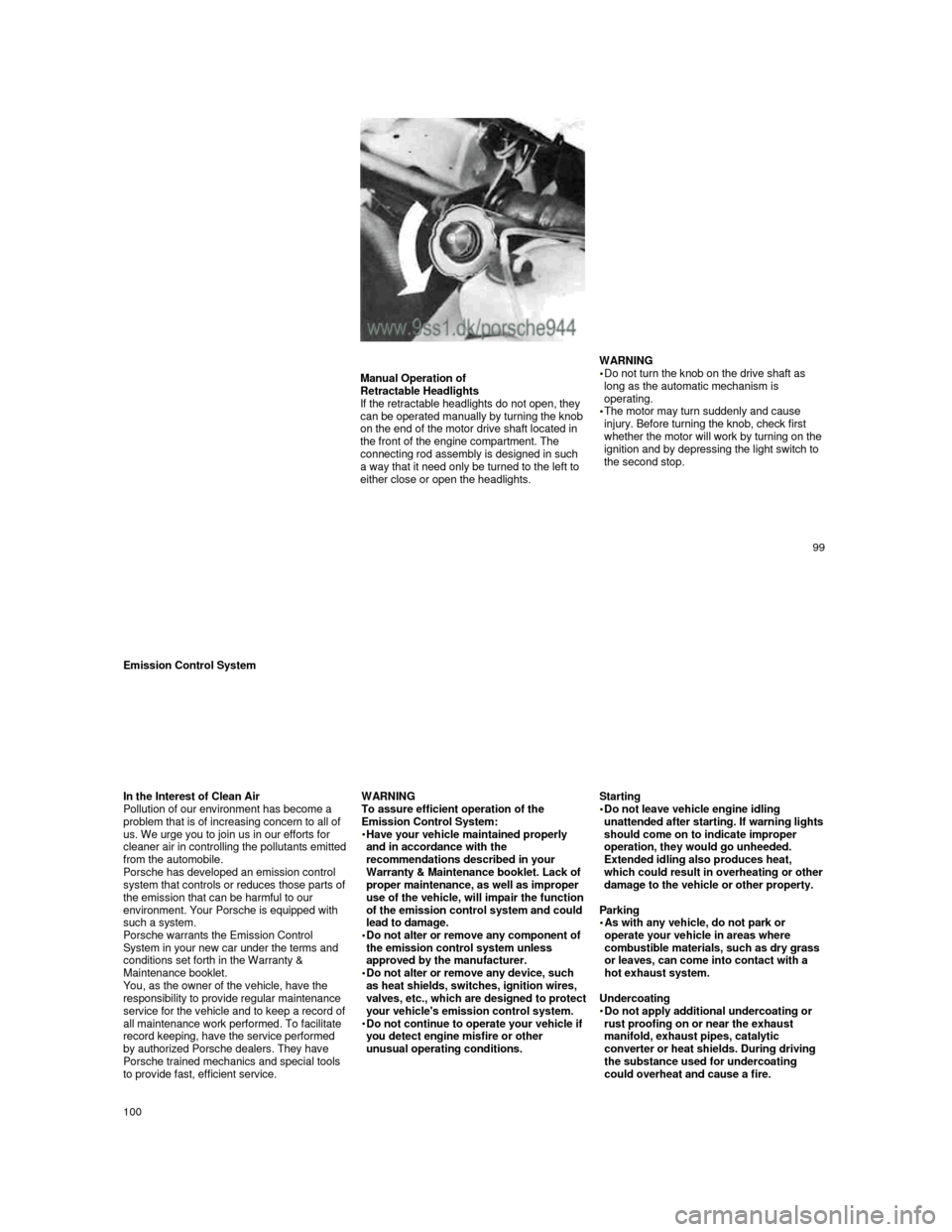
Manual Operation of
Retractable Headlights
If the retractable headlights do not open, they
can be operated manually by turning the knob
on the end of the motor drive shaft located in
the front of the engine compartment. The
connecting rod assembly is designed in such
a way that it need only be turned to the left to
either close or open the headlights.
WARNING
Do not turn the knob on the drive shaft as
long as the automatic mechanism is
operating.
The motor may turn suddenly and cause
injury. Before turning the knob, check first
whether the motor will work by turning on the ignition and by depressing the light switch to
the second stop.
99
Emission Control System
In the Interest of Clean Air
Pollution of our environment has become a
problem that is of increasing concern to all of
us. We urge you to join us in our efforts for
cleaner air in controlling the pollutants emitted from the automobile.
Porsche has developed an emission control
system that controls or reduces those parts of
the emission that can be harmful to our
environment. Your Porsche is equipped with
such a system.
Porsche warrants the Emission Control
System in your new car under the terms and
conditions set forth in the Warranty &
Maintenance booklet.
You, as the owner of the vehicle, have the
responsibility to provide regular maintenance
service for the vehicle and to keep a record of
all maintenance work performed. To facilitate
record keeping, have the service performed
by authorized Porsche dealers. They have
Porsche trained mechanics and special tools
to provide fast, efficient service.
WARNING To assure efficient operation of the
Emission Control System:
Have your vehicle maintained properly and in accordance with the
recommendations described in your
Warranty & Maintenance booklet. Lack of
proper maintenance, as well as improper
use of the vehicle, will impair the function
of the emission control system and could
lead to damage.
Do not alter or remove any component of the emission control system unless
approved by the manufacturer.
Do not alter or remove any device, such as heat shields, switches, ignition wires, valves, etc., which are designed to protect your vehicle's emission control system. Do not continue to operate your vehicle if you detect engine misfire or other
unusual operating conditions.
Starting
Do not leave vehicle engine idling unattended after starting. If warning lights should come on to indicate improper
operation, they would go unheeded.
Extended idling also produces heat,
which could result in overheating or other damage to the vehicle or other property.
Parking
As with any vehicle, do not park or operate your vehicle in areas where
combustible materials, such as dry grass
or leaves, can come into contact with a
hot exhaust system.
Undercoating
Do not apply additional undercoating or rust proofing on or near the exhaust
manifold, exhaust pipes, catalytic
converter or heat shields. During driving
the substance used for undercoating
could overheat and cause a fire.
100
Page 56 of 66

Engine Design Specifications
Design
Operating cycle
Lubrication
Cylinder block
Cylinder head
Valve operation
Camshaft drive
Crankshaft
Fuel injection 4-cylinder, in-line engine, front mount with two ba
lance-shafts
4-stroke
Pressure oil circulation from oil sump,
full flow filter
Light metal
Light metal
Overhead camshaft
(944 S: 2 overhead camshafts)
Spur belt drive
Forged, 5 main bearings
AFC (Air Flow Control) Power Train
Manual transmission
Gear ratio
1st gear
2nd gear
3rd gear
4th gear
5th gear
Axle ratio Gear ratio 944
3.600:1
2.125:1
1.458:1
1.071:1
0.730:1
3.500:1
3.889:1 Gear ratio 944 S
3.500:1
2.059:1
1.400:1
1.034:1
0.829:1
3.500:1
3.889:1 Gear ratio 944 Turbo
3.500:1
2.059:1
1.400:1
1.034:1
0.829:1
3.500:1
3.375:1
Clutch
Power transmission Single plate dry disc, hydraulically operated
Double constant velocity joints and drive shaft
Automatic transmission 944
Gear ratio 1st gear
2nd gear
3rd gear
Reverse gear
Axle ratio
Clutch 2.714:1
1.500:1
1.000:1
2.429:1
3.455:1
Hydrodynamic torque converter
109
Filling Capacities
Engine oil With filter change approx. 6.34 (Turbo: approx. 6.87) U.S. qts. or 6 (Turbo: approx. 6.5) liters.
Check oil level with dipstick a few minutes after e ngine has stopped. The difference between
the max. and min. marks on the dipstick is approx. 1 U.S. qt. or 1 liter.
Only use brand name oil which has been tested and a pproved by Porsche.
Your authorized Porsche dealer will be glad to advi se you.
Porsche does not recommend the use of oil additives . See also "Engine Oils".
Cooling system with heating
Approx. 8,2 U.S. qts. or 7,8 liters. Factory filled to -31°F (-35°C). Only use phosphate-free
anti-freeze containing ethylene glycol recommended for aluminum engines and radiators.
Manual transmission
Approx. 0.53 U.S. gal. or 2.0 liters. Use hypoid oi l SAE 80 labeled "For Service API/GL4 or
Mil-L 2105".
Automatic transmission with
torque converter Approx. 1.72 U.S. gal. or 6.5 liters ATF Dexron®. At oil c hanges 3 U.S. qts. or 2.8 liters are
required.
Differential of automatic transmission
Approx. 1 U.S. qts. or 1 liter hypoid oil SAE 90 ac cording to API classification GL 5 or
Mil-L 2105 B.
Power steering
Approx. 0.63 U.S. qts. or 0.6 liter ATF Dexron®
Fuel tank Approx. 21.1 U.S. gals, or 80 liters including a re serve of 2.1 U.S. gals, or 8 liters.
Unleaded fuel only! Minimum octane rating 944 91 RO N (87 CLC or AKI ((R+M)/2) rating on fuel
pumps in U.S.A.), 944 S / 944 Turbo 95 RON (90 CLC or AKI ((R+M)/2) rating on fuel pumps in U.S.A.)
Brake fluid Approx. 0.42 U.S. pint or 0.2 liter. Only use brake fluid conforming to specifications
SAE J 1703, DOT 3 or DOT 4.
Windshield and headlight washer system
Approx. 1.59 U.S. gals, or 6.0 liters.
Refrigerant for air conditioning Approx. 33.5 oz or 950 g. Refrigerant R 12 (CCI2F2)
Cooling system mixing chart
(Approximate values)
Anti-freeze-Water
Consult your authorized dealer about
the approved anti-freeze mixtures. Temp, down to
-13° F (-25°C) -23° F (-30° C) -31° F (-35° C)
Anti-freeze
40%
45%
50% Water
60% 55% 50%
Anti-freeze
3.1 liters / 3.3 U.S. qts.3.5 liters / 3.7 U.S. qts.3.9 liters / 4.1 U.S. qts.
Water
4.7 liters / 5.0 U.S. qts.
4.3 liters / 4.5 U.S. qts. 3.9 liters / 4.1 U.S. qts.
110
Page 57 of 66
Engine Oils
Use only engine oils which meet the
specifications designated by PORSCHE. Your Porsche dealer will be glad to advise you on
the correct type of oil for your engine.
All current engine oils are compatible with each other, i. e. when making an oil change it
is not necessary to flush the engine if you
wish to use a different brand or grade of oil. Since, however, each brand of oil has a
special composition, you should, if possible,
use the same oil brand if it becomes
necessary to top up between oil changes.
PORSCHE engines have long intervals
between oil changes. You can make best use
of these long oil change intervals by using
multigrade oils since these are largely
independent of seasonal fluctuations in
temperature.
If your vehicle is used frequently in stop-and-
go traffic in winter, the engine will not always
be properly warmed up. Condensation from
products of combustion may accumulate in
the oil. In this case, it is advisable to change
the oil in spring so that your engine once
again has a 100% efficient engine oil.
Engine oil performance class
Engine oil is not only a lubricant, but also
serves to keep the engine clean, to neutralize
the dirt which penetrates into the engine
through combustion and to protect the engine
against corrosion. To perform these functions, the oil is provided with additives which have
been specially developed for these functions.
So-called mineral oils are produced directly
from crude oil. The oils can be further refined
(hydrocrack oils) or totally converted through a number of chemical processes (synthetic oils). These oils are structurally more efficient and
require fewer additives than simple mineral
oils.
The efficiency of an oil is expressed, for
example, by the API classifications which are
divided into categories "S" and "C". The
degrees of quality are expressed by final
letters in alphabetical order: The requirements for PORSCHE engines are API class SE/CC
to SF/CD.
Viscosity
Like all liquids, engine oil is viscous when
cold, and thin-bodied when warm.
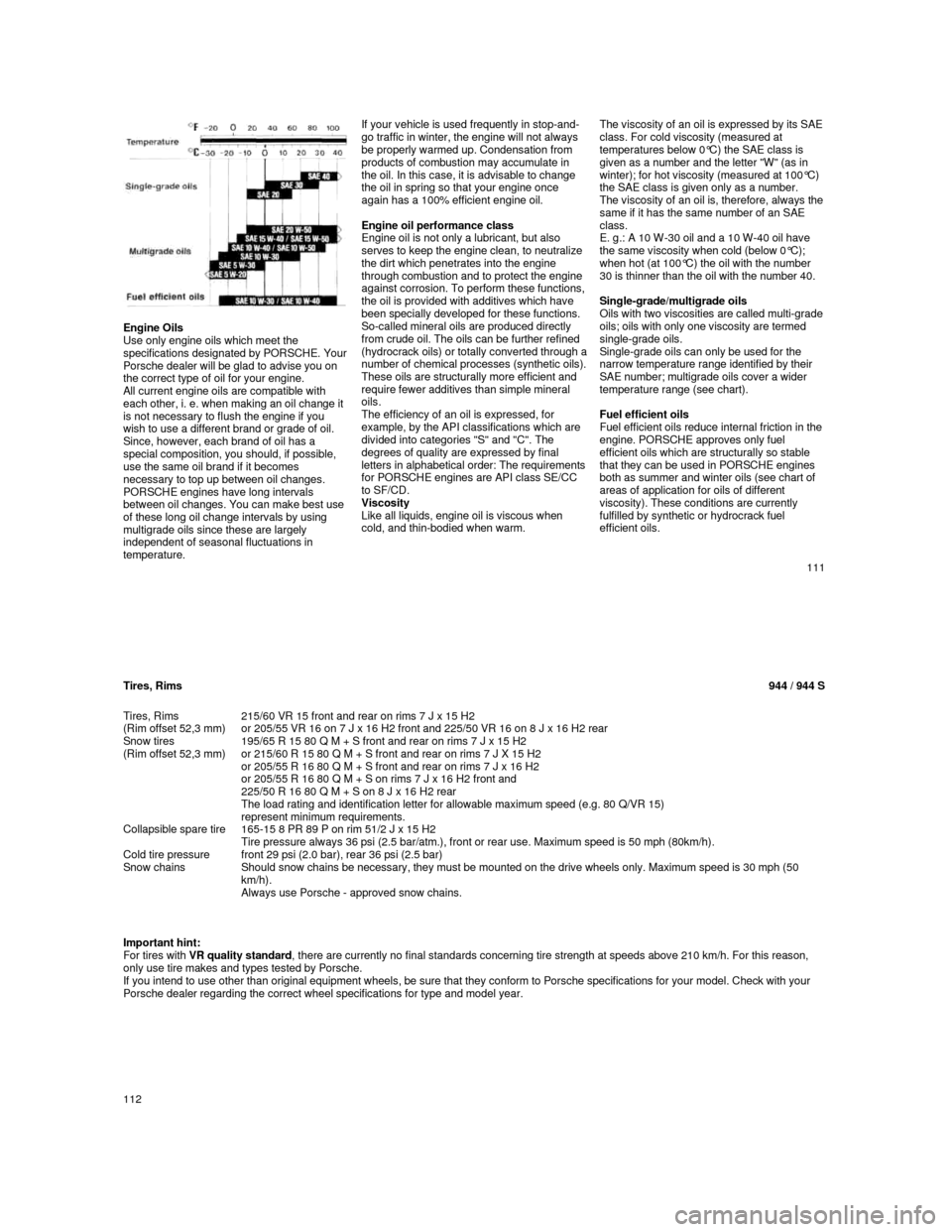
The viscosity of an oil is expressed by its SAE class. For cold viscosity (measured at
temperatures below 0°C) the SAE class is
given as a number and the letter "W" (as in
winter); for hot viscosity (measured at 100°C) the SAE class is given only as a number. The viscosity of an oil is, therefore, always the same if it has the same number of an SAE
class.
E. g.: A 10 W -30 oil and a 10 W-40 oil have
the same viscosity when cold (below 0°C);
when hot (at 100°C) the oil with the number 30 is thinner than the oil with the number 40.
Single-grade/multigrade oils
Oils with two viscosities are called multi-g
rade oils; oils with only one viscosity are termed
single-grade oils.
Single-grade oils can only be used for the
narrow temperature range identified by their
SAE number; multigrade oils cover a wider
temperature range (see chart).
Fuel efficient oils
Fuel efficient oils reduce internal friction in the
engine. PORSCHE approves only fuel
efficient oils which are structurally so stable
that they can be used in PORSCHE engines
both as summer and winter oils (see chart of
areas of application for oils of different
viscosity). These conditions are currently
fulfilled by synthetic or hydrocrack fuel
efficient oils.
111
Tires, Rims 944 / 944 S
Tires, Rims
(Rim offset 52,3 mm) 215/60 VR 15 front and rear on rims 7 J x 15 H2
or 205/55 VR 16 on 7 J x 16 H2 front and 225/50 VR
16 on 8 J x 16 H2 rear
Snow tires
(Rim offset 52,3 mm) 195/65 R 15 80 Q M + S front and rear on rims 7 J x
15 H2
or 215/60 R 15 80 Q M + S front and rear on rims 7 J X 15 H2
or 205/55 R 16 80 Q M + S front and rear on rims 7 J x 16 H2
or 205/55 R 16 80 Q M + S on rims 7 J x 16 H2 front and
225/50 R 16 80 Q M + S on 8 J x 16 H2 rear
The load rating and identification letter for allow able maximum speed (e.g. 80 Q/VR 15)
represent minimum requirements.
Collapsible spare tire 165-15 8 PR 89 P on rim 51/2 J x 15 H2
Tire pressure always 36 psi (2.5 bar/atm.), front o r rear use. Maximum speed is 50 mph (80km/h).
Cold tire pressure front 29 psi (2.0 bar), rear 36 psi (2.5 bar)
Snow chains Should snow chains be necessary, they m ust be mounted on the drive wheels only. Maximum speed is 30 mph (50
km/h).
Always use Porsche - approved snow chains.
Important hint:
For tires with VR quality standard , there are currently no final standards concerning tire strength at speeds above 210 km/h. For this r eason,
only use tire makes and types tested by Porsche.
If you intend to use other than original equipment wheels, be sure that they conform to Porsche specif ications for your model. Check with your
Porsche dealer regarding the correct wheel specific ations for type and model year.
112
Page 58 of 66

Tires, Rims 944 Turbo
Tires, Rims
(Rim offset 52,3 mm) 205/55 VR 16 on rims 7 J x 16 H2 front and 225/50 V
R 16 on rims 8 J x 16 H2 rear
Snow tires
(Rim offset 52,3 mm) 205/55 R 16 82 Q M+S on rims 7 J x 16 H2 front and
rear
or 205/55 R 16 82 Q M + S on rims 7 J x 16 H2 front and
225/50 R 16 82 Q M + S on rims 8 J x 16 H2 rear
The load rating and identification letter for allow able maximum speed (e.g. 82 Q/VR 16)
represent minimum requirements.
Collapsible spare tire 165-15 8 PR 89 P on rim 51/2 J x 15 H2
Tire pressure always 36 psi (2.5 bar/atm.), front o r rear use. Maximum speed is 50 mph (80 km/h).
Cold tire pressure front and rear 36 psi (2.5 bar)
Snow chains Should snow chains be necessary, they m ust be mounted on the drive wheels only. Maximum
speed is 30 mph (50 km/h). Always use Porsche - app roved snow chains.
Important hint:
For tires with VR quality standard , there are currently no final standards concerning tire strength at speeds above 210 km/h. For this r eason,
only use tire makes and types tested by Porsche.
If you intend to use other than original equipment wheels, be sure that they conform to Porsche specif ications for your model. Check with your
Porsche dealer regarding the correct wheel specific ations for type and model year.
113
Dimensions
Length
Width
Height
Wheel base
Wheel track, front
Wheel track, rear
Ground clearance*
Tuning circle (curb to curb)
Tuning circle (wall to wall)
Overhang angle, front*
Overhang angle, rear*
944 / 944 S
168.90 in. / 4290 mm 68.31 in. / 1735 mm
50.20 in. / 1275 mm
94.49 in. / 2400 mm
58.15 in. / 1477 mm
57.13 in. / 1451 mm
4.72 in. / 120 mm
31.17 ft. / 9.5 m
33.80 ft./ 10.3 m
14°
15°
944 Turbo
168.90 in. / 4290 mm
68.31 in. / 1735 mm
50.20 in. / 1275 mm
94.49 in. / 2400 mm
58.15 in. / 1477 mm
57.13 in. / 1451 mm
4.72 in. / 120 mm
31.17 ft. / 9.5 m
33.80 ft./ 10.3 m
12,5°
15°
Weights
Curb weight
Maximum load capacity
Total permissible weight
Maximum axle load, front**
Maximum axle load, rear**
Permissible rack load**/***
944
2778 Ibs. / 1260kg
661 Ibs. / 300 kg
3439 Ibs. / 1560kg
1587 Ibs. / 720kg
1984 Ibs. / 900kg
165 Ibs. / 75kg 944 S
2866 Ibs. / 1300 kg
661 Ibs. / 300 kg
3527 Ibs. / 1600 kg
1609 Ibs. / 730kg
1984 Ibs. / 900 kg
165 Ibs. / 75kg 944 Turbo 2998 Ibs. / 1360 kg650 Ibs. / 285 kg 3626 Ibs. / 1645 kg1675 Ibs./ 760kg
2028 Ibs. / 920 kg 165 Ibs. / 75kg
* At total permissible weight. ** Do not exceed tot al permissible weight.
*** Applies only if the basic rack of the original Porsche Roof Transport System is used. If old type Porsche ski and luggage racks are used the
permissible roof weight is 35 kg (77 Ibs.).
The vehicle capacity weight (max. load), the Gross Vehicle Weight Rating (GVWR) and the Gross Axle Wei ght Ratings (GAWR) for front and
rear, are listed on the sticker on the left upper s ide member in the engine compartment.
The gross vehicle weight rating includes the weight of the basic vehicle plus full tank, oil and coolant, plus max. load which combines passenger
(150 pounds / 68 kg per designated position) and lu ggage weight. Luggage weight is not increased by th e use of roof, ski or luggage racks,
unless passenger capacity is reducted accordingly.
114
Page 65 of 66
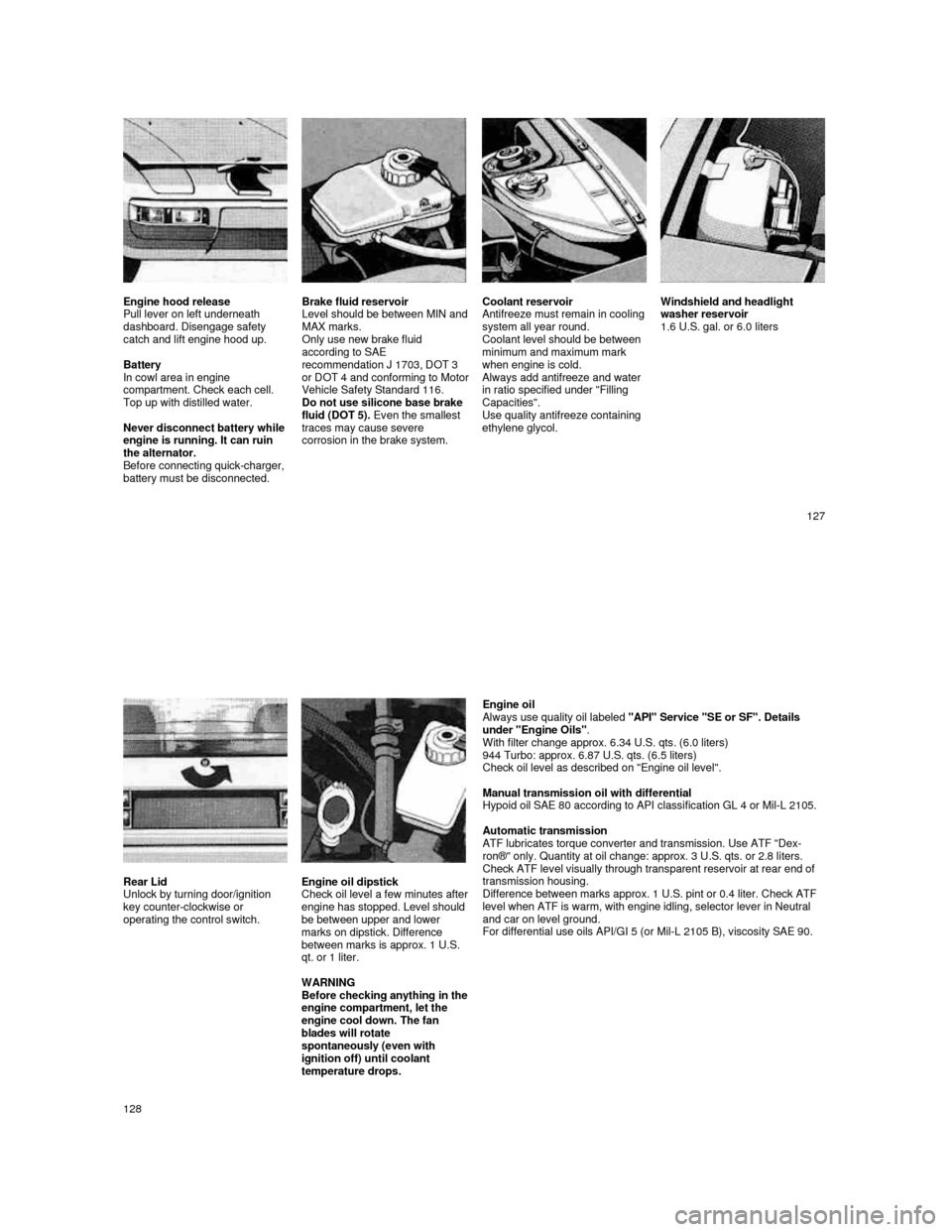
Engine hood release
Pull lever on left underneath
dashboard. Disengage safety
catch and lift engine hood up.
Battery
In cowl area in engine
compartment. Check each cell.
Top up with distilled water.
Never disconnect battery while
engine is running. It can ruin
the alternator.
Before connecting quick-charger,
battery must be disconnected. Brake fluid reservoir
Level should be between MIN and MAX marks.
Only use new brake fluid
according to SAE
recommendation J 1703, DOT 3
or DOT 4 and conforming to Motor Vehicle Safety Standard 116.
Do not use silicone base brake
fluid (DOT 5). Even the smallest
traces may cause severe
corrosion in the brake system.
Coolant reservoir
Antifreeze must remain in cooling
system all year round.
Coolant level should be between
minimum and maximum mark
when engine is cold. Always add antifreeze and water in ratio specified under "Filling
Capacities".
Use quality antifreeze containing
ethylene glycol.
Windshield and headlight
washer reservoir
1.6 U.S. gal. or 6.0 liters
127
Rear Lid
Unlock by turning door/ignition
key counter-clockwise or
operating the control switch.
Engine oil dipstick
Check oil level a few minutes after engine has stopped. Level should
be between upper and lower
marks on dipstick. Difference
between marks is approx. 1 U.S.
qt. or 1 liter.
WARNING
Before checking anything in
the engine compartment, let the
engine cool down. The fan
blades will rotate
spontaneously (even with
ignition off) until coolant
temperature drops.
Engine oil Always use quality oil labeled "API" Service "SE or SF". Details
under "Engine Oils" .
With filter change approx. 6.34 U.S. qts. (6.0 lite rs)
944 Turbo: approx. 6.87 U.S. qts. (6.5 liters)
Check oil level as described on "Engine oil level".
Manual transmission oil with differential
Hypoid oil SAE 80 according to API classification G L 4 or Mil-L 2105.
Automatic transmission
ATF lubricates torque converter and transmission. U se ATF "Dex-
ron®" only. Quantity at oil change: approx. 3 U.S. qts. or 2.8 liters.
Check ATF level visually through transparent reserv oir at rear end of
transmission housing.
Difference between marks approx. 1 U.S. pint or 0.4 liter. Check ATF
level when ATF is warm, with engine idling, selecto r lever in Neutral
and car on level ground.
For differential use oils API/GI 5 (or Mil-L 2105 B ), viscosity SAE 90.
128