ESP inoperative PORSCHE 944 1987 1.G Owners Manual
[x] Cancel search | Manufacturer: PORSCHE, Model Year: 1987, Model line: 944, Model: PORSCHE 944 1987 1.GPages: 66, PDF Size: 3.3 MB
Page 15 of 66
ABS Brake System (Antilock brake system)
The ABS system represents a major
contribution to the enhancement of active
safety in your vehicle. This system prevents
the wheels from locking in a panic stop on
almost all road surfaces.
With ABS system in your vehicle, the
following areas are enhanced:
Full steerability , vehicle remains steerable
under all braking forces.
Good directional control , no swerving
caused by locking of wheels under braking
conditions.
Excellent stopping distance , stopping
distances are usually reduced because
controlled braking is maximized.
Prevention of wheel lock up , no brake-
induced sliding and thus no localized tire wear from emergency braking.
The crucial advantage of ABS system over a
conventional brake system is in the area of
maintaining directional control and
maneuverability of the car in emergency
situations, including panic braking in turns.
WARNING:
In spite of the improved handling afforded
by the ABS system, it still remains the
responsibility of the driver to adapt the
driving style to the prevailing road and
weather conditions, as well as, obeying
traffic laws. In no case, should the higher
degree of safety offered by ABS be
regarded as a
justification for taking greater risks. Other vehicles not equipped with the ABS
system may not be able to maintain
control, especially on wet or poor road
surfaces and thus may be more likely to
impact you in the rear. To minimize that r
isk, use your ABS system to increase your ability to maneuver to avoid dangerous
situations and not merely to try to stop in
the shortest distance possible.
Driving with the ABS System
A wheel speed sensor is fitted to each of the four wheels. If wheel slippage of either of the
front wheels or the rear wheels is sensed
during braking, the brake pressure is adjusted
automatically until the wheel no longer slips.
The brake pressure is regulated for each front
wheel individually and for both rear wheels together.
On a road surface which is slippery on only
one side, the rear wheel which is braking on
the slippery surface determines the brake
pressure which will be applied equally to both
rear wheels. This ensures that directional
stability is maintained. However, if braking
force approaches the wheel locking-up point
for all wheels (panic braking) the ABS system
will intervene in a way comparable with rapid rhythmic braking. The proper operation of ABS is perceived by the driver as a pulsating brake pedal in conjunction with audible noise
and perhaps some vibration. The driver is
thereby warned to reduce vehicle speed
appropriate for the prevailing road conditions.
If your ABS system should ever malfunction,
the ABS system is automatically switched off,
but the normal brake system, without ABS,
would remain fully operational. Such a malfunction would be indicated by the illumination of the central warning light, as well as the "ANTILOCK" light on the right hand
side of the instrument cluster.
If the ABS system becomes inoperative,
take your vehicle to your authorized dealer immediately.
Note
The control unit of the ABS brake system is
set for standard tire sizes. If non-standard
tires are fitted, the control unit may
misinterpret the speed of the vehicle, because of the variant data it receives from the sensors on the axles.
If the difference in rolling radius exceeds
approx. 17%, the control unit deactivates the
ABS system and the ABS warning lamp lights up.
28
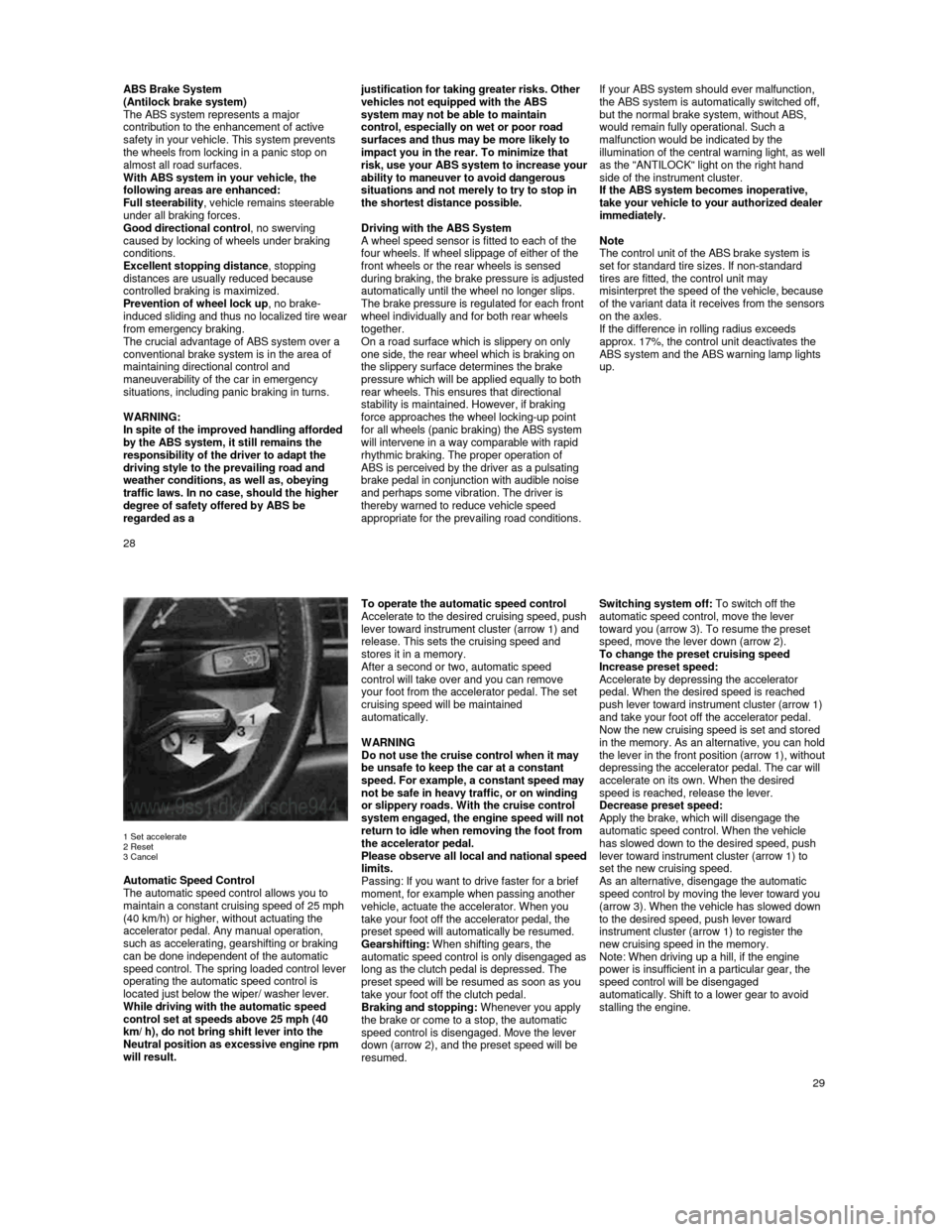
1 Set accelerate
2 Reset
3 Cancel
Automatic Speed Control
The automatic speed control allows you to
maintain a constant cruising speed of 25 mph
(40 km/h) or higher, without actuating the
accelerator pedal. Any manual operation,
such as accelerating, gearshifting or braking
can be done independent of the automatic
speed control. The spring loaded control lever
operating the automatic speed control is
located just below the wiper/ washer lever.
While driving with the automatic speed
control set at speeds above 25 mph (40
km/ h), do not bring shift lever into the
Neutral position as excessive engine rpm
will result.
To operate the automatic speed control Accelerate to the desired cruising speed, push lever toward instrument cluster (arrow 1) and
release. This sets the cruising speed and
stores it in a memory.
After a second or two, automatic speed control will take over and you can remove
your foot from the accelerator pedal. The set
cruising speed will be maintained
automatically.
WARNING
Do not use the cruise control when it may
be unsafe to keep the car at a constant
speed. For example, a constant speed may not be safe in heavy traffic, or on winding
or slippery roads. With the cruise control
system engaged, the engine speed will not
return to idle when removing the foot from
the accelerator pedal.
Please observe all local and national speed limits.
Passing: If you want to drive faster for a brief
moment, for example when passing another
vehicle, actuate the accelerator. When you
take your foot off the accelerator pedal, the
preset speed will automatically be resumed.
Gearshifting: When shifting gears, the
automatic speed control is only disengag
ed as long as the clutch pedal is depressed. The
preset speed will be resumed as soon as you
take your foot off the clutch pedal.
Braking and stopping: Whenever you apply
the brake or come to a stop, the automatic
speed control is disengaged. Move the lever
down (arrow 2), and the preset speed will be
resumed.
Switching system off: To switch off the
automatic speed control, move the lever
toward you (arrow 3). To resume the preset
speed, move the lever down (arrow 2).
To change the preset cruising speed
Increase preset speed:
Accelerate by depressing the accelerator pedal. When the desired speed is reached push lever toward instrument cluster (arrow 1) and take your foot off the accelerator pedal.
Now the new cruising speed is set and stored
in the memory. As an alternative, you can hold the lever in the front position (arrow 1), without depressing the accelerator pedal. The car will
accelerate on its own. When the desired
speed is reached, release the lever.
Decrease preset speed:
Apply the brake, which will disengage the automatic speed control. When the vehicle
has slowed down to the desired speed, push
lever toward instrument cluster (arrow 1) to
set the new cruising speed.
As an alternative, disengage the automatic
speed control by moving the lever toward you
(arrow 3). When the vehicle has slowed down
to the desired speed, push lever toward
instrument cluster (arrow 1) to register the
new cruising speed in the memory.
Note: When driving up a hill, if the engine
power is insufficient in a particular gear, the
speed control will be disengaged
automatically. Shift to a lower gear to avoid
stalling the engine.
29
Page 18 of 66
944 / 944 S
944 Turbo The trip odometer
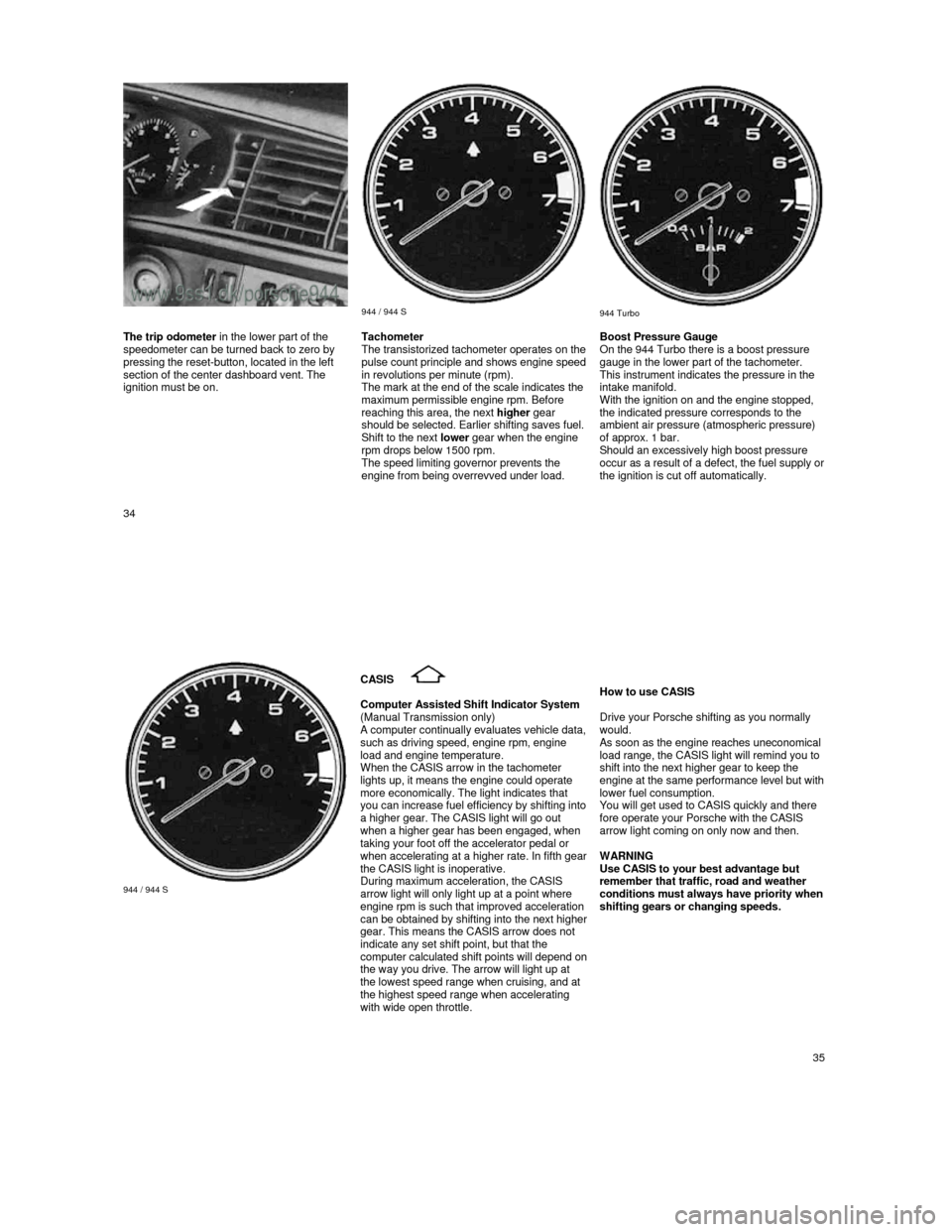
in the lower part of the
speedometer can be turned back to zero by
pressing the reset-button, located in the left
section of the center dashboard vent. The
ignition must be on. Tachometer
The transistorized tachometer operates on the pulse count principle and shows engine speed in revolutions per minute (rpm).
The mark at the end of the scale indicates the
maximum permissible engine rpm. Before
reaching this area, the next higher gear
should be selected. Earlier shifting saves fuel.
Shift to the next lower gear when the engine
rpm drops below 1500 rpm.
The speed limiting governor prevents the
engine from being overrevved under load.
Boost Pressure Gauge
On the 944 Turbo there is a boost pressure
gauge in the lower part of the tachometer.
This instrument indicates the pressure in the
intake manifold.
With the ignition on and the engine stopped,
the indicated pressure corresponds to the
ambient air pressure (atmospheric pressure)
of approx. 1 bar.
Should an excessively high boost pressure
occur as a result of a defect, the fuel supply or the ignition is cut off automatically.
34
944 / 944 S
CASIS
Computer Assisted Shift Indicator System (Manual Transmission only) A computer continually evaluates vehicle data, such as driving speed, engine rpm, engine
load and engine temperature.
When the CASIS arrow in the tachometer
lights up, it means the engine could operate
more economically. The light indicates that
you can increase fuel efficiency by shifting into a higher gear. The CASIS light will go out when a higher gear has been engaged, when taking your foot off the accelerator pedal or when accelerating at a higher rate. In fifth gear the CASIS light is inoperative.
During maximum acceleration, the CASIS
arrow light will only light up at a point where
engine rpm is such that improved acceleration
can be obtained by shifting into the next higher gear. This means the CASIS arrow does not
indicate any set shift point, but that the
computer calculated shift points will depend on the way you drive. The arrow will light up at
the lowest speed range when cruising, and at
the highest speed range when accelerating
with wide open throttle.
How to use CASIS
Drive your Porsche shifting as you normally
would. As soon as the engine reaches uneconomical load range, the CASIS light will remind you to
shift into the next higher gear to keep the
engine at the same performance level but with lower fuel consumption.
You will get used to CASIS quickly and there
fore operate your Porsche with the CASIS
arrow light coming on only now and then.
WARNING
Use CASIS to your best advantage but
remember that traffic, road and weather
conditions must always have priority when shifting gears or changing speeds.
35
Page 19 of 66
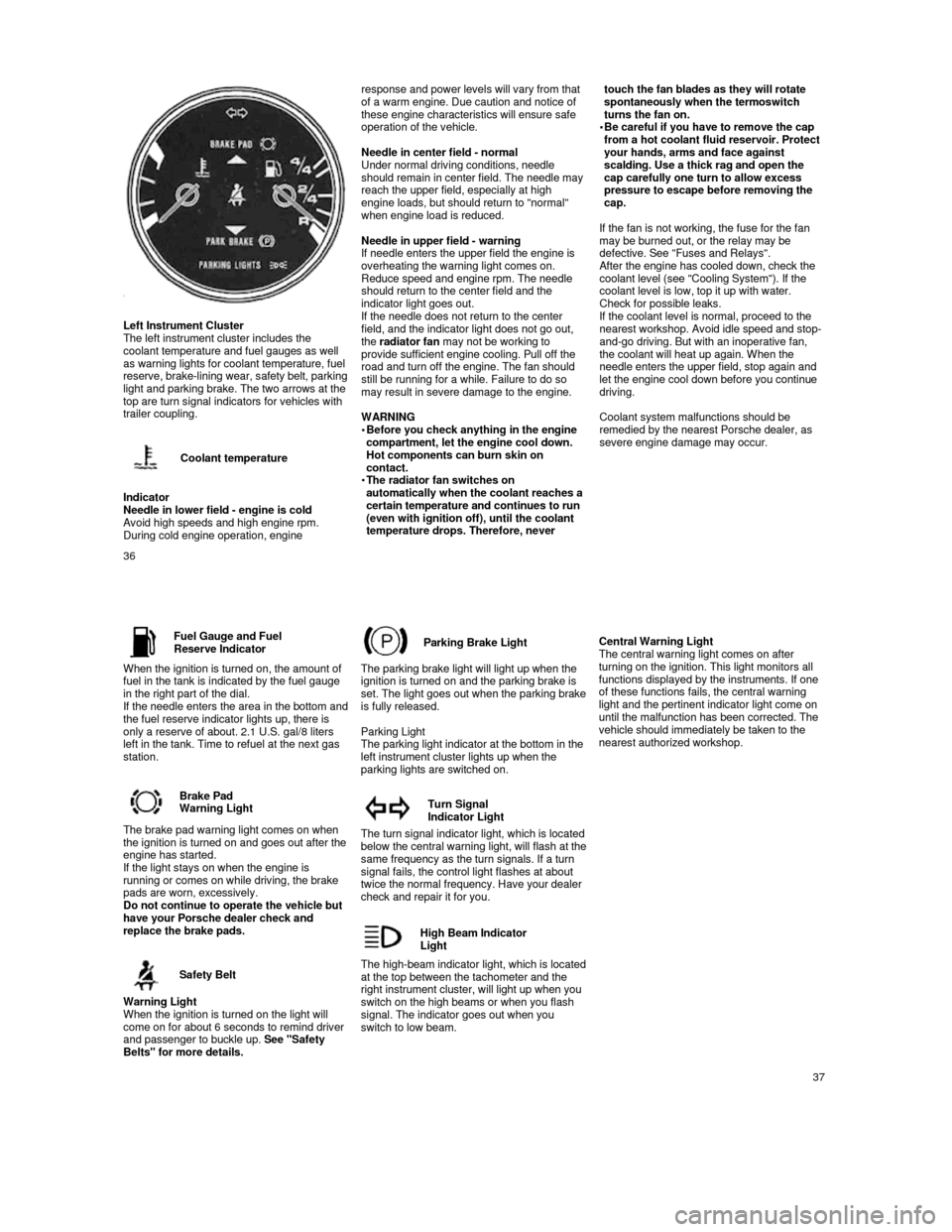
Left Instrument Cluster
The left instrument cluster includes the
coolant temperature and fuel gauges as well
as warning lights for coolant temperature, fuel
reserve, brake-
lining wear, safety belt, parking light and parking brake. The two arrows at the
top are turn signal indicators for vehicles with
trailer coupling.
Coolant temperature
Indicator
Needle in lower field - engine is cold
Avoid high speeds and high engine rpm. During cold engine operation, engine
response and power levels will vary from that
of a warm engine. Due caution and notice of
these engine characteristics will ensure safe
operation of the vehicle.
Needle in center field - normal
Under normal driving conditions, needle
should remain in center field. The needle may
reach the upper field, especially at high
engine loads, but should return to "normal"
when engine load is reduced.
Needle in upper field - warning
If needle enters the upper field the engine is
overheating the warning light comes on.
Reduce speed and engine rpm. The needle
should return to the center field and the
indicator light goes out.
If the needle does not return to the center
field, and the indicator light does not go out,
the radiator fan may not be working to
provide sufficient engine cooling. Pull off the
road and turn off the engine. The fan should
still be running for a while. Failure to do so
may result in severe damage to the engine.
WARNING
Before you check anything in the engine compartment, let the engine cool down.
Hot components can burn skin on
contact. The radiator fan switches on automatically when the coolant reaches a
certain temperature and continues to run
(even with ignition off), until the coolant
temperature drops. Therefore, never
touch the fan blades as they will rotate spontaneously when the termoswitch
turns the fan on.
Be careful if you have to remove the cap from a hot coolant fluid reservoir. Protect
your hands, arms and face against
scalding. Use a thick rag and open the
cap carefully one turn to allow excess
pressure to escape before removing the
cap.
If the fan is not working, the fuse for the fan
may be burned out, or the relay may be
defective. See "Fuses and Relays".
After the engine has cooled down, check the coolant level (see "Cooling System"). If the
coolant level is low, top it up with water.
Check for possible leaks.
If the coolant level is normal, proceed to the
nearest workshop. Avoid idle speed and stop-
and-go driving. But with an inoperative fan,
the coolant will heat up again. When the
needle enters the upper field, stop again and
let the engine cool down before you continue
driving.
Coolant system malfunctions should be
remedied by the nearest Porsche dealer, as
severe engine damage may occur.
36
Fuel Gauge and FuelReserve Indicator
When the ignition is turned on, the amount of
fuel in the tank is indicated by the fuel gauge
in the right part of the dial.
If the needle enters the area in the bottom and the fuel reserve indicator lights up, there is
only a reserve of about. 2.1 U.S. gal/8 liters
left in the tank. Time to refuel at the next gas
station.
Brake Pad
Warning Light
The brake pad warning light comes on when the ignition is turned on and goes out after the engine has started.
If the light stays on when the engine is
running or comes on while driving, the brake
pads are worn, excessively.
Do not continue to operate the vehicle but
have your Porsche dealer check and
replace the brake pads.
Safety Belt
Warning Light
When the ignition is turned on the light will
come on for about 6 seconds to remind driver
and passenger to buckle up. See "Safety
Belts" for more details.
Parking Brake Light
The parking brake light will light up when the
ignition is turned on and the parking brake is
set.
The light goes out when the parking brake is fully released.
Parking Light
The parking light indicator at the bottom in the
left instrument cluster lights up when the
parking lights are switched on.
Turn Signal
Indicator Light
The turn signal indicator light, which is located below the central warning light, will flash at the same frequency as the turn signals. If a turn
signal fails, the control light flashes at about
twice the normal frequency. Have your dealer
check and repair it for you.
High Beam Indicator
Light
The high-beam indicator light, which is located at the top between the tachometer and the
right instrument cluster, will light up when you
switch on the high beams or when you flash
signal. The indicator goes out when you
switch to low beam.
Central Warning Light
The central warning light comes on after
turning on the ignition. This light monitors all
functions displayed by the instruments. If one
of these functions fails, the central warning
light and the pertinent indicator light come on
until the malfunction has been corrected. The
vehicle should immediately be taken to the
nearest authorized workshop.
37