horn PORSCHE 944 1987 1.G Owners Manual
[x] Cancel search | Manufacturer: PORSCHE, Model Year: 1987, Model line: 944, Model: PORSCHE 944 1987 1.GPages: 66, PDF Size: 3.3 MB
Page 3 of 66

INDEX
A
ABS Acceleration diagram Accelerator pedal Air Bag System Air - cleaner
- conditioner
- filter
Alternator warning light Antifreeze Antilock, Brake system Anti-theft alarm Ashtray Automatic- garage door
- speed control
- transmission
- transmission fluid B
Battery
Boost pressure gauge
Brake - booster
- fluid
- fluid warning light
- pads
- parking
- pedal
- system
- warning light
Break-in hints
Bulb replacing
Buzzer 28,39
118-129
55
20, 21, 38, 3980, 8144-4680,81 39
74,75,11028, 39
11
42, 98
25
29
53-55
78,110,128
90-9234
27
39,79,11039
27,37,47,79,80 26
26, 27
26,27,11537
47
93-98
10,18,24,30
C/D
CASIS
Capacities
Car care instructions
Casis
Catalytic Converter
Cautions
Central locking
Central warning light
Cigarette lighter
Cleaning
Clock
Clutch pedal
Collapsible spare tire
Control warning light system
Coolant Temperature Gauge
Cooling system
Corrosion prevention
Dashboard
Defogging/defrosting
Dimensions
Doors
Driving hints
E/F
Electrical system
Emergency- flasher
- starting
Emission Control System
Engine - cooling
- exhaust
- hood
- number
- oil checking & changing
- oil
-speed, max 35
110
61-66
35
50,10267
13
37
41
61-66 40
27
85
36-39 36
74-77
65-66
24
44-46 114
12,138-9, 48, 49
89-92
41
92
100-103 74-77
48
586
69-72
69,110,111,128
34,47,52,106-
108
Fan control switch knob
Fan, radiator
Filling capacities
Fog lights
Fuel - economy
- evaporation control
- gauge
- recommendation
- tank
Fuses and relays
G/H
Gas Station Information
Gasohol
Gasoline
Gear ratio diagram
Gearshift lever
Glove compartment
Hatchback
Headlights
Headlight- dimmer
- flasher
- switch
- washing system
Heater/ventilation controls
Hood - front
- rear
Horn
I/J
Ignition/steering lock
Instrument illumination
Instruments
Interior ligh 44
36, 74 110
30, 96, 97
49
103 37
50, 51
50,110
89,126
126-129 51
50,51
122-125 52-55
42
56
30,95,99 30
30
30
31,32,81,11044-4658
56,57
21,24
24
30
33-40
43, 98
4
Jack
- supports
K/L
Keys
Kickdown
Lane changer
Leather
License plate light
Light switch
Lights - ashtray
- fog
- interior
- license plate
- parking
- turn signal
Locks - doors, wheels
Loudspeakers
Lubricants
Luggage compartment
M/O
Manual transmission
- oil
Mirrors
Oil- change
- consumption
- filter changing
- pressure gauge
- pressure warning light
Octane rating
Oxygen Sensor
P/R
Paint code number 68
87, 88, 129
10-11,86 55
30
65
98
30
98
30, 96, 97
43, 9898
30, 37, 93, 94
30,93,94
10-13, 86 89
110,111 57
52,122-125 77,11022,43
71,72
47, 69
71, 72 38
38
50, 51,106-108 101,102
7
Parking- brake
- lights
Performance
Power assisted steering
Power train
Power windows
Prop-up roof
Radiator fan
Rear - hood
- view mirrors
- window defogger
- wiper
Recirculation Switch
Refrigerant
Relays
Rims
Roof racks
Roof, removable S
Safe driving hints
Safetybelts
Safety belt warning light
Safety compliance sticker
Seat heating System
Seats
Sekuriflex windshield
Shift indicator
Shift points
Side marker lights
Ski racks
Snow- chains
- tires
Spare tire, collapsible
Spark plugs
Specifications, engine
26, 3730,37,93,94116731091259, 6036, 7456,572241424446,11089,12664,112,11357,11459, 60
8-9
17-21,6518,3771514-1631, 63, 643552-559457,11483, 84,112,113
83,84, 111,113
85106-108106-109
Speedometer
Starting procedures
Sun visors
T/U
Tachometer
Technical data
Tirepressure
Tires
Tool kit
Trip odometer
Transmission oil
Trunk
Turn signal lights
Undercoating
Unleaded fuel
V/W
Vehicle identification
Ventilation
Voltmeter
Warning/indicator lights
Washer reservoir
Washing
Water temperature gauge
Weatherstrips
Weights
Wheel alignment
Wheel nuts, lockable
Wheels
Wheel changing
Windows
Windshield- washer reservoir
- wiper/washer lever 3324, 2543
34, 35105-12582,112,113,12947,82-87,112,113683377, 78,11056,5730, 37, 93, 9465, 66,10050, 51,106-108,110
6-744-463835-4081,11061-6636641141158647,64,82-87,11285-8812,63,6481,11031
5
Page 5 of 66

Dear Porsche Owner Before going on a trip...
A lot has gone into the manufacture of your Porsche, including advanced engineering
techniques, rigid quality control and
demanding inspections. These engineering
and safety features will be enhanced by
you... the safe driver...
who knows his car and all controls who maintains his vehicle properly who uses his driving skills wisely, and who always drives within his own capabilities and
his level of familiarity with his vehicle.
You will find helpful hints in this manual on
how to perform most of the checks listed on
these pages. If in doubt, have these checks
performed by your Porsche dealer.
First things first
Turn the engine off before you attempt any
checks or repairs of the vehicle.
Be sure tires are inflated correctly. Check for
damage and tire wear.
See that wheel bolts are properly tightened
and not loose or missing.
Check engine oil level, add if necessary.
Make it a habit to have engine oil checked
with every fuel filling. Check coolant level to assure sufficient
engine cooling.
Be sure you have a well charged battery. Check brake fluid level. If too low, have
brake system checked.
Replenish windshield washer fluid. Check if engine hood is latched safely. Replace worn or cracked wiper blades. See that all windows are clear and
unobstructed.
Keep air intake slots and area between engine hood and windshield free of snow and ice, so that the heater and the windshield wipers work properly.
Check whether all light lenses are clean.
Be sure all lights are working and headlights
are aimed correctly.
Check under vehicle for leaks. Be sure all luggage is stowed securely.
Emergency equipment 3
It is good practice to carry emergency
equipment in your vehicle. Some of the things
you should have are: window scraper, snow
brush, container or bag of sand or salt,
emergency light, small shovel, first-
aid kit, etc.
8
In the driver's seat... On the road...
Check operation of horn.
Position seat for easy reach of controls. Adjust inside and outside rear view mirrors. Attach your safety belts. Check operation of foot and parking brakes. Check all warning and indicator lights when
starting the engine.
NEVER leave car idling unattended. Lock doors from inside, especially with
children in the car.
To prevent inadvertent opening of doors
from inside or outside, drive with locked
doors.
Never drive after you have consumed
alcohol.
Always have your safety belt attached. Always drive defensively. Expect the unexpected. Use signals to indicate turns and lane
changes.
Turn on headlights at dusk. Always keep a safe distance from the vehicle in front of you, depending on traffic, road and weather conditions. Reduce speed at night and during inclement weather.
Driving in wet weather requires caution and
reduced speeds, particularly on roads with
standing water, as the handling characteristics of the vehicle may be impaired due to tire
aquaplaning.
Also, when crossing stretches of deeper water there is a danger that too high of a speed can
cause water to enter the engine combustion
chambers through the intake air system
and/or water may strike the cooling fan
causing cooling system damage. In order to
avoid possible en- gine or cooling system damage when driving
through deep water, the vehicle should be
driven at a walking speed in first gear.
Observe speed limits and obey road signs.
When tired, get well off the road, stop and
take a rest. Turn the engine off. Do not sit in
the vehicle with engine idling. See
WARNINGS on "Engine Exhaust".
When parked, always set the parking brake.
Move the selector lever to "P" (Automatic
transmission) or move the gearshift lever to
reverse or first gear (Manual transmission).
On hills also turn the wheels toward the curb.
When emergency repairs become necessary, move the vehicle well off the road. Turn on
emergency flasher and use other warning
devices to alert other motorists. Do not park
or operate the vehicle in areas where the hot
exhaust system may come in contact with dry grass, brush, fuel spill or other flammable
material.
Make it a habit to have the engine oil
checked with every fuel filling.
9
Page 11 of 66
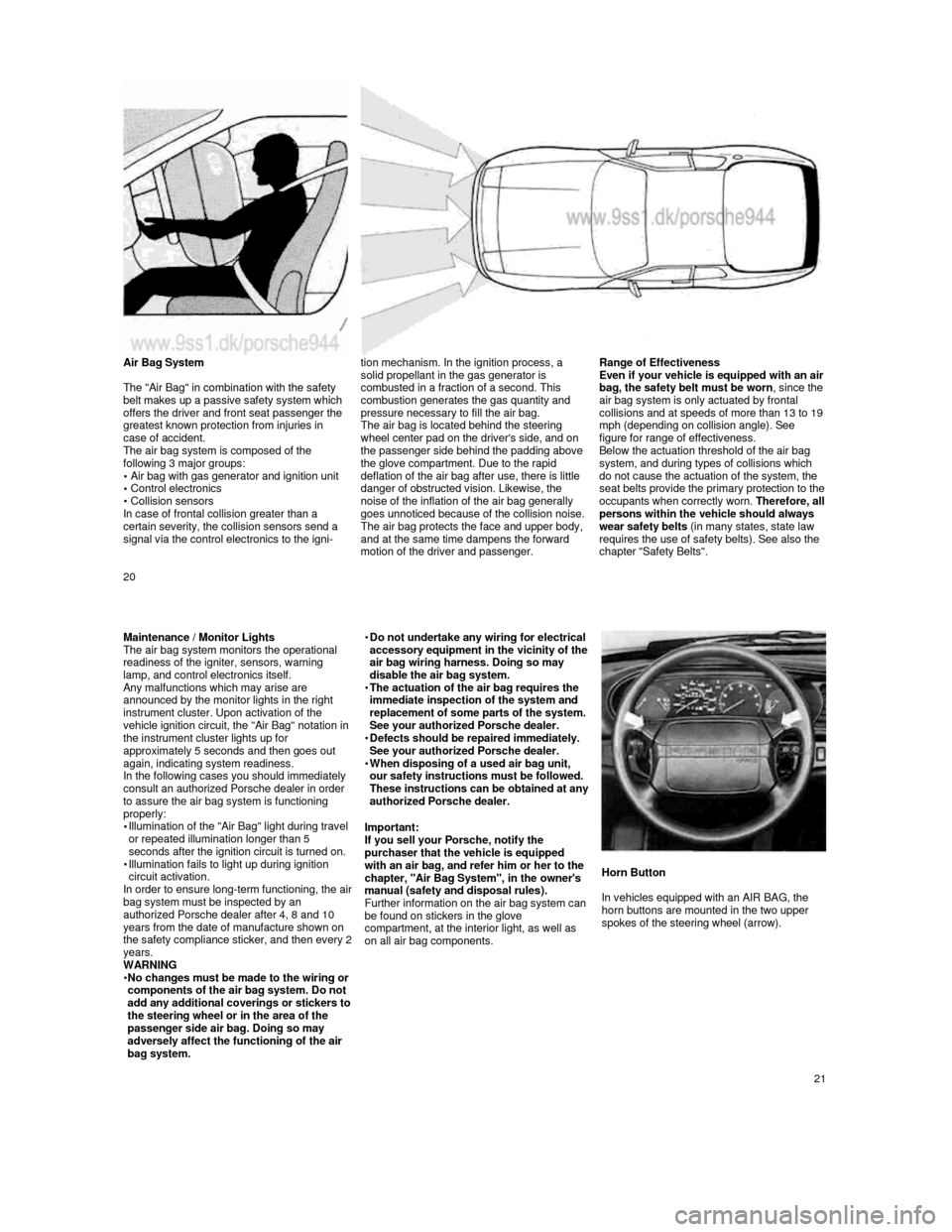
Air Bag System
The "Air Bag" in combination with the safety
belt makes up a passive safety system which
offers the driver and front seat passenger the
greatest known protection from injuries in
case of accident.
The air bag system is composed of the
following 3 major groups:
Air bag with gas generator and ignition unit Control electronics Collision sensors
In case of frontal collision greater than a
certain severity, the collision sensors send a
signal via the control electronics to the igni- tion mechanism. In the ignition process, a
solid propellant in the gas generator is
combusted in a fraction of a second. This
combustion generates the gas quantity and
pressure necessary to fill the air bag.
The air bag is located behind the steering
wheel center pad on the driver's side, and on the passenger side behind the padding above
the glove compartment. Due to the rapid
deflation of the air bag after use, there is little
danger of obstructed vision. Likewise, the
noise of the inflation of the air bag generally
goes unnoticed because of the collision noise. The air bag protects the face and upper body,
and at the same time dampens the forward
motion of the driver and passenger.
Range of Effectiveness Even if your vehicle is equipped with an air bag, the safety belt must be worn, since the air bag system is only actuated by frontal collisions and at speeds of more than 13 to 19 mph (depending on collision angle). See
figure for range of effectiveness.
Below the actuation threshold of the air bag
system, and during types of collisions which
do not cause the actuation of the system, the
seat belts provide the primary protection to the occupants when correctly worn. Therefore, all persons within the vehicle should always
wear safety belts (in many states, state law
requires the use of safety belts). See also the
chapter "Safety Belts".
20
Maintenance / Monitor Lights
The air bag system monitors the operational
readiness of the igniter, sensors, warning
lamp, and control electronics itself.
Any malfunctions which may arise are announced by the monitor lights in the right
instrument cluster. Upon activation of the
vehicle ignition circuit, the "Air Bag" notation in
the instrument cluster lights up for
approximately 5 seconds and then goes out
again, indicating system readiness.
In the following cases you should immediately
consult an authorized Porsche dealer in order
to assure the air bag system is functioning
properly:
Illumination of the "Air Bag" light during travel
or repeated illumination longer than 5
seconds after the ignition circuit is turned on.
Illumination fails to light up during ignition
circuit activation.
In order to ensure long-
term functioning, the air bag system must be inspected by an
authorized Porsche dealer after 4, 8 and 10
years from the date of manufacture shown on
the safety compliance sticker, and then every 2 years.
WARNING
No changes must be made to the wiring or components of the air bag system. Do not
add any additional coverings or stickers to the steering wheel or in the area of the
passenger side air bag. Doing so may
adversely affect the functioning of the air
bag system.
Do not undertake any wiring for electrical accessory equipment in the vicinity of the air bag wiring harness. Doing so may
disable the air bag system.
The actuation of the air bag requires the immediate inspection of the system and
replacement of some parts of the system.
See your authorized Porsche dealer.
Defects should be repaired immediately. See your authorized Porsche dealer. When disposing of a used air bag unit, our safety instructions must be followed. These instructions can be obtained at any authorized Porsche dealer.
Important:
If you sell your Porsche, notify the
purchaser that the vehicle is equipped
with an air bag, and refer him or her to the
chapter, "Air Bag System", in the owner's
manual (safety and disposal rules).
Further information on the air bag system can
be found on stickers in the glove
compartment, at the interior light, as well as
on all air bag components.
Horn Button
In vehicles equipped with an AIR BAG, the
horn buttons are mounted in the two upper
spokes of the steering wheel (arrow).
21
Page 12 of 66
Rear View Mirrors
Do not put decals or other signs on the
windows that may interfere with the driver's
vision.
Adjust the outside and inside mirrors before driving. It is important for safe driving that you have good vision to the rear.
Inside day-night mirror
You can adjust the day-
night mirror from clear daylight visibility to non-glare visibility at night by moving the lever at the bottom of the
mirror forward or rearward.
Heated outside mirrors with remote
control
When you turn on the rear window defogger,
the outside rear view mirror is also heated.
The outside mirrors are ad
justable from inside of the vehicle by a four direction switch
located on the left door and a rocker switch
located on the center console ahead of the
gear selection lever. The rocker switch (A)
selects either the left or right mirror for
adjustment. Push
the rocker switch forward to select the left mirror, and rearward to select
the right mirror. Then the four direction switch
will adjust the selected mirror in any of the four directions.
The mirror housing is hinged and can be
folded flat against the c
ar in either direction to prevent damage in tight parking spots.
If necessary, the outside mirrors can also be
adjusted manually.
22
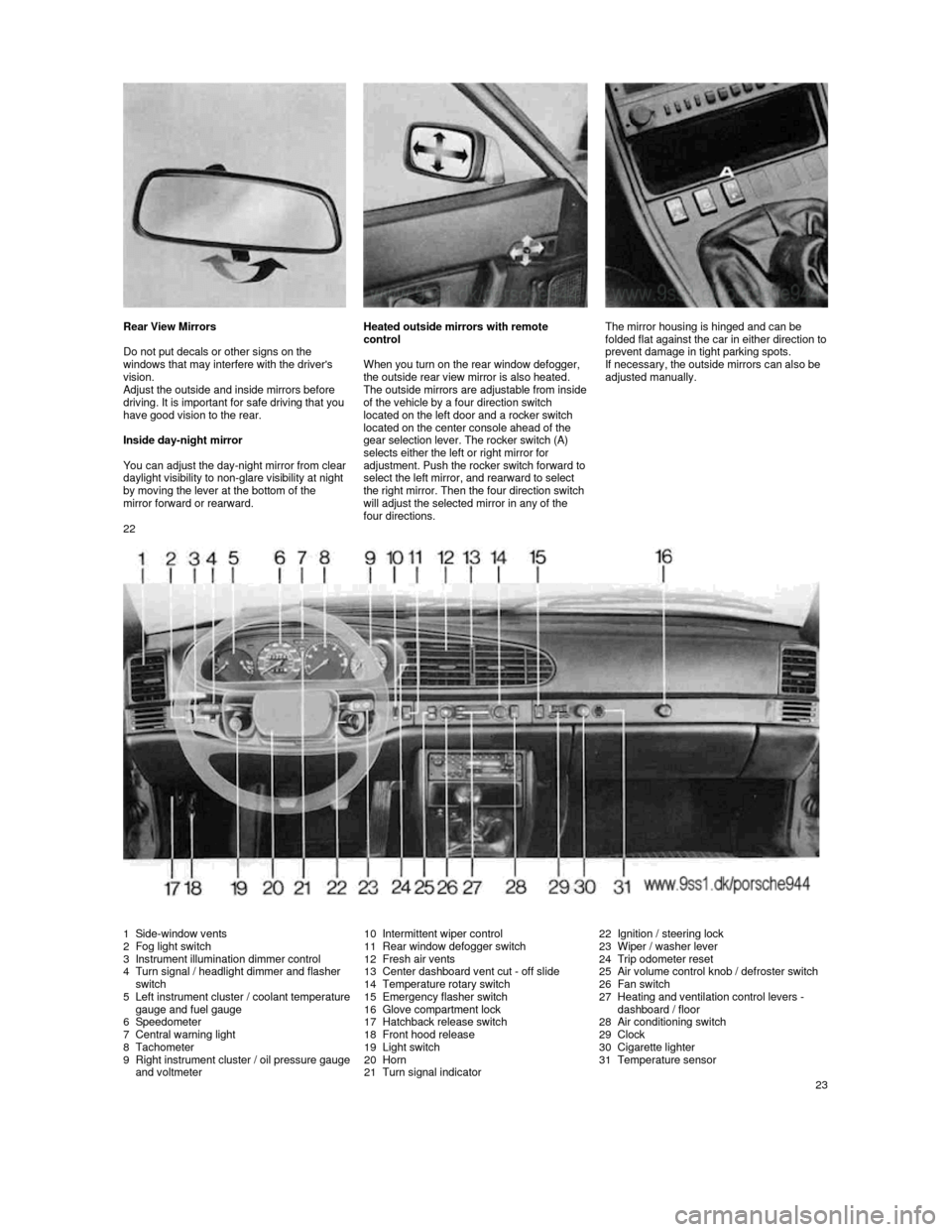
1 Side-window vents 2 Fog light switch
3 Instrument illumination dimmer control
4 Turn signal / headlight dimmer and flasher
switch
5
Left instrument cluster / coolant temperature gauge and fuel gauge
6 Speedometer
7 Central warning light
8 Tachometer
9 Right instrument cluster / oil pressure gauge and voltmeter
10 Intermittent wiper control
11 Rear window defogger switch
12 Fresh air vents
13 Center dashboard vent cut -
off slide14 Temperature rotary switch
15 Emergency flasher switch
16 Glove compartment lock
17 Hatchback release switch
18 Front hood release
19 Light switch
20 Horn
21 Turn signal indicator
22 Ignition / steering lock
23 Wiper / washer lever
24 Trip odometer reset
25
Air volume control knob / defroster switch
26 Fan switch
27 Heating and ventilation control levers -
dashboard / floor
28
Air conditioning switch
29 Clock
30 Cigarette lighter
31 Temperature sensor
23
Page 16 of 66
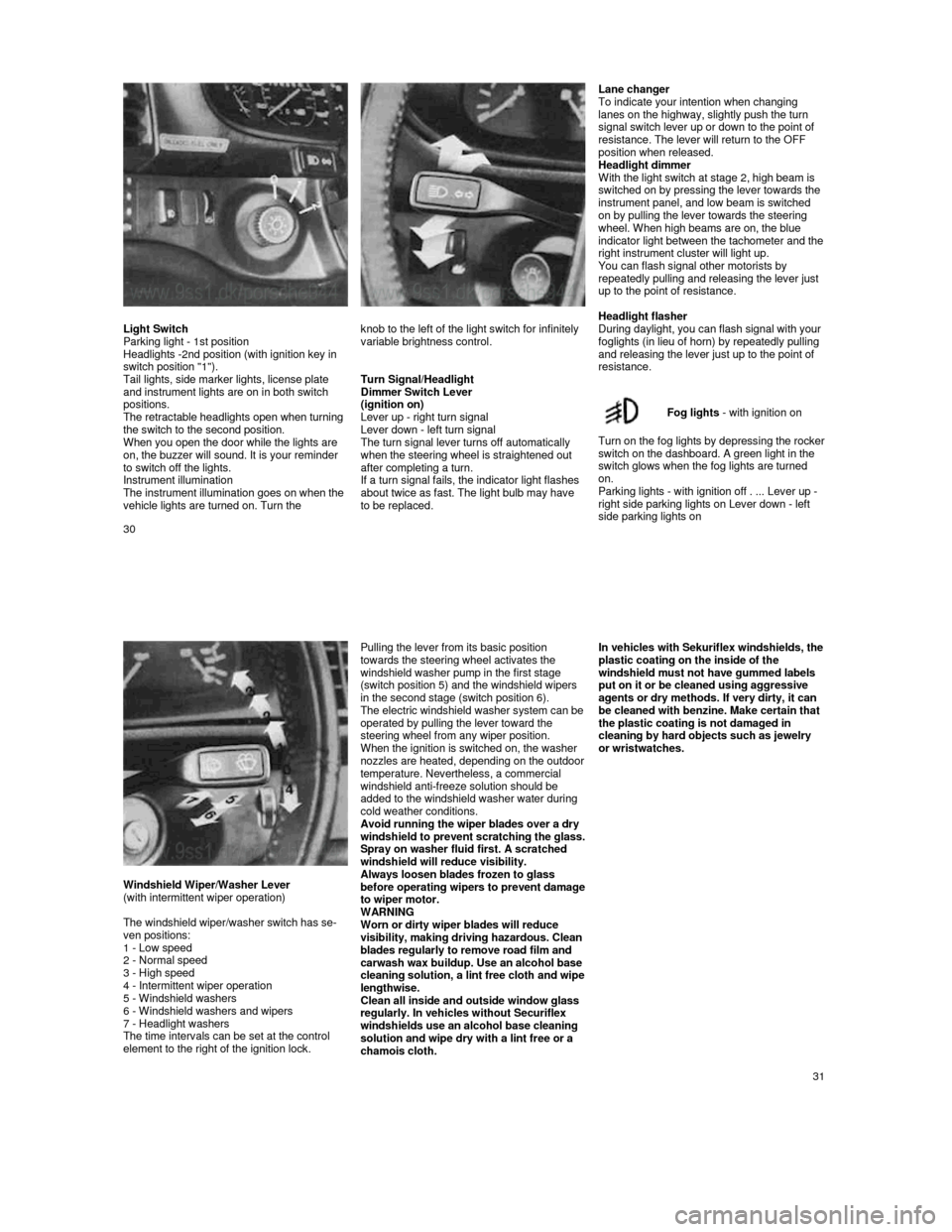
Lane changer
To indicate your intention when changing
lanes on the highway, slightly push the turn
signal switch lever up or down to the point of
resistance. The lever will return to the OFF
position when released.
Headlight dimmer
With the light switch at stage 2, high beam is
switched on by pressing the lever towards the
instrument panel, and low beam is switched
on by pulling the lever towards the steering
wheel. When high beams are on, the blue indicator light between the tachometer and the right instrument cluster will light up.
You can flash signal other motorists by
repeatedly pulling and releasing the lever just
up to the point of resistance.
Light Switch
Parking light - 1st position
Headlights -2nd position (with ignition key in
switch position "1").
Tail lights, side marker lights, license plate
and instrument lights are on in both switch
positions.
The retractable headlights open when turning
the switch to the second position.
When you open the door while the lights are
on, the buzzer will sound. It is your reminder
to switch off the lights.
Instrument illumination
The instrument illumination goes on when the
vehicle lights are turned on. Turn the
knob to the left of the light switch for infinitely
variable brightness control.
Turn Signal/Headlight
Dimmer Switch Lever
(ignition on)
Lever up - right turn signal
Lever down - left turn signal
The turn signal lever turns off automatically
when the steering wheel is straightened out after completing a turn.
If a turn signal fails, the indicator light flashes
about twice as fast. The light bulb may have
to be replaced.
Headlight flasher
During daylight, you can flash signal with your
foglights (in lieu of horn) by repeatedly pulling
and releasing the lever just up to the point of
resistance.
Fog lights
- with ignition on
Turn on the fog lights by depressing the rocker switch on the dashboard. A green light in the
switch glows when the fog lights are turned
on.
Parking lights - with ignition off . ... Lever up -
right side parking lights on Lever down - left
side parking lights on
30
Windshield Wiper/Washer Lever
(with intermittent wiper operation)
The windshield wiper/washer switch has se-
ven positions:
1 - Low speed
2 - Normal speed
3 - High speed
4 - Intermittent wiper operation
5 - Windshield washers
6 - Windshield washers and wipers
7 - Headlight washers
The time intervals can be set at the control
element to the right of the ignition lock.
Pulling the lever from its basic position
towards the steering wheel activates the
windshield washer pump in the first stage
(switch position 5) and the windshield wipers
in the second stage (switch position 6).
The electric windshield washer system can be operated by pulling the lever toward the
steering wheel from any wiper position.
When the ignition is switched on, the washer
nozzles are heated, depending on the outdoor temperature. Nevertheless, a commercial windshield anti-freeze solution should be
added to the windshield washer water during
cold weather conditions.
Avoid running the wiper blades over a dry
windshield to p
revent scratching the glass. Spray on washer fluid first. A scratched
windshield will reduce visibility.
Always loosen blades frozen to glass
before operating wipers to prevent damage to wiper motor.
WARNING
Worn or dirty wiper blades will reduce
visibility, making driving hazardous. Clean
blades regularly to remove road film and
carwash wax buildup. Use an alcohol base
cleaning solution, a lint free cloth and wipe lengthwise.
Clean all inside and outside window glass
regularly. In vehicles without Securiflex
windshields use an alcohol base cleaning
solution and wipe dry with a lint free or a
chamois cloth.
In vehicles with Sekuriflex windshields, the plastic coating on the inside of the
windshield must not have gummed labels
put on it or be cleaned using aggressive
agents or dry methods. If very dirty, it can
be cleaned with benzine. Make certain that
the plastic coating is not damaged in
cleaning by hard objects such as jewelry
or wristwatches.
31