lights PORSCHE BOXSTER 2005 2.G User Guide
[x] Cancel search | Manufacturer: PORSCHE, Model Year: 2005, Model line: BOXSTER, Model: PORSCHE BOXSTER 2005 2.GPages: 276, PDF Size: 4.05 MB
Page 51 of 276
Controls, Instruments
51
Clutch Pedal The clutch pedal must be depressed fully be-
fore the starter will engage.
Warning!
Risk of an accident.
fAlways check the movement of the clutch pe-
dal before driving and make sure that it is not
obstructed by a floor mat or any other object.
fSecure the floor mat to prevent it from sliding
into positions that could interfere with the safe
operation of your vehicle.
Your Porsche dealer will be glad to offer you
nonskid floor mats of the correct size.
To avoid damage to the clutch and transmis-
sion:
fAlways depress the clutch pedal fully when
changing gears.
fDo not hold the car on a steep grade with the clutch pedal partially depressed.
Should the free travel of the clutch pedal suddenly
become larger, it could mean a malfunction of the
clutch.
fSee your Porsche dealer for correction.
Parking Brake Parking brake force is mechanically transferred to
the rear wheels by means of cables.
fUse the parking brake only after the vehicle
has come to a full stop.
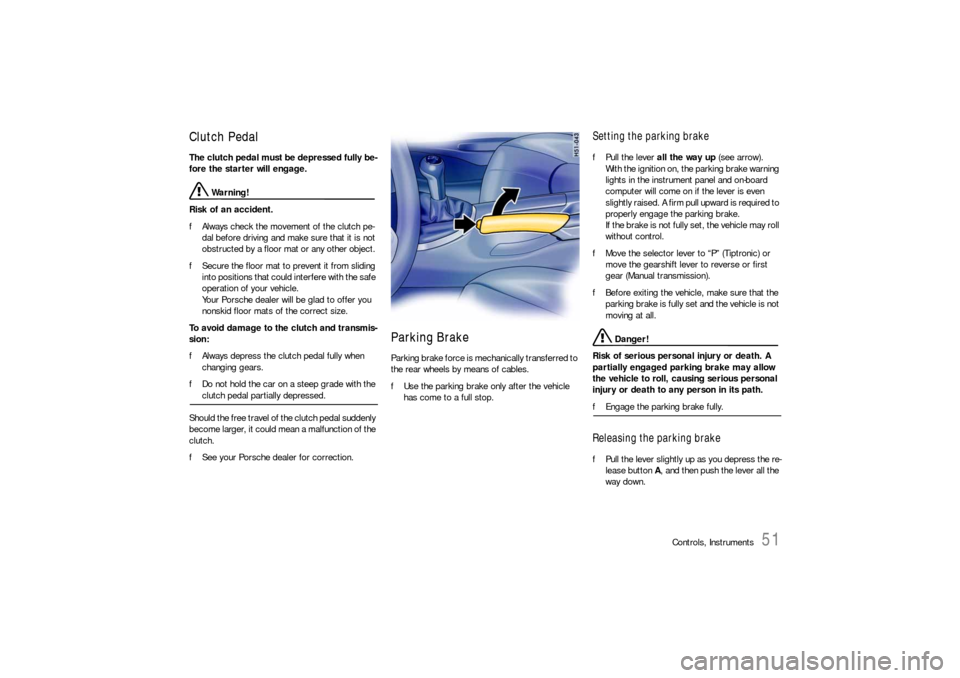
Setting the parking brake fPull the lever all the way up (see arrow).
With the ignition on, the parking brake warning
lights in the instrument panel and on-board
computer will come on if the lever is even
slightly raised. A firm pull upward is required to
properly engage the parking brake.
If the brake is not fully set, the vehicle may roll
without control.
fMove the selector lever to “P” (Tiptronic) or
move the gearshift lever to reverse or first
gear (Manual transmission).
fBefore exiting the vehicle, make sure that the
parking brake is fully set and the vehicle is not
moving at all.
Danger!
Risk of serious personal injury or death. A
partially engaged parking brake may allow
the vehicle to roll, causing serious personal
injury or death to any person in its path.
fEngage the parking brake fully.Releasing the parking brake fPull the lever slightly up as you depress the re-
lease button A, and then push the lever all the
way down.
Page 52 of 276

52
Controls, Instruments The parking brake warning lights will go out after
the parking brake is fully released.
The warning lights are not an indicator that the
parking brake is fully set; it is only intended to be
a warning to release the parking brake before dri-
ving the car. Caution!
A partially engaged brake will overheat the
rear brakes, reduce their effectiveness and
cause excessive wear.
fRelease the parking brake fully.
fWhen parking your car, always set the parking
brake by pulling all the way up on the lever.
fMove the selector lever to “P” (Tiptronic) or
move the gearshift lever to reverse or first
gear (Manual transmission).
fOn hills also turn the front wheels towards the
curb.
Brakes fMake it a habit to check the operation of your
brakes before driving.
Keep in mind that the braking distance increases
very rapidly as the speed increases. At 60 mph or
100 km/h, for example, it is not twice but four ti-
mes longer than 30 mph or 50 km/h. Tire traction
is also less effective when the roads are wet or
slippery.
fTherefore, always maintain a safe distance
from the car in front of you.
Vehicles without Porsche Ceramic
Composite Brake (PCCB)
Even though the brake discs consist of alloyed
grey cast iron, they will unavoidably start to corro-
de if your car is parked for an extended period.
The brakes will tend to “rub” as a result.
The nature, extent and effects of corrosion de-
pend on the amount of time the vehicle was par-
ked, whether granular or liquid road salt was
spread and whether grease-dissolving agents
were used in car washes.
If the braking comfort is noticeably impaired, we
recommend having the brake system checked by
experts at an authorized Porsche dealer.
Brake system function Your Porsche is equipped with a power assisted
hydraulic dual circuit brake system with disc bra-
kes at the front and rear.
Both circuits function independently. One brake
circuit operates the front and the other operates
the rear.
If one brake circuit has failed, the other will still
operate. However, you will notice an increased pe-
dal travel when you apply the brakes.
Failure of one brake circuit will cause the stopping
distance to increase.
Warning!
Risk of an accident.
In the unlikely event of hydraulic failure of
one brake circuit:
fPush the brake pedal down firmly and hold it in
that position.
A mechanical linkage activates the second cir-
cuit, and you will be able to bring the vehicle to
a stop.
fAfter bringing your vehicle to a complete stop,
avoid driving the vehicle and instead have it to-
wed to the nearest authorized Porsche dealer for repair.
Parking brake warning light USA
Parking brake warning light
Canada
Page 53 of 276

Controls, Instruments
53
If the warning lights in the instrument panel and on-
board computer go on while driving, the brake flu-
id level may be too low, or (if the brake pedal travel
has increased) one of the two brake circuits may
have failed.
A greater braking pressure will be required, stop-
ping distances will be longer and the braking beha-
vior will change, particularly in curves.
With correctly adjusted brakes, and a correctly
working brake system, the pedal travel to the
point of brake actuation should be 1-3/16" to
1-9/16" or 30 to 40 mm.
Whenever the brake pedal travel exceeds this dis-
tance, have the brake system checked.
Brake pedal
Warning!
Risk of an accident.
Any obstruction of the pedal could increase
the stopping distance.
fAlways check the movement of the brake pedal
before driving and make sure that it is not obs-
tructed by a floor mat or any other object.
fSecure the floor mat to prevent it from sliding
into positions that could interfere with the safe
operation of your vehicle.
Your Porsche dealer will be glad to offer you
floor mats of the correct size including a secu-ring possibility.
Note
In case one of the two brake circuits fails, increa-
sed pedal travel is required to bring your vehicle
to a full stop.
Warning!
To avoid overheating and premature wear of
the brakes:
fBefore descending a steep grade, reduce
speed and shift the transmission into a lower
gear or driving position to control speed.
fDo not ride the “brakes” by resting your foot on
the pedal when not intending to apply brake
pressure.
fDo not hold the pedal down too long or too of-
ten.
This could cause the brakes to get hot and not function properly.
Brake warning light USA
Brake warning light
Canada
Page 54 of 276

54
Controls, Instruments
Brake booster The brake booster assists braking only when
the engine is running.
When the car is moving while the engine is not run-
ning, or if the brake booster is defective, more
pressure on the brake pedal is required to bring
the car to a stop.
Moisture or road salt on brakes affects braking.
When the vehicle is driven on salted roads for ex-
tended periods, the brakes should be washed
down thoroughly about every 2 weeks. An auto-
matic carwash facility cannot do this job properly.
Brakes will dry after a few cautious brake applica-
tions.
Warning!
Driving through water may reduce traction.
Moisture on brakes from road water, car
wash, or coating of road salt may affect bra-
king efficiency.
fCautiously apply brakes to test brakes after being exposed.
Brake wear Your car has excellent brakes, but they are still
subject to wear. The rate at which they wear de-
pends on how the brakes are used.
fHave the brake system inspected at the inter-
vals recommended in your Maintenance Book-
let.
If the lights in the instrument panel and on-board
computer stay on when the engine is running or
come on while driving, the brake pads are worn,
excessively.
fDo not continue to operate the vehicle.
Have your authorized Porsche dealer inspect
or replace the brake pads.
Brake pads Wear on the brake pads and brake discs depends
to a great extent on the driving style and the con-
ditions of use and therefore cannot be expressed
in actual miles on the road.
The high-performance brake system is designed
for optimal braking effect at all speeds and tempe-
ratures.
Certain speeds, braking forces and ambient
conditions (such as temperature and humidity)
therefore might cause the brakes to squeal.
New brake pads or linings
New brake pads have to be “broken in”, and there-
fore only attain optimal friction when the car has
covered several hundred miles or km.
The slightly reduced braking ability must be com-
pensated for by pressing the brake pedal harder.
This also applies whenever the brake pads and
brake discs are replaced.
Warning light USA
Warning light Canada
Page 56 of 276

56
Controls, Instruments
Operation of the ABS system A wheel speed sensor is mounted to each of the
four wheels. If wheel lock-up of either of the front
wheels or the rear wheels is sensed during bra-
king, the brake pressure is adjusted automatically
until the wheel no longer slips. The brake pressure
is regulated for each front wheel individually and
for both of the rear wheels together.
On a road surface which is slippery on only one si-
de, the rear wheel which is braking on the slippery
surface determines the brake pressure which will
be applied equally to both rear wheels. This ensu-
res that directional stability is maintained. Howe-
ver, if braking forces approach the wheel lock-up
point for all wheels (panic braking) the ABS system
will intervene to provide a rapid rythmic braking.
The proper operation of ABS is perceived by the
driver as a pulsating brake pedal in conjunction
with audible noise and perhaps some vibration.
fIf you experience these sensations while dri-
ving or a road surface with questionable trac-
tion, reduce vehicle speed appropriate for the
prevailing road conditions.
The functional readiness of all the main electrical
components of the ABS is checked by an electro-
nic monitoring system both before and while you
drive. When the ignition is switched on the ABS warning
light will light up while the system is electronically
interrogated and goes out when the engine is star-
ted if the check is not yet complete.
If the ABS warning lamp fails to go out, this indica-
tes that ABS has been deactivated due to a fault.
If the warning lights in the instrument panel and on-
board computer light up while you are driving, this
indicates that a fault has occurred. In both cases,
normal braking, as in vehicles without ABS, is still
retained.
The ABS system should, however, be examined at
an authorized Porsche dealer immediately to pre-
vent the occurrence of further faults.
fIf the ABS system becomes inoperative, take
your vehicle to your authorized Porsche dealer
immediately.
Warning!
The control unit of the ABS brake system is
set for standard tire size. If non-standard ti-
res are installed, the control unit may misin-
terpret the speed of the vehicle, because of
the variant data it receives from the sensors
on the axles.
fUse only tire makes and types tested by Porsche.
Warning light USA
Warning light Canada
Page 60 of 276

60
Controls, Instruments
Sport modeA sportier car set-up is obtained when Sport mode
is switched on.
PSM interventions are later than in Normal mode;
the vehicle can be manoeuvred with greater agility
at its performance limits, without the need to
dispense with the assistance of PSM in
emergency situations. This helps to achieve
optimal lap times, particularly on race circuits and
a dry road surface.
– The multifunctional light on the instrument
panel lights up for a lamp check when the
ignition is switched on.
– The light indicates a control operation by
flashing, including when PSM is switched off
(brake control in the event of one-sided wheel
spin).
– In conjunction with a message on the on-board
computer, the light indicates that PSM is
switched off.
A gong also sounds.– Faults are displayed by the light in conjunction
with a message on the on-board computer.
PSM is out of order.
fPlease go to a qualified specialist workshop.
We recommend a Porsche partner for this
work as they have trained workshop personnel
and the necessary parts and tools.
fPlease observe the chapter “STORING YOUR
PORSCHE” on Page 200.
TowingfPlease observe the chapter “TOWING” on Page
254.Checks on test standsWhen carrying out brake tests on roller test
stands a maximum testing speed of 5 mph
(8 km/h) must not be exceeded.
Handbrake checks on the roller brake tester
must be performed only with the ignition switched
off.
Multifunctional PSM light
Page 62 of 276

62
Controls, Instruments
Retractable Spoiler The spoiler reduces air resistance and, particu-
larly at high speeds, reduces rear axle lift. Automatic controlThe spoiler extends at approx. 75 mph
(120 km/h) and retracts at approx. 50 mph
(80 km/h).
If automatic control fails, the warning light lights
up and the spoiler must be extended manually
before driving.
Warning!
Risk of accident. If the spoiler cannot be
extended, driving stability will be adversely
affected by increased rear axle lift.
fAdapt your driving style and speed to the
changed driving conditions.
fHave the fault remedied as soon as possible.
Please go to a qualified specialist workshop.
We recommend a Porsche dealer for this work
as they have trained workshop personnel and
the necessary parts and tools.
Risk of injury during manual retraction or ex-
tension of the spoiler with the vehicle statio-
nary.
fMake sure that no persons or objects are
within the range of movement of the spoiler.
Risk of damage, if the vehicle is pushed
using the spoiler.
fDo not push the vehicle at the spoiler.The warning light lights up for a lamp check when
the ignition is switched on.
The warning lights in the instrument panel and in
the on-board computer come on if the spoiler
does not extend or does not reach its final position
at more than 75 mph (120 km/h).
Warning light
Page 63 of 276
Controls, Instruments
63
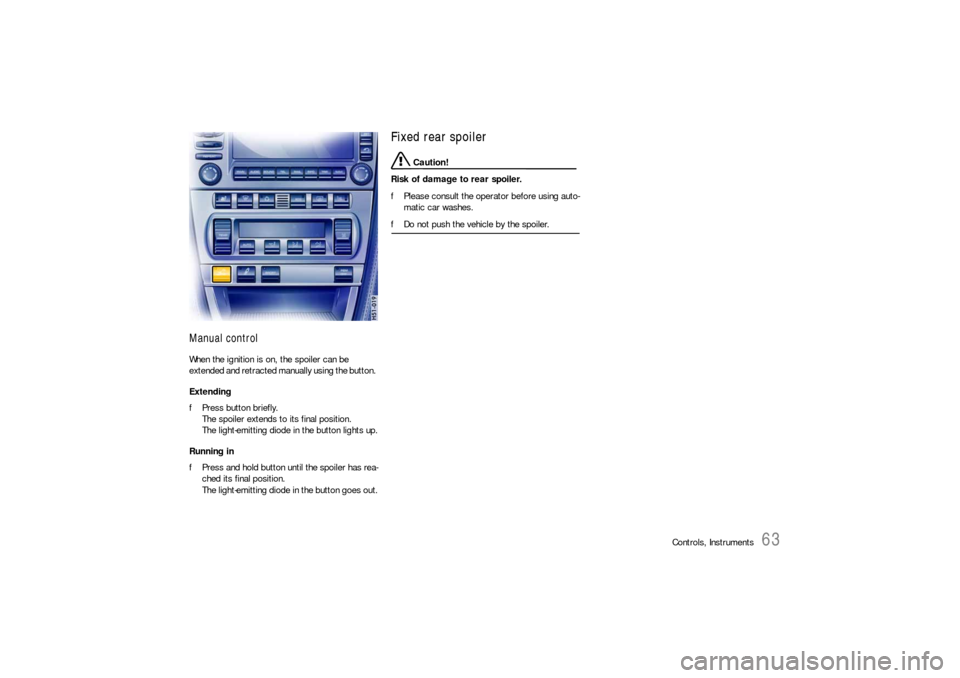
Manual controlWhen the ignition is on, the spoiler can be
extended and retracted manually using the button.
Extending
fPress button briefly.
The spoiler extends to its final position.
The light-emitting diode in the button lights up.
Running in
fPress and hold button until the spoiler has rea-
ched its final position.
The light-emitting diode in the button goes out.
Fixed rear spoiler
Caution!
Risk of damage to rear spoiler.
fPlease consult the operator before using auto-
matic car washes.
fDo not push the vehicle by the spoiler.
Page 70 of 276

70
Controls, Instruments
Starting Procedures fPlease observe the chapter “IMMOBILIZER” on
Page 17.
fPlease observe the chapter “EMISSION CONT-
ROL SYSTEM” on Page 182.
Warning!
Serious injury may result if you are involved
in a collision without having fastened the
safety belts.
fFasten safety belts before driving away. Before starting the engine fApply the handbrake.
fManual transmission:
Move the gearshift lever into neutral.
The clutch pedal must be depressed fully
before the starter will engage.
fTiptronic:
Move the selector lever to P or N.
Temperature sensors on the engine automatically
provide the correct fuel/air mixture required for
starting.
Therefore, it is not necessary to depress the
accelerator pedal while starting a cold or a
warm engine.
Starting the enginefTurn ignition key to ignition lock position 2.
fAs soon as the engine starts, release the igni-
tion key.
The first operation of the starter is ended auto-
matically when the engine starts.
If the engine does not start, subsequent starter
operations will not be ended automatically.
If the engine fails to start after 10 or 15 seconds
of cranking:
fWait about 10 seconds before engaging the
starter again.
fWhen starting the engine, be ready to drive im-
mediately.
Drive vehicle at moderate speeds and avoid
engine speeds above 4,200 rpm during the
first 5 minutes.
fDo not let the engine idle to warm up.
Danger!
Engine exhaust fumes have many compon-
ents which you can smell. They also contain
carbon monoxide (CO), which is a colorless
and odorless gas.
Carbon monoxide can cause unconscious-
ness and even death if inhaled.
fNever start or let the engine run in an enc-
losed, unventilated area.
It is not recommended to sit in your car for pro-
longed periods with the engine on and the car
not moving.
An unattended vehicle with a running engine
is potentially hazardous.
If warning lights should come on to indicate
improper operation, they would go un-
noticed.
fNever leave the engine idling unattended.
Danger of fire.
fDo not park or operate the vehicle in areas
where the hot exhaust system may come in
contact with dry grass, brush, fuel spill or
other flammable material.
fIf your car catches on fire for any reason, call
the fire department.
Do not endanger your life by attempting to put out the fire.
Page 73 of 276

Controls, Instruments
73
Instrument Panel USA Models Also refer to the corresponding chapter in
the Owner’s Manual.
1 Speedometer with analogue display
2 Turn signal indicator light, left
3 Tachometer
4 High beam indicator light
5 Turn signal indicator light, right
6 ABS warning light
7 Cooling system
Temperature gauge, warning light
8Fuel
Level gauge, warning light
9 Adjusting button for instrument illumination
and trip counter
10 Odometer and daily trip mileage display
11 Automatic speed control indicator light
12 Light sensor for instrument illumination13 Airbag warning light
14 Emission control warning light (Check Engine)
15 Central warning light
16 On-board computer display
17 Porsche Stability Management
Multifunctional PSM light
18 Brake warning light
19 Safety belt warning light
20 Tiptronic indicator
21 Clock and outside temperature display
22 Adjustment button for clockWhen the ignition is switched on, the warning
lights light up for a lamp check.
Note
Warnings that have been given are stored in the
appropriate control unit memory and can be read
out at an authorized Porsche dealer.
This information can help to warn you about situa-
tions which may be hazardous to you or your car.