radio PORSCHE BOXSTER 2005 2.G User Guide
[x] Cancel search | Manufacturer: PORSCHE, Model Year: 2005, Model line: BOXSTER, Model: PORSCHE BOXSTER 2005 2.GPages: 276, PDF Size: 4.05 MB
Page 99 of 276
Controls, Instruments
99
SET
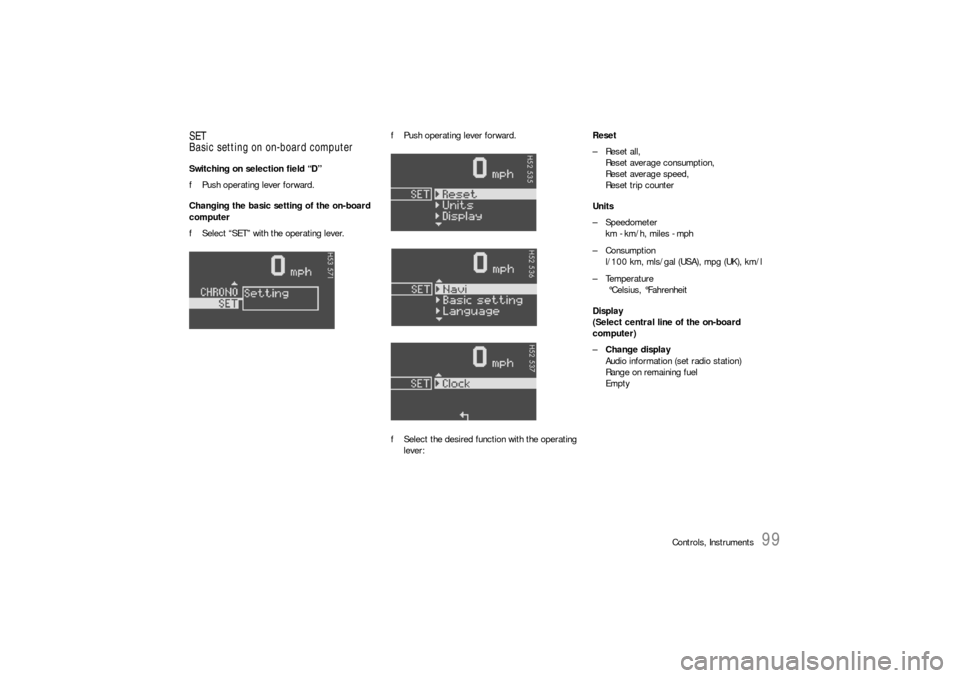
Basic setting on on-board computerSwitching on selection field “D”
fPush operating lever forward.
Changing the basic setting of the on-board
computer
fSelect “SET” with the operating lever.fPush operating lever forward.
fSelect the desired function with the operating
lever:Reset
– Reset all,
Reset average consumption,
Reset average speed,
Reset trip counter
Units
– Speedometer
km - km/h, miles - mph
–Consumption
l/100 km, mls/gal (USA), mpg (UK), km/l
– Temperature
°Celsius, °Fahrenheit
Display
(Select central line of the on-board
computer)
–Change display
Audio information (set radio station)
Range on remaining fuel
Empty
Page 134 of 276

134
Controls, Instruments
A - Opening front luggage compartment lid
B - Opening rear luggage compartment lid Luggage compartment lidsUnlocking fOperate the appropriate pull-button next to the
driver’s seat.
The luggage compartment is illuminated when
the respective lid is open.
fPlease observe the chapter “LOAD SWITCH-
OFF AFTER 2 HOURS OR 7 DAYS” on Page
226.The luggage compartment lid can also be un-
locked with the radio remote control.
fPlease observe the chapter “KEYS” on Page
17.
Important Note
If the vehicle battery is discharged, the front lug-
gage compartment lid can be opened only by con-
necting an external electrical power source.
fPlease observe the chapter “ELECTRICAL SYS-
TEM” on Page 226.
or the description inside the fuse box lid.
A warning message in the on-board computer
comes on if the lids are not completely closed.
fFully close the lid.
Warning message
Page 138 of 276

138
Controls, Instruments
Porsche Communication
Management (PCM) fRefer to the separate operating instructions
before putting the PCM into operation.
fPlease observe the chapter “LOAD SWITCH-
OFF AFTER 2 HOURS OR 7 DAYS” on Page
226.
Warning!
There is a danger of accident if you set or
operate the on-board computer, radio, navi-
gation system, telephone or other equipment
when driving.
This could distract you from the traffic and
cause you to lose control of the vehicle resul-
ting in serious personal injury or death.
fOperate the components while driving only if
the traffic situation allows you to do safely.
fCarry out any complicated operating or setting procedures only with the vehicle stationary.The reception conditions for the radio module inte-
grated in the PCM change continuously as you
drive. Interference from buildings, terrain and the
weather is unavoidable.
FM stereo reception is particularly susceptible to
varying reception conditions.
Electronic accessories should only be retrofitted
by a qualified specialist workshop.
Accessories which have not been tested and
approved by Porsche may impair radio reception.
NavigationWhen put into operation for the first time, a
distance of approx. 31 miles (50 km) must be dri-
ven in order for the navigation system to complete
the process of fine calibration.
The same applies when the tires are changed (e.g.
summer/snow tires) or new tires fitted.
Full location accuracy is not yet achieved during
the fine-calibration process.
If the vehicle has been transported (e.g. ferry, car
train), the system may take a few minutes after
being switched on before it determines the current
location.
Serious tire slip (e.g. spinning wheels on snow)
may result in temporarily inaccurate navigation.
When the battery has been disconnected, it may
take up to 15 minutes before the navigation
system becomes operational again.
Page 139 of 276

Controls, Instruments
139
Car Audio Operation/Tips For radio operation see your radio manual
which is included with your on-board
literature.
fPlease observe the chapter “LOAD SWITCH-
OFF AFTER 2 HOURS OR 7 DAYS” on Page
226. FM reception A vehicle is not an ideal place to listen to a radio.
Because the vehicle moves, reception conditions
are constantly changing.
Buildings, terrain, signal distance and noise from
other vehicles are all working against good recep-
tion.
Some conditions affecting FM may appear to be
problems when they are not.
The following characteristics are completely nor-
mal for a given reception area, and they do not in-
dicate any problem with the radio itself.
Note
Electronic accessories should only be installed by
your authorized Porsche dealer.
Equipment which has not been tested and appro-
ved by Porsche may impair radio reception. Fading and drifting
FM range is limited to about 25 miles (40 km), ex-
cept for some high power stations.
If a vehicle is moving away from the desired stati-
on’s transmitter, the signal will tend to fade and/or
drift. This condition is more prevalent with FM than
AM, and is often accompanied by distortion.
Fading and drifting can be minimized to a certain
degree by careful attention to fine tuning or selec-
tion of a stronger signal.
Static and fluttering
When the line-of-sight link between a transmitter
and vehicle is blocked by large buildings or moun-
tains, the radio sound may be accompanied with
static or fluttering because of the characteristic of
FM.
In a similar effect, a fluttering noise is sometimes
heard when driving along a tree-lined road.
This static and fluttering can be reduced by adjus-
ting the tone control for greater bass response un-
til the disturbance has passed. Multipath
Because of the reflecting characteristics of FM, di-
rect and reflected signals may reach the antenna
at the same time (multipath) and cancel each other
out.
As a vehicle moves through these electronic dead
spots, the listener may hear a momentary flutter
or loss of reception.
Station swapping
When two FM stations are close to each other, and
an electronic dead spot, such as static or multi-
path area, interrupts the original signal, someti-
mes the stronger second signal will be selected
automatically until the original one returns.
This swapping can also occur as you drive away
from the selected station and approach another
station of a stronger signal.
Page 141 of 276
Controls, Instruments
141
Car Telephone and
Aftermarket Alarms Important legal and safety information
regarding the use of cellular telephones:
Some states may prohibit the use of cellular tele-
phones while driving a vehicle. Check the laws and
regulations on the use of cellular telephones in the
areas where you drive.
Danger!
Risk of an accident.
Severe personal injury or death can result in
the event of an accident.
Looking away from the road or turning your
attention away from your driving can cause
an accident and serious or fatal injury.
When using your cellular telephone, you should al-
ways:
fGive full attention to your driving - pull off the
road and park before making or answering a
call if traffic conditions so require; and
fKeep both hands on the steering wheel - use
hands-free operation (if available) - pull off the
road and park before using a hand-held tele-phone. It is essential to observe the instructions of
the telephone manufacturer before putting
the telephone into operation.
Any portable telephone or radio transmitter which
is used in a Porsche must be properly installed in
accordance with the technical requirements of
Porsche.
The transmission power must not exceed
10 W.
The devices must possess a type approval for
your vehicle and have an “e” symbol.
If you should require equipment with transmission
power values greater than 10 W, please consult
your authorized Porsche dealer for this purpose.
He is familiar with the technical requirements for
installing devices of this kind.
The antennas for all radios and telephones with a
transmitting antenna must be externally mounted.
The improper installation of radios or telephones
or use of a radio or telephone with a transmitting
antenna inside the car may cause the warning
lights to come on.
Improper installation of such equipment can crea-
te a discharged battery or excessive current draw
from added equipment. If aftermarket systems are installed by non-dealer-
ship technicians or outside the selling dealer, pro-
blems may result. Installation of aftermarket
equipment is not covered under the New Car War-
ranty.
fConsult your authorized Porsche dealer about
the installation of non Porsche approved equip-
ment.
Reception quality
The reception quality of your car telephone will
change constantly when you are driving. Interfe-
rence caused by buildings, landscape and
weather is unavoidable. It may become particular-
ly difficult to hear when using the hands-free func-
tion due to external noise such as engine and wind
noise.
Automatic car-wash
fUnscrew the external antenna before using an
automatic car-wash.
Page 226 of 276

226
Practical Tips, Emergency Service
Electrical System In order to avoid damage and faults in electrical or
electronic systems, electrical accessories should
be installed at your authorized Porsche dealer.
fOnly use accessories authorized by Porsche.
Warning!
Risk of short circuit and fire.
Replacing fuses or relays with the engine
running or the ignition on could cause elec-
trical shock.
fDisconnected the battery during all work on
the electrical system.
Please observe the chapter “BATTERY” on Page 229.
Relays Defective relays should be changed only by an
authorized workshop.
Alarm system, central locking The status of the central locking and alarm system
is not changed by disconnecting the battery.
When the battery is disconnected, the alarm sys-
tem ceases to function. Overload protection If the central locking system is operated more
than ten times within a minute, further operation is
blocked for 30 seconds.
Load switch-off after 2 hours or 7 daysIf the ignition key is removed, loads which are
switched on or are in standby mode (such as the
luggage compartment light, interior light and
radio) are automatically switched off after approx.
2hours.
If the vehicle is not started or unlocked with the
remote control within 7days, the remote control
standby function is switched off (to save the
vehicle battery).
1. In this case, unlock the driver's door with the
key at the door lock.
Leave the door closed in order to prevent the
alarm system from being triggered.
2. Press button 1 on the remote control.
The remote control is now activated again.
Page 235 of 276
Practical Tips, Emergency Service
235
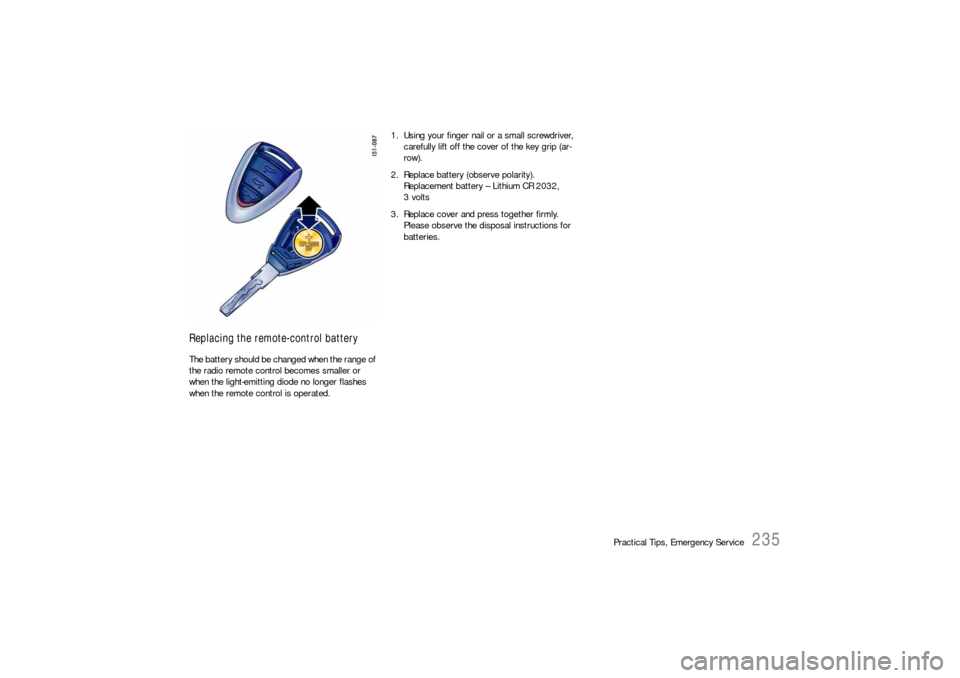
Replacing the remote-control batteryThe battery should be changed when the range of
the radio remote control becomes smaller or
when the light-emitting diode no longer flashes
when the remote control is operated.1. Using your finger nail or a small screwdriver,
carefully lift off the cover of the key grip (ar-
row).
2. Replace battery (observe polarity).
Replacement battery – Lithium CR 2032,
3volts
3. Replace cover and press together firmly.
Please observe the disposal instructions for
batteries.
Page 275 of 276

Index
275
RRadiator fans .............................................. 171
Radio reception .......................................... 139
Rain sensor ................................................ 110
Range on remaining fuel ........................87
, 100
Rear fog light .....................................108, 249
Rear lid ...................................................... 132
Rear spoiler............................................62, 63
Rear view mirrors ......................................... 31
Rear window defogger.................................. 33
Rear wing
Retractable........................................... 62
Relays ........................................................ 226
Release button ........................................... 147
Remote control ............................................. 18
Replacement key .......................................... 17
Replacing bulbs .......................................... 239
Replacing wiper blades................................ 169
Retractable spoiler........................................ 62
Rims
Diameter ............................................ 215
Rim width ........................................... 215
Running in .................................................... 14
SSafety belts ..........................................42
, 199
Warning light ........................................ 43
Safety compliance sticker ........................... 258
Sealing set ................................................. 220
Seals, care of ............................................. 197
Seat ............................................................ 34
Adjustment ........................................... 34
Heating ................................................ 38Memory................................................36
Selector lever .............................................147
Selector lever position indicator ............ 81
, 149
Shifting gear ...............................................146
Shiftlock .....................................................147
Side lights ..................................................249
Side marker light ............................... 108, 248
Side vents ..................................................120
Snow chains .............................. 213
, 263
, 264
Snow tires ......................................... 212, 262
Sockets .....................................................124
Spare key .....................................................17
Spare wheel ...............................................264
Speed code letter .......................................214
Speed control .............................. 76
, 113
, 114
Speed limit .......................................... 88, 214
Speedometer................................................78
Spoiler .........................................................62
Fixed ....................................................63
Retractable ...........................................62
Sport mode ..................................... 57
, 60, 61
Sports seat ..................................................34
Stability management system (PSM) ...............58
Starting ................................................. 67, 68
Starting and stopping the engine ....................67
Steering wheel
Adjustment ...........................................39
Buttons ................................................40
Lock ................................. 67
, 68, 69, 70
Rocker switches..................................147
Toggle switches ..................................147
Stopwatch ....................................................92
Storage options ..........................................126
Storing your Porsche..................................200
Sun visors ....................................................41Switching passenger’s airbag on and off ........ 48
TTachometer ................................................. 79
Tail light ..................................................... 249
Tank .................................................. 178
, 179
cap ................................................... 179
Ventilation system.............................. 184
Telephone .................................................. 141
Temperature setting........................... 114, 117
Temperature, outside indicator ...................... 83
Test stand, measurements ............................ 60
Theft protection ........................................... 16
Tiptronic .................................................... 147
Indicator .............................................. 81
Tires ................................... 14
, 203
, 262
, 263
Checking pressure............................. 223
Inscription .......................................... 214
Loading information ............................ 216
Pressure................................ 5
, 206
, 263
Pressure plate.................................... 259
Sealant .............................................. 220
Sidewall ............................................. 214
Size .................................................. 214
Tires and tire care ...................................... 203
Tools ......................................................... 136
Towing .............................................. 254, 255
Track ........................................................ 262
Transmission ............................. 145
, 146
, 261
Fluid .......................................... 190, 266
Trunk entrapment ....................................... 132
Turn signals ......................................... 79, 109