check engine PORSCHE BOXSTER 2005 2.G Owner's Manual
[x] Cancel search | Manufacturer: PORSCHE, Model Year: 2005, Model line: BOXSTER, Model: PORSCHE BOXSTER 2005 2.GPages: 276, PDF Size: 4.05 MB
Page 170 of 276
170
Maintenance, Car Care
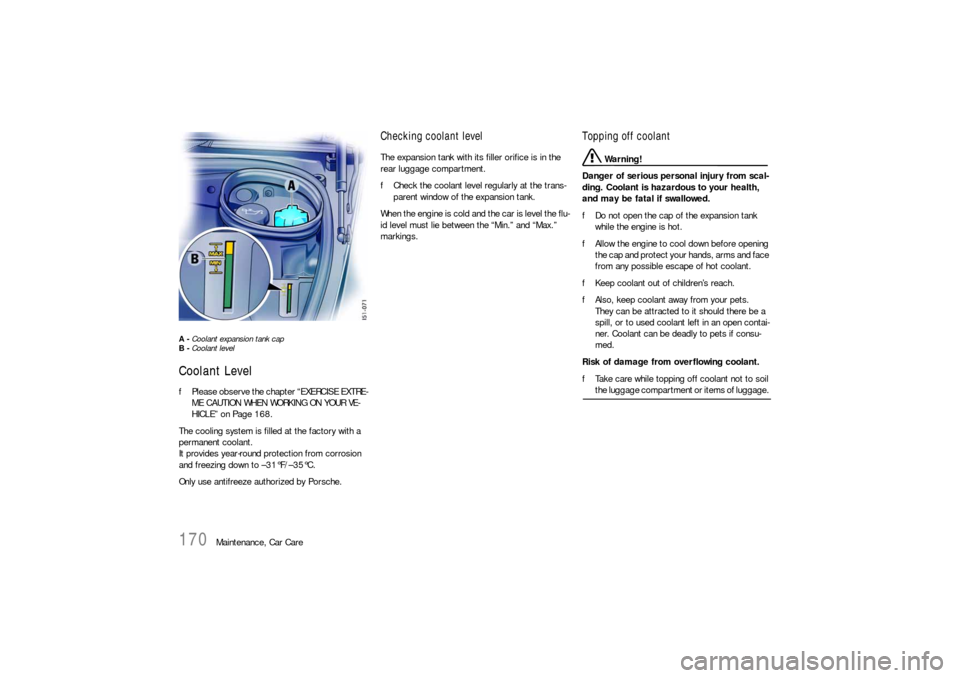
A - Coolant expansion tank cap
B - Coolant level Coolant Level fPlease observe the chapter “EXERCISE EXTRE-
ME CAUTION WHEN WORKING ON YOUR VE-
HICLE” on Page 168.
The cooling system is filled at the factory with a
permanent coolant.
It provides year-round protection from corrosion
and freezing down to –31°F/–35°C.
Only use antifreeze authorized by Porsche.
Checking coolant level The expansion tank with its filler orifice is in the
rear luggage compartment.
fCheck the coolant level regularly at the trans-
parent window of the expansion tank.
When the engine is cold and the car is level the flu-
id level must lie between the “Min.” and “Max.”
markings.
Topping off coolant
Warning!
Danger of serious personal injury from scal-
ding. Coolant is hazardous to your health,
and may be fatal if swallowed.
fDo not open the cap of the expansion tank
while the engine is hot.
fAllow the engine to cool down before opening
the cap and protect your hands, arms and face
from any possible escape of hot coolant.
fKeep coolant out of children’s reach.
fAlso, keep coolant away from your pets.
They can be attracted to it should there be a
spill, or to used coolant left in an open contai-
ner. Coolant can be deadly to pets if consu-
med.
Risk of damage from overflowing coolant.
fTake care while topping off coolant not to soil the luggage compartment or items of luggage.
Page 172 of 276

172
Maintenance, Car Care
Engine Oil Engine oil consumption
It is normal for your engine to consume oil.
The rate of oil consumption depends on the quality
and viscosity of oil, the speed at which the engine
is operated, the climate, road conditions as well
as the amount of dilution and oxidation of the lub-
ricant.
If the vehicle is used for repeated short trips, and
consumes a normal amount of oil, the engine oil
measurement may not show any drop in the oil le-
vel at all, even after 600 miles (1000 km) or more.
This is because the oil is gradually becoming dilut-
ed with fuel or moisture, making it appear that the
oil level has not changed.
The diluting ingredients evaporate out when the
vehicle is driven at high speeds, as on an express-
way, making it then appear that oil is excessively
consumed after driving at high speeds.
If the conditions you drive your vehicle in are dus-
ty, humid, or hot, the frequency of the oil change
intervals should be greater. If the vehicle is driven at a high rate of speed, cli-
matic conditions are warm, and the load is high,
the oil should be checked more frequently, as dri-
ving conditions will determine the rate of oil con-
sumption.
– The engine in your vehicle depends on oil to lu-
bricate and cool all of its moving parts.
Therefore, the engine oil should be checked re-
gularly and kept at the required level.
– Make it a habit to have the engine oil level che-
cked with every fuel filling.
– The oil pressure warning light is not an oil level
indicator.
The oil pressure warning light indicates serious
engine damage may be occuring when lit, if en-
gine rpm is above idle speed.
Page 173 of 276
Maintenance, Car Care
173
Engine Oil Level fPlease observe the chapter “EXERCISE EXTRE-
ME CAUTION WHEN WORKING ON YOUR VE-
HICLE” on Page 168.
fRegularly check the oil level using the on-board
computer after the vehicle is refuelled.
Please observe the chapter “OIL DISPLAY AND
MEASUREMENT OF THE ENGINE OIL LEVEL”
on Page 97.
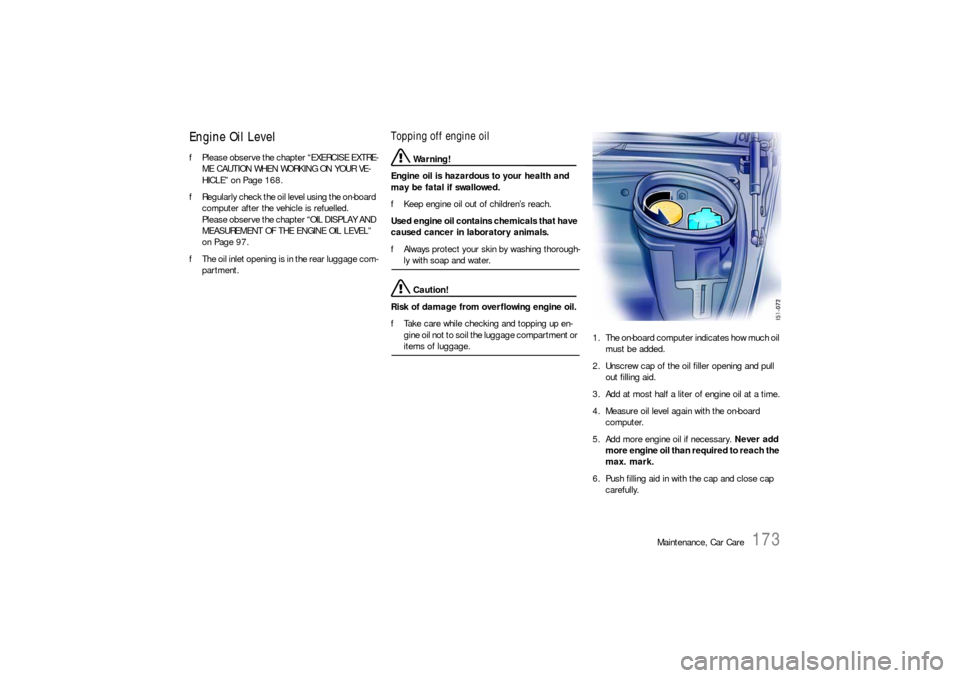
fThe oil inlet opening is in the rear luggage com-
partment.
Topping off engine oil
Warning!
Engine oil is hazardous to your health and
may be fatal if swallowed.
fKeep engine oil out of children’s reach.
Used engine oil contains chemicals that have
caused cancer in laboratory animals.
fAlways protect your skin by washing thorough-ly with soap and water. Caution!
Risk of damage from overflowing engine oil.
fTake care while checking and topping up en-
gine oil not to soil the luggage compartment or items of luggage. 1. The on-board computer indicates how much oil
must be added.
2. Unscrew cap of the oil filler opening and pull
out filling aid.
3. Add at most half a liter of engine oil at a time.
4. Measure oil level again with the on-board
computer.
5. Add more engine oil if necessary. Never add
more engine oil than required to reach the
max. mark.
6. Push filling aid in with the cap and close cap
carefully.
Page 178 of 276
178
Maintenance, Car Care
Fuel
Warning!
Fuel is highly flammable and harmful to
health.
fFire, open flame and smoking are prohibited
when handling fuel.
fAvoid contact with skin or clothing.
fDo not inhale fuel vapors.
To prevent damage to the emission control
system and engine:
fNever drive the tank completely out of fuel.
fAvoid high cornering speeds after the warning lights have come on.
fPlease observe the chapter “FUEL ECONOMY”
on Page 177.
fPlease observe the chapter “EMISSION CONT-
ROL SYSTEM” on Page 182.
fPlease observe the chapter “FUEL” on Page
82.
Check engine warning light
If the warning lights in the instrument panel and on-
board computer come on and remain on while
driving, it suggests:
– an improperly fastened tank cap or
– refuelling with engine running.
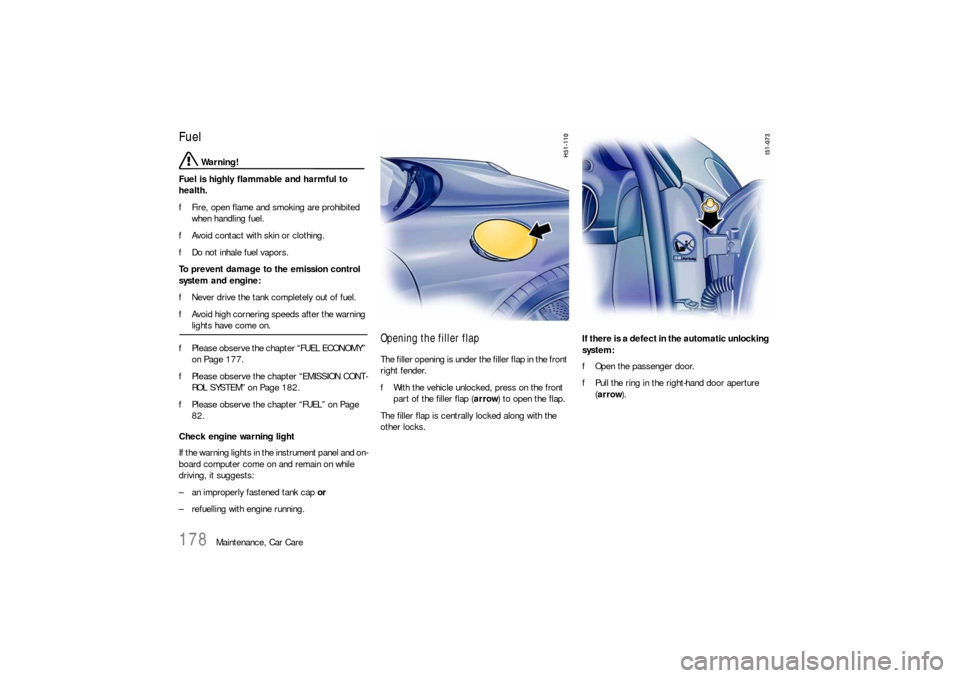
Opening the filler flap The filler opening is under the filler flap in the front
right fender.
fWith the vehicle unlocked, press on the front
part of the filler flap (arrow) to open the flap.
The filler flap is centrally locked along with the
other locks. If there is a defect in the automatic unlocking
system:
fOpen the passenger door.
fPull the ring in the right-hand door aperture
(arrow).
Page 181 of 276

Maintenance, Car Care
181
Fuels containing MMT Some North American fuels contain an octane en-
hancing additive called methylcyclopentadienyl
manganese tricarbonyl (MMT).
If such fuels are used, your emission control sys-
tem performance may be negatively affected.
The check engine warning light on your instrument
panel may turn on.
If this occurs, Porsche recommends you stop
using fuels containing MMT.
Portable Fuel Containers
Danger!
Portable fuel containers, full or partially em-
pty, may leak causing an explosion, or result
in fire in case of an accident.
fNever carry additional fuel in portable contai-ners in your vehicle.
Page 189 of 276
Maintenance, Car Care
189
Power Steering
Warning!
Risk of accident.
When the engine is stopped (e.g. when on
tow) or the power steering has failed there is
no steering assistance.
Therefore, substantially more force will have
to be exerted in order to steer.
fExercise great care when being towed.
fHave the fault remedied at your nearest autho-rized Porsche dealer. Note
The flow noise heard at full steering lock is design-
related and does not indicate a defect in the stee-
ring system.
Checking hydraulic fluid fPlease observe the chapter “EXERCISE EXTRE-
ME CAUTION WHEN WORKING ON YOUR VE-
HICLE” on Page 168.
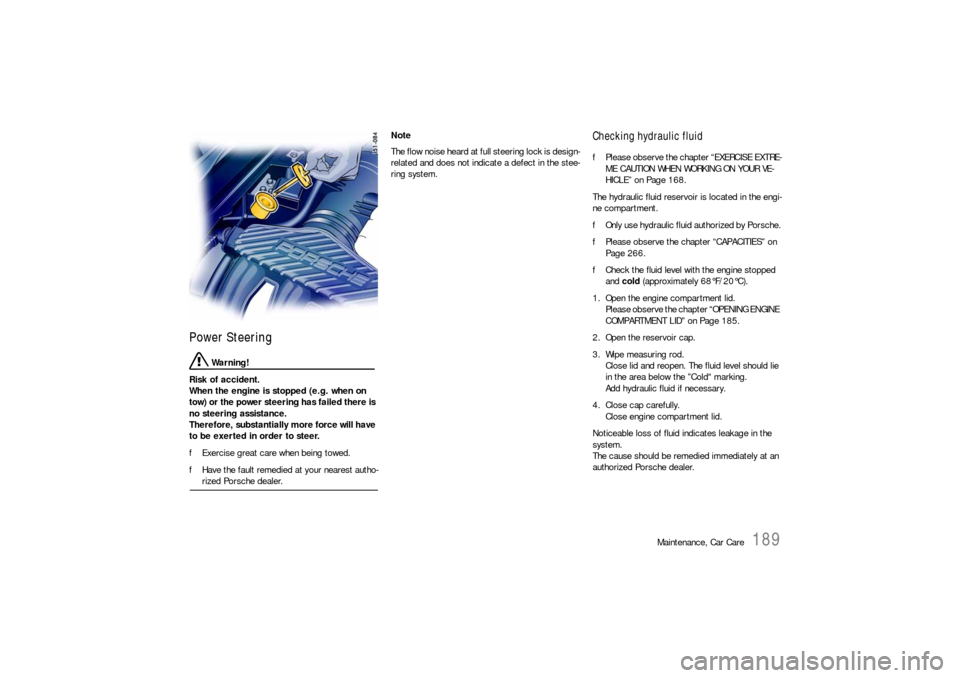
The hydraulic fluid reservoir is located in the engi-
ne compartment.
fOnly use hydraulic fluid authorized by Porsche.
fPlease observe the chapter “CAPACITIES” on
Page 266.
fCheck the fluid level with the engine stopped
and cold (approximately 68°F/20°C).
1. Open the engine compartment lid.
Please observe the chapter “OPENING ENGINE
COMPARTMENT LID” on Page 185.
2. Open the reservoir cap.
3. Wipe measuring rod.
Close lid and reopen. The fluid level should lie
in the area below the ”Cold“ marking.
Add hydraulic fluid if necessary.
4. Close cap carefully.
Close engine compartment lid.
Noticeable loss of fluid indicates leakage in the
system.
The cause should be remedied immediately at an
authorized Porsche dealer.
Page 190 of 276

190
Maintenance, Car Care
Air Filter The air filter is on the left-hand side of the engine
compartment.
A dirty air filter not only reduces engine perfor-
mance, but can lead to premature engine wear.
Regular filter replacement is part of the routine
maintenance service.
fIn dusty conditions, check the filter element
more frequently and replace if necessary. Combination filterThe fresh air passing through the combination
filter into the passenger compartment is virtually
free of dust, pollen, and unpleasant odours.
fIf the outside air is polluted by exhaust fumes,
press the circulating-air button.
A dirty filter can be the cause of reduced air
throughput:
fHave the filter replaced by an authorized
Porsche dealer.
Regular filter replacement is part of servicing.
Automatic Transmission Fluid The torque converter and the transmission are lu-
bricated with Automatic Transmission Fluid (ATF).
The final drive requires transmission oil.
fPlease observe the chapter “CAPACITIES” on
Page 266.
Do not tow the car or run the engine without ATF
in the transmission. The automatic transmission
may be damaged by even a tiny speck of dirt, only
a clean funnel or spout must be used when adding
AT F.
The ATF and transmission oil has to be checked
and changed at the intervals listed in your Mainte-
nance Schedule.
We recommend that you have the ATF and trans-
mission oil changed at your Porsche dealer, who
has the required lubricants and the necessary fil-
ling equipment.
If you suspect an oil leak in the transmission, have
your authorized Porsche dealer check it out imme-
diately.
Manual Transmission Oil The transmission oil has to be checked and chan-
ged at the intervals listed in your Maintenance
Schedule.
fPlease observe the chapter “CAPACITIES” on
Page 266.
We recommend that you have the transmission oil
changed at your Porsche dealer, who has the re-
quired lubricants and the necessary filling equip-
ment.
If you suspect an oil leak in the transmission, have
your authorized Porsche dealer check it out imme-
diately.
Page 200 of 276

200
Maintenance, Car Care
Storing your Porsche If you intend to store your Porsche for a prolonged
period, please consult your authorized Porsche
dealer. The staff will be glad to advise you on the
most suitable and necessary methods.
fClean your vehicle thoroughly inside and out-
side.
Clean the engine compartment.
The under carriage and chassis components
should be free of dirt and salt deposits.
fFill up the fuel tank.
fChange the oil and oil filter, and run the engine
for several minutes.
fIncrease the tire pressure to 58 psi (4 bar).
It is not recommended to lift the vehicle, due to
the possibility of corrosion on shock absorber
piston shafts.
The vehicle should be moved slightly, approxi-
mately every four weeks, to prevent flat spot
on the tires. Climate control
The air conditioning system should be in good wor-
king condition and fully charged.
Windshield/Headlight washer
fCheck and correct antifreeze/cleaning solution
level as necessary.
Electrical system
fRemove the battery from the vehicle and store
it in a cool dry place, not on a cement floor.
When the battery is disconnected, the
alarm system is deactivated.
fRecharge the battery every 3 months. If the
battery remains in the vehicle with the cables
connected, it is necessary to check, remove
and recharge the battery every 2-3 weeks.
Do not fast charge the battery.
fPlease observe the chapter “BULB CHART” on
Page 239. Vehicle interior
The interior must be dry, especially in the area of
the floor carpets. The use of drying agents (Silica-
Gel) is recommended in vehicles with leather inte-
rior and in areas with high humidity. The recom-
mended amount is 3 fabric bags of 1.1 lbs. (500
grams) each placed on the floor carpets.
Windows, doors, lids and top must be closed. The
air vents should be opened.
Page 230 of 276

230
Practical Tips, Emergency Service
Charge stateA well-charged battery prevents starting problems
and has a longer useful life.
Traffic density, speed limits, requirements
regarding noise, exhaust gas and fuel consump-
tion reduce the engine speed and, hence, the
generator output.
However, the large number of electrical loads has
markedly increased the demand for electrical
power.
In order to avoid unintended battery
discharge
fSwitch off unnecessary electrical loads in city
traffic, on short trips and in queues.
fAlways withdraw the ignition key when leaving
the vehicle.
fAvoid frequent operation of the convertible top
and operation of the Porsche Communication
Management system when the engine is not
running.
Battery carefKeep battery surface clean and dry.
fEnsure that cell plugs and terminal clamps are
firmly secured.
Checking acid level
The acid level should be more frequently checked
by a qualified specialist workshop during the
summer months and in predominantly warm
countries.
Charging the battery
Your Porsche partner will be pleased to advise you
about a suitable charger.
1. Always observe the instructions of the charger
manufacturer.
Depending on the type of charger, the battery
may have to be disconnected. Extremely
important: disconnect the negative cable first,
and then the positive cable – danger of short
circuit!
Reconnection must be carried out in reverse
order.
2. Before charging, cold batteries must be
warmed up indoors.
3. Frozen batteries must not be charged. They
must be replaced with a new battery.
4. When charging, ensure adequate ventilation. 5. Connect charger to the battery.
Only plug into the mains and switch the
charger on when it has been correctly
connected up.
Warning!
Hydrogen gas generated by the battery
could cause an explosion, resulting in severe
personal injuries.
fCharge battery in a well ventilated area.
fNever charge a frozen battery. It may explode
because of gas trapped in the ice. Allow a fro-
zen battery to thaw out first.
fIf you get electrolyte, which is an acid, in your
eyes or on your skin, immediately rinse with
cold water for several minutes and call a doc-tor.
Page 272 of 276

272
Index
IndexAABS (antilock brake system) .......................... 55
Air conditioning ...................................114
, 117
Air distribution ....................................114, 117
Air filter ...................................................... 190
Airbag system .............................................. 49
Disposal ............................................... 50
Switching passenger’s airbag on and off . 48
Air-conditioning compressor ................116, 119
Alarm system ............................................. 141
Alcantara ................................................... 199
Antenna .............................................141, 194
Antilock brake system................................... 55
Warning light ........................................ 56
Ashtray ...................................................... 122
Assembly aids for wheel changes................. 224
Assistant ...................................................... 64
Audio operation .......................................... 139
Auto-button air conditioning ......................... 117
Automatic
Anti-glare mirrors .................................. 30
Car washes ........................................ 192
Door locking ......................................... 24
Headlight beam adjustment.................. 109
Speed control ....................................... 76
Automatic air conditioning system ................ 117
Average consumption............................87, 100
Average speed .....................................87, 100
BBackrest
Adjustment ........................................... 34
Release ................................................ 34
Battery....................................................... 229
Care .................................................. 230
Charge state....................................... 230
Putting vehicle into operation ............... 232
Remote control ................................... 235
Removing ........................................... 233
Warning light......................................... 84
Winter driving...................................... 231
Before driving off ....................................12
, 13
Blower adjustment..............................114, 117
Brake light..........................................249, 250
Brakes
Brake pad warning light ......................... 85
Fluid ...........................................175, 266
Fluid warning light ............................... 175
Pads ..............................................14, 54
Test stand ............................................ 60
Break in hints................................................ 14
Bulbs
Chart ................................................. 239
Replacing ........................................... 239
CCabriolet .................................................... 154
Canholder .................................................. 128
Capacities, overview ................................... 266Car care ..................................................... 168
Car telephone ............................................. 141
Car washes ................................................ 192
Catalytic converters ....................................183
Cautions............................................ 168
, 202
Central locking....................................... 19, 21
Emergency operation ..................... 19, 22
Central vents .............................................. 120
Central warning light..................................... 85
Changing wheels ......................................... 224
Check engine
Warning light......................................... 84
Checking pressure ...................................... 223
Chield retraint system.................................... 45
Child restraint system
Switching passenger’s airbag on and off . 48
Chime ........................................................ 108
CHRONO stopwatch ......................................92
Circulating-air button .......................... 114, 117
Clock .................................................. 83, 100
Clutch ........................................................ 146
Clutch pedal ................................................. 51
Combination filter ........................................190
Comfort seat ................................................ 34
Coming Home mode ................................... 108
Compact disc
holder ................................................ 127
Player ................................................ 140
Storage .............................................. 136
Convertible top ........................................... 154
Care................................................... 193
Coolant ....................................... 80
, 170
, 266