oil change PORSCHE BOXSTER 2005 2.G Owners Manual
[x] Cancel search | Manufacturer: PORSCHE, Model Year: 2005, Model line: BOXSTER, Model: PORSCHE BOXSTER 2005 2.GPages: 276, PDF Size: 4.05 MB
Page 3 of 276

3
Regularly check your vehicle for signs of da-
mage.
Damaged or missing aerodynamic compon-
ents such as spoilers or underside panels af-
fect the driving behavior and therefore must
be replaced immediately.
Your car may have all or some of the components
described in this manual.
Should you have difficulty understanding any of
the explanations of features or equipment installed
in your vehicle, contact your authorized Porsche
dealer. He/She will be glad to assist you. Also
check with your dealer on other available options
or equipment.
Throughout this booklet, left is designated as the
driver’s side of the vehicle, and right as the pas-
senger’s side of the vehicle.
Text, illustrations and specifications in this manual
are based on the information available at the time
of printing.
It has always been Porsche’s policy to continuous-
ly improve its products. Porsche, therefore, reser-
ves the right to make changes in design and spe-
cification, and to make additions or improvements
in its product without incurring any obligation to in-
stall them on products previously manufactured.
We wish you many miles of safe and pleasurable
driving in your Porsche.
Important
For your own protection and longer service life of
your car, please follow all operating instructions
and special warnings. These special warnings use
the safety alert symbol, followed by the words
Danger, Warning and Caution. These special
warnings contain important messages regarding
your safety and/or the potential for damage to
your Porsche. Ignoring them could result in se-
rious mechanical failure or even physical injury.
fDo not alter your Porsche. Any alteration could
create dangerous conditions or defeat safety
engineering features built into your car.
fDo not misuse your Porsche. Use it safely, and
consistently with the law, according to the dri-
ving conditions, and the instructions in this ma-
nual.
Alteration or misuse of your Porsche could
cause accidents and severe or fatal personal
injuries.
Note to owners In Canada, this manual is also available in French.
To obtain a copy contact your dealer or write to: Note aux proprietaires Au Canada, ce manuel est également disponible
en francais. Pour en obtenir un exemplaire, adres-
sez-vous à votre concessionnaire ou écrivez à
l’adresse ci-dessous.
Porsche Cars Canada, Ltd.
Automobiles Porsche Canada, LTEE
5045 Orbitor Drive
Building #8, Suite 200
Mississauga, Ontario
Canada L4W 4Y4
Telephone number for customer assistance:
1-800-PORSCHE / Option 3
Page 13 of 276

Controls, Instruments
13
In the driver’s seat... fCheck operation of the horn.
fPosition seat for easy reach of foot pedals and
controls.
To reduce the possibility of injury from the air-
bag deployment, you should always sit back as
far from the steering wheel as is practical,
while still maintaining full vehicle control.
fAdjust the inside and outside rear view mirrors.
fBuckle your safety belts.
fCheck operation of the foot and parking brake.
fCheck all warning and indicator lights with
ignition on and engine not running.
fStart engine and check all warning displays for
warning symbols.
fNever leave an idling car unattended.
fLock doors from inside, especially with child-
ren in the car to prevent inadvertent opening of
doors from inside or outside.
Drive with doors locked.
On the road... fNever drive after you have consumed alcohol
or drugs.
fAlways have your safety belt fastened.
fAlways drive defensively.
Expect the unexpected.
fUse signals to indicate turns and lane changes.
fTurn on headlights at dusk or when the driving
conditions warrant it.
fAlways keep a safe distance from the vehicle in
front of you, depending on traffic, road and
weather conditions.
fReduce speed at night and during inclement
weather.
Driving in wet weather requires caution and re-
duced speeds, particularly on roads with stan-
ding water, as the handling characteristics of
the vehicle may be impaired due to hydropla-
ning of the tires.
fAlways observe speed limits and obey road
signs and traffic laws.
fWhen tired, get well off the road, stop and take
a rest. Turn the engine off. Do not sit in the ve-
hicle with engine idling.
fPlease observe the chapter “ENGINE EX-
HAUST” on Page 8.fWhen parked, always set the parking brake.
Move the Tiptronic selector lever to ”P“ or the
gearshift lever to reverse or first gear.
On hills also turn the front wheels toward the
curb.
fWhen emergency repairs become necessary,
move the vehicle well off the road. Turn on the
emergency flasher and use other warning de-
vices to alert other motorists. Do not park or
operate the vehicle in areas where the hot ex-
haust system may come in contact with dry
grass, brush, fuel spill or other flammable ma-
terial.
fMake it a habit to have the engine oil checked
with every fuel filling.
Danger!
Danger of fire in engine compartment due to
burning cigars or cigarettes.
fDo not throw any lit cigars or cigarettes out of
the vehicle.
They can be blown into the air inlets by the air
flow and cause a fire in the engine compart-
ment.
fPlease observe the chapter “ASHTRAY” on Page 122.
Page 62 of 276

62
Controls, Instruments
Retractable Spoiler The spoiler reduces air resistance and, particu-
larly at high speeds, reduces rear axle lift. Automatic controlThe spoiler extends at approx. 75 mph
(120 km/h) and retracts at approx. 50 mph
(80 km/h).
If automatic control fails, the warning light lights
up and the spoiler must be extended manually
before driving.
Warning!
Risk of accident. If the spoiler cannot be
extended, driving stability will be adversely
affected by increased rear axle lift.
fAdapt your driving style and speed to the
changed driving conditions.
fHave the fault remedied as soon as possible.
Please go to a qualified specialist workshop.
We recommend a Porsche dealer for this work
as they have trained workshop personnel and
the necessary parts and tools.
Risk of injury during manual retraction or ex-
tension of the spoiler with the vehicle statio-
nary.
fMake sure that no persons or objects are
within the range of movement of the spoiler.
Risk of damage, if the vehicle is pushed
using the spoiler.
fDo not push the vehicle at the spoiler.The warning light lights up for a lamp check when
the ignition is switched on.
The warning lights in the instrument panel and in
the on-board computer come on if the spoiler
does not extend or does not reach its final position
at more than 75 mph (120 km/h).
Warning light
Page 169 of 276
Maintenance, Car Care
169
Wiper BladesfWhen wiper performance deteriorates, replace
the wipers.
fPlease observe the chapter “CAR CARE IN-
STRUCTIONS” on Page 191.
Caution!
Risk of damage if the wiper arm accidentally
falls back on to the window.
fAlways hold the wiper arm securely when re-
placing the wiper blade.
Risk of damage if wiper blades that are fro-
zen in place are loosened improperly.
fThaw the wiper blades before loosening them.
Maintenance note
If the wiper blades rub or squeak, this can be as a
result of the following:
– If the vehicle is washed in an automatic car
wash, residues may adhere to the windshield.
These residues can only be removed using a
special cleaning solution.
Please contact your authorized Porsche dealer
for further information.
– The wiper blades may be damaged.
fReplace damaged wiper blades as soon as
possible.
Changing windshield wiper blades
Caution!
Risk of damage.
If a wiper blade is not changed properly, it
can come loose when the car is moving.
fCheck whether the wiper blade is seated
securely.
The wiper blade must engage the wiper arm properly.
1. Apply the handbrake.
2. Switch the wipers off (position 0) and remove
the ignition key.
3. Fold windshield wiper arm away from the
windshield.
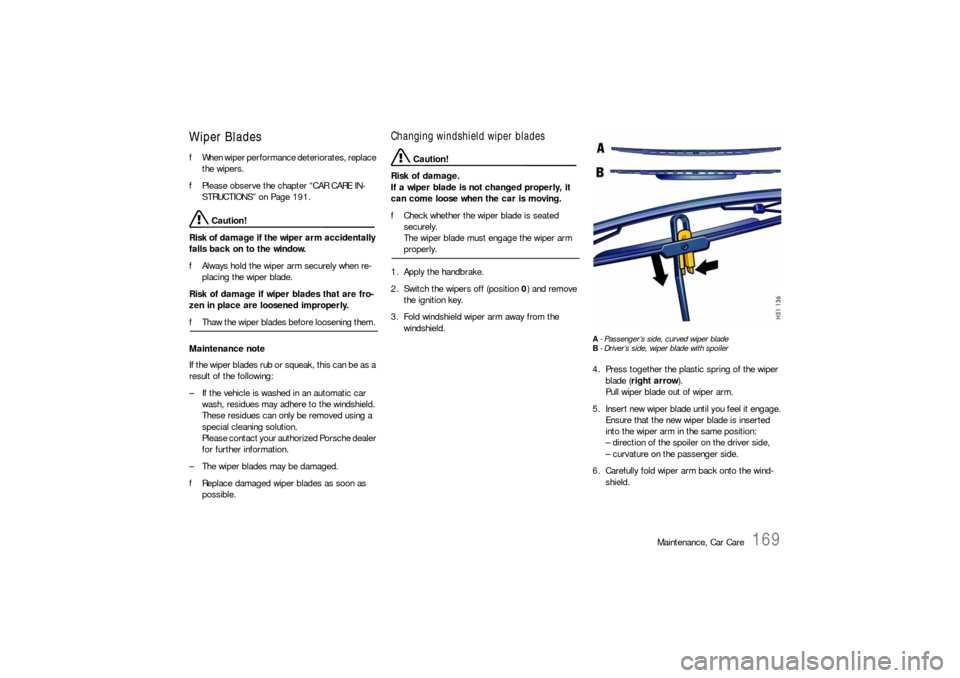
A- Passenger’s side, curved wiper blade
B- Driver’s side, wiper blade with spoiler4. Press together the plastic spring of the wiper
blade (right arrow).
Pull wiper blade out of wiper arm.
5. Insert new wiper blade until you feel it engage.
Ensure that the new wiper blade is inserted
into the wiper arm in the same position:
– direction of the spoiler on the driver side,
– curvature on the passenger side.
6. Carefully fold wiper arm back onto the wind-
shield.
Page 172 of 276

172
Maintenance, Car Care
Engine Oil Engine oil consumption
It is normal for your engine to consume oil.
The rate of oil consumption depends on the quality
and viscosity of oil, the speed at which the engine
is operated, the climate, road conditions as well
as the amount of dilution and oxidation of the lub-
ricant.
If the vehicle is used for repeated short trips, and
consumes a normal amount of oil, the engine oil
measurement may not show any drop in the oil le-
vel at all, even after 600 miles (1000 km) or more.
This is because the oil is gradually becoming dilut-
ed with fuel or moisture, making it appear that the
oil level has not changed.
The diluting ingredients evaporate out when the
vehicle is driven at high speeds, as on an express-
way, making it then appear that oil is excessively
consumed after driving at high speeds.
If the conditions you drive your vehicle in are dus-
ty, humid, or hot, the frequency of the oil change
intervals should be greater. If the vehicle is driven at a high rate of speed, cli-
matic conditions are warm, and the load is high,
the oil should be checked more frequently, as dri-
ving conditions will determine the rate of oil con-
sumption.
– The engine in your vehicle depends on oil to lu-
bricate and cool all of its moving parts.
Therefore, the engine oil should be checked re-
gularly and kept at the required level.
– Make it a habit to have the engine oil level che-
cked with every fuel filling.
– The oil pressure warning light is not an oil level
indicator.
The oil pressure warning light indicates serious
engine damage may be occuring when lit, if en-
gine rpm is above idle speed.
Page 176 of 276

176
Maintenance, Car Care
Changing the brake fluid Brake fluid absorbs moisture from the air over ti-
me. This accumulation of water lowers the boiling
point and, under certain operating con ditions,
can affect the braking action.
Therefore have the brake fluid changed in accor-
dance with the change intervals stated in the bro-
chure “Maintenance”. The brake-fluid warning lights in the instrument pa-
nel and on-board computer indicate:
– brake-fluid level too low,
– in conjunction with large pedal travel, braking-
circuit failure.
If the warning lights should light up while
driving:
fStop immediately in a suitable place.
fDo not continue driving.
Please have the fault remedied at your nearest
authorized Porsche dealer.
Warning light USA
Warning light Canada
Page 190 of 276

190
Maintenance, Car Care
Air Filter The air filter is on the left-hand side of the engine
compartment.
A dirty air filter not only reduces engine perfor-
mance, but can lead to premature engine wear.
Regular filter replacement is part of the routine
maintenance service.
fIn dusty conditions, check the filter element
more frequently and replace if necessary. Combination filterThe fresh air passing through the combination
filter into the passenger compartment is virtually
free of dust, pollen, and unpleasant odours.
fIf the outside air is polluted by exhaust fumes,
press the circulating-air button.
A dirty filter can be the cause of reduced air
throughput:
fHave the filter replaced by an authorized
Porsche dealer.
Regular filter replacement is part of servicing.
Automatic Transmission Fluid The torque converter and the transmission are lu-
bricated with Automatic Transmission Fluid (ATF).
The final drive requires transmission oil.
fPlease observe the chapter “CAPACITIES” on
Page 266.
Do not tow the car or run the engine without ATF
in the transmission. The automatic transmission
may be damaged by even a tiny speck of dirt, only
a clean funnel or spout must be used when adding
AT F.
The ATF and transmission oil has to be checked
and changed at the intervals listed in your Mainte-
nance Schedule.
We recommend that you have the ATF and trans-
mission oil changed at your Porsche dealer, who
has the required lubricants and the necessary fil-
ling equipment.
If you suspect an oil leak in the transmission, have
your authorized Porsche dealer check it out imme-
diately.
Manual Transmission Oil The transmission oil has to be checked and chan-
ged at the intervals listed in your Maintenance
Schedule.
fPlease observe the chapter “CAPACITIES” on
Page 266.
We recommend that you have the transmission oil
changed at your Porsche dealer, who has the re-
quired lubricants and the necessary filling equip-
ment.
If you suspect an oil leak in the transmission, have
your authorized Porsche dealer check it out imme-
diately.
Page 195 of 276

Maintenance, Car Care
195
Paint fNever rub a dusty car with a dry cloth since
dust particles are abrasive and could dull and
damage the surface finish.
The paintwork of your car is exposed to all types
of mechanical and chemical conditions, particular-
ly climatic ones such as bright sunlight, rain, frost
and snow. Ultraviolet light, rapid changes in tem-
perature, rain, snow, industrial dust and chemical
deposits constantly attack the paint which is only
able to withstand such exposure in the long term
if it is given regular care and attention.
fDo not apply silicone polishes to the winds-
hield, windows or convertible top.
fDo not treat matt-painted components with
preservatives or polishes as this will spoil the
matte effect. Preservation
The paint surface becomes dull over time due to
weathering. It is therefore necessary to preserve
the paint regularly.
This keeps the paint shiny and elastic. Dirt is pre-
vented from adhering to the paint surface and in-
dustrial dust is prevented from penetrating the
paint.
Provided it is washed and treated with preservati-
ve regularly, the brand new finish of your car will
be retained for years to come.
fApply the Porsche paint preservative after the
car wash and polish it dry to obtain a bright fi-
nish or simply add a liquid preservative regular-
ly to the final rinse water and rub down with a
leather chamois.
Polishing
Do not resort to using Porsche polish until it beco-
mes evident that the normal preservatives no lon-
ger produce the desired finish.
Spots and stains
fRemove tar stains, grease, oil spots and dead
insects as soon as possible with Insect Remo-
ver. They can cause discoloration if allowed to
remain on the paintwork.
fWash the affected area immediately after trea-
ting it. Minor paint damage
fHave minor paint damage, such as scratches,
scores or chips caused by flying stones, re-
paired immediately by your authorized
Porsche dealer before corrosion sets in.
However, if there are already traces of corrosion,
they must first be removed carefully and tho-
roughly. Coat the area with a rust-proofing primer
and finish off with a top coat. The paint code and
color number are found on the vehicle’s tire pres-
sure plate.
Page 200 of 276

200
Maintenance, Car Care
Storing your Porsche If you intend to store your Porsche for a prolonged
period, please consult your authorized Porsche
dealer. The staff will be glad to advise you on the
most suitable and necessary methods.
fClean your vehicle thoroughly inside and out-
side.
Clean the engine compartment.
The under carriage and chassis components
should be free of dirt and salt deposits.
fFill up the fuel tank.
fChange the oil and oil filter, and run the engine
for several minutes.
fIncrease the tire pressure to 58 psi (4 bar).
It is not recommended to lift the vehicle, due to
the possibility of corrosion on shock absorber
piston shafts.
The vehicle should be moved slightly, approxi-
mately every four weeks, to prevent flat spot
on the tires. Climate control
The air conditioning system should be in good wor-
king condition and fully charged.
Windshield/Headlight washer
fCheck and correct antifreeze/cleaning solution
level as necessary.
Electrical system
fRemove the battery from the vehicle and store
it in a cool dry place, not on a cement floor.
When the battery is disconnected, the
alarm system is deactivated.
fRecharge the battery every 3 months. If the
battery remains in the vehicle with the cables
connected, it is necessary to check, remove
and recharge the battery every 2-3 weeks.
Do not fast charge the battery.
fPlease observe the chapter “BULB CHART” on
Page 239. Vehicle interior
The interior must be dry, especially in the area of
the floor carpets. The use of drying agents (Silica-
Gel) is recommended in vehicles with leather inte-
rior and in areas with high humidity. The recom-
mended amount is 3 fabric bags of 1.1 lbs. (500
grams) each placed on the floor carpets.
Windows, doors, lids and top must be closed. The
air vents should be opened.
Page 210 of 276

210
Practical Tips, Emergency Service
Tire replacements If in doubt, contact your Porsche dealer.
Use only tire makes and types approved by
Porsche.
If you do not use a Porsche recommended
replacement tire, make sure that you
purchase your new tires from a reputable tire
dealer and that the dealer complies with all
manufacturers warnings for those tires.
Only tires with the same make and with the
same specification code (e.g. “N0”, “N1”...)
can be mounted.
Before mounting new tires, check with your
Porsche dealer about the current release
status.
Use tires with “ZR” quality standards. There
are currently no standards concerning tire
strength at speeds above 150 mph (240 km/h).
Tires should be replaced no less than on one axle
at the time.
Only tires of the same make and type must be
used. Mixed tires are not permissible.
Initially, new tires do not have their full traction.
You should therefore drive at moderate speeds
during the first 60 - 120 miles (100 - 200 km). If new tires are installed only on one axle, a notice-
able change in handling occurs due to the different
tread depth of the other tires.
This happens especially if only rear tires are re-
placed. However, this condition disappears as the
new tires are broken in.
fPlease adjust your driving style accordingly.
Installation of new tires should only be done by a
qualified tire technician.
Valves
Rubber valve stems must be replaced every time
a tire is replaced.
For metal valves, the installation and replacement
instructions must be observed.
fUse only genuine Porsche metal valves.
fProtect the valve inserts against soiling with
valve caps.
Soiled valve inserts can cause a gradual loss
of air.
fUse only plastic valve caps.
Parking at the curb
Warning!
Hard impacts against curbs (or traffic
islands) are dangerous and may cause hid-
den tire damage which is not noticeable until
later. Such damage can result in accidents at
high speeds causing severe personal injury.
Depending on the force of impact, the edge
of the rim can also be damaged.
fIf you are in doubt, have the wheel checked by
an expert, particularly if you suspect damage
on the inside.
fIf you must drive over a curb or other obstacle,
drive slowly and at an obtuse angle. Exercise care when parking along curbs.