lock PORSCHE BOXSTER 2005 2.G Service Manual
[x] Cancel search | Manufacturer: PORSCHE, Model Year: 2005, Model line: BOXSTER, Model: PORSCHE BOXSTER 2005 2.GPages: 276, PDF Size: 4.05 MB
Page 125 of 276

Controls, Instruments
125
A - Orientation light
B - Interior light switch, footwell lightInterior lightsfPlease observe the chapter “LOAD SWITCH-
OFF AFTER 2 HOURS OR 7 DAYS” on Page
226.
Interior light, footwell lightsSwitching off
fPress left half of switch.
Switching to continuous illumination
fPress right half of switch.
Switching on and off automatically
fMove switch to center position.
The lights are switched on when a door is unlo-
cked or opened or when the ignition key is with-
drawn from the ignition lock.
The lights are switched off with a delay of ap-
prox. 30 seconds after the door is closed.
The lights go out immediately as soon as the igni-
tion key is inserted in the ignition lock or the vehic-
le is locked.
Orientation lightThe light-emitting diode in the interior light impro-
ves your orientation inside the vehicle when it is
dark.
fPlease observe the chapter “Individual Memo-
ry” in the separate PCM operating instructions.
Page 127 of 276
Controls, Instruments
127
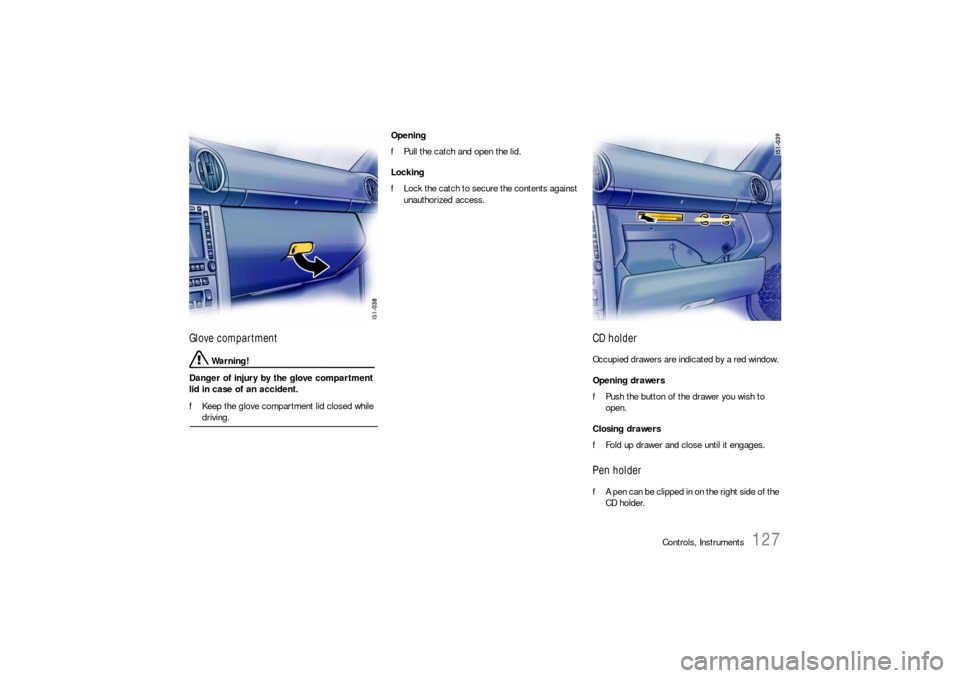
Glove compartment
Warning!
Danger of injury by the glove compartment
lid in case of an accident.
fKeep the glove compartment lid closed while driving. Opening
fPull the catch and open the lid.
Locking
fLock the catch to secure the contents against
unauthorized access.
CD holderOccupied drawers are indicated by a red window.
Opening drawers
fPush the button of the drawer you wish to
open.
Closing drawers
fFold up drawer and close until it engages. Pen holderfA pen can be clipped in on the right side of the
CD holder.
Page 132 of 276

132
Controls, Instruments
Front luggage compartment Trunk Entrapment Your vehicle is equipped with an internal front/rear
trunk release mechanism.
A person trapped in the luggage compartment
can release the lid from the inside using unlocking
handle A.
The handle A is fluorescent and glows in the dark.
Rear luggage compartment A warning message in the on-board computer
lights up when unlocking handle A is operated.
fStop the vehicle immediately when the warning
message lights up.
fCheck the luggage compartment.
fClose the lid.
Front luggage compartment lid Function with vehicle stationary
If the luggage compartment lid is unlocked with
unlocking handle A, the lid can be opened from the
inside immediately.
Function with vehicle in motion
If the luggage compartment lid is unlocked with
unlocking handle A when a speed of 3 km/h
(2
mph) is exceeded, the warning message in the
on-board computer
lights up.
At the same time, the lid is unlocked and the latch
striker pops into the catch-hook position. The lid
lock is fully released as soon as the car slows to
less than 2 mph (3 km/h), and the trapped person
can open the lid immediately.
Warning message
Page 133 of 276

Controls, Instruments
133
Danger!
Risk of accident.
If the warning message in the on-board com-
puter lights up when the vehicle is in motion,
the lid may impact in front of the windshield
and can tear off.
You can lose control of the vehicle.
fStop the vehicle immediately when the warning
message lights up.
fCheck the luggage compartment.
fClose the lid. Rear luggage compartment lid If the rear luggage compartment lid is unlocked
with unlocking handle A, the lid opens immediate-
ly.
fStop the vehicle immediately when the warning
message lights up.
fCheck the luggage compartment.
fClose the lid. Note
The front lid cannot be opened from the inside if
the battery is disconnected or empty.
Safety reasons therefore require that you un-
screw the latch striker of the front lid lock if
you plan to put the vehicle out of operation
for an extended period.
Please consult your authorized Porsche dealer.
They will advise you about the necessary measu-
res. Note
fWhen loading the luggage compartment, make
sure that items of luggage or other objects
cannot become caught on handle A.
This could cause the luggage compartment to
open unintentionally.
Page 134 of 276

134
Controls, Instruments
A - Opening front luggage compartment lid
B - Opening rear luggage compartment lid Luggage compartment lidsUnlocking fOperate the appropriate pull-button next to the
driver’s seat.
The luggage compartment is illuminated when
the respective lid is open.
fPlease observe the chapter “LOAD SWITCH-
OFF AFTER 2 HOURS OR 7 DAYS” on Page
226.The luggage compartment lid can also be un-
locked with the radio remote control.
fPlease observe the chapter “KEYS” on Page
17.
Important Note
If the vehicle battery is discharged, the front lug-
gage compartment lid can be opened only by con-
necting an external electrical power source.
fPlease observe the chapter “ELECTRICAL SYS-
TEM” on Page 226.
or the description inside the fuse box lid.
A warning message in the on-board computer
comes on if the lids are not completely closed.
fFully close the lid.
Warning message
Page 135 of 276

Controls, Instruments
135
Opening front luggage compartment lid
Caution!
Risk of damage to luggage compartment lid
or windshield wipers.
fMake sure that the windshield wipers are not
folded out forwards when opening the luggage compartment lid.
fRaise lid slightly and unlatch the safety catch
with the lever (arrow).
Closing front and rear luggage
compartment lid fLower the lid and close it.
fPush the lid closed with the palm of your hand
in the area of the lock.
Check that the lid has correctly engaged in the
lock.
Warning!
Risk of loss of control or an accident, result-
ing in serious personal injury or death.
fShould you notice at any time while driving that
one of the lids is not secured properly, please
stop immediately in a suitable place and close
it. The front lid may fly up impairing vision.
Page 136 of 276
136
Controls, Instruments
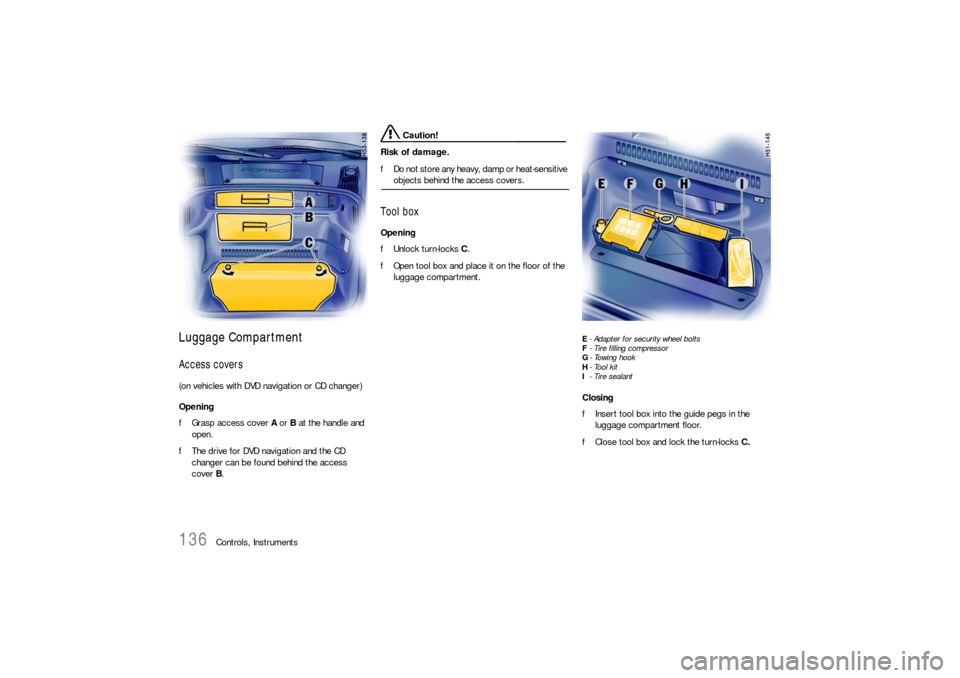
Luggage Compartment Access covers(on vehicles with DVD navigation or CD changer)
Opening
fGrasp access cover A or B at the handle and
open.
fThe drive for DVD navigation and the CD
changer can be found behind the access
cover B.
Caution!
Risk of damage.
fDo not store any heavy, damp or heat-sensitive objects behind the access covers.
Tool boxOpening
fUnlock turn-locks C.
fOpen tool box and place it on the floor of the
luggage compartment.
E- Adapter for security wheel bolts
F- Tire filling compressor
G-Towing hook
H-Tool kit
I-Tire sealantClosing
fInsert tool box into the guide pegs in the
luggage compartment floor.
fClose tool box and lock the turn-locks C.
Page 139 of 276

Controls, Instruments
139
Car Audio Operation/Tips For radio operation see your radio manual
which is included with your on-board
literature.
fPlease observe the chapter “LOAD SWITCH-
OFF AFTER 2 HOURS OR 7 DAYS” on Page
226. FM reception A vehicle is not an ideal place to listen to a radio.
Because the vehicle moves, reception conditions
are constantly changing.
Buildings, terrain, signal distance and noise from
other vehicles are all working against good recep-
tion.
Some conditions affecting FM may appear to be
problems when they are not.
The following characteristics are completely nor-
mal for a given reception area, and they do not in-
dicate any problem with the radio itself.
Note
Electronic accessories should only be installed by
your authorized Porsche dealer.
Equipment which has not been tested and appro-
ved by Porsche may impair radio reception. Fading and drifting
FM range is limited to about 25 miles (40 km), ex-
cept for some high power stations.
If a vehicle is moving away from the desired stati-
on’s transmitter, the signal will tend to fade and/or
drift. This condition is more prevalent with FM than
AM, and is often accompanied by distortion.
Fading and drifting can be minimized to a certain
degree by careful attention to fine tuning or selec-
tion of a stronger signal.
Static and fluttering
When the line-of-sight link between a transmitter
and vehicle is blocked by large buildings or moun-
tains, the radio sound may be accompanied with
static or fluttering because of the characteristic of
FM.
In a similar effect, a fluttering noise is sometimes
heard when driving along a tree-lined road.
This static and fluttering can be reduced by adjus-
ting the tone control for greater bass response un-
til the disturbance has passed. Multipath
Because of the reflecting characteristics of FM, di-
rect and reflected signals may reach the antenna
at the same time (multipath) and cancel each other
out.
As a vehicle moves through these electronic dead
spots, the listener may hear a momentary flutter
or loss of reception.
Station swapping
When two FM stations are close to each other, and
an electronic dead spot, such as static or multi-
path area, interrupts the original signal, someti-
mes the stronger second signal will be selected
automatically until the original one returns.
This swapping can also occur as you drive away
from the selected station and approach another
station of a stronger signal.
Page 147 of 276

Shifting Gear
147
Tiptronic SThe Porsche Tiptronic is a five-speed transmission
with an “automatic” and a “manual” selection
mode.
In automatic selection mode (selector lever po-
sition D), gear changing is automatic.
You can change temporarily from automatic to
manual mode using the rocker switches on the
steering wheel.
In manual selection mode (selector lever posi-
tion M), you change gear using the rocker switch-
es on the steering wheel.
You can change between selector lever position D
and M as you wish while driving.
Note
Take care not to operate the rocker switches on
the steering wheel inadvertently in either auto mat-
ic or manual mode, thereby triggering undesired
gear changes.Keylock positionThe ignition key can be withdrawn only in selec-
tor lever position P.
Changing the selector lever positionThe selector lever is locked with the ignition key
withdrawn.
The selector lever can be moved from position P
or N only with:
– the ignition switched on,
– the brake pedal pressed and
– the release button pressed.Release button
The release button (arrow) in the selector lever
prevents unintentional gear changes.
The release button must be pressed when shifting
to position R or P.
StartingThe engine can be started only if the brake pedal
is depressed and the selector lever is in position
P or N.Moving offfOnly select the desired position for moving off
(D, M or R) when the engine is idling and the
brake pedal is depressed.
fSince the vehicle creeps when in gear, do not
release the brake until you want to move off.
fAfter selecting a gear, do not accelerate until
you can feel that the gear is engaged.
Page 149 of 276

Shifting Gear
149
Selector Lever Positions P – Parking lock fSelect only when car has been stopped.
fEngage parking lock after applying the hand-
brake and release it before releasing the hand-
brake.
The ignition key can be withdrawn only in
selector lever position P. R – Reverse fSelect only when car has been stopped and
the brake is applied. N – Neutral Selector lever position N must be selected for to-
wing or in car washes, for example.
fSelect the desired position for moving off (D,
M or R) only when the engine is idling and while
depressing the brake pedal.
fSelect position N while driving only if the car
is threatening to skid in slippery conditions.
Otherwise N should not be selected when dri-
ving.
D – Automatic selection mode fSelect position D for “normal” driving. The ge-
ars are shifted automatically according to the
accelerator position and speed.
Depending on the way the vehicle is driven and on
the resistance (e.g. uphill), the gear-changing
points are shifted towards higher or lower engine-
speed ranges.
The accelerator position, driving speed, engine
speed, longitudinal and lateral acceleration and
the road profile all have an influence on the gear-
changing characteristic.
Unwanted upward shifts, e.g. before bends, are
prevented by swiftly releasing the accelerator pe-
dal.
Depending on lateral acceleration, upward shifts
on bends are not made until the engine-speed limit
is reached.
Under braking, and depending on the amount of
deceleration, the Tiptronic shifts down earlier.
For subsequent cornering, the right gear is enga-
ged when pressure is applied to the brakes before
the bend.
The bend is taken in the right gear, and when you
accelerate out of the bend you do not have to shift
down. Driving off
In 2nd gear, the vehicle drives off with the throttle
only slightly open.
Drive off in 1st gear with the throttle open wider
or when the engine is cold.