ABS PORSCHE BOXSTER 2005 2.G Owners Manual
[x] Cancel search | Manufacturer: PORSCHE, Model Year: 2005, Model line: BOXSTER, Model: PORSCHE BOXSTER 2005 2.GPages: 276, PDF Size: 4.05 MB
Page 11 of 276

Controls, Instruments
11 Controls, Instruments
Before driving off .......................................... 12
Break in hints for the first
2,000 miles/3,000 kilometers ...................... 14
Keys ........................................................... 17
Security Wheel Bolts .................................... 17
Central Locking in Cars
without Alarm System................................... 19
Doors ......................................................... 25
Alarm System,
Passenger Compartment Monitoring ............. 26
Power Windows ........................................... 28
Inside mirror ................................................ 30
Automatic Anti-Glare
Interior Mirror and Door Mirrors .................... 30
Door Mirrors................................................ 31
Seat Adjustment .......................................... 34
Seat Memory ............................................... 36
Heated Seats .............................................. 38
Steering Wheel Adjustment ........................... 39
Multi-functional steering wheel....................... 40
Sun Visors................................................... 41
Safety Belts................................................. 42
Child Restraint Systems................................ 45
Key-operated airbag deactivation device ........ 46
LATCH System
Child seat bracket on the passenger’s seat .... 47
Key-operated airbag deactivation device ........ 48
Airbag Systems ........................................... 49
Clutch Pedal ................................................ 51
Parking Brake .............................................. 51
Brakes ........................................................ 52ABS Brake System
(Antilock Brake System) ................................ 55
Sport Mode ................................................. 57
Porsche Stability Management (PSM)............. 58
Porsche Active Suspension Management
(PASM) ........................................................ 61
Retractable Spoiler ...................................... 62
Parking Aids ................................................ 64
Ignition/Starter Switch with anti-theft Steering
Lock ........................................................... 67
Starting Procedures ..................................... 69
Stopping engine........................................... 70
Instrument Panel USA Models ....................... 73
Automatic Speed Control Indicator light ......... 76
Instrument Illumination.................................. 76
Trip Odometer ............................................. 77
Speedometer .............................................. 78
Changing over between
Miles / Kilometers........................................ 78
Tachometer ................................................. 79
Turn Signal Indicator Light ............................ 79
High Beam .................................................. 79
Cooling System ........................................... 80
Tiptronic ...................................................... 81
Fuel ............................................................ 82
Clock .......................................................... 83
Outside temperature .................................... 83
Check Engine Warning Light.......................... 84
Central warning light .................................... 85
Brake warning light USA ............................... 85
Brake warning light Canada .......................... 85On-Board Computer (BC)............................... 86
Light Switch .............................................. 108
Welcome Home Lighting............................. 108
Automatic Headlight Beam Adjustment......... 109
Turn Signal/ Headlight Dimmer/Parking light /
Flasher Lever............................................. 109
Windshield Wiper / Washer Lever ................ 110
Automatic Speed Control ............................ 112
Air conditioning .......................................... 114
Automatic air conditioning system ............... 117
Central and side vents................................ 120
Fresh-air intake .......................................... 120
Emergency Flasher Switch .......................... 121
Ashtray ..................................................... 122
Cigarette Lighter ........................................ 123
Sockets .................................................... 124
Interior lights ............................................. 125
Storage in the passenger compartment ....... 126
Cupholder
(holder for drinks cans and cups) ................ 128
Luggage Storage on
Engine Compartment Lid ............................. 130
Fire extinguisher ........................................ 131
Trunk Entrapment ...................................... 132
Luggage compartment lids ......................... 134
Luggage Compartment.............................. 136
Rear luggage compartment ........................ 137
Porsche Communication Management
(PCM) ........................................................ 138
Car Audio Operation/Tips ........................... 139
HomeLink .................................................. 142
Page 55 of 276

Controls, Instruments
55
ABS Brake System
(Antilock Brake System) The ABS system represents a major contribution
to the enhancement of active safety in your vehic-
le. This system prevents the wheels from locking
in a panic stop on almost all road surfaces. With the ABS system in your vehicle, the fol-
lowing areas are enhanced:
Steering, vehicle remains steerable under all bra-
king forces when ABS is engaged.
Good directional control, no swerving caused
by locking of wheels under braking conditions.
Shorter stopping distance, stopping distances
are usually reduced because controlled braking is
maximized.
Prevention of wheel lock up, no brake- induced
sliding and thus no localized tire wear from emer-
gency braking.
The crucial advantage of the ABS system over a
conventional brake system is in the area of
maintaining directional control and maneuverabili-
ty of the car in emergency situations during nor-
mal driving, including panic braking in turns.
Warning!
The increased control that is provided should
not induce you to take greater risks with your
safety. The limits dictated by the laws of phy-
sics cannot be overcome, even with ABS.
The risk of accidents due to inappropriate
speed cannot be reduced, even by the ABS.
The driver bears the responsibility for all dri-
ving maneuvers.
fAdapt your driving style to the prevailing road
and weather conditions.
fObey all traffic laws.
Other vehicles not equipped with the ABS
system may not be able to maintain control,
especially on wet or poor road surfaces and
thus may be more likely to impact you from
behind.
fTo minimize that risk, use your ABS system to
increase your ability to maneuver to avoid dan-
gerous situations and not merely to try to stop in the shortest distance possible.
Page 56 of 276

56
Controls, Instruments
Operation of the ABS system A wheel speed sensor is mounted to each of the
four wheels. If wheel lock-up of either of the front
wheels or the rear wheels is sensed during bra-
king, the brake pressure is adjusted automatically
until the wheel no longer slips. The brake pressure
is regulated for each front wheel individually and
for both of the rear wheels together.
On a road surface which is slippery on only one si-
de, the rear wheel which is braking on the slippery
surface determines the brake pressure which will
be applied equally to both rear wheels. This ensu-
res that directional stability is maintained. Howe-
ver, if braking forces approach the wheel lock-up
point for all wheels (panic braking) the ABS system
will intervene to provide a rapid rythmic braking.
The proper operation of ABS is perceived by the
driver as a pulsating brake pedal in conjunction
with audible noise and perhaps some vibration.
fIf you experience these sensations while dri-
ving or a road surface with questionable trac-
tion, reduce vehicle speed appropriate for the
prevailing road conditions.
The functional readiness of all the main electrical
components of the ABS is checked by an electro-
nic monitoring system both before and while you
drive. When the ignition is switched on the ABS warning
light will light up while the system is electronically
interrogated and goes out when the engine is star-
ted if the check is not yet complete.
If the ABS warning lamp fails to go out, this indica-
tes that ABS has been deactivated due to a fault.
If the warning lights in the instrument panel and on-
board computer light up while you are driving, this
indicates that a fault has occurred. In both cases,
normal braking, as in vehicles without ABS, is still
retained.
The ABS system should, however, be examined at
an authorized Porsche dealer immediately to pre-
vent the occurrence of further faults.
fIf the ABS system becomes inoperative, take
your vehicle to your authorized Porsche dealer
immediately.
Warning!
The control unit of the ABS brake system is
set for standard tire size. If non-standard ti-
res are installed, the control unit may misin-
terpret the speed of the vehicle, because of
the variant data it receives from the sensors
on the axles.
fUse only tire makes and types tested by Porsche.
Warning light USA
Warning light Canada
Page 59 of 276
Controls, Instruments
59
Examples of PSM control operations
– If the “front wheels of the vehicle drift” on a
bend, the rear wheel on the inside of the bend
is braked and the engine power is reduced if
necessary.
– If the rear of the vehicle swings out on a bend,
the front wheel on the outside of the bend is
braked.
PSM should always be switched on during
“normal” driving.
However, it may be advantageous to switch off
PSM temporarily in exceptional situations, for
example:
– On a loose surface or in deep snow,
– When “rocking the vehicle free”, or
– When using snow chains.
Tiptronic vehicles
When the PSM is switched off the slip monitoring
function of the Tiptronic is also deactivated.
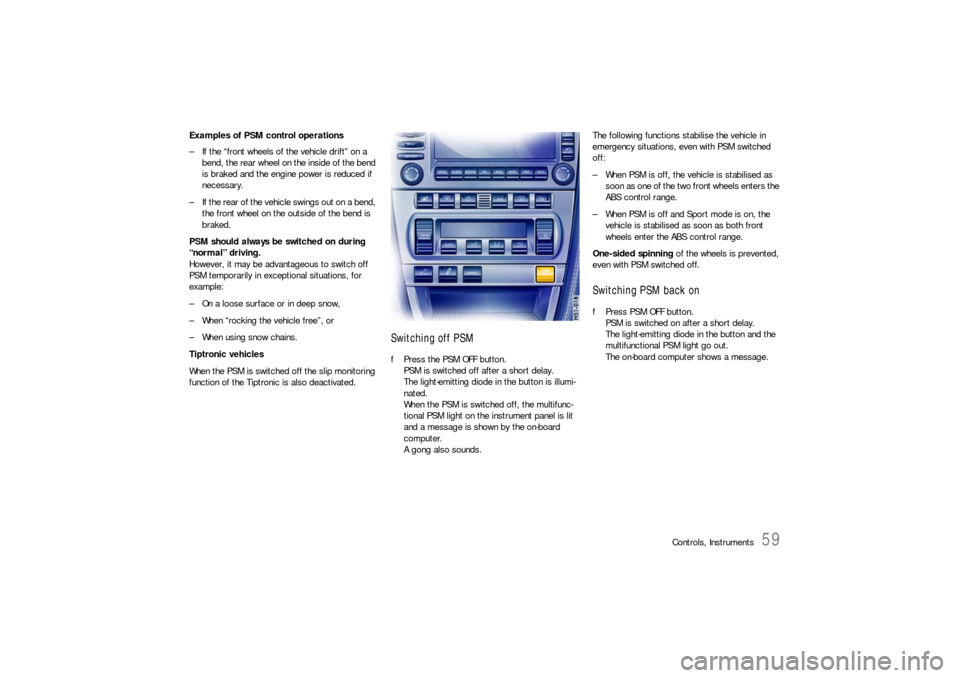
Switching off PSMfPress the PSM OFF button.
PSM is switched off after a short delay.
The light-emitting diode in the button is illumi-
nated.
When the PSM is switched off, the multifunc-
tional PSM light on the instrument panel is lit
and a message is shown by the on-board
computer.
A gong also sounds.The following functions stabilise the vehicle in
emergency situations, even with PSM switched
off:
– When PSM is off, the vehicle is stabilised as
soon as one of the two front wheels enters the
ABS control range.
– When PSM is off and Sport mode is on, the
vehicle is stabilised as soon as both front
wheels enter the ABS control range.
One-sided spinning of the wheels is prevented,
even with PSM switched off.
Switching PSM back onfPress PSM OFF button.
PSM is switched on after a short delay.
The light-emitting diode in the button and the
multifunctional PSM light go out.
The on-board computer shows a message.
Page 61 of 276
Controls, Instruments
61
The previously selected PASM mode is always
activated after the engine is started.
There is no automatic return to Normal mode after
the ignition is switched off.
PASM makes two running-gear setups available to
the driver: “Normal” and “Sport”.
The selection is made via a button on the center
console.
In Normal mode the running gear is in a sporty and
comfortable setup.
Sport mode offers a markedly sporty shock
absorber tuning (e.g. for driving on the race
circuit).
The variable suspension system selects the appro-
priate damping level for each wheel according to
the situation and conditions of driving.
Example:
If the vehicle is driven in a markedly sporty manner
in Normal mode, PASM automatically adapts the
shock-absorber behavior to the driving situation in
this case as well.
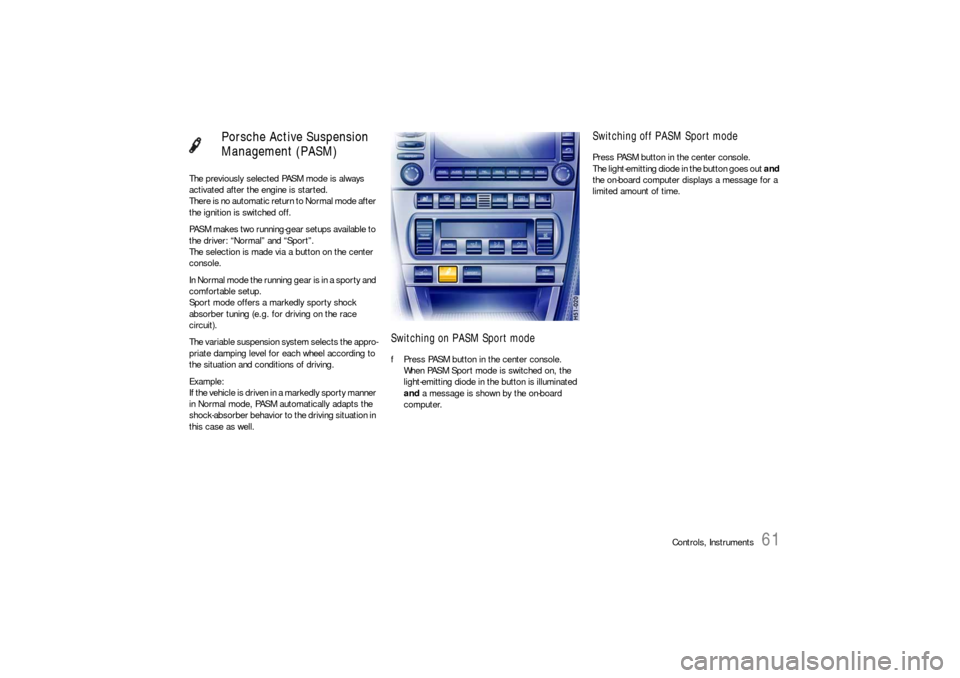
Switching on PASM Sport modefPress PASM button in the center console.
When PASM Sport mode is switched on, the
light-emitting diode in the button is illuminated
and a message is shown by the on-board
computer.
Switching off PASM Sport modePress PASM button in the center console.
The light-emitting diode in the button goes out and
the on-board computer displays a message for a
limited amount of time.
Porsche Active Suspension
Management (PASM)
Page 65 of 276
Controls, Instruments
65
Limits of ultrasonic measurement
The parking assistant system cannot detect:
– sound-absorbing obstacles (e.g. powder
snow),
– sound-reflecting obstacles (e.g. glass sur-
faces, flat painted surfaces)
– and very thin obstacles.
Other ultrasound sources (e.g. pneumatic brakes
of other vehicles, jackhammers) can interfere with
detection of obstacles.
Fault indication
The parking assistant system indicates a fault in
two ways:
– After reverse gear has been selected, the
short signal tone is followed by a continuous
tone of the same pitch:
This indicates that sensors are soiled or cove-
red with ice.
– After reverse gear has been selected, the
short signal tone is followed by a continuous
tone with a much lower pitch:
This indicates a general system fault. Please
have the fault remedied at an authorized
Porsche dealer.
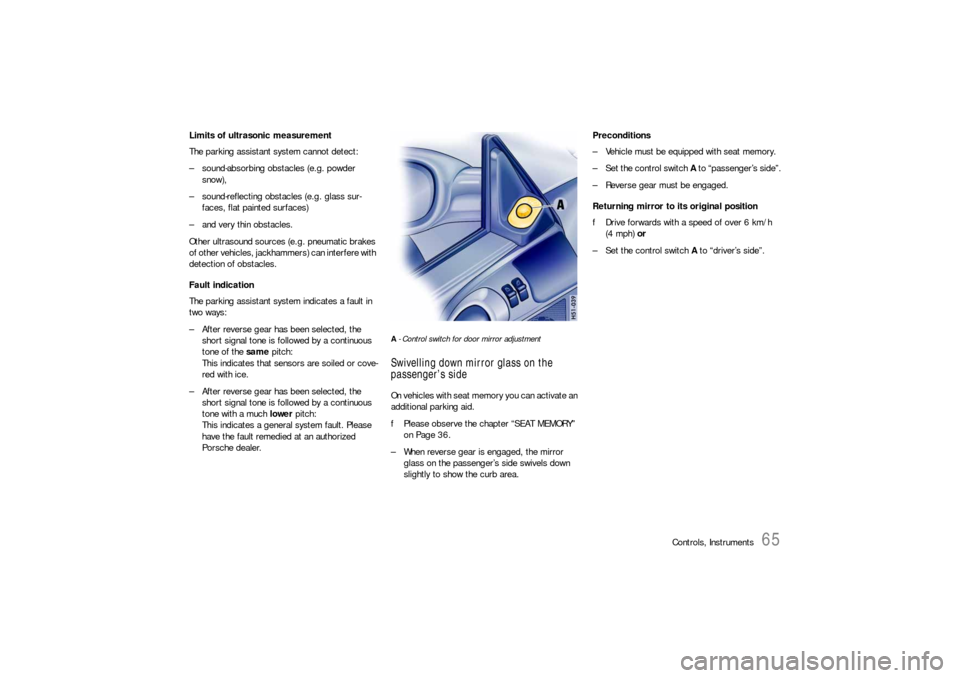
A - Control switch for door mirror adjustment Swivelling down mirror glass on the
passenger’s side On vehicles with seat memory you can activate an
additional parking aid.
fPlease observe the chapter “SEAT MEMORY”
on Page 36.
– When reverse gear is engaged, the mirror
glass on the passenger’s side swivels down
slightly to show the curb area. Preconditions
– Vehicle must be equipped with seat memory.
– Set the control switch A to “passenger’s side”.
– Reverse gear must be engaged.
Returning mirror to its original position
fDrive forwards with a speed of over 6 km/h
(4 mph) or
– Set the control switch A to “driver’s side”.
Page 73 of 276

Controls, Instruments
73
Instrument Panel USA Models Also refer to the corresponding chapter in
the Owner’s Manual.
1 Speedometer with analogue display
2 Turn signal indicator light, left
3 Tachometer
4 High beam indicator light
5 Turn signal indicator light, right
6 ABS warning light
7 Cooling system
Temperature gauge, warning light
8Fuel
Level gauge, warning light
9 Adjusting button for instrument illumination
and trip counter
10 Odometer and daily trip mileage display
11 Automatic speed control indicator light
12 Light sensor for instrument illumination13 Airbag warning light
14 Emission control warning light (Check Engine)
15 Central warning light
16 On-board computer display
17 Porsche Stability Management
Multifunctional PSM light
18 Brake warning light
19 Safety belt warning light
20 Tiptronic indicator
21 Clock and outside temperature display
22 Adjustment button for clockWhen the ignition is switched on, the warning
lights light up for a lamp check.
Note
Warnings that have been given are stored in the
appropriate control unit memory and can be read
out at an authorized Porsche dealer.
This information can help to warn you about situa-
tions which may be hazardous to you or your car.
Page 75 of 276

Controls, Instruments
75
Instrument Panel Canada Models Also refer to the corresponding chapter in
the Owner’s Manual.
1 Speedometer with analogue display
2 Turn signal indicator light, left
3 Tachometer
4 High beam indicator light
5 Turn signal indicator light, right
6 ABS warning light
7 Cooling system
Temperature gauge, warning light
8Fuel
Level gauge, warning light
9 Adjusting button for instrument illumination
and trip counter
10 Odometer and daily trip mileage display
11 Automatic speed control indicator light
12 Light sensor for instrument illumination13 Airbag warning light
14 Emission control warning light (Check Engine)
15 Central warning light
16 On-board computer display
17 Porsche Stability Management
Multifunctional PSM light
18 Brake warning light
19 Safety belt warning light
20 Tiptronic indicator
21 Clock and outside temperature display
22 Adjustment button for clockWhen the ignition is switched on, the warning
lights light up for a lamp check.
Note
Warnings that have been given are stored in the
appropriate control unit memory and can be read
out at an authorized Porsche dealer.
This information can help to warn you about situa-
tions which may be hazardous to you or your car.
Page 91 of 276
Controls, Instruments
91
TEL
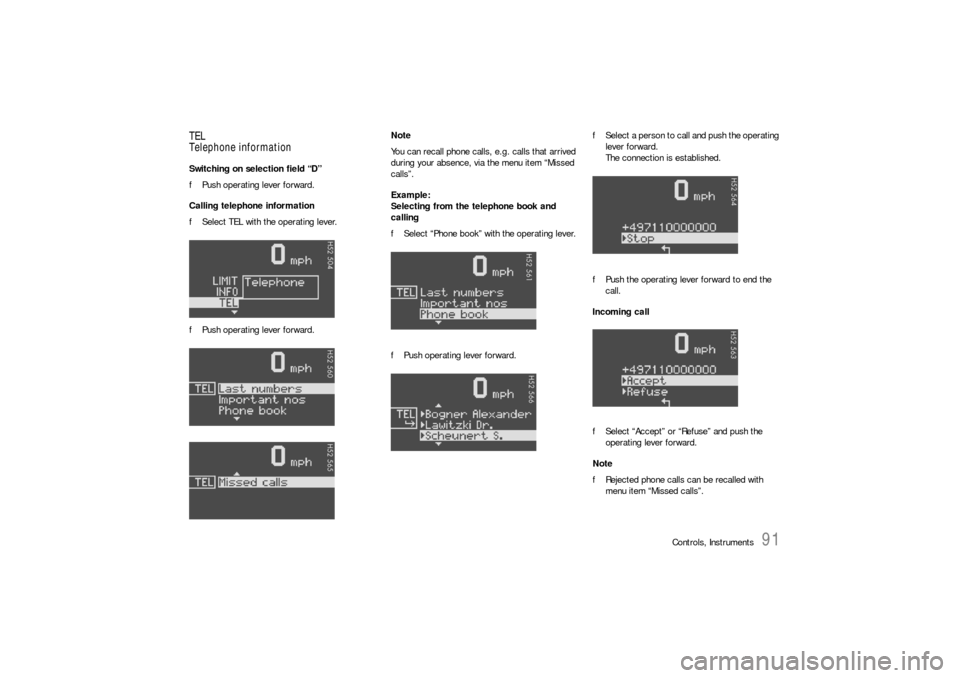
Telephone informationSwitching on selection field “D”
fPush operating lever forward.
Calling telephone information
fSelect TEL with the operating lever.
fPush operating lever forward.Note
You can recall phone calls, e.g. calls that arrived
during your absence, via the menu item “Missed
calls”.
Example:
Selecting from the telephone book and
calling
fSelect “Phone book” with the operating lever.
fPush operating lever forward.fSelect a person to call and push the operating
lever forward.
The connection is established.
fPush the operating lever forward to end the
call.
Incoming call
fSelect “Accept” or “Refuse” and push the
operating lever forward.
Note
fRejected phone calls can be recalled with
menu item “Missed calls”.
Page 105 of 276

Controls, Instruments
105
Indicator faulty Coolant indicator failed.
Have the fault remedied at an authorized
Porsche dealer.
Brake pad wear Have the brake pads changed immediately at an
authorized Porsche dealer.
Warning – Brake fluid level Stop immediately in a suitable place.
Do not continue driving. Have the fault remedied
at an authorized Porsche dealer.
Warning – Brake circuit division Stop immediately in a suitable place.
Do not continue driving. Have the fault remedied
at an authorized Porsche dealer.
ABS failure Have the fault remedied at an authorized
Porsche dealer.
PSM off Porsche Stability Management has been swit-
ched off.
PSM on Porsche Stability Management has been swit-
ched on.
PSM failure Have the fault remedied at an authorized
Porsche dealer.
PASM Normal/Sport Indicator for selected PASM mode
PASM failure Have the fault remedied at an authorized
Porsche dealer.
PASM indicator faulty Have the fault remedied at an authorized
Porsche dealer.
Sport mode failure Have the fault remedied at an authorized
Porsche dealer.
Instrument
panelOn-board
computerText display on on-board
computerMeaning/measure