instrument panel PORSCHE BOXSTER 2005 2.G Owners Manual
[x] Cancel search | Manufacturer: PORSCHE, Model Year: 2005, Model line: BOXSTER, Model: PORSCHE BOXSTER 2005 2.GPages: 276, PDF Size: 4.05 MB
Page 4 of 276

4Fuel Quality Your engine is designed to provide optimum performance and fuel economy using
unleaded premium fuel with an octane rating of 98 RON (93 CLC or AKI).
Porsche therefore recommends the use of these fuels in your vehicle.
Porsche also recognizes that these fuels may not always be available. Be assured that your vehicle will operate
properly on unleaded premium fuels with octane numbers of at least 95 RON (90 CLC or AKI),
since the engine’s “Electronic Oktane™ knock control” will adapt the ignition timing, if necessary. Fuels containing alcohol and ether Some areas of the U.S. require oxygenated fuels during certain portions of the year.
Oxygenated fuels are fuels which contain alcohols (such as methanol or ethanol) or ether (such as MTBE).
Under normal conditions, the amount of these compounds in the fuel will not affect driveability.
You may use oxygenated fuels in your Porsche, provided the octane requirements for your vehicle are met.
We recommend, however, to change to a different fuel or station if any of the following problems occur with your vehicle:
– Deterioration of driveability and performance.
– Substantially reduced fuel economy.
– Vapor lock and non-start problems, especially at high altitude or at high temperature.
– Engine malfunction or stalling. Fuels containing MMT Some North American fuels contain an octane enhancing additive called methylcyclopentadienyl manganese tricarbonyl (MMT).
If such fuels are used, your emission control system performance may be negatively affected.
The check engine warning lights on your instrument panel may turn on.
If this occurs, Porsche recommends you stop using fuels containing MMT.
Page 7 of 276

7
Environmentally friendly vehicles Modern environmental technology ensures compli-
ance with all emission laws applicable worldwide.
It has the following advantages:
– Rapid operational readiness of the catalytic
converters ensures low emissions, even in
short-trip operation.
– Reliable operation and good emission control
over a long useful life.
– Please observe the chapter “FUEL ECONOMY”
on Page 177.
Recycling – for a Porsche, this is virtually
an academic question More than two-thirds of all Porsches ever built are
still running.
Just in case recycling is ever necessary, we
take the following precautionary measures:
– Identification of all materials.
– Use of recyclable materials.
– Reusable components designed for simple
removal.
– These reasons result in a further increase in
the recycling rate which is currently 80 per
cent.
Emission control is built in Innovative engine technology combines high engi-
ne performance and environmental compatibility.
The engine diagnosis system electronically moni-
tors the components and systems that affect ex-
haust gases.
This continuous monitoring and fault storage en-
ables swift, reliable diagnosis and fault detection.
Any fault messages are indicated to the driver by
the “Check Engine” warning light and the on-board
computer.
fPlease observe the chapter “WARNINGS ON
THE INSTRUMENT PANEL AND THE ON-
BOARD COMPUTER” on Page 102.
Page 11 of 276

Controls, Instruments
11 Controls, Instruments
Before driving off .......................................... 12
Break in hints for the first
2,000 miles/3,000 kilometers ...................... 14
Keys ........................................................... 17
Security Wheel Bolts .................................... 17
Central Locking in Cars
without Alarm System................................... 19
Doors ......................................................... 25
Alarm System,
Passenger Compartment Monitoring ............. 26
Power Windows ........................................... 28
Inside mirror ................................................ 30
Automatic Anti-Glare
Interior Mirror and Door Mirrors .................... 30
Door Mirrors................................................ 31
Seat Adjustment .......................................... 34
Seat Memory ............................................... 36
Heated Seats .............................................. 38
Steering Wheel Adjustment ........................... 39
Multi-functional steering wheel....................... 40
Sun Visors................................................... 41
Safety Belts................................................. 42
Child Restraint Systems................................ 45
Key-operated airbag deactivation device ........ 46
LATCH System
Child seat bracket on the passenger’s seat .... 47
Key-operated airbag deactivation device ........ 48
Airbag Systems ........................................... 49
Clutch Pedal ................................................ 51
Parking Brake .............................................. 51
Brakes ........................................................ 52ABS Brake System
(Antilock Brake System) ................................ 55
Sport Mode ................................................. 57
Porsche Stability Management (PSM)............. 58
Porsche Active Suspension Management
(PASM) ........................................................ 61
Retractable Spoiler ...................................... 62
Parking Aids ................................................ 64
Ignition/Starter Switch with anti-theft Steering
Lock ........................................................... 67
Starting Procedures ..................................... 69
Stopping engine........................................... 70
Instrument Panel USA Models ....................... 73
Automatic Speed Control Indicator light ......... 76
Instrument Illumination.................................. 76
Trip Odometer ............................................. 77
Speedometer .............................................. 78
Changing over between
Miles / Kilometers........................................ 78
Tachometer ................................................. 79
Turn Signal Indicator Light ............................ 79
High Beam .................................................. 79
Cooling System ........................................... 80
Tiptronic ...................................................... 81
Fuel ............................................................ 82
Clock .......................................................... 83
Outside temperature .................................... 83
Check Engine Warning Light.......................... 84
Central warning light .................................... 85
Brake warning light USA ............................... 85
Brake warning light Canada .......................... 85On-Board Computer (BC)............................... 86
Light Switch .............................................. 108
Welcome Home Lighting............................. 108
Automatic Headlight Beam Adjustment......... 109
Turn Signal/ Headlight Dimmer/Parking light /
Flasher Lever............................................. 109
Windshield Wiper / Washer Lever ................ 110
Automatic Speed Control ............................ 112
Air conditioning .......................................... 114
Automatic air conditioning system ............... 117
Central and side vents................................ 120
Fresh-air intake .......................................... 120
Emergency Flasher Switch .......................... 121
Ashtray ..................................................... 122
Cigarette Lighter ........................................ 123
Sockets .................................................... 124
Interior lights ............................................. 125
Storage in the passenger compartment ....... 126
Cupholder
(holder for drinks cans and cups) ................ 128
Luggage Storage on
Engine Compartment Lid ............................. 130
Fire extinguisher ........................................ 131
Trunk Entrapment ...................................... 132
Luggage compartment lids ......................... 134
Luggage Compartment.............................. 136
Rear luggage compartment ........................ 137
Porsche Communication Management
(PCM) ........................................................ 138
Car Audio Operation/Tips ........................... 139
HomeLink .................................................. 142
Page 43 of 276
Controls, Instruments
43
An audio-visual warning system is interconnec-
ted with the driver’s safety belt.
Every time the ignition is turned on, the gong will
sound for about 6 seconds to remind driver and
passenger to buckle up.
In addition, the gong will sound if the vehicle speed
exceeds 6mph (10 km/h).
The safety belt warning light in the instrument
panel and on-board computer will go off as soon
as the driver has buckled up.
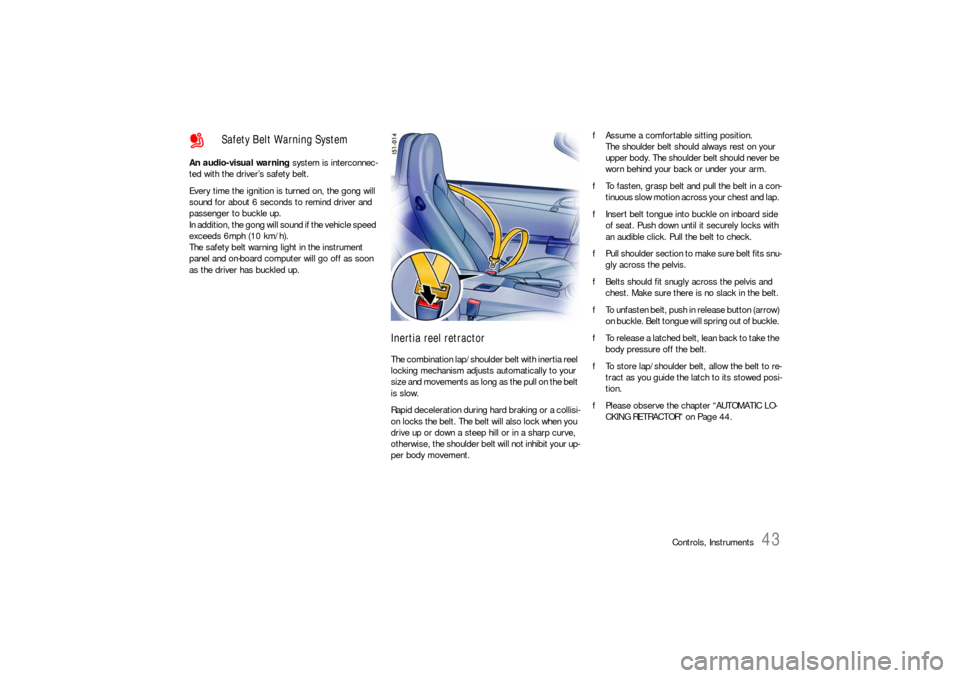
Inertia reel retractor The combination lap/shoulder belt with inertia reel
locking mechanism adjusts automatically to your
size and movements as long as the pull on the belt
is slow.
Rapid deceleration during hard braking or a collisi-
on locks the belt. The belt will also lock when you
drive up or down a steep hill or in a sharp curve,
otherwise, the shoulder belt will not inhibit your up-
per body movement. fAssume a comfortable sitting position.
The shoulder belt should always rest on your
upper body. The shoulder belt should never be
worn behind your back or under your arm.
fTo fasten, grasp belt and pull the belt in a con-
tinuous slow motion across your chest and lap.
fInsert belt tongue into buckle on inboard side
of seat. Push down until it securely locks with
an audible click. Pull the belt to check.
fPull shoulder section to make sure belt fits snu-
gly across the pelvis.
fBelts should fit snugly across the pelvis and
chest. Make sure there is no slack in the belt.
fTo unfasten belt, push in release button (arrow)
on buckle. Belt tongue will spring out of buckle.
fTo release a latched belt, lean back to take the
body pressure off the belt.
fTo store lap/shoulder belt, allow the belt to re-
tract as you guide the latch to its stowed posi-
tion.
fPlease observe the chapter “AUTOMATIC LO-
CKING RETRACTOR” on Page 44.
Safety Belt Warning System
Page 48 of 276
48
Controls, Instruments
Key-operated airbag deactivation
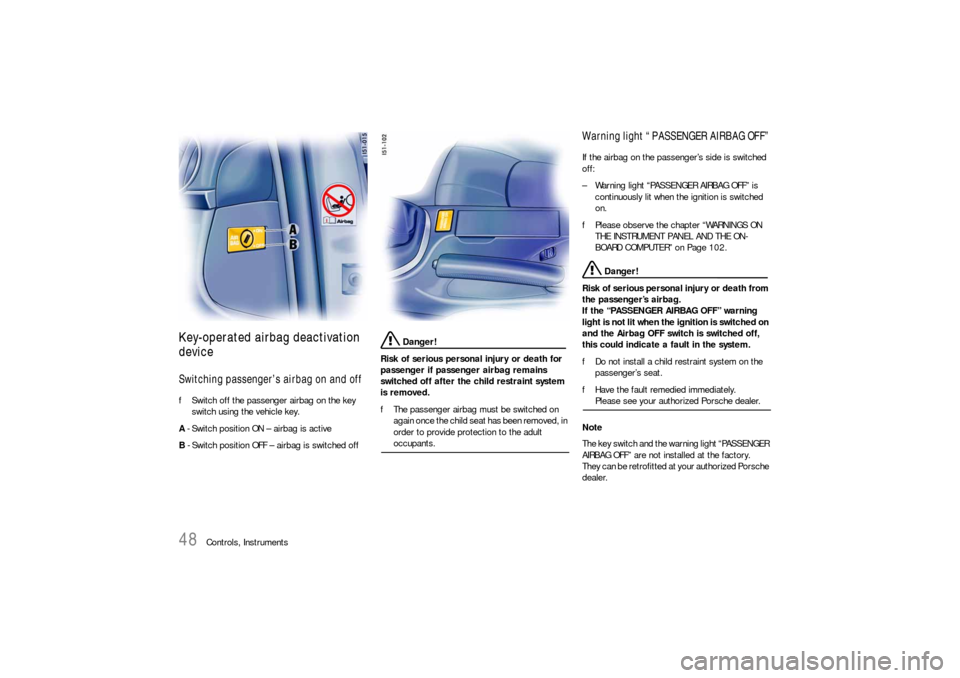
deviceSwitching passenger’s airbag on and offfSwitch off the passenger airbag on the key
switch using the vehicle key.
A - Switch position ON – airbag is active
B - Switch position OFF – airbag is switched off
Danger!
Risk of serious personal injury or death for
passenger if passenger airbag remains
switched off after the child restraint system
is removed.
fThe passenger airbag must be switched on
again once the child seat has been removed, in
order to provide protection to the adult occupants.
Warning light “PASSENGER AIRBAG OFF”If the airbag on the passenger’s side is switched
off:
– Warning light “PASSENGER AIRBAG OFF” is
continuously lit when the ignition is switched
on.
fPlease observe the chapter “WARNINGS ON
THE INSTRUMENT PANEL AND THE ON-
BOARD COMPUTER” on Page 102.
Danger!
Risk of serious personal injury or death from
the passenger’s airbag.
If the “PASSENGER AIRBAG OFF” warning
light is not lit when the ignition is switched on
and the Airbag OFF switch is switched off,
this could indicate a fault in the system.
fDo not install a child restraint system on the
passenger’s seat.
fHave the fault remedied immediately. Please see your authorized Porsche dealer.
Note
The key switch and the warning light “PASSENGER
AIRBAG OFF” are not installed at the factory.
They can be retrofitted at your authorized Porsche
dealer.
Page 49 of 276

Controls, Instruments
49
Airbag Systems The ”Airbags“ in combination with the safety belts
makes up a safety system which offers the driver
and the passenger the greatest known protection
from injuries in case of an accident.
Even if your vehicle is equipped with airbags, the
safety belts are your primary protection and
must be worn at all times.
The airbags can only help protect you where the
impact is of sufficient severity and from a speci-
fied direction.
Therefore, all persons within the vehicle
must always wear safety belts (in many states,
state law requires the use of safety belts).
fPlease observe the chapter “SAFETY BELTS”
on Page 42.
The front airbags are located behind the padded
steering wheel panel on the driver’s side and on
the passenger’s side in the dashboard.
The side airbags are installed in the side of the
seat backrests.
The head airbags are installed in the door linings.
Function Depending on the force and angle of impact, the
corresponding airbags can be triggered.
The inflation process generates the amount of gas
required to fill the airbags at the necessary pres-
sure in fractions of a second. Because of the pos-
sibility of injuries from airbag deployment, airbags
are designed to deploy only when occupants
would receive substantial additional injuries if the
airbags did not deploy.
Airbags protect the face and upper body, while si-
multaneously damping the motion of the driver
and passenger in the impact direction in the event
of a frontal impact or side impact.
Your vehicle is equipped with a crash sensing and
diagnostic module. This module will record the
use of the safety belt restraint system by the driv-
er and front passenger when the side airbags and
head airbags are inflated.
Danger!
To provide optimal occupant protection, air-
bags must inflate at very high speed.
If you are not wearing your safety belt or are
too close to the airbag when its deployed, in-
flating airbags can result in serious personal
injury or death.
fMake sure there are no people, animals or ob-
jects between the driver or passenger and the
area into which the airbag inflates.
fSit back as far from the dashboard or steering
wheel as is practical, while still maintaining full
vehicle control.
fDo not lean against the inside of the doors.
fAlways leave feet in the footwell when driving.
Do not put feet on the dashboard or the seat
cushion.
fAlways hold the steering wheel by the outer
rim.
Never rest your hands on the airbag panel.
fNever transport heavy or sharp objects on or
in front of the passenger seat.
fAlways keep the lid of the door storage com-
partment closed. Objects must not protrude
out of the door storage compartment.
fGive your passenger all of the information in
this chapter.
fNo changes must be made to the wiring or
components of the airbag system.
Page 50 of 276

50
Controls, Instruments fDo not add any additional coverings or stickers
to the steering wheel or in the area of the pas-
senger airbag and side airbags. Doing so may
adversely affect the functioning of the airbag
system or cause harm to the occupants if the
airbag system should deploy.
fDo not undertake any wiring for electrical ac-
cessory equipment in the vicinity of the airbag
wiring harnesses. Doing so may disable the air-
bag system or cause inflation.
fIf the warning light comes on, the airbag sys-
tem should be repaired immediately by your
authorized Porsche dealer.
Note
Airbag components (e.g. steering wheel, door
trim, seats) may be disassembled only by an au-
thorized Porsche dealer.
When disposing of a used airbag unit, our safety
instructions must be followed. These instructions
can be obtained at any authorized Porsche dealer.Faults are indicated by a warning light in the instru-
ment panel and a message on the on-board com-
puter.
fIn the following cases you should immedi-
ately consult an authorized Porsche deal-
er in order to assure the airbag system is
functioning properly:
– If the warning light does not light up when the
ignition is switched on or
– if the warning light does not go out once the
engine is running or
– if the warning light appears while driving.
fPlease observe the chapter “WARNINGS ON
THE INSTRUMENT PANEL AND THE ON-
BOARD COMPUTER” on Page 102.
Warning light “PASSENGER AIRBAG OFF”fPlease observe the chapter “KEY-OPERATED
AIRBAG DEACTIVATION DEVICE” on Page 48.
Airbag maintenanceIn order to ensure long-term functioning, the air-
bag system must be inspected by an authorized
Porsche dealer at the intervals recommended in
your Maintenance booklet.
Important information
If you sell your Porsche, notify the purchaser that
the vehicle is equipped with airbags, and refer
them to the chapter, “Airbag Systems”, in the own-
er’s manual (safety and disposal rules).
Further information on the airbag system can be
found on labels on the sun visors, as well as on all
airbag components.
fFor special recommendations on the use of
child restraints:
Please observe the chapter “CHILD RES-
TRAINT SYSTEMS” on Page 45.
Warning light and warning
message
Page 51 of 276
Controls, Instruments
51
Clutch Pedal The clutch pedal must be depressed fully be-
fore the starter will engage.
Warning!
Risk of an accident.
fAlways check the movement of the clutch pe-
dal before driving and make sure that it is not
obstructed by a floor mat or any other object.
fSecure the floor mat to prevent it from sliding
into positions that could interfere with the safe
operation of your vehicle.
Your Porsche dealer will be glad to offer you
nonskid floor mats of the correct size.
To avoid damage to the clutch and transmis-
sion:
fAlways depress the clutch pedal fully when
changing gears.
fDo not hold the car on a steep grade with the clutch pedal partially depressed.
Should the free travel of the clutch pedal suddenly
become larger, it could mean a malfunction of the
clutch.
fSee your Porsche dealer for correction.
Parking Brake Parking brake force is mechanically transferred to
the rear wheels by means of cables.
fUse the parking brake only after the vehicle
has come to a full stop.
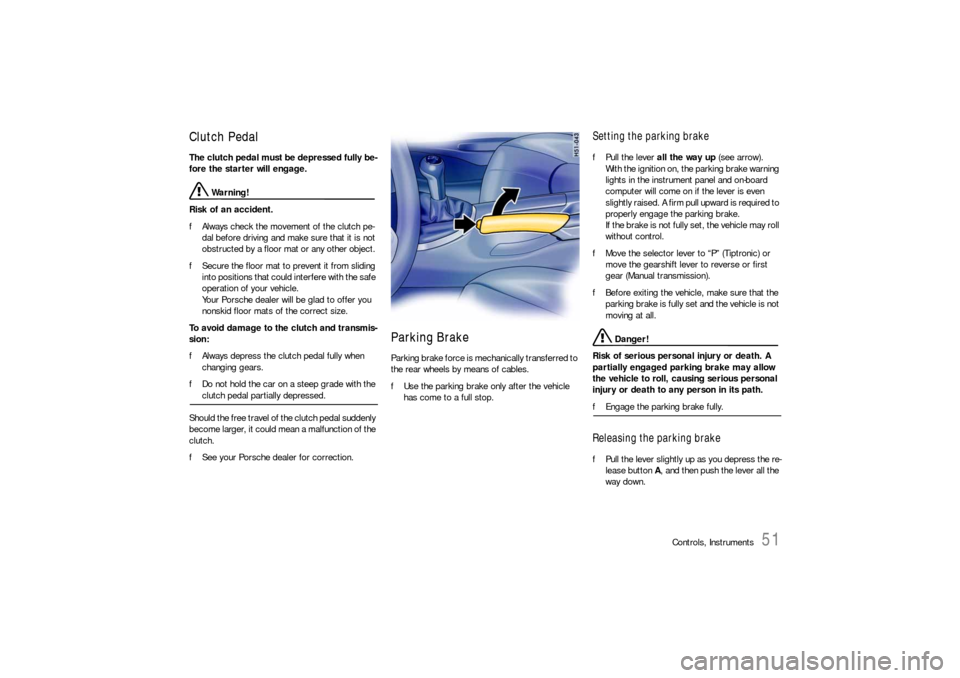
Setting the parking brake fPull the lever all the way up (see arrow).
With the ignition on, the parking brake warning
lights in the instrument panel and on-board
computer will come on if the lever is even
slightly raised. A firm pull upward is required to
properly engage the parking brake.
If the brake is not fully set, the vehicle may roll
without control.
fMove the selector lever to “P” (Tiptronic) or
move the gearshift lever to reverse or first
gear (Manual transmission).
fBefore exiting the vehicle, make sure that the
parking brake is fully set and the vehicle is not
moving at all.
Danger!
Risk of serious personal injury or death. A
partially engaged parking brake may allow
the vehicle to roll, causing serious personal
injury or death to any person in its path.
fEngage the parking brake fully.Releasing the parking brake fPull the lever slightly up as you depress the re-
lease button A, and then push the lever all the
way down.
Page 53 of 276

Controls, Instruments
53
If the warning lights in the instrument panel and on-
board computer go on while driving, the brake flu-
id level may be too low, or (if the brake pedal travel
has increased) one of the two brake circuits may
have failed.
A greater braking pressure will be required, stop-
ping distances will be longer and the braking beha-
vior will change, particularly in curves.
With correctly adjusted brakes, and a correctly
working brake system, the pedal travel to the
point of brake actuation should be 1-3/16" to
1-9/16" or 30 to 40 mm.
Whenever the brake pedal travel exceeds this dis-
tance, have the brake system checked.
Brake pedal
Warning!
Risk of an accident.
Any obstruction of the pedal could increase
the stopping distance.
fAlways check the movement of the brake pedal
before driving and make sure that it is not obs-
tructed by a floor mat or any other object.
fSecure the floor mat to prevent it from sliding
into positions that could interfere with the safe
operation of your vehicle.
Your Porsche dealer will be glad to offer you
floor mats of the correct size including a secu-ring possibility.
Note
In case one of the two brake circuits fails, increa-
sed pedal travel is required to bring your vehicle
to a full stop.
Warning!
To avoid overheating and premature wear of
the brakes:
fBefore descending a steep grade, reduce
speed and shift the transmission into a lower
gear or driving position to control speed.
fDo not ride the “brakes” by resting your foot on
the pedal when not intending to apply brake
pressure.
fDo not hold the pedal down too long or too of-
ten.
This could cause the brakes to get hot and not function properly.
Brake warning light USA
Brake warning light
Canada
Page 54 of 276

54
Controls, Instruments
Brake booster The brake booster assists braking only when
the engine is running.
When the car is moving while the engine is not run-
ning, or if the brake booster is defective, more
pressure on the brake pedal is required to bring
the car to a stop.
Moisture or road salt on brakes affects braking.
When the vehicle is driven on salted roads for ex-
tended periods, the brakes should be washed
down thoroughly about every 2 weeks. An auto-
matic carwash facility cannot do this job properly.
Brakes will dry after a few cautious brake applica-
tions.
Warning!
Driving through water may reduce traction.
Moisture on brakes from road water, car
wash, or coating of road salt may affect bra-
king efficiency.
fCautiously apply brakes to test brakes after being exposed.
Brake wear Your car has excellent brakes, but they are still
subject to wear. The rate at which they wear de-
pends on how the brakes are used.
fHave the brake system inspected at the inter-
vals recommended in your Maintenance Book-
let.
If the lights in the instrument panel and on-board
computer stay on when the engine is running or
come on while driving, the brake pads are worn,
excessively.
fDo not continue to operate the vehicle.
Have your authorized Porsche dealer inspect
or replace the brake pads.
Brake pads Wear on the brake pads and brake discs depends
to a great extent on the driving style and the con-
ditions of use and therefore cannot be expressed
in actual miles on the road.
The high-performance brake system is designed
for optimal braking effect at all speeds and tempe-
ratures.
Certain speeds, braking forces and ambient
conditions (such as temperature and humidity)
therefore might cause the brakes to squeal.
New brake pads or linings
New brake pads have to be “broken in”, and there-
fore only attain optimal friction when the car has
covered several hundred miles or km.
The slightly reduced braking ability must be com-
pensated for by pressing the brake pedal harder.
This also applies whenever the brake pads and
brake discs are replaced.
Warning light USA
Warning light Canada