warning PORSCHE BOXSTER 2006 2.G Owners Manual
[x] Cancel search | Manufacturer: PORSCHE, Model Year: 2006, Model line: BOXSTER, Model: PORSCHE BOXSTER 2006 2.GPages: 296, PDF Size: 4.12 MB
Page 170 of 296

170
Mobile Roofs
Convertible Top Brief operating instructions can be found on the
back side of the driver’s sun visor.
fPlease observe the chapter “CAR CARE IN-
STRUCTIONS” on Page 209.
Warning!
When opening or closing the convertible top,
serious personal injury may occur if a per-
son’s body parts are near or in the way of the
convertible top mechanism’s moving parts.
fMake absolutely sure that nobody can be inju-
red by the convertible-top mechanism or the convertible-top compartment lid. Do not operate convertible top:
– At temperatures below 32°F/0°C.
– When one side of the car is on a curb, a hoist
or a jack.
– When items of luggage or other objects hinder
the convertible top movement or are in abrasi-
ve contact with the convertible top or rear win-
dow.
Items of luggage or objects on the luggage
tray above the engine compartment lid must
be put in the storage box or be secured under
the net to prevent their sliding out.
– Drive only with the convertible top fully open or
closed.
fAvoid frequent operation of the convertible top
with the engine off; the vehicle battery would
be unintentionally discharged rapidly.
fThe convertible top must be operated only
when the car is stationary. Make sure there is
sufficient clearance above the convertible top
(e.g. in the garage).
fTo prevent damp stains and abrasions, only
open the convertible top in a dry, clean state.
fPark your car in the shade whenever possible,
as the fabric, rubber material and color can be
harmed by long exposure to sunlight.
Door windows If the door windows are closed, they will automati-
cally be lowered a few centimeters before the con-
vertible top is opened or closed.
The door windows close automatically when the
convertible top is locked with the latching lever on
the windshield frame. Conditions for operating the convertible
top – The ignition must be switched on
(engine running or off).
– Maximum speed 30 mph (50 km/h)
The opening/closing process of the convert-
ible top will be interrupted if the maximum
speed is exceeded.
fReduce speed.
Press button again.
The opening/closing process is ended.
Page 171 of 296
Mobile Roofs
171
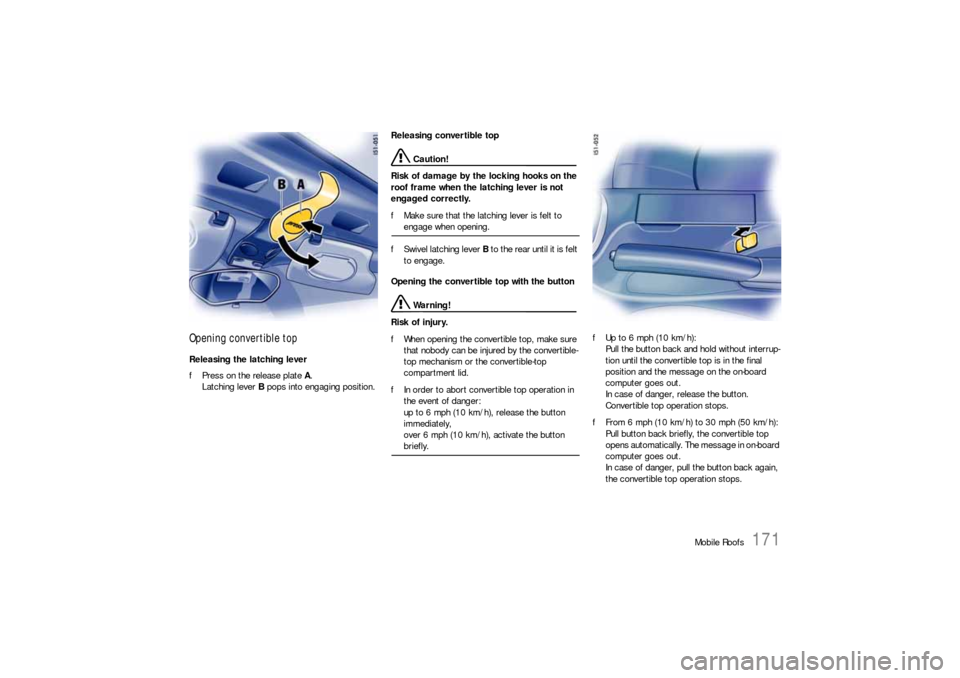
Opening convertible topReleasing the latching lever
fPress on the release plate A.
Latching lever B pops into engaging position. Releasing convertible top
Caution!
Risk of damage by the locking hooks on the
roof frame when the latching lever is not
engaged correctly.
fMake sure that the latching lever is felt to engage when opening.
fSwivel latching lever B to the rear until it is felt
to engage.
Opening the convertible top with the button Warning!
Risk of injury.
fWhen opening the convertible top, make sure
that nobody can be injured by the convertible-
top mechanism or the convertible-top
compartment lid.
fIn order to abort convertible top operation in
the event of danger:
up to 6 mph (10 km/h), release the button
immediately,
over 6 mph (10 km/h), activate the button briefly.fUp to 6 mph (10 km/h):
Pull the button back and hold without interrup-
tion until the convertible top is in the final
position and the message on the on-board
computer goes out.
In case of danger, release the button.
Convertible top operation stops.
fFrom 6 mph (10 km/h) to 30 mph (50 km/h):
Pull button back briefly, the convertible top
opens automatically. The message in on-board
computer goes out.
In case of danger, pull the button back again,
the convertible top operation stops.
Page 172 of 296
172
Mobile Roofs
Closing the convertible top
Warning!
Danger of injury and damage.
fWhen closing the convertible top, make sure
that nobody can be injured by the convertible-
top mechanism or the convertible-top
compartment lid.
fIn order to abort convertible top operation in
the event of danger:
up to 6 mph (10 km/h), release the button
immediately,
over 6 mph (10 km/h), activate the button
briefly.
fKeep the lids of the make-up mirrors in the sun
visors closed when closing the convertible top.
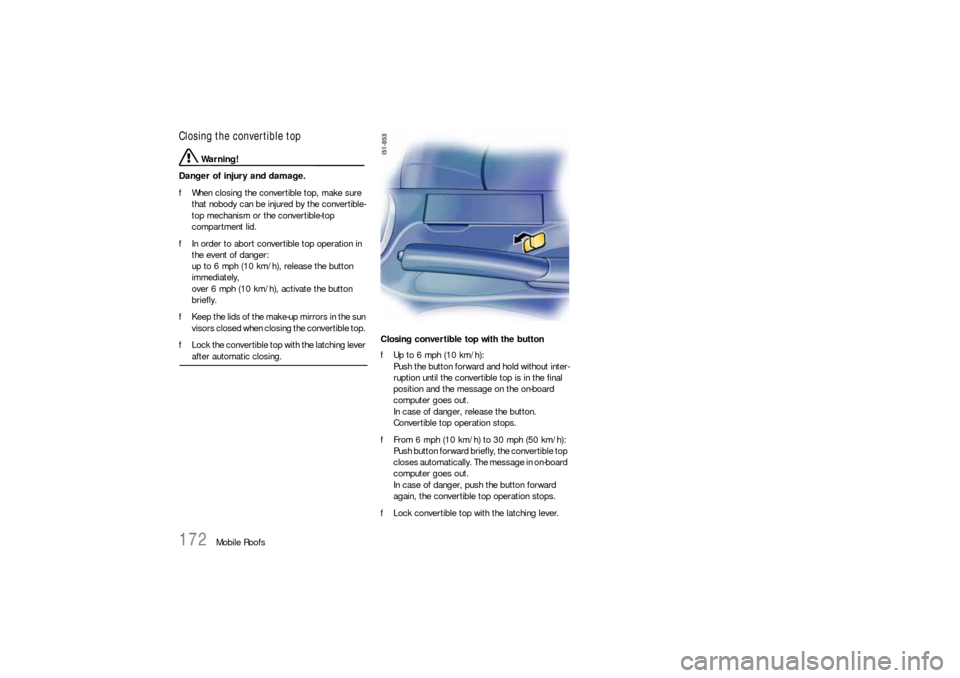
fLock the convertible top with the latching lever after automatic closing.Closing convertible top with the button
fUp to 6 mph (10 km/h):
Push the button forward and hold without inter-
ruption until the convertible top is in the final
position and the message on the on-board
computer goes out.
In case of danger, release the button.
Convertible top operation stops.
fFrom 6 mph (10 km/h) to 30 mph (50 km/h):
Push button forward briefly, the convertible top
closes automatically. The message in on-board
computer goes out.
In case of danger, push the button forward
again, the convertible top operation stops.
fLock convertible top with the latching lever.
Page 173 of 296

Mobile Roofs
173
Locking the convertible topfSwivel latching lever B to the front until it is felt
to engage.
The locking hook must engage in the
receptacle on the windshield frame C.
Note
If the convertible top has been opened for a longer
period, it could be necessary to assist the locking
hook engage C.
fWith the vehicle stationary, press and hold the
button for convertible top operation and pull
the convertible top to the windshield using the
handle recess D.
Emergency operation fBefore performing emergency operation, ple-
ase check:
Was the ignition switched on and the handbra-
ke applied?
Are the electrical fuses defective?
Please observe the chapter “ELECTRICAL SYS-
TEM” on Page 246.
Warning!
There is a danger of injury and risk of dama-
ge during emergency operation.
There is a danger of crushing or pinching
body parts at all moveable convertible top
parts which could cause serious personal in-
jury.
fTake great care when performing emergency
operation.
fDo not operate the convertible top during and
after emergency operation.
fLever off joint rods only with the greatest care.
fIf the convertible top is not in the rearward final
position, the convertible-top compartment lid
or the convertible top could fall down when the
joint rods are levered off.
For this reason, hold convertible top or conver-
tible-top compartment lid firmly before levering
off the second joint rod.
fDuring emergency operation, ensure that the paint is not damaged.
Page 174 of 296
174
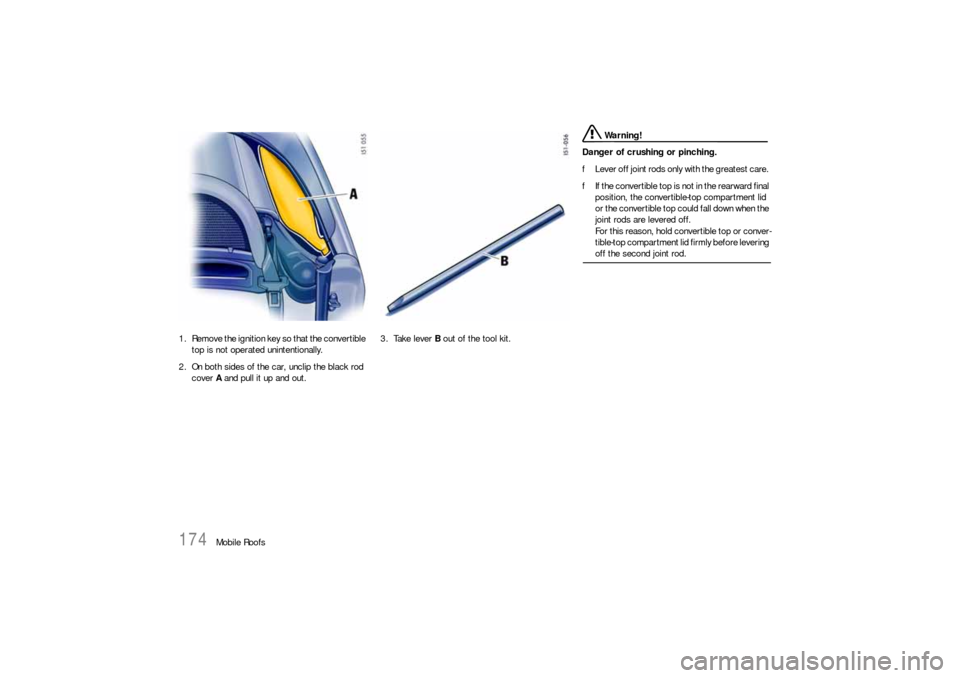
Mobile Roofs 1. Remove the ignition key so that the convertible
top is not operated unintentionally.
2. On both sides of the car, unclip the black rod
cover A and pull it up and out. 3. Take lever B out of the tool kit.
Warning!
Danger of crushing or pinching.
fLever off joint rods only with the greatest care.
fIf the convertible top is not in the rearward final
position, the convertible-top compartment lid
or the convertible top could fall down when the
joint rods are levered off.
For this reason, hold convertible top or conver-
tible-top compartment lid firmly before levering off the second joint rod.
Page 180 of 296
180
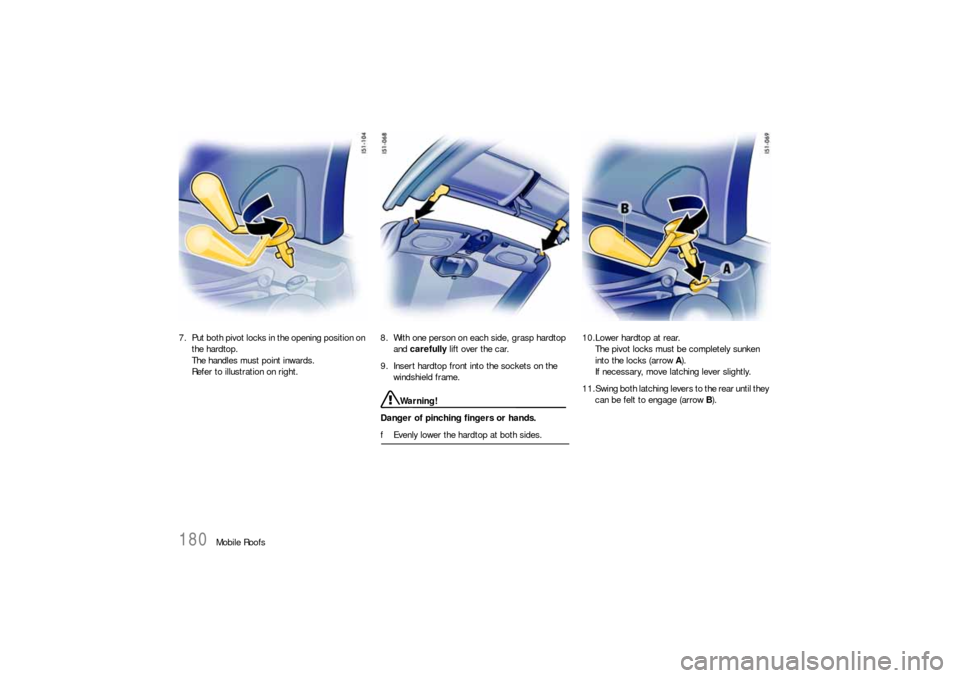
Mobile Roofs 7. Put both pivot locks in the opening position on
the hardtop.
The handles must point inwards.
Refer to illustration on right. 8. With one person on each side, grasp hardtop
and carefully lift over the car.
9. Insert hardtop front into the sockets on the
windshield frame.
Warning!
Danger of pinching fingers or hands.
fEvenly lower the hardtop at both sides.10.Lower hardtop at rear.
The pivot locks must be completely sunken
into the locks (arrow A).
If necessary, move latching lever slightly.
11.Swing both latching levers to the rear until they
can be felt to engage (arrow B).
Page 182 of 296

182
Mobile Roofs
Removing the hardtop1. Make sure that the hardtop is placed on a
clean, soft surface.
2. Open doors.
3. Remove cover from the front locking lever.
4. Open front latch.
5. Open rear pivot locks (swivel inwards).
Unplug plug of the hardtop heated rear
window.
6. With one person on each side, grasp the
hardtop.
Lift hardtop at rear and pull out of the sockets
on the windshield frame at front.
Warning!
Danger of pinching fingers or hands.
fEvenly lift the hardtop at both sides.
7. Carefully lift the hardtop up and off the vehicle
to the rear.
8. Close front hardtop latch.
Fit cover on the front latch.
9. Close pivot locks on the vehicle with the plastic
covers.
10.Remove the connector of the convertible top
heated rear window from the empty socket
and insert into the socket.11.Swivel the sash guide of the seat belt forward.
Insert the lower retaining lugs of the cover
from above and clip in the upper retaining lugs
on the bar.
Page 186 of 296

186
Maintenance, Car Care
A - Coolant expansion tank cap
B - Coolant level Coolant Level fPlease observe the chapter “EXERCISE EXTRE-
ME CAUTION WHEN WORKING ON YOUR VE-
HICLE” on Page 184.
The cooling system is filled at the factory with a
permanent coolant.
It provides year-round protection from corrosion
and freezing down to –31°F/–35°C.
Only use antifreeze authorized by Porsche.
Checking coolant level The expansion tank with its filler orifice is in the
rear luggage compartment.
fCheck the coolant level regularly at the trans-
parent window of the expansion tank.
When the engine is cold and the car is level the flu-
id level must lie between the “Min.” and “Max.”
markings.
Topping off coolant
Warning!
Danger of serious personal injury from scal-
ding. Coolant is hazardous to your health,
and may be fatal if swallowed.
fDo not open the cap of the expansion tank
while the engine is hot.
fAllow the engine to cool down before opening
the cap and protect your hands, arms and face
from any possible escape of hot coolant.
fKeep coolant out of children’s reach.
fAlso, keep coolant away from your pets.
They can be attracted to it should there be a
spill, or to used coolant left in an open contai-
ner. Coolant can be deadly to pets if consu-
med.
Risk of damage from overflowing coolant.
fTake care while topping off coolant not to soil the luggage compartment or items of luggage.
Page 187 of 296

Maintenance, Car Care
187
1. Switch engine off and let it cool.
Please observe the chapter “COOLING SYS-
TEM” on Page 86.
2. Cover the expansion tank cap with a thick rag.
Open cap slowly and carefully and allow over-
pressure to escape.
Then unscrew cap completely.
3. Only add a mixture of antifreeze and water in
equal parts, and do not exceed the “Max.”
mark.
Antifreeze in coolant:
50% gives protection down to –31°F/–35°C
60% gives protection down to –58°F/–50°C
4. Screw cap firmly on.
If in an emergency pure water has been added, the
mix ratio must be corrected at an authorized
Porsche dealer.
Marked loss of coolant indicates leakage in the
cooling system.
The cause should immediately be remedied at an
authorized Porsche dealer.
Radiator fansThe radiator and radiator fans are in the front of
the vehicle.
Warning!
Risk of injury. The fans can start running as
a function of temperature, even with the
engine switched off.
fExercise extreme caution when working in the area of the radiator fans.
Page 188 of 296

188
Maintenance, Car Care
Engine Oil Engine oil consumption
It is normal for your engine to consume oil.
The rate of oil consumption depends on the quality
and viscosity of oil, the speed at which the engine
is operated, the climate, road conditions as well
as the amount of dilution and oxidation of the lub-
ricant.
If the vehicle is used for repeated short trips, and
consumes a normal amount of oil, the engine oil
measurement may not show any drop in the oil le-
vel at all, even after 600 miles (1000 km) or more.
This is because the oil is gradually becoming dilut-
ed with fuel or moisture, making it appear that the
oil level has not changed.
The diluting ingredients evaporate out when the
vehicle is driven at high speeds, as on an express-
way, making it then appear that oil is excessively
consumed after driving at high speeds.
If the conditions you drive your vehicle in are dus-
ty, humid, or hot, the frequency of the oil change
intervals should be greater. If the vehicle is driven at a high rate of speed, cli-
matic conditions are warm, and the load is high,
the oil should be checked more frequently, as dri-
ving conditions will determine the rate of oil con-
sumption.
– The engine in your vehicle depends on oil to lu-
bricate and cool all of its moving parts.
Therefore, the engine oil should be checked re-
gularly and kept at the required level.
– Make it a habit to have the engine oil level che-
cked with every fuel filling.
– The oil pressure warning light is not an oil level
indicator.
The oil pressure warning light indicates serious
engine damage may be occuring when lit, if en-
gine rpm is above idle speed.