warning PORSCHE BOXSTER 2009 2.G Owners Manual
[x] Cancel search | Manufacturer: PORSCHE, Model Year: 2009, Model line: BOXSTER, Model: PORSCHE BOXSTER 2009 2.GPages: 294, PDF Size: 6.89 MB
Page 212 of 294
210
Maintenance, Car Care
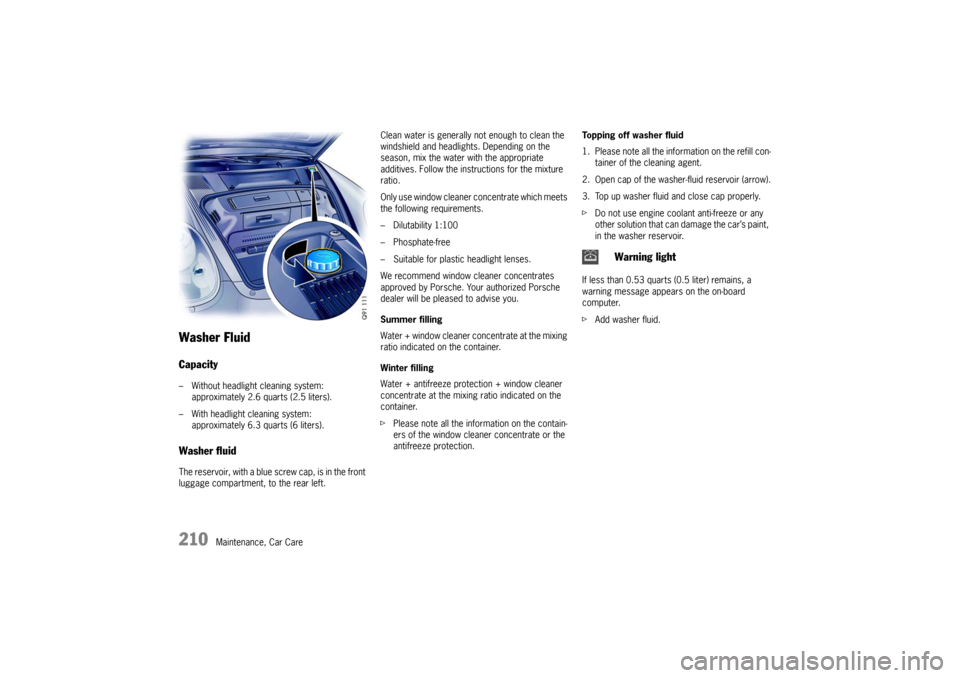
Washer FluidCapacity – Without headlight cleaning system:approximately 2.6 quarts (2.5 liters).
– With headlight cleaning system: approximately 6.3 quarts (6 liters). Washer fluidThe reservoir, with a blue screw cap, is in the front
luggage compartment, to the rear left. Clean water is generally
not enough to clean the
windshield and headlights. Depending on the
season, mix the water with the appropriate
additives. Follow the instructions for the mixture
ratio.
Only use window cleaner concentrate which meets
the following requirements.
– Dilutability 1:100
– Phosphate-free
– Suitable for plastic headlight lenses.
We recommend window cleaner concentrates
approved by Porsche. Your authorized Porsche
dealer will be pleased to advise you.
Summer filling
Water + window cleaner concentrate at the mixing
ratio indicated on the container.
Winter filling
Water + antifreeze protection + window cleaner
concentrate at the mixing ratio indicated on the
container.
f Please note all the info rmation on the contain-
ers of the window cleaner concentrate or the
antifreeze protection. Topping off washer fluid
1. Please note all the info
rmation on the refill con-
tainer of the cleaning agent.
2. Open cap of the washer-fluid reservoir (arrow).
3. Top up washer fluid and close cap properly.
f Do not use engine coolant anti-freeze or any
other solution that can damage the car’s paint,
in the washer reservoir.
If less than 0.53 quarts (0.5 liter) remains, a
warning message appears on the on-board
computer.
f Add washer fluid.
Warning light
Page 213 of 294

Maintenance, Car Care
211
Power Steering
Warning!
Risk of accident resulti ng in serious personal
injury or death.
When the engine is stopped (e.g. when being
towed) or the hydraulic system fails, there is
no assistance for steering.
Therefore, substantially more force will have
to be exerted in order to steer.
f Exercise great care when being towed.
f Have the fault remedied at your nearest autho-rized Porsche dealer.
Note
The flow noise heard at full steering lock is system
related and does not indi cate a defect in the
steering system.
Checking hydraulic fluid f Please see the chapter “EXERCISE EXTREME
CAUTION WHEN WORKING ON YOUR VEHICLE”
on Page 196.
The hydraulic fluid reservoir is located in the engi-
ne compartment.
Regular checking of hydraulic fluid is part of
servicing.
Air Filter A dirty air filter not only reduces engine perform-
ance, but can lead to premature engine wear.
Regular filter replacement is part of the routine
maintenance service.
f In dusty conditions, check the filter element
more frequently and replace if necessary.Combination Filter The fresh air passing through the combination fil-
ter into the passenger co mpartment is virtually
free of dust, pollen, and unpleasant odors.
f If the outside air is polluted by exhaust fumes,
press the circulating-air button.
A dirty filter can be the cause of reduced air flow:
f Have filter replaced by your authorized
Porsche dealer.
Regular filter replacement is part of the routine
maintenance service.
Fluids/Oils for Manual
Transmission and Porsche
Doppelkupplung (PDK)The transmission fluids/oils have to be checked
and changed at the intervals listed in your Mainte-
nance Schedule.
f Please see the chapter “CAPACITIES” on
Page 281.
Do not tow the car or run the engine without fluid/
oil in the transmission. The transmission may be
damaged by even a tiny speck of dirt, only a clean
funnel or spout must be used when adding fluid/
oil.
We recommend that you have the fluids/oils
changed at your Porsche dealer, who has the re-
quired lubricants and the necessary filling equip-
ment.
f If you suspect an oil leak in the transmission,
have your authorized Porsche dealer check it
out immediately.
Page 215 of 294

Maintenance, Car Care
213
Car Care Instructions fPlease see the chapter “EXERCISE EXTREME
CAUTION WHEN WORKING ON YOUR VEHICLE”
on Page 196.
Regular and correct care helps to maintain
the value of your car and is also a
precondition for the New Vehicle Warranty
and the Anti Corrosion Warranty.
Your authorized Porsche dealer has specially
developed car-care products from the
Porsche program available either singly or
as complete car-care sets. They will be
pleased to help you select suitable products.
Whether you use Porsche products or other
commercially available cleaning agents first
make sure of their correct application.
A Porsche that is well-cared for can look like new
for years. It all depends on the amount of care the
owner is willing to give the car.
Warning!
Risk of serious personal injury or damage to
the vehicle or property.
Cleaning agents may be hazardous to your
health.
Most chemical cleaners are concentrates
which require dilution. High concentrations
might cause problems ranging from irritation
to serious injury as we ll as damage to your
vehicle. f
Keep cleaning agents out of reach from chil-
dren.
f Observe all caution labels.
f Always read directions on the container before
using any product. These directions may con-
tain information necessary to avoid personal
injury.
f Do not use fuel, kerosene, naphtha, nail polish
remover or other volatile cleaning fluids. They
may be toxic, flammable or hazardous in other
ways. Only use spot removing fluids in a well
vented area.
f Do not clean the underside of chassis, fend-
ers, wheel covers, etc., without protecting
your hands and arms as you may cut yourself
on sharp-edged metal parts.
Moisture and road salt on brakes may affect brak-
ing efficiency.
f Test the brakes after each vehicle washing.
Decorative film Caution!
Risk of damage due to separation of the
decorative film when cleaning your vehicle with
high-pressure cleaning equipment or steam
cleaners.
f Do not use high-pressure cleaning equipment or steam cleaners for cl eaning decorative film.
High-pressure cleaning units,
steam
cleaners
Warning!
High-pressure cleaning units or steam clea-
ners can damage the following components:
–tires,
– logos, emblems,
– painted surfaces,
– alternator,
– ParkAssist sensors,
– convertible top.
f Please observe the operating instructions from
the unit manufacturer.
f When cleaning with a flat-jet nozzle or the like,
maintain a minimum distance of 20 inches (50
cm).
f Never use high-pressure cleaning units or
steam cleaners with a ro und-jet nozzle. A high-
pressure cleaning unit or steam cleaners with
round nozzle will damage your vehicle.
f The tires are particularly susceptible to dam-
age.
f Do not point the cleaning jet directly at any of the aforementioned components.
Page 216 of 294

214
Maintenance, Car Care
Washing The best method of protecting your car from the
damaging effects of the environment is frequent
washing and the application of a preservative. The
underside of your vehicle should also be thorough-
ly washed for cinders, salt or sanding at winter’s
end.
The longer salt, road du st and industrial dust,
dead insects, bird droppi ngs or substances from
trees (resin, pollen) are allowed to remain on the
bodywork, the more serious is their harmful ef-
fect.
New cars should be washed carefully with plenty
of clear water to protect the new paint work. Dark
paint finishes show up the smallest of surface
damage (e.g., scratches) more readily than lighter
colors.
Dark colors are also more susceptible to scratch-
ing because of the compos ition of their pigments
and require particularly careful paint care.
f Do not wash your car in bright sunlight or while
the bodywork is still hot.
f When washing by hand, use abundant water, a
soft sponge or wash brush, and Porsche car
shampoo.
f Begin by spraying the body thoroughly with wa-
ter to rinse away loose dirt. f
After washing, rinse the car with plenty of wa-
ter and then dry with a chamois leather.
Do not use the same chamois leather for dry-
ing as you use for cleaning the windshield and
windows.
Warning!
Moisture which gets on to the brakes during
a car wash can reduce braking efficiency or
make the brakes pull unevenly which could
increase the danger of an accident, causing
serious personal injuries or death.
f After washing the car, test the brakes and
steering and briefly brake the discs dry.
When doing this, take care not to hamper other
road users behind you (traffic conditions permitting).
Automatic car washes
f Please see the chapter “WIPER BLADES” on
Page 212.
Optional add-on parts or parts which project
beyond the contours of the vehicle may be
damaged by design features (e.g. brushes) of au-
tomatic car washes. The following parts are particularly
susceptible to damage:
– Convertible top (hot wax treatment cannot be
used, as the wax attacks the convertible top
material)
– Windshield wipers (alw ays switch them off to
prevent them wiping unintentionally in intermit-
tent or sensor operation)
– External antennas (always unscrew)
– Rear spoiler
– Wheels (the wider the rim and the lower the tire height, the greater the risk of damage)
– High-gloss wheels (to prevent these from get- ting scratched, do not clean with the wheel-
cleaning brushes of the car wash).
f Please consult the operator before using auto-
matic car washes.
f Wash and dry by hand all points not reached by
a car wash, such as door and lid seams or
door sills.
Note
Automatic car washes spray water at odd angles
and high pressures, which are not seen in normal
driving. Therefore, water can sometimes find its
way into the passengers compartment during or
shortly after the car wash.
Page 219 of 294

Maintenance, Car Care
217
Note
Door windows feature a water-repellent (hydro-
phobic) coating which prevents soiling of the
windows.
This coating is subject to natural wear and can be
renewed.
fConsult an authorized Porsche dealer.Wiper blades Wiper blades that are in perfect condition are vital
for a clear view.
fPlease see the chapter “WIPER BLADES” on
Page 212.
f Replace the wiper blades twice per year (be-
fore and after the cold season) or whenever
wiper performance deteriorates or the blades
are damaged.
f Periodically clean the wiper blades with
Porsche window cleaner, especially after the
vehicle has been washed in a car wash.
If they are very dirty (e.g. with insect remains),
they can be cleaned with a sponge or cloth.
If the wiper blades rub or squeak, this can be as a
result of the following:
– If the vehicle is washed in an automatic car wash, residues may adhere to the windshield.
These wax residues can be removed only by
using window cleaner concentrate.
– The wiper blades may be damaged or worn. – Replace damaged or worn wiper blades imme-
diately.
f Please see the chapter “WASHER FLUID” on
Page 210.
f Please contact your authorized Porsche dealer
for further information.
Undercoating As it is not possible to ex clude the risk of damage
to this protective coating in day to day driving, it
is advisable to have the underside of the car in-
spected at certain interv als – preferably before
the start of winter and again in spring – and the un-
dercoating restored as necessary.
Your authorized Porsche dealer is familiar with the
bodyseal treatment procedures and has the nec-
essary equipment for applying factory approved
materials. We recommend that you entrust them
with such work and inspections.
Unlike conventional spray oils, undercoating and
rust-proofing compounds based on bitumen or
wax do not attack the so und-proofing materials ap-
plied at the factory.
Warning!
Danger of fire resulting in serious personal
injury or death.
f Do not apply additional undercoating or rust-
proofing on or near the exhaust manifold, ex-
haust pipes, catalytic converters or heat shields. During driving the substance used for
undercoating could overheat and ignite.
f Before applying fresh underseal, carefully
remove any deposits of dirt and grease. Once
it has dried, the new undercoating compound
forms a tough protective coating which
provides efficient rust-proofing of the floor
panels and components.
f Always apply a fresh coating of suitable pre-
servative to unprotected areas after cleaning
the underside of the body, the transmission,
the engine or carrying out repairs to under-
body, engine or transmission components.
Effective rust-proofing is particularly important
during the cold weather seas on. If your car is driv-
en frequently in areas where salt has been spread
on the roads, the whole engine compartment
should be cleaned thoroughly after the winter to
prevent salt from causing any lasting damage. A
full under-body wash should also be performed at
the same time.
Stainless steel exhaust tailpipesStainless steel exhaust tailpipes can discolor due
to soiling, strong heat, and combustion residues.
The original polish can be achieved again using
commercially available metal polishing paste or
metal polish.
Page 220 of 294

218
Maintenance, Car Care
Light alloy wheels fPlease see the chapter “WASHING” on
Page 214.
Warning!
Danger of accident re sulting in serious per-
sonal injury or death if cleaning agents (e.g.
wheel cleaning agents) come into contact
with the brake discs.
The resulting film on the brake discs can im-
pair braking performance.
f Make sure that no cleaning agent comes into
contact with the brake discs.
f If cleaning agent has come into contact with
the brake discs, thoroughly clean the brake
discs with a strong jet of water.
f Paying attention to any road users behind you,
dry the brake discs by applying the brakes at short intervals.
Metal particles (such as brass or copper in brake
dust) must not remain too long on alloy wheels.
Contact corrosion can cause pitting.
Cleaners with an oxide-removing effect or the
wrong pH value, as are commonly used for other
metals, as well as mechanical tools and products,
will damage the oxide layer and are therefore
unsuitable.
f Use only cleaners for alloy wheels (pH value
9.5). Products with the wrong pH value can destroy the protective layer on the wheels.
We recommend Porsche cleaner for alloy rims.
f If possible, wash the wheels every two weeks
with a sponge or washing brush. If the wheels
are exposed to road salt, grit or industrial dust,
weekly cleaning is necessary.
Door, roof, lid and window seals
Caution!
The lubricant coating on the inner door seals,
convertible top and hardtop seals may be
damaged by unsuitable cleaning and care agents.
f Do not use any chemic al cleaning agents
or solvents.
f Do not use any preservative agents.
f Wash dirt (e.g. abrasion, dust, road salt and
grit) from all seals regularly using warm
soapy water.
f If there is a risk of frost, protect the outer door
seals and lid seals against freezing into place
with a suitable care product.
Headlights, lights, interior and exterior
plastic parts, adhesive filmsfUse only clean water and a little dishwashing
detergent to clean light lenses, plastic head-
light lenses, plastic parts, adhesive films and
surfaces.
Do not clean when dry.
Use a soft sponge or a so ft, lint-free cloth. Gen-
tly wipe the surface without applying too much
pressure.
An interior window cleaner can also be used to
clean plastic surfaces (always read the cleaning
instructions on the container). We recommend
Porsche interior window cleaner.
f Gently wipe the surfac e without applying too
much pressure.
f Do not clean when dry.
f Never use other chemical cleaners or
solvents.
f Rinse cleaned surfaces with clear water.Leather Characteristics and special features
The natural surface markings of leather, e.g.
creases, healed scars, in sect sting marks, struc-
tural differences and slight variations in shade and
grain add to the attractiveness of the natural leath-
er product.
Page 221 of 294

Maintenance, Car Care
219
Observe the following care instructions:
Caution!
The leather will be da maged by the use of
unsuitable cleaning and care agents and by
incorrect treatment.
f Do not use caustic cleaners or hard
cleaning aids.
f Perforated leather must under no circumstances get wet on its reverse side.
f Clean all types of leather regularly to remove
fine dust using a soft, damp, white woollen
cloth or a commercially available
microfibre cloth.
f Remove heavy contamination with a leather
cleaner.
Always read the instructions for use given on
the containers.
We recommend Porsche leather cleaner.
f Treat cleaned leather only with a leather
care product.
We recommend the Porsche leather
care product.
Cleaning airbags covers
Danger!
There is a danger of serious personal injury
or death if the airbag system is impaired by
improper cleaning work.
f Do not make any modifications whatsoever on
individual components such as the padded
covers of the steering wheel, passenger side
instrument panel, the front seats and the door
linings.
f Let your authorized Porsche dealer clean these components.
Carpets and floor-mats fUse only a vacuum clea ner or a medium stiff
brush.
f Remove stains and spots with Porsche stain
remover.
To protect carpets, the Porsche range of accesso-
ries includes mats of th e correct size and with the
appropriate fastening.
Warning!
Risk of an accident re sulting in serious per-
sonal injury or death.
f Always check the movement of the pedals be-
fore driving and make sure that they are not ob-
structed by a floor-ma t or any other object. f
Secure the floor-mat to prevent it from sliding
into positions that could interfere with the safe
operation of your vehicl e - do not install them
loosely in the vehicle.
Your Porsche dealer will be glad to offer you
nonskid floor-mats of the correct size.
Cleaning fabric linings
f Fabric linings on pillars, convertible top liner
and sun blinds, etc. must be cleaned only
using suitable cleaning agents or a suitable dry
foam and a soft brush.
Alcantara fDo not use a leather care product to clean
Alcantara.
For regular care it is su fficient to clean the cover
with a soft brush.
Heavy abrasion or rubbing when cleaning causes
a lasting change in the surface.
Cleaning when lightly soiled
f Wet a soft cloth with water or a neutral soap
solution and wipe off the dirt.
Cleaning when heavily soiled
f Wet a soft cloth with lukewarm water or
thinned white spirit and dab the dirt from the
outside in.
Cleaning safety belts
Page 226 of 294

224
Practical Tips, Emergency Service
and a half (1-1/2) times as well on the government
course as a tire graded 100.
The relative performance of tires depends upon
the actual conditions of
their use, however, and
may depart significantly fr om the norm due to var-
iations in driving habits, service practices and dif-
ferences in road characteristics and climate.
Traction AA, A, B, C
The traction grades, from highest to lowest, are
AA, A, B, and C and they represent the tire’s ability
to stop on wet pavement as measured under con-
trolled conditions on specified government test
surfaces of asphalt and concrete.
A tire marked C may have poor traction perform-
ance.
Warning!
The traction grade assigned to this is based on
braking (straight-ahead) traction tests and does
not include cornering (turned) traction, accelera-
tion, hydroplaning or peak traction characteris-
tics.
Temperature A, B, C
The temperature grades ar e A (the highest), B and
C, representing the tire’s resistance to the gener-
ation of heat and its abilit y to dissipate heat when
tested under controlled conditions on a specified
indoor laboratory test wheel.
Sustained high temperatur es can cause the mate-
rial of the tire to degenerate and reduce tire life,
and excessive temperature can lead to sudden tire failure.
The grade C corresponds to a level of perform-
ance which all passenger car tires must meet un-
der the Federal Motor Vehi
cle Safety Standard No.
109.
Grades B and A represent higher levels of per-
formance on the laboratory test wheel than the
minimum required by law.
Warning!
The temperature grade for this tire is established
for a tire that is properly inflated and not overload-
ed.
Excessive speed, underinflation, or excessive
loading, either separately or in combination, can
cause heat buildup and possible tire failure, result-
ing in serious personal injury or death. Tire pressures
Warning!
Incorrect tire pressure causes increased tire
wear and adversely affects road handling.
This could lead to tire fa ilure, resulting in loss
of control, leading to serious personal injury
or death.
f Always use an accurate tire pressure gage
when checking inflation pressures.
f Do not exceed the maximum tire pressure list-
ed on the tire sidewall.
Please see the chapter “TIRE PRESSURE PLA-
TE” on Page 275. f
Cold tire inflation pressure means: all tires
must be cold, ambient temperature maximum
(68 °F/20 °C)
, when adjusting the inflation
pressure.
Avoid sunlight striking the tires before measur-
ing cold pressures, since the pressures would
rise from temperature influence.
f Valve caps protect the valve from dust and dirt,
and thus from leakage.
Always screw caps tightly down.
Replace missing caps immediately.
f Use only plastic valve caps.
f Do not use commercially available sealant or
tire inflating bottles. Only use Porsche
approved tire sealant.
f Please see the chapter “TIRE PRESSURE FOR
COLD TIRES (68 °F/20 °C)” on Page 277.
Page 228 of 294

226
Practical Tips, Emergency Service
B Vehicle load limit
Is the maximum total weight limit specified of
the load (passengers and cargo) for the vehi-
cle. This is the maximum weight of passengers
and cargo that can be loaded into the vehicle.
Please see the chapter “LOADING INFORMA-
TION” on Page 234.
C Tire size for the front axle Check with your authorized Porsche dealer
about the current release status.
D Recommended tire pre ssure for the front axle
These values are for cold tires (68 °F/20 °C).
E Tire size for the rear axle Check with your authorized Porsche dealer
about the current release status.
F Recommended tire pressure for the rear axle. These values are for cold tires (68 °F/20 °C).
G In vehicles with collapsible spare wheel: Size and tire pressure of the spare wheel.
Tire traction
Warning!
When driving on wet or slushy roads, a
wedge of water may build up between the
tires and the road. This phenomenon is
known as “hydroplane” and may cause par-
tial or complete loss of traction, vehicle
control or stopping ability.
f Reduce speed on wet surface to prevent this. Tire life Tire life depends on vari ous factors, i. e., road
surfaces, traffic and wea ther conditions, driving
habits, type of tires and tire care.
f Inspect your tires for wear and damage before
driving off. If you notice uneven or substantial
wear, wheels might need alignment or tires
should be balanced or replaced.
Tire wear The original equipment tires on your Porsche have
built-in tire wear indicato rs. They are molded into
the bottom of the tread grooves and will appear as
approximately 1/2 in. (12 mm) bands when the
tire tread depth is down to 1/16 of an in.
(1.6 mm).
When the indicators appear in two or more adja-
cent grooves, it is time to replace the tires. We
recommend, however, that you do not let the tires
wear down to this extent.
Worn tires cannot grip the road surface properly
and are even less effective on wet roads.
Snow tires lose their traction capability when their
tread depth falls below 5/32 in. (4 mm).
In the United States, state laws may govern the
minimum tread depth permissible. Follow all such
laws.
Page 230 of 294

228
Practical Tips, Emergency Service
Danger!
Risk of serious personal injury or death.
Driving the vehicle with low tire pressure
increases risk of a tire failure and resulting
loss of control. Furthermore, low tire pres-
sure increases rate of wear of the affected
tires.
f Check tires – including sidewalls – regularly for
foreign bodies, nicks, cuts, cracks and bulges.
f After driving off road, examine tires for signs
of damage such as cuts, tears, bulges or for-
eign objects stuck in the tread. Replace a dam-
aged tire if necessary.
f Cross curb edges slowly and at right angles if
possible.
Avoid driving over steep or sharp curbs.
f In cases of doubt, have the wheel (particularly
the inner side) checked by an authorized Porsche dealer.
Tire replacements If in doubt, contact your Porsche dealer.
Use only tire makes and types approved by
Porsche.
If you do not use a Porsche recommended
replacement tire, make sure that you
purchase your new tires from a reputable tire
dealer and that the dealer complies with all
manufacturers warnings for those tires.
Only tires with the same make and with the
same specification code (e.g. “N0”, “N1”...)
can be mounted.
Before mounting new tires, check with your
Porsche dealer about the current release
status.
Use tires with “ZR” quality standards. There
are currently no standards concerning tire
strength at speeds above 150 mph (240 km/h).
Tires should be replaced no less than on one axle
at the time.
Only tires of the same make and type must be
used. Mixed tires are not permissible.
Initially, new tires do not have their full traction.
You should therefore drive at moderate speeds
during the first 60 - 120 miles (100 - 200 km). If new tires are installed only on one axle, a notice-
able change in handling occurs due to the different
tread depth of the other tires.
This happens especially if only rear tires are re-
placed. However, this condition disappears as the
new tires are broken in.
f
Please adjust your driving style accordingly.
Installation of new tires sh ould only be done by a
qualified tire technician.
Valves
Rubber valve stems must be replaced every time
a tire is replaced.
For metal valves, the installation and replacement
instructions must be observed.
f Use only genuine Porsche metal valves.
f Protect the valve inserts against soiling with
valve caps.
Soiled valve inserts can cause a gradual loss
of air.
f Use only plastic valve caps.