key PORSCHE BOXSTER 2009 2.G User Guide
[x] Cancel search | Manufacturer: PORSCHE, Model Year: 2009, Model line: BOXSTER, Model: PORSCHE BOXSTER 2009 2.GPages: 294, PDF Size: 6.89 MB
Page 25 of 294
Operation, Safety
23
Indication by emergency flasher and
alarm horn If the remote control is used for unlocking or
locking, a response is provided by the emergency
flasher:
– Unlocking – single flash.
– Locking – double flash.
– Locking twice – continuous illumination for approx. 2 seconds. The passenger compart-
ment monitoring is switched off.
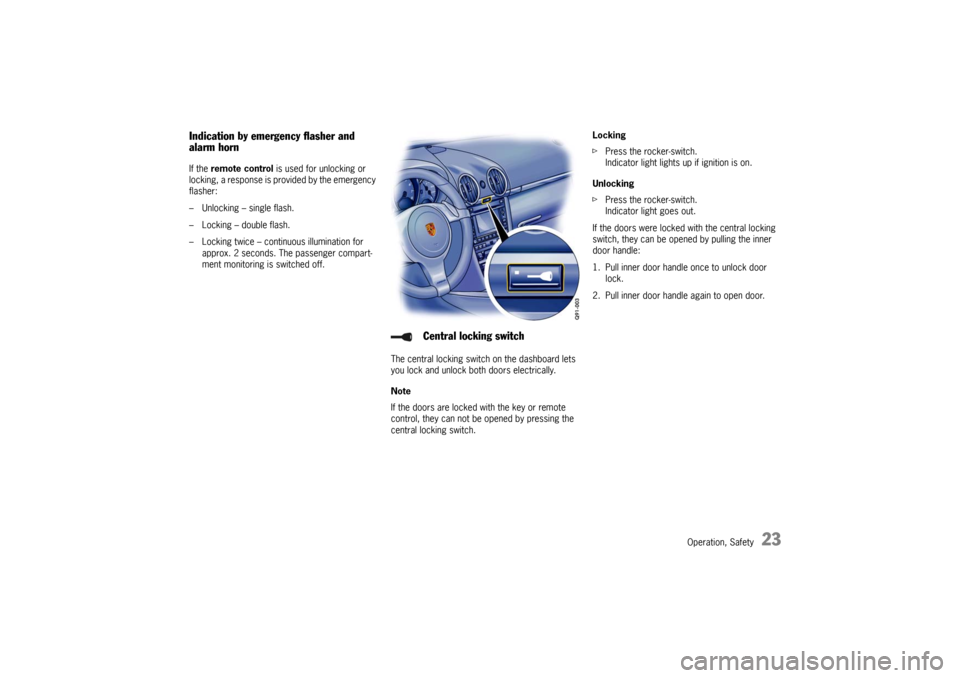
The central locking switch on the dashboard lets
you lock and unlock both doors electrically.
Note
If the doors are locked with the key or remote
control, they can not be opened by pressing the
central locking switch. Locking
f
Press the rocker-switch.
Indicator light lights up if ignition is on.
Unlocking
f Press the rocker-switch.
Indicator light goes out.
If the doors were locked with the central locking
switch, they can be opened by pulling the inner
door handle:
1. Pull inner door handle once to unlock door lock.
2. Pull inner door handle again to open door.
Central locking switch
Page 27 of 294
Operation, Safety
25
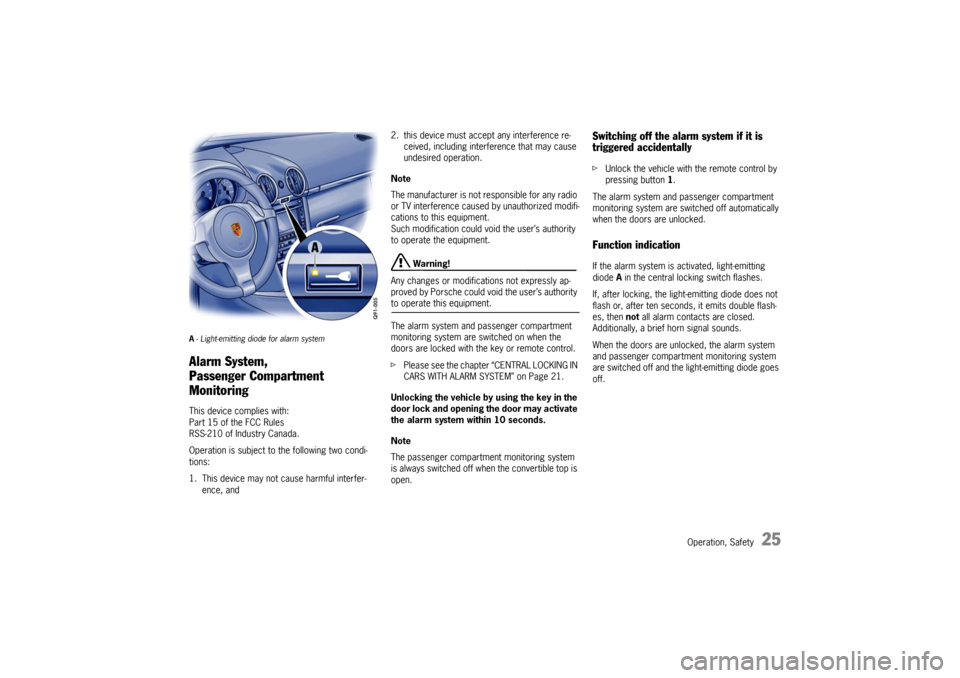
A- Light-emitting diode for alarm systemAlarm System,
Passenger Compartment
MonitoringThis device complies with:
Part 15 of the FCC Rules
RSS-210 of Industry Canada.
Operation is subject to the following two condi-
tions:
1. This device may not cause harmful interfer- ence, and 2. this device must accept any interference re-
ceived, including interference that may cause
undesired operation.
Note
The manufacturer is not responsible for any radio
or TV interference caused by unauthorized modifi-
cations to this equipment.
Such modification could void the user’s authority
to operate the equipment.
Warning!
Any changes or modifications not expressly ap-
proved by Porsche could void the user’s authority
to operate this equipment.
The alarm system and passenger compartment
monitoring system are switched on when the
doors are locked with the key or remote control.
f Please see the chapter “CENTRAL LOCKING IN
CARS WITH ALARM SYSTEM” on Page 21.
Unlocking the vehicle by using the key in the
door lock and opening the door may activate
the alarm system within 10 seconds.
Note
The passenger compartment monitoring system
is always switched off when the convertible top is
open.
Switching off the alarm system if it is
triggered accidentallyf Unlock the vehicle with the remote control by
pressing button 1.
The alarm system and passenger compartment
monitoring system are switched off automatically
when the doors are unlocked.Function indication If the alarm system is activated, light-emitting
diode A in the central locking switch flashes.
If, after locking, the light- emitting diode does not
flash or, after ten seconds, it emits double flash-
es, then not all alarm contacts are closed.
Additionally, a brief horn signal sounds.
When the doors are unlocked, the alarm system
and passenger compartment monitoring system
are switched off and the light-emitting diode goes
off.
Page 29 of 294
Operation, Safety
27
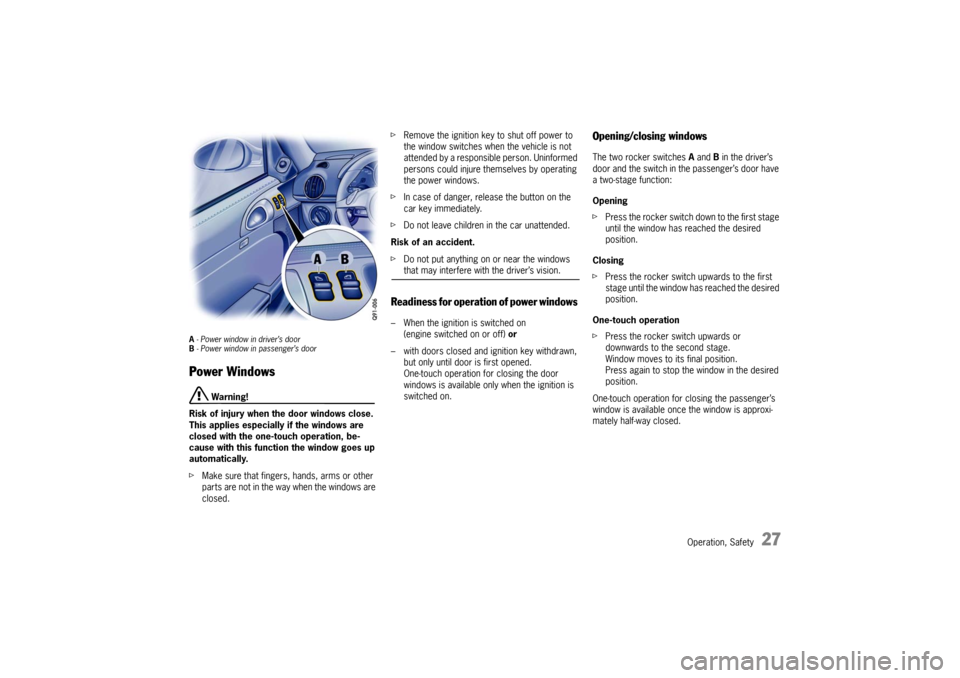
A - Power window in driver’s door
B - Power window in passenger’s doorPower Windows
Warning!
Risk of injury when the door windows close.
This applies especially if the windows are
closed with the one-touch operation, be-
cause with this function the window goes up
automatically.
f Make sure that fingers, hands, arms or other
parts are not in the way when the windows are
closed. f
Remove the ignition key to shut off power to
the window switches when the vehicle is not
attended by a responsible person. Uninformed
persons could injure themselves by operating
the power windows.
f In case of danger, release the button on the
car key immediately.
f Do not leave children in the car unattended.
Risk of an accident.
f Do not put anything on or near the windows
that may interfere with the driver’s vision.
Readiness for operation of power windows – When the ignition is switched on
(engine switched on or off) or
– with doors closed and ignition key withdrawn, but only until door is first opened.
One-touch operation for closing the door
windows is available only when the ignition is
switched on.
Opening/closing windowsThe two rocker switches A and B in the driver’s
door and the switch in the passenger’s door have
a two-stage function:
Opening
f Press the rocker switch down to the first stage
until the window has reached the desired
position.
Closing
f Press the rocker switch upwards to the first
stage until the window ha s reached the desired
position.
One-touch operation
f Press the rocker switch upwards or
downwards to the second stage.
Window moves to its final position.
Press again to stop the window in the desired
position.
One-touch operation for closing the passenger’s
window is available once the window is approxi-
mately half-way closed.
Page 37 of 294
Operation, Safety
35
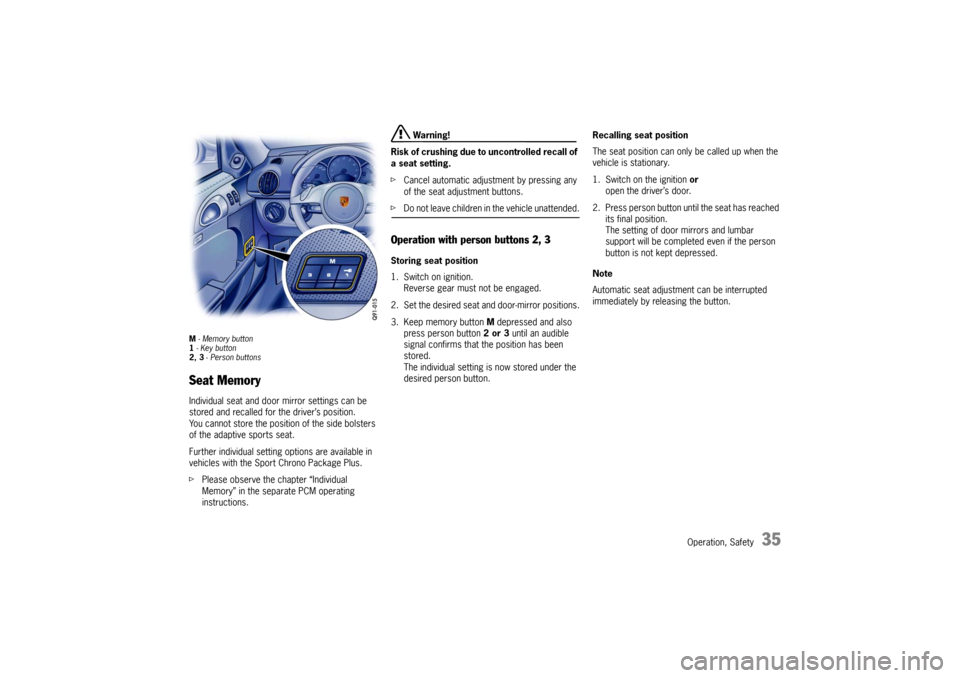
M - Memory button
1 - Key button
2, 3 - Person buttonsSeat MemoryIndividual seat and door mirror settings can be
stored and recalled for the driver’s position.
You cannot store the position of the side bolsters
of the adaptive sports seat.
Further individual setting options are available in
vehicles with the Sport Chrono Package Plus.
f Please observe the chapter “Individual
Memory” in the separate PCM operating
instructions.
Warning!
Risk of crushing due to uncontrolled recall of
a seat setting.
f Cancel automatic adjustment by pressing any
of the seat adjustment buttons.
fDo not leave children in the vehicle unattended.Operation with person buttons 2, 3Storing seat position
1. Switch on ignition.
Reverse gear must not be engaged.
2. Set the desired seat and door-mirror positions.
3. Keep memory button M depressed and also
press person button 2 or 3 until an audible
signal confirms that the position has been
stored.
The individual setting is now stored under the
desired person button. Recalling seat position
The seat position can only
be called up when the
vehicle is stationary.
1. Switch on the ignition or
open the driver’s door.
2. Press person button until the seat has reached its final position.
The setting of door mirrors and lumbar
support will be completed even if the person
button is not kept depressed.
Note
Automatic seat adjustment can be interrupted
immediately by releasing the button.
Page 38 of 294

36
Operation, Safety
Operating with the remote control of the
vehicle keyEach remote control (up to six) can be assigned an
individual seat and door mirror position.
The stored seat and door mirror position is set au-
tomatically when the vehicle is unlocked using the
corresponding remote control.
Storing seat position
1. Switch the ignition on with the desired car key.Reverse gear must not be engaged.
2. Set the desired seat and door-mirror positions.
3. Keep memory button M depressed and also
press key button 1 until an audible signal
confirms that the position has been stored.
The individual setting is now assigned to this
remote control and to the key button.
It is necessary to wait for at least 15 seconds
between locking and unlocking the door. Storing individual lowered position of the
passenger’s door mirror as a parking aid
Once the driver's seat setting has been stored, an
individual lowered position of the passenger's
door mirror may be stored for driving in reverse:
1. Apply the handbrake.
2. Switch the ignition on
with the desired car key.
3. Engage reverse gear.
4. Select passenger side with mirror switch. The passenger’s mirror swivels downwards.
5. Set passenger’s door mirror to desired final position.
6. Keep memory button M depressed and also
press key button 1 until an audible signal
confirms that the position has been stored.
The individual setting is now assigned to this
remote control and to the key button. Recalling seat position
f
Unlock the locked vehicle or the luggage
compartment with the remote control.
The stored seat position is automatically set.
The seat position assigned to a remote control
can also be recalled with the key button 1 if the
corresponding key was used to switch on the
ignition.
If no seat position has be en assigned to a remote
control, the key button will not work.
Note on operation
Automatic seat adjustment can be interrupted
immediately:
f by switching on the ignition,
f by pressing the central locking button,
f by pressing any memory or seat adjustment
button.
Clearing the stored seat position
1. Switch the ignition on with the desired car key.
2. Press memory button twice and key button 1
once consecutively.
Page 41 of 294
Operation, Safety
39
Adjusting steering wheel height and
longitudinal direction1. Insert ignition key fully into ignition lock.
2. Push the locking lever downwards.
3. Adjust steering wheel to fit the chosen backrest angle and your seat position by
moving the steering wheel up or down and
longitudinally.
4. Swivel locking lever back until you feel it en- gage.
If necessary, move steering wheel slightly lon-
gitudinally.
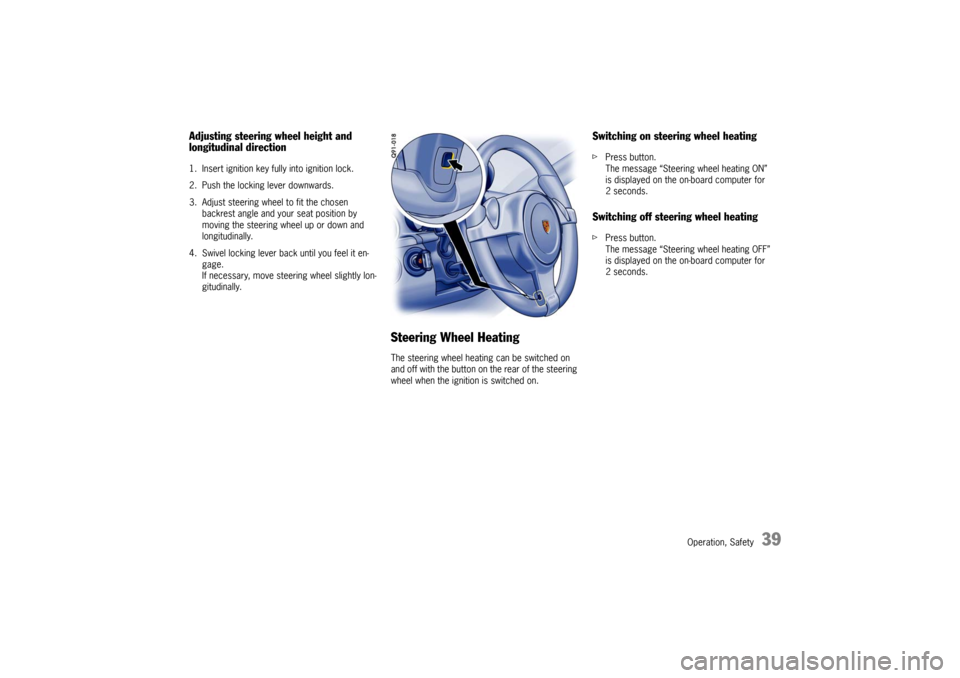
Steering Wheel HeatingThe steering wheel heatin g can be switched on
and off with the button on the rear of the steering
wheel when the ignition is switched on.
Switching on steering wheel heatingf Press button.
The message “Steering wheel heating ON”
is displayed on the on-board computer for
2seconds.Switching off steering wheel heatingfPress button.
The message “Steering wheel heating OFF”
is displayed on the on-board computer for
2seconds.
Page 42 of 294
40
Operation, Safety
Multi-Functional Steering Wheel
Warning!
There is a danger of accident if you set or
operate the on-board computer, radio,
navigation system, telephone or other
equipment when driving.
Operating these devices while driving could
distract you from traffic and cause you to
lose control of the vehicle.
f Operate these components while driving only if
the traffic situation allows you to do so safely.
f Carry out any complicated operating or setting procedures only while the vehicle is stationary.
Depending on the equipment in your vehicle, you
can use the function keys of the multi-functional
steering wheel to operate the following Porsche
communication systems:
–PCM
– Telephone
– Radio with CD-Drive
–CD-Audio
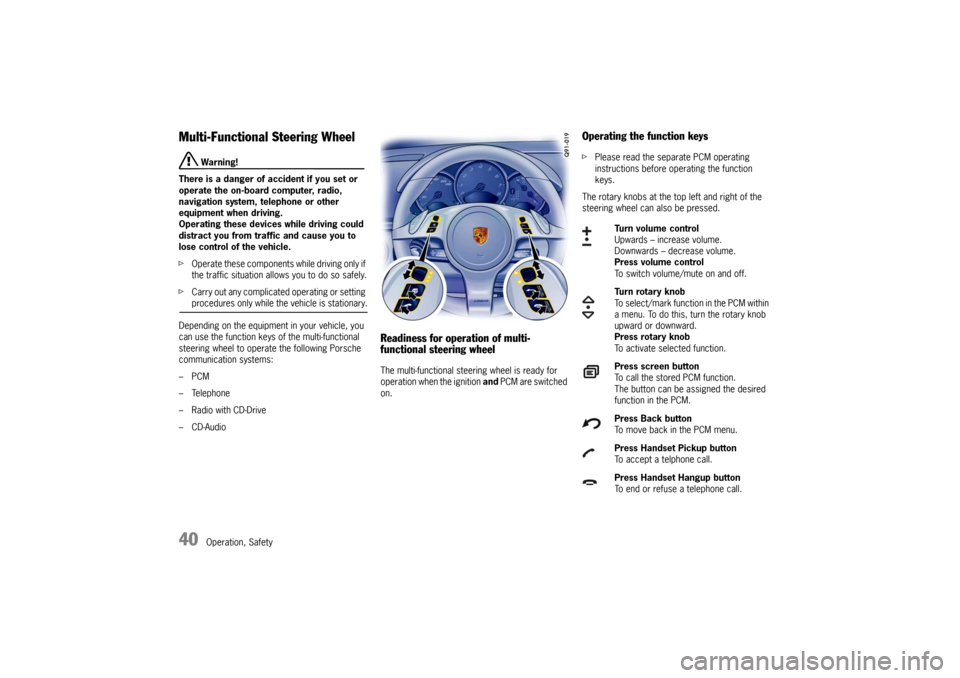
Readiness for operation of multi-
functional steering wheelThe multi-functional steering wheel is ready for
operation when the ignition and PCM are switched
on.
Operating the function keysf Please read the separate PCM operating
instructions before operating the function
keys.
The rotary knobs at the top left and right of the
steering wheel can also be pressed.
Turn volume control
Upwards – increase volume.
Downwards – decrease volume.
Press volume control
To switch volume/mute on and off.
Turn rotary knob
To select/mark function in the PCM within
a menu. To do this, turn the rotary knob
upward or downward.
Press rotary knob
To activate selected function.
Press screen button
To call the stored PCM function.
The button can be assigned the desired
function in the PCM.
Press Back button
To move back in the PCM menu.
Press Handset Pickup button
To accept a telphone call.
Press Handset Hangup button
To end or refuse a telephone call.
Page 44 of 294

42
Operation, Safety
Safety Belts
Warning!
Always make sure your and your passenger’s
safety belts are properly fastened while the
vehicle is in motion.
Failure to follow safety belt warnings may re-
sult in serious personal injury or death.
f For your and your passenger’s protection, use
safety belts at all times while the vehicle is in
motion.
f Use appropriate child restraint systems for all
small children.
Proper wearing of safety belts
f S a f e t y b e l t s m u s t b e p o s i t i o n e d o n t h e b o d y a s
to restrain the upper body and lap from sliding
forward. Improperly positioned safety belts
can cause serious personal injury or death in
case of an accident.
f The shoulder belt should always rest on your
upper body. The shoulder belt should never be
worn behind your back or under your arm.
f For maximum effectiveness, the lap belt
should be worn low across the hips.
f Pregnant women should position the belt as
low as possible across the pelvis. Make sure it
is not pressing against the abdomen. f
Belts should not be worn twisted.
f Do not wear belts over rigid or breakable ob-
jects in or on your clothing, such as eye glass-
es, pens, keys, etc. as these may cause injury.
f Several layers of heavy clothing may interfere
with proper positioning of belts.
f Belts must not rub against sharp objects or
damage may occur to the belt.
f Two occupants should never share the same
belt at the same time.
Care and maintenance
f Keep belt buckles free of any obstruction that
may prevent a secure locking.
f Belts that have been subjected to excessive
stretch forces in an accident must be inspect-
ed or replaced to ensure their continued effec-
tiveness in restraining you.
The same applies to belt tensioner systems
which have been triggered.
In addition, the anchor points of the belts
should be checked.
f If safety belts do not work properly, see your
authorized Porsche dealer immediately.
f I f t h e b e l t s s h o w d a m a g e t o w e b b i n g , b i n d i n g s ,
buckles or retractors, they should be replaced
to ensure safe operation.
f Do not modify or disasse mble the safety belts
in your vehicle. f
The belts must be kept clean or the retractors
may not work properly.
Please see the chapter “CAR CARE INSTRUC-
TIONS” on Page 213.
f Never bleach or dye safety belts.
f Do not allow safety belts to retract until they
are completely dry after cleaning or this may
cause damage to the belt.
Belt tensioner Depending on the force of an impact, fastened
safety belts are tightened in an accident.
The belt tensioners are triggered in:
– Front, side and rear impacts of sufficient
severity.
– In cases of vehicle rollover.
Note
The belt-tensioner system can be triggered only
once; the system must be replaced afterward.
If there is a fault in the belt-tensioner system, the
airbag warning light lights up.
Work may be performed on the belt-tensioner sys-
tem only by an authorized Porsche dealer.
Smoke is released when the belt tensioners are
triggered. This does not indicate a fire in the
vehicle.
Page 47 of 294

Operation, Safety
45
fUsing accessories not approved by Porsche
can cause the weight sensing system to be im-
paired.
f Do not squeeze objects, such as the fire extin-
guisher, or first aid kit under the seat.
f Only have seats removed and installed by an
authorized Porsche dealer so that weight sens-
ing components will not be damaged.
f Give your passenger all of the information in
this chapter.
Note
Airbag components (e.g. steering wheel, door lin-
ing, seats) may be disassembled only by an autho-
rized Porsche dealer.
When disposing of a used airbag unit, our safety
instructions must be followed. These instructions
can be obtained at any authorized Porsche dealer.
Function of the airbag systemAirbags are a supplemental safety system. Your
primary protection comes from your safety belts.
The front airbags are triggered during a frontal
collision of sufficient force and direction.
In the event of a side impact of corresponding
force, the side airbag on the impact side is
triggered.
The inflation process gene rates the amount of gas
required to fill the airbags at the necessary pres-
sure in fractions of a second.
Airbags help to protect the head and upper body,
while simultaneously damp ing the motion of the
driver and passenger in the impact direction in the
event of a frontal impact or side impact.
In order to help provide protection in severe colli-
sions which can cause death and serious injury,
airbags must inflate extremely rapidly. Such high
speed inflation has a negative but unavoidable
side effect, which is that it can and does cause in-
juries, including facial an d arm abrasions, bruising
and broken bones. You can help minimize such in-
juries by always wear ing your safety belts.
There are many types of accidents in which air-
bags are not expected to deploy. These include
accidents where the airbags would provide no be-
nefit, such as a rear impact against your vehicle.
Other accidents where the airbags are designed
not to deploy are those where the risk of injury
from the airbag deployment could exceed any pro-
tective benefits, such as in low speed accidents or higher speed accidents where the vehicle decele-
rates over a long time. Since airbag deployment
does not occur in all accidents, this further em-
phasizes the need for yo
u and your passenger to
always wear safety belts.
Your vehicle is equipped with a crash sensing and
diagnostic module. This module will record the
use of the seat belt restraint system by the driver
and passenger when the airbags and/or belt ten-
sioner work.
Advanced AirbagYour vehicle is equipped with a weight sensing sys-
tem for the passenger's seat in accordance with
U.S. Federal Motor Vehicle Safety Standard 208.
Depending on the weight acting on the passen-
ger's seat, the passenger's airbag will automati-
cally be switched on and off.
Depending on the angle and force of impact, the
passenger's airbag which is activated will be trig-
gered during a collision.
Precondition for switching the passenger's airbag
on and off, depending on weight:
– Vehicles equipped with key-operated airbag deactivation device:
Switch position AUTO.
– Ignition key is inserted.
Improper handling of the weight sensing system
can unintentionally impair switching the
passenger's airbag off and on.
Page 49 of 294
Operation, Safety
47
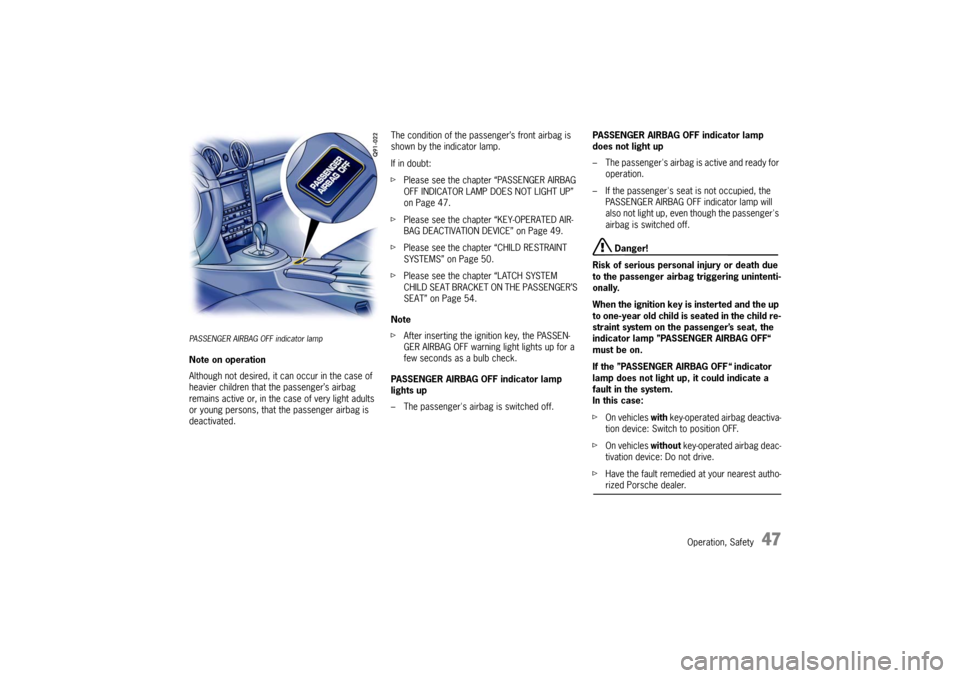
PASSENGER AIRBAG OFF indicator lampNote on operation
Although not desired, it can occur in the case of
heavier children that the passenger’s airbag
remains active or, in the case of very light adults
or young persons, that the passenger airbag is
deactivated.The condition of the passenger’s front airbag is
shown by the indicator lamp.
If in doubt:
f
Please see the chapter “PASSENGER AIRBAG
OFF INDICATOR LAMP DOES NOT LIGHT UP”
on Page 47.
f Please see the chapter “KEY-OPERATED AIR-
BAG DEACTIVATION DEVICE” on Page 49.
f Please see the chapter “CHILD RESTRAINT
SYSTEMS” on Page 50.
f Please see the chapter “LATCH SYSTEM
CHILD SEAT BRACKET ON THE PASSENGER’S
SEAT” on Page 54.
Note
f After inserting the ignition key, the PASSEN-
GER AIRBAG OFF warning light lights up for a
few seconds as a bulb check.
PASSENGER AIRBAG OFF indicator lamp
lights up
– The passenger's airbag is switched off. PASSENGER AIRBAG OFF indicator lamp
does not light up
– The passenger's airbag is active and ready for
operation.
– If the passenger's seat is not occupied, the PASSENGER AIRBAG OFF indicator lamp will
also not light up, even though the passenger's
airbag is switched off.
Danger!
Risk of serious personal injury or death due
to the passenger airbag triggering unintenti-
onally.
When the ignition key is insterted and the up
to one-year old child is seated in the child re-
straint system on the passenger’s seat, the
indicator lamp ”PASSENGER AIRBAG OFF“
must be on.
If the ”PASSENGER AIRBAG OFF “ indicator
lamp does not light up , it could indicate a
fault in the system.
In this case:
f On vehicles with key-operated airbag deactiva-
tion device: Switch to position OFF.
f On vehicles without key-operated airbag deac-
tivation device: Do not drive.
f Have the fault remedied at your nearest autho-rized Porsche dealer.