ESP PORSCHE BOXSTER 2009 2.G Owner's Guide
[x] Cancel search | Manufacturer: PORSCHE, Model Year: 2009, Model line: BOXSTER, Model: PORSCHE BOXSTER 2009 2.GPages: 294, PDF Size: 6.89 MB
Page 154 of 294

152
Instruments, On-Board Computer, Warnings
The tire selection has only been successfully
completed when the message “Process
complete” is displayed by the on-board computer.
f
Select arrow (Back) and push the operating
lever forward. The display returns to the tire
pressure menu.
The on-board computer additionally displays
the message “System learning”. Note
The message “Process aborted” appears if the
setting process is interrupted. All entries made up
to this point are lost, and the original settings
remain in effect.
Only if the message “Process complete” appears
after the settings have been made will the Tire
Pressure Monitoring re-learn the wheels.
f
Please see the chapter “SYSTEM LEARNING”
on Page 154.
Before fitting tires with sizes which are not stored
in the on-board computer, the missing information
should be supplemented in the on-board
computer.
f Please consult your authorized Porsche
dealer.
f Use only tires approved by Porsche.
The available items in the tire pressure menu
depend on the equipment of your vehicle. For this
reason it is possible that some of the items shown
here are not available on your on-board
computer’s display.
f Make sure that tire pressures correspond to
the on-board computer settings. Correct the
tire pressure if necessary.
f Please see the chapter “TIRE PRESSURE FOR
COLD TIRES (68 °F/20 °C)” on Page 277. Tire pressure warnings
The tire pressure warning light on the instrument
panel and a corresponding message on the on-
board computer warn about loss of pressure in
two stages, depending on the amount of pressure
loss.
Driving with insufficient tire pressure reduces the
road safety of the vehicle
and destroys the tire and
wheel.
Stage 1 – Add air
The pressure in the tire is too low by 4 to 7 psi (0.3
to 0.5 bar).
f The tire pressure warning contains the
affected tire with the tire pressure to be added.
Correct the tire pressure at the next
opportunity.
Page 157 of 294

Instruments, On-Board Computer, Warnings
155
Warning!
Your vehicle has also be en equipped with a TPM
malfunction indicator to indicate when the system
is not operating properly.
The TPM malfunction indicator is combined with
the low tire pressure telltale.
When the system detects a malfunction, the tellta-
le will flash for approximately one minute and then
remain continuously illuminated. This sequence
will continue upon subsequent vehicle start-ups as
long as the malfunction exists.
When the malfunction indi cator is illuminated, the
system may not be able to detect or signal low tire
pressure as intended.
TPM malfuntions may occur for a variety of
reasons, including the installation of replacement
or alternate tires or wheels on the vehicle that
prevent the TPM from functioning properly.
Always check the TPM malfunction telltale after
replacing one or more tires or wheels on your
vehicle to ensure that the replacement or alter-
nate tires and wheels allow the TPM to continue to
function properly.
The warning light in the speedometer lights up:
– When a loss in pressure has been detected.
– When learning newly mounted wheels/wheel sensors, as long as the vehicle’s own wheels
have not yet been recognized. In the event of a defect in Tire Pressure Monitoring
or a temporary fault, the warning light in the
speedometer flashes for approx. one minute and
then remains continuously illuminated.
The tire pressure warning light in the instrument
panel goes out only when
the cause of the fault
has been rectified.
Partial monitoringMonitoring of the other wheels is continued if there
is a fault in one or two wheel transmitters.
– The tire pressure warning light lights up.
– The message “TPM partial monitoring” is displayed on the on-board computer.
– No tire pressures are displayed on the on- board computer for wheels with faulty wheel
transmitters.
No monitoringIn the event of faults the Tire Pressure Monitoring
cannot monitor the tire pressure.
The warning light in the speedometer flashes for
approx. one minute and then remains continuously
illuminated and a corresponding message
appears on the on-board computer.
Monitoring is not active when:
– the Tire Pressure Monitoring is faulty,
– wheel transmitters for the Tire Pressure Monitoring are missing,
– during the learning phase after the tire settings have been updated,
– after a wheel change without updating the tire settings,
– more than four wheel transmitters are detected,
– there is external interference by other radio sources, e.g. wireless headphones,
– tire temperatures are too high.
f Please see the chapter “WARNINGS ON THE
INSTRUMENT PANEL AND THE ON-BOARD
COMPUTER” on Page 162.
Warning light
Page 160 of 294
158
Instruments, On-Board Computer, Warnings
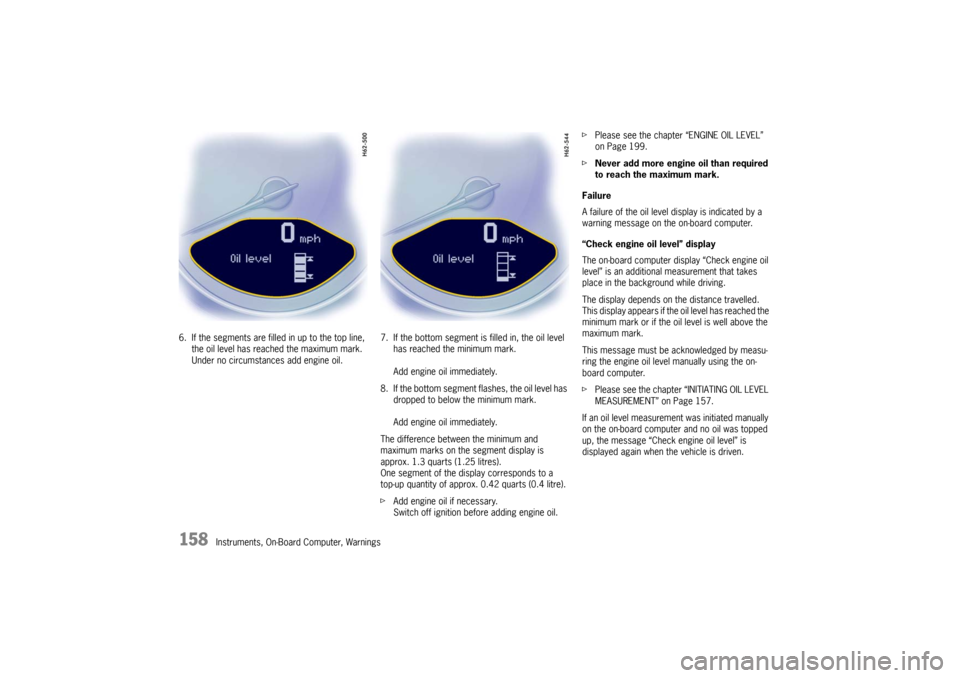
6. If the segments are fille
d in up to the top line,
the oil level has reached the maximum mark.
Under no circumstances add engine oil. 7. If the bottom segment is filled in, the oil level
has reached the minimum mark.
Add engine oil immediately.
8. If the bottom segment fl ashes, the oil level has
dropped to below the minimum mark.
Add engine oil immediately.
The difference between the minimum and
maximum marks on the segment display is
approx. 1.3 quarts (1.25 litres).
One segment of the display corresponds to a
top-up quantity of approx. 0.42 quarts (0.4 litre).
f Add engine oil if necessary.
Switch off ignition before adding engine oil. f
Please see the chapter “ENGINE OIL LEVEL”
on Page 199.
f Never add more engine oil than required
to reach the maximum mark.
Failure
A failure of the oil level display is indicated by a
warning message on the on-board computer.
“Check engine oil level” display
The on-board computer display “Check engine oil
level” is an additional measurement that takes
place in the background while driving.
The display depends on the distance travelled.
This display appears if th e oil level has reached the
minimum mark or if the o il level is well above the
maximum mark.
This message must be acknowledged by measu-
ring the engine oil leve l manually using the on-
board computer.
f Please see the chapter “INITIATING OIL LEVEL
MEASUREMENT” on Page 157.
If an oil level measurement was initiated manually
on the on-board computer and no oil was topped
up, the message “Check engine oil level” is
displayed again when the vehicle is driven.
Page 164 of 294

162
Warnings
Warnings on the instrument panel and the on-board computerIf a warning message appears, always refer to the corresponding chapters in the Owner’s Manual.
Warning messages are issued only if all measurement preconditi ons are met. Therefore, check all fluid levels regularly –
in particular, always check the en gine oil level before refuelling.
Instrument
panel On-board
computerText display on on-board
computer Meaning/measure
Seat belt
Driver and passengers must fasten their seat
belts.
Handbrake Handbrake is still on.
Ignition key
not removed
Replace battery
in ignition key Replace the remote-control battery.
Ignition lock faulty,
please go to workshop Have the fault remedied at an authorized
Porsche dealer.
Ignition lock faulty,
visit workshop now Have the fault remedied at an authorized
Porsche dealer.
Relieve steering Relieve the steering l o c k b y m o v i n g t h e s t e e r i n g
wheel to the left or right.
Steering locked The steering wheel lock remains engaged.
Have the fault remedied at an authorized
Porsche dealer.
Lights on Low beam/side marker lamps on
Parking light on Left/right parking light on
Page 175 of 294

Shifting Gears
173
Drive-Off AssistantThe Drive-Off Assistant assists the driver when
moving off on hills.
The vehicle must have sufficient road contact.
The Drive-Off Assistant is available on gradients as
from around 5%.
Danger!
Risk of accident.
Assistance by the Drive-Off Assistant is not
guaranteed when moving off on a slippery
surface (e.g. on icy or loose surfaces). In this
case, the vehicle could slip.
The limits dictated by the laws of physics
cannot be overcome, even with the Drive-Off
Assistant. The responsi bility for moving off
on upward slopes is still the driver’s, despite
the Drive-Off Assistant.
f Always adjust your driving style to the driving
conditions and vehicle load, use the brake
pedal if necessary.
Risk of accident.
If the Drive-Off Assistant is not functioning,
the driver cannot be assisted when moving
off on hills.
f Hold the vehicle with the brake pedal. Driving off with the Drive-Off Assistant
(vehicles with manual transmission)
1. Hold the vehicle secure
ly on the slope with the
brake pedal.
The engine must be running.
2. Fully depress the clutch pedal.
3. Engage a gear corresponding to the direction of travel up the slope (1st gear or reverse
gear).
4. Fully release the parking brake.
5. While keeping the clutch pedal depressed, release the brake pedal.
The vehicle is held on the slope for a short time
in order to allow driving off directly after the
brake is released.
6. Move off as usual.
Note on operation
The Drive-Off Assistant is not active:
– If the clutch is not depressed.
– If the vehicle is not stationary.
– If the engine is not running.
– On gradients of less than 5%.
– If the pressure on the brake pedal is too low. Driving off with the Drive-Off Assistant
(vehicles with PDK transmission)
1. Hold the vehicle securely on the slope with the
brake pedal.
The engine must be running.
2. Select a gear corresponding to the direction of travel up the slope (selector lever position
Dor R).
3. Fully release the parking brake.
4. Release the brake pedal. The vehicle is held on the slope for a short time
in order to allow driving off directly after the
brake is released.
5. Move off as usual.
Note on operation
The Drive-Off Assistant is not active:
– In the event of shift to neutral.
– If the vehicle is not stationary.
– If the engine is not running.
– On gradients of less than 5%.
– If the pressure on the brake pedal is too low.
Page 177 of 294

Shifting Gears
175
Indicator for selector lever position and
engaged gearWhen the engine is running, the selector lever
position and engaged gear are indicated.
If the selector lever is between two positions
–Effects: The corresponding selector-lever position in
the instrument panel flashes and the warning
“Actuate brake” or “Selector lever not
engaged” appears on the on-board computer.
f Action required:
Operate the footbrake and engage the
selector lever properly. If the selector lever is inadvertently (due to
a defect or incorrect operation) moved out of P or
N into gear without pressing the brake, this gear
will start to “flash” and no power transmission is
built up. To drive off, press the brake and move
the selector lever from P
or N into the required
gear again.
Selector-lever position R or D is flashing in the
instrument cluster
f Effects:
There is no power transmission.
The selector lever was engaged without
pressing the footbrake or only the restricted
driving programme is available when the
“Transmission emergency run” message
is displayed.
Action required:
Press the footbrake and engage the required
selector-lever position again by moving the
selector lever from P or N.
If reverse gear fails:
Please see the chapter “REDUCED DRIVING
PROGRAM” on Page 180. If there is a fault in the transmission:
– The warning “Transmission emergency run” in
white or red lettering or the warning “Transmis-
sion temperature too high” is displayed on the
on-board computer.
Please see the chapter “REDUCED DRIVING
PROGRAM” on Page 180.
f Have the fault repaired immediately at an
authorized Porsche dealer.
Page 180 of 294
178
Shifting Gears
Kickdown
The kickdown function is active in selector lever
positions
D and M.
f For optimum acceleration, e.g. when
overtaking, depress the accelerator pedal
beyond the full-throttle point (kickdown).
The transmission shifts down depending on the
speed of travel and engine speed.
Upward shifts occur at the highest possible engine
speeds.
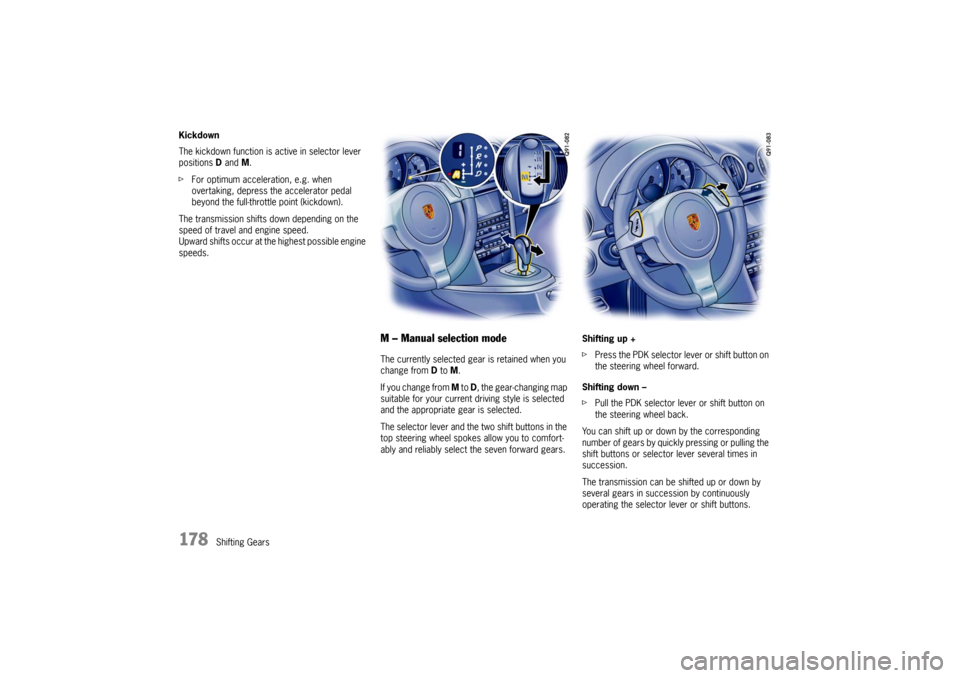
M – Manual selection modeThe currently selected gear is retained when you
change from D to M.
If you change from M to D, the gear-changing map
suitable for your current driving style is selected
and the appropriate gear is selected.
The selector lever and the two shift buttons in the
top steering wheel spokes allow you to comfort-
ably and reliably select the seven forward gears. Shifting up +
f
Press the PDK selector lever or shift button on
the steering wheel forward.
Shifting down –
f Pull the PDK selector leve r or shift button on
the steering wheel back.
You can shift up or down by the corresponding
number of gears by quickly pressing or pulling the
shift buttons or selector lever several times in
succession.
The transmission can be shifted up or down by
several gears in succe ssion by continuously
operating the selector lever or shift buttons.
Page 189 of 294
Mobile Dächer
187
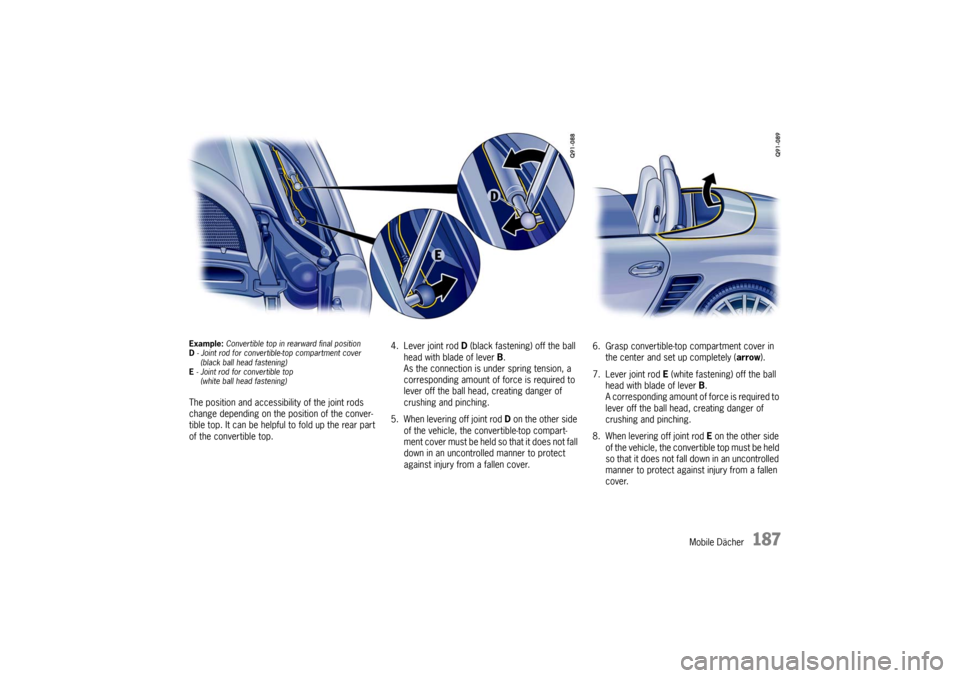
Example: Convertible top in rearward final position
D - Joint rod for converti ble-top compartment cover
(black ball head fastening)
E - Joint rod for convertible top
(white ball head fastening) The position and accessibility of the joint rods
change depending on the position of the conver-
tible top. It can be helpful to fold up the rear part
of the convertible top. 4. Lever joint rod
D (black fastening) off the ball
head with blade of lever B.
As the connection is under spring tension, a
corresponding amount of force is required to
lever off the ball head, creating danger of
crushing and pinching.
5. When levering off joint rod D on the other side of the vehicle, the convertible-top compart-
ment cover must be held so that it does not fall
down in an uncontrolled manner to protect
against injury from a fallen cover.
6. Grasp convertible-top compartment cover in the center and set up completely ( arrow).
7. Lever joint rod E (white fastening) off the ball
head with blade of lever B.
A corresponding amount of force is required to
lever off the ball head, creating danger of
crushing and pinching.
8. When levering off joint rod E on the other side
of the vehicle, the convertible top must be held
so that it does not fall down in an uncontrolled
manner to protect against injury from a fallen
cover.
Page 191 of 294
Mobile Roofs
189
WindstopfMake sure that all windstop parts are fastened
securely, especially when driving with the con-
vertible top open.
Note
When the convertible top is closed, it is a good
idea to remove the center section of the windstop
to permit good ventilation of the interior or for
demisting the rear window.
This is particularly the ca se in cold, wet weather.
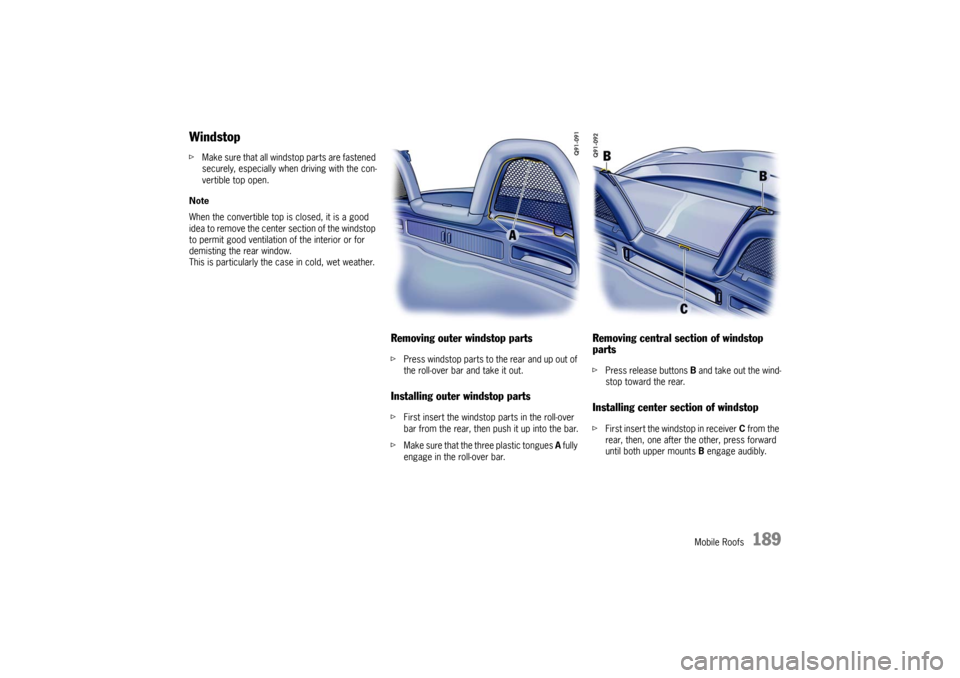
Removing outer windstop partsfPress windstop parts to the rear and up out of
the roll-over bar and take it out.Installing outer windstop partsfFirst insert the windstop parts in the roll-over
bar from the rear, then push it up into the bar.
f Make sure that the three plastic tongues A fully
engage in the roll-over bar.
Removing central section of windstop
parts f Press release buttons B and take out the wind-
stop toward the rear. Installing center section of windstopf First insert the windstop in receiver C from the
rear, then, one after the other, press forward
until both upper mounts B engage audibly.
Page 198 of 294

196
Maintenance, Car Care
Exercise Extreme Caution when
Working on your Vehicle
Danger!
Ignoring the following instructions may
cause serious personal injury or death.
f The engine compartment of any motor vehicle
is a potentially hazardou s area. If you are not
fully familiar with proper repair procedures, do
not attempt the adjustments described on the
following pages.
This caution also applies to the entire vehicle.
f O n l y w o r k o n y o u r v e h i c l e o u t d o o r s o r i n a w e l l
ventilated area.
f Ensure that there are no open flames in the
area of your vehicle at any time when fuel
fumes might be present. Be especially cau-
tious of such devices such as hot water heat-
ers which ignite a flame intermittently.
f Before working on any part in the engine com-
partment, turn the engine off and let it cool
down sufficiently. Hot engine compartment
components can burn skin on contact.
f Be alert and cautious around engine at all
times while the engine is running.
If work has to be performed with the engine
running, always set the parking brake, and
make sure the shift lever is in neutral position
or the PDK selector lever in position P or N . f
In particular, be very careful to ensure that
items of clothing (ties, shirt, sleeves etc.),
jewelry, long hair, hand or fingers cannot get
caught in the engine-compartment blower, fan,
belts or other moving parts.
The radiator and radiator fans are in the front
of the car.
The engine-compartment blower is mounted in
the engine-compartment.
The fans can start or continue running as a
function of temperature, even with the engine
switched off.
Carry out work in these areas only with the en-
gine off, the ignition switched off, and exercise
extreme caution.
f Your Porsche is equipped with an electronic ig-
nition system. When the ignition is on, high
voltage is present in all wires connected with
the ignition system; therefore, exercise ex-
treme caution when working on any part of the
engine while the ignition is on or the engine is
running.
f Always support your car with safety stands if it
is necessary to work under the car.
f When working under the car without safety
stands but with the wheels on the ground,
make sure the car is on level ground, the
wheels are blocked, and that the engine
cannot be started.
Remove the ignition key. f
Do not smoke or allow an open flame around
the battery or fuel.
Keep a fire extinguisher in close reach.
f Incomplete or improper servicing may cause
problems in the operation of the car. If in doubt
about any servicing, have it done by your
authorized Porsche dealer.
Improper maintenance during the warranty
period may affect your Porsche warranty cov-
erage.
f Supplies of fluids, e.g. engine oil, brake fluid or
coolant, are hazardous to your health.
Keep these fluids out of children’s reach and
dispose of them in accordance with the appro-
priate regulations.
f Some countries require additional tools and
special spare parts to be carried in your vehi-
cle.
Please make enquiries before driving abroad.